A Two Hop Power Adaptive MAC Protocol for Densely
Populated Wireless Networks
S.L.Prathapa Reddy
Associate Professor of ECE ALFA College of Engg. & Tech.
Allagadda, India-518543
M.V. Subramanyam
Professor of ECE Shantiram college of Engg.,
Nandyal, India - 518501
K. Satyaprasad
Professor of ECE JNTU College of Engg., Kakinada, India-533003
ABSTRACT
Studies of ad hoc wireless networks are rapidly gaining popularity due to its varied and innovative applications. Medium Access Control (MAC) protocols in such networks are responsible to coordinate access among active nodes. Wireless nodes are largely powered by batteries which restricts the quantity of energy available to the nodes. Routing for wireless nodes is incorporated with power saving mechanisms to conserve energy. The most common techniques for power saving is by allowing a node to be in sleep state when possible or by varying transmitting power to reduce energy consumption. The energy saving power control can possibly be used to increase spatial reuse of the wireless channel and at the same time reduce power consumption. In this paper, a MAC protocol is proposed which achieves better spatial reuse of spectrum due to power adjustments established on the number of neighbors in the two-hop neighborhood. Simulation results show improved performance compared to MAC-DCF.
General Terms
Wireless Ad Hoc Networks, Algorithms
Keywords
Power Control, Medium Access Control (MAC), Energy Saving.
1.
INTRODUCTION
Devices sizes have shrunk due to technology development and also include more advanced functions. Thus, a node is also a wireless terminal and repeater and still small enough to be mobile. A collection of these devices, self-organizing and adaptive with wireless links is now labeled an Ad Hoc Network which needs no centralized control. The network detects new nodes automatically, inducting them seamlessly. Alternatively, when a node leaves the network, the reminder automatically reconfigures and adjusts to the new scenario. The network is termed a MANET (Mobile Ad hoc NET work) when the nodes are mobile.
Ad hoc networks have two types of architectures: flat and hierarchical [1]. Each ad hoc network node has a transceiver, an antenna and power source. Node characteristics vary with regard to size, battery power, transmission range and processing ability. Some nodes pass on as servers, others as clients and still others could be flexible enough to be both, based on the situation. In some instances, a node may be a router to deliver information from one node to another [2].
Wireless ad hoc networks are made of wireless nodes, which form a network with no central authority or infrastructure. Batteries power the nodes due to which it faces energy constraints. A node connects directly with neighboring nodes
within wireless range for communication and via multi-hop route with all other nodes outside the range in the network. The network topology is dynamic as the nodes are mobile, so move randomly and organize themselves arbitrarily. Routing for wireless nodes is incorporated with power saving mechanisms to conserve energy. Moreover, wireless ad hoc networks are limited by interference/capacity considerations due to the broadcast nature of the wireless medium. The most common techniques for power saving is by allowing a node to be in sleep state when possible or by varying transmitting power to reduce energy consumption [3, 4, 5].
IEEE 802.11 DCF [6] is the most prevalent Medium Access Control (MAC) protocol for wireless ad hoc networks. One of the chief disadvantages of the IEEE 802.11 MAC is that all nodes in the network are required to use a common approved transmission power for transmitting control and data packets. Several studies show that IEEE 802.11 is not the most advantageous MAC protocol for multi-hop wireless ad hoc networks [7, 8, 9], as lower throughput and high end-to-end delays is experienced by the applications [10, 11]. This problem is also highlights the fact that when all nodes use the same common transmission range exhibits a poor spectral reuse footprint. Thus, in IEEE 802.11, the capacity of simultaneous transmissions that can take place is considerably reduced in the network. A node transmitting data to another node in close vicinity must convey “Request to Send/Clear to Send” (RTS/CTS) packets with the common agreed transmission range for correct operation of the MAC layer. Generally, the power is higher than the minimum power required reaching the target destination. During transmission with common range transmission approach, it “locks” an area restricted by the sensing range where all other transmission are stopped, due to which an inherent space is wasted during each transmission.
The following issues are faced during the design of power management protocol for large scale wireless networks.
Neighbor Discovery – The Host transmits and receives activities from the neighboring as they are not aware of power saving host. Such incorrect neighbor information is detrimental for the routing protocol. Since the route discovery procedure inaccurately reports when there is no route, even though the route exists in the middle with some power saving host [12].
In ad hoc network, node may either a data source or sink. The data is forwarded by the routers to its neighboring nodes participates in high-level routing and control protocol. Moreover, the roles of specific node may be changed. The centralized entity such as access point control does not exist. In the network, the power management mode of each and every node is maintained; it also wakes up the sleeping nodes and buffers the data. Therefore ad hoc network must be made up off a cooperative and distributed fashion for effective management of power.
Energy conservation generally is at the cost of degraded performance which includes longer delay and lowered throughput which happens to be a foremost challenge in the designing of power management framework for ad hoc network. Naïve solution only consider about the power savings at individuals nodes may result in a beneficial to the operation of the entire network [14].
Power control is necessary in order to reduce power consumption rates, avoid collisions within packets, increase spatial throughput of the system and to reduce contention among flows. The energy saving power control can potentially be used to improve spatial reuse of the wireless channel. In this paper, a MAC protocol is proposed which achieves better spatial reuse of spectrum due to power adjustments established on the number of neighbors in the two-hop neighborhood.
2.
RELATED WORKS
Kara [15] proposed an on-demand and position based algorithms for effective use of node energies and to minimize end-to-end packet delays. The proposed power control method provides long-lasting ad hoc networks by sending packets to their destinations in the shortest time slice. The data transfer power of nodes is maintained at the lowest level during the transport of data packets to their destinations. The time it takes to reach the destination does not exceed a certain value. The algorithm is evaluated through a simulation program in MATLAB. From the simulation results, it was observed that the proposed algorithm optimizes energy consumption of nodes and minimizes total energy consumption. Such a network lives longer than the others. The proposed algorithm consumes about 22% less energy for 50-noded network and 31% less for 100-noded network according to the results of the simulation.
Gomez et al [16] presented a power-controlled Quality of Service (PCQoS) technique for wireless ad hoc networks. The model constructs QoS mechanisms for specific applications where better QoS performance is incorporated though it is through sub-optimal paths. PCQoS allows modification of transmit power to add and remove relay nodes from their paths to roughly modify their observed application QoS performance. Simulations results demonstrate that PCQoS provide coarse control over traditional QoS metrics such as delay, throughput. PCQoS protocol symbolizes the use variable-range transmission control for providing QoS differentiation to applications in wireless networks.
Saravanan et al [17] developed a power adjustment algorithm to reduce the power consumption and improve the throughput in the Mobile Ad hoc Networks. The receiver computes an optimal transmission power based on the interference amount and the data payload length. Based on the power given the transmitter increments or decrements the power depending on the number of neighboring nodes present. The adjusted power is sent to the receiver and the power level is adjusted between
power is computed based upon the interference amount, the number of collision between the nodes is lowered. Simulation results demonstrated that the proposed algorithm achieves lower energy consumption and higher throughput in ad hoc networks.
Tang et al [18] presented PW-MAC (Predictive-Wakeup MAC), a new energy-efficient MAC protocol based on asynchronous duty cycling where nodes wake up to receive randomized, asynchronous times. PW-MAC reduces sensor node energy consumption by making senders predict receiver wakeup times. To ensure accurate predictions, PW-MAC introduces an on-demand prediction error correction mechanism which addresses timing challenges like unpredictable hardware and operating system delays and clock drift. A prediction based retransmission mechanism is introduced to ensure high energy efficiency when wireless collisions occur and packets require retransmission. PW-MAC is evaluated on a testbed of MICAz motes and compared to X-MAC, Wise X-MAC, and RI-X-MAC, three energy-efficient MAC protocols, under multiple concurrent multi-hop traffic flows and under hidden-terminal scenarios and also scenarios where nodes have wakeup schedule conflicts. PW-MAC significantly outperformed other protocols in all experiments. For example, evaluated on scenarios with 15 concurrent network transceivers, average sender duty cycle were all over 66% for X-MAC, Wise MAC and RI-MAC, while PW-MAC’s average sender duty cycle was only 11%; PW-PW-MAC’s delivery latency was less than 5% than that of Wise MAC and X-MAC. PW-MAC had 100% delivery ratio in all experiments.
Design, implementation and performance evaluation of a hybrid MAC protocol, called Z-MAC was presented by Rhee et al [19], for wireless sensor networks joining strengths of TDMA and CSMA and simultaneously offsetting their weaknesses. Like CSMA, Z-MAC achieved high channel utilization and low latency under low contention and similar to TDMA, achieved high channel utilization under high contention and lower collision among two-hop neighbors at low cost. A distinctive Z-MAC feature is robust performance to synchronization errors, slot assignment failures, and time-varying channel conditions; its performance always fell to that of CSMA in the worst case. Z-MAC is implemented in Tiny OS and useful for applications where expected data rates and two-hop contentions are medium to high.
Shih et al [20] proposed a distributed spatial reuse (DSR) MAC protocol for IEEE 802.11 ad-hoc wireless LANs (WLANs). The proposed MAC protocol increased bandwidth utilization and reduced power consumption. Power control is incorporated such that the transmissions does not interfere with each other and can be transmitted simultaneously. Consequently, improving the overall efficiency of IEEE 802.11 ad-hoc WLANs. The proposed DSR avoids collisions by allowing maximum number of interference-free communication pairs to transmit in parallel. Experiment results show that DSR performs better than traditional WLAN protocol, IEEE 802.11 DCF, and the related work. The proposed protocol successfully enhances the overall WLANs efficiency.
traffic loads. To reduce long sleep duration induced delays, a node's transmission opportunity is increased by enabling a next hop nodes group to accomplish packet-relaying. This enhances the proposed protocol’s robustness. Simulation results prove that QMAC saves more energy and reduces transmission latency greatly. This shows that QMAC LR is a promising energy-saving protocol for randomly-deployed sensor networks.
B-MAC [22] is an asynchronous mechanism using lower power listening and a longer preamble to ensure low power operation. To transmit data reliably, a sender forwards a preamble long enough to notify a receiver. For example, the preamble must be at least 20 ms long if a receiver checks the channel every 20 ms. once the preamble is recognized, the receiver stays awake to receive the packet. Compared to synchronous solutions, B-MAC’s extended preamble consumes excess energy. Also, when a preamble is detected, significant energy waste is seen in non-target nodes as they stay awake till preamble’s end to check if they are targeted. Long preamble generates long delays.
Liu et al [23] designed a new, low duty cycle MAC layer protocol called Convergent MAC (CMAC). CMAC avoids synchronization overhead and supports reduced latency. Use of zero communication when there is no traffic enables CMAC to allow sensor nodes to operate at low duty cycles. During traffic, CMAC initially uses anycast to awaken forwarding nodes before converging from route suboptimal anycast with unsynchronized duty cycling to route-optimal unicast with synchronized scheduling. For design validation and provision of usable module for research CMAC was implemented in Tiny OS and evaluated on the Kansei test bed having 105 XSM nodes. Results prove that CMAC at 1% duty cycle greatly outperforms BMAC at 1% with regard to latency, throughput and energy efficiency. CMAC performance is compared to other protocols through simulations where results show that for 1% and lower duty cycles, CMAC shows similar throughput and latency as CSMA/CA using still reduced energy, outperforming SMAC, DMAC and GeRaF in all facets.
3.
METHODOLOGY
IEEE 802.11 specifies two MAC protocol modes: Distributed Coordination Function (DCF) mode and Point Coordination Function (PCF) mode [24, 25]. DCF mode is used for ad hoc networks and PCF for centrally coordinated, infrastructure-based networks. DCF in IEEE 802.11 is CSMA infrastructure-based with Collision Avoidance (CSMA/CA), a combination of CSMA and MACA schemes. The protocol uses RTS–CTS–DATA– ACK sequence to transmit data. The protocol not only uses physical carrier sensing but also introduces virtual carrier sensing implemented in a form of Network Allocation Vector (NAV), maintained by each node. NAV has a time value representing the duration to which a wireless medium needs to be busy due to other node transmissions. As every packet includes duration information for the message’s remainder, a node on overhearing a packet updates its NAV continuously.
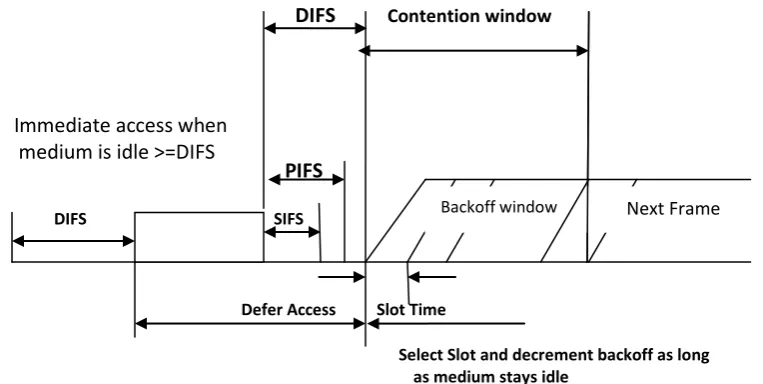
Time slots divided into multiple frames, also have several inter frame spacing (IFS) slots. They include Short IFS (SIFS), Point Coordination Function IFS (PIFS), DCF IFS (DIFS) and Extended IFS (EIFS). The node awaits a free medium to combine various times before actually transmitting. Different packet types need a free medium for different IFS number/type. If a medium is free after a node has awaited DIFS in a ad hoc mode, it transmits a queued packet. If it is still busy, it initiates a backoff timer. The timer’s initial backoff value is selected randomly from between 0 and CW-1 where CW is contention window width with regard to time-slots. After unsuccessful transmission, a doubled size CW performs another backoff as decided by binary exponential backoff (BEB) algorithm. Whenever the medium is idle after DIFS, the timer is decremented. The packet is transmitted when it expires. After successful transmission, the transmission-completing node performs another random backoff (known as post-backoff. Control packets like RTS, CTS or ACK is transmitted after the medium is SFS free. Fig. 1 reveals channel access in IEEE 802.11.
DIFS
Contention windowPIFS
DIFS SIFS
Defer Access Slot Time
[image:3.595.63.445.518.710.2]Select Slot and decrement backoff as long as medium stays idle
Fig 1. IEEE 802.11 DCF channel access.
Backoff window Next Frame
DCF’s main concern is collision reduction among flows competing for access to a wireless medium. PCF (point coordination function) targets both transmission of real time traffic and best-effort data traffic where traffic of different priorities are differentiated to ensure high priority frames quicker access to a wireless medium. PCF access method is based on a central polling scheme controlled by an access point (AP) [26]. In summary, 802.11 wireless LAN is viewed as a wireless version of wired Ethernet, supporting best-effort services [27, 28].
Generally, IEEE 802.11 wireless LAN standard covers MAC sub-layer and OSI network reference model’s physical layer. IEEE 802.11 MAC protocol supports two transmission types: Asynchronous and Synchronous. DCF provides asynchronous transmission and implements IEEE 802.11 MAC protocol’s basic access method. DCF is based on the Carrier Sense Multiple Access with Collision Avoidance (CSMA/CA) protocol, and is a default implementation. PCF provides synchronous service implementing a polling-based access method. PCF uses a centralized polling approach needing an AP to be point coordinator. AP cyclically polls stations to provide opportunity for packet transmission. Unlike DCF, PCF implementation is not mandatory. Further, PCF relies on underlying DCF provided asynchronous service. Though providing different service functions neither DCF nor DCF+PCF are capable of offering true QoS over wireless LAN applications.
All stations share the same queue in a round robin manner without priority in DCF. Packets go to a queue and operate in a FIFO (first in first out) manner. No packet scheduling is done.
[image:4.595.328.531.167.270.2]The idea of the proposed protocol is to adjust power if the number of neighbors increases in order to achieve a better spatial reuse, smaller packet loss and an enhanced throughput. Each node estimates the number of neighbors it has in its 2-hop neighborhood. The nodes arrive at the estimate using table which is built by the routing mechanism or by detected signals. If the estimated number of neighbors is different from the desired number of neighbors, number of NeighMAX, then the power is adjusted. The neighbors in the transmission range are discovered (with initial power p0) [17]. In this study, the desired number of neighbours (k) is set at 10. Thus, if the number of neighbors is more than k for a node, then only the closest neighbors are preserved in the neighboring list as the neighboring nodes and the rest is eliminated from the list. The change of the desired transmits power pd is applied by using a logarithmic increase and decrease of power [16] subject to the number of neighbors:
1 2
1 2
18
(
) * * log
4
preferred
preferred hop preferred hop current
current hop current hop
p
d
d
p
dB
d
d
where pcurrent is the current used power, dpreferred the desired number of one hop or two hop neighbors, dcurrent, the current number of one hop and two hop neighbors and the value e is selected between 3 and 6. In proposed method, the power is adjusted according to the number of two hop neighbour. If the number of two hops neighbors increases, the power is decreased and if the number of neighbors decreases, the power is increased. Thus, the algorithm is executed whenever the number of neighbors changes.
4.
RESULTS AND DISCUSSION
[image:4.595.317.548.340.531.2]To evaluate the proposed two hop method, simulation was conducted in a testbed made of 15 nodes spread over 1000 x 1000 m. All nodes have a transmission range of 100m and constant bit rate (CBR) traffic. The proposed method is compared with DSR routing. The simulations were conducted using the following parameter listed in Table 1.
Table 1: Simulation Parameters
Parameter Values
Number of nodes 15
Simulations area (m) 1000 x 1000 Transmission range (m) 100
Traffic model CBR
Packets size (bytes) 512 Simulation time 3000 sec
Bandwidth 2Mbps
Routing DSR
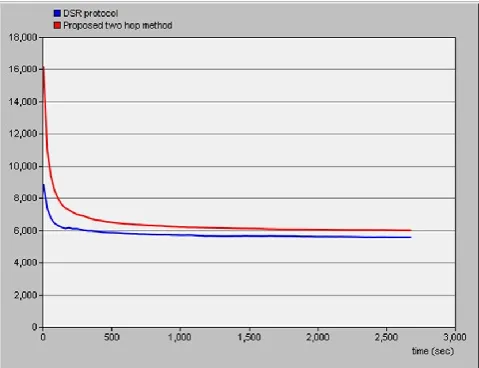
The performance of the network with studied on the basis of parameters such as data dropped, average time delay, throughput and time average control packet overhead. The simulation results comparing the proposed power control routing and DSR are shown in Figures 2 – 5.
Figure 2: Data dropped in bits/sec
The average data dropped for both the proposed method and DSR is nearly the same over time.
[image:4.595.316.550.573.739.2] [image:4.595.58.270.596.643.2]Figure 4: Throughput in Bits/sec
It is observed from the Figures 4 that the proposed protocol improves the performance of the network. Throughput is increased and time delay decreased.
Figure 5: Time Average control packet overhead
The time average control packet overhead is more in the proposed when compared to DSR.
5.
CONCLUSIONS
Several MAC layer power control protocols have been proposed to address the limited power supplies in ad hoc networks. Power control is necessary in order to reduce power consumption rates, avoid collisions within packets, increase spatial throughput of the system and to reduce contention among flows. In this paper, the performance of a MAC protocol for ad hoc networks with a power control scheme added to the standard IEEE 802.11 DCF is investigated. The energy saving power control can potentially be used to improve spatial reuse of the wireless channel. In this paper, a MAC protocol is proposed which achieves better spatial reuse of spectrum due to power adjustments based on the number of neighbors in the two-hop neighborhood. Simulation results show that the proposed protocol satisfactorily improves the performance of the network.
6.
REFERENCES
[1] S. Chakrabarti, A. Mishra, QoS issues in ad hoc wireless networks, IEEE Commun. Mag. 39 (2) (2001) 142–148, February.
[2] E.M. Royer, C.K. Toh, A review of current routing protocols for ad hoc mobile wireless networks, IEEE Personal Commun. 6 (2) (1999) 46–55, April.
[3] Anastasi, G., Conti, M., Di Francesco, M., & Passarella, A. (2009). Energy conservation in wireless sensor networks: A survey. Ad Hoc Networks, 7(3), 537-568.
[4] V. Raghunathan, S. Ganeriwal, M. Srivastava, Emerging techniques for long lived wireless sensor networks, IEEE Communications Magazine 44 (4) (2006) 108–114.
[5] A. Warrier, S.Park J. Mina, I. Rheea, How much energy saving does topology control offer for wireless sensor networks? – A practical study, Elsevier/ACM Computer Communications 30 (14-15) (2007) 2867–2879.
[6] Wireless LAN Medium Access Control (MAC) and Physical Layer (PHY) Specifications, IEEE Std. 802.11, Jan. 1999
[7] Xu, S., & Saadawi, T. (2001). Does the IEEE 802.11 MAC protocol work well in multihop ad hoc networks. IEEE Communications Magazine, 39(6) 130–137.
[8] Garcia-Saavedra, A., Serrano, P., Banchs, A., & Hollick, M. (2012). Balancing energy efficiency and throughput fairness in IEEE 802.11 WLANs. Pervasive and Mobile Computing.
[9] Hiertz, G. R., Zang, Y., Max, S., Junge, T., Weiss, E., & Wolz, B. (2008). IEEE 802.11 s: WLAN mesh standardization and high performance extensions. Network, IEEE, 22(3), 12-19.
[10] Ali, I., Gupta, R., Bansal, S., Misra, A., Razdan, A., & Shorey, R. (2002). Energy efficiency and throughput for TCP traffic in multihop wireless networks. In Proceedings of Infocom, New York, NY
[11] Li, J. et al. (2002). Capacity of ad hoc wireless networks. In Proceedings of ACM Mobicom, Atlanta
[12] Yu-Chee Tseng, Chih-Shun Hsu, and Ten-Yueng Hsieh “Power-Saving Protocols for IEEE 802.11-BasedMulti-Hop Ad Hoc Networks” INFOCOM 2002. Twenty-First Annual Joint Conference of the IEEE Computer and Communications Societies. Proceedings. IEEE.
[13] Shih-Lin Wu, Pao-Chu Tseng, and Zi-Tsan Chou “Distributed power management protocols for multi-hop mobile ad hoc networks” 2004 Elsevier Journal Computer Networks: The International Journal of Computer and Telecommunications Networking archive Volume 47 Issue 1, 14 January 2005.
[14] Rong Zheng, and Robin Kravets “On-demand Power Management for Ad Hoc Networks” INFOCOM 2003. Twenty-Second Annual Joint Conference of the IEEE Computer and Communications. IEEE Societies.
[15] Kara, R. (2011). Power control in wireless ad hoc networks for energy efficient routing with end-to-end packet delay minimization. International Journal of the Physical Sciences, 6(7), 1773-1779.
[image:5.595.55.295.291.475.2][17] Saravanan, K., & Ravichandran, T. (2012). Power Adjustment Algorithm for Higher Throughput in Mobile Ad hoc Networks. IJCSNS, 12(4), 77.
[18] Tang, L., Sun, Y., Gurewitz, O., & Johnson, D. B. (2011, April). PW-MAC: An energy-efficient predictive-wakeup MAC protocol for wireless sensor networks. In INFOCOM, 2011 Proceedings IEEE (pp. 1305-1313). IEEE.
[19] Rhee, I., Warrier, A., Aia, M., Min, J., & Sichitiu, M. L. (2008). Z-MAC: a hybrid MAC for wireless sensor networks. IEEE/ACM Transactions on Networking (TON), 16(3), 511-524.
[20] Shih, K. P., Chou, C. M., Lu, M. Y., & Chen, S. M. (2005, June). A distributed spatial reuse (DSR) MAC protocol for IEEE 802.11 ad-hoc wireless LANs. In Computers and Communications, 2005. ISCC 2005. Proceedings. 10th IEEE Symposium on (pp. 658-663).
[21] Chao, C. M., & Lee, Y. W. (2010). A quorum-based energy-saving MAC protocol design for wireless sensor networks. Vehicular Technology, IEEE Transactions on, 59(2), 813-822.
[22] J. Polastre, J. Hill, and D. Culler. Versatile Low Power Media Access for Wireless Sensor Networks. In Proceedings of the 2nd International Conference on
Embedded Networked Sensor Systems (SenSys), pages 95{107, Baltimore, Nov. 2004.
[23] Liu, S., Fan, K. W., & Sinha, P. (2009). CMAC: an energy-efficient MAC layer protocol using convergent packet forwarding for wireless sensor networks. ACM Transactions on Sensor Networks (TOSN), 5(4), 29.
[24] IEEE 802.11 Working Group, Wireless LAN Medium Access Control (MAC) and Physical Layer (PHY) Specification, 1997.
[25] B.P. Crow, I. Widjaja, J.G. Kim, P.T. Sakai, IEEE 802.11, wireless local area networks, IEEE Commun. Mag. (1997).
[26] Engelstad, P. E., and Osterbo, O. N., (2005), “Analysis of QoS in WLAN”, Telektronikk, pp.132-147.
[27] Choi, J. K., Park, J. S., Lee, J.H., and Ryu, K.S., (2006), “Review on QoS issues in IEEE 802.11 W-LAN”, ICACT, pp. 2109-2113.