How to cite this paper: Mohajer, A., Hajimobini, M.H., Mirzaei, A. and Noori, E. (2014) Trusted-CDS Based Intrusion Detec-tion System in Wireless Sensor Network (TC-IDS). Open Access Library Journal, 1: e848.
http://dx.doi.org/10.4236/oalib.1100848
Trusted-CDS Based Intrusion Detection
System in Wireless Sensor Network (TC-IDS)
Amin Mohajer, Mohammad Hasan Hajimobini, Abbas Mirzaei, Ehsan Noori
High Speed Networking Lab (HSNL), Computer and Information Technology Engineering Department, Amirkabir University of Technology (Tehran Polytechnic), Tehran, Iran
Email: [email protected]
Received 1 August 2014; revised 16 September 2014; revised 19 October 2014
Copyright © 2014 by authors and OALib.
This work is licensed under the Creative Commons Attribution International License (CC BY).
http://creativecommons.org/licenses/by/4.0/
Abstract
Security mechanism is a fundamental requirement of wireless networks in general and Wireless Sensor Networks (WSN) in particular. The Intrusion Detection System (IDS) has become a critical component of wireless sensor networks security strategy. There are several architectures for em-bedding IDS in WSN. Due to Energy Limitation, in this paper we use a distributed architecture which activates intrusion detection system for limited number of nodes. For this purpose we select a secure set of nodes called secure Connected Dominating Set (CDS). In this paper first, we propose a heuristic for selecting CDS based on weighing factor which uses the trust value. Trust is based on reputation and reputation refers to the opinion of one node about another node. Hence only well behaving and good quality nodes are selected as a dominant node for CDS construction. Then we activate IDS on these selected node set. In our proposed work the task of all dominating nodes is to discover any attack and threat that can affect the normal behavior of sensor nodes by analyzing actual status of a node, packet sent and received by node and measurement made to the environ-ment. The simulation results show that our TC-IDS model have high packet delivery ratio, high throughput and low delay than existing IDS Schemes such as Lightweight IDS.
Keywords
Secure CDS, Wireless Sensor Network, Trust, Intrusion Detection System
Subject Areas: Computer and Network Security, Cooperative Communications, Information and Communication: Security, Privacy, and Trust
1. Introduction
OALibJ | DOI:10.4236/oalib.1100848 2 October 2014 | Volume 1 | e848
are tightly constrained in processing ability, storage capacity and energy, routing and data aggregation in WSN are very challenging due to inherent characteristics. Therefore, sensor network needs to become autonomous and exhibit responsiveness and adaptability to evolution changes in real time, without explicit user or administrator action. This need is even more imperative when it comes to security threats, so an attempt to apply the idea of implementation of an IDS that can detect a third party attempts of exploiting possible insecurities and warn for malicious attack in WSN makes a lot of sense.
In case of wireless sensor network, the communication among the sensors is done using wireless transceivers. The threats that damaged the security in WSN can be detected by the Intrusion detection systems (IDSs). An IDS attempts to identify computer system, network intrusions and misuse by gathering and analyzing data. The wireless IDS can monitor and analyze user and system activities, recognize patterns of known attacks, identify abnormal network activity, and detect policy violations for WSN. Thus it is desirable to have several sensors that monitor the attacks and let each sensor report to a base station to avoid losing an important event [3]. In this paper, we explore the related issues for IDS in wireless sensor networks and a model for the implementation of IDS using concept of virtual backbone created by connected dominating set of sensor nodes.
According to energy limitations in WSNs, it is necessary to use architectures in which IDS is not active on all nodes. In this paper, for this purpose a method is proposed with 2 stages. In the first step, CDS nodes are se-lected based on a trust weighting factor. In the second step we activate IDS on the sese-lected nodes. These intru-sion detection systems detect the existing intruintru-sions in the network through a cooperative process.
This paper is organized as follows. Section II describes related works associated with CDS construction and IDS issues. In section III, we present a trust-based method for CDS construction. In section IV we describe ar-chitecture of our IDS. Finally, after presenting the numerical results in section V, we concluded this paper in section VI.
2. Related Works
2.1. Connected Dominating Set: Issues
The nodes in a wireless sensor network are categorized into dominant nodes (CDS nodes) and dominate nodes. The connected structure of the dominant nodes creates a virtual backbone or a Connected Dominating Set (CDS). The adjacent nodes of dominant nodes are called dominate nodes. The messages transmitted by using this virtual backbone effectively reduce the communication overhead. The selection strategy of dominant node for con-nected dominating set construction is different for different approaches.
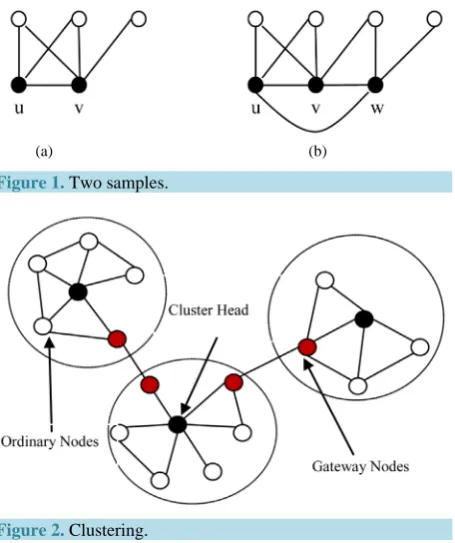
J. Wu and H. Li [4] proposed a simple and efficient algorithm for calculating the connected dominating set in a connected graph, which represents the scenario for a wireless network. In this paper they proposed a marking process that marks every vertex in a connected and un-weighted graph. A node is marked as dominant if two of its neighbors are not directly connected. To reduce the size of a connected dominating set, they proposed two rules.
RULE 1: If u and v are two vertices in a graph G, and id u
( )
<id v( )
, then a marked node “u” can unmark itself if the marked node “v” covers it.RULE 2: A marked node can unmark it, if it is covered by two other directly connected marked neighbors. In Figure 1(a), since N v
( )
N u( )
and{
id v( )
<id u( )
}
, then the node v can unmark itself. In Figure 1(b), the node v can unmark itself because of N v N u N w( ) ( ) ( )
and id v( )
=min{
id v id u id w( ) ( ) ( )
, ,}
. Wu and Li’s approach performs well for finding a small dominating set than any other classical approaches. Each node gets its neighborhood information and their status (mark or unmark) by exchanging Hello messages. So it im-poses communication overhead and high energy consumption. The main advantage of connected dominating set is that the routing information is localized to adapt the topological changes.OALibJ | DOI:10.4236/oalib.1100848 3 October 2014 | Volume 1 | e848
[image:3.595.201.429.82.354.2](a) (b)
Figure 1. Two samples.
Figure 2. Clustering.
F. Theoleyre and F. Valois [6] proposed a virtual structure which consists of three phases: Neighborhood Discovery, Cluster formation, Backbone creation. Neighborhood discovery is performed by sending HELLO messages.
The cluster formation and Cluster-Head election is done by a distributed election and forms a cluster of radius Kcluster. A node moving inside a cluster does not make any topology changes. The Cluster-Heads and gateway nodes together form a CDS structure. The distance from a node to the backbone is at most kcds hops. A back-bone helps to collect control traffic and to reduce overhead of route discovery. The integration of stable cluster formation and backbone creation creates an infrastructure that adapts to topological changes.
Ali Kies et al. [7] present a self organization framework based on weight parameter. Here the distance be-tween the dominant node and dominate node is one hop. It is to limit the disconnection in the network. The weight parameter depends on quality of link, energy and connectivity. Equation (1) depicts the weight parame-ter.
Pselection= × + × + ×α D β E γ M (1) where:
D: is the degree of the node;
E: represents the remaining energy level; M: is the received signal strength; α, β and γ: are the weighting factor.
To build the connected dominating structure, it acquires neighborhood knowledge by using the HELLO mes-sages. In this approach, the dominant nodes have high energy, strong neighborhood and good quality of signal. This will help to avoid the frequent disconnection. But the problem with CDS construction is that the choice of misbehaving node as the dominant node will affect the network performance. Also, a distributed intelligent agent-based system is.
2.2. Intrusion Detection System: Issues
OALibJ | DOI:10.4236/oalib.1100848 4 October 2014 | Volume 1 | e848
A description of the requirements of a WSN oriented IDS is given in [7]. Embedded systems, by definition, must use the minimum resources possible to preserve their lifetime. One of the main characteristic is that it must work with only localized and partial data due to the possible lack of centralized points with a global view. Other characteristics are that the system can never trust any node completely and that the system should be fully dis-tributed. Finally, it should be able to withstand an attack to the IDS itself. A distributed intelligent agent-based system is proposed in [8]. It detects intrusions in a fully distributed way [9] [10]. This characteristic comes from the fact that all nodes have an independent IDS agent installed [11]. This agent is able to detect intrusions local-ly, always based on data collected by the same node and by neighbour nodes. Once an intrusion is detected, the responses or actions taken to isolate it are based on determines that is made collaboratively by the set of partici-pating nodes. Other collaborative approaches on the local detection of selective forwarding and sinkhole attacks can be found in [12] and [13].
Regarding distributed systems, LIDeA is a Lightweight WSN oriented IDS [14]. It is based on a distributed architecture [15], where nodes listen to their neighbour nodes and collaborate with each other in order to detect an intrusion successfully.
3. Proposed CDS Model: Trusted CDS
The proposed CDS model is based on a weighing CDS factor which uses the trust value. The weighting factor depends upon energy, degree, willingness and trust factor of each node. This helps to reduce energy consumption, and thereby increasing the survivability of the network. Also this approach reduces the number of dropped pack-ets.
3.1. Reputation
Reputation is the opinion of a node about another node. Reputation based frameworks helps to analyze the behavior of a node, i.e. whether the node is misbehaving or well-behaving by analyzing the previous history of a node.
3.2. Trust Factor Estimation
As every node of sensor network must store information about its surroundings in order to work properly. This information can be divided into two categories: knowledge about the security (an alert data base that contain information about alerts and suspicious nodes), and the knowledge about the environment (a list of the neighbors of the immediate neighbors of the node, which can be updated over the lifetime of the node using received messages). To determine the behaviour of a node, reputation and trust is used. If node A sus-pects about the confidence of node B, node A can ask the other nodes their reputation value for node B. The most shared opinion about the confidence of node B can confirm or discard the suspicions of node A. To determine the reputation of node B, node A takes into account the communications and iterations between them [14]. To calculate the reputation is used Beta distribution [16] [17] which uses correct and incorrect iterations to give a reputation value.
(
1, 1)
ij j j
R =β α + β + (2) where Rij represents the confidence of the node i for node j, αj are the cooperative iterations and βj are
the no cooperatives ones.
}
{
(
)
11, 1
2
i
ij i j
i j
T E β α β α
α β +
= + + =
+ + (3)
where Tij is the trust of a node for other node, is given by a value from 0 to 1 (1 meaning absolute trust)
and is based on Beta distribution.
OALibJ | DOI:10.4236/oalib.1100848 5 October 2014 | Volume 1 | e848 is applied.
}
{
(
)
(
)
}
{
{
}
22 2 2
k
k j
NEW
j j
k k
k j j k
α α
α α
β α β α
× ×
= +
+ × + + + × (4)
}
{
(
)
(
)
}
{
{
}
2
2 2 2
k
k j
NEW
j j
k k
k j j k
α β
β β
β α β α
× ×
= +
+ × + + + × (5)
When a node asks for information about another node to the neighbourhood, it receives observations that nodes of neighbourhood have about the node in question
(
k, k)
j j
α β , where αkj is the correct iterations
per-formed by node k with node j and βkj are the incorrect ones.
With this second hand information a node can calculate the new iteration values that are used to recalcu-late the reputation. Moreover, information received from nodes with high reputation will have greater weight than those with less reputation.
3.3. Weighting Factor Estimation
The weight parameter depends on degree, energy, quality of the link, and trust value. Equation 6 depicts the weight parameter.
WF=D+ +E WL T+ (6)
where:
• WF: is the weighting factor;
• D: is the degree of the node;
• E: represents the remaining energy level;
• WL: is the willingness of a node to become CDS;
• T: is the trust factor.
3.4. Heuristic for CDS Selection
The purpose of this CDS selection algorithm is to identify well behaving nodes as CDS and thereby opti-mizing the control overhead. In our reputation based system, there are two phases: Well-behaving node dis-covery based on the reputation value of and CDS construction based on the weight factor. In this section we describe about proposed heuristics for CDS selection based on a weight factor and reputation value. The proposed CDS heuristic is applied to each node x in network G as shown in Figure 3, the following termi-nologies will be used in describing the algorithm.
In this algorithm, CDS selector selects the well behaving node as dominant node. In step 2, it identifies the nodes that have connectivity from N1 to N2. This helps to avoid the unnecessary calculation of non- reachable nodes. Then it calculates the reputation value of all nodes which belonging to R x
( )
. Nodes can have a trust factor greater than 0.8 are added to the set T x( )
. Calculate the weighing factor of every neighboring node which belongs to the set T x( )
. In step 3, CDS selector selects the node having highest weighing factor as dominant node. If there is any tie (two or more nodes with the same value of weighing factor), a node with maximum remaining energy will be chosen. In addition if there is another tie, node which provide highest degree value will be selected as CDS node.4. Architecture of the IDS
OALibJ | DOI:10.4236/oalib.1100848 6 October 2014 | Volume 1 | e848
Figure 3. Heuristic for CDS selection process.
As sensor nodes can operate on their own, however for propagating information on misbehaving nodes a platform to enable collaboration for dissemination of such IDS data is needed [20] [21]. The scope of a trusted dominating set based IDS deployed on a dense sensor are a helpful in selection of nodes to monitor and increase the scalability and detection accuracy of the IDS. It will be highly fault tolerant as well as enhances the security by providing maximum are a coverage using virtual backbone concept.
5. Simulation Results
We conducted simulations using NS2 [22], to determine the effectiveness of our proposed scheme and compare it with the Lightweight IDS approach in [23]. Table 1 gives the simulation parameters.
To evaluate the performance of our scheme, we focused on three performance parameters: average throughput, packet delivery ratio and average end-to-end delay by considering nodes density and the number of traffic con-nection. For each scenario we performed ten random simulations. The performance metrics are described as fol-lows:
• Average throughput: the amount of data that are delivered per second over the network;
• Packet delivery ratio (PDR): the ratio of total number of packets received by destinations to total number of packets sent by sources;
OALibJ | DOI:10.4236/oalib.1100848 7 October 2014 | Volume 1 | e848
Table 1. Simulation parameters.
Parameter Value
Number of Nodes 50 - 100
Simulation Time 500 s
Simulation Area 670 × 670 m2
MAC IEEE 802.11b
Initial Energy 1000 Joules
Transmission Power 1.4 W
Reception Power 1.2 W
Idle Power 0.9 W
Traffic Type CBR
Packet Size 512 Bytes
Figure 4 shows that, false detection our scheme is better than Lightweight IDS. The low probability of false detection of TC-IDS is due to using trust along with IDS for detecting malicious nodes.
In our architecture, malicious nodes are detected by considering the trust in IDS that it helps to improve the security of the network.
PDRs of the two schemes are demonstrated in Figure 5. Trusted-proactive CDS based IDS has the highest PDR than Lightweight IDS, because stable and better nodes are selected as CDS nodes, based on a weighing factor which uses the trust value.
This avoids misbehaving nodes and these safe nodes perform the routing task in the network. Thus results in a higher packet delivery ratio. Detection rate of each architecture is highlighted in Figure 6. The detection rate of Lightweight IDS is lesser than TC-IDS.
In TC-IDS the intrusion detection is performed by CDS nodes which are selected using trust weighting factor. Also it uses intrusion detection rules along with trust in IDS detecting the malicious nodes. It results that the de-tection rate of proposed method gets close to 1, despite the growth of malicious nodes.
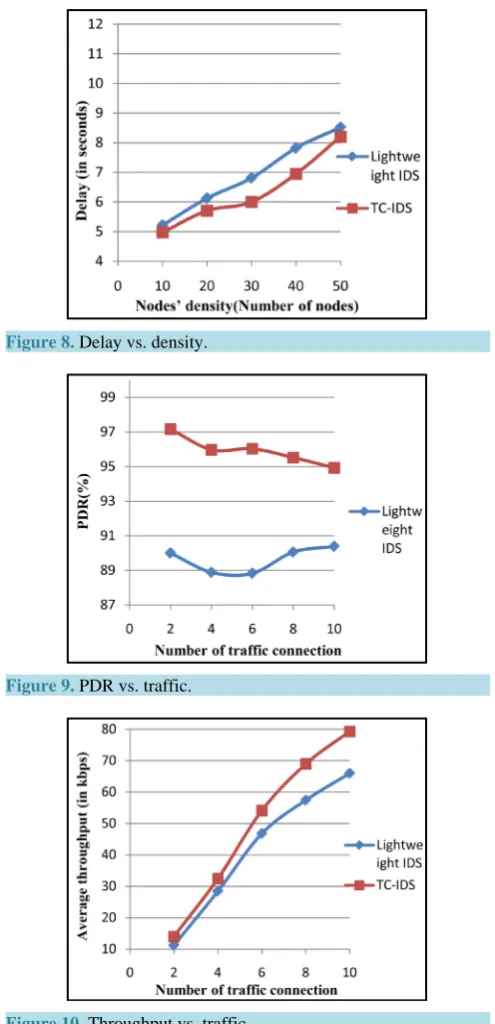
Figure 7 shows that PDR of Lightweight IDS decreases with increasing node density because in TC-IDS the packet routing task is done by trusted-CDS nodes. Hence dropping of packet is less in TC-IDS compared to Lightweight IDS. Figure 8 shows delay with the number of nodes. According to Figure 8, TC-IDS have lower delay than Lightweight IDS as there will not be any broken links between the CDS nodes.
Figure 9 compares the PDR of architectures by varying the number of traffic connections. The PDR of TC- IDS is much better than Lightweight IDS. It is above 95%, while Lightweight IDS provide only 88%. The in-crease in the rate of traffic connection will not inversely affect the delivery of packets in TC-IDS. In Figure 10, the average throughput of TC-IDS is greater than that of Lightweight IDS because it limits the dropping of packet by introducing trusted CDS.
6. Conclusions
In this paper, we proposed a new CDS model for wireless sensor networks based on a weighing CDS factor which uses the trust value. The weighting factor also depends upon the energy, willingness and degree of a sen-sor node. The CDS heuristic helps to identify the best and well behaving nodes for the construction of CDS be-cause the selfish dominant node will inversely affect the network performance. Here the nodes having highest weight factor and trust value are selected as CDS node. Then we activate the IDS on trusted-CDS nodes. An IDS further defenses the strength of a wireless sensor networks. In this paper we used an efficient scheme for IDS implementation which is more secure, provide efficient coverage and connectivity and minimize routing over-heads. Also this helps to increase the survivability of the network.
OALibJ | DOI:10.4236/oalib.1100848 8 October 2014 | Volume 1 | e848
Figure 4. False detection vs. number of monitor nodes.
Figure 5. PDR vs. malicious nodes.
Figure 6. Detection rate vs. percentage of malicious nodes.
[image:8.595.205.427.91.568.2]OALibJ | DOI:10.4236/oalib.1100848 9 October 2014 | Volume 1 | e848
Figure 8. Delay vs. density.
Figure 9. PDR vs. traffic.
Figure 10. Throughput vs. traffic.
ments. As many of proposed security schemes are based on specific network models, lack of combined efforts to take a common model to ensure security for each layer, in future though the security mechanisms become well- established for each individual layer, combining all the mechanisms together for making them work in collabo-ration with each other will incur a hard research challenge.
References
[1] Townsend, C. and Arms, S. (2002) Wireless Sensor Networks: Principles and Applications. Sensor Technology Hand-book, 11, 575589.
OALibJ | DOI:10.4236/oalib.1100848 10 October 2014 | Volume 1 | e848
Proceedings of 8th IEEE ICACT 2006, Volume II, Seon Hong, 20-22 February 2006, 1043-1048.
[3] Bhatnagar, R. and Shankar, U. (2012) The Proposal of Hybrid Intrusion Detection for Defence of Sync Flood Attack in Wireless Sensor Network. International Journal of Computer Science & Engineering Survey, 3, 31-38.
http://dx.doi.org/10.5121/ijcses.2012.3204
[4] Wu, J. and Li, H. (1999) On Calculating Connected Dominating Set for Efficient Routing in Ad-hoc Wireless Net-works. Proceedings of the 3rd InternationalWorkshop on Discrete Algorithms and Methods for Mobile Computing and Communication (DIAL’M), Seattle, August 1999, 7-14.
[5] Haggar, B. (2009) Self-Stabilizing Clustering Algorithm for Ad-hoc Networks. Proceedings of the 5th International Conference on Wireless and Mobile Communications, ICWMC 2009, French Riviera, August 2009, 24-29.
[6] Theoleyre, F. and Valois, F. (2005) Virtual Structure Routing in Ad-hoc Networks. IEEE ICC’2005, Seoul, May 2005, 78-82.
[7] Ali, K., Sara, M., Belbachir, R., Maaza, Z.M. and Senouci, S.M. (2012) Self-Organization Framework for Mobile
Ad-hoc Networks. Proceedings of 8th International conference on Wireless Communications and Mobile Computing, August 2012, 14-22.
[8] Krontiris, I., Benenson, Z., Giannetsos, T., Freiling, F. and Dimitriou, T. (2009) Cooperative Intrusion Detection in Wireless Sensor Networks. Wireless Sensor Networks, 5, 263-278.
http://dx.doi.org/10.1007/978-3-642-00224-3_17
[9] Stetsko, A., Folkman, L. and Matyas, V. (2010) Neighbor-Based Intrusion Detection for Wireless Sensor Networks.
Proceedings of International Conference on Wireless and Mobile Communications, Los Alamitos, 420-425.
[10] Giannetsos, A. (2008) Intrusion Detection in Wireless Sensor Networks. Master’s Thesis, Carnegie Mellon University, Pittsburgh.
[11] nShield Project (2012) New Embedded Systems Architecture for Multi-Layer Dependable Solutions. Project No: 269317, Selex Elsag, SE Europe.
[12] Krontiris, I., Dimitriou, T. and Freiling, F.C. (2007) Towards Intrusion Detection in Wireless Sensor Networks. Pro-ceedings of the 13th European Wireless Conference, Paris, April 2007, 166-173.
[13] Krontiris, I., Dimitriou, T., Giannetsos, T. and Mpasoukos, M. (2008) Intrusion Detection of Sinkhole Attacks in Wireless Sensor Networks. In: Algorithmic Aspects of Wireless Sensor Networks, Springer, Sophia Antipolis, 150-161. [14] Gerrigagoitia, K., Uribeetxeberria, R., Zurutuza, U. and Arenaza, I. (2012) Reputation-Based Intrusion Detection
Sys-tem for Wireless Sensor Networks. Complexity in Engineering (COMPENG), Aachen, 11-13 June 2012, 1-5.
[15] Krontiris, I., Giantsos, T. and Dimitriou, T. (2008) LIDeA: A Distributed Lightweight Intrusion Detection Architecture for Sensor Networks. Proceedings of the 4th International Conference on Security and Privacy in Communication Networks, ACM,Istanbul, 22-25 September 2008, 1-10.
[16] Buchegger, S. and Boudec, J.Y.L. (2003) A Robust Reputation System for Mobile Ad-hoc Networks. Proceedings of P2PEcon, EPFL IC Technical Report IC/2003/50.
[17] Jsang, A. and Ismail, R. (2002) The Beta Reputation System. Proceedings of the 15th Bled Electronic Commerce Con-ference, Bled, 17-19 June 2002, 41-55.
[18] Ganeriwal, S., Balzano, L.K. and Srivastava, M.B. (2008) Reputation-Based Framework for High Integrity Sensor Networks. ACM Transactions on Sensor Networks (TOSN), 4, 1-7.
http://dx.doi.org/10.1145/1362542.1362546
[19] Bidgoly, A.J. and Ladani, B.T. (2013) Quantitative Verification of Beta Reputation System Using PRISM Probabilistic Model Checker. Proceedings of 10th International ISC Conference on Information Security and Cryptology (ISCISC), Yazd, 29-30 August 2013, 1-6.
[20] Roman, R., Zhou, J.Y. and Lopez, J. (2006) Applying Intrusion Detection Systems to Wireless Sensor Networks. 3rd IEEE Consumer Communications and Networking Conference, CCNC 2006, 1, 640-644.
[21] Patwardhan, A., Parker, J., Joshi, A., Iorga, M. and Karygiannis, T. (2005) Secure Routing and Intrusion Detection in Ad Hoc Networks. 3rd IEEE International Conference on Pervasive Computing and Communications, PerCom 2005, Kauai Island, 8-12 March 2005, 191-199.
[22] Network Simulator NS-2, 2002. http://www.isi.edu/nsnam/ns/index.html
[23] Hai, T.H., Huh, E.N. and Jo, M. (2009) A Lightweight Intrusion Detection Framework for Wireless Sensor Networks.