4955
INFLUENCES OF E-WOM DATA ON VIEWER RATINGS
TAKHUN KIM1,ALICE KYUNGRAN MA2, JONGCHANG AHN3*
1Master, School of Management Engineering, KAIST, Republic of Korea
2Candidate Doctor, Department of Media & Technology Management, University of Cologne, Germany
3Associate Professor, Department of Information Systems, Hanyang University, Republic of Korea
E-mail: 1[email protected], 2[email protected], 3[email protected] (*corresponding
author)
ABSTRACT
As media have evolved, consumer behavior for media and their contents were developed together. For the traditional market of television and the program that still maintain consumer power in terms of volume, that economic function had been studied constantly. Therefore, the stakeholders who are seriously interested in television program watching behavior are heavily noticing on so-called e-WoM (word of mouth). With this situation, several studies were performed to illuminate the effect of user-generated contents on the Internet toward viewing rates. But the attention for essential characteristics for both media content and user-generated content is considerably related to the celebrities consisting of the media industry and contents inside. Thus the analysis on checking the effect of consumer reaction’s volume toward celebrities was performed. We collected the data of generated articles and the consumer-generated comments inside for the television drama just until before its first episode, to capture the factor explaining the number of viewer ratings, or market share in the media industry. And it turns out that web buzz data volume talking about celebrities made a positive impact on television viewer ratings while other factors such as comprehensive user-generated variables or promotion volume made by content supplier side were not. The results show that the variable (the total number of articles received at least one comment in the comment section) was significant statistically and present meaningful suggestions for practitioners in an organization.
Keywords: Media Management, e-Word of Mouth (e-WoM), User Generated Contents (UGCs), Viewer
Ratings, Celebrities
1. INTRODUCTION
Under the birth and growth of media with diversified types, most people frequently meet the media and the contents inside. Contents consist of results of performance such as movies or comedies. In many cases, some people who work in media content, such as television comedy show or drama, evolve into a celebrity, that they are evaluated as an entity of economic effect from the media. Nowadays, those special people called as celebrities are the core factor of media business in terms of promotion. Because audiences (media consumers) easily notice their attention and interest with celebrity’s managed appearance and entertaining competence.
Not only celebrities but also the content generated itself is also treated as an asset. One of the easiest ways to understand this system is by looking into the television industry. This powerful field keeps its level of market size until nowadays. Also, the one core pillar of economics in that industry is commercial. Due to the characteristic of the commercial economics that is heavily relying on the number of exposure to the audience, viewer ratings index is the key factor to take notice of the stakeholders who are involved with the media industry. Therefore, several media programs make their marketing promotions boost ratings and be highly evaluated.
4956 one of the factors is word of mouth (WoM) in the physical world. People had a chat about what television program they watch and how they do it. And for now, a lot of sources got into the line of variables that determine the viewer ratings (Ma & Ahn, 2019; Ma et al., 2019). Among them, the discussion generated in the world of web is the biggest cause. We call that electric word of mouth, shortly e-WoM.
In this study, we would like to explore the data collected from the website that we can observe plentiful e-WoM so that we can check that which factors could be an important factor explaining the viewer ratings of the television drama and influences of e-WoM data on it. We investigate and check factors regarding the volume of consumer-generated contents, the volume of reaction toward celebrities starring in the television drama, and the volume of promotion generated. The big data are gathered from seven Korean drama cases aired in 2016. This study sets three hypotheses and tests them through regression analysis using IBM SPSS package. Findings of this study might not only add suggestions for the spheres of media, management, and information systems but also contribute to producers, managers, and advertising sponsors of broadcasting area. This study can become a clue for various variables to analyze influences of e-WoM data on viewing rate, especially drama cases.
The remainder of this paper is organized as follows: Section 2 reviews the previous literature based on several focusing points. Section 3 outlines the research design and hypotheses. Section 4 describes the method used for data collection and research model. Analytical and statistical results are reported in Section 5. Section 6 concludes the proposed research, including further research and limitations.
2. LITERATURE REVIEW
2.1 Media Consumer and Economics
A simple economic principle which led us to strong attention is that a specific media channel would directly connect to higher commercial value. In the television media industry, this type of commercial relationship becomes more clearly. Pricing the unit cost of advertisement can be determined by the performance of programs or channels. It is clear that all advertisers would be happy if their competency can be well exposed to
as many as the audience on their sponsoring programs or channels.
If there seems to be common knowledge of advantages to boost viewer ratings for a TV program, what do stakeholders of TV program including contents generator to choose the strategical options for promoting viewer ratings? When we discuss how to promote newly launching television program, we need to clarify some conditions regarding the goods, such as the genre, the audience target, duration, casting, budget, and so on.
Nelson (1970) started to separate search goods from experience goods. Search goods possess attributes that consumers can learn all of its information before they buy, whereas experience goods cover goods that consumers can learn their purchases’ information only after they buy. Of course, we often do not pay and evaluate it with consumer utility for every television show we tuned, but at least we could put this point of view to understand how media consumers make their choice.
Today, TV audiences are practicing greater control over how they watch TV through the platforms that best suit their needs. The more TV viewers with internet access are surfing or tele-webbing surfing the web while watching TV (Bucy, 2003). Social TV viewing is emerging as a noteworthy phenomenon - the act of social media while watching TV (CTAM, 2012). Watching TV content and communicating with other audiences often simultaneously happen in online space. In this perspective, this study is able to have a meaning for analyzing on the effect of consumer/watcher reaction’s volume toward celebrities.
2.2 User-Generated Contents
4957 UGCs which we can call e-WoM include economic implication as described above, which makes the interested parties around the goods notice them. For the case in this study, the drama is television goods itself that make many buzzes from its issues such as celebrities or episodes. Thus the extent of exposure of consumer reaction to the crowd plays an important role in the success in the market. Ahn et al. (2017) showed that consumer-generated media, which were denoted by UGCs from social network services (SNSs), explained considerable portions of average minute ratings.
In this paper, we moved our data focus on portal website buzz on online news articles. However, we could still expect that audience reactions from the most accessible media and the Internet will perform crucially toward viewer ratings for television drama.
2.3 Anchoring Effect
Tversky and Kahneman (1974) had several representative experiments of how people act when the estimation job accorded with insufficient information. Subjects are instructed to estimate the
answers of 1*2*3*4*5*6*7*8 and
8*7*6*5*4*3*2*1. The answers are the same, which are 40320. But people were ordered to estimate the answer within a few seconds. The interesting result here is that the mean value that people estimated their answer for product question from 1 to 8 with ascending order was 512. On the other hand, the answers made with the multiplication from 8 to 1 with descending order got their mean value 2250. Without this, several experiments from different domain made Tversky and Kahneman (1974) propose an anchoring effect. Like the ships being effective to their mobility after the anchor drop, people try to find an answer near from the first point they were externally accepted, under insufficient information. This biased behavior later followed from a broad area such as marketing or decision making.
A more trustworthy source or plausible bid/estimate, the stronger the anchoring effects (Van Exel et al., 2006). Estimates are biased toward the anchor values. Strack and Mussweiler (1997) presented, “Anchor values serve as the reference point for people to adjust the boundary of the range of plausible values for the question, presuming that the given anchor is more extreme than the boundary value for the range of plausible
answers.”(Strack & Mussweiler,1997; Epley &
Gilovich, 2005).
It might be assumed that if the viewer sees the extremely high number of comments about a new TV drama, the influence on the decision of the drama choice and the content evaluation could also be high. This research assumes that the volume of consumer-generated contents, the volume of reaction toward celebrities starring in the drama, and the number of promotion generated before broadcasting are considered as an initially presented value for forecasting and decision making to select TV content.
In this study, especially for television contents, following studies for anchoring effects in case of decisions proposed by Ariely et al. (2003) can be applied to build the research framework by denoting there is an anchoring effect in this area too. Another new study (Ma & Ahn, 2019) presented the anchoring effects on online comments before broadcasting through eight Korean drama analyses.
2.4 Celebrity Effect
Celebrities are special groups upraised with the birth and growth of media. So-called ‘stars’ collect their popularity through their physical or other ability for their content performance. Even though one celebrity gets objective agreement to their ability or attraction, the notable fact is that they get attention whether the direction is positive or negative, which leads to economic value. Desai et al. (2005) showed that although the extent depends on genre awareness, basically the star effect brings positive influence on selling in the media industry. On this research, target subjects are TV drama shows that is not significantly differentiated with its genre awareness or target group. Thus it makes it available to watch the star effect from its controlled environment (Noh et al., 2017).
4958 and diffusion (Bayus, 1985; Assael, 1984). The motivations behind WoM activities on the Internet are distinct based on the quest for psychological stability, positive WoM, favorable relationships, and utilitarian information-seeking behaviors (Baik, 2005).
According to Kim et al. (2006), consumers spontaneously engage in e-WoM communication to share their experiences and knowledge through the Internet. Online users can obtain e-WoM information from unrelated others or strangers on the Internet. Therefore, if any recipients of e-WoM information have interesting information to acquire, e-WoM can serve as a source of a wide range of information and play an important role (Kim, 2008). The effectiveness of e-WoM varies according to the characteristics of the sender providing specific information. This effectiveness means the sender may have some popularity, relationship, friendship, attraction, and expertise when the recipient obtains information from the sender (Katz & Lazarsfeld, 1995). Therefore, when the sender has characteristics associated with his or her popularity, relationship, friendship, attraction, and expertise, e-WoM affects his or her decision-making process. In particular, any information based on reliability from a relationship on the Internet strengthens the effectiveness of e-WoM.
E-WoM affects mainly acceptance and confidence (Kim et al., 2011; Lee & Park, 2005). Vivid community interactions and control of users have considerable influence on the effectiveness of e-WoM (Lee & Lee, 2005). Because consumers recognize that negative and objective postscripts are more useful forms of information than typical online WoM communication, these have positive effects on purchase intentions, e-WoM intentions, personal decision-making processes for product attitudes (Lee & Park, 2005; Baik, 2005; Sohn & Rhee, 2007; Shim, 2007), and recommendation intentions (Suh et al., 2009; Sung et al., 2012).
Chu and Kim (2015) confirmed that tie strength, trust, normative and informational influence are positively associated with users’ overall e-WoM behavior, whereas a negative relationship was found with regard to homophily. It suggested that product-focused e-WoM in SNSs is a unique phenomenon with important social implications (Chu & Kim, 2015). In the tourism area, Tham et al. (2013) presented that three considerations for destination management organizations are creating opportunities for past
visitors to narrate memorable tourism experiences, involving industry partners to build relevant destination images and greater engagement with social media. The study (Tham et al., 2013) advanced the understanding of electronic word of mouth in presenting distinctive credibility profiles toward a proposed influence on destination image and choice. Therefore, we mainly investigate the e-WoM effects in the consumer’s decision-making of viewing behavior on TV drama based on the previous literature and findings.
3. RESEARCH DESIGN AND
HYPOTHESES
Based on literature reviews, research framework and questions inside can be developed. The focus of this study, again, is to explore the core factors among several aspects of the e-WoM data that determine the success of the media industry with the case of television drama. We could first consider how we can classify this market between search goods and experience goods market. But this market can be interpreted as both types, as it depends on time. Before the television drama starts, nobody ever can know exactly about that product’s value. For that aspect, we could view this situation as things of experience goods market. But when the drama series starts and goes on, then people can get a piece of information for valuation with their utility function. So when the time is that, it could be told as search goods. For the search goods, suppliers concentrate more on its intrinsic competitiveness such as the production team’s ability.
4959 variable, in this case, is set to be viewer ratings of the first episode of each drama.
And then we can consider which factors could be crucial for viewer ratings. This discussion could start from the anchoring effect. In this situation, the anchoring effect could be applied to two aspects. First one is the decision of watching television drama for consumers. That would heavily rely on the consumers’ feeling for the first episode. Because even when the first episode is broadcasted the drama product immediately changed into search goods, anchoring effect will drag viewer ratings for a while. There would be ambivalence between anchoring effect from preexistence watching choice and newly accepted search information from other substitute goods (other dramas or other shows), but direct acceptance of contents would be superior rather than indirect search information acceptance. Therefore, we can say the first episode capturing is important in this industry. For the second, the decision of watching newly launched drama would be affected by the anchoring effect. Thus, stakeholders would consider exposing themselves with prior promotion very important.
For the promotion performance to expose, obviously one of the most important media is the Internet. On the Internet, two components will compose e-WoM. First one is promotions from the supplier side. If the promotion team would boost with several promotions such as preview show, radio promotion or advertisement, the promotion performance and the report of the press can make the higher probability that consumers eventually sit and watch the first episode of the show. The second one that constitutes e-WoM is user-generated contents. As mentioned above, users voluntarily share their opinions on the Internet platform, and that record indicates a huge mass of interests and reactions of consumers. This mass of reaction is re-exposed to the consumers so that they could be affected when they decide to watch the drama or not. Therefore, understanding the characteristics of these crowd reactions is a key process for this research.
With the nature described above, penetrating the essentials of data both from derived promotion and consumer-driven is important. We decided to define several factors we can find on our data, and they are operationalized into variables to be tested whether they are important factors to decide drama’s viewer ratings or not. With all factors or constructs that could explain our
dependent variable, viewer ratings of the drama, we selected several constructs regarding the promotion and the reaction for the drama. Then, we could build hypotheses as below from the question of whether that construct would be important or not.
First construct was the basic stuff, a consumer reaction volume. We thought that in our context, the volume of user-generated contents spread on the platform where people express their opinion about the forthcoming show would be important. Therefore, we could build the hypothesis as below in H1.
H1. The volume of the user-generated contents on the Internet for the television show before revealed, positively affect first-episode viewer ratings.
The second construct was based on the expectation that user-generated-content volume itself could insufficiently explain viewer ratings. Rather, e-WoM generated on the platform would consist of consumers’ interesting point of the show. Also, we thought that a substantial portion of the reaction in the comment showed their opinions on the celebrity starring in the show. Therefore, we could hypothesize and expect that the volume of reaction toward celebrities in the show could do an important role in explaining viewer ratings.
H2. The reaction toward celebrity in the show within user-generated contents toward the television show before revealed, positively affect first-episode viewer ratings.
For the last, we could select the factor from the supplier side, a promotion. We wanted to check whether variables denoting promotion volume would be reflected in the viewer ratings. Therefore, we built our last hypothesis stating the prediction about the promotion scale to be meaningful while predicting the viewer ratings.
H3. The promotion scale toward the media contents before revealed, positively affect first-episode viewer ratings.
4960
4. METHODOLOGY
4.1 Data Collection
A dataset denoting online media consumer reaction in the form of comments was gathered for the analysis. Since the context here is observing the online consumer reaction for drama in Korea, the target website was picked as one of the biggest web portals in Korea. In that website, in detail, we narrowed down our interest to the online news aggregator. That research context setting was based on the expectation that unlike other websites like fan pages, online news page in the web portal is relatively easily accessible and widely noticeable to the normal standard users. Seven titles of television drama in Korea were collected, and in total, approximately 69,000 comments from the news section of the portal website were collected by web crawling and data processing with R programming. The original dataset that has gathered mainly included timestamp-related variables, the text of the comment and evaluation toward the comment as a form of ‘like’ or ‘dislike’ button. Additional data pre-processing procedures were executed. Thus we could obtain final dataset for our main analysis. Unlike user-generated contents variables, the data for our object variable, viewer ratings could be obtained from an agent, Nielsen Korea (www.nielsenkorea.co.kr) with the form of a percentage.
[image:6.612.91.301.591.728.2]For the recall, we wanted to test the hypotheses for a situation that all possible customers who are going to decide whether to watch the show or not, are in the state of uncertainty in terms of product quality. Each of the reaction data was collected within the period of prior promotion that limited as three weeks before the first episode starts. A list of targeted television drama and its details are put in below as Table 1.
Table 1: Collected List of Drama
Title Episode First Day
Advanced -Promotio
n Period (3 weeks)
Genre of Drama
Beautiful
Mind 20
th.June of
2016
31.May – 20.Jun of
2016
Medical
W 20th2016 .July of 20.Jul of 30.Jun – 2016
Fantasy
God of Jealousy
24th.August
of 2016
03.Aug – 24.Aug of
2016
Romantic comedy
Love in Moonlight 22
nd.August
of 2016
01.Aug – 22.Aug of
2016
Historical romance
Way to Airport
21st.
September of 2016
31.Aug – 21.Sep of
2016 Romance
King of Shopping
21st.Septem
ber of 2016
31.Aug – 21.Sep of
2016
Romantic comedy
Carrying Woman
22nd
.September of 2016
05.Sep – 26.Sep of
2016 Detective
4.2 Research Model
For hypothesis testing, a linear regression model for the main analysis was picked. Each variable processed from the crawled raw dataset is to imply a specific construct. The analysis has implemented in each drama level. Therefore, the dependent variable and independent variables were existent in a drama level, or we can say brand level or were summated from the raw dataset into a drama level. The only dependent variable in analysis was viewer ratings of the drama. Specifically, we narrowed down and used the viewer ratings of the first episode of the drama, because that variable could be assumed not to be realized their real product quality, thus shows a more clearly effect from promotion. Therefore, the dependent variable for each drama could be repeatedly expressed below in Y1.
Y1: The drama’s first episode average viewer ratings
4961 to be an important independent variable. Those two variables are written again in below as X1 and X2.
X1: The total number of consumer-generated comments
X2: The total number of consumer-generated comments weighted with the absolute volume of total collected like/dislike (divided into 100,000)
For the next hypothesis, we could impose the factor of celebrity issue on the decision of consumers. With the same website and the same comment system, we could apply another procedure to operationalize this construct. We assumed that people could be attracted by the announced starring celebrity in the show whether the audience is the fan of the celebrity or not. Because by noticing who is starring in the drama and recalling inherent information of the celebrity for each consumer, it could relieve the uncertainty in the utility function of both fan of the star and normal audience. Therefore, operationalization was executed for this construct as the total number of comments that mentioned one of the major celebrities’ names. For this variable, we could also build an additional variable weighted by the net-like/dislike button with the same construct. Therefore, we could check that the weighted sum of celebrity mention volume could be existent with a different meaning. Repeatedly described variables for this construct are X3 and X4.
X3: The total number of consumer comments that mentioned celebrities who are starring in the drama
X4: The total number of consumer comments that mentioned celebrities who are starring in the drama weighted with the absolute volume of total collected like/dislike (divided into 100,000)
For the last, we could check the research question about viewer rating with another construct, a promotion power. We assumed that the total number of article gathered on the news website would represent the promotion power itself. Therefore, simply the number of article generated in the 3-week advanced promotion period would be our next independent variable.
Furthermore, we also derived the other variable denoting the promotion power. It was the number of the article not only generated in the advanced promotion period but also got at least one more comments within the own article page. Because even there are many articles generated,
there might be a chance that some portion of them could be noticed by the consumers and some part of them could be ignored. Therefore, this filtered number of the article represents recognized promotion power from the media content producer side. This operationalization is also re-written in below as X5 and X6.
X5: The total number of articles relevant to the drama during the advanced promotion period
X6: The total number of articles relevant with the drama during the advanced promotion period that received at least one comment in the comment section
In total, we developed six independent variables to check the significance of their effect on the dependent variable. Among them, we tested and observed that which variable turned out to be meaningful when explaining our dependent variable, a viewer rating. Thus, research model of this study is presented like Figure 1.
Promotion scale toward the media contents Reaction toward celebrity in
the show
Weighted total number of consumer comments that mentioned celebrities (X4)
H3 H2
H1
Volume of the user-generated contents
Total number of consumer-generated comments (X1)
Weighted total number of consumer-generated (X2)
Total number of consumer comments that mentioned
celebrities (X3)
Total number of articles relevant to the drama (X5)
Total number of articles relevant to the drama that received at least one comment
(X6)
Viewer ratings of the
4962
Figure 1: Research Model
5. RESULTS
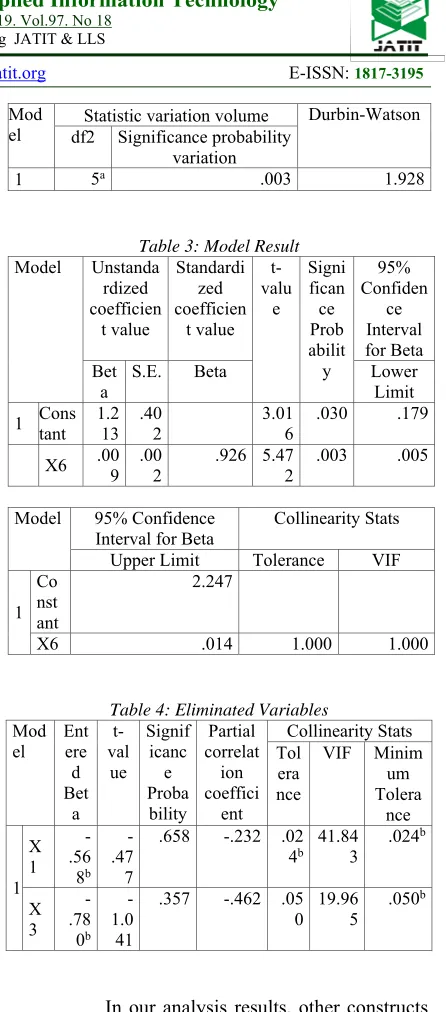
As explained above, a linear regression analysis was implemented with six major independent variables. Rather than putting all variable in the analysis, we first distinguished three variables among all independent variables in terms of the highest correlation value with the dependent variable Y1, viewer ratings. Through this procedure, we could select the independent variable of X1 (user-generated comments volume, not weighted), X3 (user-generated comments regarding celebrity), and X6 (volume of promotion power recognized to the consumer) to put in our regression analysis.
For the next, in our main analysis, we used a stepwise regression method to figure out the important variable explaining our object variable. The analysis results are in below. Through this process, we figured out that the variable X1 and X3 would be eliminated in our result due to the insignificance of estimated beta coefficients (p>0.05). We can confirm it in Table 4.
[image:8.612.308.531.42.548.2]As a result, we could say that the only survived variable was X6, the number of articles relevant to the drama generated during the advanced promotion period that including at least one comment inside. Thus, X6 was supported (beta is 0.926; t-value is 5.472 under p<0.01) in Table 3. As we can see in the model summary in Table 2, we could check the overall status of our estimation. We can confirm relatively high R square and adjusted R square (0.828 under p<0.01) for explaining the dependent variable. Furthermore, with the Durbin-Watson statistics in Table 2, we can say that this estimation is not suffering from the issue of auto-correlation of errors because of having 1.928 near 2.0. Also, there was no problem with multi-collinearity because of values of Tolerance over 0.1 and VIF less than 10 in Table 3.
Table 2: Model Summary
M o d el
R R
squ are adj uste d R-squ are Standar d error Statistic variation R²
variation variation F df1
1 .9 26 a .85 7 .82 8
.45975 .857 29.941 1
Mod
el Statistic variation volume
Durbin-Watson df2 Significance probability
variation
1 5a .003 1.928
Table 3: Model Result
Model Unstanda rdized coefficien t value Standardi zed coefficien t value t-valu e Signi fican ce Prob abilit y 95% Confiden ce Interval for Beta Bet
a S.E. Beta Lower Limit
1 Constant 1.213 .402 3.016 .030 .179
X6 .009 .002 .926 5.472 .003 .005
Model 95% Confidence
Interval for Beta Collinearity Stats
Upper Limit Tolerance VIF
1 Co nst ant
2.247
X6 .014 1.000 1.000
Table 4: Eliminated Variables
Mod el Ent ere d Bet a t-val ue Signif icanc e Proba bility Partial correlat ion coeffici ent Collinearity Stats Tol era nce
VIF Minim um Tolera nce 1 X 1 -.56 8b -.47 7
.658 -.232 .02
4b 41.843 .024 b X 3 -.78 0b -1.0 41
.357 -.462 .05 0
19.96 5
.050b
[image:8.612.89.302.614.717.2]4963 reaction toward celebrity which is X3 and X4 were not significant in our estimation.
For the last, variable X5, the total number of generated articles in the advanced promotion period denoting promotion power from the producer side, was not significant either. Rather, we could find that recognized volume of promotion rather than mere promotion volume was important. X6 (The total number of articles relevant with the drama during the advanced promotion period that received at least one comment in the comment section) was significant. Therefore, we could conditionally assert the hypothesis 3 (The promotion scale toward the media contents before revealed, positively affect first-episode viewer ratings), supported by X6.
[image:9.612.89.297.433.637.2]However, Hypothesis 1 (The volume of the user-generated contents on the Internet for the television show before revealed, positively affect first-episode viewer ratings) and Hypothesis 2 (The reaction toward celebrity in the show within user-generated contents toward the television show before revealed, positively affect first-episode viewer ratings) were not supported. Table 5 presents the results of hypothesis testing in summary.
Table 5: Results of Hypothesis Testing
Hypothesis Variable Variable Results Hypothesis results
H1
X1 supported Not
Not supported X2 supported Not
H2
X3 supported Not
Not supported X4 supported Not
H3
X5 supported Not Partially supported
X6 Supported
6. CONCLUSION
This study had a chance to check the main interest in the effect of buzz data of user-generated contents (e-WoM) and promotion that could decide media consumption behaviors. From the analysis, our main conclusion could confirm the volume of promotion recognized by the consumers. Concretely, “The promotion scale toward the media
contents before revealed, positively affect first-episode viewer ratings” was conditionally supported by “the total number of articles relevant with the drama during the advanced promotion period that received at least one comment in the comment section”. At the same time, we could not find other variables (X1, X2, X3, X4, and X5) that are meaningful in explaining our dependent variable, viewer ratings of the first episode. Thus, Hypothesis 1 and Hypothesis 2 were not supported. The finding can add suggestions for the spheres of media, management, information systems, and convergence area of them. In addition, it can contribute for producers, managers, and advertising sponsors of broadcasting area in differentiating their strategies among other subjects.
The limitation of our result is that not much meaningful independent variables were figured out. This problem may bring further research direction considering possibly omitted variables with richer data. For the further extension, to understand the decision-making process of consumer affected from the e-WoM, concentrating more effort on the text itself would also be valuable. The number of volume of reaction toward celebrities could be meaningful and it would be basic for counting the number and the volume of user-generated contents. As a result, for the extension, text mining with techniques such as sentiment analysis would interpret buzz data from consumer more precisely. It can penetrate a consumer utility function through sentiment analysis by understanding the direction and strength of their opinions. In addition, for the last, even though the traditional media and advertisement market are still large forming economics, new media such as over-the-top services such as YouTube or Netflix are rapidly encroaching media market share. Therefore, expanding the focus of interest into the newly formed market would enrich the understandings about both the status quo and future transition of the media market.
REFRENCES:
[1] A. Ma and J. Ahn, “The correlation on online comments before broadcasting and television content viewers’ behavior pattern: the anchoring effect perspective”, TIIS Transactions on
Internet and Information Systems, Vol. 13, No.
6, 2019, pp. 2491-2508.
4964 perspective”, TIIS Transactions on Internet and
Information Systems, Vol. 13, No. 5, 2019, pp.
3023-3036.
[3] P. Nelson, “Information and consumer behavior”, Journal of Political Economy, Vol.
78, No. 2, 1970, pp. 311-329.
[4] E.P. Bucy, “Media credibility reconsidered: Synergy effects between on-air and online news“, Journalism & Mass Communication
Quarterly, 80(2), 2003, pp. 247-264.
[5] CTAM, How chatter matters in TV viewing, May 4, 2012.
http://www.ctam.com/research/studies/pages/ho w-chatter-matters-in-tv-viewing.aspx
[6] J. Ahn, K. Ma, O. Lee, and S. Sura, “Do big data support TV viewing rate forecasting? A case study of a Korean TV drama”, Information
Systems Frontiers, Vol. 19, No. 2, 2017, pp.
411-420.
[7] A. Tversky and D. Kahneman, “Judgment under
uncertainty: Heuristics and
biases”, Science, Vol. 185, No. 4157, 1974, pp.
1124-1131.
[8] N.J.A. Van Exel, W.B.F. Brouwer, B. van den Berg, and M.A. Koopmanschap, “With a little help from an anchor: discussion and evidence of anchoring effects in contingent valuation,” The
Journal of Socio-Economics, Vol. 35, No. 5,
2006, pp. 836-853.
[9] F. Strack and T. Mussweiler, “Explaining the enigmatic anchoring effect: Mechanisms of selective accessibility,” Journal of personality
and social psychology, Vol. 73, No. 3, 1997, pp.
437-446.
[10] N. Epley and T. Gilovich, “When effortful thinking influences judgmental anchoring: differential effects of forewarning and incentives on self-generated and externally provided anchors,” Journal of Behavioral
Decision Making, Vol. 18, No. 3, 2005, 199-212.
[11] D. Ariely, G. Loewenstein, and D. Prelec, “Coherent arbitrariness”: Stable demand curves without stable preferences”, The Quarterly
Journal of Economics, Vol. 118, No. 1, 2003,
pp. 73-106.
[12] K.K. Desai and S. Basuroy, ”Interactive influence of genre familiarity, star power, and critics' reviews in the cultural goods industry: The case of motion pictures”, Psychology &
Marketing, Vol. 22, No.3, 2005, pp. 203-223.
[13] J.H. Noh, K.W. Lee, & J. Hwang, ”The effect of motivational factor for using SNSs on tourist attitude”, Tourism and Hospitality
Management, Vol. 23, No. 2, 2017, pp.
185-194.
[14] H.S. Lee and D.R. Lyi, “A Study on the effects of online postscript as Word-of-Mouth”,
Korean Academic Society for Public Relations,
Vol. 8, No. 2, 2004, pp. 234-268.
[15] B.J. Kim and E.R. Hwang, “The effect of product evaluation information on the consumer decision making in the on-line context: The word of mouth effect of product review and consumer replies”, The Korean Academic
Society of Business Administration, 2007, pp.
1-26
[16] J.S. Lee and M.J. Park, “The relationship among servicescape, emotional response and behavior intention in hotel restaurant”, Journal
of the Korea Service Management Society, Vol.
6, No. 2, 2005, pp. 105-128.
[17] B.L. Bayus, “Word of mouth-the indirect effects of marketing efforts”, Journal of
Advertising Research, Vol. 25, No. 3, 1985, pp.
31-39.
[18] H. Assael, Consumer behavior and marketing
action. Kent Pub. Co., 1984.
[19] S.L. Baik, “An exploratory study of motives toward word of mouth activities on the internet”, The Korean Journal of Advertising
and Public Relations, Vol. 7, No. 1, 2005, pp.
108-144
[20] N.M. Kim, H.R. Kim, M.K. Lee, H.K. Choi, and I.M. Kim, “Factors affecting consumers’ acceptance of internet Word-of-Mouth information”, Korea Journal of Business
Administration, Vol. 19, No. 4, 2006, pp.
1515-1534.
[21] K.S. Kim, The influence of marketing mix elements and consumer needs on satisfaction and recommendation intention in the musical performance, Hongik University, 2008.
[22] E. Katz and P.F. Lazarsfeld, Between media and mass/the part played by people/the two-step flow of communication. Boyd-Barrett, Ch.
Newbold (red.), Approaches to Media, London,
1995, pp. 124-134.
[23] H.J. Kim, H.S. Pyo, and M.J. Han, “Analysis on the influences and effects of e-WOM of power blog post as a source of advertisement”, The Korean Journal of Advertising and Public
Relations, Vol. 13, No. 4, 2011, pp. 315-362.
4965
of the Korea Service Management Society, Vol.
6, No. 2, 2005, pp. 105-128.
[25] E.Y. Lee and T.M. Lee, “The effects of information characteristics on word of mouth performance in online environment: Focused on the moderating effect of consumer knowledge”,
Journal of Information Technology Applications
and Management, Vol. 16, No. 2, 2005, pp.
145-171.
[26] J.A. Son and E.Y. Rhee, “The effects of information characteristics (direction, consensus) on word of-mouth performance in online apparel shopping”, Journal of the Korean
Society of Clothing and Textiles, Vol. 31, No. 8,
2007, pp. 1157-1167
[27] W.S. Shim, “An exploratory study on the review classification, products evaluation and purchase intention”, The International
Association of Area Studies, Vol. 11, No. 1,
2007, pp. 608-629.
[28] M.S. Suh, J.W. Ahn, J.E. Lee, and S.K. Park, “The effects of multidimensional review in online”, The Korea Contents Association, Vol.
9, No. 8, 2009, pp. 362-367.
[29] H.J. Sung, J.Y. Ko, and Y.K. Kim, “The study of the effects of individual characteristics on customer satisfaction and intention of the use, intention of site recommendation focused on the online social network service”, Journal of
Foodservice Management, Vol. 15, No. 3, 2012,
pp. 81-101.
[30] S.C. Chu and Y. Kim, “Determinants of consumer engagement in electronic word-of-mouth (eWOM) in social networking sites”,
International Journal of Advertising, Vol. 30,
No. 1, 2015, pp. 47-75.
[31] A. Tham, G. Croy, and J. Mair, “Social Media in Destination Choice: Distinctive Electronic Word-of-Mouth Dimensions”, Journal of Travel
and Tourism Marketing, Online, March, 2013,