Munich Personal RePEc Archive
The Transfer Space
Friedrich, T.
Humboldt-Universitaet zu Berlin
1 July 2010
Online at https://mpra.ub.uni-muenchen.de/24682/
The transfer space
Abstract
Within the transfer space source and sink exchange material and energy
to optimize their own productivity. Under certain conditions this
optimization will lead to a productivity increase of the whole ensemble.
The present day view that cooperation is the most productive interaction
between organisms is an illusion. Whenever two not identically equipped
parties meet with the potential to exchange substrates one party will
become a source and the other a sink. This is realistically called
exploitation. The outcome depends on the relation between fix cost,
variable cost, productivity and affinity. Brute force and educational
conditioning used by the sink take advantage of emotions to hide the real
size of cost in exploitation. In case the transfer of substrates leads to
increased productivity parts of the productivity might be reinvested to
keep the exploited party. The lasting relationship is called wise
exploitation. Wise exploitation may last for one or many generations
depending on the use of breeding, brute force or education. All actions
have to be viewed under thermodynamic considerations and the benefit
must always exceed the cost to maintain a stable system. This
hypothesis explains observations from catalytic networks to societies.
Key words: source, sink, wise exploitation, brute force, education,
emotions, fix cost, variable cost, productivity, game theory, cooperation,
Introduction
Cooperation and prisoners´ dilemma
What is cooperation? Many definitions exist in the different fields of
research. They all speak of joint interactions and working together of two
parties for mutual benefits. But this kind of cooperation is hardly - if at all
- observed. The reason is prisoners´ dilemma.
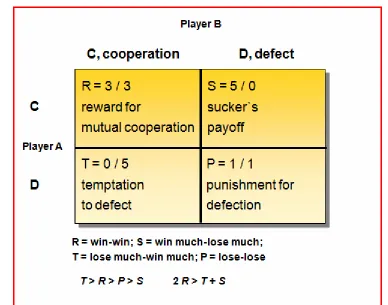
Axelrod and Hamilton (Axelrod, R. and Hamilton, W. D., 1981) use the
following and generally accepted matrix to explain prisoners´ dilemma
[image:3.595.100.488.378.683.2](Figure 1).
Figure 1
Figure 1. Prisoners´ dilemma, an example.
From arbitrary values they learn that successful exploitation (D) of a
best productivity or fitness has the ensemble (Player A+B) if both parties
cooperate (C+C>C+D>D+D). This is the prisoners´ dilemma – it would
be better to cooperate, but the temptation to exploit someone or the
danger of being exploited prevents cooperation. As defect is stable
(D+D; a Nash equilibrium) it is puzzling to many authors why help
between two organisms is observable. One reason is genetic relation –
kin selection (Hamilton, W.D., 1964).
An unanswered question in this example is where does the productivity
come from and why should the productivity in cooperation (C+C) be
higher than in exploitation (C+D)? This view has evolved a little (Nowak,
M. A., 2006). This author writes: “a cooperator is someone who pays a
cost, c for another individual to receive a benefit, b. A defector has no
cost and does not deal out benefits.” To assume that something (a
benefit) can only come from something else (a cost) is a step forward.
However such behavior (giving) is difficult to understand. Giving is an
altruistic action – it pays in terms of evolution only for offspring and other
genetic relation. Complex evolutionary ideas are invented to transfer the
genetically founded behavior altruism and kin selection to group
selection with no genetic foundation (“A group of cooperators might be
more successful than a group of defectors”, same author). The question
is not answered where this additional fitness (productivity) has its source.
The answer to this question is important as we live under the law of
mass and energy conservation - one of the most important empirical
laws and philosophic meaningful concepts.
As the values are arbitrary other outcomes are possible and would be
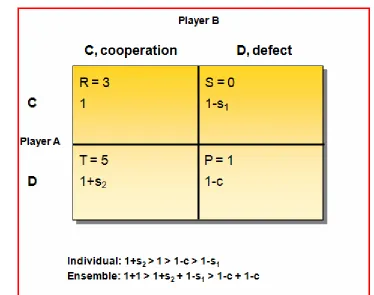
worth to be discussed. A general form should be helpful. Turner and
to explain prisoners´ dilemma (Figure 2). They introduce a further
[image:5.595.104.478.160.455.2]simplification: one side will only give and one side will only take.
Figure 2
Figure 2. Prisoners´ dilemma, one side gives (giving is –s1) and one side takes (+s2).
Using the same values as Axelrod and Hamilton we obtain the same
result. Prisoners´ dilemma is P>S though 2R>T+S>P+P. In this new
general form prisoners´ dilemma equals 1-s1<1-c. Cooperation (1=1) is
doing better than exploitation (1-s1<1+s2). We could say: 1+1>1- s1+1+s2.
The transfer space
What does the generalization (prisoners´ dilemma: c<s1; cooperation is
better than exploitation: 0>s2-s1 = s2<s1) teach?
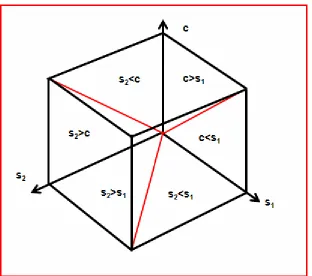
It seems there are three variables: s1, s2 and c and they are considered
independent because the used values were arbitrary. Three independent
The size comparison of these variables may teach something like in
prisoners´ dilemma (not giving, c<s1). The pair wise combinations of
[image:6.595.144.456.187.463.2]three variables are: c<s1, c>s1, s2<s1, s2>s1, s2>c and s2<c.
Figure 3
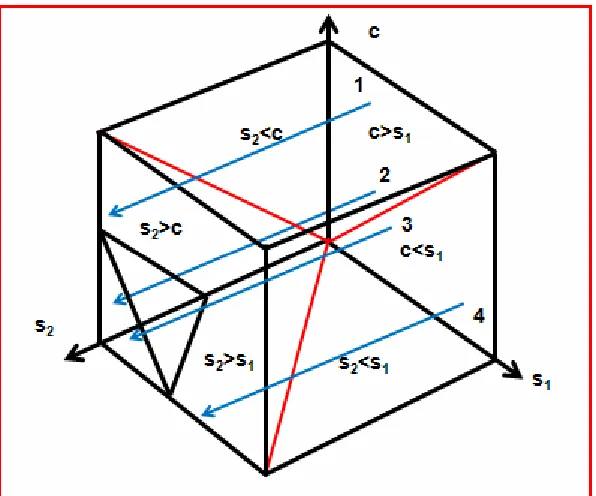
Figure 3. The transfer space formed by the variables c, s1 and s2. The origin of the transfer space is where the red lines meet; c=s1=s2=0. The red lines are s2=s1, c=s1 and s2=c.
What do the variables mean?
• The variable c is the loss if an exchange does not take place. This variable seems to be some kind of fix cost – always present. It is a fix
cost for both sides. But this fix cost is not necessarily of the same size
for player A and player B but will be connected by a factor or an
equation.
• Although one substrate is exchanged the loss to one party is not necessarily identical with the gain to the other party (s2>s1, s2<s1)! The
• The variable s1 is the loss of one party. It consists of the fix cost (the essence of a fix cost is the ubiquity; c), the variable cost that is
connected to the lost substrate (S) and the loss in productivity (p) with
this lost substrate.
• The variable s2 is the gain of the other party. It consists of the fix cost (c), the variable cost that is connected to the gained substrate (S) and
the gain in productivity (p) with this substrate.
• Productivity (p) is a saturation function. At high saturation the gain in productivity is small compared to low saturation for the same amount
of substrate (S). At high saturation the productivity with this substrate
may be less earning than the variable cost for this substrate. • The substrate (S) is a variable cost with a linear dependence.
• s1=c+S+p and s2=c+S+p. This helps to understand why there is “giving”, “not giving”, taking and “not taking” without genetically
founded altruism involved.
giving: c>s1 equals c>c+S+p or 0>S+p
not giving: c<s1 equals c<c+S+p or 0<S+p
taking: s2>c equals c+S+p>c or S+p>0
not taking: s2<c equals c+S+p<c or S+p<0
As S is always a positive value, p must be a large negative value in the
case of “giving” (0>S+p) and “not taking” (S+p<0).
Giving: A negative productivity loss is a relative productivity gain.
Giving will increase the productivity! Giving will reduce variable costs
that do not pay. Giving is a selfish act. It will increase the productivity
via reducing the amount of substrate not earning the variable cost at
high saturation. This idea is important for two reasons. Giving is
reasonable and selfish, economically and thermodynamically founded.
Not taking: A negative productivity gain is a productivity loss. The
second party will not take because a loss in productivity would be
realized. Increasing the substrate (increase variable costs) at high
saturation will decrease the relative productivity. This idea is important
for two reasons. Not taking is not generous, it is reasonable. Not taking
can prevent worsening of the productivity.
Giving (not) and taking (not): This 4 types of behavior meet in the three
dimensional complex exchange space. The outcome of interactions
depends on the physiological, emotional, informational and genetic
condition of the parties.
• The saturable production function determines whether the transfer s1 to s2 will be productive (s2>s1) or consumptive (s2<s1). The effect is
that the ensemble will be more or less productive than the sum of the
single entities.
• The variables c, S and p will be of typical size for a species/population and vary slightly between individuals.
Now we can give names to the different situations:
c<s1 prisoners´ dilemma; avoided exploitation, not giving;
giving will decrease own productivity
c>s1 tolerated exploitation, giving improves own productivity
s2<s1 consumptive exploitation, the system looses productivity
s2>s1 productive exploitation, the system gains productivity
s2>c cost efficient exploitation, taking will increase own productivity
s2<c costing exploitation, taking will decrease own productivity
Discussion
I suggest a new way to look on two parties capable to exchange
substrates. This idea is able to explain exchange related behavior on
different levels of complexity (enzymes, organisms - many enzymes -
and societies - many organisms) and suggests a source of productivity to
fuel group selection without any genetically or else founded form of
altruism. Here a purely selfish founded explanation is introduced. Let us
first discuss important definitions. To do this we should for simplicity
keep some of the variables zero.
• Cooperation, the entry point into the exchange space:
Cooperation is now formally the entry point into the transfer space. In
cooperation nothing is exchanged (s1=s2=0) at no cost (c=0) but the two
parties are able to exchange. What is usually implied using the word
cooperation is a point of the coordinates s2>>s1, s1~0, c~0. In this point
productivity is generated from a small loss at negligible costs and parts
of the gain are shared. This will be explained later and is called wise
exploitation.
• Productive and consumptive exploitation; the plane s2-s1:
Giving and taking create or destroy productivity within the ensemble. The
productivity gain s2>s1 is the intrinsic power source for the system and is
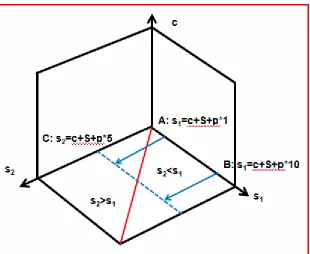
called productive exploitation. The transfer of one substrate from a
saturated condition to an unsaturated condition is the reason for the
increase in productivity (Figure 4). The increased productivity is realized
in the sink. The sink controls the gain and this is the maximal reward.
The ensemble of sink and source together has a better productivity then
the source. The productivity of the source will decrease and finally the
source will be lost. The advantage to the sink and the group is gone. The
sink will need new exploitable source from somewhere else.
The transfer from an unsaturated condition to a saturated condition will
lead to a decrease in productivity (s2<s1) and is called consumptive
exploitation (Figure 4). The smaller productivity is realized and controlled
by the sink. A reward is still obtained but the catch to the sink is smaller
than the loss to the source. But it is still an advantage to the sink. The
ensemble of sink and source together has a smaller productivity then
both parties alone. This is a disadvantage to the group and in addition on
cost of the source. The productivity of the source and the group will
decrease very fast and finally the source will be lost. The sink will need
[image:10.595.144.454.453.707.2]new exploitable source from somewhere else.
Figure 4
substrate the sink has a productivity of p*5 at identical fix and variable cost. The ensemble AC will have a fivefold increased productivity. The productivity of the ensemble BC however is cut by half. AC is a productive transfer (s2>s1), BC is a consumptive transfer (s2<s1).
• Brute force, the plane c-s1:
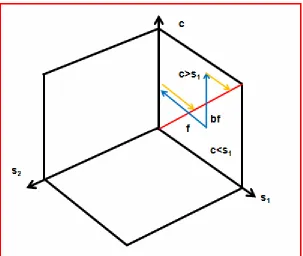
In prisoners´ dilemma (avoided exploitation) nothing is transferred
because not giving is cheaper (c<s1). Only the fix cost (c) is lost. Brute
force will increase the cost of “not giving”. The size relation will therefore
change from c<s1 to c+bf>s1. Now the subdominant party will give to
optimize own productivity. On one side bf is a risky investment. Both
sides may be hurt seriously. But once bf is effective cheap threatening
will make the subdominant party give. Threatening evokes an emotion
called fear. Fear will hide the true cost of giving (s1) (Figure 5). The
[image:11.595.147.450.438.694.2]intensity of brute force and fear correlate directly to the amount given.
Figure 5
• Education, the plane c-s1:
Education is used in intelligent species. It is difficult to determine the true
degree of saturation in a complex organism. Manifold, different and
complex internal and external information has to be processed.
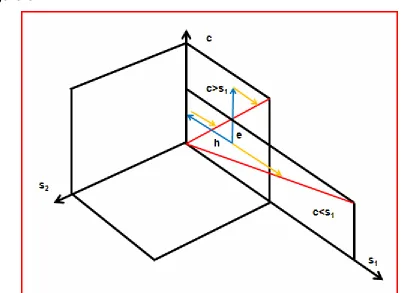
Education is an investment by one party to influence the behavior of a
second party. Education as external information is capable to change the
perception of the relation between fix cost, variable cost and productivity.
This changes the behavior of the source from not giving to giving.
Emotions (hope, h) hide the true size of the loss (s1). The role of
emotions in cooperation related behavior has been addressed (Fessler
and Haley, 2002). Alternatively the whole space is changed and the
source judges the position of the border between c<s1 and c>s1
differently and will give (Figure 6). Giving will stop at c=s1. The size of the
difference c<s1 determines how intensive education and hope have to
[image:12.595.88.490.485.778.2]be.
Figure 6. Education manipulates the perception of the fix cost (blue arrow, e) and giving is induced (orange arrow). Hope (blue arrow, h, educational conditioning of endogenous reward systems) is induced and hides the true cost (s1) and giving is induced (orange arrow). Education can also change the perception of the whole exchange space and induce giving (long orange arrow) directly. The red lines separate c>s1 and c<s1.
• Brute force, the plane c-s2:
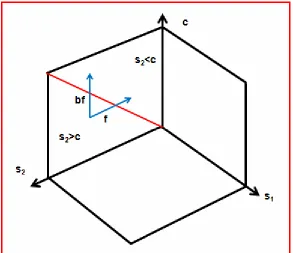
In cost efficient exploitation (s2>c) taking is cheap and effective for the
dominant party but the subdominant party may not be willing to give
because the status there is not saturated anymore. Brute (counter) force
will increase the cost of taking. The size relation will therefore change
from s2>c to s2<c+bf. Now the dominant party will no longer take
because the border to costing exploitation is exceeded. Also here bf is a
risky investment. Both sides may be hurt seriously. But once bf is
effective cheap threatening will make the dominant party recoil from
taking. Threatening evokes an emotion called fear. Fear is an emotion
[image:13.595.152.445.491.744.2]and will hide the true gain of taking (s2) (Figure 7).
Figure 7
(costing exploitation). Later fear (f) is sufficient. Fear (f) hides the true gain s2. The red line separates s2>c and s2<c. In the described case giving back could be a result as the border s2=c is exceeded.
A fight could be interpreted as a test which party is nearer to the border
of giving/not giving – taking/not taking. Or: Who is more and who is less
saturated? The minimal intensity of the counterforce is determined by the
distance to the border s2=c. But it should be clear that in every
production function the most left point is zero. At a high saturation there
may be low productivity but there is also endurance. s1 or s2=c+S+p
could also be interpreted as a space with many different positions.
• Education, the plane c-s2:
Usually the exploiting party (sink) will educate the exploited party
(source) to tolerate exploitation. This may lead to exhaustion of the
exploited party and a decrease of productivity of the whole ensemble.
Ensembles with low productivity will be defeated by ensembles with high
productivity. The highest productivity will be reached at optimal
distribution of material and energy between both parties so that both are
combined maximal productive. Therefore, it could be in the interest of
the exploiting party to restrain from complete exploitation of the exploited
party.
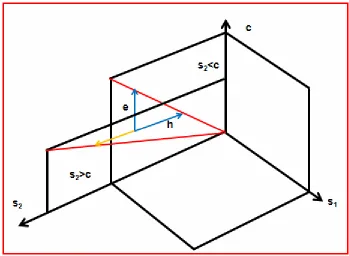
Education as investment could originate in the dominant party but also
within the subdominant party to change the behavior of the dominant
party. The dominant party is changed from “taking” to “not taking”. The
deception of the size of the fix cost (c) is changed by education (e).
Emotions (hope, h) hide here the size of s2, the possible gain and
reward. A second effect of education is that the exchange space is
deformed and the addressed party judges the position of the border
will stop at c=s2. The size of the difference s2>c determines how
intensive education and hope (emotions) have to be to avoid taking.
[image:15.595.122.471.165.421.2]Figure 8
Figure 8. Education manipulates the perception of the fix cost (blue arrow, e). Hope (h, emotions, blue arrow; an educational conditioning of the endogenous reward system) is induced and hides the true gain. Education can also change the whole judgment of the exchange space and the perception of the own position within that space (from s2>c to s2<c). In this case giving back would be induced in the sink (orange arrow).
• Exploitation
As long as the source is in c>s1 the source will selfish give to increase
own productivity – in case a sink will take. This is an advantage through
increased productivity to all sides: source, sink and the ensemble. If
taking by the sink is larger than the additional productivity through giving
the source will approach c=s1. As soon as the source enters c<s1 further
taking would decrease productivity of the source and therefore giving by
the source will selfish end. The exploited party is at first lost to prisoners´
dilemma. A source also may be right from the very beginning of the
contact in prisoners´ dilemma. If the sink wants to take now two
Exploitation with brute force, (s2-s1-bf>0) or (s2-s1-bf<0):
Brute force (bf) is an investment of the exploiting party to induce giving.
Fear (f) hides the true size of s1 but is imaginary and therefore not
added.
Exploitation with education, (s2-s1-e>0) or (s2-s1-e<0):
Education (e) is an investment of the exploiting party to induce giving.
Hope (h, a complex of conditioned emotions. The reward exists only in
the brain.) is virtual and therefore not added.
The use of brute force and education changes the behavior of the
exploited party from not giving to giving. But this behavior is harmful and
not reasonable. The productivity of the source will further decrease and
then the source will be lost completely (physically) through extinction or
consumption. Why can it be evolutionary stable to take in prisoners´
dilemma? How can the loss of the exploited party be avoided?
• Productive wise exploitation with brute force (s2-s1-bf>0):
Brute force between different species: In two different species the
transfer of the substrate to the sink may lead to a higher productivity of
the ensemble so that the investment (bf) is overcompensated. This leads
to productive wise exploitation with brute force (s2-s1-bf>0). In primitive
organisms fear will be absent anyhow. Brute force in enzymes is a higher
affinity. The ensemble with such a behavior will succeed against other
not so productive ensembles of different species. However, the source
will suffer a decrease in fitness and therefore vanish. The ensemble may
succeed against competing groups on the short run but it will only
survive on the long run if parts of the gain are also used to breed the
their garden. The fungus is partly eaten alive (bf) but also bred (br).
Gracing and hunting use brute force but usually no breeding of the
source is observed. This leads only to predator-prey type stability. If the
transfer is consumptive (s2-s1-bf<0) the dominant party needs continuous
influx of exploitable individuals also.
Brute force within the same species: Naturally emerging asymmetries
(male/female; young/old, strong/weak) may serve the same purpose as
breeding. With every new generation the consumed sources are
replaced resulting in a higher productivity of the ensemble of e.g. strong
and weak. The increased productivity (s2-s1-bf>0) comes from the
species internal transfer. This could be called self-exploitation. Every
species produces surplus offspring. This surplus is consumed by
disasters, diseases, predators and starvation. In self exploitation part of
the surplus is transformed into e.g. more muscles or larger fat reserves
or more offspring of the dominant animal. This may lead to a better
survival or better competitiveness of the whole group against other
groups.
• Productive wise exploitation with education (s2-s1-e>0):
The transfer of the substrate to the exploiting party may lead to a higher
productivity of the ensemble so that the investment education (e) is
overcompensated. This leads to productive wise exploitation with
education to hope (s2-s1-e>0). In this case the ensemble with such a
behavior will succeed against other not so productive ensembles.
However, the subdominant party will suffer a decrease in fitness in c<s1.
The ensemble may succeed against competing groups on the short run
but it will only survive on the long run if parts of the gain are also used to
dominant party needs continuous influx of exploitable individuals also.
This behavior is not self sustainable and will only continue as long as no
better competitors arise and the influx is constant. The long term physical
loss of the exploited party can be counteracted through breeding.
• Productive wise exploitation with breeding (s2-s1-br>0):
All organisms depend on an energy and substrate source. If the source
is consumed completely the organism can no longer survive. Taking from
a source will decrease the productivity of the source and finally consume
the source. The source must be replaced if the sink will use the source
further. Two possibilities exist.
First: New sources must be found. This will only be the case when the
source is produced somewhere else unhindered and unconsumed and a
surplus leaks to the place where it will be consumed. Or the energy
reserves are big enough to carry the sink there. This situation reminds of
a predator-prey relationship in biology. This is the case (consumptive or
productive exploitation) as long as breeding is absent.
Second: The sink uses parts of the gain to replace the consumed source
through breeding. Though the source is consumed, new source will
replace the loss. This is called wise exploitation: s2-s1-br>0, the essence
of farming. The productivity gain (s2-s1>0, productive exploitation) is so
big that besides a reward a reinvestment (br) into the stability of the
source can be made. Due to the reinvestment farming is not as much
earning as complete exploitation but will last longer.
• Productive wise exploitation, the plane s2-s1:
When s2>>s1 there will be so much productivity generated that besides a
reward for the exploiting party parts of the gain may be reinvested to
case of productive exploitation, Figure 9). Due to the reinvestment wise
exploitation is earning less than productive exploitation in the same spot
but it will last longer. The productivity gain to the system is no miraculous
violation of mass and energy conservation. The gain is a result of the
transfer of a substrate from a flat part of a production function (saturated,
source) to the steep part of another production function (not saturated,
[image:19.595.154.446.284.546.2]sink).
Figure 9
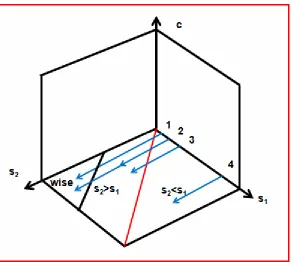
Figure 9. At small fix and variable costs and high productivity (low saturation) in the sink and low productivity (high saturation) in the source the region of wise exploitation is in reach (blue arrow, 1). This region is also in reach by adding smaller amounts from several sources (2) or by inventions to increase the leverage. At higher costs only the region of productive exploitation (3) can be reached. But a reward will always be gained and the ensemble is more productive than the single parties. The size of the reward and the size of the necessary investment determine when wise exploitation will be reached. Finally at very high cost (or low costs and high productivity; s1=c+S+p) only consumptive exploitation is reached. A reward is still earned but here the productivity of the ensemble is below the productivity of both parties. In 3 and 4 the source must come from somewhere else to maintain the system. The red line separates s2>s1 from s2<s1.
Breeding, brute force and education are different forms of wise
exploiting party into the exploited party. This is driven by the gain from
the transfer of the substrate to a better production function. Breeding will
last many generations although wise exploitation is less earning than
productive exploitation in the same spot. Pure productive exploitation will
consume the source push trough against direct competitors and
disappear when there is no source anymore. If both strategies are not in
permanent contact and only in indirect competition reinvesting strategies
win. In intelligent species exploitation will be detected very fast and
avoided. On the short run - only within one lifetime - brute force and
education prevent the loss of the exploited party, too. The loss here is to
be understood as entering prisoners´ dilemma (not giving).
• Productive wise exploitation within the complete exchange space: The three variables s1, s2 and c shape the exchange space. Within this
space we observe self-ordering. If c>s1 giving will be no problem as
giving will improve the productivity of the source. To give in avoided
exploitation (prisoners´ dilemma, c<s1) would decrease the productivity of
the source and is therefore not reasonable and will lead to exhaustion if
induced by brute force or education. On the other side taking will only be
observed if s2>c (cost efficient exploitation). Costing exploitation (s2<c)
would lead to a decrease in productivity of the sink.
Additional consequences are to be discussed:
1. Taking not and giving deliberately are observed with high fix costs
and high saturation. This is rare and will not lead to wise
exploitation due to the high fix costs (Figure 10,1). The outcome of
s2<c and c>s1 depends on the degree of saturation and on specific
affinities.
2. Once giving deliberately (c>s1) and taking (s2>c) are combined the
much. But taking will not end if saturation (s2<c) is not reached for
the sink. The source will cross the border (c=s1) and then move on
to prisoners´ dilemma (c<s1).
3. Taking from prisoners´ dilemma (giving not) is attractive as fix
costs are very low (c<s1) (Figure 10). Only the use of brute force
and education is able to realize this. The productivity of the
ensemble will end when the source is consumed without breeding.
But until then the ensemble is more productive.
4. The subspace s2-s1-br-2c>0 (or s2-s1-br-2c-bf>0) is producing the
surplus and long term stability to fuel co-evolution (Figure 10).
5. There is another subspace of stability in the transfer space. This
subspace is called “true symbiosis” and is under strict control of the
saturated source. The source can stop giving at (c=s1). The sink is
then no longer able to take.
6. Wise exploitation is under the control of the sink, true symbiosis is
under the control of the source.
[image:21.595.159.457.527.775.2]7. Matrix and Vector calculations would be an appropriate treatment.
Figure 10. In this example the transformation s1 to s2 is very effective (high productive in s2), the blue arrows are very long. High fix costs will lead to the behavior of giving deliberately, but even at high productivity the transfer will not reach the corner of wise exploitation as 2c has to be paid (arrow 1). At small fix and variable costs wise exploitation is in reach (2: s2-s1-br-2c>0; 3: s2-s1-br-2c-bf or s2-s1-br-2c-e>0). Giving will be deliberately in 2. Education and brute force have to be used to induce giving in 3 and 4. At higher costs only the region of productive exploitation (4: s2-s1-2c-bf>0 or s2-s1-2c-e>0) will be in reach. Consumptive exploitation is not discussed here.
In general the final benefit (b) to cost (c) ratio for organisms and societies
must be larger than zero (b/c>0) to lead to stability and growth. The
benefit could be interpreted as the productivity (p) per used substrate
(variable cost, S). The cost (c) is the total cost (fix cost).
• The external energy source
All actions of life depend on the external energy from the sun (a few
exceptions exist). The suns energy is collected by plants and handed
over from consumers of different levels to man in the food chain. The
loss of energy in each step is about 90%. The empirical law of mass and
energy conservation is strictly obeyed on all levels! On each level of the
food chain the residual 10% are handed over via consumption of
generated surplus in form of offspring or offspring related products. Only
two offspring will survive under stable conditions. The rest is consumed
and transformed into productivity of the next trophic level. Man is the final
stage of the food chain (usually). If man invests all collected energy and
material in offspring, density dependent problems will arise (disease,
aggression, starvation). Man can also transform the material and energy
into other activities (manufacture, art, science, etc). But energy and
material can be spent only once for physical activity. Productivity will
result either in offspring or in economic productivity or a mixture with less
offspring and suboptimal economic productivity. The transformation
M., Kohler, H.-P., Billari, F.C., 2009). The transformation process comes
to saturation at an offspring level between three and two as expected. A
speed limit is reached when all energy determined to produce offspring is
converted to economic activity.
Interpretation
Enzymes
Enzymes are biological catalysts. Their production function is a
saturation curve. The behavior is predictable by thermodynamics and
reaction kinetics. In a test tube their activity and productivity depends on
external physical and chemical parameters (pH, temperature, substrate
concentration, product concentration etc) and intrinsic features (substrate
affinity, specificity, etc). Source and sink in the test tube depends purely
on thermodynamics. If a system of identical enzymes is not well mixed
there may be local substrate concentration differences and therefore
productivity differences. The combination of local substrate depletion
(S+p>0) with potential high productivity and local substrate surplus
(S+p<0) with low productivity will lead to a higher overall activity after
mixing. After mixing differences in productivity are due to differences in
intrinsic features. Enzymes never give beyond the border to prisoners´
dilemma (c=s1; 0=S+p) in a well mixed solution. A thermodynamic view
of economy has already been developed. (Eric Smith and Duncan K.
Foley, 2005) Enzymes are important active building blocks of organisms.
Organisms
Cells and organisms are partially closed and not identically equipped.
different degree of saturation leads to different behavior. Only hungry
animals grace or hunt. Many enzymes in their bodies are not saturated.
Saturated animals will not grace or hunt because their enzymes are
saturated.
Brute force is a fact in animal societies. (Clutton-Brock, T.H., 2009 and
Clutton-Brock, T.H. and Parker, G.A., 1995). Animals respond to brute
force from other animals. They will not feed or mate and leave the
opportunity to dominant animals. Brute force is an investment by the
dominant animal and will not be used all the time as fear will be induced.
Fear makes the subdominant animal obey. Brute force in intra species
conflicts is generally observed and therefore evolutionary stable. What is
the reason?
Dominance is a result of mutual aggression and fight. Dominant animals
have been successful in such conflicts. Therefore, their genes must be
fitter. They are more productive (e.g. more muscles, faster reactions).
Taking away food from weaker animals will only increase the productivity
of the ensemble if: s2-s1-bf>0. This seems to be the case because we
observe many species with this behavior. Why is that so? The
consequence of the law of energy and mass conservation is that mass
and energy stay either within one species/population or are transferred to
another species/population. Weak animals are either consumed partially
or completely by another species (e.g. pathogen, predator) or they are
“consumed” by their own species. This seems to be of advantage to
ensembles with brute force as investment. Material and energy stay in
the same species/population.
Organisms of different degree of complexity take care for their offspring –
others not. Infanticide and cannibalism is observed (Bluffer Hrdy, S.,
dependent on complexity. Could there be another reason for genetically
founded altruism? Highly productive organisms produce much offspring.
They do not take care but sow the offspring. It would be expected that
high productivity is connected to low saturation. Organisms with scare
offspring invest the productivity not completely into the production of
progeny. Therefore they are saturated. In saturation the productivity of
the ensemble of progeny and parent will become higher if material and
energy is transferred from the saturated partner (parent, source) to the
unsaturated partner (offspring, sink). Not genetic tradition but economics
makes parental care under saturated condition a successful behavior.
Now we can interpret infanticide differently. The flow of material and
energy is reversed when the probability of a successful investment due
to a dangerous environment (stress) has become too low.
Societies
Man seems to behave completely unexpected. Enzymes behave rational
controlled by thermodynamics - man does not. Man does not have all
information necessary and big parts of information given to him (cultural
tradition, personal information by others) are systematically aimed to
manipulate and disguise him. Education and emotional conditioning is
able to modify the behavior in a way that individual harm is the outcome.
The group may have an advance. Emotions are a product of man´s
evolutionary history. They summarize complex situation and are prone to
be manipulated.
The degree of saturation is difficult to determine in complex
multidimensional systems. On the background of different genetic
equipment two parties with the potential to exchange goods meet. Both
sides give and take, do not give and do not take. The fix cost, the
different quality (wrong by accident, deliberately wrong, partially right,
right) is processed on the background of different educational
conditioning and prejudgments. In addition the costs and productivity and
the informational content change within time and in dependence of
former decisions. The result is a complex, multidimensional, constantly
changing space. The outcome of exchange decisions is partly rational
and seems partly irrational with severe consequences for the individual
and the group. A rational decision to give (optimize own productivity)
may be wrong because the information was intentional wrong to induce
giving. Suffering of the source (biologically or personally) will give a
reward to the sink and may foster the productivity of the group. Economic
growth seems to be a transfer of material and energy from reproduction
to production. The success of a group may relay on the suffering of
individuals. But suffering of the source will not guarantee the productive
success of the group – it may only serve the consumptive well being of
the sink. As always in evolution - success is a feature of the successful -
the timescale has to be observed.
Emotions could be a byproduct of evolution. Emotions (fear, love, pride,
hate, contempt, etc) reduce the fix cost in the induction of giving/not
taking. A reduction of fix cost will increase the productivity of this group.
The transfer space helps to understand the effect of brute force,
education (motivation) and emotions in general but also subvention or
corruption can be understood.
Summary
A saturated source with high fix cost and low productivity will give
and optimize own productivity. The transfer of a substrate from a
saturated production function to an unsaturated production function
leads to a productivity increase of the ensemble. This is called productive
exploitation. The collective advantage may help that the ensemble will
prevail against competitors. The productivity gain however is controlled
by the sink. The source will give voluntarily until prisoners´ dilemma is
reached.
The asymmetry of the beginning and the control of the gain enables the
sink to exploit the source further to completeness using brute force or
education not to detect prisoners´ dilemma. The sink will use the gain to
exploit new sources as long as they are available. When all sources are
completely exploited the system will collapse. Stability here is dependent
on the continuous influx of new exploitable sources. This reminds of a
predator-prey system in biology.
A lasting, self sustaining stability is reached when the gain from the
transfer is big enough to pay besides a reward to the sink the necessary
reinvestment into the stability of the source. The source is preserved
through breeding. This is called wise exploitation. The system will prevail
against the exploiting system on the long run but not in direct
confrontation.
Saturation is a rare event in the real world! A source having a lower
saturation than the sink will not give (prisoners´ dilemma). Here brute
force or education to not detect the loss may be used from the beginning
to change the behavior from “not giving” to “giving”. Starting in prisoners´
dilemma is attractive as the fix costs are low. The price is paid by the
source. Productive and consumptive exploiting systems as well as
sustainable systems in combination with breeding may originate here
also. The reward in productive wise exploitation is larger than in wise
indirect competition. A saturated sink with high fix cost and low
productivity will not take deliberately. The sink will only take when it pays.
Game theory seems to be only a flat piece of a whole exchange space.
Literature
Axelrod R. and Hamilton W.D., The evolution of cooperation; Science,
New Series, Vol. 211, No. 4489 (1981) 1390-1396
Blaffer Hrdy, S. Infanticide among animals: A review, classification, and
examination of the implications for the reproductive strategies of females;
Ethology and Sociobiology Volume 1, Issue 1, (1979) 13-40
Clutton-Brock, T.H., Cooperation between non-kin in animal societies;
Nature 462 (2009) 51-57
Clutton-Brock, T.H. and Parker, G.A., Punishment in animal societies;
Nature 373 (1995) 209 – 216
Fessler, D.M.T. and Haley K.J., The Strategy of Affect. In: Hammerstein
P. (Ed.), Genetic and cultural evolution of cooperation; The MIT Press
Hamilton W.D., The genetical evolution of social behaviour I and II;
Journal of Theoretical Biology 7 (1964) 1-16 and 17-52
Myrskylä, M., Kohler, H.-P. and Billari, F.C.; Advances in development
reverse fertility declines; Nature 460 (2002) 741-743
Nowak, M. A., Five Rules for the Evolution of Cooperation; Science 314
(2006) 1560-1663
Smith, E. and Foley, D.K., Classical thermodynamics and economic
general equilibrium theory; Journal of Economic Dynamics and Control
Volume 32, Issue 1 (2008) 7-65
Turner, P.E., and Chao. L.; Prisoner's dilemma in an RNA virus;