© 2016, IRJET ISO 9001:2008 Certified Journal
Page 323
A Survey on Image retrieval techniques with feature extraction
Mr. S.S. Mukati
1, Mr. Nitesh Rastogi
21
PG Scholar, Computer Science and Engineering Department, Indore Institute of Science and Technology
Indore ,
M.P., India
2
Assistant Professor
, Computer Science and Engineering Department, Indore Institute of Science and Technology
Indore , M.P., India
---***---Abstract -
In the past researches, Image retrieval wasthe part of searching trends in research and development. The reason behind those trends is additional need of multimedia and text data on internet. As the content based image retrieval techniques outperforms because of its usability over syntactical features and their content based comparisons. But that is more promising to work in direction of finding more accurate images from their description or their tags. Therefore this paper discusses different techniques and methods that are recently developed for improving the performance of image search. In addition of that a new model is suggested so far to optimize the performance of the existing techniques.
Key Words: CBIR, survey, tag based, feature
computation, system modelling
1.
INTRODUCTION
Content Based Image Retrieval (CBIR) [1] is a scheme that searches images from a large database by means of visual contents, as per the interest of user. Since 1990s, it has been rapid growing research area. Moreover, in the past years, the researchers have made notable results. In late 1970s, the field got its foundation in a conference on Database Technical for Pictorial Applications which was held in Florence [3]. This made the researchers to be attracted towards the field. At early stage, the technique was based on textual annotations of images i.e. images were first annotated with text and then searched using a text-based scheme from typical database systems [2]. This scheme was little simple and could sometimes fail to deliver precise results. Moreover, it is not easy to automatically generate annotations for each image, therefore manual annotation was followed which is a clumsy and complicated task plus much expensive if we have bulk databases.
Further in early 1990s, with rapid growth in internet and digital image sensors, usage and production of images
increased which further created a need of CBIR systems. Since then, research on content-based image retrieval has developed rapidly [4].
This article lists out some essential works and contributions place in the direction of CBIR and presents a brief survey about different techniques. In addition of that the work is extended and obtained a new image retrieval model. The detailed discussion of the image retrieval model is given in further sections.
2.
BACKGROUND
This section provides the basic understanding of the content based image retrieval and their functioning.
2.1.
Image Retrieval
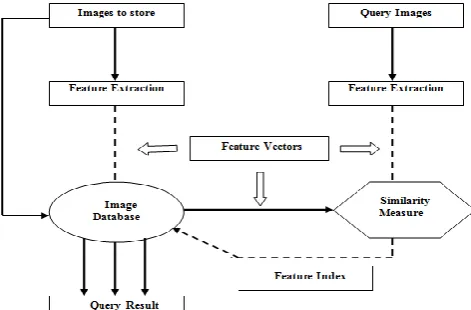
[image:1.595.310.546.574.729.2]Image retrieval systems with their basic components are simulated using figure 1. That can be identified as searching, browsing, and retrieving images from gigantic databases consisting of digital images. Although Traditional and ordinary techniques of retrieving images employs adding metadata i.e. captioning keywords so as to perform annotation of words. However image search can be portrayed by dedicated technique of search which is habitually used to find images. For that, user provides the query image and the system returns the image similar to that of query image [5].
© 2016, IRJET ISO 9001:2008 Certified Journal
Page 324
The image Retrieval has been adopted by most of themajor search engines, including Google, Yahoo!, Bing, etc. Surrounding texts is considered by a large number of search engines and image names to index them, since there are only two main places where text can be placed. First is title and the other is caption or tags which are proposed and implemented using web 2.0 concepts. Usually users make query in the text format for search contents over any search engine.
2.2.
Image Retrieval Techniques
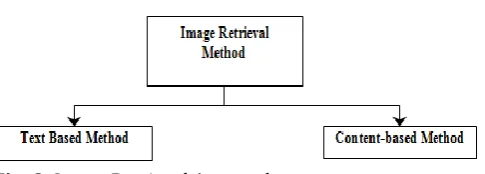
With the expanding use of internet and availability of different image capturing devices such as digital camera, bulk amount of images are being created every day in different areas including remote sensing, fashion, crime prevention, publishing, medicine, architecture, etc. Therefore, development of efficient and effective methodologies to manage large image databases for retrieval is urgently needed. Three methods of image retrieval are used i.e. text-based method, content-based method and hybrid method. This section explains in details each method. Image retrieval system can be classified in two key streams as given in figure 2:
[image:2.595.39.282.412.499.2]• Text based Image retrieval system • Content Based Image retrieval system
Fig -2: Image Retrieval Approaches
2.3.
Text-based image retrieval
Text Based Image Retrieval (TBIR) is presently used in nearly all general-purpose web image retrieval systems nowadays. This approach uses the text allied with an image to find out what the image contains. This text can be text surrounding the image, the image's filename, a hyperlink leading to the image, an annotation to the image, or any other piece of text that can be associated with the image. Examples of systems using this approach are Google, Yahoo Image Search engines. These search engines having indexed over one billion images. Although after being fast and robust, these search engines sometimes fail to retrieve relevant images.
2.4.
Content - based image retrieval
Content Based Image Retrieval is a set of techniques for retrieving semantically-relevant Images from an image database based on automatically-derived image features [6]. CBIR seeks to avoid the use of textual query inputs.
Rather, it retrieves images based on their visual similarity to a user-supplied query image or user-specified image features.
The core objective of CBIR is efficiency while retrieval and indexing of image, thereby reducing the need for human intervention in the indexing process [7]. The computer must be capable of retrieving images from a database without any human assumption on specific domain (such as texture vs. non texture). One of the key tasks for CBIR systems is similarity comparison, extracting feature of every image based on its pixel values and defining rules for comparing images. These features become the image representation for the measurement of similarity with other images in the database. Images are compared by calculating the difference of its feature components to other image descriptors. These image descriptors are globally obtained on the basis of color histograms for color features; global texture information on coarseness, contrast, and direction; and shape features about the curvature, moment’s invariants, circularity, and eccentricity.
Majority of existing CBIR systems takes each image as a complete; although, a single image may comprise multiple regions/objects with totally different semantic meaning. An ordinary user will often be interested in only one particular region of the query image not the whole. So, instead of viewing an image as whole, viewing it as a set of regions is more reasonable. Most Image Retrieval systems include colour, texture, shape and spatial layout. Such feature lose their effectiveness for CIBR if they get retrieved from a whole image, because they suffer from distinct backgrounds, overlaps, occlusion and cluttering in different images and they do not possess satisfactory capability to capture mandatory properties of objects, as a consequence the primary focus of most popular approaches is being shifted from the global content description of images into the local content description by regions or even the objects in images. RBIR is a showing to be a potential extension of the classical CBIR: rather than using global features over the entire content, RBIR systems partition an image into a number of homogenous regions and extract local features for each region then features of regions are used to represent and index images in RBIR. For RBIR, The user puts in a query object by selecting a region of a query image and then the consequent similarity measure is computed between features of region in the query and a set of features of segmented regions in features database and the system returns a ranked list of images that contain the same object. The content-based approach can be summarized as follows:
© 2016, IRJET ISO 9001:2008 Certified Journal
Page 325
2. Images are represented as collections of theirdistinguished features. For a given feature, an appropriate representation of the feature and a notion of similarity are determined.
3. Image retrieval is performed based on computing similarity or Dissimilarity in the feature space, and results are ranked based on the similarity measure.
3.
RELATED WORK
This section provides the recently made contributions and efforts in the direction of content based image retrieval technique.
In this day and age, Content based image retrieval (CBIR) has become a stronghold of image retrieval systems. In order to get more yields, a feature of relevance feedback was added to CBIR so that more precise results can be obtained by taking user’s feedback into considering. Though, iterative feedbacks are being offered by existing systems to obtain refined results, particularly in systems with large scale image database. Unfortunately this is infeasible in real applications. In 2011, Ja-Hwung proposed a novel approach, Navigation-Pattern-based Relevance Feedback (NPRF), to cope up with large scale image database thereby improving efficiency and effectiveness of CBIR. With use of navigation patterns extracted from user query log, iterations are reduced. As consequences, efficiency is increased. This proposed algorithm utilizes the extracted navigation patterns and three varieties of query refinement strategies named Query Point Movement (QPM), Query Reweighting (QR), and Query Expansion (QEX), to congregate the search space towards the specification of user. By using NPRF method, high quality of image retrieval on RF can be accomplished in a slight number of feedbacks [8].
In addition, texture features such as the entropy based on the gray level co-occurrence matrix and the edge histograms of an image are also taken into consideration. Moreover, the IGA is employed to bridge the gap between retrieved results and user’s expectation and help him to get the image most satisfying user’s necessity. Experimental results clearly demonstrate feasibility of the method [9].
CBIR systems are having their hands in so many different fields and domains. A CBIR based image retrieval system was developed for medical applications by Ramesh in 2012. In this application the CBIR is used for searching medical image collections in large scale. The system should be capable of retrieving images from the same disease class as the patient is suffering. The study presented by Ramesh examines the extraction of histogram from a medical image. That image is resample and classified by using Sequential minimal optimization
technique for various percentage of dataset produced subsequent to the extraction [10].
A number of variants of relevance feedback are available these days. In order to find out most optimum methodology, an experiment was presented by Ghanshyam in 2012 in which various new applications of genetic algorithm to information retrieval, most of them related to relevance feedback. Efficient storage and retrieval of image data is always mandatory in order to perform assigned tasks and making decisions. The manuscript presented a new framework for image retrieval with two types of relevance feedback named implicit feedback and explicit feedback. It utilizes Interactive Genetic Algorithm to discover a combination of descriptors that better characterizes the need of user in terms of image resemblance [11].
P. Jayaprabha has presented a study in similar domain, in 2013. They presented a high level semantic retrieval process, in which the search engine is utilized for retrieving a large number of images using a given text based query. In a low level image retrieval process, similar image search function is provided for user to fill in the input query for image similarity characterizations. The internet revolution and digital technologies have obligated a need to have a system to organize abundantly available digital image for effortless categorization and retrieval. The techniques involves broad areas, i.e. image segmentation, image feature extraction, representation, mapping of features to semantics, storage and indexing, image similarity distance measurement and retrieval making CBIR system development a exigent task [12].
Local Binary Patterns are extensively used for texture classification, have projected a method for facial expression recognition using Local Binary Patterns (LBP) as features and Artificial Neural Network [13]. Six universal expressions, i.e. anger, disgust, fear, happy, sad, and surprise along with seventh one neutral, are recognized by the Generalized Feed-forward Neural Network. Levenberg - Marquart (LM) nonlinear optimization algorithm is used to train and test the Neural Network. They have attained 93.3 % classification rate with testing performance 0.0573.
A. R. Ardakany, in 2012 provided classification using a simple feature extraction which performs geometric and appearance features at the same time. This feature extraction is carried out by computing the derivative in all pixels of face images and then constructing a histogram based on edges magnitudes and directions. The experiments are clear evidence that presented method is quite competitive with 95.67% accuracy on FERET database [14].
© 2016, IRJET ISO 9001:2008 Certified Journal
Page 326
Yohan in 2005. This approach attempts to trim irrelevantkeywords by the usage of Word Net. To categorize irrelevant keywords, investigation on various semantic similarities of keywords and to fuse the outcomes of all these measures together to make a final decision with the help of Dempster-Shafer evidence combination. Various models have implemented by them to associate visual tokens with keywords based on knowledge-based, Word Net and evaluated performance using precision, and recall using benchmark dataset. The results show that by augmenting knowledge-based with classical model they can improve precision of annotation by taking out irrelevant keywords [15].
4.
PROPOSED WORK
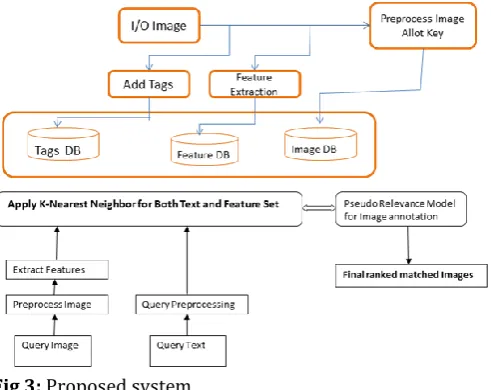
[image:4.595.40.286.384.579.2]The proposed system design is given using figure 3 which is given in two main phases. First for train the system or storing the data into the database and second is used for accepting the user query and producing the search results. Therefore the entire system is described in three major modules first feature extraction, Query interfacing and finally the results listing.
Fig 3: Proposed system
4.1.
Feature extraction
The content based images are retrieved by their image properties such as image objects edges, color distributions and the image textures. Therefore all the tree image features are computed and normalized first which is stored in a database table for image feature representation. At the same time the image are also tagged with some kind of text which indicates the objects available in the input image during training phase. These tags are preserved separately in a table. But in order to recognize the image a key is assigned which is also preserved with the databases.
4.2.
Query interface
As database is filled with the image contents the training session of the presented model is completed. Now for accepting the user query the system can accept the text query and image query also through the individual user interface.
4.3.
Search outcomes
The user produced query is supplied to the KNN algorithm where the KNN having to inputs first the user query tokens and second the database of images, image features and the tag associated with images. Thus by finding the distance between the user query input and the data base scenarios the nearest distance images and their objects are recognized.
The basic features of the proposed work model are explained in this section. In addition of that their modular distribution for implementation of the CBIR model is also explained. The next section discussed the conclusion and the future extension of the presented work.
5.
CONCLUSIONS
n this age need of efficient and accurate systems are increases due to uneven increasing demand of image contents. Thus in this paper first a survey on Content based image retrieval (CBIR) is performed in addition of that the different approaches developed in recent years are also discussed. During investigation that is found that there are a number of techniques that have been introduced so far but most of them are not much accurate or sometimes lake in performance. This paper has portrayed some of major contributions made in this field and discusses the fundamentals. Additionally a new model is also suggested for future implementation.
ACKNOWLEDGEMENT
This research paper is written by me with help of my PG guide Mr. Nitesh Rastogi and HOD Mr. Anil Khandekar of IIST, Indore. Thanks a lot of them.
REFERENCES
[1] Datta, Ritendra, Jia Li, and James Z. Wang. "Content-based image retrieval: approaches and trends of the new age." Proceedings of the 7th ACM SIGMM international workshop on Multimedia information retrieval. ACM, 2005.
[2] Paton, Norman W., and Oscar Díaz. "Active database systems." ACM Computing Surveys (CSUR) 31.1 (1999): 63-103.
© 2016, IRJET ISO 9001:2008 Certified Journal
Page 327
Techniques and Applications." InternationalConference on Recent Advances and Future Trends in Information Technology (iRAFIT2012). 2012.
[4] Madugunki, Meenakshi, et al. "Comparison of different CBIR techniques." Electronics Computer Technology (ICECT), 2011 3rd International Conference on. Vol. 4. IEEE, 2011.
[5] Rui, Yong, et al. "Relevance feedback: a power tool for interactive content-based image retrieval." Circuits and Systems for Video Technology, IEEE Transactions on 8.5 (1998): 644-655.
[6] Murthy, V. S. V. S., et al. "Content based image retrieval using Hierarchical and K-means clustering techniques." International Journal of Engineering Science and Technology 2.3 (2010): 209-212.
[7] Siorpaes, Katharina, and Elena Simperl. "Human intelligence in the process of semantic content creation." World Wide Web 13.1-2 (2010): 33-59. [8] Su, Ja-Hwung, et al. "Efficient relevance feedback for
content-based image retrieval by mining user navigation patterns." Knowledge and Data Engineering, IEEE Transactions on 23.3 (2011): 360-372.
[9] Lai, Chih-Chin, and Ying-Chuan Chen. "A user-oriented image retrieval system based on interactive genetic algorithm." Instrumentation and Measurement, IEEE Transactions on 60.10 (2011): 3318-3325.
[10]Ramesh BabuDurai, C., V. Balaji, and V. Duraisamy. "Improved content based image retrieval using SMO and SVM classification technique." European Journal of Scientific Research 69.4 (2012): 560-564.
[11]Raghuwanshi, Ghanshyam, Nishchol Mishra, and Sanjeev Sharma. "Content based image retrieval using implicit and explicit feedback with interactive genetic algorithm." International Journal of Computer Applications 43.16 (2012): 8-14.
[12]Jayaprabha, P., and RmSomasundaram. "Content Based Image Retrieval Methods Using Self Supporting Retrieval Map Algorithm." IJCSNS 13.1 (2013): 141. [13]Moore, S., and R. Bowden. "Local binary patterns for
multi-view facial expression recognition." Computer Vision and Image Understanding 115.4 (2011): 541-558.
[14]Ardakany, Abbas Roayaei, and A. M. Joula. "Gender recognition based on edge histogram." International Journal of Computer Theory and Engineering 4.2 (2012): 127.