Energy-aware MAC and Routing Protocol Design
for Lifetime Maximization in Wireless Sensor
Networks
Raja Al Kiyumi
Submitted for the Degree of Doctor of Philosophy
from the University of Surrey
Institute for Communication Systems (ICS) Faculty of Engineering and Physical Sciences
University of Surrey
Guildford, Surrey GU2 7XH, U.K.
October 2017
c
Abstract
WSN applications demand prolonged network operation in which manually replenishing the scarce battery resources of sensor nodes are not usually possible. When the limited energy of sensor nodes is completely exhausted, this leads to reduced coverage and may cause network partitioning, which dramatically reduces the network lifetime. In this respect, network lifetime enhancement is considered the most critical aspect of WSN performance. Prolonging network lifetime requires mechanisms that provide energy consumption balancing (ECB) in addition to energy efficiency (EE).
This thesis investigates network lifetime maximization problem and proposes solutions to address both EE and ECB. The scope covers two separate but equally important fronts: duty cycling mechanisms and maximum lifetime routing strategies. Duty cy-cling significantly reduces the energy consumption of sensor nodes resulting from idle listening. Meanwhile, maximum lifetime routing schemes aim at balancing traffic loads and hence energy consumption among sensor nodes across the network.
In this regard, our contributions are in three-folds. First, a distributed sleep mechanism is proposed for the non-beacon-enabled mode of the IEEE 802.15.4 MAC protocol, to support energy-efficient operation in WSNs. In addition to achieving energy savings, our mechanism helps reshape generated traffic so that the overall channel contention is reduced. This effect in turns improves packet delivery ratio at the data sink.
Second, we propose a Control-theoretic Duty Cycle Adaptation algorithm (CDCA) to adapt nodes duty cycle based on time-varying and/or spatially non-uniform data traffic loads. The proposed mechanism is distributed; hence each node adjusts its duty cycle independently. We introduce a novel concept called virtual queue, which provides bet-ter insight into actual traffic conditions in comparison to existing schemes and prevents excessive packet drop. Using NS-3 simulation, we demonstrate the performance im-provements obtained from CDCA in comparison to the state of the art. Furthermore, a stability analysis is conducted to investigate system stability conditions.
Third, we formulate the maximum lifetime routing problem as a minimax optimization problem, and numerically obtain the upper bound network lifetime. Moreover, we pro-pose a Distributed Energy-aware Fuzzy-Logic based routing algorithm (DEFL). DEFL makes an appropriate trade-off between energy efficiency and energy consumption bal-ancing and successfully extends the network lifetime under different network conditions. The simulation results demonstrate that DEFL outperforms all tested algorithms and performs very close to the upper bound.
Key words: Network Lifetime Maximization, Energy Efficiency, Energy Consumption Balancing, MAC, Routing, Wireless Sensor Networks.
Email: [email protected] WWW: http://www.eps.surrey.ac.uk/
As my long journey comes to an end, a note of thanks is the most appropriate way to finish my thesis. I am indebted to many wonderful people without whom it would not have been possible to complete this work. I would like to express my sincere gratitude to my supervisor Dr. Chuan Heng Foh for his continuous guidance and immense knowledge which helped shape my research, and for his patience and valuable feedback throughout my study. I would like to thank my principle supervisor Prof. Rahim Tafazolli for providing me an opportunity to study at ICS and for his insightful comments and encouragement. My sincere thanks also go to my previous supervisor Dr. Piraba Navarathnam and to Dr. Serdar Vural, who supported me through the initial phase of my study and helped me gain confidence in my research skills. I am also grateful to my colleagues and friends at ICS for their wise counsel and sympathetic ears during rough times, for sharing their technical knowledge, and even volunteering to proofread parts of my writing when I get stuck. Special thanks go to Miss Yasmin Fathy, Dr. Mona Jaber, and Mr. Marcin Filo. I would also like to gratefully acknowledge the support provided by admin staff at ICS.
I will always be indebted to my parents, who have always been my source of inspiration. You taught me to dream big and to follow my dreams through with hard work and dedication. I would also like to thank my four amazing daughters, Hanaa, Lubna, Daniya and Lamiya, who have been through all the ups and downs of this journey. You have encouraged me in so many ways, in chasing me up to meet my deadlines, in cheering me up during hard times and even offering to help in my research work. To you, I say: believe in the beauty of your dreams and have the courage to pursue them. Finally, the biggest share of thanks goes to my husband Abdulbari Al-Kindi. Your love and support remained indispensable. Thank you for making this journey a lot easier and more enjoyable.
Contents
1 Introduction 1
1.1 Scope and Challenges . . . 2
1.2 Objectives and Contributions . . . 5
1.3 Thesis Organization . . . 8
2 Background and Literature Review 11 2.1 Overview of Wireless Sensor Networks . . . 12
2.2 Research Directions and Trends in WSN . . . 15
2.3 Lifetime Maximization in WSN . . . 17
2.3.1 Node Deployment Mechanisms . . . 20
2.3.2 Energy Mapping and Monitoring Mechanisms . . . 22
2.3.3 Battery Charging Solutions . . . 22
2.3.4 Energy Conservation and Balancing Schemes . . . 23
2.3.4.1 Physical Layer Schemes . . . 24
2.3.4.2 Application Layer Schemes . . . 25
2.3.4.3 MAC Layer Schemes . . . 26
2.3.4.4 Network Layer Schemes . . . 27
2.3.4.5 Cross-layer Techniques . . . 30
2.4 Energy-aware MAC Protocols for WSN . . . 31
2.4.1 Schedule-based MAC Protocols . . . 33
2.4.2 Synchronous MAC Protocols . . . 34
2.4.3 Asynchronous MAC Protocols . . . 38
2.4.4 On Demand Wake-up Protocols . . . 41
2.5 IEEE 802.15.4 MAC Protocol . . . 43 v
2.5.1 Beacon-enabled Mode . . . 43
2.5.2 Non-beacon-enabled Mode . . . 44
2.6 Traffic Awareness and Duty Cycle Adaptation . . . 46
2.7 Energy-aware Routing Protocols for WSNs . . . 49
2.7.1 Hierarchical Protocols . . . 49
2.7.2 Flat Protocols . . . 51
2.7.3 Computational Intelligence Based Techniques . . . 53
2.8 Summary and Motivation . . . 54
3 A Distributed Sleep Mechanism for Non-Beacon-Enabled IEEE 802.15.4 Networks 57 3.1 Introduction . . . 57
3.2 Proposed Mechanism: IEEE 802.15.4 Non-beacon-enabled Mode with Sleep . . . 59
3.2.1 Network Model . . . 59
3.2.2 Optimal Sleep Period . . . 59
3.3 Performance Evaluation . . . 61
3.3.1 Effect of Sleep . . . 62
3.3.2 Traffic Shaping . . . 64
3.3.3 Energy Consumption . . . 64
3.3.4 Packet Delivery Ratio . . . 66
3.4 Conclusion . . . 67
4 Duty Cycle Adaptation in Dynamic Wireless Sensor Networks 69 4.1 Introduction . . . 69
4.2 Related Work . . . 72
4.2.1 Heuristic Approaches . . . 72
4.2.2 Feedback Controller Based Approaches . . . 73
4.3 Control-theoretic Duty Cycle Adaptation (CDCA) Algorithm . . . 75
4.3.1 Duty Cycles . . . 75
4.3.2 Synchronization Mechanism . . . 76
4.3.3 Virtual Queue . . . 77
Contents vii
4.4 Stability Analysis . . . 80
4.5 Performance Evaluation . . . 84
4.5.1 Simulation Settings . . . 85
4.5.2 Simulation Results for a Linear Network Topology . . . 85
4.5.2.1 Duty Cycle of Different Nodes . . . 85
4.5.2.2 Packet Drop Performance . . . 87
4.5.2.3 Energy Consumption Performance . . . 88
4.5.2.4 Virtual Queue Performance . . . 89
4.5.2.5 Adaptation to Traffic Load Variation . . . 90
4.5.2.6 Effect of Virtual Queue Threshold Setting . . . 91
4.5.3 Simulation Results for a Tree Network Topology . . . 93
4.5.3.1 Duty Cycle of Different Nodes . . . 94
4.5.3.2 Packet Drop and Energy Consumption Performance . . 95
4.5.3.3 Adaptation to Traffic Load Variation . . . 96
4.6 Conclusion . . . 98
5 Fuzzy Logic-based Routing Algorithm for Lifetime Enhancement in Heterogeneous Wireless Sensor Networks 101 5.1 Introduction . . . 101
5.1.1 Maximum Lifetime Routing Strategies . . . 102
5.1.2 Research Challenge . . . 103
5.1.3 Main Contributions . . . 104
5.2 Related Work . . . 106
5.2.1 Cost Function Based Routing Algorithms . . . 106
5.2.2 Fuzzy Logic Based Routing Algorithms . . . 108
5.3 Overview of Fuzzy Logic Approach . . . 110
5.4 Sensor Network Model . . . 111
5.4.1 Network Topology . . . 112
5.4.2 Traffic Model . . . 112
5.4.3 Energy Consumption Model . . . 113
5.4.4 Lifetime of Sensor Network . . . 113
5.6 The Proposed Routing Algorithm- DEFL . . . 115
5.6.1 Metrics Used in our Algorithm . . . 117
5.6.2 Design of the Proposed Cost Function . . . 118
5.6.3 Fuzzy System Implementation . . . 120
5.7 Performance Evaluation . . . 124
5.7.1 Simulation Setup and Assumptions . . . 124
5.7.2 Settingτ Parameter . . . 127
5.7.3 Network Lifetime Performance . . . 129
5.7.4 Energy Consumption Performance . . . 133
5.7.5 Energy Balancing Performance . . . 134
5.8 Conclusion . . . 137
6 Conclusions and Future Work 141 6.1 Conclusions . . . 141
6.2 Future Work . . . 146
List of Figures
2.1 Typical WSN Architecture. . . 13
2.2 A typical sensor node. . . 14
2.3 Classification of Network Lifetime Maximization Techniques. . . 20
2.4 Classification of Energy Conservation and Balancing Schemes. . . 24
3.1 Network Topology. . . 60
3.2 Effect of sleep state. . . 63
3.3 Traffic shaping effect of sleep. . . 64
3.4 Power consumption in Sleep and No Sleep. . . 66
3.5 Effect of sleep state on packet delivery ratio. . . 67
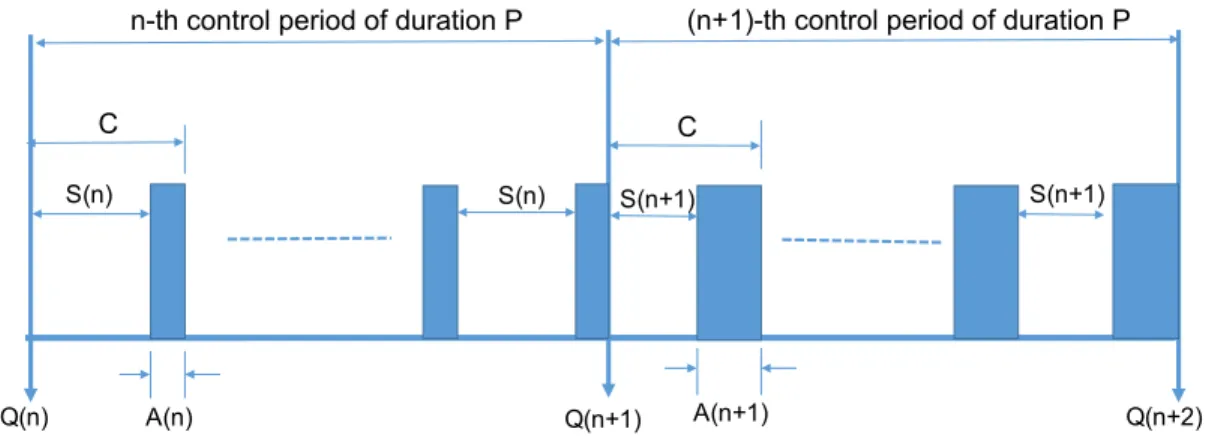
4.1 Node duty cycle in the proposed algorithm CDCA. . . 76
4.2 Sleep duration mismatch between parent and child nodesSm > Si, and the corresponding packet drop experienced by child node i. . . 82
4.3 Linear network topology. . . 86
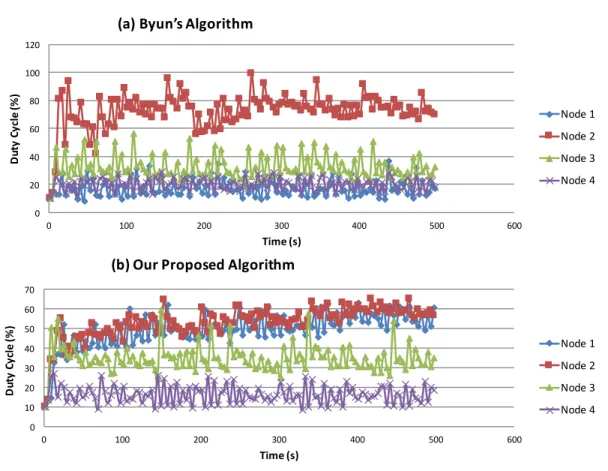
4.4 Time evolutions of duty cycle using (a) Byun’s algorithm and (b) our proposed algorithm CDCA. . . 87
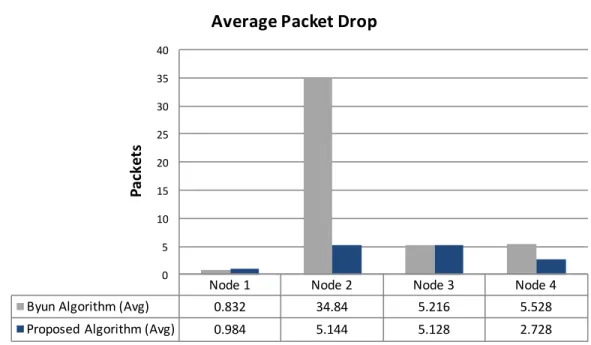
4.5 Average packet drop at different nodes. . . 88
4.6 Average energy consumption at different nodes. . . 89
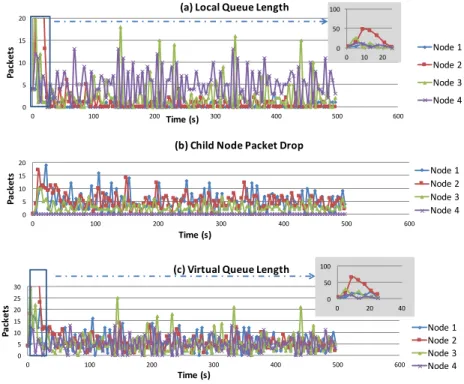
4.7 Time evolutions of (a) local queue length, (b) child node packet drop and (c) virtual queue length. . . 90
4.8 Time evolutions of (a) duty cycle and (b) virtual queue when traffic rate changes at runtime. . . 91
4.9 Average duty cycle under different packet inter-arrival times. . . 92
4.10 Duty cycle and packet loss under different virtual queue threshold values. 93 4.11 Packet delivery ratio under different virtual queue threshold values. . . . 94
4.12 Tree network topology. . . 95 ix
4.13 Time evolutions of duty cycle using (a) Byun’s algorithm and (b) our
proposed algorithm CDCA. . . 96
4.14 Average packet drop at different nodes. . . 97
4.15 Average energy consumption at different nodes. . . 98
4.16 Time evolutions of (a) duty cycle and (b) virtual queue when traffic rate changes at runtime. . . 99
5.1 Cost function design framework. . . 120
5.2 Fuzzy systems (a) FS1, and (b) FS2. . . 121
5.3 The membership functions used for all input and output variables of both fuzzy systems. . . 122
5.4 Network A. . . 127
5.5 Network B. . . 127
5.6 The total link cost for τ = 2, 20 and 80. . . 129
5.7 Network lifetime versus τ, for different traffic rates. . . 130
5.8 Network lifetime performance of different algorithms (Network A). . . . 131
5.9 Network lifetime performance of different algorithms (Network B). . . . 132
5.10 Average energy consumption rate of different algorithms (Network A). . 134
5.11 Average energy consumption rate of different algorithms (Network B). . 135
5.12 Residual energy cumulative distribution for different algorithms at TR= 6 packets/sec (Network A). . . 136
5.13 Residual energy cumulative distribution for different algorithms at TR= 18 packets/sec (Network A). . . 137
5.14 Residual energy cumulative distribution for different algorithms at TR= 8 packets/sec(Network B). . . 138
5.15 Residual energy cumulative distribution for different algorithms at TR= 40 packets/sec (Network B). . . 139
List of Tables
4.1 Definition of variables used in equations 4.1 and 4.2. . . 79
5.1 Fuzzy rules for FS1. . . 124
5.2 Fuzzy rules for FS2. . . 126
5.3 Simulation Parameters. . . 128
Acronyms
6LoWPAN IPv6 over Low-Power Wireless Personal Area Networks ACK Acknowledgement packet
AIS Artificial Immune Systems BE Back-off Exponent
BI Beacon Interval
BO Beacon Order
CAP Contention-based Access Period CCA Clear Channel Assessment
CDCA Control-theoretic approach for Duty Cycle Adaptation CFP Contention Free Period
CH Cluster Head
CI Computational Intelligence CPU Central Processing Unit
CR Cognitive Radio
CSMA Carrier Sense Multiple Access
CSMA/CA Carrier Sense Multiple Access with Collision Avoidance
CTS Clear-to-Send
DEFL Distributed Energy-aware Fuzzy Logic based routing algorithm EA Evolutionary Algorithms
ECB Energy Consumption Balancing EE Energy Efficiency
EM Electro-Magnetic
FA Flow Augmentation
FL Fuzzy Logic
FND First Node Dies
GPS Global Positioning System GTSs Guaranteed Time Slots
HART Highway Addressable Remote Transducer
IEEE Institute for Electrical and Electronic Engineering IETF Internet Engineering Task Force
IoT Internet of Things
IPv6 Internet Protocol version 6
ISA International Society of Automation
LR-WPANs Low Rate Wireless Personal Area Networks MAC Medium Access Control
MDR Minimum Drain Rate xiii
MEMS Micro-Electro-Mechanical Systems MIMO Multiple Input and Multiple Output MTE Minimum Total Energy
NC Network Coding
NFC Near Field Communication
NN Neural Networks
NS-3 Network Simulator 3
OSI Open Systems Interconnection OSWA Open Sensor Web Architecture PAN Personal Area Network
PHY Physical Layer QoS Quality of Service QSI Queue Status Indicator
RFID Radio-Frequency IDentification RL Reinforcement Learning
RSRP Reference Signal Received Power RTS Request-to-Send
SD Superframe Duration SI Swarm Intelligence
SO Superframe Order
SQP Sequential Quadratic Programming
TCP/IP Transport Control Protocol/ Internet Protocol TDMA Time Division Multiple Access
TPC Transmission Power Control WBANs Wireless Body Area Networks WPAN Wireless Personal Area Network WSNs Wireless Sensor Networks
Symbols
α Set of routing decisions
αij Percentage of traffic that node iforwards to nodej Am Duration of active period of node m
B Channel bandwidth
β Control parameter
C Duration of node cycle
Ci Set that collects the child nodes of node i
dij Distance between node iand node j
Dm Number of packets dropped by nodem during a control period DR(i) Energy drain rate of node i
E Set of all directed links of a graph G
Eave Average energy consumption per successful packet transmission per node Ei Initial battery energy of node i
Eirx Overall receive energy of node i
Eitotal Total energy consumed by node iwithin a unit time
Eitx Overall transmit energy of node i
Epkt Average energy expended by a node for a successful packet transmission Et(ij) Energy required to transmit one unit of information from node ito node j Etotal Total energy consumption by a node
eidle Node current consumption in Idle state ercv Node current consumption in Receive state esleep Node current consumption in Sleep state etx Node current consumption in Transmit state Fk Traffic of node kwithin a unit time
γ Control parameter
Gm Packet generation rate at node m
Km Set of child nodes of node m
Li Lifetime of node i Lnet Network lifetime
N Number of nodes in the network Ni Set of neighboring nodes of nodei
nsuccess Number of successful packet transmissions by a node P Duration of control period
Pi Set that collects the parent nodes of node i
Qm Local queue length of node m Qthm Virtual queue threshold
RE(i) Normalized residual energy of nodei RP Relay probability
RP1(ij) Relay probability 1 of link ij
RP2(ij) Relay probability 2 of link ij
σ Routing update period
Sm Duration of sleep period of node m τ Normalized weight
T E(ij) Energy consumed in transmitting a unit data over the linkij
Tm Number of packets successfully transmitted by node mduring a control period tidle Total time the node spends in Idle state
trcv Total time the node spends in Receive state tsleep Total time the node spends in Sleep state ttx Total time the node spends in Transmit state
UA(Vi) Membership degree of the corresponding output fuzzy set
Um Number of packets arrive at node mqueue during a control period Umf Total number of packets received by nodem during a control period Umg Number of packets generated by nodem during a control period
V Set of all nodes of a graphG
Vbi Average packet drop ratio due to channel conditions of linkli Vdm Average packet drop ratio of link lm
Vi Center of the output fuzzy set corresponding to rule i
Vsi Average packet drop ratio due to sleep duration mismatch between child & parent node Vtm Average successful packet transmission ratio of link lm
wij Final link cost of linkij w1(ij) Cost 1 of link ij
w2(ij) Cost 2 of link ij
Chapter 1
Introduction
In recent years, the use of the Internet in our daily life has taken a big leap from being a luxury to a necessity. Internet of Things (IoT) is the next revolutionary technology that will transform the Internet into a fully integrated Future Internet. The basic idea of IoT is the pervasive presence of a variety of things or objects which are able to interact with each other to achieve common goals. US National Intelligence Council NIC foresees that “by 2025 Internet nodes may reside in everyday things - food packages, furniture, paper documents, and more”. The IoT transforms these objects from being traditional to smart by exploiting its underlying technologies such as ubiquitous and pervasive computing, embedded devices, communication technologies, sensor networks, Internet protocols, and applications. Radio-Frequency IDentification (RFID) and Near Field Communication (NFC) together with Wireless Sensor Networks (WSNs) are considered as the main technologies that will link the physical world with the digital world [1]. IoT is expected to support numerous home and business applications which will contribute to the quality of our life and will significantly develop world’s economic [2]. Smart home, intelligent transportation systems, smart healthcare, industrial automation, smart grids and smart city are some examples of IoT applications. In order to realize the full potential of IoT and to meet the demands of its growing applications, a large research effort is still required to overcome several challenges.
Wireless sensor network is one of the key technologies supporting the Internet of Things. WSNs consist of a large number of sensing nodes often communicate in a multi-hop
fashion to report the results of their sensing to a small number (usually only one) of special nodes called gateways, which are also known as sinks [1]. An extensive literature has been produced on WSNs in the recent past to address several problems including some unique challenges. Main design objectives of the proposed solutions are energy efficiency and lifetime maximization, scalability, reliability, and adaptiveness to dynamic environments.
In WSNs, different applications have different requirements in terms of delay, reliabil-ity, QoS, securreliabil-ity, mobilreliabil-ity, coverage and scalability. However, all these applications demand prolonged network operation in which manually replenishing the scarce battery resources of sensor nodes are not usually possible. Even applications that can toler-ate battery replacement, their wide adoption may be prevented by the rapid depletion of the battery. For this reason, network lifetime enhancement is considered the most critical aspect of WSN performance.
1.1
Scope and Challenges
Recent advances in Micro-Electro-Mechanical Systems (MEMS) technology have made available low-cost miniature sensor devices for use in remote sensing applications. While these features improved the feasibility of large and dense deployments of WSNs, it resulted in these devices having limited energy resources and processing capabilities, as well as short communication ranges. The nature of WSN applications and the scale of deployments have made it neither practical nor feasible to replace or recharge sensor batteries.
When sensor nodes deplete their batteries, this results in coverage holes in the network, i.e. such nodes become non-operational and can no longer collect data. This also leads to connectivity loss at parts of a WSN, as communications paths may be broken as a result of node failure events. This generally reduces the overall network lifetime. In this respect, the energy efficiency of a node operation is crucial and essential in WSNs. To prolong network lifetime, WSN communication protocols, which usually account for a large proportion of energy consumption of a node, must be energy-efficient [3]. The
1.1. Scope and Challenges 3
lifetime of the network is defined in most of the literature as the time elapsed until the first node in the network dies i.e. depletes its energy.
While focusing on energy efficiency alone minimizes the energy consumption of indi-vidual sensor nodes, it does not guarantee an even distribution of energy consumption across all sensors in the network. Energy consumption balancing (ECB) is an impor-tant feature to achieve maximum network lifetime, where ideally all sensor nodes should consume energy such that they reach the end of their operational lifetime at the same time. However, variations in sensor activities and subsequently traffic loads may create energy imbalance across the network. Moreover, multi-hop communication is widely adopted in WSNs to achieve energy efficiency by ensuring short range transmissions. On the other hand, this mode of communication may also induce an energy imbalance across a WSN, as multi-hop communication paths naturally cause an unequal commu-nication load on sensors, especially higher on those sensors closer to the data sinks. As such, in order to maximize a WSN’s lifetime, besides reducing transmission ranges via multihop communication paths, it is also necessary to balance energy consump-tion in the WSN. Therefore, mechanisms and algorithms that ensure uniform energy dissipation are highly desirable in order for a WSN to remain fully functional for the maximum possible time period [4].
In this thesis, we focus on proposing solutions to address energy efficiency, energy consumption balancing, and lifetime maximization objectives.
Extensive research efforts have been dedicated to proposing energy saving and lifetime maximization techniques at different layers of the protocol stack. These techniques range from radio optimization, data compression and aggregation, clustering and rout-ing, sleep mechanisms and duty cycling techniques to energy harvestrout-ing, wireless charg-ing, and node deployment optimization approaches. In this work, our scope covers MAC layer duty cycling mechanisms and network layer maximum lifetime routing strategies. These approaches were selected mainly because they are known to have more potential in saving energy in addition to their high applicability in different types of applications and network configurations.
inter-dependent. Duty cycle decisions made at the MAC layer affect the energy consumption of different nodes where energy-related metrics are used in routing algorithms. Mean-while, routing decisions made at the network layer impact the traffic load at different nodes which is in turn used to adjust the duty cycles of the nodes.
Some of the main challenges with regards to duty cycle mechanisms and maximum lifetime routing strategies are listed below:
1. The IEEE 802.15.4 protocol is widely adopted as the MAC sub-layer standard for wireless sensor networks, with two available modes: beacon-enabled and non-beacon-enabled. The non-beacon-enabled mode could be more suitable for future WSNs due to its simplicity and lack of synchronization requirements. However, it lacks an explicit energy saving mechanism that is crucial for its deployment on energy-constrained sensors. Therefore, there is a need to propose an energy saving mechanism for un-slotted IEEE 802.15.4. In doing so, the main trade-off is between two conflicting goals: (i) to meet the data delivery requirements of appli-cations, i.e. high packet delivery ratio, and (ii) to minimise energy consumption. 2. Besides energy efficiency, it is important for MAC protocols to be adaptable to the dynamic conditions often encountered in WSN deployments. Data traffic loads on sensor nodes in a multi-hop WSN vary in time due to unpredictable changes in packet generation rates and/or changes in network topology as a result of node failures, additions, or inactivity. Furthermore, due to packet forwarding in multi-hop networks, traffic load may quickly grow and get heavier at short multi-hop distances to the data sink. This requires nodes to stay active for extended periods of time (i.e. fewer sleep opportunities) at such network locations. Therefore, the duty-cycle of a sensing device should be adaptive to time-varying network conditions and/or spatially non-uniform data traffic loads. Unfortunately, the IEEE 802.15.4 standard lacks this important feature.
3. While energy efficiency refers to energy saving or reduction in energy consump-tion, energy consumption balancing signifies the uniform dissipation of energy among all sensor nodes. These two features are often conflicting, since the reduc-tion of energy consumpreduc-tion could be achieved by over utilizing specific nodes for
1.2. Objectives and Contributions 5
packet forwarding resulting in uneven consumption of energy. Prolonging net-work lifetime requires, in addition to energy efficiency, even dissipation of energy among sensor nodes. On the other hand, spatial and temporal variations in sensor activities create energy imbalance across the network. Therefore, it is important to design routing algorithms that are able to make an appropriate trade-off be-tween energy efficiency and energy consumption balancing to extend the network lifetime.
1.2
Objectives and Contributions
This thesis aims at proposing MAC and Network layer algorithms that maximize net-work lifetime in wireless sensor netnet-works. The proposed algorithms should surely be energy-aware, but should also be distributed to ensure scalability, and lightweight to be suitable for resource-constrained sensor nodes. Additionally, they should be adaptive to variable traffic conditions. Therefore, the main objectives of this research work are as follows:
1. The first objective of the research work is to improve energy efficiency at MAC layer without degrading the packet delivery performance.
2. The second objective of the research work is to adapt the duty cycle of different nodes independently in order to meet the time-varying and/or spatially non-uniform traffic loads. The proposed mechanism should aim at improving energy efficiency while maximizing packet delivery performance under variable traffic conditions.
3. Finally, the last objective of the research work is to evaluate network lifetime and understand the key factors that contribute to energy imbalance in multi-hop wireless sensor networks. Furthermore, to propose an energy-aware routing protocol that is able to achieve the right trade-off between energy efficiency and energy consumption balancing and maximize network lifetime in heterogeneous WSNs.
In accordance with the objectives of the research work, our contributions in the context of MAC and routing solutions can be summarized as follows:
1. Proposed a distributed sleep mechanism for single hop non-beacon enabled IEEE 802.15.4 in order to support energy-efficient operation in WSNs. This mode of IEEE 802.15.4 could practically be a more viable solution for future WSNs due to its simplicity and lack of synchronization requirement. We show through NS-3 simulation that:
(a) Having a duty cycle in non-beacon enabled IEEE 802.15.4 not only saves energy but also shapes traffic patterns such that channel contention is effec-tively reduced and packet delivery ratio is improved.
(b) The sleep period of a node can be adjusted to achieve the optimal packet delivery ratio based on the traffic arrival rate and the level of network con-tention.
(c) There exists a certain threshold on the number of nodes the system can support, for the given values of packet inter-arrival time, sleep period and required packet delivery ratio.
2. We propose an effective duty-cycle adaptation mechanism, called Control-theoretic approach for Duty Cycle Adaptation (CDCA). A distributed controller is consid-ered to be run at each node which adapts its duty cycle to achieve energy efficiency and maximise packet delivery performance under variable traffic conditions. This contribution can be further divided as follows:
(a) We introduce a novel concept called a virtual queue, which is determined based on the local queue length of a node and an explicit packet drop infor-mation from its child nodes. This concept enhances the nodes awareness of its child traffic conditions allowing the node to promptly respond to it and prevents unnecessary packet drop.
(b) Based on the virtual queue concept, we design a new distributed algorithm (CDCA) that utilizes control theoretic approach to adjust the duty cycle
1.2. Objectives and Contributions 7
of each node and achieve high performance under variable traffic condi-tions. The proposed algorithm is evaluated using NS-3 simulator and its performance improvement, in terms of energy efficiency and packet delivery performance, is demonstrated.
(c) Furthermore, based on control theory, we analyze the proposed controller to investigate system stability conditions.
3. We propose a novel Distributed Energy-aware Fuzzy Logic based (DEFL) routing algorithm that simultaneously addresses energy efficiency and energy consump-tion balancing to improve network lifetime in dynamic network condiconsump-tions. We provide a generic framework for designing energy-related cost functions that are used to calculate the cost of a link based on the network status. Instead of using rigid computation model to blend different metrics, we apply soft human logic through fuzzy logic approach. We evaluate the performance of our routing algo-rithm (DEFL) through simulation using various performance metrics. Therefore, our contributions in this work can be summarized as follows:
(a) A generic formulation of the maximum network lifetime routing problem has been provided. A max-min optimization problem is formulated to maximize the minimum lifetime over all nodes. Matlab fminimax solver is used to determine the upper bound lifetime performance of a given network config-uration which we use as a performance benchmark.
(b) A generic framework for designing energy-related cost functions is intro-duced. Based on the framework, a heuristic routing algorithm DEFL is proposed which combines cost function based routing and fuzzy logic ap-proach to improve network lifetime in heterogeneous networks. Appropriate energy metrics are combined using two fuzzy logic systems and the output costs are then aggregated to produce the final link cost. A shortest path method, Bellman-Ford algorithm, is employed to determine the minimum cost route from any sensor node to the sink node. The performance of the proposed algorithm is evaluated through simulation and compared with ex-isting well-known algorithms including Minimum Total Energy (MTE), Flow
Augmentation (FA), and Minimum Drain Rate (MDR), as well as the upper bound calculated by the solver. The simulation results demonstrate that DEFL indeed provides better performance than the evaluated algorithms in terms of network lifetime and energy balancing property. It consistently performs very close to the optimal performance obtained by the solver.
Research work carried out during the course of this Ph.D. has resulted in the publica-tions listed below.
Journals
J.1R. Al Kiyumi, C. H. Foh, S. Vural, P. Chatzimisios and R. Tafazolli, “Fuzzy Logic-based Routing Algorithm for Lifetime Enhancement in Heterogeneous Wireless Sensor Networks”, IEEE Transactions on Green Communications and Networking, 2018. Conferences
C.1 R. Al Kiyumi, S. Vural, C. H. Foh, and R. Tafazolli, “A distributed Sleep Mecha-nism for Energy-efficiency in Non-beacon-enabled IEEE 802.15.4 Networks”, in Com-puter Aided Modelling and Design of Communication Links and Networks (CAMAD), 2015 IEEE 20th International Workshop on. IEEE, 2015, pp. 237-241.
C.2R. Al Kiyumi, C. H. Foh, S. Vural, and R. Tafazolli, “A Control-theoretic Approach for Duty Cycle Adaptation in Dynamic Wireless Sensor Networks”, in Computers and Communications (ISCC), 2017 IEEE Symposium on. IEEE, 2017, pp. 465-472.
1.3
Thesis Organization
The content of this thesis is structured as follows:
Chapter 2 provides a background on wireless sensor networks and their key research directions. Then, it investigates network lifetime maximization as the main research problem and reviews different techniques proposed in the literature to improve this
1.3. Thesis Organization 9
critical performance aspect. Next, we survey the relevant duty cycling mechanisms proposed at MAC layer and energy-aware routing algorithms proposed at the network layer to prolong WSN lifetime. The chapter concludes with summary and motivation. Chapter 3 presents the proposed distributed sleep mechanism introduced to non-beacon enabled IEEE 802.15.4. The performance results, obtained by NS-3 simulations, are provided and the improvements as compared to the original IEEE 802.15.4 protocol are demonstrated. Also, key observations are discussed and summarized.
Chapter 4 describes the proposed duty cycle adaptation algorithm (CDCA) which is based on control theory approach. The virtual queue concept is introduced and its significance is explained. Moreover, the chapter covers the stability analysis of the proposed controller and the performance evaluation of our mechanism compared to the state-of-the-art. A brief conclusion is given at the end of the chapter.
Chapter 5 provides a generic formulation of the maximum lifetime routing problem and recommends a solver algorithm to derive an upper bound that is used as a performance benchmark. It presents a generic framework for designing energy-related cost functions and describes our proposed routing algorithm (DEFL), which is based on fuzzy logic approach. It further demonstrates the performance DEFL achieves in comparison to existing heuristic routing mechanisms, as well as the upper bound obtained by the solver. The chapter ends with a brief conclusion.
Chapter 6 concludes the thesis with key results and highlights the main contributions and achievements. It also discusses the remaining challenges and shortcomings of this work and recommends future research directions.
Chapter 2
Background and Literature
Review
The revolutions in communication technologies which began a few decades ago, con-necting people by means of mobile phones and concon-necting computers via the Internet, have started to fade. A new revolution is starting to take shape, related to intercon-necting many of the objects around us to create an Internet of Things (IoT) [5]. The IoT will allow collecting useful information about these objects to use them in various applications. This innovation will be enabled by embedding computing/communication capabilities into everyday physical objects, making them smart and letting them seam-lessly integrate within a global infrastructure, paving the way for new services and applications [6].
One of the most important elements in the IoT paradigm is wireless sensor networks (WSNs). WSNs provide a virtual layer where the information about the physical world can be accessed by any computational system. Therefore, these networks are considered as one of the key enablers to the IoT era.
This chapter provides an overview of wireless sensor networks and its key research topics. Then, it investigates network lifetime maximization as the main research prob-lem and reviews different techniques proposed in the literature to improve this critical performance aspect. Next, we survey the relevant duty cycling mechanisms proposed
at MAC layer and energy-aware routing algorithms proposed at the network layer to prolong WSN lifetime. The chapter concludes with summary and motivation.
2.1
Overview of Wireless Sensor Networks
Recent advances in wireless communication and integrated circuits have made available efficient, low cost, low power miniature devices that can be used in remote sensing applications.
A wireless sensor network consists of a large number of sensor nodes spatially distributed over a geographical area for monitoring physical phenomena such as temperature, hu-midity, vibrations, noise, object motion, the existence of pollutants, and many more. In addition to sensing, these nodes have basic processing capabilities and make wireless transmissions to deliver collected data to one or more data sinks, either over a single hop or over multiple hops. Sink nodes take charge of sending instructions and queries, collecting data and communicating with other networks (e.g. the Internet).
Let’s consider a sensor network model [7] as illustrated in Fig. 2.1, which is the most commonly used model in the literature. It consists of one or more sink(s) and a large number of sensor nodes deployed over a large geographic area (sensing field). Multi-hop communication paradigm is adopted for data transfer from sensor nodes to the sink.
Sink Internet Remote Control Center User Sensing Field Sensor Node
Figure 2.1: Typical WSN Architecture.
2.1. Overview of Wireless Sensor Networks 13
acquisition from the physical surrounding environment, which may include one or more sensors and analogue-to-digital converters; (ii) a processing subsystem for local data processing and storage, which includes a micro-controller and memory; (iii) a wireless communication subsystem for data transmission to a central collection point (sink node or base station); and (iv) a power supply unit that supplies energy to the device [3]. Figure 2.2 shows the architecture of a typical wireless sensor node as widely assumed in the literature. Sensor nodes may also include additional components needed for specific applications such as a location finding system to determine their position.
Radio MCU Memory ADC Sensors DC-DC Battery
Power Supply Subsystem Sensing Subsystem Processing Subsystem
Communication Subsystem
Figure 2.2: A typical sensor node.
In addition to the hardware components, a WSN also consists of a communication stack, which contains the MAC and routing protocols used for communication between nodes, and a middleware for developing sensor applications, such as an Open Sensor Web Architecture (OSWA).
With these capabilities, WSNs can support a wide range of applications, such as military target tracking and surveillance, biomedical health monitoring, hazardous environment monitoring, smart home/office, smart cities, smart grid, smart transport, industrial applications, structural monitoring, emergency response among many others [8]. It is envisaged that WSN will be an integral part of our daily life and will significantly improve many aspects of how we live.
The era of wireless sensor networks had attracted academic researchers for more than a decade which resulted in a great expertise in the area and hundreds of published articles. Various pioneering companies have subsequently emerged, dedicated to WSN technology, such as Crossbow, Dust Networks, Arch Rock, and Coronis [5]. These
com-panies acted as a bridge between the academic findings and the industrial needs. These developments have naturally led to the emergence of standards developing organiza-tions in the area of short-range low-power low-rate wireless systems. The aim of these standardization bodies is to create a common understanding of the architecture, pro-tocols, and functionality of the IoT. Examples of such bodies are IEEE, IETF, HART, ISA, ZigBee among others [5].
2.2
Research Directions and Trends in WSN
While sensor networks offer countless applications, their design at the same time poses numerous challenges due to their peculiarities. This has led to a growing interest in the research area of WSN considering the vital role it is expected to play in IoT and the Future Internet.
There is a wide range of research topics and trends that are gaining interest in WSN. This section provides an overview of the key research areas.
Sensor networks based on proprietary or closed systems have limited communication to the external world. There is the need to use gateways to export WSN data to other devices connected to the Internet. Therefore, interoperabilityamong heterogeneous sensing systems and abstraction between low layers and high layers are very impor-tant challenges. The current trend, however, is to move away from proprietary and closed standards, to embrace IP-based sensor networks using the emerging stan-dard 6LoWPAN/IPv6. 6LoWPAN is an IETF stanstan-dard that stands for IPv6 over Low power Wireless Personal Area Network. It acts as a simplified gateway between the low power embedded network and the Internet. It provides neighborhood discovery, header compression with up to 80% compression rate, packet fragmentation of 1260 byte IPv6 frames into127 byte IEEE 802.15.4 frames and thus direct end-to-end Internet integra-tion. 6LoWPAN allows native connectivity between WSNs and the Internet, enabling smart objects to participate in the IoT [9].
Scalability is another challenge for WSN because of the large scale of deployments and the number of densely deployed sensor nodes needed to seamlessly communicate
2.2. Research Directions and Trends in WSN 15
with each other. WSN protocols should be able to dynamically adapt to changes in node density and topology. Distributed algorithms are more favorable in this respect as they depend only on local information, thus they have good scalability for large-scale networks. On the other hand, centralized algorithms generally need global information, hence they generate extra communication overhead and have poor scalability as the number of nodes in the network becomes large.
The unavoidable failures of individual nodes and frequent changes in link status increase the dynamicity in WSNs. These conditions should not jeopardize the proper functioning of the network. Hence, fault-tolerance is crucial in such networks where ongoing maintenance is rarely an option.
Even though the amount of data transferred from a single sensor is very limited, the overall amount of data could be huge due to the large number of sensors and their frequent interactions. How the Future Internet will handle abig volume of data is one of the important challenges where a lot of research efforts are directed [9].
Moreover, there is a strong need forsecurityin WSNs in order to guarantee the privacy, confidentiality, and authenticity of communication. The large number of unattended devices used in WSNs makes security challenges even greater; on the other hand, the low complexity of these devices prevents the use of powerful security schemes.
In addition, there are many applications of WSNs have mobility requirements such as smart transport and logistics. Mobility brings additional challenges to the design of WSNs and has, therefore, become one of the recent research areas.
As future WSN deployments are expected to support a diverse set of applications, designing a network that can efficiently support all various applications needs is a great challenge. Adaptive and highly configurable communication schemes are highly required to enable this vision.
Additionally, while early WSN research was focusing on monitoring applications as the main domain, recent WSN research has considered network performance challenges re-quired tosupport wider range of applications including real-time and mission-critical applications. Accordingly, traditional metrics such as response time, relia-bility and throughput are becoming very critical to the operation of these applications.
As WSNs deal with battery-operated smart objects,energy efficiency and extend-ing network lifetime has been the most critical and the most researched aspect in WSNs. Tremendous research efforts have been dedicated to proposing energy efficient communication mechanisms and investigating power harvesting and battery charging techniques. Despite these efforts, this research topic remains active and challenging.
2.3
Lifetime Maximization in WSN
Recent advances in Micro-Electro-Mechanical Systems (MEMS) technology have made it possible to reduce both the size and the cost of sensors, enabling large and dense WSN deployments. However, these small and simple sensors have limited energy re-sources and processing capabilities, as well as short communication ranges. Moreover, the nature of WSN applications and the scale of deployments have made it neither prac-tical nor feasible to replace or recharge sensor batteries. Besides, even when battery replacements are feasible, frequently replacing batteries could prevent wide deployment of such networks. On the other hand, WSN should have a lifetime long enough to fulfill the application requirements. In many cases, a lifetime in the order of several months, or even years, may be required. When sensor nodes deplete their batteries, this re-sults in coverage holes in the network, i.e. such nodes become non-operational and can no longer collect data. This also leads to connectivity loss at parts of a WSN, as communications paths may be broken as a result of node failure events.
Therefore, network lifetime maximization is considered the most critical aspect of WSN performance. This thesis is concerned with network lifetime maximization as the main research topic.
There are various alternative definitions of network lifetime that have been considered in the literature [10]. The decision on which one to adopt is guided by the specific application, the objective function and the network topology considered. A survey paper of network lifetime maximization techniques [10] provides a comprehensive list of different definitions used in the literature. In [11], network lifetime is formulated as the total amount of time during which the network is capable of maintaining its full functionality. Whereas the authors of [12], [13] and [14] considered the network
2.3. Lifetime Maximization in WSN 17
lifetime as the time instant at which a certain number of nodes in the network depleted their batteries. This portion of nodes varies depending on the context of the sensor network. One extreme definition of network lifetime [15], is the time when all the sensor nodes in the network fully deplete their battery. Meanwhile, the authors of [16] defined network lifetime, based on coverage and connectivity, as the total amount of time beyond which either the coverage or the packet delivery ratio falls below a certain threshold. In [17], the network lifetime is defined as the instant when the first data collection failure occurred. However, the most commonly used definition of the network lifetime [17] [18] [19] [20] [21] is the time it takes for the first sensor node to run out of battery. This is the definition we adopt in our work since we assume that the sensing capability of the network starts degrading once a sensor node dies.
In order to prolong WSN lifetime, many researchers have exploited several approaches, individually or jointly, to minimize power consumption in wireless sensor networks.These approaches include energy saving in the operation of individual nodes, the design of energy efficient protocols that minimize energy consumption during network activity, and application-layer techniques that are used to reduce the amount or frequency of data samples.
Based on the understanding of power consumption breakdown of different node compo-nents in different operation states, effective energy saving techniques may be proposed. For example, it has been demonstrated that the energy consumption of the commu-nication subsystem is significantly higher than that of the processing subsystem. The energy consumed in transmitting a single bit of information is as much as the energy needed for executing a few thousands instructions [3]. Therefore, the number of com-munications should be minimized even at the cost of increasing data processing. In this respect, WSN communication protocols, which usually account for a large proportion of energy consumption of a node, must be energy-efficient.
Meanwhile, the energy consumption of the sensing subsystem depends generally on the sensor type. In most cases, it is negligible with respect to the energy consumed by the other subsystems. Additionally, since the energy consumed by a node during idle state is of the same order of magnitude as the energy consumed in reception and transmission
states, considerable energy saving can be achieved by putting the radio transceiver in the (low-power) sleep mode whenever communication is not required.
In some cases, it could be possible to scavenge energy from the external environment by using solar cells, for example. However, current energy harvesting techniques provide conversion efficiency just between 10% and 30% which is very low. In the future, improving conversion efficiency could lead to a wider adoption of energy harvesting techniques. However, even in such a case, energy is a very critical resource and must be used very sensibly. Therefore, minimizing energy consumption is a key aspect in designing protocols and systems for WSN.
A comprehensive survey article [8] provides an overview of different approaches pro-posed in the literature to improve the energy efficiency of wireless sensor networks. While Energy Efficiency (EE) is essential in WSN, since it minimizes the energy con-sumption of individual sensor nodes, it does not guarantee even energy dissipation among all sensor nodes. Uneven energy consumption could result in few sensor nodes exhaust their energy reserve much faster than others causing network partitioning, dis-connection and data incompleteness which dramatically reduces the network lifetime. In WSNs, multi-hop communication is widely adopted to achieve energy efficiency by ensuring short range transmissions. On the other hand, this mode of communication may also induce an energy imbalance across a WSN, as multi-hop communication paths naturally cause an unequal communication load on sensors, especially higher on those sensors closer to the data sinks. Therefore, Energy Consumption Balancing (ECB) is an important feature to achieve maximum network lifetime, where ideally all sensor nodes should consume energy such that they reach the end of their operational lifetime at the same time. Researchers realized the need for ECB in order for a WSN to remain fully functional for the maximum possible time period, hence they have proposed dif-ferent mechanisms to achieve this goal. These mechanisms have been summarized in a comprehensive survey article [4].
In the following subsections, we present the different techniques proposed in the litera-ture to achieve both energy efficiency (EE) and energy consumption balancing (ECB) which are required to maximize WSN lifetime. Figure 2.3 illustrates the proposed
2.3. Lifetime Maximization in WSN 19
taxonomy of lifetime maximization mechanisms. These mechanisms can be widely cat-egorized into four main categories: node deployment mechanisms, energy conservation and balancing schemes, battery repletion (charging) solutions, and energy mapping and monitoring mechanisms. Network Lifetime Maximization Node Deployment Sensor Node
Placement Relay Node Placement Multiple Sink Nodes Mobile Sink Node Energy Conservation and Balancing Battery Charging Energy Harvesting Wireless Charging Energy Monitoring
Figure 2.3: Classification of Network Lifetime Maximization Techniques.
2.3.1 Node Deployment Mechanisms
The basic idea of these mechanisms is to control sensor nodes or sink node placement at the deployment stage in order to achieve more uniform energy dissipation across the network. These mechanisms can be further classified into sensor node placement, relay node placement, multiple sink nodes, and mobile sink node.
Sensor node placement
In sensor node placement schemes the energy consumption of sensor nodes can be bal-anced by deploying more sensor nodes in locations where traffic load is relatively high and energy consumption is relatively intense. There are two types of schemes that can be used to control the node placement: distance-based or density-based deployment
techniques [22] [23]. In the distance-based scheme, the sink estimates the number of forwarding packets required by each node according to its position in the data gathering tree. Based on the load, the distance between any pair of nodes is estimated. Sensor nodes adjust the transmission power based on the distance to balance energy consump-tion. In the density-based scheme, the monitoring area is partitioned into a number of equal-sized zones. The density of nodes in each zone is then adjusted according to the load. In any zone, only one of the nodes stays active in turn, while other nodes go to sleep. Hence, nodes in higher density zones will have more opportunity to sleep compared to the nodes in lower density zones in order to achieve energy consumption balancing. The transmission power in this scheme is fixed.
Relay node placement
In order to avoid early network partition, some techniques [24] consider adding some heterogeneous nodes (relay nodes), which are more powerful than other nodes in terms of energy and computational capacity, in places where the load is more. Several studies have investigated the optimal number of relay nodes and their optimal placement to prolong the network lifetime. Other studies proposed assigning different initial energy to nodes according to their location and energy consumption rate [25].
Multiple sink nodes
Other mechanisms, such as [26], propose deploying multiple data sinks in different locations to attain energy balance in the network. The core issues of this scheme are to determine optimal sink locations and energy balancing routing paths.
Mobile sink node
In networks with a static sink node, premature network disconnections occur due to the high traffic load on the nodes closer to the sink causing faster depletion of their batteries compared to other nodes. In order to balance the load between nodes and extend the network lifetime, some researchers have proposed using a mobile sink node that moves around the sensing field to collect data from sensor nodes [27]. Since communication occurs in a single-hop fashion, contention and collisions are reduced and reliability is generally improved using this technique. However, this scheme is not supported in many
2.3. Lifetime Maximization in WSN 21
applications. In addition to the issue of determining the optimal movement trajectory for the sink.
Although node deployment mechanisms generally provide good distribution of commu-nication load, they require nodes to be manually placed in a predetermined manner which might not be feasible in many applications. Additionally, financial cost associ-ated with these mechanisms can be high, such as in multiple sink nodes and relay node deployments. Moreover, deployment time optimization needed in these mechanisms is another issue that limits their applicability.
2.3.2 Energy Mapping and Monitoring Mechanisms
These techniques produce a snapshot of energy distribution in the network and provide early warnings of network failures so that preventive actions can be taken to prolong network lifetime [28] [29]. For example, network managers may reconfigure the network or deploy some additional sensors in the part of the network with low residual energy to prolong the network lifetime. The main constraint of these techniques is the need for periodic updates on residual energy levels of all sensors, which may cause extra message overhead and hence energy inefficiency. On the other hand, decreasing the frequency of the updates reduces the mapping accuracy. Also, in forecasting-based monitoring, system convergence may take a long time.
2.3.3 Battery Charging Solutions
Recent studies consider techniques that aim at recharging sensor batteries without human intervention such as energy harvesting and wireless charging techniques. Energy harvesting
This technology enables sensors to harvest energy from the surrounding environment including solar and kinetic energy and convert it to electrical energy which can either be consumed directly or stored in a buffer for later use [30] [31]. This technique involves the need for energy prediction schemes and dynamic adjustment of nodes operating parameters such as transmit power, duty cycles and sampling rate to ensure their power
consumption behavior allows them to last until the next recharge cycle. Therefore, nodes remain energy limited in between the recharge cycles and hence energy-saving mechanisms are still needed for their operation. additionally, the variation in the amount of collected energy among different nodes could lead to uneven distribution of residual energy. Thus, designing routing protocols that address energy balancing issues is also applicable when implementing these technologies.
Wireless charging
There are two ways to achieve wireless charging in WSNs: Electromagnetic (EM) radiation and magnetic resonant coupling [32]. The power efficiency of EM waves drops rapidly with increase in distance, in addition to the safety concerns active radiation technology poses to human health. Meanwhile, magnetic resonant coupling provides higher efficiency within a range of several meters and therefore it is a more promising technology. In future wireless networks, the concept of energy cooperation is envisioned to enable nodes to share energy between neighbors [8].
2.3.4 Energy Conservation and Balancing Schemes
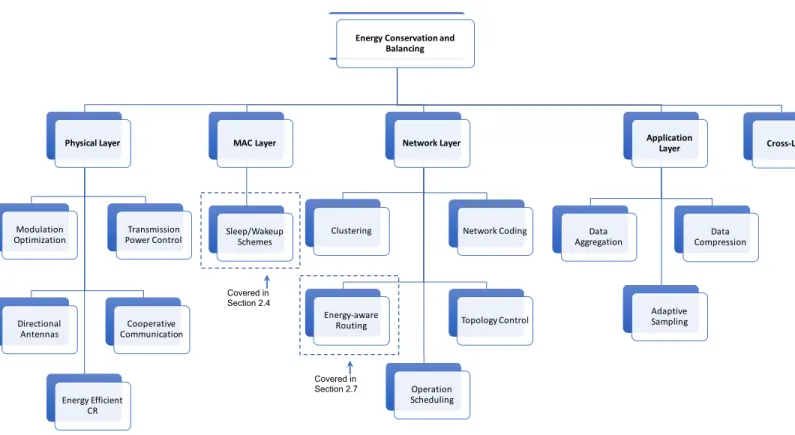
This category covers the most generic and applicable mechanisms; since it does not have the limitations of all other mechanisms. For example; (i) the feasibility of node deployment mechanisms is limited by type of application, cost, and deployment time optimization requirements, (ii) the energy mapping mechanisms is limited by the avail-ability of energy monitoring solutions and network managers to consider network re-configuration possibilities, (iii) the effectiveness of battery charging solutions is limited due to the low conversion efficiency of current energy harvesting techniques. In fact, even when all above mechanisms exist in a WSN, they will not render energy saving and energy consumption balancing techniques unnecessary in the foreseeable future. This category of mechanisms can be further subdivided into five main categories: phys-ical layer, MAC layer, network layer, application layer and cross-layer approaches. Fig-ure 2.4 illustrates the proposed taxonomy.
2.3. Lifetime Maximization in WSN 23
Energy Conservation and Balancing
Physical Layer
Modulation Optimization
Directional
Antennas CommunicationCooperative Transmission Power Control Energy Efficient CR MAC Layer Sleep/Wakeup Schemes Network Layer Clustering Energy-aware
Routing Topology Control
Operation Scheduling Network Coding Application Layer Data
Aggregation CompressionData
Adaptive Sampling Cross-Layer Covered in Section 2.4 Covered in Section 2.7
Figure 2.4: Classification of Energy Conservation and Balancing Schemes.
2.3.4.1 Physical Layer Schemes
A number of physical layer techniques have been proposed by researchers to reduce energy dissipation in the radio module such as modulation optimization, transmission power control, directional antennas, cooperative communication schemes and energy-efficient cognitive radio.
Modulation optimization
This technique is concerned with the optimal modulation parameters that can lead to the minimum energy consumption of the radio. Researchers study the trade-off between the constellation size (number of symbols), the information rate (number of information bits per symbol), the transmission time, the distance between the nodes and the noise [33] [34].
Transmission Power Control (TPC)
ad-justing the radio transmission power based on the distance to next hop node [35] [36]. However, this strategy has other effects on delays, link quality, interference and con-nectivity which should be taken into account when proposing TPC.
Directional antennas
Directional antennas enable signals to be transmitted and received in one direction at a time which enhances transmission range, improves throughput, limit overhearing and require less power for a given range [37] [38]. However, problems such as signal interference, antenna adjustment, and deafness problems have to be addressed [39]. Cooperative communication
These schemes exploit several single-antenna devices which collaborate to create a vir-tual multiple antenna transmitter. They utilize the broadcast nature of the channel to involve the overhearing nodes in the data retransmission in order to combat multi-path fading and shadowing and improve the received signal quality [40]. Researchers show that virtual MIMO (Multiple Input and Multiple Output) systems can provide better energy savings over certain transmission range [41] [42].
Energy-efficient cognitive radio
A cognitive radio (CR) can dynamically select a communication channel and adapt its transmission and reception parameters accordingly. However, due to the increased com-plexity involved in its operation, CR requires significant energy consumption compared with conventional radios [43]. Recent CR studies focus on designing energy-efficient cognitive radio sensor networks which include transmitter power control [44], residual energy-based channel assignment, and combining network coding and CR.
2.3.4.2 Application Layer Schemes
This category of solutions aims at reducing the amount of data to be delivered to the sink through the elimination of unneeded samples and the reduction of sensing tasks. These techniques include data aggregation, data compression, and adaptive sampling.
2.3. Lifetime Maximization in WSN 25
Data aggregation
Using this scheme, nodes perform data fusion to reduce the amount of data forwarded towards the sink. For example, nodes can re-transmit only the average or the minimum of the received data. On the other hand, these techniques may compromise the accuracy of the collected data. A detailed survey of data aggregation techniques can be found in [45] and [46].
Data compression
Data compression aims at improving energy efficiency by reducing the number of bits needed to represent the original message. As the packet size becomes smaller, the transmission time will be reduced. Due to resource limitations of sensor nodes, specific compression techniques are needed which adapt to the computational capabilities of the nodes. Compression algorithms designed for WSNs are surveyed in [47].
Adaptive sampling
This technique is used to eliminate unneeded samples by adjusting the sampling rate at each sensor while ensuring that application needs are satisfied in terms of coverage and information precision. For example, in human activity monitoring applications, the data acquisition frequency can be adjusted in accordance with user activity [48].
2.3.4.3 MAC Layer Schemes
Duty cycling (sleep/wakeup) schemes are employed at MAC layer to save node energy by putting the node radio in low power sleep mode when the node is in an idle state. Duty cycling reduces significantly the energy consumption of sensor nodes as, ideally, it keeps nodes active only when there is network activity. Actually, it is the most effective approach to energy conservation. However, it induces sleep latency as a node must wait for the receiver node to be awake. Protocol parameters such as sleep and active periods can be fixed at the deployment stage for simplicity which also leads to a lack of flexibility. However, these parameters can be dynamically adjusted in order to improve the protocol adaptation to traffic load conditions while optimizing energy savings.
Energy-efficient MAC protocols can be classified into four categories: schedule based, synchronous, asynchronous, and on-demand wakeup protocols.
In our work, we focus on duty cycling schemes which represent the most suitable tech-nique for energy saving. More details of these schemes are provided in the next section.
2.3.4.4 Network Layer Schemes
Many network layer approaches have been proposed in the literature with the main aim of achieving energy efficiency while also ensuring even distribution of the communication load among all sensors so that energy consumption is balanced and network lifetime is maximized. These mechanisms include clustering techniques, energy-aware routing, network coding, operation scheduling, and topology control.
Clustering techniques
Clustering techniques are used to enhance energy efficiency as the transmission power required to communicate with the cluster head (CH) inside the cluster is less. Addition-ally, the number of transmissions is reduced by performing fusion at the CH. Nodes that are members of a cluster are turned-off while the CH is forwarding aggregated packets to other CHs or to the sink node. Moreover, intra-cluster load balancing is achieved by rotating the cluster head role among all sensors within the cluster. Inter-cluster load balancing is achieved by distributing the communication load in different ways so that all CHs consume energy equally. A survey of clustering algorithms proposed for wireless sensor networks can be found in [49]. Clustering techniques generally improve network scalability. However, they are applicable only in dense network deployments and they incur high overhead in the cluster head election and rotation mechanisms. Moreover, since CHs utilize multi-hop communication to send data to the sink, CHs closer to the sink deplete their energy much faster. Unequal clustering addresses this problem by having different cluster sizes according to their location with respect to the sink [50] [51] [52]. Hence, clusters closer to the sink should have a smaller size in order to reduce the intra-cluster communication energy consumption and compensate for the high inter-cluster energy consumption. While CHs farthest away from the sink should
2.3. Lifetime Maximization in WSN 27
have the largest size due to their light inter-cluster load. Although unequal clustering algorithms are good in prolonging network lifetime, they cannot provide full ECB due to the many to one traffic pattern of WSN.
Topology control
This scheme exploits redundancy in nodes deployment and minimizes the number of active nodes in order to prolong the network lifetime while maintaining network oper-ations and connectivity. Nodes that are not required for ensuring connectivity can go to sleep and save energy. Topology control protocols dynamically adapt the network topology based on the application’s requirements and aim to find the optimal subset of nodes that guarantee connectivity.
Topology control techniques manage the transmission power of nodes to construct the required topology. In addition, it deals with the state of the nodes (active or sleeping) and the role of the node (sensing only or sensing and forwarding). Transmission power control aims at optimising a single wireless transmission, whereas topology control is a wider concept that controls the topology of the graph. These mechanisms result in energy inefficiency when nodes in the far field send data on a longer distance to balance load in the network.
Topology control protocols can be classified into location-driven and connectivity-driven protocols. A detailed survey on existing topology control protocols in wireless sensor networks is available in [53] and [54].
Network Coding (NC)
Network coding is a network layer technique to improve transmission efficiency. This technique is used to reduce the traffic in broadcast scenarios. A linear combination of multiple packets is sent instead of sending a copy of each packet. NC exploits the trade-off between computation and communication since communications are slower and more power hungry compared to computations. AdapCode [55] is an example of adaptive network coding protocol where each node sends one message for every N messages received. It enhances reliability by adapting N to the node density to ensure successful recovery of original packets.
Operation scheduling
These mechanisms can be implemented to achieve ECB by sleep scheduling and task assigning according to the level of residual energy in sensor nodes while ensuring the monitoring area is covered [56] [57]. While these mechanisms are good in saving energy, they cannot achieve a full ECB. In addition, the coordination of sleep and operation time is their main issue.
Energy-aware routing
Energy-aware routing algorithms aim at avoiding early power depletion of sensor nodes while making routing decisions. In achieving this goal, routing algorithms should con-sider not only energy efficiency but also the amount of energy remaining in each sensor. As these protocols require frequent updates of residual energy of neighboring nodes, the overhead of message exchange causes energy inefficiency which is the main issue in energy-aware routing mechanisms.
Some of the proposed routing algorithms consider energy as a routing metric in the calculation of the best route and select the next hop based on its residual energy. The key challenge in this technique is the design of the cost function used in the calculation of a link cost.
Other existing approaches utilize computational intelligence techniques such as genetic algorithms, ant colony, bee colony, fuzzy logic, and so on to obtain optimized routing decisions based on energy-related inputs.
An extensive overview of energy-aware routing protocols is available in a number of published survey articles such as [58], and [59].
In addition, multipath routing techniques enable the switching of forwarding nodes in order to balance energy among nodes. Multiple node-disjoint paths are obtained using a cost function, which depends on the energy levels of the nodes, and traffic rate is allocated to each selected path. Multipath routing enhances network reliability and enables the network to recover faster from a failure. A recent survey of multipath routing protocols for WSNs can be found in [60].