Hand Segmentation Using Learning-Based Prediction and
Verication for Hand Sign Recognition
Yuntao Cui and John J. Weng
Department of Computer Science
Michigan State University
East Lansing, MI 48824, USA
E-mail:
fcui,[email protected]Abstract
This paper presents a prediction-and-verication seg-mentation scheme using attention images from multiple xations. A major advantage of this scheme is that it can handle a large number of dierent deformable ob-jects presented in complex backgrounds. The scheme is also relatively ecient since the segmentation is guided by the past knowledge through a prediction-and-verication scheme. The system has been tested to seg-ment hands in the sequences of intensity images, where each sequence represents a hand sign. The experimen-tal result showed a 95% correct segmentation rate with a 3% false rejection rate.
1 Introduction
The ability to interpret hand signs is essential for hu-man machine interface. Recently, there is a signicant amount of research on vision-based hand sign recogni-tion (e.g. [1, 3, 4, 7, 11, 13]). One of the major di-culties faced by the vision-based approach is segmenta-tion of the moving hand from sometimes complex back-grounds. To avoid the above problem, some of the sys-tems rely on markers. The others use restrictive setups such as uniform background.
In this paper, we present a learning-based approach to perform the task of hand segmentation. In the case of analyzing temporal sequence, motion is an obvious choice of visual cue for visual attention. If we assume that the object of interest is moving in a stationary en-vironment, it is not very dicult to roughly determine the position of a moving object in the image using mo-tion informamo-tion. However, it is not simple if the task is to extract the contour of the object from various back-grounds. Several motion segmentation methods have been proposed. These approaches fall into two cate-gories. Approaches in the rst category are designed to deal with rigid moving objects (e.g. [2, 8]). This type of approaches achieves a segmentation by either
build-ing a reference image of the static background [8], or extracting the motion entity based on 3-D motion mod-els or 2-D velocity-eld modmod-els [2]. The second type of approaches t a shape to deformable moving objects (e.g. [9]). These models typically need a good initial position to converge. They also need a relatively clean background since the external forces are dened by the image gradient.
In order to overcome the diculties faced by the seg-mentation methods for deformable objects mentioned above, we have proposed an eigen-subspace learning ap-proach [5]. In that apap-proach, the object was assumed to position in a rectangular attention image together with the background. The attention image went through a reconstruction based on learning which can reduce the background interference to a certain degree. However, the reconstruction is not able to fully get rid of the background interference.
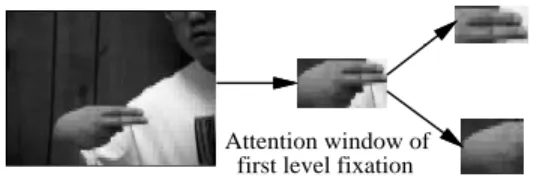
Input image
Attention window of first level fixation
Attention windows of second level fixations
Figure 1: An illustration of two level xations of an input hand image.
One attention window from a single xation can not solve the segmentation problem completely. Similar to human vision, multiple xations are needed. This kind of multiple xations has a hierarchal structure. As shown in Fig. 1, the rst level of the xation concen-trates on the entire hand, while the next level of the xation takes care of dierent parts of the hand. The attention window of the rst level xation usually con-tains a part of the background. But as we continue zooming in the object from dierent xations, the
at-tention windows become focusing on dierent parts of the object. One important feature of these attention windows is that they typically contain much less back-ground than the attention window of the rst level x-ation. These attention images from multiple xations can be used as important visual cues to segment the object of interest from the input image. In this paper, we present a learning-based approach which eciently utilizes the attention images obtained from the multiple xations through a prediction-and-verication scheme to perform the task of hand segmentation.
2 Valid Segmentation
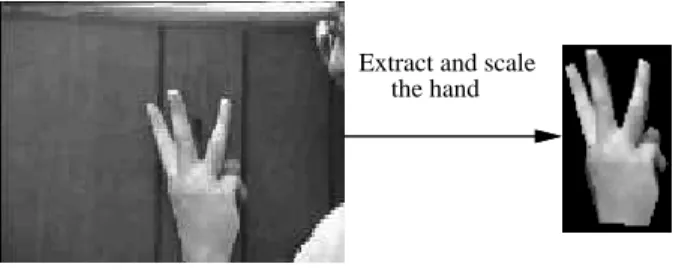
In this section, we dene the verier f to evaluate the segmentation using function interpolation based on training samples. Given an input image, we can con-struct an attention image of the hand as shown in Fig. 2.
Input image Attention image Extract and scale
the hand
Figure 2: The illustration of constructing attention images.
2.1 The Most Expressive Features (MEF)
Let an attention image F of m rows and n columns be an (mn)-dimensional vector. For example, the set of image pixels ff(i;j) j 0 i < m;0 j < ng
can be written as a vector
V
= (v1;v2;;vd) where
vmi+j = f(i;j) and d = mn. Typically d is very
large. The Karhunen-Loeve projection [12] is a very ecient way to reduce a high-dimensional space to a low-dimensional subspace. The vectors produced by the Karhunen-Loeve projection are typically called the prin-ciple components. We call these vectors the most ex-pressive features(MEF) in that they best describe the sample population in the sense of linear transform [4].
2.2 Approximation as Function
Interpola-tion
After projecting hand attention images to a low-dimensional MEF space, we are now ready to approxi-mate the verier f using function interpolation.
Denition 1
Given a training vectorX
k;i of gesturek in the MEF space, a Gaussian basis function si is
si(
X
) = e? kX?Xk;i k
2
, whereis a positive damping
fac-tor, and kkdenotes the Euclidean distance.
A very small tends to reduce the contribution of neighboring training samples.
Denition 2
Given a set of n training samples Lk =f
X
k; 1;X
k;2;;
X
k;ngof gesture k, the condence levelof the input
X
belongs to classkis dened as: gk(X
) =Pn
i=1cisi(
X
), where the si is a Gaussian basisfunc-tion and the coecientsci's are to be determined by the
training samples.
The coecients ci's are determined as follows. Given
n training samples, we have n equations gk(
X
k;i) =Xni=1
cisi(
X
k;i); (1)which are linear with respect to the coecients ci's. If
we set gk(
X
k;i) equal to 1, we can solve the aboveequa-tions for ci using Gauss-Jordan elimination method.
The condence level dened in Denition 2 can be used to verify a segmentation result.
Denition 3
Given a segmentation resultS
and a con-dence levell, the verierf outputs valid segmentation for gesture kif gk(S
) > l.Intuitively, a segmentation result
S
is valid if there is a training sample that is suciently close to it.3 Predication for Valid Segmentation
This section investigates the problem how to nd a valid segmentation. Our approach is to use the atten-tion images from multiple xaatten-tions of training hand im-ages. Given a hand attention image, a xation image is determined by its xation position (s;t) and a scale r. Fig. 3 shows the attention images of the 19 xations from one training sample.
Figure 3: The attention images from 19 xations of a training sample. The rst one is the same as the original hand attention image.
3.1 Overview
Given a training set, we obtain a set of attention images from multiple xations for each image in the set. Each attention image from a xation is associated with the segmentation mask of original hand attention image, the scale r and the position of the xation (s;t). These information is necessary to recover the segmentation for the entire object.
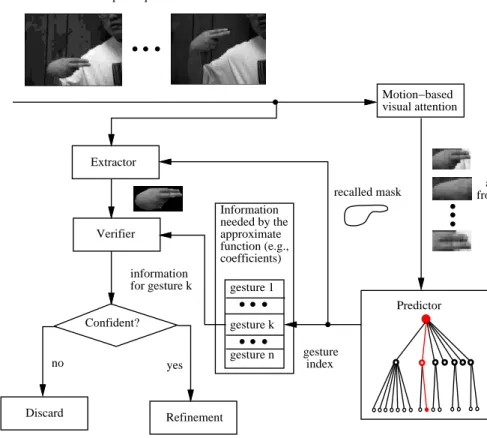
During the segmentation stage, we rst use the mo-tion informamo-tion to select visual attenmo-tion. Then, we
try dierent xations on the input image. An atten-tion image from a xaatten-tion of an input image is used to query the training set. The segmentation mask as-sociated with the query result is the predication. The predicted segmentation mask is then applied to the in-put image. Finally, we verify the segmentation result to see if the extracted subimage corresponds to a hand gesture that has been learned. If the answer is yes, we nd the solution. This solution can further go through a renement process. Fig. 4 gives the outline of the scheme.
3.2 Organization of Attention Images from
Fixations
In order to achieve a fast retrieval, we build a hier-archical structure to organize the data.
Denition 4
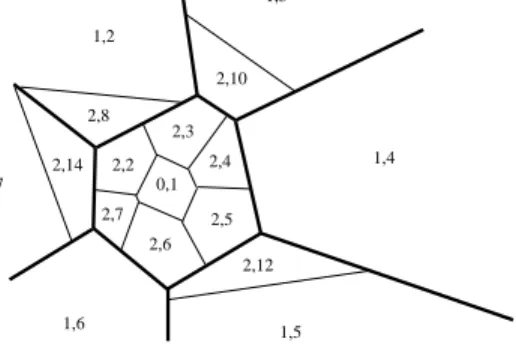
A hierarchical quasi-Voronoi diagram Pof S is a set of partitions P =fP 1;P2; ;Pmg, where every Pi = fPi; 1; ;Pi;n i g, i = 1;2;;m is a par-tition of S. Pi+1 = fPi +1;1; ;Pi +1;n i+1 g is a ner
Voronoi diagram partition of Pi in the sense that
cor-responding to every element Pi;k 2Pi,Pi
+1 contains a Voronoi partition fPi +1;s; ;Pi +1;t gofPi;k. 0,1 1,2 1,3 1,4 1,5 1,6 1,7 2,2 2,3 2,4 2,5 2,6 2,7 2,8 2,10 2,14 2,12
Figure 5: A 2-D illustration of a hierarchical quasi-Voronoi diagram.
The graphic description in Fig. 5 gives an simpli-ed but intuitive explanation of the hierarchical quasi-Voronoi diagram. The structure is a tree. The root corresponds to the entire space of all the possible in-puts. The children of the root partition the space into large cells, as shown by thick lines in Fig. 5. The chil-dren of a parent subdivide the parent's cell future into smaller cells, and so on.
3.3 Prediction as Querying the Training
Set
Given a training set L, a hierarchical quasi-Voronoi diagram P = fP
1;P2;
;Png corresponding to L and
a query sample
X
, the prediction problem is to nd a training sampleX
0 2L, such thatkX
?X
0 kkX
?X
00 k for anyX
00 2L withX
00 6=
X
0. The type of querymen-tioned above is a nearest neighbor problem, also known
as post-oceproblem [10]. There still lacks of ecient solutions for the case with dimension higher than three. In this section, we will present an ecient algorithm when the training set is d-supportive as dened below.
Denition 5
LetS be a set which contains all possible samples. A training set L = fL1;L2;
;Lng is a d
-supportive training set if for any test sample
X
2 S,there exist i such that k
X
?Lik< d, wherekkis theEuclidean distance.
Next two theorems show how to prune the search pathes when the training set is d-supportive.
Theorem 1
We have a set of d-supportive training setL = fL 1;L2;
;Lng, a hierarchical quasi-Voronoi
di-agram P =fP 1;P2;
;Png corresponding toL and a
query sample
X
2 S. Let the ith partition be Pi = fPi; 1;Pi;2; ;Pi;n i gand C = fC 1;C2; ;Cn i gbe thecorresponding centers of regions in Pi. Assume C1 be
the center to
X
such thatkC 1?
X
kkCi?X
kfor anyi6= 1. LetC
2 be any other center andP1 be a boundary
hyperplane between regions represented byC1and C2as
illustrated in Fig. 6. Then the region of C2 does not
contain the nearest training sample to
X
if the distance betweenX
and the hyperplane P1 is greater thand.d a b e f boundary hyperplane M P1 P2 m C 1 C2 X
Figure 6: A 2D illustration of nearest neighbor query theo-rems.
In order to avoid to calculate the point to hyperplane distance in a high dimensional space, we can use follow-ing equivalent theorem.
Theorem 2
Let kC 1 ?C 2 k = r, f = r 2, e = r 2 ?d, kC 1 ?X
k= a and kC 2 ?X
k= b as shown in Fig. 6.The region of C2 does not contain the nearest training
sample to
X
ifa2 ?e2< b2 ?f
2.
For the proof Theorem 1 and Theorem 2, the reader is referred to [6].
4 Experiments
We have applied our segmentation scheme to the task of hand segmentation in the experiments. The number of gestures we used in our experiment is 40. These ges-tures have appeared in the signs which have been used
input sequence yes no Motion−based visual attention Predictor attention images from multiple fixations recalled mask gesture index information for gesture k Information needed by the approximate function (e.g., coefficients) gesture 1 gesture n gesture k Extractor Refinement Verifier Discard Confident?
Figure 4: Overview of the segmentation scheme.
to test the hand sign recognition system [4]. They are illustrated in Fig. 7. The size of attention window used in the experiment is 3232 pixels.
Figure 7: 40 hand gestures used in the experiment.
4.1 Training
Two types of training were conducted in the exper-iments. The rst type of training is to get the ap-proximation for verier f which would be used later to check the validation of the segmentation. For each gesture, a number between (27 and 36) of training
sam-ples were used to obtained the approximation of the verier f for that gesture. Given a set of training sam-ples L =f
X
1;
X
2;;
X
ngfor gesture k, we empiricallydetermined the damping factor in the interpolation function as follows: = 0:2 Pn ?1 i=1 k
X
i?X
i +1 k n?1 : (2)The second type of training was to generate the at-tention images from multiple xations of training sam-ples. In the current implementation, the selection of the xations is mechanical. Totally 19 xations were used for each training sample as shown in Fig. 3. The at-tention images with more than 30% background pixels presented in the attention window would be discarded. The total number of training attention images is 1742.
4.2 Hand Segmentation
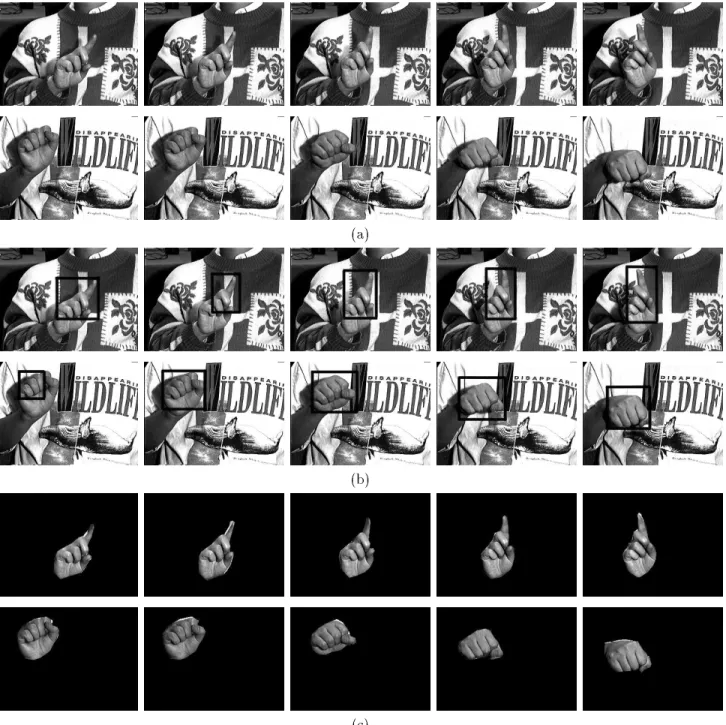
The trained system was tested to perform the seg-mentation task from a temporal sequence of intensity images. Each sequence represents a complete hand sign. Fig. 8 (a) shows two sample sequences.
In order to speed up the process of the segmentation, we utilize motion information to nd a motion attention window. The attention algorithm can detect the rough
(a)
(b)
(c)
Figure 8: The samples of the experimental results. (a) The input testing sequences; (b) The results of motion-based visual attention are shown using dark rectangular; (c) The results of the segmentation are shown after masking o the background.
position of a moving object, but the accuracy is not guaranteed as shown in Fig. 8(b). We solve this prob-lem by doing some limited search based on the motion attention window. In the current implementation, given a motion attention window with m rows and n columns, we try the candidates with size from (0:5m;0:5n) to (2m;2n) using step size (0:5m;0:5n).
We tested the system with 802 images (161 se-quences) which were not used in the training. A result was rejected if the system could not nd a valid seg-mentation with a condence level l. The segseg-mentation was considered as a correct one if the correct gesture segmentation
C
was retrieved and placed in the right position of the test image. For the case of l = 0:2, we have achieved 95% correct segmentation rate with 3% false rejection rate. Fig. 8(c) shows some segmenta-tion results. We summarize the experimental results in Table 1. The time was obtained on a SGI-INDIGO 2 workstation.Table 1: Summary of the experimental data
Number of Correct False Time
test images segmentation rejection per image
805 95% 3% 58.3 sec.
5 Conclusions and Future Work
A segmentation scheme using attention images from multiple xations is presented in this paper. The ma-jor advantage of this scheme is that it can handle a large number of dierent deformable objects presented in various complex backgrounds. The scheme is also relatively ecient since the search of the segmentation is guided by the past knowledge through a predication-and-verication scheme.
In the current implementation, the xations are gen-erated mechanically. The number of xations and the positions of xations are the same regardless of the types of gestures. This is not very ecient. Some gestures may be very simple so that a few xations are enough to recognize them. Nevertheless, in order to achieve the optimal performance, dierent gestures may require dif-ferent positions of xations. In the future, we plan to investigate the generation of the xations also based on learning. The previous xations are used to guide the next action. The next action could be (a) termination of the process of generating xation if the gesture has already been recognized; or (b) nding the appropriate position for next xation.
Acknowledgements
The authors would like to thank Yu Zhong, Kal Rayes, Doug Neal, and Valerie Bolster for making them-selves available for the experiments. This work was
sup-ported in part by NSF grant No. IRI 9410741 and ONR grant No. N00014-95-1-0637.
References
[1] A. Bobick and A. Wilson, \A state-based technique for the summarization and recognition of gesture", inProc. 5th Int'l Conf. Computer Vision, pp. 382-388, Boston, 1995.
[2] P. Bouthemy and E. Francois, \Motion segmenta-tion and qualitative dynamic scene analysis froman image sequence", inInternational Journal of Com-puter Vision, vol. 10, pp. 157-182, 1993.
[3] R. Cipolla, Y. Okamoto and Y. Kuno, \Robust structure from motion using motion parallax", in
IEEE Conf. Computer Vision and Pattern Recog., pp. 374-382, 1993.
[4] Y. Cui, D. Swets and J. Weng, \Learning-based hand sign recognition using SHOSLIF-M", inProc. 5th Int'l Conf. Computer Vision, pp. 631-636, Boston, 1995.
[5] Y. Cui and J. Weng, "2D object segmentation from fovea images based on eigen-subspace learning" ,
Proc. IEEE Int'l Symposium on Computer Vision, Coral Gables, FL, Nov. 20-22,1995.
[6] Y. Cui and J. Weng, \A learning-based prediction-and-verication segmentation scheme for hand sign image sequences", Technical Report CPS-95-43, Computer Science Department, Michigan State University, Dec., 1995.
[7] T. Darrell and A. Pentland, \Space-time ges-tures", inIEEE Conf. Computer Vision and Pat-tern Recog., pp.335-340, 1993.
[8] G. W. Donohoe, D. R. Hush and N. Ahmed, \Change detection for target detection and clas-sication in video sequences", inProc. Int'l Conf. Acoust., Speech, Signal Processing, pp. 1084-1087, 1988.
[9] M. Kass, A. Witkin and D. Terzopoulos, \Snakes: active contour models", inProc. 1st ICCV, pp. 259-268, 1987.
[10] D. Knuth,The Art of Computer Programming III: Sorting and Searching, Addison-Wesley, Reading, Mass., 1973.
[11] J. J. Kuch and T. S. Huang, \Vision based hand modeling and tracking", in Proc. International Conference on Computer Vision, June, 1995. [12] M.M. Loeve, Probability Theory, Princeton, NJ:
Van Nostrand, 1955.
[13] T.E. Starner and A. Pentland, \Visual recognition of American sign language using hidden markov models", inProc. International Workshop on Auto-matic Face- and Gesture- Recognition", June 1995.