Ko¸c University
Electrical and Computer Engineering
Graduate Student Resource Guide
Contents
College of Engineering 1
The Graduate Program 2
Facts on Graduate Alumni 3
Success Stories 4
Research Areas 6
Research Laboratories 7 Active Research Projects 8
Degree Requirements 9
Faculty 10
Recent Graduates 30
Admission 60
Financial Aid 61
For More Information 62
College of Engineering
1
This year marks the tenth anniversary of Ko¸c Engineering as the College of Engineering has admittedfirst freshman class in the 1999-2000 academic year. In 10 years, Ko¸c Engineering has become one of the most dynamic and strongest engineering colleges in Turkey. Our faculty size has reached 43 and is continuing to grow in order to further expand our impact on Turkish higher education, as well as academic and industrial research scene. Our faculty members are among the world leaders in their respective research areas and have come to Ko¸c Engineering with significant post-doc, academic and/or industrial experience from the best institutions worldwide.
Our graduate education and research mission is to create new knowledge in order to advance the state of the art in engineering internationally and to stimulate development of innovative technologies of high societal impact for Turkey. Ko¸c Engineering has the best faculty and laboratory resources in Turkey for exploring and learning together. We invite you to join us in this journey to frontiers of science, engineering, and technology for the future.
Sincerely,
Prof. Dr. A. Murat Tekalp Dean of Engineering
The Graduate Program
2
Quest for scientific knowledge, learning new technologies, performing cutting edge research in engi-neering requires high quality graduate education. Turkish industry’s growing interest to compete with technologically advanced industries worldwide has increased the demand for skilled engineers who can develop and manage new technologies. Recognizing this need our M.S. program is established to pre-pare the future engineering leaders who can acquire, synthesize and apply interdisciplinary scientific knowledge to expand the technological foundations of their professions, to better serve the needs of the nation and improve the quality of life in general. The M.S. program is designed to foster applied engineering research in selected critical areas, which can stimulate innovative technologies, and have a beneficial impact on the Turkish industry and economy at large.
Our M.S. program is a two-year program with thesis and the medium of instruction is English. The potential opportunities for graduates of these programs are diverse and include:
• employment in private and government organizations where they can provide the necessary technical expertise and leadership for development, application and management of technology,
• starting new business ventures in technology innovation and commercialization,
• continuing their graduate experience with the best Ph.D. programs worldwide.
Ph.D. programs emphasize the discovery of new scientific knowledge through extensive research ex-perience. Doctorate studies have the proper time frame to produce competitive research results and educate the future leaders of the profession. Potential opportunities for graduates of this program include academic careers worldwide, leadership positions in research and development organizations, and starting business ventures for commercialization of the new technologies.
Applicants to the Ph.D. programs must have a B.S. or M.S. degree in a related area (for specific information, we refer to the websites of the programs you are interested in). Applicants with degrees in other disciplines may be required to take a small number of undergraduate courses to cover deficiencies in their background.
• Doctor of Philosophy (Ph.D.) in Electrical and Electronics Engineering
The Ph.D. program in Electrical Engineering aims to provide advanced education and a cutting edge research experience in electrical and electronics engineering, or in electrical and computer engineering crossing the boundary of the two disciplines. The focus of this program is excellence in research. Graduates of the program can join industry or continue to work in academia.
• Doctor of Philosophy (Ph.D.) in Computer Engineering
The Ph.D. program in Computer Engineering aims to provide advanced education and a cutting edge research experience in computer engineering or in electrical and computer engineering crossing the boundary of the two disciplines. The focus of this program is excellence in research. Graduates of the program can join industry or continue to work in academia.
• Master of Science (M.S.) in Electrical and Computer Engineering
The M.S. program in Electrical and Computer Engineering aims to provide advanced education and a cutting edge research experience in one of electrical engineering, or computer engineering, or in electrical and computer engineering crossing the boundary of both disciplines. The focus of this program is excellence in research. Graduates of the program can join industry or continue their research careers in one of Ph.D. in Electrical Engineering or Ph.D. in Computer Engineering programs.
Facts on Graduate Alumni
3
• Since 2003, we have 70 MS and 8 PhD graduates.
• A significant tier (49%) of our MS graduates pursue PhD at the top universities of North America and Europe.
• A significant tier (75%) of our PhD graduates continue their academic careers at competing universities as faculty and post-doctoral researcher.
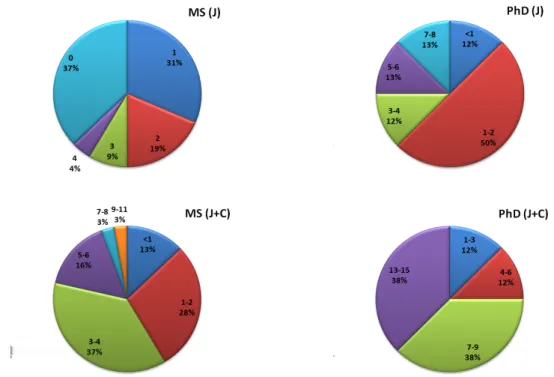
Figure 2: Destination statistics for MS and PhD graduates.
• Our MS graduates have outstanding publication records with average conference and journal publication counts of 1.93 and 1.11, respectively.
• Our PhD graduates have outstanding publication records with average conference and journal publication counts of 6.38 and 2.75, respectively.
Success Stories
4
Tanır ¨Oz¸celebi
Ph.D. Ko¸c University, 2007
“My Ph.D. study at Ko¸c University Graduate School provided me with a top-quality international research and education envi-ronment, allowing me to grow as an independent and competent scholar. Having access to modern laboratory equipment and excel-lent research facilities in combination with endless support from worldwide renowned academics was a great experience. Ko¸c
Uni-versity plays significant roles in internationally funded research projects, where graduate students gain knowledge and get to meet experts from academy and industry on a regular basis.” Assist. Prof. Tanır
¨
Oz¸celebi, Eindhoven University of Technology C¸ a˘glar Ataman
Ph.D. Ko¸c University, 2008 M.S. Ko¸c University, 2004
“Doktora e˘gitimi bir bilim insanının kariyeri boyunca gereksinim duyaca˘gı ara¸stırma y¨ontem ve alı¸skanlıklarını edindi˘gi, bir nevi kendi alet ¸cantasını olu¸sturdu˘gu, belki de akademik hayatın en ¨onemli evresidir. S¨urekli daha karma¸sı˘ga ve yetkine do˘gru hızla evrilen ve bu s¨ure¸cte kendini durmaksızın yeniden ¨ureten k¨uresel bilim ortamında her an en u¸cta kalabilmek bu ¸cantadaki gere¸clerin kalitesine dayanır. Sonrasındaki tecr¨ubelerime dayanarak, Ko¸c ¨
Universitesi’ndeki doktora e˘gitimimin bana iyi bir bilim insanı olabilmek i¸cin gerekli t¨um teorik ve pratik yetenekleri kazandırmı¸s oldu˘gunu s¨oyleyebilirim. Ortak projeler ve kısa s¨ureli akademik zi-yaretler yoluyla, bana daha hen¨uz y¨uksek lisansımın ilk yılından ba¸slayarak altı yıl boyunca alanımın en ¨
onde gelen bilim insanlarıyla ortak ¸calı¸sma fırsatını sunan tez danı¸smanım sayesinde de, bu yetenek-lerin d¨unyanın her yerinde etkin bir ¸sekilde kullanılabileceklerinin ayırdına vardım. Bu farkındalı˘gın a¸ctı˘gı yolda y¨ur¨urken Ko¸c tecr¨ubelerimi yanımda ta¸sımaktan memnuniyet duyuyorum.” C¸ a˘glar Ata-man, Postdoctoral Research Associate, EPFL
Ferda Ofli
Ph.D. Ko¸c University, 2010
“Having completed both my undergraduate and graduate studies at Ko¸c University, I can say confidently that Ko¸c University pro-vided me with everything I would want from a university: livable campus, strong faculty, solid educational background and sophisti-cated research atmosphere. Having attended several international conferences and workshops during my PhD study, not only was I motivated and rewarded for my work, but I also got exposed to
the vast world of science and engineering. Thanks to unfailing guidance and support of my exceptional advisors from whom I have learned much more than just science, I have become a self-confident and enthusiastic researcher. Besides seeking excellence in scientific education and research, Ko¸c Univer-sity cherishes also the quality of its students’ life by offering them extra benefits and high-standard facilities such as lodging, transportation, etc.; knowing that living a happy life is crucial for having a successful career. And, I have lived a truly happy life at Ko¸c University!” Ferda Ofli, Postdoctoral Research Associate, UC Berkeley, USA
Success Stories
5
Tayfun ElmasPh.D. Ko¸c University, 2010
“Ko¸c University created from a passionate coder a world-class researcher. Prof. Serdar Ta¸sıran was not only an advisor but also a life coach to me; his expe-rience, understanding, and patience added considerably to my experience at Ko¸c University. I must give immense gratitude to all faculty and staff for helping me in adapting intensive academic research.” Tayfun Elmas, Postdoc-toral Researcher, The Parallel Computing Laboratory (ParLab), UC Berkeley, USA
Emrah Akyol
M.S. Ko¸c University, 2005
“Ko¸c University is world renowned with a fascinating research atmosphere. My studies of scalable video compression with Prof. Tekalp was a truly remark-able experience. I owe my enthusiasm and success in research to my time at Ko¸c.” Emrah Akyol, Postdoctoral Research Associate, UC Santa Barbara, USA
Serhan I¸sıkman
M.S. Ko¸c University, 2008
“Halen doktora d¨uzeyinde devam etti˘gim Elektrik ve Elektronik m¨uhendisli˘gi e˘gitimimin lisans ve y¨uksek lisans derecelerini Ko¸c ¨Universitesi’nde tamam-ladım. Alanında lider niteli˘gindeki ara¸stırmacıları kadrosunda bulundurması ve ¨o˘grencilerine lisans seviyesinden ba¸slayarak ¨ust d¨uzey ara¸stırma laborat-uarlarında ¸calı¸sma fırsatı veriyor olması ile Ko¸c ¨Universitesi ¸cok ayrıcalıklı bir m¨uhendislik e˘gitimine sahip. Bu sayede ben de Optik Mikrosistemler Laboratuarında altı yıl boyunca Prof. Dr. Hakan ¨Urey ile birlikte ¸calı¸sma
fırsatı yakaladım. Lisans d¨oneminde kazanmı¸s oldu˘gum ivme sayesinde, ¸cok verimli ve kendimi hızla geli¸stirebildi˘gim bir y¨uksek lisans s¨ureci ge¸cirdi˘gimi d¨u¸s¨un¨uyorum. Dr. Urey ile end¨¨ ustri ve ¨universiteleri bulu¸sturan uluslar arası projelerde ¸calı¸sarak edindi˘gim tecr¨ube ve ¸cok uluslu takım ¸
calı¸sması becerisi, bug¨un i¸cerisinde bulundu˘gum uluslar arası ara¸stırma ortamında kendimi daima ¨
onc¨u hissetmemde, kolaylıkla sorumluluk almamda ve duydu˘gum ¨ozg¨uvende ¸cok b¨uy¨uk rol oynuyor.” Serhan I¸sıkman, Ph.D. Student, UCLA
H. Ertan C¸ eting¨ul
M.S. Ko¸c University, 2005
“Ko¸c University has become a well-recognized institution and benchmark in graduate study by offering a truly remarkable research environment. At Ko¸c, not only did I learn how to do proper research, but I also had the opportunity to contribute in the field of biometrics with my work on audiovisual speaker iden-tification. In total, I am honored to be a Ko¸c alumnus.” H. Ertan C¸ eting¨ul, Ph.D. candidate in Biomedical Engineering at Johns Hopkins University, Bal-timore MD, USA
Research Areas
6
Communications Alper Demir, Alper Erdo˘gan, Sinem C¸ ¨oleri Er-gen, ¨Ozg¨ur Barı¸s Akan, Serdar Kozat
Computational Biology & Bioinformatics Attila G¨ursoy, Serdar Ta¸sıran, Deniz Yuret Computational EM, Waves and Optics Hakan ¨Urey, ˙Ir¸sadi Aksun, Alper Demir,
Al-phan Sennaro˘glu
Computer Graphics Y¨ucel Yemez
Concurrent systems: Multi-threaded soft-ware, multi-core systems
Serdar Ta¸sıran, Alper Demir, Attila G¨ursoy, ¨
Oznur ¨Ozkasap Cryptography, Security and Privacy Alptekin K¨up¸c¨u Design Technologies for Hardware,
Soft-ware and Biological Systems
Alper Demir, Serdar Ta¸sıran
Digital Signal Processing Murat Tekalp, Engin Erzin, Alper Erdo˘gan, Serdar Kozat, ¨Ozg¨ur Barı¸s Akan
Distributed & Parallel Computing Attila G¨ursoy, ¨Oznur ¨Ozkasap
Image Processing & Computer Vision Y¨ucel Yemez, Murat Tekalp, Tevfik Metin Sezgin
Information Theory Ozg¨¨ ur Barı¸s Akan Integrated Circuits and Computer-Aided
Design for VLSI
Alper Demir
Intelligent Systems & Machine Learning Tevfik Metin Sezgin, Deniz Yuret, Engin Erzin Micro & Nano Systems (MEMS & NEMS) Hakan ¨Urey, ¨Ozg¨ur Barı¸s Akan
Multimedia & Networking Murat Tekalp, ¨Oznur ¨Ozkasap, ¨Ozg¨ur Barı¸s Akan
Multimedia Signal Processing Murat Tekalp, Engin Erzin, Y¨ucel Yemez, Tevfik Metin Sezgin
Nanoscale and Molecular Communications Ozg¨¨ ur Barı¸s Akan
Natural Language Processing Deniz Yuret, Engin Erzin, Serdar Kozat, Tev-fik Metin Sezgin
Peer-to-Peer Systems and Network Proto-cols
Sinem C¸ ¨oleri Ergen, ¨Oznur ¨Ozkasap, Alptekin K¨up¸c¨u
Secure Cloud Services Alptekin K¨up¸c¨u Software Engineering: Reliability,
Analy-sis, Verification
Serdar Ta¸sıran
Speech Processing Engin Erzin
Underwater Acoustic Communications Ozg¨¨ ur Barı¸s Akan Wireless Communications Ozg¨¨ ur Barı¸s Akan Wireless Networks Sinem C¸ ¨oleri Ergen
Research Laboratories
7
• Molecular Engineering and Biotechnology Research Center http://bioparc.ku.edu.tr, Hakan ¨Urey
• Computational Systems Biology Group (COSBI)
http://prism.ccbb.ku.edu.tr/cosbi, Attila G¨ursoy, ¨Ozlem Keskin
• Multimedia, Vision & Graphics Laboratory (MVGL)
http://mvgl.ku.edu.tr, A. Murat Tekalp, Engin Erzin, Y¨ucel Yemez, Metin Sezgin
• Optical Microsystems Laboratory (OML)
http://mems.ku.edu.tr, Hakan ¨Urey, Erdem Alaca
• Micro-Nano Fabrication Laboratory (Clean room) http://home.ku.edu.tr/˜ealaca/links.html,
B. Erdem Alaca, Hakan ¨Urey, Can Erkey, Alper Kiraz, Alphan Sennaro?lu
• Wireless Communications and Networks Laboratory Sinem C¸ ¨oleri Ergen
• Wireless Vehicular Networks Laboratory Sinem C¸ ¨oleri Ergen
• Center for Advanced Design Technologies
http://home.ku.edu.tr/˜designtech, Alper Demir, Lerzan ¨Ormeci, Serdar Ta¸sıran
• Intelligent User Interfaces Laboratory http://iui.ku.edu.tr, Metin Sezgin
• Networked and Distributed Systems Laboratory (NDSL)
http://ndsl.ku.edu.tr, ¨Oznur ¨Ozkasap, A. Murat Tekalp, Sinem C¸ ¨oleri Ergen
• Next-generation Wireless Communications Laboratory (NWCL) http://nwcl.ku.edu.tr, ¨Ozg¨ur Barı¸s Akan
• Koc University Photonics Research Center http://storage.ku.edu.tr/˜photonicscenter,
Alper Demir, Alper Erdo˘gan, Alphan Sennaro˘glu, Hakan ¨Urey, ˙Ir¸sadi Aksun
• Advanced Signal Processing and Communications Group http://portal.ku.edu.tr/˜aspc, Alper Erdo˘gan
• Cryptography, Security, and Privacy Research Group (CRYPTO) http://crypto.ku.edu.tr, Alptekin K¨up¸c¨u
• Next Generation Adaptive Signal Processing Laboratory (NGASPL) http://ngaspl.ku.edu.tr, Serdar Kozat
Active Research Projects
8
• Intra-Vehicular Wireless Sensor Networks, Sinem C¸ ¨oleri Ergen, Marie Curie International Rein-tegration Grants, 100000EUR, 2010-2014
• SARACEN, Murat Tekalp, EC - FP7, 314698EUR, 2010-2012
• DIOMEDES, Murat Tekalp, EC - FP7, 401440EUR, 2010-2012
• Bologna Translation Service, Deniz Y¨uret, EC - FP7, 409466EUR, 2011-2013
• HELIUM3D 3-D Laser Display Development, Hakan ¨Urey, European Commission, 350000EUR, 2008-2011
• MEMFIS Portable MEMS Spectrometer Development, Hakan ¨Urey, European Commission, 350000EUR, 2008-2011
• 3D Dense Shape Correspondence in Sequential Surface Meshes, Y¨ucel Yemez, T ¨UB˙ITAK, 113110TL, 2010-2012
• A new model for representing protein-protein interaction networks, Attila G¨ursoy, T ¨UB˙ITAK, 118080TL, 2010-2012
• Do˘gal Dil ˙I¸slemede Kelime Anlam ve Anlamsal ˙Ili¸skilerinin ˙Istatistiksel Dil Modelleri Kullanarak Belirlenmesi, Deniz Y¨uret, T ¨UB˙ITAK, 137911TL, 2009-2012
• Vision-based Multimodal Intelligent User interfaces, T. Metin Sezgin, T ¨UB˙ITAK Career Award, 242956TL
• NanoCom: Nano-scale and Quantum Communication Networks, ¨Ozg¨ur Barı¸s Akan, T ¨UB˙ITAK EEEAG, 208750TL, 2010-2013
• Energy Efficiency in Peer-to-Peer Network Services, ¨Oznur ¨Ozkasap, T ¨UB˙ITAK COST, 182930TL, 2010-2013
• Microvision Research Project 7, Hakan ¨Urey, MICROVISION INC., 271186USD 2010-2012
• Speech Driven Upper Body Animation, Engin Erzin, T¨urk Telekom, 198000TL, 2010-2013
• Sketch-Based Intelligent Interfaces, T. Metin Sezgin, T¨urk Telekom, 198000TL, 2010-2013
Degree Requirements
9
Ph.D. programs: Students can apply to the Ph.D. programs with a B.S. or M.S. degree. The Ph.D.degree requires successful completion of 14 courses beyond the B.S. degree or 7 courses beyond the M.S. degree. All students must pass the Ph.D. Qualifying Examination in the first year after they have been admitted to the Ph.D. program. Students are encouraged to begin research early. Students who have passed the Ph.D. qualifying examination are assisted in matters pertaining to their thesis research by a faculty thesis advisory committee. The research advisor serves as the chair of this committee. The committee meets with the student at least once each semester. Ph.D. students must submit a satisfactory written Ph.D. thesis proposal in their second year of study. At the completion of the Ph.D. research, the students must submit a written Thesis and pass an oral defense to complete the degree requirements.
In addition to the two courses listed below, students in this program can take any of the courses listed under the “MS in Electrical and Computer Engineering” program or under other graduate programs subject to the approval of their advisors in accordance with their research specialty.
• ECOE 581 - Selected Topics in Electrical Engineering
• ECOE 695 - Ph.D. Thesis
M.S. program: Applicants must have B.S. or B.A. degrees preferably in engineering or in sciences relevant to the particular degree program. In addition to course work, students are engaged in thesis research or projects. Every student is supervised by an advisor. The M.S. Program with Thesis option requires that the students successfully complete a minimum of 21 credits (or 7 courses) beyond a Bachelor’s degree. The students are required to enroll in the M.S. Thesis course. At the completion of the M.S. Thesis, the students have to submit a thesis and pass an oral defense to complete the degree requirements.
Students in the M.S. in Electrical and Computer Engineering program must select at least four (4) courses in one of the following three core lists: Electrical Engineering Core, Computer Engineering Core, or Electrical and Computer Engineering Core. The remaining three (3) courses can be selected from one of these lists or from other graduate courses not listed in one of these lists subject to the approval of their advisors in accordance with their research specialty. In addition, each student has to register for a seminar course, ECOE 590 Seminar. Students working towards their thesis must register for ECOE 595 M.S. Thesis, and students enrolled in non-thesis option should register for ECOE 591 Project.
Faculty
11
¨
ozg¨
ur barı¸
s akan
Associate Professor Department of Electrical and Electronics Engineering Ph.D. Georgia Institute of Technology
http://home.ku.edu.tr/˜akan [email protected]
Ozgur B. Akan’s research interests span a wide spectrum of problem domains mainly in communications and network-ing. More specifically, Dr. Akan’s current research inter-ests are in next-generation wireless (NG) communications, cognitive radio, nanoscale, molecular, and quantum com-munications, sensor networks, satellite and space commu-nications, underwater commucommu-nications, signal processing, multimedia communications, information theory.
The vision of NG wireless communications is built around the primary goal of enabling the end users to seamlessly communicate with very high bandwidth required for a wide variety of resource-demanding applications such as reliable (and possibly real-time) delivery of large-scale data, inter-active audio and video communications, and 3DTV stream-ing. We work on several important problems of NG wire-less communications such as cognitive radio, UWB and radar sensor networks, multimedia communications, un-derwater acoustic and magneto-inductive communications, nanoradio-based wireless communications, bio-inspired and green communication techniques for NG wireless systems. Dr. Akan also explores an interdisciplinary and young re-search field of nanoscale communications, which aims to enable collaborative operation of a number of nanoma-chines towards realizing complex tasks of emerging nan-otechnology applications. This objective mandates for new communication theories and techniques devised according to the physical rules governing the nano regime. Hence, we investigate the communication and information theo-retical modeling, analysis, and design of novel techniques for nanonetworks with various physical nanoscale commu-nication paradigms including molecular commucommu-nications, carbon-nanotube (CNT)-based wireless communications, neuro-spike communications.
Dr. Akan is an Editor for IEEE Transactions on Vehicular Technology, International Journal of Communication Sys-tems, and Nano Communication Networks Journal. He is an IEEE Senior Member, IEEE Communications Society Distinguished Lecturer, and the Vice President for IEEE Communications Society - Turkey Chapter, and received numerous recognitions including IEEE ComSoc Outstand-ing Young Researcher Award 2010, IBM Faculty Award (twice in 2010 and 2008), TUBA-GEBIP Award 2008. He is the Director of the Next-generation Wireless Com-munications Laboratory (NWCL). For more information on research and currently open assistantship positions please check the NWCL website, i.e., http://nwcl.ku.edu.tr.
F. Dressler and O. B. Akan. Bio-inspired Networking: From Theory to Practice. IEEE Communications Mag-azine, November 2010.
M. Arik and O. B. Akan. Collabo-rative Mobile Target Imaging in UWB Wireless Radar Sensor Networks. IEEE Journal on Selected Areas in Communi-cations (JSAC), August 2010.
B. Atakan and O. B. Akan. Car-bon Nanotube-based Nanoscale Ad Hoc Networks. IEEE Communications Magazine, June 2010.
B. Atakan and O. B. Akan. Deter-ministic Capacity of Information Flow in Molecular Nanonetworks. Nano Communication Networks Journal (El-sevier), March 2010.
M. T. Isik and O. B. Akan. A Three Dimensional Localization Algorithm for Underwater Acoustic Sensor Networks. IEEE Transactions on Wireless Com-munications, September 2009.
Communication Theoretical Model of Neuro-spike Communication Channel between Neuron Cells
12
E. P. Karabulut, A. T. Erdogan, andM. I. Aksun. Discrete complex im-age method with spatial error criterion. IEEE Trans. Microwave Tech., 2011. E. P. Karabulut and M. I. Aksun. Characterization of finite photonic crys-tals with defects. J. Quantum Electron-ics, 2011.A. Alparslan, M. I. Aksun, and K. A. Michalski. Closed-form green’s func-tions in planar layered media for all ranges and materials. IEEE Trans. Mi-crowave Tech., 2010.
M. Dogan, M. I. Aksun, A. Swan, B. B. Goldberg, and M. S. Unlu. Closed-form representations of field components of fluorescent emitters in layered media. J. Opt. Soc. Am. A., 2009.
M. I. Aksun, A. Alparslan, E. P. Karab-ulut, E. Irci, and B. V. Erturk. De-termining the effective constitutive pa-rameters of finite periodic structures: Photonic crystals and metamaterials. IEEE Trans. Microwave Tech., 2008. T. Onal, M. I. Aksun, and N. Kinay-man. A rigorous and efficient analysis of 3d printed circuits: vertical conduc-tors arbitrarily distributed in multilayer environment. IEEE Trans. Antennas Propagation, 2007.
...
Electromagnetic spectrum
m. ir¸
sadi aksun
Professor
Department of Electrical and Electronics Engineering Ph.D. University of Illinois at Urbana-Champaign
http://home.ku.edu.tr/˜iaksun [email protected]
I believe stating my interests and motivations in a sim-ple sentence would be a time-saver for those who share no common interest with me. Here is what I enjoy working and learning the most ”electromagnetic waves and light and their interplays with all sorts of materials, natural and artificial, and their applications in engineering.” Of course, such a short and general statement needs further discussion, or perhaps more focused explanation, for the interested au-dience, for whom the following section was prepared. Before getting into the details of the topics of my interests, I would like to state my main motivations for electromagnetism: 1. although the underlying rules of electromagnetism were set more than a century ago, the impact of these rules and the associated wave picture in the development of technology today are more pronounced than ever, like the advances in the areas of wireless communications, computer intercon-nects, super-resolution optical microscopy, nanophotonics, antennas for communications and optics applications, and microwave and millimeter wave devices; and 2. electromag-netics play major roles in understanding most of the natural phenomena, with the exception of those related to gravity, like rainbow, mirage on hot highways, lightning, extraor-dinary colors of some butterflies, biological and chemical interactions, and many more.
Among the wide variety of challenging research topics in the fields of electromagnetism and optics, here are the topics that I have been working recently:
1. Understanding the wave mechanisms in layered media, as - substrates in electronic and optic systems, - tissues in biological systems, - earth’s crust in geological systems, and many more systems can be modeled as layered media; 2. Developing electromagnetic-based accurate and efficient computational tools to help - design microwave, mm-wave and optic components, - design multifunction antennas and printed circuits;
3. Studying the mechanisms of light propagation in any natural or artificial structures, like photonic crystals, meta-materials, and plasmonic nanostructures;
4. Developing nanostructures and particles that shape the flow of light.
13
alper demir
Associate Professor Department of Electrical and Electronics Engineering Ph.D. University of California, Berkeley
http://home.ku.edu.tr/˜aldemir [email protected]
Professor Demir’s research work concentrates on the math-ematical modeling and numerical analysis of nonlinear, stochastic and/or statistical phenomena that arise in phys-ical, biological and engineered systems, a multi-disciplinary endeavor that lies at the intersection of electrical engineer-ing, computer science, applied mathematics and the sci-ences.
Rigorous mathematical models based on first principles and analysis-based, efficient numerical simulation techniques are indispensable tools in forming a fundamental under-standing of complex system behavior and in building com-putational prototypes for the design of various types of en-gineering systems, especially when nonlinear and stochastic phenomena co-exist and interfere with each other in deter-mining the system behavior.
Current research projects include
• Analysis of all kinds of oscillatory systems that are ubiquitous in electronic, optical, mechanical, biolog-ical and other types of systems. We strive to un-derstand oscillatory system behavior in the presence of undesired disturbances such as noise and develop rigorous and efficient numerical techniques for their analysis.
• Signal and noise propagation in optical fibers. We develop techniques for the estimation of optical fiber communication system performance in the presence of noise, nonlinearities and dispersion.
• Statistical timing analysis for integrated circuits. We develop analysis techniques for the performance pre-diction of digital circuits in the presence of manufac-turing and environmental variations.
• Modeling and management of energy consumption in multi-core processor systems.
• Numerical analysis techniques and software tools for the design of synthetic biological systems, noise in biological systems.
A.Demir and A.Sangiovanni-Vincentelli. Analysis and Simulation of Noise in Nonlinear Electronic Circuits and Systems. Kluwer, 1998.
A.Demir, A.Mehrotra, and J.Roychowdhury. Phase noise in oscillators: A unifying theory and numerical methods for practical char-acterization. IEEE Trans on Circuits and Systems, May 2000.
A.Demir. non Monte Carlo formu-lations and computational techniques for the stochastic nonlinear Schrodinger equation. Journal of Computational Physics, Nov 2004.
A.Demir. Nonlinear phase noise in optical fiber communication systems. Journal of Lightwave Technology, Aug 2007.
S.Yaldiz, A.Demir, and S.Tasiran. Stochastic modeling and optimization for energy management in multi-core systems: A video decoding case study. IEEE Trans on Computer-Aided De-sign of ICs and Systems, July 2008.
14
Alperally convergent deflationary instanta-Tunga Erdo˘gan. Glob-neous blind source separation algo-rithm for digital communication sig-nals. IEEE Transactions on Signal Processing, 55(5):2182–2192, May 2007. AT Erdo˘gan. A simple geometric blind source separation method for bounded magnitude sources. IEEE Transac-tions on Signal Processing, 54(2):438– 449, Feb 2006.B Hassibi, AT Erdo˘gan, and T Kailath. Mimo linear equalization with an h-infinity criterion. IEEE Transac-tions on Signal Processing, 54(2):499– 511, Feb 2006.
AT Erdo˘gan and C Kizilkale. Fast and low complexity blind equalization via subgradient projections. IEEE Transactions on Signal Processing, 53(7):2513–2524, Jul 2005.
AT Erdo˘gan, B Hassibi, and T Kailath. Mimo decision feedback equalization from an h-infinity perspective. IEEE Transactions on Signal Processing, 52(3):734–745, Mar 2004.
Adaptive Signal Processing and Communications
alper erdo˘
gan
Associate Professor
Department of Electrical and Electronics Engineering Ph.D. Stanford University
http://home.ku.edu.tr/˜alperdogan [email protected]
Alper Erdo˘gan’s main research area is the adaptive al-gorithm design and analysis, with a particular emphasis on physical layer multiple-input-multiple-output (MIMO) communication system design applications. After his Ph.D., he worked as a principal researcher in Virata Corp. (currently Connexant Corp.), where he involved in the de-sign and implementation of adaptive algorithms and hard-ware for the new generation xDSL modems. He also ac-tively participated in US (T1E1) and International (ITU) DSL standard meetings. Dr. Erdo˘gan currently serves as an Associate Editor for IEEE Trans. on Signal Processing. Adaptive systems are at the core of many modern engineer-ing applications such as echo-noise cancellation, adaptive equalization/inversion, source separation, peak-to-average ratio adjustment, system identification, direction finding etc. By including an embeded intelligent core, the devices can be designed to learn and adapt to their enviroments. As an illustrative example, current cell phones have the ability to learn the wireless propogation channels and correct the impairments caused by these channels.
Increasing demand and growing number of applications have been the major driving forces for the adaptive sig-nal processing research. The adaptation capability can be achieved via use of algorithms that exploit some training data and/or some structural information about the envi-ronment and the signals. Central to the adaptive signal processing research is the development of such algorithms to train the adaptive components, which balance high per-formance - low complexity trade-off in an optimal way. Another central research area in adaptive signal processing is the investigation of the properties of adaptive algorithms such as convergence speed, performance limits, numerical stability and robutsness. These efforts provide a valueable guideline for selecting suitable adaptive algorithms for dif-ferent applications and inspire the development of new al-gorithms with better features.
One of the emphasis areas of Dr. Erdo˘gan’s research, is the development and analysis of unsupervised adaptive algo-rithms for MIMO systems. Application span of this prob-lem is quite large including mobile and fiber communica-tions, audio processing, brain monitoring, pattern recogni-tion and even some non-engineering problems such as fi-nancial data analysis.
15
sinem ¸
c¨
oleri ergen
Assistant Professor Department of Electrical and Electronics Engineering Ph.D. University of California Berkeley
http://home.ku.edu.tr/˜sergen [email protected]
In recent years, we have been witnessing the proliferation of wireless networking to such novel applications as sensor networks, vehicular ad hoc networks and cognitive radio networks. Each of these applications requires the design of specialized protocols based on a model of communication environment, resource constraints of customized hardware platform and application requirements. For example, the design of a communication protocol for a sensor network where the energy efficiency is primary concern is very dif-ferent from that of a vehicular network where the main goal is to achieve reliable delivery of critical data under high mobility. My research interests are wireless commu-nication and networks with applications in intra-vehicular sensor networks, inter-vehicle communication and cognitive radio.
Intra-vehicular wireless sensor networks is a novel wireless network application that aims to enable new sensor tech-nologies to be integrated into vehicles, which would other-wise be impossible using wired means. Intelligent Tire, the project I worked on in Pirelli, is an encouraging example for the use of wireless communication within the vehicle with extremely challenging requirements. The idea is to place sensor nodes inside each tire of an automobile to ex-tract directly from the tire relevant information to improve significantly active control systems. The goal now is to ex-tend this idea to other sensor technologies within the vehicle based on experimental measurements in a real vehicle. Inter-vehicle communication (IVC) networks on the other hand are expected to significantly improve the safety of our transportation systems by making information available beyond the driver’s knowledge. Unlike traditional mobile networks, IVC networks have high but more predictable mobility with strict delay and reliability requirements. Cognitive radio is a novel application of wireless networks that aims to improve the current spectrum management techniques. Current policy for spectrum management ex-clusively license frequency bands to users such that each system has to operate within a limited frequency band. With most of the spectrum being already allocated, it is becoming unlikely that the bandwidth needs of the emerg-ing technologies can be met. Actual measurements however demonstrated that less than 10% of the spectrum is actu-ally used. Cognitive radio network resolves this paradox by opening assigned but sparsely used frequency bands to cog-nitive radio users provided that interference to the actual licensed devices is kept insignificant.
S. C. Ergen, A. Sangiovanni-Vincentelli, X. Sun, R. Tebano, S. Alalusi, G. Audisio, and M. Saba-tini. The tire as an intelligent sensor. IEEE Transactions on Computer-Aided Design of Integrated Circuits and Systems, 28(7):941–955, July 2009. S. Pollin, M. Ergen, S. C. Ergen, B. Bougard, L.V. Perre, I. Moerman, A. Bahai, P. Varaiya, and F. Catthoor. Performance analysis of slotted carrier sense ieee 802.15.4 medium access layer. IEEE Transactions on Wireless Com-munications, 7(9):3359–3371, Septem-ber 2008.
S. C. Ergen and P. Varaiya. Pedamacs: Power efficient and delay aware medium access protocol for sensor networks. IEEE Transactions on Mobile Comput-ing, 5(7):920–930, July 2006.
S. Y. Cheung, S. Coleri, B. Dundar, S. Ganesh, C.W. Tan, and P. Varaiya. Traffic measurement and vehicle clas-sification with a single magnetic sen-sor. Journal of Transportation Re-search Record, presented in 84th An-nual Meeting, Transportation Research Board, (1917), February 2006.
Towards Intra-Vehicular Wireless Sensor Networks
16
E. Erzin.crophone Speech Recognition by JointImproving Throat Analysis of Throat and Acoustic Mi-crophone Recordings. IEEE Transac-tions on Audio, Speech and Language Processing, 2009.M. E. Sargın, Y. Yemez, E. Erzin, and A. M. Tekalp. Analysis of Head Gesture and Prosody Patterns for Prosody-Driven Head-Gesture Anima-tion. IEEE Transactions on Pattern Analysis and Machine Learning, 2008. U. Ba˘gcı and E. Erzin. Automatic clas-sification,of musical genres using inter-genre similarity. IEEE Signal Process-ing Letters, 2007.
H. E. C¸ eting¨ul, E. Erzin, Y. Yemez, and A. M. Tekalp. Multimodal speaker/speech recognition using lip motion, lip texture and audio. Signal Processing, 2006.
E. Erzin, Y. Yemez, and A. M. Tekalp. Multimodal speaker identification using an adaptive classifier cascade based on modality reliability. IEEE Transac-tions on Multimedia, 2005.
Multimodal recognition system
engin erzin
Associate ProfessorDepartment of Computer Engineering Ph.D. Bilkent University
http://home.ku.edu.tr/˜eerzin [email protected]
Engin Erzin’s research interests include speech process-ing, multimodal signal processprocess-ing, pattern recognition and human-computer interfaces. Prof. Erzin is a member of Multimedia, Vision and Graphics Laboratory (MVGL), where he is actively part of many national and international research projects.
The speech processing research area, which refers to analysis, synthesis and recognition of speech signals, is playing a key role in the state-of-art digital speech com-munication and multimedia services. While Internet and wireless telephony is expected to remain one of the most important application for several years to come, the use of speech processing applications, such as automatic speech recognition (ASR), text-to-speech synthesis (TTS), speaker identification/verification, emotion and mood analysis from speech, is expected to increase in multimedia-rich scenarios.
“the use of speech processing applications
is expected to surge in multimedia-rich
scenarios”
Multimodal signal processing refers to combined process-ing of signals from multiple modalities such as speech, still images, video, and other sources. It plays a key role in the design of future human-computer interfaces and intel-ligent systems, such as intelintel-ligent vehicles. The ultimate goal of human-computer interface research is to develop a machine that is able to identify humans, to analyze and understand them from biometric input signals and to syn-thesize a human-like output in response, in a similar way to human-to-human communication. The study of relations and correlations between different modality signals plays an important role in effective use of multimodal information. Prof. Erzin’s active research activities in the area of mul-timodal signal processing include speech/speaker recogni-tion, body motion analysis, speech-driven face gesture anal-ysis and synthesis, speaker animation, audio-driven body animation and driver behavior modeling.
More details on Prof. Erzin’s research activities and current research projects are available under:
17
attila g¨
ursoy
Professor Department of Computer Engineering Ph.D. University of Illinois at Urbana-Champaign
http://home.ku.edu.tr/˜agursoy [email protected]
Attila G¨ursoy’s research interest are in two major areas: computational/systems biology and parallel programming. Parallel Programming and Multi-core Computing The personal computers will likely contain hundreds of cores in the near future. Multi-core computing and par-allel programming will be the key challenges that software developers will face in the coming years. Dr. G¨ursoy’s re-search is concerned with parallel programming patterns, de-sign and development of better applications , particularly, data mining and machine learning based applications in the area of computational biology. In his research, the ben-efits of message-driven parallel objects and patterns such as proxy objects have been successfully demonstrated to separate the application logic from the parallelization part. This approach leads to development of parallel applications that are easily composable without significant performance penalties. With the emergence of multi-core personal com-puters, such techniques will be even more crucial, for ex-ample, in applications involving complex human-computer interactions.
Computational and Systems Biology
Biology is becoming an information driven science. An ex-plosion of biological data including genome sequences and protein structures has been taking place with the recent advances in biotechnology, hence computational methods have become increasingly important to understand biolog-ical processes. In collaboration with faculty from chem-ical and biologchem-ical sciences, Dr. G¨ursoy is investigating how proteins and drugs interact with each other (PRISM project). Proteins are the working horse of the cellular ma-chinery. They are responsible for diverse functions ranging from molecular motors to signaling. Prediction of protein-protein and protein-protein-drug interactions is crucial for under-standing diseases and for drug discovery. By unifying pro-tein interfaces with propro-tein-interaction networks, PRISM project aims to provide insight into the role of proteins within the complex network of interactions. The research integrates various approaches/methods from machine learn-ing, computer graphics, graph theory, and parallel comput-ing in developcomput-ing new prediction and analysis methods.
G Kar, O Keskin, A Gursoy, and R Nussinov. Allostery and popula-tion shift in drug discovery. Current Opinion in Pharmacology, 10(6):715– 722, 2010.
N Tuncbag, A G¨ursoy, and O Ke-skin. Identification of computational hot spots in protein interfaces. Bioin-formatics, 25(12):1513–1520, 2009. O Keskin, A G¨ursoy, B Ma, and R Nussinov. Towards drugs targeting multiple proteins in a systems biology approach. Current Topics in Medicinal Chemistry, 7(10):943–951, 2007. S Aytuna, A G¨ursoy, and O Keskin. Predictions of protein-protein interac-tions by combining structure and se-quence conversation in protein inter-faces. Bioinformatics, 21(12):2850– 2855, 2005.
A G¨ursoy and L Kale. Performance and modularity benefits of message-driven execution. Journal of Parallel and Distributed Computing, 64(4):461–480, 2004.
18
S. S Kozat and A. C. Singer. Univer-sal switching linear least squares pre-diction. IEEE Transactions on Signal Processing, 56, 2008.S. S Kozat, A. C. Singer, , and Georg Zeitler. Universal piecewise linear pre-diction via context trees. IEEE Trans-actions on Signal Processing, 55, 2007. S. S. Kozat, K. Visweswariah, and R. Gopinath. Efficient, low latency adaptation for speech recognition. In Proceedings of ICASSP, 2007.
S. S. Kozat and A. C. Singer. Universal switching portfolios under transaction costs. InProceedings of ICASSP, 2008. A. C. Singer, S. S. Kozat, and M. Feder. Universal linear least squares predic-tion: upper and lower bounds. IEEE Transactions on Information Theory, 48(8), 2002.
S. S. Kozat, R. Venkatesan, and M. K. Mihcak. Robust perceptual image hashing via matrix invariants. In Pro-ceedings of ICIP, 2004.
A mixture of different models.
serdar kozat
Assistant ProfessorDepartment of Electrical and Electronics Engineering Ph.D. University of Illinois at Urbana-Champaign
http://home.ku.edu.tr/˜skozat [email protected]
Dr. Serdar Kozat’s research interests include design and implementation of machine learning algorithms for signal processing problems, concentrating on data prediction, au-dio/speech processing and mathematical finance. Before joining to Koc University, Dr. Kozat was a Researcher in Pervasive Speech Technologies group at IBM Research, and extensively contributed to next generation speech recogni-tion products of IBM Research.
Recently, the field of signal processing experienced dramatic growth, due to the proliferation of new and exciting appli-cations ranging from the Internet, wireless communiappli-cations to multimedia and quantitative finance. Signal processing systems have become an integral part of information and communication industries as a result of advances in device technology. As the range of environments that these appli-cations are expected to work are increasing, there is now a greater need for systems that can operate efficiently in the presence of a wide range of environmental uncertain-ties and volatility; such as digital communication in urban areas and speaker interfaces in mobile environments. To answer these challenges, Dr. Kozat investigates signal pro-cessing systems that self-improve and adapt to their respec-tive environment. These self adaprespec-tive algorithms can pro-vide efficient solutions to several key problems in adaptive signal estimation, speech recognition and multi-modal sig-nal processing systems. A promising approach is to design merging strategies. In this framework, we merge decisions coming from a family of strategies by comparing the rela-tive performance of each strategy on the task at hand. Ex-ample model combinations include language model combi-nation for speech recognition, merging different modalities or attributes in multimedia signal processing, especially for audio-visual applications. This interdisciplinary research that leverages ideas from information theory and machine learning into signal processing, has the promise of gener-ating precisely robust strategies that are crucial for next generation signal processing systems.
As an exciting and promising research direction, Dr. Kozat also investigates robust perceptual hashing and randomized feature extraction algorithms for speech, audio and image signals. In perceptual hashing (or feature extraction), we map multimedia signals to relatively short representations in order to facilitate comparisons, searches, data mining and authentication. A multimedia hash function is desired to produce similar hash values for perceptually similar me-dia inputs. These extracted features are then used to model medical signals, such as ECG, spoken language dialogs or images and used for transmission with side information in speech and video coding applications.
19
alptekin k¨
up¸
c¨
u
Assistant Professor Department of Computer Engineering Ph.D. Brown University
http://home.ku.edu.tr/˜akupcu [email protected]
“A young robber demands the store owner put everything in a bag and hand it to him. The owner puts everything except a bottle of liquor into the bag. The robber demands the liquor too, but the owner refuses. The robber asks why the owner is refusing, and so the owner tells him that he does not believe the robber is over 18. The robber then hands over his iden-tification card to the owner in order to prove he is over 18. The owner looks at the ID, then puts the bottle in the bag, and then gives the ID card to the robber back. The robber runs away, but two hours later the police catches him be-cause the store owner obtained all the necessary information from the robber’s ID card.”
The moral of the story is that to prove our age, we re-veal much more information about ourselves than necessary. With cryptography, using a concept called zero knowledge proofs, one can prove that (s)he is over 18 without even re-vealing her/his age (and any other information), therefore protecting her privacy. Here are some of my projects:
• Many people store their data on cloudservers such as Dropbox, Google Documents, and Microsoft Sky-drive. Yet, none of these cloud storage providers offer any guarantee on the security of your data. Using cryptography, one can provide guaranteed security against such modifications or deletions of your data.
• In cryptography, we deal with adversaries acting mali-ciously. In game theory, we deal with rational partic-ipants who are acting selfishly. Inoutsourced com-putation (e.g., SETI@Home, Rosetta@Home, Elec-tric Sheep), combining game-theoretic and crypto-graphic techniques can provide guarantees on the cor-rectness of the result while performing minimal work.
• I am sure you have usedBitTorrent(or alternatives) at some point in your life. One reason that BitTorrent is not as fast as it can be is that there arefree-rides who download much more than they upload. Using fair exchangetechniques, we can ensure that everyone contributes to the system as much as they download.
• Inonline commerce, we provide the merchant with our credit card number, who can then misuse that in-formation to buy other stuff (identity fraud). Besides, the credit card company knows exactly how we spend our money (no privacy). Instead, if we use e-cash, which is the digital equivalent of cash (untraceable and anonymous), then we solve both of the issues.
A. K¨up¸c¨u. Efficient Cryptography for the Next Generation Secure Cloud. Lambert Academic Publishing, 2010. A. K¨up¸c¨u and A. Lysyanskaya. Usable optimistic fair exchange. In CT-RSA, 2010.
A. K¨up¸c¨u and A. Lysyanskaya. Opti-mistic fair exchange with multiple ar-biters. InESORICS, 2010.
C. Erway, T. Hinkle, A. K¨up¸c¨u, A. Lysyanskaya, and S. Meiklejohn. Zkpdl: Enabling efficient implementa-tion of zero-knowledge proofs and elec-tronic cash. InUSENIX Security, 2010. C. Erway, A. K¨up¸c¨u, C. Papamanthou, and R. Tamassia. Dynamic provable data possession. InACM CCS, 2009. M. Belenkiy, M. Chase, C. Erway, J. Jannotti, A. K¨up¸c¨u, and A. Lysyan-skaya. Incentivizing outsourced com-putation. InNetEcon, 2008.
M. Belenkiy, M. Chase, C. Erway, J. Jannotti, A. K¨up¸c¨u, A. Lysyanskaya, and E. Rachlin. Making p2p account-able without losing privacy. In ACM WPES, 2007.
Cryptography can make
unimaginable things
possible...
20
¨O. ¨Ozkasap, M. C¸ a˘glar, E.S¸. Yazıcı, and S. K¨u¸c¨uk¸cifci. An analytical framework for self-organizing peer-to-peer anti-entropy algorithms. Perfor-mance Evaluation Journal, 2010. ˙I.E. Akku¸s, ¨O. ¨Ozkasap, and M.R. Civanlar. Peer-to-peer multipoint video conferencing with layered video. Journal of Network and Computer Ap-plications, 34(1), 2011.
¨
O. ¨Ozkasap, Z. Gen¸c, and E. Atsan. Epidemic-based reliable and adaptive multicast for mobile ad hoc networks. Computer Networks, 2009.
¨
O. ¨Ozkasap, M. C¸ a˘glar, E. C¸ em, E. Ahi, and E. Iskender. Stepwise fair-share buffering for gossip-based peer-to-peer data dissemination. Computer Net-works, 2009.
E. Atsan and ¨O. ¨Ozkasap. SCALAR: Scalable data lookup and replication framework for mobile ad-hoc networks. InWWASN, ICDCS’08, 2008. ... modeling P2P algorithms
¨
oznur ¨
ozkasap
Associate ProfessorDepartment of Computer Engineering Ph.D. Ege University
http://home.ku.edu.tr/˜oozkasap [email protected]
¨
Oznur ¨Ozkasap’s research is concerned with distributed computing systems, peer-to-peer (P2P) services, reliable multicast protocols, biologically-inspired distributed algo-rithms, distributed real-time systems, mobile ad hoc and computer networks. Prof. Ozkasap conducts research¨ projects, funded by national and international sources, as part of the Networked and Distributed Systems Laboratory. P2P networking has emerged as a promising paradigm for building distributed services and applications. Unlike tra-ditional centralized models, P2P systems provide scalable, fault-tolerant and self-organizing operational environment. They offer benefits for information dissemination, sharing, efficient collaboration, real-time communication, and load-balancing. A self-organizing system consists of a large num-ber of components that function autonomously and interact via basic and local rules. The individual components do not depend on centralized mechanisms and they are capable of tolerating the failures of the other components. The global behavior become apparent from the local interactions and such systems are often inspired by biological phenomena. In this endeavor, bio-inspired approaches have become an appealing alternative for building self-organizing P2P ap-plications in distributed settings.
Developments in P2P and bio-inspired paradigms are rel-evant for several areas in information and communication technology including networks and protocols, mathemati-cal models and tools, media streaming, energy efficiency, grid and cloud computing, and security mechanisms. How-ever, designing efficient distributed algorithms, protocols and services is not straightforward and an active area of research. As part of the current projects, our goal is to in-vestigate and develop a framework of techniques by apply-ing P2P and bio-inspired principles to significant research problems in distributed systems. The areas that we study include (i) bio-inspired P2P content dissemination, (ii) en-ergy efficiency in P2P network services, (iii) P2P media streaming, (iv) self-organizing data replication in mobile ad hoc networks and (v) performance measurement tools for scalable bio-inspired models.
21
alphan sennaro˘
glu
Professor Department of Departments of Physics and Electrical and Electronics Engineering Ph.D. Cornell University
http://home.ku.edu.tr/˜asennar [email protected]
My research focuses on the development of novel application-specific solid-state lasers for biomedical imag-ing, microscopy, spectroscopy, and materials processing. Projects mainly involve experimental work and modeling. Students working on these projects gain experience in the design of optical systems, design and experimental con-struction of laser resonators, building and characterization of solid-state lasers, and operating these lasers in different regimes to generate constant or pulsed output. The solid-state laser systems we are interested in span the wavelength range of 700-3000 nm. Some of the on going projects in-clude: 1. Generation of femtosecond pulses from highly efficient, low-threshold solid-state lasers near 1300 nm. We are particularly interested in developing low-cost, 1300-nm femtosecond lasers because of their potential applications in tissue imaging. These wavelengths suffer far less scatter-ing in comparison with widely used Ti:sapphire lasers near 800 nm and can be used to generate images at greater tis-sue depths. Specific application areas of this laser system include optical coherence tomography and multi-photon mi-croscopy. 2. Femtosecond pulse generation using multi-pass cavities. These are lasers with cavity lengths far longer than standard lasers. The typical cavity lengths can be more than 10 meters. Extension of the cavity length leads to direct scaling of the output energy without the need for amplifiers. In practice, multi-pass resonator configurations are used in achieving the long effective lengths in a com-pact arrangement. We are working on the design of such cavities and their application in efficient femtosecond pulse generation from different solid-state lasers. 3. Develop-ment of glass lasers. Here, the motivation lies in the fact that manufacturing of laser-active glasses is far simpler and more cost effective than that of crystals. Furthermore, bulk glass-based lasers can be used in the development of fiber lasers. We do spectroscopic characterization of potential glass hosts and evaluate their laser performance by doping different types of rare-earth ions. We have so far demon-strated lasing in neodymium-doped telluride glasses near the wavelength of 1064 nm.
Alphan Sennaro˘glu. Solid-State Lasers and Applications. Ed., CRC Press (Taylor and Francis Group),, 2006. Sava Sakadic, Umit¨ Demirba¸s, Thorsten R. Mempel, Anna Moore, Svetlana Ruvinskaya, David A. Boas, Alphan Sennaro˘glu, Franz X.Kaertner, and James G. Fujimoto. Multi-photon microscopy with a low-cost and highly efficient Cr:LiCAF laser. Optics Express, 16:20848–20863, 2008.
A. Sennaro˘glu, ¨U. Demirba¸s, A. Kurt, and M. Somer. Direct Exper-imental Determination of the Op-timum Chromium Concentration in Continuous-Wave Cr2+:ZnSe Lasers. IEEE J. Selected Topics in Quantum Electron., 13:823–830, 2007.
¨
U. Demirba¸s and A. Sennaro˘glu. Intracavity-pumped Cr2+:ZnSe laser with ultrabroad tuning range between 1880 and 3100 nm. Opt. Lett., 31:2293– 2295 , 2006.
H. Kalaycıo˘glu, H. C¸ ankaya, G. ¨Ozen, L. ¨Oveco˘glu, and A. Sennaro˘glu. Las-ing at 1065 nm in bulk Nd3+-doped telluride-tungstate glass. Opt. Com-mun., 281:6056–6060, 2008.
Ko¸c University Laser Research Labo-ratory (Picture by Arif Mostafazadeh)
22
T. M. Sezgin and R. Davis.interpretation using multiscale modelsSketch of temporal patterns. IEEE Computer Graphics and Applications, 27(1), 2007. T. M. Sezgin and P. Robinson. Affec-tive video data collection using an au-tomobile simulator. In ACII, volume 4738 ofLNCS, 2007.X. Pan, M. Gillies, T. M. Sezgin, and C. Loscos. Expressing complex mental states through facial expressions. In ACII, volume 4738 ofLNCS, 2007. F. Sezgin and T. M. Sezgin. On the statistical analysis of feigenbaum con-stants. Journal of the Franklin Insti-tute, 343, 2007.
T. M. Sezgin and R. Davis. HMM-based efficient sketch recognition. In IUI ’05: Proc. of the 10th Int. Conf. on Intelligent user interfaces, 2005.
Sketch recognition example: the free-hand device drawing is automatically converted to a CAD model.
t. metin sezgin
Assistant ProfessorDepartment of Computer Engineering Ph.D. Massachusetts Institute of Technology
http://home.ku.edu.tr/˜mtsezgin [email protected]
Can you write a program that can recognize a hand-drawn circiut diagram or an architect’s drawing of her latest design? Can you build an intelligent com-puter system that can recognize human emotions?
Professor Sezgin’s areas of interest include multimodal and intelligent human-computer interfaces; affective interfaces; pen-based computing; computer graphics and animation; machine learning and computer vision applications. The overarching theme of Dr. Sezgin’s research is enabling people to interact with computers in a more natural fashion by combining techniques from computer vision, machine learning, computer graphics, human-computer interaction and psychology.
Prof. Sezgin completed his doctoral work at MIT, where he worked onsketch recognitiontechnologies for intelligent pen-based human-computer interfaces. Sketch recognition, can be described as the automated parsing and recogni-tion of structured hand-drawn diagrams (e.g., technical drawings, circuit diagrams, architectural drawings). Sketch recognition is fundamentally a pattern recognition problem like speech recognition and face recognition, but poses addi-tional challenges due to its inherent free-form nature, thus it is a relatively unexplored fertile research area.
Upon the completion of his PhD, Prof. Sezgin joined Cam-bridge University where he started to work on affective (emotion-aware) user interfaces. Display and recognition of emotions is an essential component of face-to-face human communication. Yet, computers lack the social intelligence needed to recognize or reason about emotions of human users. Although humans seem to be good at recognizing emotions by reading facial expressions and body language, even very simple tasks such as finding faces in an image are very hard for computers. Dr. Sezgin’s work focuses on com-bining computer vision and machine learning techniques to build core recognition algorithms for emotion recogni-tion, and also explores potential application grounds for the emotion recognition tecnologies in areas such as active driver monitoring in automobiles and animation of com-puter graphics characters.
23
serdar ta¸
sıran
Assistant Professor Department of Computer Engineering Ph.D. University of California at Berkeley
http://portal.ku.edu.tr/˜stasiran [email protected]
”Software is hard,” says noted computer scientist Don Knuth, a Turing Award winner. ”From now on I shall have significantly greater respect for every successful ware tool that I encounter [...] The creation of good soft-ware demands a significantly higher standard of accuracy than [...] other things do, and it requires a longer attention span than other intellectual tasks.” In fact, verifying that software is free of bugs is an undecidable problem. This means there is no amount of testing that can prove that a software system does not have a bug. Yet, we trust our data, money, and even lives on software each day. It is of critical importance to make sure that software is bug free. Prof. Ta¸sıran’s research group investigates formal (mathematical) and algorithmic methods for verifying and debugging software and develops software tools which find bugs in other software. The recipients of the 2007 Turing Award were formal verification researchers in recognition of the increasing importance of this field.
The primary focus of Dr. Ta¸sıran’s group is concurrent sys-tems. Concurrent systems are becoming ubiquitous, with the spread of multicore processors and multithreaded soft-ware. In Dr. Ta¸sıran’s group, students have developed algorithms and tools that have been successful in find-ing bugs in industrial-scale concurrent software. These algorithms and tools have been developed in close col-laboration with the Software Reliability Research group at Microsoft Research (http://research.microsoft.com/srr/) and integrated into verification tools there (Chess: http://research.microsoft.com/projects/CHESS, Spec#). The Goldilocks race-detection algorithm was implemented in the Kaffe Java Virtual Machine. Some of these tools and techniques are now included in the curricula at American and European universities.
Verification research is not only important and practical but also fun. Finding bugs in software is like solving riddles. Developing a software tool that finds bugs is like building a riddle-solver, and building the theory behind such a tool is like proving that your riddle-solver is clever and efficient enough to solve a certain class of riddles. Because of this, a researcher in this field ends up developing both good soft-ware development skills and mathematical skills. For more information, see http://theorem.ku.edu.tr
T Elmas, S Qadeer, and S Ta¸sıran. Goldilocks: A race- and transaction-aware java runtime. ACM Conf. on Prog. Lang. Design and Implementa-tion, PLDI’07, 42(6), 2007.
T Elmas, S Ta¸sıran, and S Qadeer. Vyrd: Verifying concurrent programs by runtime refinement-violation detec-tion. ACM Conf. on Prog. Lang. Design and Implementation, PLDI’05, 40(6):27–37, 2005.
S Ta¸sıran, Y Yu, and B Batson. Link-ing simulation with formal verification at a higher level. IEEE Design and Test of Computers, Nov-Dec 2004.
R Joshi, L Lamport, J Matthews, S Ta¸sıran, M Tuttle, and Y Yu. Check-ing cache-coherence protocols with tla+. Formal Methods in System De-sign, 22(2):125–131, 2003.
T Henzinger, S Qadeer, S Rajamani, and S Ta¸sıran. An assume-guarantee rule for checking simulation. ACM Trans. on Programming Languages and Systems (TOPLAS), 24(1):51–64, JAN 2002.
Multi-core processors and concurrency are everywhere. Techniques for writing and verifying concurrent software are hot research topics.
24
A. Murat Tekalp, Engin Kurutepe,and M. Reha Civanlar. 3dtv over ip: End-to-end streaming of multi-view video. IEEE Signal Processing Maga-zine, 24(6):77–87, Nov 2007.A. Murat Tekalp, Engin Kurutepe, and M. Reha Civanlar. Client-driven selec-tive streaming of multi-view video for interactive 3dtv. IEEE Trans. on Circ. and Syst. for Video Technology, 17(11):1558–1565, Nov 2007.
G.B. Akar, A.M. Tekalp, C. Fehn, and M.R. Civanlar. Transport methods in 3dtv-a survey. Circuits and Systems for Video Technology, IEEE Transactions on, 17(11):1622–1630, Nov 2007. M.E. Sargın, Y. Yemez, E. Erzin, and A.M. Tekalp. Audiovisual synchro-nization and fusion using canonical cor-relation analysis. Multimedia, IEEE Transactions on, 9(7):1396–1403, Nov 2007.
E. Akyol, A.M. Tekalp, and M.R. Civanlar. A flexible multiple de-scription coding framework for adaptive peer-to-peer video streaming. Selected Topics in Signal Processing, IEEE Journal of, 1(2):231–245, Aug 2007.
Multimedia laboratory: http://portal.ku.edu.tr/˜mvgl
murat tekalp
ProfessorDepartment of Electrical and Electronics Engineering Ph.D. Rensselaer Polytechnic Institute
http://portal.ku.edu.tr/˜mtekalp [email protected]
Research Interests:
3D Media over the Future Internetrefers to 3D video trans-port over the Internet of the future. We are only in the be-ginnins of the digital multimedia revolution. As the band-width of various wired and wireless networks continue to expand, and better 3D capable displays and 3D content be-come available, real-life like 3D multimedia communication and entertainment services, which we refer as “3D expe-riences over IP,” will be introduced towards realizing the 3D Internet of the future. Since large amounts of data is involved in the transmission of such 3D experiences, dis-tributed transport scenarios, such as cooperative streaming and broadcast, should be considered where both wired and wireless peers may partially or fully cooperate among each other. In a cooperative scenario, each peer may use some of its resources in order to contribute to the transport of con-tent to other peers. The goal of this project is to propose a new adaptive framework for time-varying, cooperative, wired and wireless 3D multimedia transport architectures and protocols with dynamic level of cooperation between peers depending on the network state and application re-quirements.
Multi-modal Human-Computer Interaction refers to human-computer interfaces using audio, video, as well as other possible modalities, similar to human-to-human inter-faces. Such interfaces will rely on multimodal models of hu-man communication, such as the joint dynamics of facial ex-pressions/upper body gestures and speech content/prosody. Hence, research towards developing innovative multimodal audio-visual analysis and modelling techniques and tools forms an integral part of this project. Another goal of this project is to build a large, carefully annotated, multicul-tural, multimodal database of speech-gesture signals to fa-cilitate fast and efficient linguistic and/or cultural adapta-tion across the world.
Motion-compensated Video Filtering and Superresolution
refers to video filtering to achieve better visual quality for commercial applications or better information extraction for forensic applications. Examples of commercial appli-cations include conversion of 50/60 Hz 1080I (interlaced) video to 50/60 Hz 1080P (progressive) video for HDTV sets. Examples of forensic applications include face recognition from low quality surveillance videos.
Road and Traffic Analysis from Videocan be used for traf-fic monitoring with fixed road-side cameras or for driver warning systems with on-board cameras looking outward the windshield.
25
hakan ¨
urey
Professor Department of Electrical and Electronics Engineering Ph.D. Georgia Institute of Technology
http://portal.ku.edu.tr/˜hurey [email protected]
Hakan ¨Urey’s main research focus is the development of novel enabling micro/nano optical and electro-mechanical system (NEMS/MEMS) technologies, and 3D displays. The research is mostly coupled with the industry and focus on a number of applications including cell-phone projectors (classified as pico-projectors), thermal imaging cameras for night-vision, ultra-miniaturized spectroscopy instruments for chemical and biological analysis, disposable bio-nano sensors, and novel 3D displays.
Hakan ¨Urey is the director of the Optical Microsystems Laboratory (http://mems.ku.edu.tr). The research carried out at OML is highly innovative and in addition to a num-ber of scientific papers, it resulted in a numnum-ber of US and European patents where MS and Ph.D. students are also co-inventors. There are several technologies originated from OML that are already licensed to industrial partners for commercial product development including Microvision Inc. (USA), Fraunhofer IPMS (Germany), and Aselsan (Ankara).
The figure below shows the picture of a Silicon wafer with various micro-electro-mechanical system (MEMS) devices that are fabricated in clean room environment by Optical Microsystems Laboratory researchers. Amog the devices are MEMS scanners that are used as rotating mirrors for projection displays; MEMS dynamic grating structures that are used as compact spectrometers; and MEMS dynamic stages that are integrated with microlens arrays for high-resolution imaging.
OML has extensive design (software tools) and experimen-tal testing capabilities for optical and micro/nano mechan-ical systems. Dr. ¨Urey is also co-director of the clean room facilities established at Ko¸c University that is suitable for microfabrication.
OML currently has 16 members (1 researcher, 1 technician, 2 Ph.D. students, 7 MS students, and 5 undergraduate as-sistants) and looking for 2 post-doctoral researchers and several MS/Ph.D. students.
O. Ferhano˘glu, M. Toy, and H. ¨Urey. Two-wavelength grating interferometry for mems sensors. IEEE Photon-ics Technology Letters, 19:1895–1897, 2007.
P. Benzie, J. Watson, P. Surman, I. Rakkolainen, K. Hopf, H. ¨Urey, V. Sainov, and C. Kopylow. A survey of 3- dtv displays: Techniques and tech-nologies. IEEE Transactions on Cir-cuits and Systems for video Technology, 17:1647–1658, 2007.
A. Akatay and H. ¨Urey. Design and optimization of microlens array based high resolution beam steering system. Optics Express, 15(8):4523–4529, 2007. C. Ataman, H. ¨Urey, and A. Wolter. MEMS-based fourier transform spec-tromer. J. Micromechanics and Mi-croengineering, 16:2516–2523, 2006. A. Yal¸cinkaya, H. ¨Urey, T. Brown, T. Montague, and R. Sprague. Two-axis electromagnetic microscanner for high resolution displays. IEEE J. Microelectromechanical Systems, 15(4):786–794, AUG 2006.