Abstract— Core concept of creative higher education is presented. Inter-relation between computing higher education and employment is briefly discussed. It is shown how strategic model is directly connected with skills, knowledge and industry. Program content and its real-time application are key areas of reformation. The high rate of long-term unemployment among both young people and adults reflects the mismatch between skills and available jobs. Hiring methodologies will check practical problem solving capacity of the IT graduates. It is shown how strategic model of creative higher education will help to reduce unemployment.
Index Terms— Creative higher education, skills, hiring methodologies, employment, information technology.
I. INTRODUCTION
NEMPLOYMENT is a serious concern in 21st century fast paced IT industry. The higher education process should be more sharper and stronger in longevity rather than treating it as marketing business strategy. Starting from curriculum design to end evolution requires reformation. Higher Educational studies includes: Post graduation and research.
This paper presents a new model of higher education specially to reduce the unemployment rate, one which leverages the best academic traditions, yet will provide a fresh approach in a number of areas, including learning methodologies and program content.
Understanding the industry need is imperative before deciding course structure, or for that, even a implementation. At higher levels of attainment, people are less exposed to unemployment and have better chances to keep participating actively in the economic system, for the benefit of both individuals and society.
Spiking tuition cost, apparently insurmountable loan balances and unemployment rate are hampering traditional educational system. Somehow, Education is also one of the reason affecting countries 'Gross Domestic Product (GDP)' [1]. As per Central Intelligence Agency report, 167 countries are spending 2% of GDP for Education across the world. Today, globally, 781 million people are illiterate . That's more than the population of Europe or 1 in every 10 people alive today [6].
Manuscript received June 30, 2015; revised August 6, 2015. This work was supported in part by the Ramrao Adik Institute of Technology, Navi Mumbai. India.
Mohit Satoskar is a research associate with the Department of Computer Engineering, Ramrao Adik Institute of Technology, Navi Mumbai. India (phone: +91 97679 79933; e-mail: mohitsatoskar@ gmail.com).
Anuprita Satoskar is a student of Institute of Chartered Accountants of India (e-mail: [email protected]).
II. RATIONALE OF RESEARCH
Change is the only true constant, and each year the pace of change only accelerates. The biggest fundamental change, the world is experiencing since the inception of computers, ultimately it's technology. However, it is having an profound impact on individuals, businesses, communities and countries. One of the pivotal factor is Higher Education. The rapid growth in computing or engineering education with more than 500,000 undergraduate IT engineers graduating per year, but majority of them unable to feed this growing IT industry [5] [9] [10] [11]. Unfortunately, there is a massive gap in-between Information Technology higher education system and employment.
The high rate of long-term unemployment among both young people and adults reflects the mismatch between skills and available jobs. There are many factors which are becoming a reason of unemployment in the sprawling IT industry[1].
Prof. APJ Abdul Kalam admits: 'Creativity in Education leads to Evolution of Self Reliant Youth with Knowledge and Action'[4]. That will be ultimately solution to the problem of
unemployment driven through creative higher education. Against the backdrop, Information Technology, in their role, as key enablers of innovation but drawing more attention for creative practical based model than ever before. The rationale of this project is to research a new strategic model of computing highereducation to reduce the unemployment rate for the betterment of society. To reduce the growing gap of unemployment, it is necessary to design strategic development in computer science course structure, which will be directly connected with skills, knowledge and industry. Professional experience is the cure for the ills, that plague the higher education system that is not suitably current to the rigours of practice. It is seen that, courses do not satisfactory equip a student for a real-life professional competition. Area is divided into two sections: Technical and Non-Technical courses.
However, Computer Education is different from other technical education. Each and Every day, innovation takes places. By considering the following facts about the Computer Science and other similar disciplines, one realizes that the need for this work becomes multi-fold:
1. Even after graduation, fresher fails to get employment.
2. Severe mismatch between graduate skills and professional jobs.
Strategic Model of Creative Higher Education to
Employment for Information Technology
Mohit Satoskar, Member, IAENG, Anuprita Satoskar
3. Reduce the unemployment rate in the Information Technology sector with the aim of creating quality based higher education
4. Promote R&D in the core sector by identifying thrust areas and drawing up a blueprint for action.
III. RELATION BETWEEN EDUCATION AND EMPLOYMENT Education is the never ending ritual of every soul. It is a continuous process. After the acquisition of the knowledge of a particular quality and quantity, the individual is required to apply the same in the real-life at his workplace. Thus, traditionally, education decides the standard and tenure of the employment of every individual. Education and employment are two sides of the same coin. Both the constraints are interdependent on each other. Education mainly consist of the three phases namely the Primary, Secondary and the Higher Education. However, the rate and the standard of the employment in the above phases is dependent upon the performance in the higher education along with the respective experience. Though, as a matter of fact, the entire inputs and the quality of the primary education serve as a foundation for every forthcoming step. Thus, the employment and its standard are dependent upon the inputs given during the primary educational phase and the action performed thereon for the development of corresponding inputs in the later stages of the secondary and higher education. The success in the employment is directly related to the inputs and processing constraints of the education acquisition system.
Above statistics of literacy rate depicts about the global adult literacy rates and youth literacy rates.
Surprisingly, 6.7% of the world's population are college degree holders whereas due to the various factors, affecting the employment phenomenon 202 million people were suffering the problem of the unemployment all across the globe which was approximately 5% increase than the year before. And it was predicted that if the situation did not change, the statistics will worsen and till the end of 2018, the world will have approximately 215 million jobseekers. According to the CIA World Factbook, almost 75% of the world's 775 million illiterate adults are concentrated in ten countries (in descending order: India, China, Pakistan, Bangladesh, Nigeria, Ethiopia, Egypt, Brazil, Indonesia, and the Democratic Republic of Congo) [3] [5] [7]. Women represent two-third of illiterate adults globally. Extremely
low literacy rates are focused in three regions: South Asia, West Asia and Sub-Saharan Africa. The global literacy rate for all people aged 15 and over is 84.1%. The global literacy rate for all males is 88.6% and the rate for all females is 79.7% [3][9][10][11].
IV. PRACTICAL REQUIREMENT AND ACTUAL SITUATION Every economy has three types of sectors Primary, Secondary, and Tertiary [1][11]. The primary sector initially produces the raw inputs whereas the secondary sector is mainly concerned about the manufacturing activities which convert the raw material into the finished goods. The tertiary sector is concerned about providing various kinds of services to the public. Information Technology is the part and parcel of the 21st century service sector. Moreover, the active participation of Information Technology in the field of education has widened the horizons for all the three respective constraints. Generation and rendering of all kinds of services related to the Information Technology sector also is a part of tertiary sector. It may comprise of activities such as paying attention, advice, access, experience, and discussion. The tertiary sector which is also known as service sector has the percentage of 63.3 towards the contribution in the gross domestic product[1] [3] [10].
The service sector provides employment to the educated people. The actual requirements of the industry and the actual skill sets that the applicants possess vary immensely. The gap between the industry requirements and the knowledge possessed by the applicant leads to the higher percentage of unemployment. Under many circumstances the theoretical knowledge possessed by the applicant lack him in real-life functionality. The practical issues require many more things and qualities just than what has been taught in the books traditionally.
Thus, the traditional aspect of hiring the labor force should be revolutionized and more practicality should be imparted into the process rather than just judging the candidate on his qualifications in the particular examinations and the outcomes of the same. The qualifications and the actual knowledge possessed may vary and the greater is this variant factor more will be the rate of unemployment. The phenomenon of unemployment affects many other factors such as social, economical and also various other developmental factors. The rate of unemployment is directly proportional to the standard of living of the society.
V. PROBLEM OF UNEMPLOYMENT
[image:2.595.47.295.410.566.2]education, fails to get the appropriate employment. The applicants do not qualify for the requirement as they do not possess the practical skills, or the skills to implement the knowledge they have acquired. Information technology stream of the service sector mainly faces the following types of unemployment:
A. Voluntary Unemployment
There exists a type of society where people are unwilling to do the work at the prevailing wage rates. Sometimes, it is also backed up with the reason of continuous flow of income from other sources such as properties or investments. Information Technology sector faces this type of unemployment. The individual bearing a particular qualifications on papers has certain expectations from the employment offered and the wages offered thereof. Though, their expectations may seemingly be more than the quality of education they have gained, or the capabilities of imparting such knowledge in the practical world, such people are voluntarily unemployed which is nothing but the wastage of the human energy and efficiency.
B. Frictional Unemployment
Frictional unemployment is a temporary phenomenon. It is generally the situation arises due to the difficulties in getting the vacancies and the willing workforce together. Information Technology is a fast paced industry. Each day brings out a different challenge to face for the pupils. Thus, the applicant must possess the necessary updated knowledge to be in the pace with the industry. Otherwise he may cease to utilize the opportunity of employment at that particular period of time. Frictional unemployment is caused by the imperfect mobility of labor.
C. Structural Unemployment
Every economy undergoes certain changes from time to time. For the betterment and development of the economy, the respective government takes decisions, frames the necessary policies, takes certain initiatives. Thus, the unemployment caused due to the structural changes is known as structural unemployment. It may also occur due to the geographical or occupational immobility. Structural unemployment is a concurrent phenomenon of economic progress and development in a complicated industries of the modern time. In the sector of Information Technology, the decisions regarding the infrastructure of the various regions, also the co-ordination between the region having ample sources and knowledge and that of the region of scarce means, also the investments in the sector affect the development of such and decides the fate of employment in such.
D. Technological Unemployment
Technological unemployment arises due to the advancements in the processes. Generally, as the economy develops the labor force is replaced by the advance machineries causing the employment rates to drop down. Microsoft co-founder, Bill Gates, in his speech [6] at the American Enterprise Institute think tank in Washington, DC, admits: 'Software substitution, whether it's for drivers or waiters or nurses ... it's progressing. ... Technology over time will reduce demand for jobs, particularly at the lower
end of skill set. ... 20 years from now, labor demand for lots of skill sets will be substantially lower. I don't think people have that in their mental model.' Information Technology
sector also comprises of the hardware and the processes related to those. Due to the advancements, a large number of workers have been replaced by the automated systems. For an instance, in the hardware area, traditionally for the designing and manufacturing processes the human touch is required, which now a days is replaced by the advance systems which work more effectively as well as efficiently, substantially proving economical for the entrepreneurs. For the developed geological areas across the globe, the severity of this situation is not that harsh as they are already working at an advance level and thus the technological changes are gradual, keeping the margin of the obsolete workforce comparatively lesser than those underdeveloped geological areas where the slightest advancement result in a huge margin of obsolete labor.
E. Cyclical Unemployment
The global economy as well as the geological economies are subject to trade cycles. Trade cycles are consisting of four phases out of which generally the two phases namely the 'Recessionary' and 'Depressionary' phases cause the extensive damages to the economical conditions leading to the outcome of the cyclical unemployment. Due to the recession, many factors such as disinvestment, decline in the productivity hampers all the walks of the economy as well as the society. Due to the recessionary and depressionary cycles, the graduates of the Information Technology field find it difficult to get an employment opportunity.
F. Chronic Unemployment
When unemployment tends for a longer time for a particular economy it is said to be of the chronic type. The geological areas which are underdeveloped face this type of unemployment. This is the outcome of the issues like under utilization, lack of developed resources and infrastructures, backward or primitive state of technology. The stream of Information Technology faces this type of unemployment due to the lack of resources and the primitive stage of the knowledge available about it in many areas. There exist still many areas where the technology and the education about is not that advance or is at an infant stage.
VI. STRATEGIC SOLUTION TO THE PROBLEM The corollary incidences of low standard of education and the unemployment are worsen day by day. And to overcome this problem the proposed strategic model will help. The strategic model consists of the three processes namely:
A. Creative Higher Education
k(p)= Practical based knowledge, k(t)= theory based knowledge, K= Efficient education pattern.
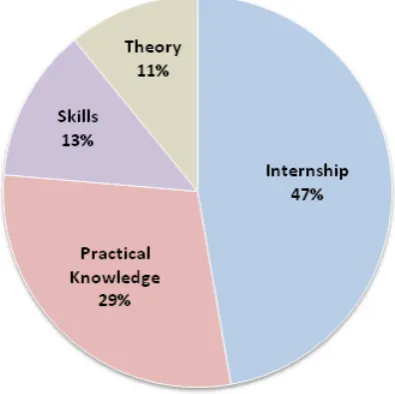
In the proposed model, the traditional focus towards the theory base is shifted to the practical base. When the pupil will be more efficient in the practical areas and the real life implementation of the theoretical knowledge when needed the incidence of unemployment will not arise. Thus, in an efficient education structure, two third, that is the majority of the focus is given to the practical skill set development and one third that is the remaining attention has to be paid to the theory and basic concepts.
Computer Science Education is directly related to real-world, thus it is required to reform the course structure such a way it will reduce the unemployment rate in IT sector. Figure 2 highlights the modified creative model. Such course-related internships plays an integral role, helping students to get a competitive edge in the global market.
Curriculum of programming for engineers, teaching model and learning outcomes also plays vital role in the process of computer science higher education [12].
B. Hiring Methodologies
The traditional method of hiring the labor even needs modernization. The new model proposed states that the employment should be given on the basis of the practical problem solving capacity. The interviews should be conducted in such a way that not only the theoretical knowledge base but the real time problem solving capacity of the applicant must be tested. Traditionally, giving an interview is also seen as giving an exam with pre-set syllabus and questions. So generally for giving an successful interview the whole process is divided into five phases.
The first phase states that the applicant should prepare for that particular interview. Following with the step of giving an introduction to the evaluators. Then comes the phase presentation where the applicant is expected to present his skills and all his documents certifying that he is qualifies enough to do the task. After that the applicant should obtain
some data about himself about the opinions of the evaluation. The whole process ends with the phase where the applicant or the judge wraps the things up. This is the traditional approach of giving an good qualifying interview. Though, the traditional approach is successful in testing the workplace manners and ethics of the applicant, it lacks in judging and determining the actual productivity of the applicant. The proposed model states that along with the testing of necessary workplace ethics, the judges should test the applicants knowledge and the capabilities of applying that knowledge whenever necessary through the method of practical troubleshooting. For an instance, in the sector of Information Technology after knowing the basic information about the applicant, he may be asked to solve a real-life problem which is particularly designed for the testing purpose. In this process, the applicant will be asked to diagnose a deliberately created error or a problem which is designed by the company according to their requirement. The techniques used by the applicant along with the constraint of time will determine his accuracy and efficiency which will highlight the best productive applicant. Moreover, there is additional way of selecting the most efficient person, fit for the job that is by creating virtual environment. The applicant will be asked the questions and to diagnose the problem accordingly, immediately in front of the evaluators so that they can keenly observe and assess applicants problem solving ways, skill-sets and applications.
C. Workplace Testing
When the most effective personnel is hired it is further necessary to test their limits. After successful implementation of the modern proposed interview methods the applicants limits and his abilities to push the limits should also be tested. In a particular period of time, all sorts of problems must be handed down to him to diagnose . This will help the organization evaluate him and his abilities furthermore.
VII. CONCLUSION
The main emphasis of the paper is to design a strategic model for computing higher education which will strengthen the skills. It is a cycle, starting from admission process heading to end results of employment. Knowledge should be tested during admission process to higher education. However, it will be more useful to employer and corporate world.
Solution to the problem of unemployment in Information Technology has been introduced through 'Creative Higher Education', 'Hiring Methodologies' and 'Workplace Testing'.
This model will make higher education system more skill oriented. This model should be implemented by higher educational institutions to impart quality education for better tomorrow. However, the outcome will be more realistic for the employer as well which will help to reduce the unemployment rate in developing countries.
ACKNOWLEDGMENT
[image:4.595.76.274.227.424.2]Author would like to convey sincere gratitude to the Prof. APJ Abdul Kalam (Former President of India, Eminent Scientist), who contributed an outstanding chapters along with his continuous guidance and motivation. We also thank Figure 2 Strategic model of Creative Skill based higher
Dr D.Y.Patil (Former Governor of Tripura, Bihar and West Bengal) and Dr Vijay D. Patil (President- D Y Patil University) for their excellent support. Also authors wish to thank Shri. Dhan Shyam Sharma for helpful discussions.
REFERENCES
[1] “General Economics", The Institute of Chartered Accounts of India. New Delhi. ISBN: 978-81-8441-035-8
[2] Mohit Satoskar, "Cognitive Prior-Knowledge Testing Method for Core Development of Higher Education of Computing in Academia",FECS'15- The 2015 Int'l Conference on Frontiers in Education: Computer Science and Computer Engineering, Las Vegas, July 2015. Paper ID: FEC6191.
[3] Philip Altbach, "International Higher Education- An Encyclopedia: Volume 1", Routledge Library Editions: Education. 2012.
ISBN: 978-0-415-61517-4
[4] http://www.abdulkalam.com/ (accessed :21 May 2015)
[5] "World Education Report", 2000, United Nations Educational, Scientific and Cultural Organization.
[6] http://bgr.com/2014/03/14/bill-gates-interview-robots/ (accessed: 6th August 2015)
[7] http://www.projectliteracy.com/about (accessed : 30 July 2015) [8] Global Employment Trends for Youth 2012, International Labour
Office. Geneva. ISBN: 978-92-2-126326-5
[9] Aspiring Minds- Report on Unemployment in India. June 2013. New Delhi.
[10] http://www.uis.unesco.org/FactSheets/Pages/Literacy.aspx (accessed: 10 June 2015)
[11] EFA Global Monitoring Report- 2013/14- "Teaching and Learning: Achieving quality for all", UNESCO. ISBN:978-92-3-104255-3 [12] Report on Adult and Youth Literacy, 1990-2015, UNESCO. Canada.
ISBN: 978-92-9189-117-7
[13] Satoskar¹, Mohit and S. Mali. "Comprehensive Curriculum of Programming for Engineers, its Teaching Models and in-Lab Monitoring Technique", Proceedings of the International Multi-Conference of Engineers and Computer Scientists. Vol. 1. 2015. ISBN: 978-988-192530209
BIBLIOGRAPHY
Mohit Satoskar received Bachelors of Engineering (Hons) degree in Computer Systems Engineering from London Metropolitan University, United Kingdom in 2012. Currently, Mohit is a Research Associate with Department of Computer Engineering in Ramrao Adik Institute of Technology, Navi Mumbai. India.
Mohit has published several research papers, see the latest http://independent.academia.edu/MohitSatoskar/Activity. He did consulting for ECHS- Indian Armed Forces. He is a Certified Ethical Hacker.
Mohit's current research interests are: natural multi-language processing, educational technology, e-governance, curriculum design and implementation.