Text Categorization as a Graph Classification Problem
François Rousseau Emmanouil Kiagias
LIX, École Polytechnique, France
Michalis Vazirgiannis
Abstract
In this paper, we consider the task of text categorization as a graph classifica-tion problem. By representing textual doc-uments as graph-of-words instead of his-torical n-gram bag-of-words, we extract more discriminative features that corre-spond to long-distance n-grams through frequent subgraph mining. Moreover, by capitalizing on the concept of k-core, we reduce the graph representation to its dens-est part – its main core – speeding up the feature extraction step for little to no cost in prediction performances. Experiments on four standard text classification datasets show statistically significant higher accu-racy and macro-averaged F1-score com-pared to baseline approaches.
1 Introduction
The task of text categorization finds applications in a wide variety of domains, from news filter-ing and document organization to opinion minfilter-ing and spam detection. With the ever-growing quan-tity of information available online nowadays, it is crucial to provide effective systems capable of classifying text in a timely fashion. Compared to other application domains of classification, its specificity lies in its high number of features, its sparse feature vectors and its skewed multiclass scenario. For instance, when dealing with thou-sands of news articles, it is not uncommon to have millions of n-gram features, only a few hundreds actually present in each document and tens of class labels – some of them with thousands of articles and some others will only a few hundreds. These particularities have to be taken into account when envisaging a different representation for a docu-ment and in our case when considering the task as a graph classification problem.
Graphs are powerful data structures that are used to represent complex information about en-tities and interaction between them and we think text makes no exception. Historically, following the traditional bag-of-words representation, uni-grams have been considered as the natural features and later extended to n-grams to capture some
word dependency and word order. However,
n-grams correspond to sequences of words and thus
fail to captureword inversion andsubset
match-ing(e. g., “article about news” vs. “news article”). We believe graphs can help solve these issues like they did for instance with chemical compounds where repeating substructure patterns are good in-dicators of belonging to one particular class, e. g., predicting carcinogenicity in molecules (Helma et al., 2001). Graph classification has received a lot of attention this past decade and various tech-niques have been developed to deal with the task but rarely applied on textual data and at its scale.
In our work, we explored a graph representation of text, namely graph-of-words, to challenge the traditional bag-of-words representation and help better classify textual documents into categories. We first trained a classifier using frequent sub-graphs as features for increased effectiveness. We then reduced each graph-of-words to its main core before mining the features for increased efficiency. Finally, we also used this technique to reduce the total number of n-gram features considered in the baselines for little to no loss in prediction perfor-mances.
The rest of the paper is organized as follows. Section 2 provides a review of the related work. Section 3 defines the preliminary concepts upon which our work is built. Section 4 introduces the proposed approaches. Section 5 describes the ex-perimental settings and presents the results we ob-tained on four standard datasets. Finally, Section 6 concludes our paper and mentions future work directions.
2 Related work
In this section, we present the related work intext categorization, graph classificationand the com-bination of the two fields like in our case.
2.1 Text categorization
Text categorization, a.k.a. text classification, cor-responds to the task of automatically predicting the class label of a given textual document. We refer to (Sebastiani, 2002) for an in-depth re-view of the earliest works in the field and (Ag-garwal and Zhai, 2012) for a survey of the more recent works that capitalize on additional meta-information. We note in particular the seminal work of Joachims (1998) who was the first to
pro-pose the use of a linear SVM with TF×IDF term
features for the task. This approach is one of the standard baselines because of its simplicity yet ef-fectiveness (unsupervised n-gram feature mining followed by standard supervised learning). An-other popular approach is the use of Naive Bayes and its multiple variants (McCallum and Nigam,
1998), in particular for the subtask of spam
de-tection (Androutsopoulos et al., 2000). Finally, there are a couple of works such as (Hassan et al., 2007) that used the graph-of-words representa-tion to propose alternative weights for the n-gram features but still without considering the task as a graph classification problem.
2.2 Graph classification
Graph classificationcorresponds to the task of au-tomatically predicting the class label of a given graph. The learning part in itself does not differ from other supervised learning problems and most proposed methods deal with the feature extrac-tion part. They fall into two main categories:
ap-proaches that consider subgraphs as featuresand
graph kernels.
2.2.1 Subgraphs as features
The main idea is to mine frequent subgraphs and use them as features for classification, be it with Adaboost (Kudo et al., 2004) or a linear SVM (Deshpande et al., 2005). Indeed, most datasets that were used in the associated experiments cor-respond to chemical compounds where repeating substructure patterns are good indicators of be-longing to one particular class. Some popular graph pattern mining algorithms are gSpan (Yan and Han, 2002), FFSM (Huan et al., 2003) and
Gaston (Nijssen and Kok, 2004). The number of frequent subgraphs can be enormous, especially for large graph collections, and handling such a feature set can be very expensive. To overcome this issue, recent works have proposed to retain or even only mine the discriminative subgraphs, i. e. features that contribute to the classification decision, in particular gBoost (Saigo et al., 2009), CORK (Thoma et al., 2009) and GAIA (Jin et al., 2010). However, when experimenting, gBoost did not converge on our larger datasets while GAIA and CORK consider subgraphs of node size at least 2, which exclude unigrams, result-ing in poorer performances. Moreover, all these approaches have been developed for binary clas-sification, which meant mining features as many times as the number of classes instead of just once (one-vs-all learning strategy). In this paper, we tackle the scalability issue differently through an unsupervised feature selection approach to reduce the size of the graphs and a fortiori the number of frequent subgraphs.
2.2.2 Graph kernels
Gärtner et al. (2003) proposed the first kernels be-tween graphs (as opposed to previous kernels on graphs, i. e. between nodes) based on either ran-dom walks or cycles to tackle the problem of clas-sification between graphs. In parallel, the idea of marginalized kernels was extended to graphs by Kashima et al. (2003) and by Mahé et al. (2004). We refer to (Vishwanathan et al., 2010) for an in-depth review of the topic and in particular its lim-itations in terms of number of unique node labels, which make them unsuitable for our problem as tested in practice (limited to a few tens of unique labels compared to hundreds of thousands for us).
2.3 Similar works
3 Preliminary concepts
In this section, we introduce the preliminary con-cepts upon which our work is built.
3.1 Graph-of-words
We model a textual document as agraph-of-words,
which corresponds to a graph whose vertices rep-resent unique terms of the document and whose edges represent co-occurrences between the terms within a fixed-size sliding window. The under-lying assumption is that all the words present in a document have some undirected relationships with the others, modulo a window size outside of which the relationship is not considered. This rep-resentation was first used in keyword extraction and summarization (Ohsawa et al., 1998; Mihal-cea and Tarau, 2004) and more recently in ad hoc IR (Blanco and Lioma, 2012; Rousseau and Vazir-giannis, 2013). We refer to (Blanco and Lioma, 2012) for an in-depth review of the graph repre-sentations of text in NLP.
system softwar implement
disciplin
scienc
span
topic
theoret studi
rang
limit
algorithm issu
practic
hardwar
comput
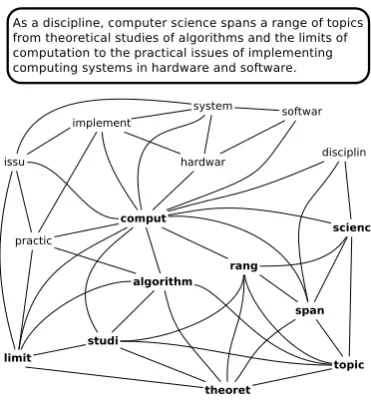
As a discipline, computer science spans a range of topics from theoretical studies of algorithms and the limits of computation to the practical issues of implementing computing systems in hardware and software.
[image:3.595.86.272.365.568.2]hide me
Figure 1: Graph-of-words representation of a tex-tual document – in bold font, its main core.
Figure 1 illustrates the graph-of-words repre-sentation of a textual document. The vertices cor-respond to the remaining terms after standard pre-processing steps have been applied (tokenization, stop word removal and stemming). The undirected edges were drawn between terms co-occurring within a sliding window over the processed text of size4, value consistently reported as working well in the references aforementioned and validated in our experiments. Edge direction was used by Fil-ippova (2010) so as to extract valid sentences but
not here in order to capture some word inversion. Note that for small-enough window sizes (which is typically the case in practice), we can
consider that two terms linked represent a
long-distance bigram(Bassiou and Kotropoulos, 2010), if not a bigram. Furthermore, by extending the denomination, we can consider that a subgraph
of size n is a long-distance n-gram, if not an
n-gram. Indeed, the nodes belonging to a subgraph do not necessarily appear in a sequence in the doc-ument like for a n-gram. Moreover, this enables us to “merge” together n-grams that share the same terms but maybe not in the same order. In the ex-periments, by abusing the terminology, we will re-fer to them as n-grams to adopt a common termi-nology with the baseline approaches.
3.2 Node/edge labels and subgraph matching In graph classification, it is common to introduce a node labeling functionµto map a node id to its label. For instance, consider the case of chemi-cal compounds (e. g., the benzeneC6H6). Then in
its graph representation (its “structural formula”), it is crucial to differentiate between the multiple nodes labeled the same (e. g.,CorH). In the case of graph-of-words, node labels are unique inside a graph since they represent unique terms of the document and we can therefore omit these func-tions since they are injective in our case and we can substitute node ids for node labels. In
partic-ular, the general problem of subgraph matching,
which defines an isomorphism between a graph and a subgraph and is NP-complete (Garey and Johnson, 1990), can be reduced to a polynomial problem when node labels are unique. In our ex-periments, we used the standard algorithm VF2 developed by Cordella et al. (2001).
3.3 K-core and main core
Seidman (1983) defined thek-core of a graph as
the maximal connected subgraph whose vertices
are at least of degreekwithin the subgraph. The
non-emptyk-core of largest k is called the main
core and corresponds to the most cohesive set(s)
4 Graph-of-words classification
In this section, we present our work and the sev-eral approaches we explored, from unsupervised feature mining using gSpan to propose more dis-criminative features than standard n-grams to un-supervised feature selection using k-core to reduce the total number of subgraph and n-gram features.
4.1 Unsupervised feature mining using gSpan We considered the task of text categorization as a graph classification problem by representing ttual documents as graph-of-words and then ex-tracting subgraph features to train a graph classi-fier. Each document is a separate graph-of-words and the collection of documents thus corresponds to a set of graphs. Therefore, for larger datasets, the total number of graphs increases but not the average graph size (the average number of unique terms in a text), assuming homogeneous datasets.
Because the total number of unique node la-bels corresponds to the number of unique terms in the collection in our case, graph kernels are not suitable for us as verified in practice using the MATLAB code made available by Shervashidze (2009). We therefore only explored the meth-ods that consider subgraphs as features. Repeat-ing substructure patterns between graphs are intu-itively good candidates for classification since, at least for chemical compounds, shared subparts of molecules are good indicators of belonging to one particular class. We assumed it would the same for text. Indeed, subgraphs of graph-of-words corre-spond to sets of words co-occurring together, just not necessarily always as the same sequence like for n-grams – it can be seen as a relaxed definition of a n-gram to capture additional variants.
We used gSpan (graph-based Substructure pattern (Yan and Han, 2002)) as frequent sub-graph miner like (Jiang et al., 2010; Arora et al., 2010) mostly because of its fast available C++ implementation from gBoost (Saigo et al., 2009). Briefly, the key idea behind gSpan is that in-stead of enumerating all the subgraphs and test-ing for isomorphism throughout the collection, it first builds for each graph a lexicographic order of all the edges using depth-first-search (DFS) traversal and assigns to it a unique minimum DFS code. Based on all these DFS codes, a hierarchical search tree is constructed at the collection-level. By pre-order traversal of this tree, gSpan discov-ers all frequent subgraphs with required support.
Consider the set of all subgraphs in the collec-tion of graphs, which corresponds to the set of all potential features. Note that there may be overlap-ping (subgraphs sharing nodes/edges) and redun-dant (subgraphs included in others) features. Be-cause its size is exponential in the number of edges (just like the number of n-grams is exponential in n), it is common to only retain/mine the most fre-quent subgraphs (again just like for n-grams with a minimum document frequency (Fürnkranz, 1998; Joachims, 1998)). This is controlled via a
param-eter known as the support, which sets the
mini-mum number of graphs in which a given subgraph has to appear to be considered as a feature, i. e. the number of subgraph matches in the collection. Here, since node labels are unique inside a graph, we do not have to consider multiple occurrences of the same subgraph in a given graph. The lower the support, the more features selected/considered but the more expensive the mining and the training (not only in time spent for the learning but also for the feature vector generation).
4.2 Unsupervised support selection
The optimal value for the support can be learned through cross-validation so as to maximize the prediction accuracy of the subsequent classifier,
making the whole feature mining process
super-vised. But if we consider that the classifier can only improve its goodness of fit with more fea-tures (the sets of feafea-tures being nested as the sup-port varies), it is likely that the lowest supsup-port will lead to the best test accuracy; assuming subse-quent regularization to prevent overfitting. How-ever, this will come at the cost of an exponential number of features as observed in practice. In-deed, as the support decreases, the number of fea-tures increases slightly up until a point where it increases exponentially, which makes both the fea-ture vector generation and the learning expensive, especially with multiple classes. Moreover, we observed that the prediction performances did not benefit that much from using all the possible fea-tures (support of1) as opposed to a more manage-able number of features corresponding to a higher support. Therefore, we propose to select the
sup-port using the so-calledelbow method. This is an
unsupervised empirical method initially developed
for selecting the number of clusters in k-means
4.3 Considered classifiers
In text categorization, standard baseline classifiers
include k-nearest neighbors (kNN) (Larkey and
Croft, 1996), Naive Bayes (NB) (McCallum and Nigam, 1998) and linear Support Vector Machines (SVM) (Joachims, 1998) with the latter perform-ing the best on n-gram features as verified in our experiments. Since our subgraph features corre-spond to “long-distance n-grams”, we used linear SVMs as our classifiers in all our experiments – the goal of our work being to explore and propose better features rather than a different classifier. 4.4 Multiclass scenario
In standard binary graph classification (e. g., pre-dicting chemical compounds’ carcinogenicity as either positive or negative (Helma et al., 2001)), feature mining is performed on the whole graph collection as we expect the mined features to be able to discriminate between the two classes (thus producing a good classifier). However, for the task of text categorization, there are usually more than two classes (e. g., 118 categories of news ar-ticles for the Reuters-21578 dataset) and with a skewed class distribution (e. g., a lot more news related to “acquisition” than to “grain”). There-fore, a single support value might lead to some classes generating a tremendous number of fea-tures (e. g., hundreds of thousands of frequent sub-graphs) and some others only a few (e. g., a few hundreds subgraphs) resulting in a skewed and non-discriminative feature set. To include dis-criminative features for theseminorityclasses, we would need an extremely low support resulting in an exponential number of features because of the majority classes. For these reasons, we de-cided to mine frequent subgraphs per class using the same relative support (%) and then aggregat-ing each feature set into a global one at the cost of asupervisedprocess (but which still avoids cross-validated parameter tuning). This was not needed for the tasks of spam detection and opinion mining since the corresponding datasets consist of only two balanced classes.
4.5 Main core mining using gSpan
Since the main drawback of mining frequent sub-graphs for text categorization rather than chemical compound classification is the very high number of possible subgraphs because of the size of the graphs and the total number of graphs (more than 10x in both cases), we thought of ways to reduce
the graphs’ sizes while retaining as much classifi-cation information as possible.
The graph-of-words representation is designed to capture dependency between words, i. e. de-pendency between features in the context of ma-chine learning but at the document-level. Ini-tially, we wanted to capture recurring sets of words (i. e. take into account word inversion and sub-set matching) and not just sequences of words like with n-grams. In terms of subgraphs, this means words that co-occur with each other and form a dense subgraph as opposed to a path like for a n-gram. Therefore, when reducing the graphs, we need to keep their densest part(s) and that is why we considered extracting their main cores. Com-pared to other density-based algorithms, retaining the main core of a graph has the advantage of be-ing linear in the number of edges, i. e. in the num-ber of unique terms in a document in our case (the number of edges is at most the number of nodes times the fixed size of the sliding window, a small constant in practice).
4.6 Unsupervised n-gram feature selection Similarly to (Hassan et al., 2007) that used graph-of-words to propose alternative weights for the n-gram features, we can capitalize on main core re-tention to still extract binary n-gram features for classification but considering only the terms be-longing to the main core of each document. Be-cause some terms never belong to any main core of any document, the dimension of the overall fea-ture space decreases. Additionally, since a docu-ment is only represented by a subset of its original terms, the number of non-zero feature values per document also decreases, which matters for SVM, even for the linear kernel, when considering the dual formulation or in the primal with more recent optimization techniques (Joachims, 2006).
Compared to most existing feature selection techniques in the field (Yang and Pedersen, 1997),
it is unsupervised and corpus-independent as it
does not rely on any labeled data like IG, MI orχ2 nor any collection-wide statistics like IDF,
5 Experiments
In this section we present the experiments we con-ducted to validate our approaches.
5.1 Datasets
We used four standard text datasets: two for multi-class document categorization (WebKB and R8), one for spam detection (LingSpam) and one for opinion mining (Amazon) so as to cover all the main subtasks of text categorization:
• WebKB: 4 most frequent categories among labeled webpages from various CS depart-ments – split into 2,803 for training and 1,396 for test (Cardoso-Cachopo, 2007, p. 39–41).
• R8: 8 most frequent categories of
Reuters-21578, a set of labeled news articles from the 1987 Reuters newswire – split into 5,485 for training and 2,189 for test (Debole and Se-bastiani, 2005).
• LingSpam: 2,893 emails classified as spam or legitimate messages – split into 10 sets for 10-fold cross validation (Androutsopoulos et al., 2000).
• Amazon: 8,000 product reviews over four different sub-collections (books, DVDs, elec-tronics and kitchen appliances) classified as positive or negative – split into 1,600 for training and 400 for test each (Blitzer et al., 2007).
5.2 Implementation
We developed our approaches mostly in Python
using the igraph library (Csardi and Nepusz,
2006) for the graph representation and main core extraction. For unsupervised subgraph feature mining, we used the C++ implementation of gSpan from gBoost (Saigo et al., 2009). Finally for classification and standard n-gram text
catego-rization we usedscikit(Pedregosa et al., 2011),
a standard Python machine learning library. 5.3 Evaluation metrics
To evaluate the performance of our proposed ap-proaches over standard baselines, we computed on the test set both the micro- and macro-average F1-score. Because we are dealing with single-label classification, the micro-average F1-score corre-sponds to the accuracy and is a measure of the overall prediction effectiveness (Manning et al.,
Dataset # subgraphs before # subgraphs after reduction
WebKB 30,868 10,113 67 %
R8 39,428 11,373 71 %
LingSpam 54,779 15,514 72 %
Amazon 16,415 8,745 47 %
Dataset # n-grams before # n-grams after reduction
WebKB 1,849,848 735,447 60 %
R8 1,604,280 788,465 51 %
LingSpam 2,733,043 1,016,061 63 %
[image:6.595.311.526.63.182.2]Amazon 583,457 376,664 35 %
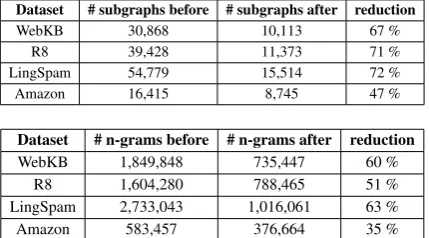
Table 1: Total number of features (n-grams or sub-graphs) vs. number of features present only in main cores along with the reduction of the dimen-sion of the feature space on all four datasets.
2008, p. 281). Conversely, the macro-average F1-score takes into account the skewed class label dis-tributions by weighting each class uniformly. The statistical significance of improvement in accuracy over the n-gram SVM baseline was assessed us-ing the micro sign test (p < 0.05) (Yang and Liu, 1999). For the Amazon dataset, we report the av-erage of each metric over the four sub-collections. 5.4 Results
Table 2 shows the results on the four considered datasets. The first three rows correspond to the baselines: unsupervised n-gram feature extrac-tion and then supervised learning using kNN, NB (Multinomial but Bernoulli yields similar results) and linear SVM. The last three rows correspond to our approaches.
In our first approach, denoted as “gSpan + SVM”, we mine frequent subgraphs (gSpan) as features and then train a linear SVM. These fea-tures correspond to long-distance n-grams. This leads to the best results in text categorization on almost all datasets (all if we compare to baseline methods), in particular on multiclass document categorization (R8 and WebKB).
Table 2: Test accuracy and macro-average F1-score on four standard datasets. Bold font marks the best performance in a column.*indicates statistical significance at p < 0.05 using micro sign test with regards to the SVM baseline of the same column. MC corresponds to unsupervised feature selection using the main core of each graph-of-words to extract n-gram and subgraph features. gSpan mining support values are 1.6% (WebKB), 7% (R8), 4% (LingSpam) and 0.5% (Amazon).
Method
Dataset WebKB R8 LingSpam Amazon
Accuracy F1-score Accuracy F1-score Accuracy F1-score Accuracy F1-score
kNN (k=5) 0.679 0.617 0.894 0.705 0.910 0.774 0.512 0.644
NB (Multinomial) 0.866 0.861 0.934 0.839 0.990 0.971 0.768 0.767
linear SVM 0.889 0.871 0.947 0.858 0.991 0.973 0.792 0.790
gSpan + SVM 0.912* 0.882 0.955* 0.864 0.991 0.972 0.798* 0.795
MC + gSpan + SVM 0.901* 0.871 0.949* 0.858 0.990 0.973 0.800* 0.798
MC + SVM 0.872 0.863 0.937 0.849 0.990 0.972 0.786 0.774
# non-zero n-gram feature values before unsupervised feature selection 0
50 100 150 200 250
# documents
0 1000 2000 3000 4000 5000
# non-zero n-gram feature values after unsupervised feature selection 0
50 100 150 200 250
[image:7.595.250.517.140.478.2]# documents
Figure 2: Distribution of non-zero n-gram feature values before and after unsupervised feature selec-tion (main core retenselec-tion) on R8 dataset.
that on average less than 60% of the subgraphs are kept for little to no cost in prediction effectiveness. In our final approach, denoted as “MC + SVM”, we performed unsupervised feature selection by keeping the terms appearing in the main core (MC) of each document’s graph-of-words representation and then extracted standard n-gram features. Ta-ble 1 (lower taTa-ble) shows the reduction in the di-mension of the feature space and we see that on av-erage less than half the n-grams remain. Figure 2 shows the distribution of non-zero features before and after the feature selection on the R8 dataset. Similar changes in distribution can be observed on the other datasets, from a right-tail Gaussian to a power law distribution as expected from the main core retention. Table 2 shows that the main core retention has little to no cost in accuracy and F1-score but can reduce drastically the feature space and the number of non-zero values per document.
1 2 3 4
support (%) 0
50k 100k 150k 200k 250k
# features
5 6 7 8 9 10 11 12 13 support (%)
1 2 3 4
support (%) 0.85
0.90 0.95 1.00
accuracy
5 6 7 8 9 10 11 12 13 support (%)
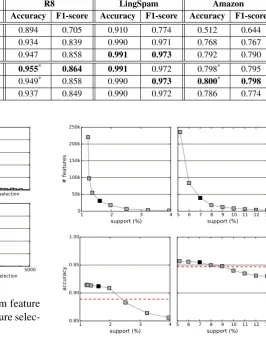
Figure 3: Number of subgraph features/accuracy in test per support (%) on WebKB (left) and R8 (right) datasets: in black, the selected support value chosen via the elbow method and in red, the accuracy in test for the SVM baseline.
5.5 Unsupervised support selection
1-grams 2-grams 3-grams 4-grams 5-grams 6-grams
0 20 40 60 80 100
# features (%)
[image:8.595.308.525.64.219.2]baseline gSpan MC + gSpan
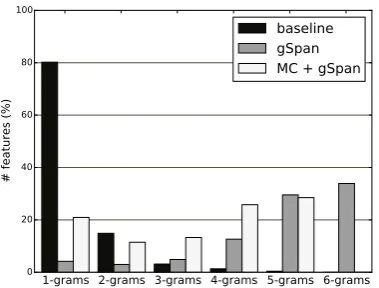
Figure 4: Distribution of n-grams (standard and long-distance ones) among all the features on We-bKB dataset.
that the elbow method helps selecting in an unsu-pervised manner a support that leads to the best or close to the best accuracy.
5.6 Distribution of mined n-grams
[image:8.595.82.272.74.218.2]In order to gain more insights on why the long-distance n-grams mined with gSpan result in bet-ter classification performances than the baseline n-grams, we computed the distribution of the num-ber of unigrams, bigrams, etc. up to 6-grams in the traditional feature set and ours (Figure 4) as well as in the top 5% features that contribute the most to the classification decision of the trained SVM (Figure 5). Again, a long-distance n-gram corre-sponds to a subgraph of size n in a graph-of-words and can be seen as a relaxed definition of the tra-ditional n-gram, one that takes into account word inversion for instance. To obtain comparable re-sults, we considered for the baseline n-grams with a minimum document frequency equal to the sup-port. Otherwise, by definition, there are at least as many bigrams as there are unigrams and so forth.
Figure 4 shows that our approaches mine way more n-grams than unigrams compared to the baseline. This happens because with graph-of-words a subgraph of size n corresponds to a set of n terms while with bag-of-words a n-gram cor-responds to a sequence of n terms. Note that even when restricting the subgraphs to the main cores, there are still more higher order n-grams mined.
Figure 5 shows that the higher order n-grams still contribute indeed to the classification deci-sion and in higher proportion than with the base-line, even when restricting to the main cores. For
1-grams 2-grams 3-grams 4-grams 5-grams 6-grams
0 20 40 60 80 100
# features (%)
baseline SVM gSpan + SVM MC + gSpan + SVM
Figure 5: Distribution of n-grams (standard and long-distance ones) among the top 5% most dis-criminative features for SVM on WebKB dataset.
instance, on the R8 dataset, {bank, base, rate} was a discriminative (top 5% SVM features) long-distance 3-gram for the category “interest” and occurred in documents in the form of “barclays bank cut its base lending rate”, “midland bank matches its base rate” and “base rate of natwest bank dropped”, pattern that would be hard to cap-ture with traditional n-gram bag-of-words.
5.7 Timing
With an Intel Core i5-3317U clocking at 2.6GHz and 8GB of RAM, mining the subgraph features with gSpan takes on average 30s for the selected support. It can take several hours with lower sup-port and goes down to 5s using the main cores.
6 Conclusion
In this paper, we tackled the task of text cate-gorization by representing documents as graph-of-words and then considering the problem as a graph classification one. We were able to extract more discriminative features that correspond to long-distance n-grams through frequent subgraph mining. Experiments on four standard datasets show statistically significant higher accuracy and macro-averaged F1-score compared to baselines.
References
Charu C. Aggarwal and ChengXiang Zhai. 2012. A Survey of Text Classification Algorithms. InMining Text Data, pages 163–222.
Ion Androutsopoulos, John Koutsias, Konstantinos V. Chandrinos, George Paliouras, and Constantine D. Spyropoulos. 2000. An Evaluation of Naive Bayesian Anti-Spam Filtering. In Proceedings of the Workshop on Machine Learning in the New In-formation Age, 11th European Conference on Ma-chine Learning, pages 9–17.
Shilpa Arora, Elijah Mayfield, Carolyn Penstein-Rosé, and Eric Nyberg. 2010. Sentiment Classification Using Automatically Extracted Subgraph Features. InProceedings of the NAACL HLT 2010 Workshop on Computational Approaches to Analysis and Gen-eration of Emotion in Text, CAAGET ’10, pages 131–139.
Nikoletta Bassiou and Constantine Kotropoulos. 2010. Word Clustering Using PLSA Enhanced with Long Distance Bigrams. InProceedings of the 20th Inter-national Conference on Pattern Recognition, ICPR ’10, pages 4226–4229.
Vladimir Batagelj and Matjaž Zaversnik. 2003. An O(m) Algorithm for Cores Decomposition of Networks. The Computing Research Repository (CoRR), cs.DS/0310049.
Roi Blanco and Christina Lioma. 2012. Graph-based term weighting for information retrieval. Informa-tion Retrieval, 15(1):54–92.
John Blitzer, Mark Dredze, and Fernando Pereira. 2007. Biographies, bollywood, boomboxes and blenders: Domain adaptation for sentiment classi-fication. In Proceedings of the 45th Annual Meet-ing of the Association of Computational LMeet-inguistics, ACL ’07, pages 440–447.
Ana Cardoso-Cachopo. 2007. Improving Methods for Single-label Text Categorization. Ph.D. thesis, Insti-tuto Superior Técnico, Universidade de Lisboa, Lis-bon, Portugal.
Luigi Pietro Cordella, Pasquale Foggia, Carlo Sansone, and Mario Vento. 2001. An improved algorithm for matching large graphs. In Proceedings of the 3rd IAPR-TC15 Workshop on Graph-based Representa-tions in Pattern Recognition, pages 149–159.
Gabor Csardi and Tamas Nepusz. 2006. The igraph software package for complex network research. In-terJournal, Complex Systems, 1695(5):1–9.
Franca Debole and Fabrizio Sebastiani. 2005. An Analysis of the Relative Hardness of Reuters-21578 Subsets: Research Articles. Journal of the Ameri-can Society for Information Science and Technology, 56(6):584–596.
Mukund Deshpande, Michihiro Kuramochi, Nikil Wale, and George Karypis. 2005. Fre-quent Substructure-Based Approaches for Classi-fying Chemical Compounds. IEEE Transactions on Knowledge and Data Engineering, 17(8):1036– 1050.
Katja Filippova. 2010. Multi-sentence Compression: Finding Shortest Paths in Word Graphs. In Proceed-ings of the 23rd International Conference on Com-putational Linguistics, COLING ’10, pages 322– 330.
Johannes Fürnkranz. 1998. A study using n-gram features for text categorization. Technical Report OEFAI-TR-98-30, Austrian Research Institute for Artificial Intelligence.
Michael R. Garey and David S. Johnson. 1990. Com-puters and Intractability; A Guide to the Theory of NP-Completeness. W. H. Freeman & Co.
Thomas Gärtner, Peter Flach, and Stefan Wrobel. 2003. On graph kernels: Hardness results and efficient alternatives. In Proceedings of the An-nual Conference on Computational Learning The-ory, COLT ’03, pages 129–143.
Samer Hassan, Rada Mihalcea, and Carmen Banea. 2007. Random-Walk Term Weighting for Improved Text Classification. InProceedings of the Interna-tional Conference on Semantic Computing, ICSC ’07, pages 242–249.
Christoph Helma, Ross D. King, Stefan Kramer, and Ashwin Srinivasan. 2001. The predictive toxicology challenge 2000–2001. Bioinformatics, 17(1):107–108.
Jun Huan, Wei Wang, and Jan Prins. 2003. Efficient Mining of Frequent Subgraphs in the Presence of Isomorphism. In Proceedings of the 3rd IEEE In-ternational Conference on Data Mining, ICDM ’03, pages 549–552.
Chuntao Jiang, Frans Coenen, Robert Sanderson, and Michele Zito. 2010. Text classification using graph mining-based feature extraction. Knowledge-Based Systems, 23(4):302–308.
Ning Jin, Calvin Young, and Wei Wang. 2010. GAIA: graph classification using evolutionary computation. InProceedings of the 2010 ACM SIGMOD interna-tional conference on Management of data, SIGMOD ’10, pages 879–890.
Thorsten Joachims. 1998. Text categorization with Support Vector Machines: Learning with many rel-evant features. InProceedings of the 10th European Conference on Machine Learning, ECML ’98, pages 137–142.
Hisashi Kashima, Koji Tsuda, and Akihiro Inokuchi. 2003. Marginalized kernels between labeled graphs. InProceedings of the 20th International Conference on Machine Learning, volume 3 ofICML ’03, pages 321–328.
Taku Kudo and Yuji Matsumoto. 2004. A Boosting Al-gorithm for Classification of Semi-Structured Text. InProceedings of the 9th Conference on Empirical Methods in Natural Language Processing, volume 4 ofEMNLP ’04, pages 301–308.
Taku Kudo, Eisaku Maeda, and Yuji Matsumoto. 2004. An application of boosting to graph classification. InAdvances in Neural Information Processing Sys-tems 17, NIPS ’04, pages 729–736.
Leah S. Larkey and W. Bruce Croft. 1996. Combining Classifiers in Text Categorization. InProceedings of the 19th annual international ACM SIGIR confer-ence on Research and development in information retrieval, SIGIR ’96, pages 289–297.
Pierre Mahé, Nobuhisa Ueda, Tatsuya Akutsu, Jean-Luc Perret, and Jean-Philippe Vert. 2004. Exten-sions of marginalized graph kernels. In Proceed-ings of the 21st International Conference on Ma-chine Learning, ICML ’04, pages 70–78.
Christopher D. Manning, Prabhakar Raghavan, and Hinrich Schütze. 2008. Introduction to Information Retrieval. Cambridge University Press, New York, NY, USA.
Alex Markov, Mark Last, and Abraham Kandel. 2007. Fast Categorization of Web Documents Represented by Graphs. In Advances in Web Mining and Web Usage Analysis, number 4811 in Lecture Notes in Artificial Intelligence, pages 56–71.
Shotaro Matsumoto, Hiroya Takamura, and Manabu Okumura. 2005. Sentiment Classification Using Word Sub-sequences and Dependency Sub-trees. In
Proceedings of the 9th Pacific-Asia Conference on Advances in Knowledge Discovery and Data Min-ing, PAKDD ’05, pages 301–311.
Andrew McCallum and Kamal Nigam. 1998. A com-parison of event models for Naive Bayes text classi-fication. InProceedings of the AAAI workshop on learning for text categorization, AAAI ’98, pages 41–48.
Rada Mihalcea and Paul Tarau. 2004. TextRank: Bringing Order into Texts. InProceedings of the 9th Conference on Empirical Methods in Natural Lan-guage Processing, EMNLP ’04, pages 404–411.
Siegfried Nijssen and Joost N. Kok. 2004. A Quick-start in Frequent Structure Mining Can Make a Dif-ference. InProceedings of the 10th ACM SIGKDD international conference on Knowledge Discovery and Data mining, KDD ’04, pages 647–652.
Yukio Ohsawa, Nels E. Benson, and Masahiko Yachida. 1998. KeyGraph: Automatic Indexing by Co-occurrence Graph Based on Building Construc-tion Metaphor. InProceedings of the Advances in Digital Libraries Conference, ADL ’98, pages 12– 18.
Arzucan Özgür, Levent Özgür, and Tunga Güngör. 2005. Text Categorization with Class-based and Corpus-based Keyword Selection. In Proceedings of the 20th International Conference on Computer and Information Sciences, ISCIS ’05, pages 606– 615.
Fabian Pedregosa, Gaël Varoquaux, Alexandre Gram-fort, Vincent Michel, Bertrand Thirion, Olivier Grisel, Mathieu Blondel, Peter Prettenhofer, Ron Weiss, Vincent Dubourg, J. Vanderplas, A. Pas-sos, D. Cournapeau, M. Brucher, M. Perrot, and E. Duchesnay. 2011. Scikit-learn: Machine learn-ing in Python. The Journal of Machine Learning Research, 12:2825–2830.
François Rousseau and Michalis Vazirgiannis. 2013. Graph-of-word and TW-IDF: New Approach to Ad Hoc IR. In Proceedings of the 22nd ACM inter-national conference on Information and knowledge management, CIKM ’13, pages 59–68.
François Rousseau and Michalis Vazirgiannis. 2015. Main Core Retention on Graph-of-words for Single-Document Keyword Extraction. In Proceedings of the 37th European Conference on Information Re-trieval, ECIR ’15, pages 382–393.
Hiroto Saigo, Sebastian Nowozin, Tadashi Kadowaki, Taku Kudo, and Koji Tsuda. 2009. gBoost: a math-ematical programming approach to graph classifica-tion and regression. Machine Learning, 75(1):69– 89.
Fabrizio Sebastiani. 2002. Machine Learning in Au-tomated Text Categorization. ACM Computing Sur-veys, 34(1):1–47.
Stephen B. Seidman. 1983. Network structure and minimum degree. Social Networks, 5:269–287. Nino Shervashidze. Visited on 30/05/2015. Graph
ker-nels. http://www.di.ens.fr/~shervashidze/code.html. Marisa Thoma, Hong Cheng, Arthur Gretton, Ji-awei Han, Hans-Peter Kriegel, Alexander J. Smola, Le Song, Philip S. Yu, Xifeng Yan, and Karsten M. Borgwardt. 2009. Near-optimal Supervised Feature Selection among Frequent Subgraphs. In Proceed-ings of the SIAM International Conference on Data Mining, SDM ’09, pages 1076–1087.
Robert Thorndike. 1953. Who belongs in the family?
Psychometrika, 18(4):267–276.
Xifeng Yan and Jiawei Han. 2002. gspan: Graph-based substructure pattern mining. InProceedings of the 2nd IEEE International Conference on Data Mining, ICDM ’02, pages 721–724.
Yiming Yang and Xin Liu. 1999. A Re-examination of Text Categorization Methods. InProceedings of the 22nd annual international ACM SIGIR conference
on Research and development in information re-trieval, SIGIR ’99, pages 42–49.