Original citation:
Kunc, Martin (2004) Simulating the evolution of industries using a dynamic behavioural model. In: 2004 International Conference of the System Dynamics Society, Oxford, UK, July 25 - 29. Published in: Proceedings of the 2004 International Conference of the System Dynamics Society
Permanent WRAP url:
http://wrap.warwick.ac.uk/58323
Copyright and reuse:
The Warwick Research Archive Portal (WRAP) makes this work by researchers of the University of Warwick available open access under the following conditions. Copyright © and all moral rights to the version of the paper presented here belong to the individual author(s) and/or other copyright owners. To the extent reasonable and practicable the material made available in WRAP has been checked for eligibility before being made available.
Copies of full items can be used for personal research or study, educational, or not-for-profit purposes without prior permission or charge. Provided that the authors, title and full bibliographic details are credited, a hyperlink and/or URL is given for the original metadata page and the content is not changed in any way.
A note on versions:
The version presented here may differ from the published version or, version of record, if you wish to cite this item you are advised to consult the publisher’s version. Please see the ‘permanent WRAP url’ above for details on accessing the published version and note that access may require a subscription.
Simulating the evolution of industries using a dynamic
behavioural model
*Paper presented at the 2004 International System Dynamics Conference at Oxford, England
Martin Kunc
Associate Professor of Strategic Management Science
Warwick Business School
Abstract
Investment decisions determine that not only the evolution of industries is hard to forecast with
certainty but also industries may have different dynamic behaviour and evolutionary paths. In
this paper we present a behavioural framework to simulate the evolution of industries. Two
factors determine the dynamic behaviour of an industry: managerial decision-making and the
interconnected set of resources. Managerial decision-making significantly affects the dynamic
behaviour of firms. Bounded rational managers define rates of asset stock accumulation to
achieve a competitive advantage using different mental models. However, the set of
interconnected internal and external resources existing at industry level affects the expected
performance of the firms. Consequently, the effect of the feedback structure existing in the
industry, which consists of managers in competing firms making similar decisions over the
interconnected set of resources, determines that the dynamically contingent behaviour of firms
influence on the industry evolutionary paths.
In our simulations, we found that simple managerial choices, such as the definition of a
market share or an expected market size, lead to diverse firm and industry performances even
though management of competing firms emphasises different sets of resources required to carry
Introduction
Porter (1998) suggests that investment decisions make not only hard to forecast with
certainty the evolution of industries but also industries may evolve following different paths at
different speeds. We propose a model to explore the effect of management decisions on the
evolution and dynamic behaviour of competitive industries.
In this model, two main factors determine the performance and dynamic behaviour of
an industry. First, firms are comprised by a set of interconnected internal and external
resources. Firms as open systems not only acquire resources from their environment but also
lose resources to competitors through competitive interactions (Warren, 2001; Warren, 2002).
Consequently, organizational survival in competitive industries is based on the ability to
acquire and maintain resources in an environment consisting of rival organizations, which
compete for shared resources or own the resources required for surviving and prospering.
Second, managerial decision-making significantly affects the dynamics of firms.
Management decisions to meet their strategic goals affect the system of resources of competing
firms, thereby generating reactions that will influence later their own resources. External
environments are not completely exogenous but are in part created by managers and their
decisions. Consequently, firms have to fit into patterns of resource exchanges with other firms
in the industry forming adaptive systems embedded in feedback process. Thus, the dynamic
complexity of industries comprising interlocking resources suggests that differences in the way
managers interpret this complexity, set priorities and guide resource building will affect relative
firm performance and, finally, the dynamic behaviour in competitive industries.
This paper presents a framework to analyse the evolution and dynamic behaviour of
competitive industries from a micro behavioural perspective. The paper has fourth parts: First,
we conceptually describe the dynamic behavioural model of competitive industries; second, we
formalise the model and their results. Finally, we suggest future directions to expand the
model.
A Micro Behavioural Model of Competitive Industries
The dynamic behavioural model consists of two main sectors: industries as feedback systems,
and the firm-wide managerial decision-making processes.
Industries as feedback systems
The concept of industry describes an environment where firms develop their business supplying
similar products or services to customers. Basically, an industry is a feedback system
comprised by firms and a market. On the one hand, firms provide services or products to
satisfy customers’ requirements. On the other hand, potential customers have requirements that
they try to satisfy with the most convenient product at the best possible price. Firms and
customers interact over time through a process of adjustment between consumers’ requirements
and firms’ products. While successful firms grow when an increasing number of potential
customers accept and adopt their products; other firms have to abandon the industry when their
products do not satisfy consumers’ needs.
The dynamic interaction between firms and market are reflected by two feedback
processes (figure 1) market evolution and firm evolution (Kunc, 2003). Market evolution is
basically a balancing feedback loop. As firms collectively grow in the industry, they reduce the
pool of potential customers until they reach the market saturation level. This pool of potential
consumers is a natural limit to growth for industries unless firms diversify into new
geographical markets or engage in product innovation to attract more consumers. Market size is
directly related to the number of potential customers attracted by industry’s products. The
evolution of firms is a reinforcing process that drives successful firms. Successful firms attract
the pool of potential customers or from rivals. This reinforcing process is controlled through
managerial investment decisions that regulate the development and configuration of the set of
resources, and competitive actions aimed to capture customers in the same market.
INSERT FIGURE 1
While the feedback structure is important as it imposes operating constraints (practical
rules for how resources work and combine to deliver products and services attractive to
customers) on managers, we believe that the effect of operating policies (management
decision-making processes that guide resource -asset stock- accumulation) are more relevant to the
dynamic behaviour of industries because they regulate the reinforcing process that drives the
dynamic behaviour of firms and, through the interconnected set of resources, of the industry.
Firm-wide managerial decision-making processes
In System Dynamics, management is viewed as the process of converting information into
action. This conversion process is decision-making. As Forrester (1994) notes, “if
management is the process of converting information into action, then management success
depends primarily on what information is chosen and how the conversion is executed. The
difference between a good manager and a poor manager lies at this point between information
and action”. The difference between a high performing firm and a less-well performing rival
also lies at this point, and, as a consequence of the feedback structure of the industry, the
evolution of an industry also depends on the individual decision-making processes of the
participants.
In our framework we build on this view of management by separating managerial
policy to control the acquisition and composition of resources, and there is strategic resource
conceptualisation to define which resources the business really needs.
Operating policy is normally represented as purposive adjustment of asset stocks or
resources through goal-seeking information feedback (Sterman, 2000; Morecroft, 2002). It is
the essence of the feedback view of the firm. Decisions stemming from operating policy lead
to corrective actions intended to close observed gaps between desired and actual resources.
Defining and monitoring the gaps (shortages or excesses) in a firm’s portfolio of resources is
essentially an information processing activity. System dynamicists recognise that such
information processing is imperfect, judgmental and behavioural and subject to the practical
constraints of bounded rationality (Morecroft, 1985). Every manager has available a large
number of information sources to determine the firm’s resources. But each manager selects
and uses only a small fraction of all available information. Through this behavioural
decision-making process, managers collectively build and configure the resources for competing in the
industry.
The process of strategic resource system conceptualisation is related to top managers’
mental models of the intended resource system and the expected sources of competitive
advantage. In other words, each manager has a blueprint in his or her mind of the system of
asset stocks that drives performance and dynamic behaviour of the firm over time. Collectively
these blueprints determine the resource building strategy as well as the markets in which the
firm competes. As Senge (1999: 175) suggests “our mental models determine not only how we
make sense of the world, but how we take action.” Mental models affect what we see, and two
people with different mental models can observe the same industry or even the same firm, and
Managerial decision-making styles explored in the simulations
While the decision-making styles of managers in an industry can be very different; we
can classify them using Porter’s (1985) “Generic Strategies” into three main styles: cost
leadership, differentiation, and focus.
The sources of cost leadership are varied and depend on the structure of the industry,
but they are generally economies of scale or highly productive operational processes. If a firm
can achieve and sustain overall costs leadership, then it will achieve above-average profits
provided it can charge prices at or near the industry average. However, a cost leader must also
achieve parity or proximity relative to its competitors in their bases of differentiation to sustain
an above-average performance. Product parity means that the price discount necessary to
achieve an acceptable market share will not erode their cost advantage.
The second generic strategy is differentiation. Firms that use this strategy in the
industry seek to be unique along some dimensions that are widely valued by buyers.
Management selects some attributes considered to be important by the potential and actual
consumers, and tries to position itself to meet their needs. Firms in this position may be able to
charge a premium price. Differentiation can be based on the product itself, the marketing
approach or other resources and attributes valued by consumers. An above-average performer
using differentiation strategy must have their extra costs incurred for being unique well below
the price premium charged. Consequently, a firm achieving differentiation must also aim to
have cost parity or proximity relative to its competitors.
The third generic strategy is focus. This strategy is based on a narrow competitive scope
in an industry. The firm selects a segment and adapts its strategy to serving exclusively this
segment. The focus strategy may use the better of the two generic strategies according to what
is demanded by customers in this segment. A focuser takes advantage of underperforming
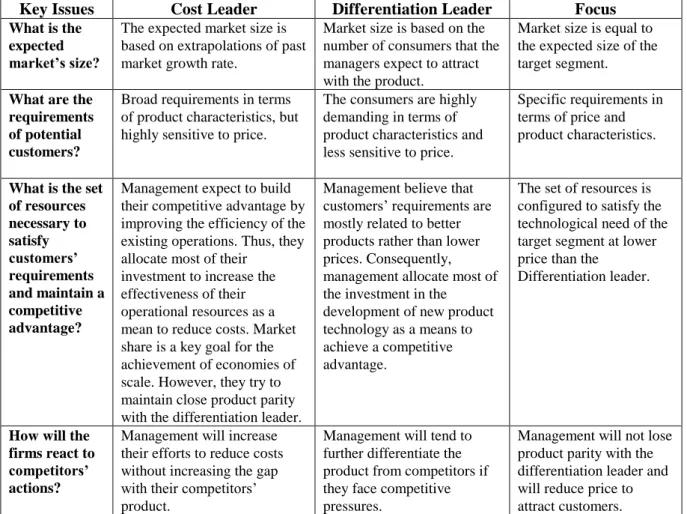
Based on the three types of managerial decision-making depicted before, we present in
table 1 the expected differences in four key issues faced by most of the firms in any industry:
market size, customers’ requirements, sources (in terms of asset stocks that need to be
developed) of competitive advantage, and competitors’ reactions.
Key Issues Cost Leader Differentiation Leader Focus
What is the expected market’s size?
The expected market size is based on extrapolations of past market growth rate.
Market size is based on the number of consumers that the managers expect to attract with the product.
Market size is equal to the expected size of the target segment.
What are the requirements of potential customers?
Broad requirements in terms of product characteristics, but highly sensitive to price.
The consumers are highly demanding in terms of product characteristics and less sensitive to price.
Specific requirements in terms of price and product characteristics.
What is the set of resources necessary to satisfy customers’ requirements and maintain a competitive advantage?
Management expect to build their competitive advantage by improving the efficiency of the existing operations. Thus, they allocate most of their
investment to increase the effectiveness of their operational resources as a mean to reduce costs. Market share is a key goal for the achievement of economies of scale. However, they try to maintain close product parity with the differentiation leader.
Management believe that customers’ requirements are mostly related to better products rather than lower prices. Consequently, management allocate most of the investment in the development of new product technology as a means to achieve a competitive advantage.
The set of resources is configured to satisfy the technological need of the target segment at lower price than the
Differentiation leader.
How will the firms react to competitors’ actions?
Management will increase their efforts to reduce costs without increasing the gap with their competitors’ product.
Management will tend to further differentiate the product from competitors if they face competitive pressures.
Management will not lose product parity with the differentiation leader and will reduce price to attract customers.
TABLE 1. Differences in decision-making styles using the Porter’s (1985) generic strategies
Model Formalisation
The model addresses the dynamic behaviour of the industry by identifying the dynamic
behaviour of individual competing firm and consumer response to firms’ actions rather than
using an aggregate view of the industry. In this model, firms have two main components:
decision functions as simple rules of thumb similarly to behavioural simulation models
(Sterman, 1987, Morecroft, 1985b). The system of resources that constitutes the firms are based
on the approach depicted in the dynamic resource-based view of strategy (Morecroft, 2000;
Warren, 2002).
Consumer behaviour is based on literature related to the diffusion and adoption of
innovations in heterogeneous populations (Mahajan, Muller, and Wind, 2000), and a simplified
model of consumer choice.
Firms
Firms in this model are assumed to be embedded in a reinforcing feedback process
regulated by managerial decision-making processes. Figure 2 represents a simplified view of
the structure of our simulated firms. Management focus its attention on sources of information
related to the performance of the firm such as profits or market share to coordinate the sectors
of the firm. There are four sectors that represent the main resources of our simulated firm:
Financial, Technology, Operational and Market Development (Marketing). The financial
sector contains one asset stock that symbolizes the financial resources of the firm. The
technology sector contains two asset stocks: one corresponds to the product technology and the
other indicates the level of productivity of the operational resources. The operational sector
contains the asset stock that represents the capacity of the firm to provide products. Finally, the
market development sector includes the marketing actions to attract customers such as price
and advertising.
INSERT FIGURE 2
Financial Resources. The goal of the decision-making process in the financial sector is to
operating income) rather than the level of the stock of financial resources. Management will
allocate more financial resources to change the configuration of the source of competitive
advantage (technology or operational resources productivity) if they fail to maintain the
operating income over time as can be seen in the left hand-side part of the table function. If the
rate of profits is considered to be satisfactory, management will reduce the allocation of
resources to technology, as they believe they have achieved a satisfactory configuration of the
product technology as can be see in the right-hand side of the table function (the stock and flow
diagram and a full list of the equations of this sector are in the Appendix).
Effect of Goal Non-attainment in the Normal Rate of Investment in Technology
Technology resources. In this simplified model, the set of resources responsible for the
competitive advantage and superior performance is the set of Technology Resources.
Technology resources comprise two resources: Product Technology and Operational
Efficiency. Product technology is the key resource for firms following a differentiation strategy,
and operational efficiency is the key resource for firms following a cost leadership strategy.
This set of resources describes the technological level of the product portfolio and the
operational efficiency level of the firm. For simplicity, we assume that the resource named
directly associated to the level of potential customers’ requirements; for example, a product
technology level of 100 is fairly close to cover all the possible customers’ requirements, and,
consequently, the firm may be able to attract a huge number of customers from the total
available market. Moreover, a higher product technology level relative to its competitors’ level
will attract not only potential customers but also customers from existing competitors.
Management change the level of the Product Technology through the investment of financial
resources, which correspond to the allocation of resources to product development projects.
Management can also invest financial resources to increase the efficiency of the
Operational resources. Operational Efficiency represents the cumulative efforts of the firm to
refine the operating technology for the actual type of products. Operational Efficiency reflects
the management efforts to reduce costs independently of the economies of scale achieved
through Operational Resources. A firm following a differentiation strategy will invest financial
resources in Operational Efficiency only when its management perceive that the actual Product
Technology level is accepted in the market. Thus, the differentiation leader will invest more in
Operational Efficiency when the operating income is increasing or stable to improve further the
income generated as the next table function shows.
On the other hand, management following a Cost leader strategy believes that their
main competitive advantage is to have the lowest cost. Consequently, management will invest
more resources to increase the efficiency of its Operational Resources and less in the
technology of the product. We assume this management style will allocate few resources to
change the technology of its products because it erodes the gains obtained from investing in
Operating Efficiency. However, if there is a widening gap between the Differentiation
Leader’s product and its own product technologies, a cost leader firm will allocate more
resources to promptly reduce the existing gap as can be observed in the next table function (see
Appendix 1 for the equations and the stock and flow diagram).
Effect of Technology Gap in the Allocation of Financial Resources to Product Technology Development
We assume that the technologies are similar to all participants in the industry. For
example, the effect of change in product technology affects similarly to the operational
efficiency in both Cost and Differentiation Leader; the economies of scale achievable by both
firms are identical; the rate of improvement of operational efficiency as well as the initial
productivity per unit of Operational Resource are also similar; and, finally, the level of
assumption. First, all resources are sourced from external and common suppliers to the
industry. Second, we want to explore in these simulations the result of dissimilar managerial
decision-making styles in a competitive industry, and not intrinsic differences in the set of
resources.
Operational Resources. We use the concept of Operational Resources to capture physical and
human assets stocks that are necessary to provide the products requested by customers. Firms
start with an initial endowment of resources that reflects their initial investments, and the
development of these resources depends on the expectations that managers have about the
evolution of the market. We assume that there is no backlog or infinite supply as well as any
effect of lower supply than demand in the consumer behaviour. Consequently, we assume that
the potential sales revenue (the unit sold to actual customers –repetitive buyers- and the unit
sold to new customers –first buyers-) is reduced by the availability of volume produced (level
of units of Operational Resources multiplied by the productivity per unit of operational
resource), and any shortage in product availability will not affect the movement of customers
between firms.
Finally, there are a series of additional assumptions related to Operational Resources.
First, the level of Operational Resources determines the basic cost per unit of product, which is
influenced by the effect of economies of scale. Second, when Operational Efficiency increases,
the productivity per unit of operational resource also increases. Higher productivity reduces the
real cost per unit of product and the amount to invest in expanding operational resources.
Operational resources is subject to a normal depreciation rate; however, when firm changes its
technology not only increases the normal depreciation rate due to technological obsolescence
Competitive Actions. While the set of resources is a source of the long-term competitive
advantage, management also take short-term competitive actions. These short-term actions are
related to the process of attraction of potential customers and competitors’ customers. In the
model, we present two short-term actions: price adjustments and advertising expenditure.
We use a ‘cost + gross margin’ pricing policy. Thus, price adjustments, which are a
result of the non-attainment of the market size goal, are implemented through the adjustment of
the gross margin as can be observed in the next table function. While a reduction of the gross
margin affects the profitability in the short term, two long-term strategic actions are also
included in the model: cost reduction through better operational efficiency and improvement of
product technology relative to competitors’ technology. Consequently, a reduction in price will
attract more customers to improve the operating income in the long-term (if the discount does
not exceed the benefit of more sales) and obtain resources to invest in cost reduction or
technology improvement.
Effect of Market Size Goal non-attainment in the gross margin
Advertising expenditure helps to attract potential customers to the industry and expand
perspective not only of the firm but also of the industry. (see in Appendix 1 the stock and flow
diagram and the equations for these sector).
Finally, consumers use price, product functionality and advertising to define the best
alternative to adopt, as a first buyer, and, later on, to replace the actual product as a repetitive
buyer (Cost Leader, Differentiation Leader or Focus products).
To conclude, table 2 presents a summary of the main decisions existing in the behavioural
model of the firm.
Management Decisions
Cost Leader Differentiation Leader Focus
Financial Resources
The objective is to maintain a stable operating income. If actual profit rate is lower than past profit rate, more financial resources will be allocated to the development of technology or operational efficiency.
The objective is to maintain a stable operating income. The evolution of profits determines the intensity of the resources allocated to technology development.
The objective is to maintain a stable operating income. The achievement of the expected market size determines the intensity of the investment in product technology.
Technology Resources
The configuration of Technology Resources is principally oriented to reduce costs by increasing operating efficiency. However, if there is an important gap with competitor’s product, the resources are mostly used to reduce the gap with competitor’s technology.
The source of competitive advantage is believed to be the development of new products. Consequently, the resources are mostly allocated to develop the product technology.
The technology goal is based on information about the requirements of the customers segment in terms of the technology of the product leader in the market
(differentiation leader product).
Operational Resources
The expected size of the market, which is adjusted by an extrapolation of the actual market growth rate, determines the expansion rate of this asset stock.
Operational resources are developed over time based on the management’s expected size of the market.
This participant does not have specific operational resources. We assume that it does not have specific manufacturing resources but a cost of sourcing the product from third parties.
Competitive Actions
Price: It aims to be lowest in market by reducing gross margin and costs of good.
Advertising: lower budget than the differentiation leader.
Price: higher than average in market but it will tend to cut gross margin aggressively if the expected market size is not achieved. However, it will increase price very fast when expectations about market size achieved are fulfilled. Advertising: highly intensive.
Price: average in market. Advertising: no resources invested in advertising.
Market Sector
The simplest model of the evolution of markets over time is the Bass Diffusion Model
(Bass, 1969). The Bass Diffusion Model has been extensively used in System Dynamics to
describe the diffusion of innovations (Sterman, 2000). The basic version of the Bass Diffusion
Model considers the diffusion process independently from the effects of firms’ strategies
(except Advertising) or the distribution of the customers’ preferences. Some researchers have
modified the model to portray customers’ response to firms’ actions; for example, Paich and
Sterman (1993) presented a revised version using price adjustment to modify the size of the
pool of potential customers.
The Bass Diffusion Model is an interesting starting point but it does not present consumers’
decision-making process. For example, the model only considers consumers’ decision-making
processes homogeneous and driven mainly by word-of-mouth. However, customers consider
other factors such as functionality and price before buying a product. While price is an
important factor to influence consumer behaviour, it does not capture the most essential
process during the evolution of industries: The match between customers’ requirements in
terms of product’s functionality and the ability of firms in the industry to provide the best
product that match these functionalities. Consequently, we include three modifications to the
Bass diffusion model in our simulated market:
• First, the stock of potential customers, fixed in a Bass based model, may change over time
as product functionality changes attracting others segments of people who have not been
interested in the product yet. The function represents the process of attracting different
segments of the total population as product technology evolves. When the industry
improves their product technology (or product functionality), the proportion of the total
population interested increases (and the fractional rate of attraction per time increases).
population remain without using the products of the industry. The next graph represents
the table function that depicts the relationship between the average product technology at
industry level and fractional rate of attraction over time of the industry.
Fractional Rate of Attraction of the Total Market
• Second, we have included behavioural variables to represent a basic consumer
decision-making process at the adoption of a new product. A weighted value is obtained for each
alternative (Cost Leader or Differentiation Leader alternatives) in function of the relative
weights that heterogeneous customers (Price or Product functionality sensitive adopters)
have about each dimension (price, product functionality or advertising) and the relative
strength of each alternative in these dimensions with respect to the existing alternatives in
the market (e.g.: Cost Leader product functionality compared to average product
functionality). The components are then combined in an overall value for that alternative in
terms of share of the potential customers that adopt any of the existing alternatives in the
market (Cost Leader alternative or Differentiation Leader alternative). The next equation
describes the process mentioned before for the Cost leader:
Adoption Rate for Cost Leader (i)= Price_Sensitive_Adopters*[α1*(Product_Technologyi/Σ
Functionality_Sensitive_Adopters*[α2*(Product_Technologyi/Σ Product_Technologyij) +
β2*(Advertisingi/Σ Advertisingij)+ γ2*(Pricej/Σ Priceij)]
Where α1 + β1 + γ1 = 1 and α2 + β2 + γ2 = 1 indicate the different weights that each type of adopter
gives to each dimension to arrive a value for each alternative; and α1 + α2 = 1, β1 + β2 = 1 and γ1 +
γ2 =1 indicate the weight that each type of adopter gives to the different dimensions. A stock and
flow diagram and the equations are included in appendix 1.
• Third, customers may change the product as competitors offer better products for the
same price or a lower price for the same product technology. The movement of
customers between firms in the industry is regulated by a long-term perception of the
relative position of each alternative (cost leader alternative or differentiation leader
alternative) in each dimension (price or product technology). For example, customers
may perceive as ‘natural’ situations where the prices of the differentiation leader is 28%
higher than the cost leader but only if the differentiation leader’s product is at the same
time 28% better than the product of the cost leader. Whenever firms in the industry
change these perceived relationships, customers will respond by switching to the firm
that offers the best combination of price and product technology. If the rival does not
react promptly, it may find itself out of the market. For simplicity, we do not model the
effect of learning processes at consumer level that may change the ‘natural’
relationships between alternatives in a certain dimension. The table function represents
the price relationship and its effects in terms of percentage of customers per unit of time
moving from one firm to the other when the actual price ratio is different than the
neutral price.
Appendix 1 contains all the equations and stock and flow diagram representing the
Long-term customers perceived price ratio between Differentiation Price and Cost Leader Price
Results of the Simulation
The natural distribution of the customers – the industry in equilibrium
The industry has three firms that each of them follows one of the three decision-making styles:
Cost Leadership, Differentiation Leadership and Focus. The total population is equally divided
among people willing to buy products according to their functionality given a certain price –
which is not necessarily the lowest- (functionality sensitive adopters), and willing to buy
products at the lowest price given a certain level of product functionality (price sensitive
adopters). In the first simulation, we left the initial conditions (price and product functionality)
fixed during all the simulation. Figure 3 presents the evolution of the market during the
simulation. Lines 1 and 2 represent the evolution of the number of customers captured by each
leader. Since the proportion of people sensitive to price and to product functionality is equal,
both leaders captured the same number of customers achieving equilibrium. Line 3 represents
the number of customer of Focus. Focus did not capture any customer because its product
INSERT FIGURE 3
Figure 4 presents the evolution of price and operating income for the two leaders during the
period of the simulation. The price and operating income of the Differentiation Leader were
higher than the Cost Leader price and operating income because it could charge a premium
price for a better product.
INSERT FIGURE 4
Industry with only Cost Leader and Differentiation Leader
Now, we simulated the industry with only two participants: a Cost Leader and a Differentiation
Leader. Figure 5 shows the evolution of the market. We can observe that the market reaches
equilibrium after quarter 130 with Differentiation Leader having 57% of the market. Both
leaders reached equilibrium when the product of the differentiation leader was 60% better than
cost leader product at a price 70% higher than cost leader price. At these price and product
technology values the number of customers who chose to switch based on product functionality
is similar to those customers who switched based on price. Consequently, the net movement of
customers between firms is zero.
INSERT FIGURE 5
We will analyze the simulation from quarter 1 to quarter 132 to identify the reasons
behind the success of the differentiation leader and demise of the cost leader. Figure 6 shows
the evolution of price and operating income for both leaders. We observe that the
attract more customers than the cost leader. However, differentiation leader rose its price too
soon as it perceived that the number of customers would keep increasing. Consequently, most
of the initial adopters were attracted by Cost Leader lower price. Cost leader obtained a huge
increase in the rate of operating profits surpassing Differentiation Leader operating income by
quarter 20, and the technological gap started to decrease as Cost Leader have more resources to
invest in technology. The Cost leader was helped by the pricing policy followed by the
Differentiation Leader, which maintained a wide gap with the price of the Cost Leader and a
small product technology difference. Only when the Differentiation Leader reduced its price to
match the price of the cost leader, Differentiation leader’s operating profits rose because it
attracted customers back. Only by quarter 50, the Differentiation Leader operating income
trend was definitively positive and growing over time because it has more resources to increase
the product technology and charge a higher price. On the other hand, Cost Leader management
continued reducing its price in order to attract the customers lost. However, this policy only
eroded more its declining operating income reducing its ability to invest in the reduction of the
technological gap with Differentiation leader as figure 7 displays.
INSERT FIGURE 6
While an increasing operating income allowed the Cost Leader management to close the
technological gap with Differentiation leader technology and employed the cost advantage for
the first 50 quarters, Cost Leader management lessened its ability to close the gap as they
continued reducing its prices when its market share was diminishing after quarter 50 as figure 7
shows.
In conclusion, Differentiation Leader aggressive price reduction at the beginning of the
industry helped it to achieve a huge market share; however, management propensity to raise
price without offering a more improved product corroded this initial advantage and customers’
long-term price relationship between alternatives drove customers to Cost Leader’s product.
Cost Leader continuous pricing reduction exploited the huge differentiation leader price to
attract customers. This huge improvement in market share created some future problems for
the Cost Leader. As Cost Leader management used past market share achieved as the source of
information for defining its prices, management started reducing its price when the
differentiation leader reaction eroded Cost Leader market share. This competitive response
from Cost Leader management destroyed the source –operating income- to sustain its long-term
cost advantage as it lost product technology parity entering into a reinforcing process.
Adding more complexity to the industry, not only a Cost and a Differentiation Leader but also
a firm with a Focus strategy
The industry now has three participants: Cost Leader, Differentiation Leader and Focus. Figure
8 presents the evolution of the market segments including a firm following a focus strategy. We
can observe that the market reaches equilibrium after quarter 160 with the Differentiation
Leader having 57% of the market. The market reached equilibrium between both leaders as the
firm following a focus strategy almost disappeared from the market. The equilibrium occurred
when the number of customers switching due to lower price was equal to the customers
switching due to better technology. Thus, we will concentrate on the first 160 quarters of the
simulation.
Figure 9 shows that the main competitive action of the Focus competitor was to
drastically reduce its price (line 3) in order to attract customers from Cost Leader and
Differentiation Leader. Focus’ alternative represented a better technology at the same price for
Cost Leader’s customers and it was a similar product technology at a much lower price for
Differentiation Leader’s customers. After Focus management achieved its expected market
size, it increased its price to the same level of Cost Leader. However, Focus management
could not sustain the continuous price reduction trend established by Cost Leader due to its
smaller size. Moreover, Cost Leader and Differentiation Leader investments in technology
determined that the product technology offered by the leaders was better than the product
technology available in Focus. From quarter 80, Focus started losing customers to both
leaders, and finally it almost disappeared by quarter 160. Such as Porter (1985) suggested
Focus was trapped in the middle and it could not sustain any specific competitive advantage.
INSERT FIGURE 9
In conclusion, Focus in the industry contributed to reduce the divergences between the
Leaders. Focus acted as a buffer between both leaders in the industry as it absorbed part of the
effects of their competitive actions (see figure 10).
INSERT FIGURE 10
Key Findings
While we cannot suggest that managers mental models are either cost or differentiation
oriented, we can observe in this simulation how bounded rational managerial
not consider the complexity of the feedback structures and the consequences of
interconnected set of resources.
In the simulations, we can observe how the interconnection between functional areas of
a company may influence its performance over time as it generates competitors’
reactions that erode the effectiveness of appropriate decision-making process.
The existence of three or more firms in an industry increased the intensity of
competitive actions, especially those from the leaders, because the third firm acted as a
buffer or delay between the competitive action and the results obtained. This situation
resulted in a higher attrition rate of financial resources to sustain the competitive
advantage.
The dynamics of the industry did not change significantly when we tested different
proportions of the customers sensitive to price or product functionality, but we obtained
quite different results when we changed the market share goal of the firms.
Final Considerations
Managers face very complex investment decisions due to uncertainties about customer
acceptance, market size, technology, actions of competitors, and a dynamic complex feedback
system. In addition, the complexity of a system of interrelated stocks and the information
feedback structure of the industry raises managerial decision-making process as one of -if not-
the most important variable to manipulate the evolution of an industry.
This paper attempts to analyse the influence of managerial decision-making on the
evolution of industries, and more specifically on the dynamic behaviour of three key
components of any industry: the rate of growth of the firms, the evolution of the market, and
technology development. Porter (1991) suggests that firms can achieve superior competitive
conditions may be a good factor when we are analysing established industries; however, in
some circumstances, established conditions can be overcame from managerial actions such as
the simple actions observed in the simulations. Pure managerial choices, such as the definition
of a market share, lead to the assembly of particular resources required to carry out the strategy.
However, managerial choices can lead to non-desired consequences because of the complexity
of the environment and the cognitive limitations of the managers, especially when there are
different conceptualisations of the set of resources and the competitive actions.
We realise that the model has its limitations in terms of the decision-making processes
described and other relationships used in the model as well as the results obtained. However,
we believe that the model as a metaphor for illustrating the balancing and reinforcing processes
References
Adner, Ron and Levinthal, Daniel A. 2001. Demand Heterogeneity and Technology Evolution: Implications for Product and Process Innovation. Management Science. 47, (5): 611-628.
Bass, Frank. 1969. A New Product Growth for Model Consumer Durables. Management Science. 15, (5): 215-227.
Forrester, Jay W. 1994. Policies, Decisions and Information Sources for Modeling . In Sterman, John D. and Morecroft, John D. (eds). Modelling for Learning Organizations. Productivity Press;
Kunc, Martin. 2003. Industry Evolution: A dynamic behavioural model . System Dynamics Conference Proceedings. XXI Conference: New York;
Mahajan, Vijay; Muller, Eitan, and Wind, Yoram Editors. 2000. New-Product Diffusion Models. Boston: Kluwer Academic Publishers;
Morecroft, John D. 1985a. The feedback view of business policy and strategy. System Dynamics Review. 1 (1): 4-19;
---. 1985b. Rationality in the Analysis of Behavioral Simulation Models. Management Science. 31 (7): 900-916.
---. 2000. Visualising and Simulating Competitive Advantage: A Dynamic Resource-Based View of Strategy. System Dynamics Group, London Business School; (WP - 0036)
---. 2002. Resource Management Under Dynamic Complexity. In Morecroft, John D.; Heene, Aime, and Sanchez, Ron (eds). Systems Perspectives on Resources, Capabilities, and Management Processes. Oxford, England: Pergamon;
Paich, Mark and Sterman, JD. 1993. Booom, Bust, and Failures to Learn in Experimental Markets.. Management Science. 39:12, 1439-1458.
Porter, Michael E. 1985. Competitive Advantage. New York: The Free Press;
---. 1991. Towards a Dynamic Theory of Strategy. Strategic Management Journal. 12, 95-117.
Senge, Peter M. 1999. The Fifth Discipline The Art & Practice of The Learning Organization. United Kingdom: Random House ;
Simon, Herbert A. 2001. The Sciences of the Artificial 3rd Edition. The MIT Press:MA;
Sterman, John D. 1987. Testing Behavioral Simulation Models by Direct Experimentation. Management Science. 33, (12): 1572-1592.
---. 1989. Misperceptions of Feedback in Dynamic Decision Making. Organizational Behavior and Human Decision Processes. 43, (3): 301-335.
Sterman, John D. 2000. Business Dynamics Systems Thinking and Modeling for a Complex World. Irvine - McGraw-Hill: New York;
Warren, Kim. 2001. Strategy Dynamics and Scenarios of Industry Evolution (DRAFT). System Dynamics Conference Proceedings. IXX Conference: Atlanta;
Figures
FIGURE 1. Conceptual representation of the Micro Behavioural Model of the Evolution of Competitive Industries
Set of Internal Resources Revenues Investment in Resources M anagerial Investment Decisions Actual Cust omers + + + +
Pot ent ial Cust omers
Set of Internal Resources Competitors Revenues Competitors Investment in Resources Competitors
Competitors M anagerial Investment Decisions -+ + + Actual Customers Competitors + + + -Firm Evolution Market Evolution
FIGURE 2. Simplified Behavioural Model of the Firm
Market Sector
Product Attractiveness + Competitive Actions
Actual Customers Level
Technology Resources
Technology Level
Product Attractiveness Operational Resources
Capacity Level
Actual Customers Level
Financial Resources
Financial Resources
Profit Goals
Market Sector
Product Attractiveness + Competitive Actions
Actual Customers Level
Technology Resources Technology Level Product Attractiveness Technology Resources Technology Level Product Attractiveness Operational Resources Capacity Level
Actual Customers Level Operational Resources
Capacity Level
Actual Customers Level
Financial Resources
Financial Resources
Version 5 Page 1
1.00 80.75 160.50 240.25 320.00 Quarters 1: 1: 1: 2: 2: 2: 3: 3: 3: 4: 4: 4: 5: 5: 5: 0 5000 10000
1: Cost Leader Cust…2: Dif f Leader Custo…3: Focus C ustomers 4: Potential Market 5: Total Av ailable Ma…
1
1 1 1
2
2 2 2
3 4 5 3 4 5 3 4 5 3 4 5
Figure 3. Market evolution under the initial conditions – Industry equilibrium
16:00 02 Apr 2004
Untitled Page 3
1.00 80.75 160.50 240.25 320.00
Quarters 1: 1: 1: 2: 2: 2: 3: 3: 3: 4: 4: 4: -2000 2500 7000 1.30 1.95 2.60
1: Cost Leader Actual Operatin…2: Dif f Leader Actual Operating…3: Cost Leader Price 4: Dif f Leader Price
1
1 1 1
2
2 2 2
3 3 3 3
4 4 4 4
Untitled Page 1
1.00 80.75 160.50 240.25 320.00
Quarters 1: 1: 1: 2: 2: 2: 3: 3: 3: 4: 4: 4: 0 5000 10000
1: Cost Leader Customers 2: Dif f Leader Customers 3: Potential Market 4: Total Av ailable Market
1 1 1 1 2 2 2 2 3
3 3 3
4
4 4 4
FIGURE 5. Market Evolution with only a Differentiation (line 2) and Cost Leader (line 1).
Untitled Page 16
1.00 33.75 66.50 99.25 132.00
Quarters 1: 1: 1: 2: 2: 2: 3: 3: 3: 4: 4: 4: -1500 2500 6500 1.00 2.00 3.00
1: Cost Leader Actual Operatin…2: Dif f Leader Actual Operating…3: Cost Leader Price 4: Dif f Leader Price
1 1 1 1 2 2 2 2 3 3 3 3 4 4 4 4
Untitled Page 16
1.00 33.75 66.50 99.25 132.00
Quarters 1: 1: 1: 2: 2: 2: 3: 3: 3: 4: 4: 4: 5: 5: 5: 10 35 60 -1500 2500 6500 0 1 1
1: Cost Leader Product …2: Dif f Leader Product T…3: Cost Leader Actual O…4: Dif f Leader Actual Op…5: Cost Leader Actual M…
1 1 1 1 2 2 2 2 3 3 3 3 4 4 4 4 5 5 5 5
Figure 7. Cost Leader technology (line 1) and operating income (line 3) and Differentiation Leader product technology (line 2) and operating income (line 4).
Version 5 Page 1
1.00 80.75 160.50 240.25 320.00 Quarters 1: 1: 1: 2: 2: 2: 3: 3: 3: 4: 4: 4: 5: 5: 5: 0 5000 10000
1: Cost Leader Cust…2: Dif f Leader Custo…3: Focus C ustomers 4: Potential Market 5: Total Av ailable Ma…
1 1 1 1 2 2 2 2 3 3 3 3
4 5 4 5 4 5 4 5
Version 5 Page 2
1.00 40.75 80.50 120.25 160.00 Quarters 1: 1: 1: 2: 2: 2: 3: 3: 3: 4: 4: 4: 1.20 2.00 2.80 0.00 0.50 1.00
1: Cost Leader Price 2: Dif f Leader Price 3: Focus Price 4: Focus Actual Market Share
1 1 1 1 2 2 2 2 3 3 3 3
4 4 4
4
Figure 9. Cost Leader price (line 1), Differentiation Leader Price (line 2), and Focus price (line 3) and market share (line 4)
Version 5 Page 6
1.00 40.75 80.50 120.25 160.00 Quarters 1: 1: 1: 2: 2: 2: 3: 3: 3: 4: 4: 4: 0 1 1
1: Cost Leader Actual Mark…2: Dif f Leader Actual Marke…3: Cost Leader Market Sha…4: Dif f Leader Market Shar…
1 1 1 1 2 2 2 2 3 3 3 3 4 4 4 4
Appendix 1
FINANCIAL SECTOR
Diff L ead er V ol ume S ol d
Diff L ead er Uni ts s ol d per cus to mer
Diff L ead er Fi na nci al Re sou rc es
Diff L ead er A ctual Op eratin g In come
Diff L ead er A ctual In vestmen ts
Diff L ead er Ma rg in Con tri buti on
Diff L ead er P la nni ng Hori zon Diff L ead er
Custome rs Differenti atio n Lea der
A dop ti on Rate Diff L ead er Uni t Costs of Go ods S ol d
Diff L ead er Operati ng E xpen ses
Diff L ead er P ri ce
Diff L ead er Inves tme nt A l lo cated to
T ech nol og y Res ource s
Diff L ead er A ctual In vestmen t Rate
i n Te chn ol ogy
Diff L ead er A ctual Op eratin g In come
Diff L ead er E stabl i she d Op eratin g In come ~
Diff L ead er
E ffec t of Op eratin g In come T rend on Inve stment Ra te s
Diff L ead er Normal A dve rti si ng
E xpen di tu re
Diff L ead er Normal Inve stment Ra te
i n Te chn ol ogy
Diff L ead er Inves tme nt a ll oc ated to Op eratio nal Re sou rc es
~ Diff L ead er
E ffec t of Op eratin g In come T rend on Op E ffi ci enc y Diff L ead er
Operati ona l Reso urces
Diff L ead er A ctual Prod ucti vty pe r Uni t
of Op eratio nal Re sou rc e
Diff_Leader_Financial_Resources(t) = Diff_Leader_Financial_Resources(t - dt) + (Diff_Leader_Actual_Operating_Income - Diff_Leader_Actual_Investments) * dt INIT Diff_Leader_Financial_Resources = 10000
INFLOWS:
Diff_Leader_Established__Operating_Income =
SMTH1(Diff_Leader_Actual_Operating_Income,Diff_Leader_Planning_Horizon) Diff_Leader_Investment_Allocation_in_Technology_Resources =
Diff_Leader_Actual_Operating_Income*Diff_Leader_Actual_Investment_Rate_in_Technology Diff_Leader_Normal_Investment_Rate_in_Technology = 0.1
Diff_Leader_Planning_Horizon = 8
Diff_Leader__Operating_Expenses = Diff_Leader_Normal_Advertising_Expenditure Diff_Leader___Margin_Contribution =
(Diff_Leader_Price-Diff_Leader_Unit_Costs_of_Goods_Sold)*MIN((Diff_Leader_Customers+Differentiation_Leader_Adoption_ Rate),Diff_Leader_Operational_Resources*Diff_Leader_Actual_Productivty_per_Unit_of_Operational_Reso urce)
Diff_Leader_Effect_of_Operating_Income_Trend_on_Investment_Rates =
GRAPH(Diff_Leader_Actual_Operating_Income/Diff_Leader_Established__Operating_Income)
(0.8, 1.50), (0.84, 1.37), (0.88, 1.25), (0.92, 1.15), (0.96, 1.02), (1.00, 1.00), (1.04, 0.975), (1.08, 0.85), (1.12, 0.74), (1.16, 0.615), (1.20, 0.5)
Diff_Leader_Effect_of_Operating_Income_Trend_on_Op_Efficiency =
GRAPH(Diff_Leader_Actual_Operating_Income/Diff_Leader_Established__Operating_Income) (0.8, 0.1), (0.84, 0.112), (0.88, 0.116), (0.92, 0.122), (0.96, 0.126), (1.00, 0.14), (1.04, 0.176), (1.08, 0.224),
(1.12, 0.278), (1.16, 0.354), (1.20, 0.5)
Cost_Leader_Financial_Resources(t) = Cost_Leader_Financial_Resources(t - dt) + (Cost_Leader_Actual_Operating_Income - Cost_Leader_Actual_Investments) * dt INIT Cost_Leader_Financial_Resources = 10000
INFLOWS:
Cost_Leader_Actual_Operating_Income = Cost_Leader__Contribution_Margin-Cost_Leader__Operating_Expenses
OUTFLOWS:
Cost_Leader_Actual_Investments =
Cost_Leader_Investment_Allocation_in_Technology_Resources+Cost_Leader_Investment_Rate_in_Oper ational_Resources
Cost_Leader_Actual_Investment_Rate_in_Technology =
Cost_Leader_Normal_Investment_Rate_in_Technology*Cost_Leader_Effect_of_Operating_Income_Trend_o n_Investment_Rates
Cost_Leader_Established__Operating_Income =
SMTH1(Cost_Leader_Actual_Operating_Income,Cost_Leader_Planning_Horizon) Cost_Leader_Fraction_of_Resources_invested_in_Op_Efficiency =
1-Cost_Leader_Effect_of_Perceived_Technological_Gap_on_Investment Cost_Leader_Investment_Allocation_in_Technology_Resources =
Cost_Leader_Actual_Operating_Income*Cost_Leader_Actual_Investment_Rate_in_Technology Cost_Leader_Normal_Investment_Rate_in_Technology = 0.1
Cost_Leader__Contribution_Margin =
(Cost_Leader_Price-Cost_Leader_Unit_Costs_of_Goods_Sold)*MIN((Cost_Leader_Customers+Cost_Leader_Adoption_Rate), Cost_Leader_Operational_Resources*Cost_Leader_Actual_Productivty_per_Unit_of_Operational_Resource) Cost_Leader__Operating_Expenses = Cost_Leader_Advertising_Expenditure_Level
Cost_Leader_Effect_of_Operating_Income_Trend_on_Investment_Rates =
GRAPH(Cost_Leader_Actual_Operating_Income/Cost_Leader_Established__Operating_Income) (0.8, 1.50), (0.84, 1.37), (0.88, 1.25), (0.92, 1.15), (0.96, 1.02), (1.00, 1.00), (1.04, 0.975), (1.08, 0.85), (1.12,
0.74), (1.16, 0.615), (1.20, 0.5)
Focus Management Goal and Financial Resources
Focus_Financial_Resources(t) = Focus_Financial_Resources(t - dt) + (Focus_Actual_Operating_Income - Focus_Actual_Investments) * dt
INIT Focus_Financial_Resources = 5000 INFLOWS:
Focus_Actual_Operating_Income = Focus_Contribution OUTFLOWS:
Focus_Financial_Resources*Focus_Investment_in_Technology_Normal_Rate*Focus_Effect_of_Market_Size _Achievement
Focus_Contribution =
(Focus_Price-Focus___Unit_Cost_of_Goods_Sold)*(Focus_Customers+Segment_Customers_Driven_by_Functionality_Swi tching_Rate+Segment_Customers_Driven_by_Price_Switching_Rate)
Focus_Investment_in_Technology_Normal_Rate = 0.1 Focus_Effect_of_Market_Size_Achievement =
GRAPH(Focus_Customers/Focus_Estimated_Size_Market_Segment)
(0.8, 1.50), (0.84, 1.41), (0.88, 1.31), (0.92, 1.18), (0.96, 1.10), (1.00, 1.00), (1.04, 0.86), (1.08, 0.685), (1.12, 0.62), (1.16, 0.56), (1.20, 0.5)
Focus_Estimated_Size_Market_Segment = GRAPH(TIME)
(1.00, 10.0), (12.9, 195), (24.8, 335), (36.7, 495), (48.6, 615), (60.5, 720), (72.4, 825), (84.3, 905), (96.2, 965), (108, 995), (120, 1000)
Focus_Expected_Rate_of_Change_in_Product_Technology = GRAPH(Focus_Actual_Investment_in_Technology)
(0.00, 0.00), (100, 0.00555), (200, 0.0101), (300, 0.0135), (400, 0.0172), (500, 0.021), (600, 0.0243), (700, 0.0268), (800, 0.0286), (900, 0.0297), (1000, 0.03)
Focus_Short_term_Gross_Margin = GRAPH(Focus_Customers/Focus_Estimated_Size_Market_Segment) (0.8, 0.6), (0.84, 0.681), (0.88, 0.795), (0.92, 0.939), (0.96, 1.03), (1.00, 1.10), (1.04, 1.15), (1.08, 1.17), (1.12,
1.19), (1.16, 1.20), (1.20, 1.20)
TECHNOLOGY SECTOR
Diff L ead er P ro duc t T ech nol og y
Diff L ead er Chan ge i n Prod uct
T ech nol og y Rate
Diff L ead er Operati ona l E ffi ci enc y
Diff L ead er Increa se i n Op eratio nal
E ffi ci enc y Rate
Diff L ead er Operati ona l E ffi ci enc y
Decrea se Rate
Differenti atio n Lea der P ro duc t T ech nol og y Rel ative Cha nge
~ Diff L ead er T ech nol og y Cha nge E ffe ct
on Operati ona l E ffi ci enc y
Diff L ead er Ini ti al Prod ucti vity per Un it
of Op eratio nal Re sou rc e Diff L ead er
A ctual Prod ucti vty pe r Uni t of Op eratio nal Re sou rc e Diff L ead er
Inves tme nt A l lo cated to T ech nol og y Res ource s
Diff L ead er Fi na nci al Re sou rc es al l oca te d to Op Improveme nt
~ Diff L ead er Operati ona l Improveme nts
Increa se Rate ~ Diff L ead er
E ffec t of Op eratin g In come T rend on Op E ffi ci enc y Diff L ead er
Fi na nci al Re sou rc es al l oca te d to P rodu ct T ec hno lo gy
~ Diff L ead er E xpec te d Ra te o f Chan ge
i n Prod uct Te chn ol ogy
Maxi mum Te chn ol ogi ca l E ffi ci enc y ~
E ffec t of li mi t i n Te chn ol ogi ca l E ffi ci enc y o ver Improve ments 2
Diff_Leader_Operational_Efficiency(t) = Diff_Leader_Operational_Efficiency(t - dt) + (Diff_Leader_Increase_in_Operational_Efficiency_Rate -
INIT Diff_Leader_Operational_Efficiency = 1 INFLOWS:
Diff_Leader_Increase_in_Operational_Efficiency_Rate =
(Diff_Leader_Operational_Efficiency*Diff_Leader_Operational_Improvements_Increase_Rate)*Effect_of _limit_in_Technological_Efficiency_over_Improvements_2
OUTFLOWS:
Diff_Leader_Operational_Efficiency_Decrease_Rate =
Diff_Leader_Operational_Efficiency*Diff_Leader_Technology_Change_Effect__on_Operational_Efficien cy
Diff_Leader_Product_Technology(t) = Diff_Leader_Product_Technology(t - dt) + (Diff_Leader_Change_in_Product_Technology_Rate) * dt
INIT Diff_Leader_Product_Technology = 16 INFLOWS:
Diff_Leader_Change_in_Product_Technology_Rate =
Diff_Leader_Product_Technology*Diff_Leader_Expected_Rate_of_Change_in_Product_Technology Differentiation_Leader_Product_Technology_Relative_Change =
Diff_Leader_Change_in_Product_Technology_Rate/Diff_Leader_Product_Technology Diff_Leader_Financial_Resources_allocated_to_Op_Improvement =
Diff_Leader_Investment_Allocation_in_Technology_Resources*Diff_Leader_Effect_of_Operating_Income_T rend_on_Op_Efficiency
Diff_Leader_Financial_Resources_allocated_to_Product_Technology = Diff_Leader_Investment_Allocation_in_Technology_Resources-Diff_Leader_Financial_Resources_allocated_to_Op_Improvement Diff_Leader_Expected_Rate_of_Change_in_Product_Technology =
GRAPH(Diff_Leader_Financial_Resources_allocated_to_Product_Technology)
(0.00, 0.00), (100, 0.00555), (200, 0.0101), (300, 0.0135), (400, 0.0172), (500, 0.021), (600, 0.0243), (700, 0.0268), (800, 0.0286), (900, 0.0297), (1000, 0.03)
Diff_Leader_Operational_Improvements_Increase_Rate =
GRAPH(Diff_Leader_Financial_Resources_allocated_to_Op_Improvement)
(0.00, 0.0005), (100, 0.00325), (200, 0.0065), (300, 0.011), (400, 0.0148), (500, 0.0203), (6 00, 0.031), (700, 0.0403), (800, 0.0452), (900, 0.0495), (1000, 0.05)
Diff_Leader_Technology_Change_Effect__on_Operational_Efficiency = GRAPH(Differentiation_Leader_Product_Technology_Relative_Change)
(0.00, 0.00), (0.1, 0.0005), (0.2, 0.0025), (0.3, 0.0045), (0.4, 0.0075), (0.5, 0.013), (0.6, 0.0203), (0.7, 0.0288), (0.8, 0.037), (0.9, 0.0445), (1, 0.05)
Effect_of_limit_in_Technological_Efficiency_over_Improvements_2 =
GRAPH(Diff_Leader_Operational_Efficiency/Maximum_Technological_Efficiency)
(0.00, 1.00), (0.1, 0.995), (0.2, 0.975), (0.3, 0.925), (0.4, 0.81), (0.5, 0.63), (0.6, 0.46), (0.7, 0.355), (0.8, 0.2), (0.9, 0.075), (1, 0.00)
Cost_Leader_Operational_Efficiency(t) = Cost_Leader_Operational_Efficiency(t - dt) + (Cost_Leader_Increase_in_Operational_Efficiency_Rate -
Cost_Leader_Operational_Efficiency_Decrease_Rate) * dt INIT Cost_Leader_Operational_Efficiency = 1
INFLOWS:
Cost_Leader_Increase_in_Operational_Efficiency_Rate =
Cost_Leader_Operational_Efficiency*Cost_Leader_Operational_Improvements_Increase_Rate*Effect_of_ technological_limits_in_the_improvement_of_Efficiency
OUTFLOWS:
Cost_Leader_Operational_Efficiency_Decrease_Rate =
Cost_Leader_Operational_Efficiency*Cost_Leader_Technology_Change_Effect__on_Operational_Efficie ncy
Cost_Leader_Product_Technology(t) = Cost_Leader_Product_Technology(t - dt) + (Cost_Leader_Change_in_Product_Technology_Rate) * dt
INIT Cost_Leader_Product_Technology = 12.5 INFLOWS:
Cost_Leader_Change_in_Product_Technology_Rate =
Cost_Leader_Investment_Allocation_in_Technology_Resources-Cost_Leader_Financial_Resources_allocated_to_Product_Technology Cost_Leader_Financial_Resources_allocated_to_Product_Technology =
Cost_Leader_Investment_Allocation_in_Technology_Resources*Cost_Leader_Effect_of_Perceived_Technolo gical_Gap_on_Investment
Cost_Leader_Product_Technology_Relative_Change =
Cost_Leader_Change_in_Product_Technology_Rate/Cost_Leader_Product_Technology
Cost_Leader_Technology_Gap = Diff_Leader_Product_Technology-Cost_Leader_Product_Technology Maximum_Technological_Efficiency = 1.5
Cost_Leader_Effect_of_Perceived_Technological_Gap_on_Investment =
GRAPH((Diff_Leader_Product_Technology)/Cost_Leader_Product_Technology)
(1.00, 0.05), (1.05, 0.0775), (1.10, 0.083), (1.15, 0.0885), (1.20, 0.0912), (1.25, 0.0995), (1.30, 0.122), (1.35, 0.165), (1.40, 0.223), (1.45, 0.33), (1.50, 0.6)
Cost_Leader_Operational_Improvements_Increase_Rate =
GRAPH(Cost_Leader_Financial_Resources_allocated_to_Op_Improvement)
(0.00, 0.0005), (100, 0.00325), (200, 0.0065), (300, 0.011), (400, 0.0148), (500, 0.0203), (600, 0.031), (700, 0.0403), (800, 0.0452), (900, 0.0495), (1000, 0.05)
Cost_Leader_Technology_Change_Effect__on_Operational_Efficiency = GRAPH(Cost_Leader_Product_Technology_Relative_Change)
(0.00, 0.00), (0.1, 0.001), (0.2, 0.003), (0.3, 0.005), (0.4, 0.008), (0.5, 0.013), (0.6, 0.02), (0.7, 0.029), (0.8, 0.037), (0.9, 0.045), (1, 0.05)
Cost_Leader_Time_to_adjust_Technology_Gap =
GRAPH(Cost_Leader_Financial_Resources_allocated_to_Product_Technology)
(0.00, 40.0), (100, 37.0), (200, 33.0), (300, 28.0), (400, 22.0), (500, 17.0), (600, 13.0), (700, 10.0), (800, 8.00), (900, 6.00), (1000, 4.00)
Effect_of_technological_limits_in_the_improvement_of_Efficiency =
GRAPH(Cost_Leader_Operational_Efficiency/Maximum_Technological_Efficiency)
(0.00, 1.00), (0.1, 0.995), (0.2, 0.975), (0.3, 0.925), (0.4, 0.81), (0.5, 0.63), (0.6, 0.46), (0.7, 0.355), (0.8, 0.2), (0.9, 0.075), (1, 0.00)
MARKET DEVELOPMENT DRIVERS AND CONSUMER COMPETITION
Diff L ead er Uni t Costs of Go ods S ol d
Diff L ead er Gro ss Margi n
Diff L ead er Chan ge i n Gros s Ma rg in
Diff L ead er P ri ce
Diff L ead er Gro ss Margi n Ad ju stment
Diff L ead er A dvertis in g E xpen di tu re
~ Diff L ead er E ffec t of Ma nag emen t Goal A chi eve ment on A dvertis in g
~ Diff L ead er E ffec t of Ma nag emen t Goal A chi eve ment on Gro ss Margi n ~
Diff L ead er E xpec te d Ma rke t S ize
Diff L ead er Custome rs Diff L ead er
P ro duc t T ech nol og y
Diff L ead er A ctual Prod ucti vty pe r Uni t
of Op eratio nal Re sou rc e
Diff L ead er P la nni ng Hori zon
Diff L ead er Normal A dve rti si ng
E xpen di tu re
~ Diff L ead er B asi c Operati ona l
Cost per Un it
Diff L ead er T ime to A dj ust
Gro ss Margi n
Differentiation Leader Market Development Drivers Diff_Leader_Advertising_Expenditure =
(Diff_Leader_Effect_of_Management_Goal_Achievement_on_Advertising*Diff_Leader_Normal_Advertising _Expenditure)
Diff_Leader_Normal_Advertising_Expenditure = 1500
Diff_Leader_Price = Diff_Leader_Unit_Costs_of_Goods_Sold*(1+Diff_Leader_Gross_Margin) Diff_Leader_Unit_Costs_of_Goods_Sold =
(Diff_Leader_Basic_Operational_Cost_per_Unit)/Diff_Leader_Actual_Productivty_per_Unit_of_Operational _Resource
Diff_Leader_Basic_Operational_Cost_per_Unit = GRAPH(Diff_Leader_Operational_Resources)
(0.00, 1.00), (500, 0.983), (1000, 0.969), (1500, 0.956), (2000, 0.94), (2500, 0. 931), (3000, 0.924), (3500, 0.918), (4000, 0.917), (4500, 0.917), (5000, 0.917)
Diff_Leader_Effect_of_Management_Goal_Achievement_on_Advertising = GRAPH(Diff_Leader_Customers/Diff_Leader_Expected_Market_Size)
(0.8, 1.60), (0.84, 1.59), (0.88, 1.59), (0.92, 1.57), (0.96, 1.55), (1.00, 1.51), (1.04, 1.45), (1.08, 1.39), (1.12, 1.32), (1.16, 1.20), (1.20, 1.00)
Diff_Leader_Expected_Market_Size = GRAPH(TIME)
(0.00, 1.00), (8.00, 500), (16.0, 1625), (24.0, 2350), (32.0, 3025), (40.0, 4025), (48.0, 4550), (56.0, 4825), (64.0, 5000), (72.0, 5000), (80.0, 5000)
Diff_Leader_Gross_Margin =
GRAPH(SMTH1((Diff_Leader_Customers/Diff_Leader_Expected_Market_Size),Diff_Leader_Planning_Hori zon))