Vital through self-concept bias modification? Using
a computer based Intervention for gaining implicit
and explicit vitality
Bachelor Thesis 2017
Roman Klein, s1572237
University of Twente
Faculty of Behavioral, Management and Social Sciences
Psychology
Table of content
1.Introduction ...3
1.1 Vitality ...3
1.2 Self-concept ...5
1.3 Implicit and explicit self-concept ...6
1.4 Implicit association test (IAT) ...7
1.5 Research question and hypotheses ...8
2. Method ...4
2.1 Design ...9
2.2 Participants ...9
2.3 Materials ... 10
2.3.1 Subjective vitality scale (SVS) ... 10
2.3.2 Brief IAT (BIAT)... 11
2.3.3 Modified IAT (Self-concept IAT) ... 11
2.4 Procedure... 12
2.5. Analysis ... 13
3. Results ... 13
4. Discussion ... 14
5. References... 17
6. Appendix ... 21
Appendix A: Study Introduction ... 21
Appendix B: Informed consent ... 21
Appendix C: BIAT ... 22
Appendix D: SVS Questionnaire... 22
Appendix E: CBM-IAT Explanation ... 23
Appendix F: Self-Concept IAT Intervention ... 23
Abstract
Aims: The aim of this study was to investigate if self-concept bias modification is an
adequate method to influence one’s automatic processes regarding vitality. It was suggested,
that implicit processes are influencing explicit ones, what should result in higher vitality in
both, implicit and explicit vitality.
Method: 63 participants went through a computer based online intervention. Two measurements regarding explicit and implicit vitality were made before and after a
self-concept IAT which was meant to modify one´s cognitive biases. During the self-self-concept IAT,
participants were faced with congruent trials (vitality related words + I) and incongruent trials
(neutral words + others). This was meant to influence one´s automatic processes to let the
participants feel implicit and explicit more vital. A brief implicit association test (BIAT) was
used to evaluate the effects to implicit vitality. Furthermore, a subjective vitality scale (SVS)
indicated effects to explicit vitality of each participant.
Results: The data analysis showed a significant difference in pre- and posttest regarding implicit vitality. Participants felt after the intervention implicit more vital than before. The
comparison of the explicit vitality measures however, showed a slight improvement of
subjective vitality. This difference in pre- and posttest however, was non-significant.
Conclusion: This studies self-concept IAT seems to be an adequate method to improve one’s implicit vitality. Due to the fact, that subjective vitality also increased, the present results are
promising and could pave the way for further interventions. More research in this topic is
recommended, to evaluate how long lasting the effects of this studies self-concept IAT are
1. Introduction
1.1 Vitality
Vitality can be described as a state of being fully functioning and psychologically well (Ryan
& Deci, 2001). Senses of feeling really alive, full of energy and enthusiasm for life
(Salma-Younes & Hashim, 2017), as well as feelings of vigor (McNair, Lorr, & Droppleman, 1971)
and activated positive affect (Watson & Tellegen, 1985), are only a few of many nameworthy
benefits of feeling vital. The subjective state of feeling vital differs from activation or energy.
Activation also can take place by sensations of anger, anxiety or arousal. These states of
activation however, are not or negatively related to vitality (Ryan & Frederick, 1997).
In contrast to feelings of fatigue, feeling vital leads to well-being what in turn is one
aspect of healthiness (WHO). Psychological well-being is furthermore defined by the world
health organization as “a state of well-being in which every individual realizes his or her own potential, can cope with the normal stress of life, and can work productively and effectively”
(WHO, 2003). This is in accordance with Ryan and Fredericks (1997) definition of subjective
vitality whereby vitality is defined as a sense of feeling alive, vital and full of energy.
Moreover, does feeling vital asses the “level of energy available to engage in agency and in striving for goals” (Tough, Fekete, Brinkhof & Siegrist, 2017), which is a motivational aspect
of self-reported health. Other positive impacts of vitality like the fact that it leads to more
resilience and helps people to cope with stress are reasons that it is a desirable state, as well as
an important factor of research (Ryan & Deci, 2008).
Vitality is one construct which is influenced by both somatic and psychological
factors. That means, that psychological as well as physical states can have an impact on one’s
feelings of vitality. Studies found, that on the physical side, sleep, diet, smoking and many
more somatic factors are influencing vitality (Rozanski et al., 2005). On the psychological
side, social events, other psychological satisfactions and demands, influencing changes in
vitality of one person. For this reason, Nix et al. (1999) stated, that vitality affects both, the
physical and the psychological well-being. Shalev (2014) moreover tested, if there is a
cognitive factor in the perceived level of energy in Individuals. In her study “Implicit energy
loss: Embodied dryness cues influence vitality and depletion”, she verified the hypothesis,
that persons who are faced with primes (images, words) associated with dryness, would show
a decrease in self-reported vitality. Unconscious processes which are activated when reading
dryness related words for example, are thus interacting with conscious processes who are
Fitzsimons, Chartrand & Fitzsimons (2008) which indicates that unconscious processes are
interacting with conscious processes. The fact that it is possible to decrease one’s experienced
vitality through activating implicit processes, leads to the assumption, that it is possible to do
the same in the other direction, thus to increase one’s experienced vitality by activating
implicit processes.
Because till now, vitality is mostly seen as one dimensional and therefore only
assumed to have an explicit side, research concerning vitality is mainly done in terms of
explicit measures(Kahneman, 2003). Nevertheless, that the role of the less conscious
processes in behavior have till today often been neglected (Sheeran et al. 2013), there are
assumptions, that implicit processes may be activating illness related processes. Moreover,
Sheeran et al. (2013), are stating that research in implicit cognitive processes showed
promising effects which will engender new targets for intervention. This is in line with
Hughes, Gordon, Chalder, Hirsch & Moss-Morris (2016), who are stating that it is an exciting
opportunity to identify the cognitive processes for creating interventions which can improve
well-being.
While on the one hand, Hughes, Gordon, Chalder, Hirsch & Moss-Morris (2016) are
stating that there is to date no single protocol which indicates the effectiveness of Cognitive
Bias modification (CBM), are on the other hand, Linetzky, Pergamin-Hight, Pine, &
Bar-Haim, 2015; MacLeod & Clarke (2015) stating, that Cognitive Bias modification (CBM) to
attend the implicit cognitive processes, has shown promising findings in the last years. These
contradictory findings, are indicating, that there is a need for further research in this area. The
present study therefore, aims to address implicit attitudes towards vitality, in order to
potentially paving the way for new interventions.
Implicit attitudes can according to McConnell, Mackie and Strain (2006) be seen as
evaluations that are automatically, and often without the awareness and control of a person,
triggered by the mere presence of the attitude object. Cunningham, Zelazo, Packer and Bavel
in this regard, assumed in their model of Iterative reprocessing (2007) that our brain systems
are organized hierarchically and that lower- order automatic processes influence and are
influenced by higher- order, reflective processes. This means, that as well the explicit side of
vitality as the implicit side are influencing each other. Changing implicit attitudes should
therefore affect attitudes in general (Petty, Tormala, Brinol, & Jarvis, 2006). The Iterative
reprocessing model (Cunningham & Zelazo, 2007) assumes that with every iteration, a
current evaluation of a stimulus can be “updated” by adjusting it through additional
associations regarding a target concept. Whilst every IAT, persons are faced with words
related to the target concept, what should activate the earlier mentioned implicit processes.
This assumption is supported by Steffens et. Al. (2004) who stated that during each implicit
association test mental representations of congruent concepts are activated.
Ebert, Steffens, von Stülpnagel and Jelenec (2009) furthermore, showed that
associative learning and reprocessing takes place during each IAT task. In this study, it is tried
to examine the effectiveness of CBM regarding vitality. One idea behind using an IAT, is that
associative learning in matters of attentional shifting takes place. Attentional shifting is
considered a central component of cognitive functioning (Feng et al., 2011) and the process of
shifting attention plays according to Rothbart, Posner and Rueda (2005) an important role in
the regulation of emotions, behaviors and thoughts. The attentional shifting manipulation aims
to overcome one´s attentional distraction for certain stimuli (Lee & Lee, 2015). That will say,
that the attention, people are spending to stimuli will be redirected in a desirable way. Wiers
et al., (2010) for example succeeded in their study in retraining the action tendencies of
hazardous drinkers. Through a variety of the alcohol Approach Avoidance Test (AAT), which
trained the participants in pushing alcohol related pictures away and pulling non-alcohol
related pictures to their bodies by using a joystick. This study showed thus a success in
retraining automatic processes of hazardous alcohol drinkers.
The other idea why it has been made use of an IAT in this study, is that it is assumed to access
implicit attitudes and to be an appropriate option in manipulating self-concept biases.
1.2 Self-concept
Self-concept can be understood as the idea someone has about themselves: More precisely,
self-concept refers to how someone evaluates, thinks or perceives themselves. To understand
how a self-concept can affect behavior, self-concept at first has to be described. Baumeister
(1999) in this regard stated that the self-concept is "The individual's belief about himself or
herself, including the person's attributes and who and what the self is". It can thus be seen as a
collection of beliefs someone has about him or herself. Hassandra et al. for example (2011), found in their study “Predicting students’ intention to smoke by theory of planned behavior
variables and parental influences across school grade levels (2011)”, that self-identity can
predict systematically the intention to smoke. This can lead to the suggestion, that the
self-concept may also have utility in studying vitality.
According to Carl Rogers (1959) does the self-concept consist of the three
the way someone sees himself even though this not necessarily reflect reality. A vital person
for example, can think of himself as a tired and listless person, what is an example for a
self-concept bias. This built self-image can get influenced by factors such as the media, parents or
friends.
Self-esteem refers to how much we value ourselves. We can either have a high
self-esteem (positive view of ourselves) or a low self-self-esteem (negative view of ourselves).
Coopersmith (1967) found that our esteem which is as mentioned above part of the
self-concept, is associated with effective personal functioning. For example, is a person who
shows a higher degree of self-esteem generally more happy and likely to believe in their own
perceptions (Edgar, Powell, Watkins, Moore & Zakharov, 1974). Research furthermore shows, that the self-esteem can be affected by belief perseverance which is a phenomenon in
which people are holding their beliefs regarding themselves, even when they are getting faced
with evidence to discredit this belief (Ross, Lepper & Hubbard, 1975). With respect to this, how could it be possible to nevertheless influence one’s self-concept? Questionnaires
indicating that a person is more vital than he thought he is, will according to Ross, Leppert
and Hubbard (1975) probably not result in someone changing his concept of the self.
The third part of the self-concept according to Rogers, is the ideal self, which refers to how
someone wishes to be. If there is a difference in the self-image and the ideal self, persons are
according to rogers experiencing incongruence, which prevents someone from achieving
self-actualization.
To sum it up, overcoming a bias in the concept, could help people to achieve
self-actualization. If a person for example suffers under the way he his thinking about himself
(self-image) and how he really wants to be (ideal self), it would be eligible to bring these two
images of himself closer together. Since it is expected, that people regularly tend to prefer
seeing themselves as vital persons in contrast to tired and unvital persons, the ideal self should
go in the direction of seeing oneself as vital. Overcoming a self-concept bias in this regard, is
therefore suggested to occur through modifying the self-image, to strengthen someone’s
association with himself and vitality.
For a better understanding of how a self-concept bias can affect our behavior, the
implicit and explicit sides of the self-concept regarding vitality has to be discussed.
1.3 Implicit and explicit self-concept
Central concepts such as the self-concept are assumed to operate besides our consciousness
contribution of two types of cognitions to behavior. These two types are the explicit
cognitions and the implicit cognitions. Explicit cognitions in this regard describes cognitions
that one can vocalize, that come up through introspection and seems to be the superior type of
cognition when one can process information deliberately (Strack, Deutsch, 2004). Implicit
cognitions on the other side, are faster and more reflexive than the explicit ones. They are
suggested to have a greater impact on behavior when cognitive control is impaired (Strack,
Deutsch, 2004). Strack and Deutsch (2004), furthermore are assuming that these two
cognitions operate in parallel and interact with each other. A change in implicit cognitions
should therefore possibly result in a change in explicit cognition and vice-versa.
In the present study, the implicit self-concept of one’s vitality is tried to be affected.
This should lead to new insights about if it is possible to influence one’s implicit self-concept
of vitality in a short time and furthermore, if the effect also affects the explicit self-concept.
In order to get a more precise picture of the difference between an implicit self-concept and
an explicit self-concept, they both will be described in detail.
As mentioned above, the explicit self-concept refers to cognitions that one can
vocalize. This however relies according to Baumeister (1995) to one’s ability for introspection
and implements, that a person can only have a limited number of explicit self-concepts
available at any given moment. Nosek, Hawkins and Frazier (2011) however, limiting the
value of introspection since some people have problems with their awareness what can result
in the circumstance that mental content might be inaccessible to introspection.
Implicit self-concepts are according to Greenwald et al. (2002), automatic associations
between the self and an attribute (i.e. vital). They are mostly produced through external stimuli such as seeing a “bed”, what can lead to the association “I am tired”. Moreover, Blair
(2002) found, that implicit attitudes are sensitive to priming effects, what leads to the
assumption, that a short implicit self-concept intervention can result in a change in regard to
vitality. Also, Rudman (2004) supports this suggestion by stating that repeatedly activated
self-concepts are likely to become activated more rapidly. The computer based Implicit
Association Test (IAT) is the most commonly used measure of the implicit self-concept and
will therefore be used in this study.
1.4 Implicit Association test (IAT)
The IAT was developed by Greenwald et al., (1998) and has compared to other implicit
paradigms, shown superior psychometric properties (Bar-Anan & Nosek, 2014). It aims to
paradigm (Greenwald, McGhee, & Schwartz, 1998). Several studies showed that the IAT can
predict behavior. Banse et al., (2014) for example proved in their research “Predicting
aggressive behavior with the aggressiveness-IAT” that an IAT can help to predict overt and
observable aggressive behavior. Swanson, Rudman, & Greenwald (2001) furthermore, used
the IAT for assessing implicit associations towards smoking among adults.
The IAT measures the time a participant needs to classify different stimuli (Greenwald
& Farnham, 2000). More specifically, automatic associations will be measured between a
bipolar target concept (e.g. self vs. others) and a bipolar attribute concept (e.g. Heterosexual
vs. Homosexual) (Schnabel, Banse, Asendorpf, 2006). The relative strengths of the measured
associations are received through evaluating the difference in reaction times between the
target and attribute concept. Associations between a concept and an attribute show themselves
through fast responses. That means that when a participant classifies two stimuli fast (e.g.
Alcohol and Pleasant) it can be concluded that this participant has the tendency to have a
positive attitude against alcohol.
Since the present study aims to modify the implicit associations in regard to vitality,
an adapted version of the IAT will be used. Like in the study “Using the Implicit Association
Test to Measure Self-Esteem and Self-concept” of Greenwald and Farnham (2000), it will be
made use of a self-concept IAT. To modify the self-concept bias, the self-concept IAT consists of the bipolar target concept “self vs. others” and the bipolar vitality related
respectively neutral attribute concepts. The vitality related words are meant to overcome one’s
implicit self-concept bias for feeling more vital, what should manifest itself in participants
feeling implicit and explicit more vital through the modified IAT. It has been made use of
neutral attribute concepts, in order not to influence participants in any other direction than in
the direction of vitality. As mentioned earlier, our implicit cognitive processes seem to be
susceptible for manipulations and it cannot be guaranteed, that reading other words as vitality
related words (i.e. tiredness related words) do not influence the self-concept IAT´s effects.
For this reason, participants are only faced with vitality related respectively neutral words.
While the intervention consists of a modified IAT, the measurement of implicit vitality
is done with a short version of the implicit association test, a brief IAT (BIAT). The BIAT is
an adequate method to measure attitudes, identities and stereotypes (Meyer, Osman, Irwin &
Yantis, 1988) and can be completed in a little over a minute. It uses only two response blocks
with 20 trials each, what shortens the overall run time of the survey.
Based on the prior literature review the following research question has been formulated:
Does the CBM-IAT have a positive impact on the participant’s vitality
To answer the research question two hypotheses have been set.
1. The participants will feel implicitly more vital after the self-concept bias modification
intervention
2. The participants will feel explicitly more vital after the self-concept bias modification
intervention
2. Method
2.1 Research design
For this study, a within-subjects design was employed. All Participants went through the same
process. A CBM-Intervention was used between two measures of implicit and explicit
vitality, which were meant to evaluate the effects of the intervention. For explicit measures,
the Subjective Vitality scale has been filled in before and after the self-concept bias
modification and for the implicit measures a brief implicit association test (BIAT) has been
done also before and after the intervention. The inclusion criteria were: every participant
needed access to a computer with a keyboard and everybody needed to be able to read and
write in German. Furthermore, should every participant experience feelings of tiredness
frequently. The exclusion criteria on the other hand were: having cancer, chronical fatigue
syndrome, COPD, arthritis, any other disease which are strongly associated with tiredness and
being under the age of 18.
2.2 Participants
In total, 73 participants of which 51 were female and 22 were male volunteered their time for
the study. The age ranged from 18 up to 50 years, with 86% between 18 and 23. From the
total amount of 76 participants 73 completed the intervention. 13 participants met the
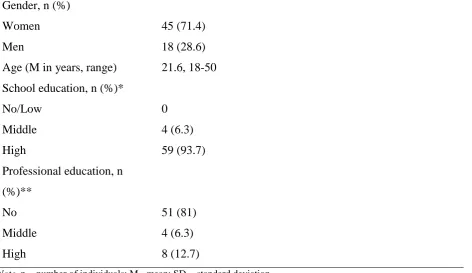
strongly associated with tiredness (10). Demographics of all included participants are shown
[image:11.595.74.547.169.442.2]in table 1.
Table 1.
Demographic´s of all participants included in the study
Note. n = number of individuals; M= mean; SD = standard deviation
*No/low school education= Hauptschulabschluss; middle school education= Mittlere Reife; high school education= Hochschulreife
** No professional education; middle professional education= Berufsausbildung; high professional education= Master, Staatsexamen
2.3 Materials
2.3.1 Subjective vitality scale (SVS)
According to, Bostic, McGartland Rubio and Hood (2000), the SVS provides the most
efficient and valid instrument to measure vitality. The scale which was, developed by Ryan
and Frederick (1997), is a 7- item self-report questionnaire, which uses a 5 point Likert scale
to measure one´s explicit level of vitality. The used SVS can be found in appendix D. Every
item can produce a score between 1 and 5 whereby 1 stands for “very true” and 5 for “not at all true”. The minimum reachable score for the whole questionnaire is 7 and the maximum
score is 35. In this study, a low score on de Subjective vitality scale means a higher level of
Gender, n (%)
Women 45 (71.4)
Men 18 (28.6)
Age (M in years, range) 21.6, 18-50
School education, n (%)*
No/Low 0
Middle 4 (6.3)
High 59 (93.7)
Professional education, n
(%)**
No 51 (81)
Middle 4 (6.3)
explicit vitality and a high score on the scale means a lower level of explicit vitality. The SVS
has been validated and shows a high reliability as well as a covariation with both
psychological and somatic factors (Ryan & Frederick, 1997). The SVS scores for example
have shown to correlate positively with measures of self-esteem, self-actualization and
satisfaction with life (Bostic, McGartland Rubio & Hood, 2000). In this study, the subjective
vitality scale showed good results in the pre-test (Cronbach’s Alpha= 0,9) as well as in the
post-test (Cronbach’s Alpha= 0,88).
2.3.2 Brief IAT
The Brief Implicit associations test (BIAT) is a short version of the IAT and meant to measure
the implicit vitality in this study. It has in contrast to the regular IAT 1/3 the number of trials
and lets the participant unlike as in the IAT focus on only two of each block four categories. To respond to the two focal categories and to categorize the shown items, the key “D” should be pushed on the keyboard respectively the “K” key to categorize any other item that is shown
on screen. These design changes regarding the standard IAT are according to Nosek,
Bar-Anan, Sriram, Axt and Greenwald (2014) simplifying the instructions and decrease the
needed time for practicing. Moreover, has the effectiveness of the BIAT in relation to
measuring stereotypes, attitudes and identities been previously established (Meyer, Osman,
Irwin & Yantis, 1988). An overview of the BIAT´s instructions can be found in appendix C.
Originally, the BIAT score could be defined as the mean latency difference between
two conditions. The from Greenwald, Nosek and Banaji introduced D-algorithm (2003)
however, is meant to improve the scoring of as well the standard IAT and the BIAT. As stated by Greenwald et al. D is “the difference between the average response latencies between
contrasted conditions divided by the standard deviation of response latencies across the conditions”. Since the present BIAT is used to determine to which degree someone associates
himself with vitality, a positive D-score indicates a stronger association with vitality than a
negative D-score.
2.3.3 Modified IAT (Self-concept IAT)
For this study, a modified self-concept IAT was used as an intervention. It consisted of 7
blocks of words, which had to be mapped to a category by the participants. In the standard
IAT, reaction times are used to measure the degree and direction of associations. Goal of the
condition “self”. For the reason that within the standard IAT also the other direction will be
tested (e.g. non-vitality related words and “self”), neutral words of the study “Emotion,
Etmnooi, or Emitoon? – Faster lexical access to emotional than to neutral words during reading” from Kissler & Herbert (2013) has been used (a list of the used words can be found
in appendix G). This was meant to prohibit the option, that participants are getting influenced
in any unwanted way but in the way of vitality. Many studies such as “Implicit Attitudes Toward Homosexuality: Reliability, Validity, and Controllability of the IAT” (Banse, Seise,
Zerbes, 2001) are supporting the reliability and validity of the IAT. The self-concept IAT´s
instructions as well as a trial of it can be found in appendix E respectively in appendix F.
2.4 Procedure
To measure the effects of the Self-concept IAT, it has been made use of the website
www.soscisurvey.de which provides users with different possibilities to create an own survey
with the option to implement several statistical tests. All participants could participate on their
own computer if they had a working connection to the internet. For this reason, most of them
have been requested to participate via mail, Facebook and Sona-systems, a cloud based
Subject Pool Software for Universities. The ethical eligibility for executing the study and for
distributing the study link was assessed by the ethical commission of the University of
Twente. The survey had an overall run-time of two weeks, beginning at the 8th of May 2017
and ending at the 21th of May 2017. Participants have been provided with an informed
consent, explaining the goal and length (about 10 minutes) of the study. Furthermore, they
received the information that they can stop at any time of the survey and that their data is
handled anonymous. After agreeing with the informed consent, the participants were asked if
they have a chronical disease which is strongly associated with tiredness. In case they had one or more diseases which were part of the exclusion criteria’s, they have been excluded from
the survey.
After that participants were asked to give some demographic information about
themselves (age, gender, educational level), they had to do the first BIAT which aims to
measure implicit vitality. To measure explicit vitality, every participant then was asked to fill
in the first subjective vitality questionnaire (Ryan & Frederick, 1997). After completing the
interventional modified IAT, which showed vitality related words with “self” related words to
subjective vitality questionnaire. These two measurements for explicit and implicit vitality
were the same as the measurements before the intervention and are meant to evaluate the
intervention effects. In the end of the survey, participants were provided with information
about how to contact the researcher for further questions.
2.5 Analysis
For the statistical analysis in this study, SPSS (Statistical Package for Social Sciences) version
22 was used. The subjective vitality scale sum-scores of the pre-and posttest were computed
by summing up the single answers of the 5 point Likert scale. One item (Item 2) therefore,
needed to be recoded.
Participants who met one or more of the earlier mentioned exclusion criteria´s had to be
removed. After that these preparatory steps were done, a paired sample t-test of the pre- and
posttest sum scores has been executed, to evaluate the interventions impact on explicit
vitality. Furthermore, was Cronbach´s alpha calculated to show the inter item reliability of the
SVS and descriptive statistics were executed for every variable.
For the comparison of the pre-and post BIAT which measured the implicit vitality,
D-scores were used. If 10% or more of the participants responses took longer than 10 seconds or
less than 300ms, the task had to be removed for the correct D-score calculation. (Greenwald,
Nosel and Banaji, 2003). After that, the average response latencies of the contrasted
conditions got divided by the standard deviation of the response latencies across the condition
(Nosek, Bar-Anan, Sriram, Axt & Greenwald, 2014). Due to the fact, that this studies first
condition of the BIAT was the “self” and “vitality” condition, higher D-scores are indicating a
higher association of participants with vitality. At least, a paired sample t-test was conducted
3. Results
To evaluate if the intervention had an impact to implicit and explicit vitality, paired-sample
t-tests were executed. The comparisons of the pre- and post BIAT D-scores, are showing a
statistical difference from pre BIAT to post BIAT test t (59) = -3.663, p= .001.
Since the first hypothesis was that the CBM leads to improved implicit vitality, this
hypothesis can be confirmed (score 95% pre-post CI [-0.46; -0.13]). Pre and Post BIAT
D-scores were furthermore weakly and positively correlated (r = 0.342, p = 0.008). Participants
showed in the pre-BIAT test a lower mean (0.0516) than in the post-BIAT (0.3468), what
indicates that participant associated themselves implicitly more with vitality than before the
Intervention. Table 2 shows the pre-as well as the post BIAT and subjective vitality scale
mean scores.
Table 2.
BIAT D-scores and SVS scores pre-and post-intervention
In order to evaluate if the second hypothesis can be confirmed or rejected, the scores of the
subjective vitality scale has been compared. The test for inter item reliability of the subjective
vitality scale showed in the pre-test (Cronbach’s Alpha= 0,9) as well as in the post-test
(Cronbach’s Alpha= 0,88) good results. Since the lowest possible SVS score (7 points), stands
for extremely high vitality and the highest possible score (35 points) for extremely low
vitality, the mean score of the pre-SVS (23,67) indicates, that the participants showed an
average to low subjective vitality on baseline. The mean score for the post-SVS (22,98)
showed no significant difference to the pre-SVS score t (62) = 1.394, p= .182. On average,
SVS pre-scores were 0.683 points higher than SVS post scores (95% CI [-.33, 1.69]). Pre- and
post SVS scores were furthermore strongly and positively correlated (r = 0.748, p < 0.001). The difference of the pre SVS-score mean (23.67) and the post SVS-score mean (22,98)
shows that participants felt explicit more vital after the intervention. This difference however
is not significant. The second hypothesis for this reason, must be rejected.
Variable Pre-intervention M (SD) n Post-intervention M (SD) n
BIAT D-score 0.051638 (,60) 60 0.346781 (,47) 60
4. Discussion
Aim of the present study was to examine, if the implicit as well as the explicit self-concept
can be manipulated using a modified implicit association test (Self-concept IAT). The
assumption that implicit processes are interacting with explicit processes led to the
hypotheses, that the implicit as well as the explicit side of vitality will increase due to CBM.
The data of 63 healthy persons has been used to evaluate if the hypotheses can be affirmed or
not.
When comparing the explicit vitality measures (SVS), participants have shown a slight
decrease in the test score, what stands for a slight increase in explicit vitality. This means that
participants tended to feel explicit more vital after the CBM. This difference in pre- and
post-test is however non-significant. Since the goal of this study was to let the participants feel
more vital, it can be concluded that this hypothesis cannot be confirmed.
For the second hypothesis, that participants will feel implicit more vital after the
CBM, the D-scores of the pre- and post-BIAT have been compared. The results are showing
higher D-scores in the post-test compared to the pre-test, what indicates that participants
implicitly felt more vital after the CBM. In contrast to the explicit measurement, this
difference is significant. The second hypothesis for this reason can be confirmed, participants
did feel implicitly more vital after the Intervention.
The present study results are indicating that Self-concept bias modification is partly a suitable intervention to enhance one’s vitality. The assumption of Cunningham, Zelazo,
Packer and Bavel (2007), that automatic cognitive processes are influencing higher order
reflective processes, led to the idea of gaining explicit vitality through manipulating implicit vitality. The present study can’t confirm this assumption due to the fact that the change in implicit vitality didn’t lead to a significant change in explicit vitality.
Nevertheless, it is noteworthy, that even if the difference in explicit vitality isn’t significant,
participants tended to show a higher degree of vitality after the intervention. Since the
Intervention is expected to be exhausting because of the needed attention and concentration,
this outcome is a promising one. It can in this regard be supposed, that the intervention can,
after some adjustments, be an eligible option to improve not only one’s implicit, but also ones
explicit vitality.
more rapidly when they are repeatedly activated. Since the intervention used in the present
study was conducted only once by every participant and the length was only about 3-5 minutes, it can be assumed that more repeating’s of the Intervention would have a greater
impact on implicit and explicit vitality.
Blair furthermore, suggested that implicit attitudes are sensitive to priming effects (2002). The
present study results are supporting this suggestion, however it would be recommended, to
use subsequent measurements for evaluating how persistent this effect over time is.
The present study has some limitations. One limitation is the lack of comparison.
Since the study design was a within group design where all participants run through the same intervention, there is no control group with which participants of today’s study could be
compared. This makes the findings difficult to interpret. The only known research in the
direction of gaining vitality through cognitive bias modification is done by Klaus (2016), who
tried to gain vitality through an attentional bias modification intervention. In her study “First
indications of the effectiveness of an IAT in modifying attentional bias regarding tiredness or
vitality”, she has made a similar intervention which showed almost the same results of the
subjective vitality scale scores as in the present study. The BIAT measurement for implicit
vitality however, showed in her study no significant increase. The reason for the different
results are supposed to be found in the intervention. Since the present study used vitality
related and neutral words, participants haven’t been faced with tiredness related words. In
Klaus research on the contrary, participants were also faced with tiredness related words, what
can have influenced implicit attitudes in the wrong direction. This assumption would support
Blair´s suggestion, that implicit attitudes are sensitive to priming effects (Blair, 2002).
Another limitation, is that almost all participants were highly educated (93%) and
relatively young (86% in the age between 18 and 23). The study for this reason, may show no
high generalizability to the broader population.
One limitation must be mentioned regarding the explicit vitality measure (SVS), which
consisted of only 7 items and was shown two times in 10 minutes. While responding to the
post-SVS, it was therefore easy to remember what has been responded in the pre-SVS.
Participants for this reason, had to be curious that the intervention changed their explicit
vitality in a short amount of time. This is of course possible, but the whole questionnaire,
including reading, BIAT and modified IAT, needed attention and concentration, what is more
likely to tire someone than to make him feel more vital. Since the intervention consisted of a
concept bias IAT furthermore, it is assumed, that participants wanted to retain their
in the first SVS that they are not feeling vital, can thus due to belief perseverance be more
likely to hold their beliefs about themselves than to discredit this belief (Ross, Lepper &
Hubbard, 1975). Another possible explanation of the missing effect in explicit vitality, could
be given by Baumeister (1995), who stated, that persons can only have a limited number of
explicit self-concepts available at any given moment. The results of the explicit measurement,
is thus dependent of one’s ability for introspection.
Another limitation must be mentioned in regard of the implicit vitality measure
(BIAT). It has not been made use of practicing trials, what could have distorted the
measurements. Even though there was provided a detailed instruction before the BIAT, which
can be found in the appendix, it is possible that some participants did not knew exactly what
to do in the beginning.
It is therefore recommended, to use practicing trials in the BIAT and to re-implement a
vitality based intervention with repeated measures over a period of at least one week. Since
the present study showed, that it is possible to improve one’s implicit association with vitality,
the next step is to indicate how long lasting this effect is. Furthermore, would repeated
interventions indicate more reliably, if the slight effect of the present study regarding explicit
vitality, can be strengthen by repeated runs of the intervention. The present studies results are
leading to this assumption, what could pave the way for other interventions. For example,
could repeated interventions be done by an app, to retrain one’s self-concept at any time, what
could lead to an improvement in vitality of a broad range of people. However, further research
in this topic with the mentioned recommendations is needed to evaluate the opportunities a
References
Banse, R., Messer, M., & Fischer, I. (2014). Predicting aggressive behavior with the aggressiveness‐ IAT. Aggressive behavior.
Banse, R., Seise, J., & Zerbes, N. (2001). Implicit attitudes towards homosexuality: Reliability, validity, and controllability of the IAT. Zeitschrift für experimentelle Psychologie, 48(2), 145-160.
Baumeister, R. F. (Ed.) (1999). The self in social psychology. Philadelphia, PA: Psychology Press (Taylor & Francis)
Baumeister RF. Self and identity: an introduction. In: Tesser A, ed. Advanced social psychology. New York, NY: McGraw-Hill; 1995. 51–97.
Baumeister, R. F., Vohs, K. D., Nathan DeWall, C., & Zhang, L. (2007). How emotion shapes behavior: Feedback, anticipation, and reflection, rather than direct causation. Personality and Social Psychology Review, 11(2), 167-203.
Blair, I. V. (2002). The malleability of automatic stereotypes and prejudice. Personality and Social Psychology Review, 6(3), 242-261.
Boettcher J, Leek L, Matson L, Holmes EA, Browning M, MacLeod C, et al. (2013) Internet-Based Attention Bias Modification for Social Anxiety: A Randomised Controlled Comparison of Training towards Negative and Training Towards Positive Cues. PLoS ONE 8(9): e71760.
https://doi.org/10.1371/journal.pone.0071760
Bostic, T. J., McGartland Rubio, D., & Hood, M. (2000). A validation of the subjective vitality scale using structural equation modeling. Social Indicators Research, 52(3), 313-324.
Carlbring, P., Apelstrand, M., Sehlin, H., Amir, N., Rousseau, A., Hofmann, S. G., & Andersson, G. (2012). Internet-delivered attention bias modification training in individuals with social anxiety disorder-a double blind randomized controlled trial. BMC psychiatry, 12(1), 66.
Carleton, R. N., Sapach, M. J. T., Oriet, C., Duranceau, S., Lix, L. M., Thibodeau, M. A., & Asmundson, G. (2015). A randomized controlled trial of attention modification for social anxiety disorder. Journal of anxiety disorders, 33, 35-44.
Coopersmith, S. (1967). The antecedents of self-esteem. San Francisco: Freeman.
Cunningham, W. A., Zelazo, P. D., Packer, D. J., & Van Bavel, J. J. (2007). The iterative reprocessing model: A multilevel framework for attitudes and evaluation. Social Cognition, 25(5), 736-760.
Deci, E. L., & Ryan, R. M. (2008). Self-determination theory: A macrotheory of human motivation, development, and health. Canadian psychology/Psychologie canadienne, 49(3), 182. De Voogd, E. L., Wiers, R. W., Prins, P. J. M., & Salemink, E. (2014). Visual search attentional bias
modification reduced social phobia in adolescents. Journal of Behavior Therapy and Experimental Psychiatry, 45(2), 252-259.
Ebert, I. D., Steffens, M. C., Von Stülpnagel, R., & Jelenec, P. (2009). How to like yourself better, or chocolate less: Changing implicit attitudes with one IAT task. Journal of Experimental Social Psychology, 45(5), 1098-1104..
Edgar, P., Powell, R. J., Watkins, D., Moore, R. J., & Zakharov, O. (1974). An analysis of the Coopersmith Self‐ Esteem Inventory: a discussion of two studies. Australian Psychologist, 9(3), 52-63.
Feng, Q., Zheng, Y., Zhang, X., Song, Y., Luo, Y. J., Li, Y., & Talhelm, T. (2011). Gender differences in visual reflexive attention shifting: Evidence from an ERP study. Brain research, 1401, 59-65.
Fitzsimons, G. M., Chartrand, T. L., & Fitzsimons, G. J. (2008). Automatic effects of brand exposure on motivated behavior: how apple makes you “think different”. Journal of consumer research, 35(1), 21-35. Greenwald, A. G., Farnham, S., & Diener, E. (2000). Using the Implicit Association Test to Measure
Self-Esteem and Self-Concept. Journal of Personality and Social Psychology, 79(6), 1022-1038. Greenwald, A. G., McGhee, D. E., & Schwartz, J. L. (1998). Measuring individual differences in implicit
cognition: the implicit association test. Journal of personality and social psychology, 74(6), 1464. Greenwald, A. G., Nosek, B. A., & Banaji, M. R. (2003). Understanding and using the implicit association test:
I. An improved scoring algorithm. Journal of personality and social psychology, 85(2), 197. Hassandra, M., Vlachopoulos, S. P., Kosmidou, E., Hatzigeorgiadis, A., Goudas, M., & Theodorakis, Y.
(2011). Predicting students’ intention to smoke by theory of planned behaviour variables and parental influences across school grade levels. Psychology & Health, 26(9), 1241-1258.
Kahneman, D. (2003). A perspective on judgement and choice: Mapping bounded Rationality. American Psychologist 58, 697–720.
Kissler, J., & Herbert, C. (2013). Emotion, Etmnooi, or Emitoon?–Faster lexical access to emotional than to neutral words during reading. Biological Psychology, 92(3), 464-479.
Klaus, O. (2016). First indications of the effectiveness of an IAT in modifying attentional bias regarding tiredness or vitality (Master's thesis, University of Twente).
Kruijt, A. W., Putman, P., & Van der Does, W. (2013). The effects of a visual search attentional bias
modification paradigm on attentional bias in dysphoric individuals. Journal of Behavior Therapy and Experimental Psychiatry, 44(2), 248-254.
Kuckertz, J. M., Gildebrant, E., Liliequist, B., Karlström, P., Väppling, C., Bodlund, O., ... & Carlbring, P. (2014). Moderation and mediation of the effect of attention training in social anxiety
disorder. Behaviour Research and Therapy, 53, 30-40.
Meyer, D. E., Osman, A. M., Irwin, D. E., & Yantis, S. (1988). Modern mental chronometry. Biological psychology, 26(1), 3-67.
MacLeod, C., Rutherford, E., Campbell, L., Ebsworthy, G., & Holker, L. (2002). Selective attention and emotional vulnerability: assessing the causal basis of their association through the experimental manipulation of attentional bias. Journal of abnormal psychology, 111(1), 107.
McNair, D. M., Lorr, M., & Droppleman, L. F. (1971). Profile of mood state manual. San Diego (CA): Educational and Industrial Testing Service.
Nix, G. A., Ryan, R. M., Manly, J. B., & Deci, E. L. (1999). Revitalization through SelfRegulation: The Effects of Autonomous and Controlled Motivation on Happiness and Vitality. Journal of
Experimental Social Psychology, 35(3), 266-28.
Nosek, B. A., Bar-Anan, Y., Sriram, N., Axt, J., & Greenwald, A. G. (2014). Understanding and using the brief I mplicit association test: recommended scoring procedures. PLoS One, 9(12), e110938.
Petty, R. E., Tormala, Z. L., Briñol, P., & Jarvis, W. B. G. (2006). Implicit ambivalence from attitude change: an exploration of the PAST model. Journal of personality and social psychology, 90(1), 21.
Ross, L., Lepper, M. R., & Hubbard, M. (1975). Perseverance in self-perception and social perception: Biased attributional processes in the debriefing paradigm. Journal of personality and social psychology, 32(5), 880.
Eds.), (pp. 167–188). Washington, D.C.: American Psychological Association.
Rozanski, A., Blumenthal, J. A., Davidson, K. W., Saab, P. G., & Kubzansky, L. (2005). The epidemiology, pathophysiology, and management of psychosocial risk factors in cardiac practice: the emerging field of behavioral cardiology. Journal of the american college of cardiology, 45(5), 637-651.
Ryan, R. M., & Deci, E. L. (2001). On happiness and human potentials: A review of research on hedonic and eudaimonic well-being. Annual review of psychology, 52(1), 141-166.
Ryan, R. M., & Frederick, C. (1997). On energy, personality, and health: Subjective vitality as a dynamic reflection of well‐being. Journal of personality, 65(3), 529-565.
Rydell, R. J., McConnell, A. R., Mackie, D. M., & Strain, L. M. (2006). Of two minds: Forming and changing valence-inconsistent implicit and explicit attitudes. Psychological Science, 17(11), 954-958.
Salama-Younes, M., & Hashim, M. (2017). Passion, vitality and life satisfaction for physically active old adults. The Journal of Positive Psychology, 1-11.
Schnabel, K., Banse, R., & Asendorpf, J. B. (2006). Assessment of implicit personality self‐concept using the implicit association test (IAT): Concurrent assessment of anxiousness and angriness. British Journal of Social Psychology, 45(2), 373-396.
Shalev, I. (2014). Implicit energy loss: Embodied dryness cues influence vitality and depletion. Journal of Consumer Psychology, 24 (2), 260-270.
Sheeran, P., Gollwitzer, P. M., & Bargh, J. A. (2013). Nonconscious processes and health. Health Psychology, 32(5), 460.
Steffens, M. C. (2004). Is the implicit association test immune to faking?. Experimental psychology, 51(3), 165. Strack F, Deutsch R. Reflective and impulsive determinants of social behavior. Pers Soc Psychol Rev
2004;8:220–247.
Tough, H., Fekete, C., Brinkhof, M. W., & Siegrist, J. (2017). Vitality and mental health in disability: Associations with social relationships in persons with spinal cord injury and their partners. Disability and health journal, 10(2), 294-302.
Watson, D., & Tellegen, A. (1985). Toward a consensual structure of mood. Psychological bulletin, 98(2), 219. Who, J., & Consultation, F. E. (2003). Diet, nutrition and the prevention of chronic diseases. World Health
Wiers R.W., Bartholow BD, van den Wildenberg E, Thush C, Engels RC, Sher KJ, et al. Automatic and controlled processes and the development of addictive behaviors in adolescents: a review and a model. Pharmacol Biochem Behav 2007;86:263–283.
Appendix
Appendix A: Study Introduction
Appendix C: BIAT
Appendix E: CBM-IAT Explanation
Appendix G: List of neutral words used in the Self-concept IAT
Gebäude
Apparat
Ding
Metall
Flugzeug
Papier