IPSO-NITRATION
STUDIES
A thesis
presented for the degree of
Doctor of Philosophy in Chemistry in the
University of Canterbury by
J.M. Readman
:'HYSICAl CHAPTER 1 2 CONTENTS ABSTRACT
GENERAL INTRODUCTION . . . . 1.1 Electrophilic Aromatic Substitution 1.2 Ipso Attack and its Consequences
1.3 The Nature of the Nitrating Agents
.
. .
1.4 Reaction of Phenols with NitrogenDioxide . . . .
NITRATION OF 4-SUBSTITUTED 2,6-DIMETHYL PHENOLS 2.1 Introduction
2.2 Reaction of 2,6-Dimethyl-4-nitrophenol (40a) with Nitrogen Dioxide . . . 2.3 Reaction Pathways in the Reaction of
PAGE ( i) 1 1 2 10 24 34 34 43
4-Nitro Phenol (40a) with Nitrogen Dioxide 47 2.4 Nitration of 2,6-Dimethyl-4-nitrophenol
(40a) with Fuming Nitric Acid in Acetic
Acid . . . . .. . . 47 2.5 Nitration of 4-Bromo-2,6-dimethylphenol
(40c) with Fuming Nitric Acid in Acetic Acid (Addition of the Phenol to the Mixed
Acids) . . . 48 2.6 Nitration of 4-Bromo-2,6-dimethylphenol
(40c) with Fuming Nitric Acid in Acetic Acid (Addition of Fuming Nitric Acid to
the Phenol in Acetic Acid) . . . 51 2.7 Reaction of 4-Bromo-2,6-dimethylphenol
(40c) with Nitrogen Dioxide in Benzene
Solution . . . • . . . 51 2.8 Reaction Pathways in the Nitration of
4-Bromo-2,6-dimethylphenol (40c) . . . 52 2.9 Further Comment on the Possible Mode of
Formation of the 2,6-Dimethyl-3,4-dinitro-phenol (43) from
CHAPTER 3
4
5
PAGE NITRATION OF 2,3,4,6-TETRAMETHYLPHENOL AND
1,2,3,5 -TETRAMETHYLBENZENE . . . . 54
3.1 Introduction 54
3.2 Reaction of 2,3,4,6-Tetramethylphenol (71)
with Nitrogen Dioxide in Benzene Solution . 55 3.3 Reaction Pathways for the Reaction of
2,3,4,6-Tetramethylphenol (71) with Nitrogen Dioxide in Benzene Solution 3.4 Nitration of 1,2,3,5-Tetramethylbenzene
58
(66a) with Fuming Nitric Acid . . . 59 3.5 Reaction Pathways in the Fuming Nitric
Acid Nitration of
1,2,3,5-Tetramethyl-benzene (66a) . . . 62
NITRATIONS OF SOME SUBSTITUTED 1,2,3-TRIMETHYL BENZENES AND
1,2,4,5-TETRAMETHYL-3,6-DINITROBENZENE . . . . 4.1 Introduction
64 64 4.2 Mixed Acid Nitration of
benzene - Preparation of
1,2,3-Trimethyl-4,6-dinitrobenzene (103) . . . 65 4.3 Nitration of
1,2,3-Trimethyl-4,6-dinitrobenzene (103) with Fuming Nitric
Acid . . . 65
4.4 Mixed Acid Nitration of 2,3,4-trimethylbenzene - Preparation of
1-Bromo-2,3,4-trimethyl-5,6-dinitrobenzene (105). . 67 4.5 Nitrations of
1,2,3-Trimethyl-4,5,6-trinitrobenzene (106) and
1-Bromo-2,3,4-trimethyl-5,6-dinitrobenzene (105) . . . . 67 4.6 Nitration of
1,2,4,5-Tetramethyl-3,6-dinitrobenzene (117) with Fuming Nitric
Acid . . . 67
CHAPTER PAGE APPENDIX I . . . 96
Nitration of 2,4-Dimethy1-6-nitropheno1
( 12 8) with Fuming Nitric Acid . . . 96
APPENDIX II . . . 105
REFERENCES . . . 127
LIST OF TABLES AND ILLUSTRATIONS
Page Page
BLOCK A 26 FIGURE 1 149
BLOCK B 137 FIGURE 2 150
BLOCK
c
138 FIGURE 3 154BLOCK D 148 FIGURE 4 161
BLOCK E 151 FIGURE 5 163
BLOCK F 153 FIGURE 6 167
BLOCK G 155 FIGURE 7 168
BLOCK H 158 FIGURE 8 169
BLOCK I 160 FIGURE 9 171
BLOCK J 162
BLOCK K 165
BLOCK L 166 TABLE 1 112
BLOCK M 170 TABLE 2 114
BLOCK N 174 TABLE 3 116
BLOCK 0 175 TABLE 4 117
BLOCK P 178 TABLE 5 46
TABLE 6 118
TABLE 7 119
TABLE 8 120
TABLE 9 122
TABLE 10 124
TABLE 11 125
LISTS OF TABLES AND ILLUSTRATIONS
Page Page
SCHEME 1 27. SCHEME 28 176
SCHEME 2 28 SCHEME 29 177
SCHEME 3 29 SCHEME 30 179
SCHEME 4 30 SCHEME 31 180
SCHEME 5 31 SCHEME 32 181
SCHEME 6,7 32 SCHEME 33 182
SCHEME 8 33
SCHEME 9 139
SCHEME 10,11,12 140
SCHEME 13 141
. -SCHEME 14,15 142
SCHEME 16 143
SCHEME 17 144
SCHEME 18 145
SCHEME 19 146
SCHEME 20 147
SCHEME 21 152
SCHEME 22 156
SCHEME 23 157
SCHEME 24 159
SCHEME 25 164
SCHEME 26 172
(i)
ABSTRACT
Nitration of 2,6-dimethyl-4-nitrophenol (40a) with fuming nitric acid gives the pair of C2-epimeric cyclohex-3-enones,
(4~)
(41) and (42), the dihydroxy cyclohex-3-enone and the
2,6-J
dimethyl-3,4-dinitrophenol (43). Reaction of the nitro phenol (40a) with nitrogen dioxide also gives compounds (41), (42), (43) and (44). The nitration of 2,6-dimethyl-4-bromophenol (40c) with fuming nitric acid (addition of the phenol to the acid) yields both possible C2-epimeric cyclohex-3-enones,
(53) and (54), the trinitro cyclohex-3-enone (55) which
decomposes to give the dinitro phenol (43), nitro phenol (58) and the 1,4-benzoquinone derivative (59). Nitration of the bromo phenol (40c) in fuming nitric acid (addition of the acid to the phenol) and reaction of the bromo phenol (40c)
with nitrogen dioxide both lead to extensive nitrodebromination. The possible reaction pathways for phenols (40a) and (40c) are discussed.
Nitration of 1,2,3,5-tetramethylbenzene (66a) with fuming nitric acid gives the tetramethylnitrobenzene (85), products of side-chain modification (86)-(90), the rearranged
6,6-dimethylcyclohexenones (91), (92), (93) and (94), and 2,3,4,6-tetramethyl ketone derivatives (73)-(76), (95) and
(96). Reaction of 2,3,4,6-tetramethylphenol (71) with nitrogen dioxide gives the hydroxy dinitro ketone (72) in addition to the trinitrocyclohexenones (74)-(77) and (82). The possible modes of formation of these compounds are discussed.
( ii)
(72%), hydroxy dienone (110) (8%) and the substituted benzoic acid (109) (9%). Corresponding nitration of 1,2,4,5-tetramethyl-3,6-dinitrobenzene (117) gives the nitro dicarboxylic acid
(119) (33%), dimethylpropanedioic acid (108) (11%) and the substituted benzoic acid (llS) (49%). Compounds (108) and
(119) are products of reaction pathways involving ipso-substitution, followed by methyl migration.
Nitration of 2,4-dimethyl-6-nitrophenol (128) with fuming nitric acid gives two 1,4-benzoquinone derivatives (129) and
(130), in addition to the two C4-epimeric cyclohex-2-enones (131) and (132), and a single cyclohex-3-enone (133). In addition, reaction of 2,4-dimethyl-6-nitrophenol (128) with . nitrogen dioxide also gives (129), (130), (131), (132) and
(133). Comment is made on the reaction mechanism and on the
probable mode of conversion of the cyclohex-3-enone (133) to give the C4~epimeric cyclohex-2-enones (131) and (132).
The structures of nine compounds (42), (44), (54), (74), (82), (92), (93), (94) and (96), have been determined
l .
CHAPTER 1
GENERAL INTRODUCTION
1.1 Electrophilic Aromatic Substitution
Electrophilic aromatic substitutions have been studied extensively,l and the general features of this class of reactions seem well understood. In the case of aromatic nitration reactions the major features may be summarised as follows:2
. - ArX
+
NO/
-
-
-The nitronium ion and the aromatic diffuse together to give an "encounter pair", represented by [ArX·No2+] but of
undefined structure. The encounter pair produces relatively unstable a-complexes (Wheland intermediates) which, by loss of x+, generate nitro compounds. Depending on the reaction conditions and the structure of the aromatic compound any of the ~teps may be rate determining. Until recently most work has concerned substitution, where X=H i.e. conventional electrophilic substitution.
In the electrophilic nitration of monosubstituted benzene derivatives there are two kinds of Wheland intermediate (W5 )
formed. Those (W0 ,Vfn and Wp) formed by ni tronium ion attack, at an unsubstituted position, to give conventional
2.
introduced the prefix "ipso" to denote attack by a reagent at a substituted position on a benzene ring.
X X
6
+ + +Direct observations of the first kind of Wheland intermediate are rare and, generally, their chemistry involves proton loss only. The characteristics, however, of these types of
reactions seem well understood.
In contrast, the observation and capture of
w
1X has been possible in some situations. In the absence of bases or nucleophiles some hexasubstituted benzenes give these cations, the structures of which were established from lH, l9F an d l3c n.m.r. spec roscopy, t 4 e.g ..·-Me
Me Me
Me Me
X
X= Me, F, Cl, Br
No; + BF 4-/FS03H/S02
--78°C
Me
Me
l. 2 Ipso Attack and its Consequences 1.2.1 The Early History
X
X= Me, F, Cl, Br
2-hydroxy-3.
3,5-dichlorobenzene sulphonic acid.
OH
OH
Cl Cl
HNO, ...,
Cl Cl
Later, von Auwers isolated6 4,6-dinitro-cyclohexa-2,5-dienone from the nitration of 2,4,5-trimethyl-phenol in fuming nitric acid.
0
OH
Me 02N Me
fuming
HN03Me Me
Me N02 Me
Subsequently Zincke and Klostermann reported? the nitration of 2,3,4,5-tetrabromo-6-methylphenol (1) (Refer Block A)*
with fuming nitric acid in acetic acid to give a cyclohexadiene derivative (2). Trituration of this compound (2) with
aqueous sodium carbonate solution or addition of water to the nitrating mixture was further reported? to give the acyclic derivative (3). Later, Zincke and Breitwieser reported8 obtaining, from the nitration of 2,4,5-tribromo-3,6-dimethylphenol (4), with fuming nitric acid, the analogous
products (5) and (6). Similar results were obtained9 by Zincke and Preiss for chlorinated 6-methylphenols.
4 .
Re-examination of these reactions has shownlOa (X-ray crystal structure analysis) that the compounds reported by Zincke et. al. as (5) and (6) have the structures (7) and (8) respectively (and by analogylOb (2) and (3) have the
structures (9) and (10)) (Refer Block A).
In addition, examples of ipso substitution in which X(X=alkyl,acyl,-SiR3,-S03H, and -N2Ar) is replaced by a nitro group are common in the literature.ll
Despite these early examples of ipso nitrations, and the long history of aromatic halogenations requiring ipso
attack for their rationalisation,l2 i t was generally thought that aromatic nitration reactions could be explained in
terms of conventional ortho, meta and para attack.
It was not until 1961 that interest in the area of ipso
substitution was reawakened. Fischer et. al. reportedl3a that the nitration of o-xylene in nitric acid and acetic anhydride yielded 3,4-dimethylphenyl acetate as the major product (51%) in addition to conventional nitration products. A significant feature of this study was exclusion of alkali
from the work-up procedure. The reaction mixture was poured into water, and the product extracted with ether which was then washed several times with water before drying over
magnesium sulphate. Subsequently, nitration of hemimellitene, under identical conditions, yielded the 4-acetoxy- and
5 •
H N03 1
mol.
+
2
mol.
NOz
OAc
+
+OAc
OAc
SSo/o
From kinetic studies i t was shown that the reaction rate of acetoxylation was independent of the concentration of aromatic substrate, although the ratio of nitration to acetoxylation was substrate dependent.
It was originally thought that the acetoxylating species was protonated acetyl nitrate which on reaction would
6 .
The information obtainedl3b was, of course, also consistent with capture of the initially formed Wheland intermediate by acetate ion and subsequent elimination of nitrous acid to give the aryl acetate product.
-HNOz~
H OAc
OAc
The next major advance in this field was made some ten years after the initial observation of acetoxylation in the nitration of methylbenzenes with nitric acid in acetic anhydride mixtures. In 1970 the isolation of the stereoisomeric adducts
OAc
7.
for a number of aromatic substrates, mainly by Fischer and his co-workers.l5 In most cases both diastereoisomers were obtained, indicating a two-step process in which initial ipso
attack is followed by capture of wix , by acetate, at the para
position.
The proportion of conventional nitration to nitro-acetate formation, which remains constant under different conditions, gives important information about positional reactivities in the aromatic substrate.l6 The need for stabilisation of the Wheland intermediate explains the low extent of
acetoxylation in toluene. In contrast nitration of 1,4-dimethylnaphthalene yields the nitro-acetate adduct exclus_i vely .17
Me OAc
100°/o
In some cases the nitro-acetate adducts can react further to give dienones, the yield of dienone being
dependent on the nature of the substituents X,R and R'.18
Me
Me N02
R
R'
R
R
R'
HN~
liP
Ac2
o
-A eX
8 .
The ipso Wheland intermediates formed can also react with water to give adducts which rearrange readily to phenols by loss of nitrous acid.
R
+
N02
H20
-HNo2 ..
H OH
For example, the nitration of a-xylene by njtric acid in 60% sulphuric acid gives a 33% yield of mono- and dinitro-3,4-dimethylphenols.l9
OH
OH
OH
+
nitro -xylel!es.
1.2.2 Migration of the Nitro Group
The Wheland intermediates wiX's formed aR a consequence of ipso nitration, are capable of rearrangement via migration of the nitro group or, less commonly, by migration of X~
9.
(i) intramolecular, (ii) extramolecular, and (iii) inter-molecular migration.
(i) Intramolecular migration refers to a process in which the nitro group is never sufficiently free of the carbon structure to do other than move to a position adjacent to the ipso position (1,2-migration).
(ii) Extramolecular migration occurs when the nitro group is able to distinguish and select between ring positions, but is unable to leave the encounter pair.
(iii) In intermolecular migration the ipso nitro group leaves its ring position and escapes, from its
encounter pair, into the solvent. There i t may react with carbon structures other than the one that i t left.
Characteristically, extramolecular migration occurs when the nitration producing
w.x
~ proceeds at the encounter rateand intermolecular migration when i t is slower than the encounter rate.
Intramolecular Migration
Nitration of o-xylene in sulphuric acid gives 3- and 4-nitro-o-xylenes in yields which are dependent upon the acidity.l9
50 60 70
111 S04(wl %)
10.
Scheme 1* outlines the proposed mechanism.20 Myhre
suggested that at low acidities ~Me was captured by water, but with increasing acidity 1,2-migration of the nitro group became more important. Solvolysis of the nitro-acetate adduct (Scheme 1) gave only 3-nitro-o-xylene and
3,4-dimethylphenol, demonstrating that return to the encounter pair - which is necessary to produce 4-nitro-o-xylene - does not compete with 1,2-migration of the nitro group on capture of
w
.Me by water.~
There are many examples of 1,2-migration of the nitro group in wiR' s generated by solvolysis of the nitro-acetate adducts.2l Similarly, reactions are known which, though formally 1,3 shifts, are best regarded as repeated 1,2 shifts.2lc,d,e
Extramolecular Migration
Extramolecular 1,3-migration of a nitro group was first proposed to explain the formation of nitrophenols in the nitration of anisole derivatives.22,23 The nitration of
4-methylanisole in sulphuric acid gives 4-methyl-2-nitrophenol as well as 4-methyl-2-nitroanisole.22 The proposed
mechanism, illustrated in Scheme 2, involves initial
formation of an encounter pair to produce both conventional and ipso Wheland intermediates. The nitrocyclohexa-2,5-dienone shown, which forms and decays during the reaction, is also produced in the nitration of p-cresol.24 In strong acid the conjugate acid of the 4-nitrocyclohexa-2,5-dienone rearranges to give the 2-nitrophenol via dissociation to an
11.
encounter pair and re-nitration. This mechanism is
consistent with nitration of p-cresol and p-methylanisole at the encounter rate. In contast, p-chloroanisole
reacts more slowly than the encounter limit and gives either 4-chloro-2-nitrophenol and 4-chloro-2-nitroanisole3,25 or 4-chloro-2,6-dinitrophenol only,26 depending on the
concentration effects. 4-Chlorophenol was detected during the course of the reaction, i t having "leaked" from the encounter pair. Studies using H2l8o enriched mixtures confirm these proposals.27
Of special relevance to the work presented in the main part of this thesis is the extramolecular migration and rearrangement of 4-nitrocyclohexa-2,5-dienones. These compounds rearrange, in the absence of ortho-substitution to give o-nitrophenols.l8a,b For example, 4-methyl-, 3,4-dimethyl- and 3,4,5-trimethyl-4-nitrocyclohexa-2,5-dienones gives the corresponding o-nitrophenols in hexane, acetic acid, ethanol, water and dimethyl sulphoxide. This
conversion has been shown to proceed via the radical
dissociation-recombination mechanism, outlined in Scheme 3, with some leakage of radicals, from the solvent cage.l8c
It appears that this radical dissociation-recombination mechanism operates also when the ortho-positions are
Me
12.
R
R
Br
Br
Br
02N
Br
Me
ll.(a)
R =Me
11.
(b) R =Me
12.
(a)
R= Br
12. (b) R = Br
In some cases the 4-nitro-dienones rearrange to give 4- and/or 6-hydroxydienones. For examples, 3,5-dibromo-2,4,6-trimethyl-4-nitrocyclohexa-2,5-dienone rearranges slowly, in chloroform at 30°, to give the corresponding 4-hydroxy dienone.29 This 4-hydroxy dienone is thought to be formed via the recombination of the radical pair to give the intermediate 4-nitrito dienone .
•
Me
N02Me
NO~Me
ONOMe
Br
Br
Br
~
Br
Br
•
Me)
Me
Me
Me
Me
OH
0
o·
0 0The rearrangement of 2,3,5,6-tetrachloro-4-methyl-4-nitrocyclohexa-2,5-dienone, in chloroform, gives a mixture
(c.2:3) of 3,4,6-trichloro-5-methyl-1,2-benzoquinone and
2,3,5,6-tetrachloro-4-hydroxy-4-methylcyclohexa-2,5-dienone.29 Addition of hydroquinone to the reaction resulted in
formation of 2,3,5,6-tetrachloro-4-methylphenol as the major product.29 These results are consistent with the mechanism
Br
13.
proposed in Scheme 4. Formation of the 4-hydroxy dienone presumably occurs via the 4-nitrito dienone intermediate. The 1,2-benzoquinone is probably formed by loss of the elements of NOCl from the 6-nitrito dienone. Whether the 6-nitrito dienone is formed directly, by recombination of the radical pair, or through the nitro-nitrito
rearrangement of the 6-nitro dienone is not clear from the information available.
In all of the examples presented hydroxy dienones are formed from nitro dienones by initial nitro-nitrito
rearrangement to yield nitrito dienones which, on hydrolysis give the corresponding hydroxy dienones. Recently i t has been demonstrated that this reaction sequence may be
reversible under certain reaction conditions.
t nitro-nitrito ()~()
B~
rearrangement
AAe
t "hydrolysis" HO
B~e
0~
rearrangement0~
by N204
Reaction of 4-hydroxy-4-methyl-2,6-di-t-butyl-cyclohexa-2,5-dienone with excess nitrogen dioxide in benzene solution forms the corresponding 4-nitro dienonein high yield.30 Similarly 4-hydroxy-4-methyl-2,6-diphenyl-cyclohexa-2,5-dienone reacts with nitrogen dioxide in benzene solution to give the following 4-nitro compounds as well as the expected
14.
These latter results also require a conversion of a 4-hydroxy dienone into a 4-nitro dienone as a crucial reaction step.
l. 2. 3 Ipso Substitution
Ipso-substitution, mentioned earlier, is often included in the description "anomalous nitration",31 and occurs in cases where i t is possible to displace the group ipso to the nitro function.
The main area of ipso-substitution considered in this work is nitrodebromination. Apparent nitrodebrominations are common in the early literature.31 Many of these
reactions involve very reactive compounds such as brominated phenols or the corresponding ethers.
The nitration of p-chloroanisole, discussed previously, proceeds mainly by demethoxylation and subsequent nitro-group migration. With p-bromoanisole, nitrodebromination is an added complication.3,25 Nitration in aqueous acetic acid in the presence of urea gave 4-bromo-2-nitroanisole,
p-nitroanisole, 2,4-dibromoanisole,p-nitrophenol and 2-bromo-4-nitrophenol.3 Scheme 5 outlines the primary processes thought to be operating. Results indicate that the wiBrformed, after demethoxylation, can be either nitrode-brominated to give p-nitrophenol or bromodenitrated to give after renitration, 4-bromo-2-nitrophenol. In acetic acid w ~ .Br
15.
4-bromo-2-nitrophenol is formed.3
1.2.4 Methyl Group Migration
There are few reports in the literature citing methyl group migration, consequent upon ipso nitronium ion attack at C-Me. In 1972 Suzuki and Nakamura reported,32 the
nitration of 1,2,3,4-tetramethyl-5,6-dinitrobenzene to give a single tetramethyltetranitrocyclohex-3-enone compound (13). This compound (13) was further reported32 to yield 2,3,6,6-tetramethyl-4,5-dinitrocyclohexa-2,4-dienone (14) by loss of nitrogen dioxide.
Me
(13)
(14)Although structures (13) and (14) were consistent with spectroscopic data,32 the alternative tetramethyl-tetranitrocyclohex-3-enone structures (15) and (16) and the tetramethyldinitrocyclohexa-2,4-dienone structure (17) could not be excluded, with confidence, on the published evidence. In addition the mechanistic rationalisation
16.
N02
Me
N020 2N
Me
0 2N-?
N02 N0 2 02NMe
0
Me
Me
Me Me
Me Me
(15)
(16) (17)In 1982 Gray et. al. re-examined the nitration of
1,2,3,4-tetramethyl-5,6-dinitrobenzene. They were able to isolate, in high yield, two compounds, (18) and (19).
Structural assignments for these two compounds were made on the basis of (i) an X-ray crystal structure of the minor product (18), (ii) their common conversion into the dinitro dienone (17), and (iii) the close similarity of their
spectroscopic data.33 The isomeric ketone~ (18) and (19), could also be generated by the addition of nitrogen dioxide to the dinitro dienone (17).
(18)
(19)
Scheme 7 outlines a likely reaction mechanism for the formation of the two isomeric tetramethyltetranitro-cyclohex-3-enones (18) and (19). Nitronium ion attack
Me
17.
at the most activated ring position gives the ipso Wheland
<
intermediate. Subsequent rearrangement through the
nitrite derivative then gives rise to the dinitro dienone (17). Homolytic two-step 1,4-addition of nitrogen dioxide to the dinitro dienone (17) then yields the observed
cyclohex-3-enones (18) and (19).
1.2.5 Substituent Modification
There are two important types of substituent
modification. One type involves a hydroxyl group ortho or
para to the ipso-position which loses its proton to form a carbonyl function. Some methoxyl groups can be included in this discussion. The other major category involves an
alkyl group, which can be modified in a number of different ways.
HydroxylandMethoxyl Groups
One of the earliest reported34 examples of nitrodienone formation from a phenol is given below.
OH 0
Cl Cl Cl
Me
18.
from o- and ~methylanisole and from pentamethylanisole35a are assumed to proceed by nucleophilic demethyoxylation following ipso-nitration.
Alkyl Groups
There are many examples where modification to the alkyl side-chain occurs during electrophilic nitration reactions. The most important reactions are those in which benzyl
nitrites, benzyl nitrates and arylnitromethanes are formed,35a,37 however acetamidation,38 acetoxylation,39
alkoxylation,40 arylation,39,41 hydroxylation42 and aldehyde, carboxylic acid and ketone formation43 are also known.
The only systematic examinations of side-chain modification have been concerned with the formation of side-chain nitro compounds. The first reported side-chain nitrations of polymethylbenzenes were effected using benzoyl nitrate.44 Later work, by Robinson and Thompson;45 gave, in high yield, a side-chain nitro compound from the nitration of 1,4-dimethylnaphthalene with nitric acid in acetic
anhydride.
Me
19.
products.46 As a general rule side-chain nitration, and in fact all side-chain modification, occur at the methyl group which is ortho or para to the most activated
ipso-position. In almost all cases the p-methyl group is involved. However a clear-cut exception occurs with
l-t-butyl-3,4-dimethyl- and 1-t-butyl-3,4,5-trimethyl-benzene and their derivatives. In these cases the site of
ipso-attack is C-4, but the methyl group modified is adjacent to this.
A possible mechanism for side-chain nitration is shown in Scheme 8. Initial ips~attack occurs at the most activated ring position. Subsequent loss of a proton from the methyl group para to the ipso-position gives a methylenecyclohex-adiene compound, which can then be attacked by any suitable nucleophile. Attack by nitronium ion would give a side-chain nitro compound. In some substrates other side-chain substitution products such as nitrates and acetates may be formed along with side-chain nitro compounds. Given the substitution pattern in side-chain nitro formation a mechanistic pattern, shown below, is attractive.
R'
20.
these terms, and i t may be that electron transfer processes are key features in the mechanistic schemes leading to these compounds.47a Certainly many of these products resemble the spectrum of radical cation mediated reactions which occur during anodic47b,c or metal ion oxidation of
aromatics.47d
1.3 The Nature of the Nitrating Agents
1.3.1 Concentrated Nitric Acid
Molecular nitric acid is the main species present in concentrated nitric acid, although physical measurements demonstrate the existence of significant concentrations of other species. Physical and spectroscopic studies indicate that there is appreciable self-hydration occurring according to the following scheme.48
The nitration of nitrobenzene, p-chloronitrobenzene and l-nitroanthraquinone49 with concentrated nitric acid is according to the law, rate= k[ArH]. As nitric acid is the solvent, terms involving its concentration cannot enter the rate equation. The rate equation is consistent with reaction via molecular nitric acid, or any species whose concentration bears a constant ratio to the initial
21.
Sulphuric acid catalyses nitration in concentrated nitric acid whereas potassium nitrate is an anticatalyst. These results are in accordance with the equilibria proposed for the self-dehydration of nitric acid. In addition,
sulphuric acid allows another mode of ionisation thus further increasing the nitronium ion concentration.
1.3.2 Nitration in Sulphuric Acid
In concentrated sulphuric acid/nitric acid reactions, the nitric acid is present predominantly as the nitronium ion. With addition of water there is a corresponding
drop in the reaction rate due to the fall in concentration of nitronium ions. However, even in weakly diluted
solutions nitronium ion is s t i l l spectroscopically detectable. As a general rule rate constants for nitration reach a maximum in c.90% H2S04.50
1.3.3 Nitration in Acetic Acid
The absence of ions in mixtures of acetic acid and
nitric acid is shown by their poor electrical conductivity.51 Raman spectra of solutions of nitric acid and acetic acid only show the presence of the molecular species. Bands corresponding to nitronium and nitrate ions cannot be detected. 52
Although nitronium ion cannot be detected, by physical methods, in solutions of nitric and acetic acids, i t would seem from kinetic studies that nitronium ion is the
22.
zeroth-order with respect to the aromatic indicating that the nitrating agent is formed from nitric acid in a slow-step Since proton transfers are unlikely to be slow, the nitrating agent is probably formed by heterolysis of protonated
nitric acid to form nitronium ion. This is supported by the depression of zeroth-order reaction rates when water is added. When large concentrations of water are added to the
solutions zeroth-order kinetics are no longer observed. Under these circumstances water competes successfully with the aromatic for the nitronium ions, and the zeroth-order law no longer holds.52
1.3.4 Nitrogen Dioxide
There is evidence in the literature that nitration of organic compounds is not confined to electrophilic attack.53 For example free-radical nitration of aromatic compounds can be achieved by the lower oxides of nitrogen, N(III) and N(IV), and the kinetics of these reactions
indicate that they involve hydrogen abstraction.54 In the nitration of alkanes such as ethane and propane with
nitrogen dioxide, in the gas phase, i t has been shown that hydrogen abstraction by nitrogen dioxide is the initiating step. 55
Colourless
Diamagnetic
Brown
Paramagnetic
23.
In the solid state, the oxide is wholly N204; in the liquid partial dissociation occurs and we can consider the liquid
(m.p. -ll.2°C) as a dilute solution of N02 in N204 and in the vapour at 100°C the composition is 90% N02, 10% N204.
Electron-spin-resonance (e.s.r.) solution studies
reveal that in non-polar non-coordinating solvents, such as cyclohexane, the unpaired-electron spin-density is
distributed so that 50% i-s located on the nitrogen atom
leaving about 25% of the spin density on each oxygen atom.56 In addition the calculated 0-N-0 bond angle in solution is l32-l34°,50a not far removed from the gas phase electron diffraction values of 134°.57 The extensive delocalisation of the unpaired-electron will oppose dimerisation.56a
Nitrogen dioxide also has a significant electric dipole moment of 0.316 D (1 Debye
=
lo-18 e.s.u. em), as compared with the dipole moment of water (1.850),58 with the nitrogen atom being the positive terminus of the dipole. This dipole moment gives the nitrogen centre of the nitrogen dioxide radical significant electrophilic character,especially toward unsaturated systems. Addition of nitrogen dioxide to unsaturated organic systems, especially
carbon-carbon double bonds and aromatic nuclei, has been shown59 to involve free-radical intermediates. The
1,4-24.
and 1,2-additions of nitrogen dioxide are also involved in the reaction of a number of 2,4- and 2,5-cyclohexadienones.60
Br Br Br
1.4 Reaction of Phenols with Nitrogen Dioxide
Phenoxy radicals are formed by abstraction of the phenolic hydrogen atoms by nitrogen dioxide.· Their presence, as intermediates, in the reactions of
2,4,6-tri-t-butylphenol6l and 2,6-di-t-butyl-4-methylphenol62 with nitrogen dioxide has been demonstrated by e.s.r.
spectroscopy.
Phenoxy radicals can, in fact, be generated from their corresponding phenols by a variety of methods.61,63 Generally, phenoxy radicals with a 2,4,6-trisubstitution pattern are more stable and those radicals with bulky 2,6-substituents which possess no a-hydrogen atoms, such as the 2,4,6-tri-t-butylphenoxy radical,61,64 are
especially stable.
E.s.r. spectroscopy measurements of phenoxy radicals63 have been made to determine the proportion of
25.
a "negative" spin density observed at C3 and CS. These results are in accord with the observed frequency of
radical attack on phenoxy radicals: C4>C2,C6>Cl,O>>C3,C5. Due to extensive delocalisation, phenoxy radicals possess reasonable stability. However, in the presence of an
Br
R
Br
OH
( 2 )
R=Br
(
~) R=Me
R
( 9
)R=Br
' ( 1 ) R
=Me
BLOCK A.
R
Br
Br
Br
OHMe
( 1 ) R = Br
(4)R=Me
Br
Br
Br
R
0 N02 Me N02
(3)R=Br
(6
)R=Me
R
N02
c==o
I
Me
( 10 ) R= Br
( 8
)R=Me
Encounter Pair
H OAc
+
-H
+
-H
11,
2-migra tionH OH
SCHEME 1.
-HNO
2
2 8.
Me
Me
Encounter Pair 1
Me
OH
OH
0
N0
2
~-H+
....+----
-+
H+
N~
Me
Me
Me N0
2
Me
N0
2
Encounter-Pair
( 1 )
2
29.
R
R
R
R
-slow
0
0·
Me
R
Me
R
OH
30.
Me
Cl
Cl Cl
o·
Me
N02Me
Me
ONOMe
Cl
Cl
Cl
Cl
CJ
-Cl
Cl
Cl
CJ
CJ
CJ
0
o·
0
0I
..
I '
'
I
'
I I
'
'
I
'
I
'
I
'
I
'
'
I
'
•
I'
',
I
' '
'
'
•
Me
Me
Me
CJ
CJ
Cl
Cl
____
.,.
Cl
Cl
CJ
Cl
0
0
031.
OMe OMe
H N01
N01
OMe
/
Br Br
OMe
OH
OH
OH
OH
OH
Br Br Br
02N*Mo
Me Me
Me
0 2 N
Me
02N~Mo
M e ¥ Me Me
N02(±)
...
+ N204 homoiytic
addition
(10)
02N~Mo
-:?"+~ Me
Me N
02 Me
0 2 N * '
-:?" Me ~Me 0
Me
SCHEME 6.
homolyt rc
(19)
~
SCHEME 1.
32.
02N~'
~Me
..
'?' Me~+
Me N02
Me
lONO~
ON~'
- N204 2
~
Me~
~ ON02
Me NO.
Me 2
N02
0
2
N~
.. -- Me---t...
I+ ~' • . 'I# O~NO
Me Me
33.
R'
R'
R
3 4.
CHAPTER 2
NITRATION OF 4-SUBSTITUTED 2,6-DIMETHYL PHENOLS
2.1 Introduction
2.1.1 Earlier Studies of Nitrations of Polysubstituted 2-Methyl Phenols in Fuming Nitric Acid
As mentioned previously (Section 1.2.1), the nitration of 2,4,5-tribromo-3,6-dimethylphenol (4) with fuming nitric acid has been shownlOa to give the corresponding cis-dinitro ketone (7); similarly 2,4-dibromo-3,6-dimethylphenol (2Q) gives the cis-dinitro ketone (21)65 (Refer Block B).* A
notable feature of these ketones, (7) and (21), is the relative all-cis stereochemistry of the two nitro groups and the
hydroxyl group, which has been established by X-ray crystal structure analysis. Similar nitrations of 3,4,5,6-tetrabromo-2-methylphenol (l)lOb and chlorinated 2-methyl phenols (22)66 also yield the corresponding cis-nitro ketone products, (9) and (23) (Refer Block B).
In contrast to the above reactions, the nitration of 3,4,5-tribromo-2,6-dimethylphenol (24) with fuming nitric acid in acetic acid gives the pair of C2-epimeric 2,5-dinitrocyclohex-3-enones, (25) and (26),60a the structures of which were determined also by X-ray crystal structure analysis (Block C).
The mode of formation of these compounds is indicated in Scheme 9. A feature of this mechanism is the formation of both 4-nitro and 6-nitro dienones as intermediates.
Evidence supporting this postulate is obtained from the study of 4-nitrocyclohexa-2,5,-dienone (lla) isolated by * Diagram Blocks and Reaction Schemes as foldouts at the
35.
crystallization from the mononitration of 3,4,6-tribromo-2,5-dimethylphenol (4). In carbon tetrachloride solution the 4-nitro dienone (lla) is shown (1H n.m.r., uv.) to attain a rapid equilibrium with its 6-nitro dienone (llb)(Block C).lOa As shown in Scheme 9, the 6-nitro dienone is subsequently
converted via a nitro-nitrito rearrangement into the 6-hydroxy dienone, which then undergoes addition reactions with
nitrogen dioxide.
2.1.2 The Mode of Formation of Nitro Dienones from Phenols in Fuming Nitric Acid
The reaction of polysubstituted phenols with nitric acid to give nitro dienones generally has been thought to proceed by initial ipso attack followed by loss of the
hydroxyl proton (Refer Scheme 10). in 1977 Perrin suggested67 that for nitronium ion mediated nitration of all aromatic
substrates with an oxidation potential lower than that of toluene, non-bonding (outer-sphere) electron transfer processes, as shown bela~ should operate.
Recently calculations have been made concerning the feasibility of such electron transfer processes.47a
36.
oxidisable substrates. It has been postulated that
observed cases of electron transfer from aromatic compounds to nitronium ion proceed via a mechanism involving direct bond formation to give a Wheland intermediate, followed by homolytic cleavage of the latter to give the radical cation and nitrogen dioxide:47a e.g.
The formation of ArN02 would then be dependent on proton loss followed by recapture of "N02 by "Ar.
Scheme 11 outlines how this electron transfer
mechanism may be related to reactions of polysubstituted phenols with nitric acid. The formation of a Wheland intermediate followed by homolytic cleavage is common to both mechanisms. However, in reactions of polysubstituted phenols with nitric acid, proton loss would involve
abstraction of the hydroxyl proton to give the phenoxy radical. Recombination of this radical with nitrogen dioxide would give the 4- or 6-nitro dienone. This
mechanism is consistent with the e.s.r. spectrum, at -20°C to -ll0°C, of a solution of 2,6-di-t-butylphenol and pure nitric acid in nitromethane, which indicated the presence of the phenol radical cation and of the nitrogen dioxide radica1.68
37.
dienones may react in fuming nitric acid by homolytic
addition of nitrogen dioxide. It would not seem unreasonable, therefore, to suggest that some dienone formation in fuming nitric acid does occur via nitrogen dioxide initiated
hydroxyl hydrogen atom abstraction. The phenoxy radical thus formed would then react with nitrogen dioxide (Refer Scheme 12).
2.1.3 Reactions of Polysubstituted Phenols with Nitrogen Dioxide
A generalised mechanism for the reaction of polysubstituted phenols with nitrogen dioxide is given in Scheme 13. The
only difference between this mechanism and the accepted
mechanism (as in Scheme 9) for the reaction of polysubstituted phenols with fuming nitric acid is in the mode of formation of 4- and 6- nitro dienones. Once formed, these nitro
dienones follow identical reaction pathways in both fuming nitric acid and nitrogen dioxide. Therefore a discussion of the reactions of polysubstituted phenols with nitrogen dioxide will also apply, to a large extent, to their
reactions in fuming nitric acid.
(a) Formation of Nitro Dienones
Scheme 12 outlines the mode of nitro dienone formation for reactions of polysubstituted phenols with nitrogen
dioxide. (See also Section 1.4). Evidence for the formation of both 4- and 6-nitro dienones is obtained from the
38.
dienone (28)and 6-nitro dienone (29) are not interconverted under the reaction conditions. As the 4-nitro dienone (28) does not react with nitrogen dioxide the range of
4,5,6-trinitrocyclohex-2-enones and 2,5,6-trinitrocyclohex-3-enones isolated must arise from 2,5- and 4,5-addition of nitrogen dioxide to the 6-nitro dienone(29) (Scheme 14).
(b) Reactions of 4-Nitrocyclohexa-2,5-dienones with Nitrogen Dioxide
Reactions of cyclohexa-2,5-dienones with nitrogen dioxide are relatively slow, but they may occur when inter-conversion of a 4-nitrocyclohexa-2,5-dienone to its 6-nitro-cyclohexa-2,4-dienone is not possible. The mechanism, given in Scheme 16, illustrates the various possible reaction
pathways. The initially formed 4-nitro dienone (16A)* may react directly with nitrogen dioxide to give addition products, (16B) and (16C), or may rearrange to give a 4-hydroxy dienone (16D), which then undergoes addition reactions. Both cyclohexa-2,5-dienones, (16A) and (16D), are attacked by nitrogen dioxide at carbon-S to form radical intermediates. These intermediates may then react by attack of "N02 at carbon-6 to form products (16B) and (16E) or by
"ONO attack, followed by hydrolysis, to give the 6-hydroxy ketones, (16C) and (16F).
For example, brief (10 min) reaction of 2,6-di-t-butyl-4-methylphenol (32) with nitrogen dioxide in cyclohexane
gives essentially a quantitative yield of the
4-methyl-4-nitrocyclohexa-2,5-dienone (33).70 Extension of the reaction time to 22h resulted in partial conversion of the initially
39.
formed 4-nitro dienone (33) into a mixture of
4,5,6-trinitrocyclohex-2-enone (34) and 6-hydroxy-4,5-dinitrocyclohex-2-enone (35) (Scheme 17). Reaction of nitrogen dioxide with the 6-hydroxycyclohexa-2,4-dienone (36) (Scheme 17) does not give the 6-hydroxydinitrocyclohex-2-enone (35) proving that (35) is not formed by addition of nitrogen dioxide to the 6-hydroxy dienone (36).70
(c) Reactions of 6-Nitrocyclohexa-2,4-dienones with Nitrogen Dioxide
In contrast to cyclohexa-2,5-dienones, reactions of
cyclohexa-2,4-dienones with nitrogen dioxide occur relatively rapidly. The reaction pathways followed are shown in
Scheme 18. The 6-nitro dienone (18A) may either react
directly with nitrogen dioxide to give 2,5- or4,5- addition products, (18B), (18C) and (18D), and/or i t may rearrange to give the 6-hydroxy dienone (18E), before undergoing 2,5-addition of nitrogen dioxide to give (18F) and (18G). The extent of 6-hydroxy dienone (18E) formation, relative to direct addition to the 6-nitro dienone (18A) is affected by the substituents present on the dienone structure. For example, in the reaction of pentamethylphenol27 with
nitrogen dioxide no products are formed via the 6-hydroxy dienone, but the compounds isolated are formed exclusively
via additions to the 6-nitro dienone (29)69 (Scheme 14). However, 2,3,5,6-tetramethyl-4-nitrophenol (37), which differs from pentamethylphenol only in the presence of an electron-withdrawing nitro group at carbon-4 instead of a methyl group, reacts with nitrogen dioxide through the
2,3,4,5,6-penta-40. methyl-6-nitrocyclohexa-2,4-dienone (29) (Scheme 14) reacts quantitatively with nitrogen dioxide to give addition
products,69 approximately 30% of the
2,3,5,6-tetramethyl-4,6-dinitrocyclohex-2,4-dienone (38) rearranges to give the 6-hydroxy dienone (39), which then reacts further to give
6-hydroxy-cyclohex-3-enones7l (Scheme 19). The two processes which are competing are (i) a homolytic dissociation-recombination
process leading to the formation of the 6-hydroxy dienone (39) and (ii) addition of nitrogen dioxide to the 6-nitro dienone
(38). For a given C6 substituent, the rearrangement to yield the 6-hydroxy dienone (39) would be expected to be essentially unaffected by the nature of the C4-substituent. However,
the rate of attack of nitrogen dioxide at CS in the 6-nitro dienone (38) might be expected to be sensitive to the electron withdrawing or electron donating character of a
C4-substituent. This is due to the substantial electrophilic character of the nitrogen centre of nitrogen dioxide
illustrated by the canonical forms given below .
.
.
0-N=O
O=N-0
I
I
- +· ~.
-0-N=O
'
O=N-0
41.
competitive, thereby increasing the proportion of 6-hydroxy dienone (39) formed.
An interesting feature of the addition reactions of nitrogen dioxide to 6-hydroxy dienones is the relative
cis-stereochemistry of the CS-nitro group and the C6-hydroxy group in the cyclohex-3-enones formed. The rationalisation for
this observation is outlined in Scheme 20. The stepwise
conversion of the phenol (20A) into the 6-nitro dienone (20C) and thence via the 6-ni tri to dienone ( 20D) into the 6-hydroxy dienone (20E) has been discussed previously. The 6-hydroxy dienone (20E) exists in a conformation determined by
intramolecular carbonyl-hydroxyl hydrogen bonding. In this conformation one face of the diene system is shielded by the C6-substituent group. Attack on the diene system at carbon-S by nitrogen dioxide can therefore only occur from the direction cis- to the C6-hydroxyl group. The delocalised radical intermediate (20F) thus formed is open to attack at carbon-2 by "N02 to form both cis- and trans-2,S-dinitro
stereoisomeric products, (20G) and (20H), or by "ONO attack, followed by hydrolysis, to give the dihydroxycyclohex-3-enone (20I) (Scheme 20).
Unlike 6-hydroxy dienones, the possible conformations of a 6-nitro dienone are not constrained by intramolecular hydrogen bonding. Initial attack on the diene system at carbon-S can, therefore, occur either cis- or trans- to the C6- nitro group, to give delocalised radical intermediates
(l8F) and (l8G). Further attack at carbon-2 by "N02 (or less commonly "ONO) would give four possible isomeric cyclohex-3-enone compounds (l8C) (or (l8D)). Similarly attack at
42.
observed) would yield 4,5,6-trinitrocyclohex-2-enones (18B) (Refer Scheme 18). For example, reaction of pentamethyl-phenol with nitrogen dioxide gives all four possible 2,5,6-trinitrocyclohex-3-enones and three 4,5,6-trinitro-cyclohex-2-enones (Scheme 14) in addition to the 2-hydroxy-5,6-dinitrocyclohex-3-enone.69
2.1.4 The Present Work
Nitration of pentamethylphenol (27) with nitrogen dioxide has been shown (Section 2.1.3(c)) to form trinitro-cyclohex-3-enones by addition of nitrogen dioxide to the 6-nitro dienone (29) (Scheme 14).69 In contrast 2,3,5,6-tetramethyl-4-nitrophenol (37), which differs from
pentamethylphenol (27) only in the presence of an electron withdrawing nitro group at carbon-4 instead of a methyl group, reacts with nitrogen dioxide via both the 6-hydroxy dienone (39) and the 6-nitro dienone (38) (Scheme 19)]1 In the latter reaction addition of nitrogen dioxide to the 6-nitro dienone (38) is in competition with the conversion of the 6-nitro dienone (38) into the 6-hydroxy dienone (39). To explore further the effect of ring substituents on the partitioning of a 6-nitrocyclohexa-2,4-dienone between (i) addition of nitrogen dioxide, and (ii) rearrangement
leading to the 6-hydroxycyclohexa-2,4-dienone, the reaction of 2,6-dimethyl-4-nitrophenol (40a) with nitrogen dioxide was examined. This substrate would be expected to give
the 4,6-dinitrocyclohexa-2,4-dienone (45) as an intermediate. This structure (45) differs from the
4 3 •
A second reason for examining the reaction of 2,6-dimethyl-4-nitrophenol (40a) with nitrogen dioxide arises from recent studies of the analogous reactions of 4-t-butyl-2,6-dimethylphenol (40b).72 The nitration of 4-t-butyl-2,6-dimethylphenol (40b) with nitrogen dioxide in cyclohexane results in partial (c.30%) nitrode-t-butylation and
isolation of a compound identified below as 6-hydroxy-2,4,5-trinitrocyclohex-3-enone (41).72 The likely mode of
formation of the 6-hydroxy ketone (41) seemed to be via
reaction of nitrogen dioxide with the
2,6-dimethyl-4-nitrophenol (40a) formed as a result of nitrode-t-butylation of 4-t-butyl-2,6-dimethylphenol (40b).
As an extension to this work the nitration of 4-bromo-2,6-dimethylphenol (40c) was examined to explore the
possible extent of nitrodebromination under a variety of reaction conditions.
2.2 Reaction of 2,6-Dimethyl-4-nitrophenol (40a) with Nitrogen Dioxide
4 4 •
was further separated by h.p.l.c. methods (normal phase preparative Zorbax cyano-propyl column with hexane/
propan-2-ol as the eluting solvent) to give compounds (43) and (44).
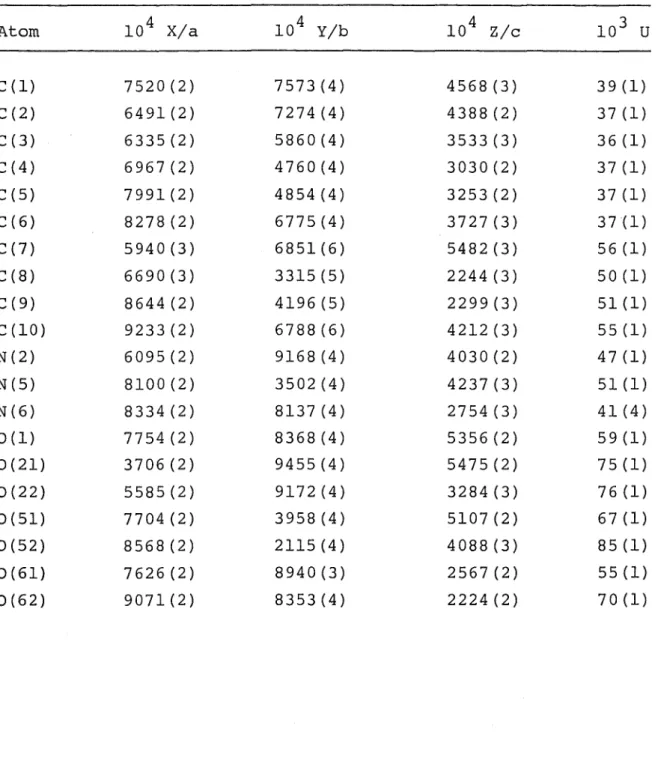
The structures of the hydroxy trinitro ketone (42) and the dihydroxy dinitro ketone (44) were determined unambiguously by X-ray crystal structure analysis.
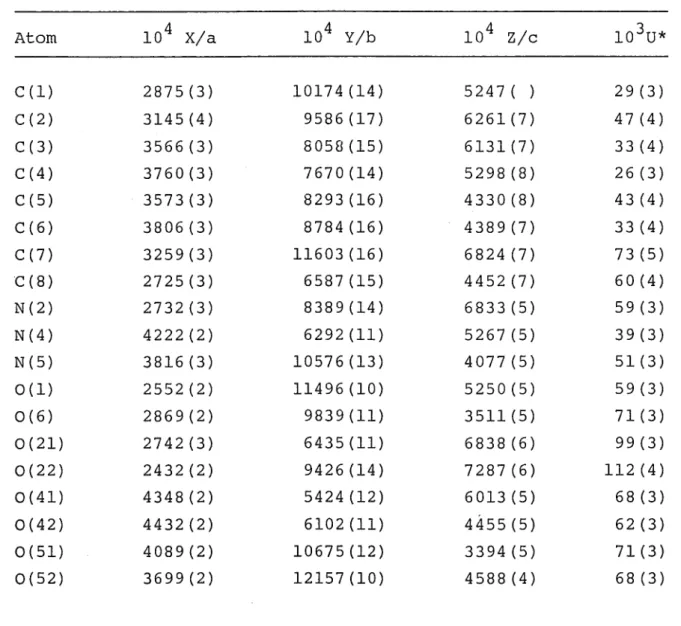
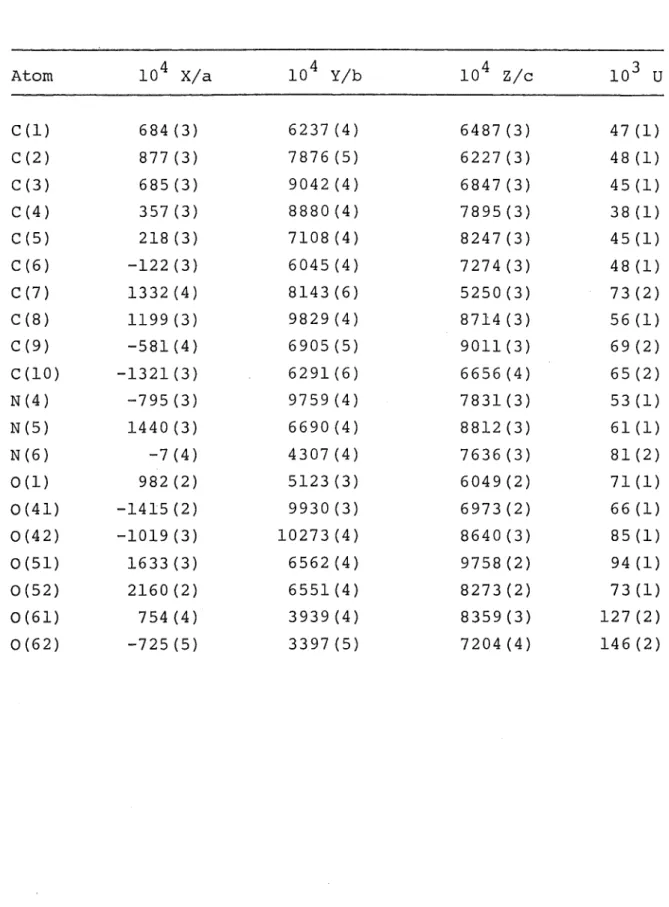
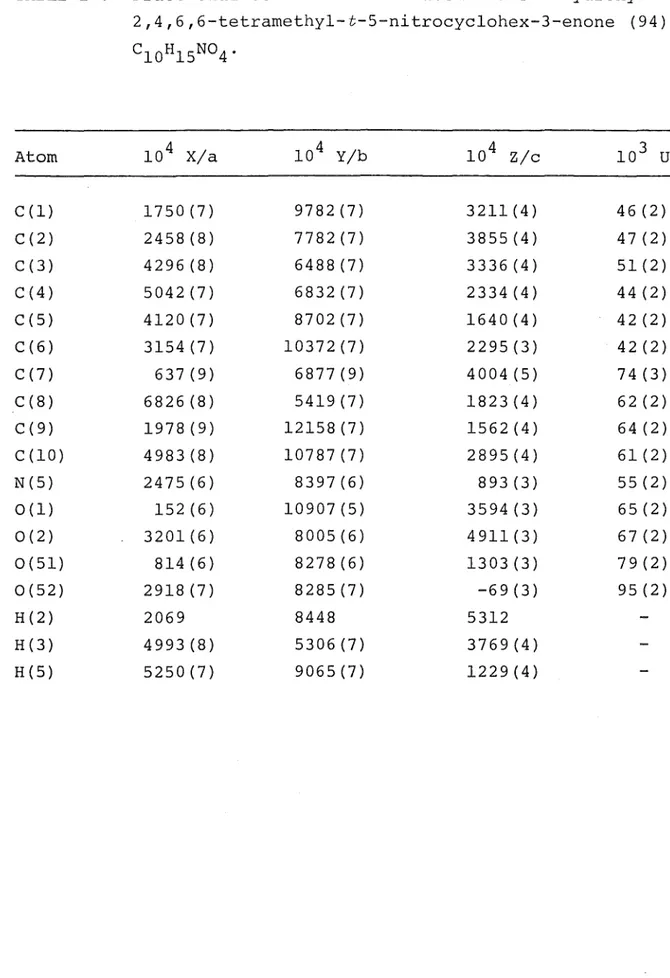
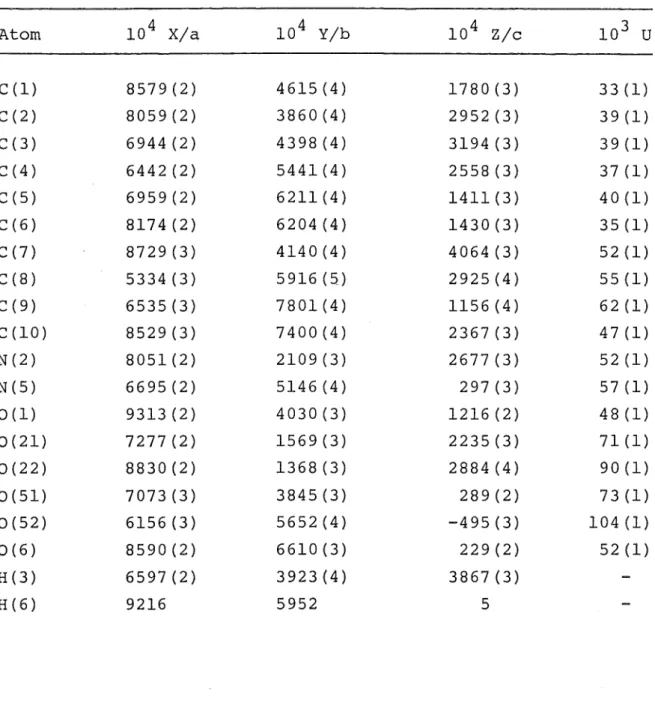
Perspective drawings (two crystallographically independent molecules) of t-6-hydroxy-2,6-dimethyl-r-2,4,t-5-trinitro-cyclohex-3-enone (42), CsHgN303, m.p. 120-121°(dec. ), are presented in Fig.l* with corresponding atomic coordinates in Table 1*. Corresponding information is presented for r-2,t-6-dihydroxy-2,6-dimethyl-4,t-5-dinitrocyclohex-3-enone
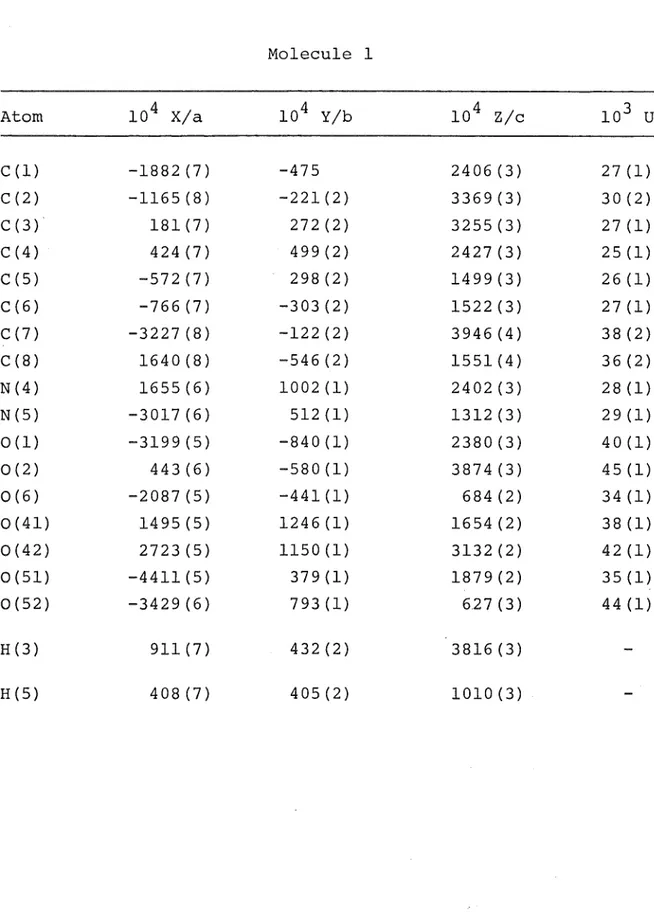
(44), CsH1oN207, m.p. 153-155°(dec.) (Fig.2, two
crystallographically independent molecules, and Table 2). The spectroscopic data for compounds (42) and (44) are in accord with their established structures (see Experimental).
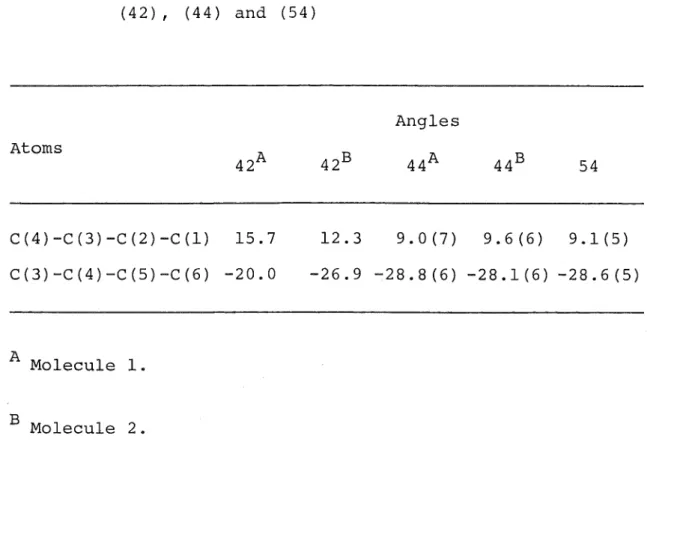
For compound (42) each molecule exists, in the solid state, with the alicyclic ring in a flattened skew boat conformation as can be seen from the appropriate torsional angles (Table 4). The most significant difference in
conformation between the two molecules lies in the
orientation of the 2-N02 functional group. This difference, which is evident in Fig.l, is revealed in the torsional
angle C(7)-C(2)-N(2)-0(22) 31(1) 0
for molecule 1 and the corresponding angle for molecule 2 of 49(1) 0
• In both
molecules the plane of the 4-N02 group is close to being
45.
eclipsed with the C(4)-C(3) double bond. [torsional angle C(3)-C(4)-N(4)-0(41) 9(1) 0
] , and the torsional angles
O(l)-C(l)-C(6)-0(6) c. 23° and 0(1)-0(6) distances c. 2.72~ are
consistent with intramolecular hydroxyl-carbonyl hydrogen bonding in compound (42).
The two crystallographically independent molecules of the dihydroxy dinitro ketone (44) exist in similar
flattened skew boat conformations (for torsional angles, Table 4). The magnitude of the differences between the
two molecules are indicated by the following: (i) torsional angle C(3)-C(4)-C(5)-N(5) 87.4(5)0
, molecule 1 [89.4(5) 0 ,
molecule 2], (ii) torsional angle C(3)-C(4)-N(4)-0(42) 11.4 (6) 0
[8.1(6) 0
] , -(iii) torsional angle H(5)-C(5)-N(5)-0(52)
-2.4(4) 0
[-4.7(4) 0
] , and (iv) torsional angle
O(l)-C(l)-C(2)-0(2) 74.2(5)0
[72.6(5) 0
] . As for compound (42), above, the
torsional angles O(l)-C(l)-C(6)-0(6) c. 26° and 0(1)-0(6) distances c. 2.68 ~are consistent with intramolecular hydroxyl-carbonyl hydrogen bonding in both molecules of compound (44). As is evident from Fig.2 and the torsion angles O(l)-C(l)-C(2)-0(2), above, intramolecular hydrogen bonding involving the 2-0H group may be excluded.
The second, less soluble, hydroxy trinitro ketone was assigned structure (41), C2-epimeric with that determined for compound (42) on the basis of spectroscopic evidence and its elemental analysis. Both structures, (41) and
(42), include the cis-5-N02/6-0H stereochemistry found in all 6-hydroxy-2,5-dinitrocyclohex-3-enones formed by
nitration of polysubstituted phenols with nitrogen dioxide or fuming nitric acid (Section 2.1.3(c)).73 The
46.
but they do reflect the differing stereochemistry at C2. Comparison of the lH n.m.r. data for a number of C2-epimeric 2,5,6-trinitrocyclohex-3-enones (Block E) reveals a correlation between the chemical shift of the C3-proton and their C2-stereochemistry. In the C2-epimers, structures
(46)-(49) (Block E), for a given 5,6-dinitro stereochemistry, the H3 resonance for a trans-2,5-dinitro ketone occurs
80.10-0.20 downfield of that for the corresponding cis-2,5-dinitro ketone (Table 5).
Table 5 'H n.m.r. (CDCl3) chemical for H3 in compounds (46)-(50)
Compound Chemical Shift ( 0 ) for H3
r-2,t-5 r-2,c-5 11.
(46)60e 6.80 6.60 0.20
(47)60e 6.78 6.59 0.19
(48)72 6.53A 6.40 0.13
(49)72 6.67A 6.52 0.15
(50) 8.30 8.13 0.17
A For CD3CN solution
A similar comparison of the chemical shifts for the C2-epimeric 6-hydroxy-2,4,5-trinitro ketones, (41) and (42)
[structure (50) in Table 5] reveals a continuation of the pattern shown in Table 5 i.e. that for the trans-2, 5 dini tro compound (42) the H3 resonance occurs at 88.30, c. 0.17 downfield of the H3 resonance of compound (41) (88.13).
47.
4-nitrophenol (40a) with nitrogen dioxide was identified as the 3,4-dinitro phenol (43) on the basis of its elemental analysis and spectroscopic data.
2.3 Reaction Pathways in the Reaction of 4-Nitro Phenol (40a) with Nitrogen Dioxide
On the basis of the informat~on obtained, above, no comment can be made about the likely mode of formation of the 3,4-dinitro phenol. However, a possible reaction
mechanism is discussed later in this Chapter (Section 2.9). By analogy with the mechanism given previously in
Scheme 20 (Sect1on 2.1.3 (c)) the three substituted cyclohex-3-enones (41), (42) and (44) may be accounted for in terms of the reaction pathways outlined in Scheme 21. Nitro-nitrite rearrangement of the initially formed 6-nitro dienone (45), followed by hydrolysis of the intermediate 6-nitrito dienone, would give the 6-hydroxy dienone (51). Reaction of the 6-hydroxy dienone (51) with nitrogen
dioxide would produce the single delocalised radical
intermediate (52) having cis-6-hydroxy-5-nitro stereochemistry. Subsequent reaction of this delocalised radical (52) with
"N02 would yield the C2-epimeric hydroxy trinitrocyclohex-3-enones (41) and (42). Reaction of (52) with "ONO, followed by hydrolysis, would give the dihydroxycyclohex-3-enone (44).
2.4 Nitration of 2,6-Dimethyl-4-nitrophenol (40a) with Fuming Nitric Acid in Acetic Acid
48.
suspension of the 4-nitro phenol (40a) in acetic acid and the mixture of products isolated by removal of the acids under reduced pressure. The product mixture was shown
(1H n.m.r.) to have a composition [(4l)(c. 32%),(42)(c. 26%), (43)(c. 19%) and (44)(c.l6%)], similar to that produced in the reaction of the 4-nitro phenol (40a) with nitrogen
dioxide in dichloromethane. These products could be isolated by fractional crystallization and h.p.l.c. methods.
2.5 Nitration of 4-Bromo-2,6-dimethylphenol (40c) with Fuming Nitric Acid in Acetic Acid (Addition of the Phenol to the Mixed Acids)
Finely divided 4-bromo phenol (40c) was added to a
stirred mixture of fuming nitric acid (d 1.~ in acetic acid. The mixture of products was obtained by removal of the
acids under reduced pressure. Eight compounds were isolated by a combination of fractional crystallization from
dichloromethane/pentane and by h.p.l.c. methods, but of these, compound (43), was shown subsequently to have been formed during the isolation procedure.
(a) 6-Hydroxy-2,4,5-trinitrocyclohex-3-enones (41) and (42) Small quantities (c. 2% each) of the C2-epimeric
49.
(b) 4-Bromo-6-hydroxy-2,5-dinitrocyclohex-3-enones (53) and (54) The C2-epimeric bromo hydroxy dinitro ketones (53) and
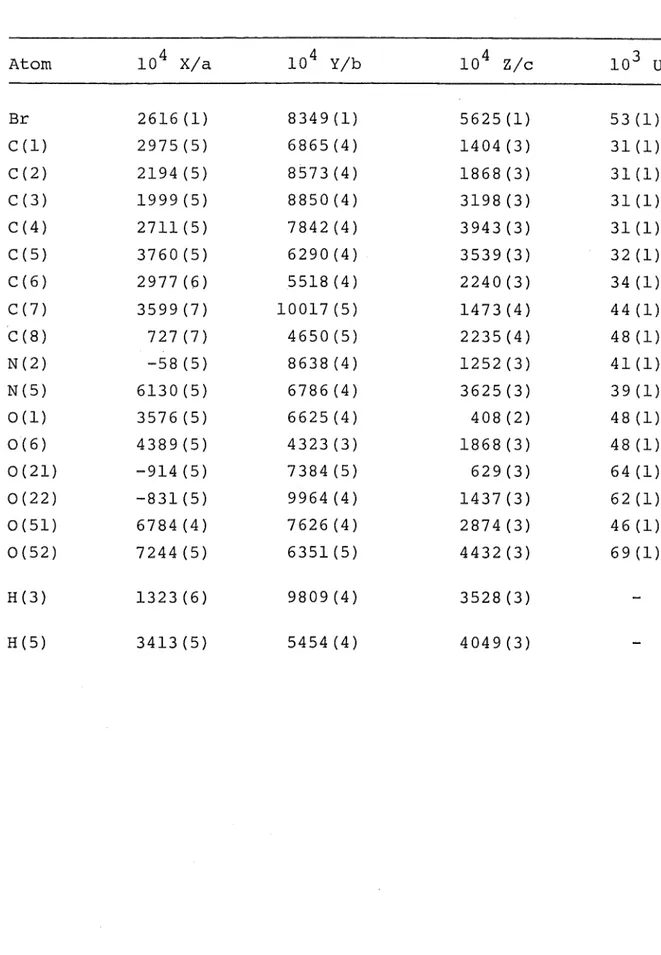
(54) (Block F) were isolated in an impure state by fractional crystallization and purified by h.p.l.c.. The structure of the more soluble isomer (54) was determined by X-ray crystal structure analysis. A perspective drawing of 4-bromo-t-6-hydroxy-2,6-dimethyl-r-2, t-5-dinitrocyclohex-3-enone (54), CaHgBrN206, m.p. l08-l09°(dec.) is presented in Fig.3 with corresponding atomic co-ordinates in Table 3. In the solid state the ring system of compound (54) exists in a
flattened skew boat conformation as can be seen from the appropriate torsional angles given in Table 4. The torsional angle O(l)-C(l)-C16)-0(6) 20.1(4)0
and the O(l)-0(6)
distance 2.52R are consistent with intramolecular hydroxyl-carbonyl hydrogen bonding in compound (54).
The second, less soluble, bromo hydroxy dinitro ketone was assigned structure (53), C2-epimeric with that
determined for compound (54), on the basis of its elemental analysis and by analogy with compound (54). The
spectroscopic data for the two compounds, (53) and (54), are similar, but the differences between the lH n.m.r. resonances for H3, H5 and the 6-CH3 for compounds (53) and (54)
parallel the differences reported above for the analagous C2-epimeric hydroxy trinitro ketones (41) and (42).
(c) 4-Bromo-2,6-dimethyl-2,5,6-trinitrocyclohex-3-enone (55) A further compound which was tentatively assigned
structure (55) was obtained only in an impure state by fractional crystallization. The carbonyl stretching
50.
2,5,6-trinitroc¥clohex-3-enone structure proposed. In 2,5-dinitrocyclohex-3-enones the chemical shift of the olefinic H3 in the lH n.m.r. spectrum is relatively
insensitive to the substituent at c660e,72, but markedly
affected by the nature of the substituent at C4. For example, examination of the lH n.m.r. spectrum for the analogous
compounds, (56) and (57) (Block G) which differ only in the presence of a nitro group or hydroxy group at carbon-6, reveals that their H3 resonances are essentially identical i.e. (56) (86.40) and (57) (86.42). By comparison of the H3 chemical shifts for pairs of compounds, (41) (88.13) and (53)
(87.08), and (42) (88.30) and (54) (87.23), which differ only in the nature of the C4 substituent i.e. 4-N02 or 4-Br, i t is clear that compound (55) (H3, 87.25) has a 4-bromo substituent (Block G).
The bromo trinitro ketone (55) was unstable and
decomposed on storage in both the solid state and solution. In both D6-acetone and deuteriochloroform compound (55) was converted quantitatively into 2,6-dimethyl-3,4-dinitrophenol
(43). No evidence of an intermediate, in this conversion, was detected by repeated scanning of a lH n.m.r. spectrum of the solution.
(d) Other Compounds Isolated
The remaining compounds isolated were 2,6-dimethyl-3,4-dinitrophenol (43), 4-bromo-2,6-dimethyl-3-nitrophenol (58) and 2,6-dimethyl-1,4-benzoquinone (59). Compounds (43) and (59) were identified by comparison with authentic material and the 4-bromo nitro phenol (58) identified from its
51.
the 1,4-benzoquinone (59) were shown to be present (lH n.m.r.) in the product mixture prior to separation processes, the
dinitrophenol (43) was not present initially but was formed thereafter by decomposition of the bromo trinitro ketone (55).
2.6 Nitration of 4-Bromo-2,6-dimethylphenol (40c) with Fuming Nitric Acid in Acetic Acid (Addition of Fuming Nitric Acid to the Phenol in Acetic Acid)
Addition of fuming nitric acid (d 1.5) to a solution of the bromo phenol (40c) in acetic acid, followed by removal of the acids under-reduced pressure, gave a mixture of products similar to that produced on nitration of the 2,6-dimethyl-4-nitrophenol (40a), above. On the basis of the lH n.m.r. spectrum of this mixture i t was estimated that nitrodebrominated products (41), (42), (43) and (44) accounted for c. 90% of the product mixture.
2.7 Reaction of 4-Bromo-2,6-dimethylphenol (40c) with Nitrogen Dioxide in Benzene Solution
Reaction of the bromo phenol (40c) with nitrogen
2.8 Reaction Pathways in the Nitration of 4-Bromo-2,6-dimethylphenol (40c)
52.
A notable feature of the nitration reactions of the 4-bromo phenol (40c) is the extent of nitrodebromination. Only when the phenol (40c) is added to excess fuming nitric acid in acetic acid is there significant retention of the 4-bromo substituent in the products. A possible explanation for this feature is that in the presence of excess nitric acid any nitro dienone formed would undergo further
reaction before nitrodebromination could occur.
The isolation of the 4-bromo-2,5,6-trinitrocyclohex-3-enone (55) indicates that, under the reaction conditions,
addition of nitrogen dioxide to the 4-bromo-6-nitrocyclohexa-2,4-dienone (60) to give the trinitro ketone (55) is competitive with the conversion of the nitro dienone (60) into the 6-hydroxy dienone (61) (Scheme 22). Addition of nitrogen dioxide to the 6-hydroxy dienone (61) gives the C2-epimeric hydroxy dinitro ketones, (53) and (54), which both
have the cis-5-N02/6-0H stereochemistry.
The proposed pathway for decomposition of the trinitro ketone (55) to give the dinitro phenol (43) is outlined in Scheme 22. The elimination of nitrous acid from the
trinitro ketone (55), probably initiated by loss of the acidic H5, gives the 6-nitro dienone (62). Rearrangement of the 6-nitro dienone (62) would give the corresponding 4-nitro dienone (63). Proto-debromination of (63) would then yield the 3,4-dinitro-2,6-dimethylphenol (43).
The bromo nitro phenol (58) is not produced by the
53.
ring nitration at C3 in 4-bromo-2,6-dimethylphenol (40c) or by an acid catalysed rearrangement of 4-bromo-2,6-dimethyl-6-nitrocyclohexa-2,4-dienone (60).
2.9 Further Comment on the Possible Mode of Formation of the 2,6-Dimethyl-3,4-dinitrophenol (43) from
2,6-Dimethyl-4-nitrophenol (40a)
The isolation of the bromo trinitro ketone (55) and its subsequent conversion into the 2,6-dimethyl-3,4-dinitrophenol (43) raises the possibility of a similar mode of formation for this dinitro phenol (43) from the nitration of 2,6-dimethyl-4-nitrophenol (40a). Such a mechanism would involve addition of nitrogen dioxide to a 6