Original research
The impact of upper limb exercise on
function, daily activities and quality of
life in systemic lupus erythematosus: a
pilot randomised controlled trial
Kyriaki Keramiotou ,1,2 Christos Anagnostou,2 Evangelia Kataxaki,2
Antonios Galanos,3 Petros P Sfikakis,1 Maria G Tektonidou 1
To cite: Keramiotou K, anagnostou c, Kataxaki e, et al. The impact of upper limb exercise on function, daily activities and quality of life in systemic lupus erythematosus: a pilot randomised
controlled trial. RMD Open 2020;6:e001141. doi:10.1136/ rmdopen-2019-001141
received 4 november 2019 revised 3 January 2020 accepted 5 January 2020
1First Department of
Propaedeutic internal Medicine, Joint rheumatology Program, Medical school, national and Kapodistrian University of athens, athens, greece 2rheumatology Unit, Thriasio
general hospital of elefsina, Magoula, greece
3laboratory for research
of Musculoskeletal system "Theodoros garofalidis", national and Kapodistrian University of athens, athens, greece
Correspondence to Professor Maria g Tektonidou; mtektonidou@ gmail. com © author(s) (or their employer(s)) 2020. re- use permitted under cc BY- nc. no commercial re- use. see rights and permissions. Published by BMJ.
Key messages
What is already known about this subject?
► The impact of upper limb exercise on function, daily activities and quality of life is not known in systemic lupus erythematosus (sle), unlike other rheumatic diseases.
What does this study add?
► This study confirms the utility of including upper limb exercise in usual care of patients with sle.
How might this impact on clinical practice?
► a 30- min upper limb exercise programme can im-prove hand function, dexterity, activities of daily liv-ing performance and quality of life in patients with sle.
AbstrAct
Objective To assess the effect of upper limb exercise on hand function, daily activities performance and quality of life of patients with systemic lupus erythematosus (sle).
Methods We performed a pilot randomised, 24- week follow- up, unmasked controlled trial. inclusion criteria were upper limb arthralgias, a Disabilities of arm, shoulder and hand (Dash) questionnaire score >10 and a stable treatment over the past 3 months. Patients were randomly allocated in the routine care (control) or exercise group that received an individually tailored 30- min daily upper- limb exercise programme by a hand therapist for 12 weeks. We evaluated at 0, 6, 12 and 24 weeks the performance of daily activities for both groups with Dash questionnaire and health assessment Questionnaire (haQ), the grip and pinch strength with Jamar dynamometer and pinch gauge tool, respectively, the dexterity with Purdue pegboard test, the quality of life with lupus Quality of life (lupusQol) Questionnaire and the pain level by Visual analogue scale (Vas) score.
Results From 293 consecutive sle patients, data from 32 patients allocated to the exercise group and 30 to the control group were analysed. There was a significant difference between the two groups in percentage changes of Dash, haQ, grip strength, pinch strength, lupusQol- physical health and fatigue, and Vas scores from baseline to 6, 12 and 24 weeks, and from baseline to 12 weeks for dexterity test (p<0.001). no interaction was observed between exercise and disease activity or medication use at baseline and during the observation period.
Conclusion Upper- limb exercise significantly improves hand function, pain, daily activity performance and quality of life in sle.
Trial registration number ncT03802578.
InTROduCTIOn
Systemic lupus erythematosus (SLE) is a chronic autoimmune disease with a signif-icant impact on function, activities of daily living, work ability and patients’ quality of life.1–5 It has been well documented that upper limb exercise is beneficial to patients with rheumatic disorders such as rheumatoid
arthritis,6 7 psoriatic arthritis8 and osteoar-thritis.9 A recent meta- analysis showed that full body exercise was well tolerated and improved physical fitness in patients with SLE.10 No studies have examined the effect of upper limb exercise on hand function and performance of daily activities in SLE patients.
The aim of this study was to evaluate the impact of an individually tailored upper limb exercise programme on hand strength, dexterity and performance of daily activities, and the quality of life of SLE patients, in addi-tion to best practice usual care.
It was hypothesised that upper limb exer-cise programme would improve the earlier parameters.
PaTIenTs and MeTHOds study design and participants
A randomised, parallel- group, 24- week follow- up, unmasked controlled trial was designed. Inclusion criteria were the 2012
on May 7, 2020 by guest. Protected by copyright.
http://rmdopen.bmj.com/
Systemic Lupus International Collaborating Clinics (SLICC) classification criteria for SLE,11 age ≥18 years, upper limb arthralgias, difficulty to perform activities of daily living (Disabilities of the Arm, Shoulder, and Hand—DASH score >10), and stable drug regimen for at least 3 months. Exclusion criteria were upper limb frac-ture or surgery in the previous 6 months, physiotherapy programme in the last month or pregnancy. Patients with any upper limb problem unrelated to SLE (eg, recent or chronic shoulder tendonopathy) which resulted to reduced upper limb function and pain were excluded.
It was calculated that a sample size of 32 patients per group was required for a 80% probability of demon-strating a difference of 15% between comparison groups (exercise: −25%±20 vs control: −10%±20) in percentage change of DASH score from baseline to 12 weeks with a significance of <5% (two- tailed test). The patients of the pilot study were included in the final sample. The estimation of sample size was performed using G*Power V.3.1.9.2 programme.
Allocation was unmasked to participants and therapists delivering the exercise programme. The Consolidated Standards of Reporting Trials statement was followed.
assessment tools
A hand therapist (KK) assessed all patients at baseline, 6, 12 and 24 weeks. Rheumatologists working in the two hospitals evaluated all participants and were masked to group allocation. Clinical evaluation included tender and swollen joint count.
Performance of daily activities was evaluated with the DASH questionnaire and the Health Assessment Ques-tionnaire (HAQ). The DASH quesQues-tionnaire is an assess-ment tool of symptoms and function of the entire upper extremity. It has 30 items regarding symptoms (pain, tingling/numbness, weakness, stiffness) and function (physical function, social/role function). Items are scored on a scale from 1 (no difficulty) to 5 (extreme difficulty/unable to do).12 The HAQ is an assessment tool measuring the difficulty of coping with everyday activities such as dressing, walking, arising, reach, eating, grip, hygiene and outside activity.13 Both questionnaires are self- administered, reliable, valid and responsive to change. High score in both questionnaires indicates a decreased ability in performance of daily activities. Participants completed all questionnaires independently.
The grip and pinch strength of dominant hand were evaluated with the Jamar dynamometer and Jamar pinch gauge tools, respectively. For both grip and pinch strength assessment participants were seated, with the shoulder joint adducted and in neutral position, forearm in neutral position, elbow flexed to 900, wrist slightly extended. Three trials were attempted, and the mean score was recorded.
Dexterity of dominant hand was evaluated with the Purdue Pegboard Test. The participants were required to take as many pins as possible within a 30- s period out of a cup and place each one into a hole in a board.14
The quality of life was evaluated with Lupus Quality of Life (LupusQoL), a questionnaire with good construct, face, discriminative and concurrent validity, and internal and test- retest reliability.15 LupusQoL evaluates eight domains including physical health, pain, planning, inti-mate relationships, a burden to others, emotional health, body image and fatigue. Each domain of the LupusQoL is scored separately, on 0–100 scale, with greater values indicating better quality of life. All participants were eval-uated for physical health and fatigue domain.
SLE activity and cumulative organ damage were evalu-ated with the SLE disease activity index 2000 (SLEDAI- 2K) and Systemic Lupus International Collaborating Clinics/ American College of Rheumatology damage index (SLICC/ACR- DI), respectively, at baseline, 12 and 24 weeks. The lupus low disease activity state (LLDAS) was also evaluated. Pain intensity was evaluated with pain visual analogue scale (VAS). Participants completed the pain VAS independently. Fibromyalgia was evaluated with the fibromyalgia rapid screening tool (FiRST), a simple and rapid self- administered questionnaire with excellent discriminative value.16
Primary and secondary outcomes
The primary outcome was the percentage change of DASH score from baseline to 12 weeks. Secondary outcomes were the percentage change of HAQ score, grip and pinch strength, purdue test and LupusQoL from baseline to 12 weeks.
exercise program
A team of hand therapists examined a variety of exer-cises described in the literature or proposed by experts and selected the most appropriate ones to include in a programme designed for SLE, taking into considera-tion the clinical relevance and home applicaconsidera-tion. Partic-ipants were provided with a booklet including pictures and instructions for the exercise programme and a kit of equipment including a stick, two resistance bands and a plastic container of 4oz, with therapeutic putty of medium soft or medium resistance depending on their strength. In order to enhance adherence, partic-ipants were provided with an exercise diary to record completion of the daily exercise programme.17 Patients were encouraged to use as little analgesic medication as possible and advised to try topical substances. Use of nonsteroidal anti- inflammatory drugs (NSAIDs) was not allowed. Clinicians recorded participants’ medication in every session.
Participants had an initial assessment to tailor the exercise programme to their strength, pain level and flexibility. The initial intensity of exercise was set at a moderate level and the programme was reassessed, using a modified Borg Scale, to maintain the same intensity, in every face to face session with the hand therapist at 0, 3, 6 and 9 weeks.
Patients in the exercise group received by the hand therapist a 30- min daily programme at home of
on May 7, 2020 by guest. Protected by copyright.
http://rmdopen.bmj.com/
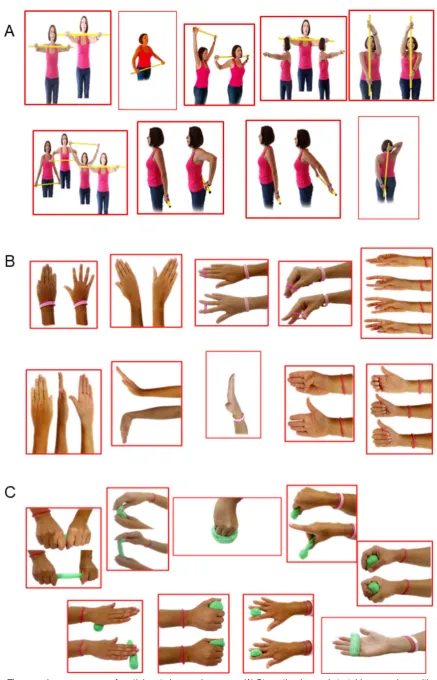
strengthening and stretching upper limb exercises for 12 weeks, in addition to routine care. The programme included 9 strengthening and stretching exercises for the upper extremities with a stick (figure 1A), 10 strength-ening and stretching exercises for the fingers (figure 1B) and 11 strengthening exercises against resistance with therapeutic putty (figure 1C). In addition to the exer-cise group, participants in the control group had four sessions of training in alternative methods of performing daily activities, use of aids, joint protection and energy conservation, additionally to assessment at baseline, 6, 12 and 24 weeks, in order to keep them also committed and motivated. All participants received the same training in alternative methods of performing daily activities, use of aids, joint protection and energy conservation.
statistical analysis
Data were expressed as mean±SD or median (in case of violation of normality) for continuous variables and as percentages for categorical data. The Kolmogorov- Smirnov test was utilised for normality analysis of the parameters.
The comparison of variables at each time point between interventions was performed using the indepen-dent samples t- test or non- parametric Mann- Whitney test. One factor repeated measures analysis of variance (ANOVA) model was used for the comparison of different time measurements (0 vs 6 vs 12 vs 24 weeks) of variables for each intervention. Pairwise multiple comparisons were performed using the Bonferroni test. The median percentage changes from baseline after 6, 12 and 24 weeks, respectively, were calculated in order to examine the two interventions adjusted for any baseline differ-ence. Comparison of percentage changes from baseline of parameters during the observation period between interventions was analysed using the Mann- Whitney test because of violation of normality.
All tests were two- sided, and statistical significance was set at p<0.05. All analyses were carried out using the statistical package SPSS V.21.00 (IBM Corporation).
ResulTs
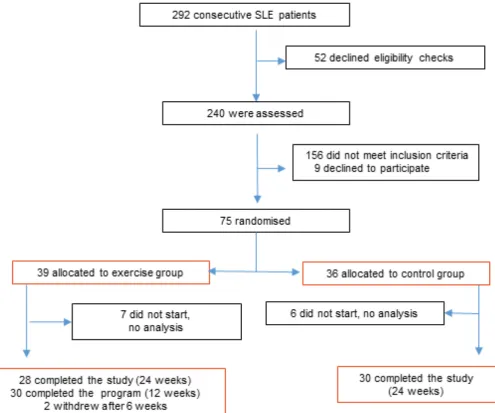
From 292 consecutive SLE patients regularly followed up in the outpatient units of two general hospitals of Athens, Greece, a total of 240 consecutive patients who accepted the eligibility tests were evaluated between September 2016 and January 2018. Of the 84 eligible patients, 9 (10.7%) declined participation due to a distant place of residence or strict time schedules. Block size 4 randomi-sation was used to allocate 75 patients, all Caucasians, who agreed to participate into the exercise group (n=39) or the routine care (control) group (n=36). Seven patients from the exercise group and six from the control group did not start the exercise programme for reasons irrelevant to the programme, like unexpected family or professional obligations and were not included in the analysis. Thirty patients (93,75%) from the exercise
group completed the 12- week exercise programme and 28 (87.5%) were re- evaluated at 24 weeks. Thirty patients (100%) from the control group completed the 24- week study (figure 2).
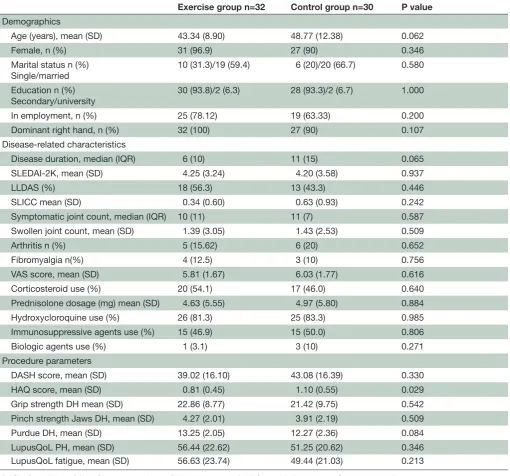
No significant differences were detected at base-line demographic and disease- related characteristics including disease duration, activity and damage, symp-tomatic and swollen joint count, percentage of arthritis, and corticosteroid, hydroxycloroquine and immuno-suppressive agent use between the exercise and control groups. Similarly, there were no significant differences in all procedure parameters between the two groups, except the HAQ scores (p=0.029) (table 1). Interestingly, sub- items of the HAQ, related to upper limb functionality, presented no significant differences such as ‘dress your-self, including shoelaces and buttons’ (p=0.350), ‘cut your own meat’ (0.967), ‘do chores such as vacuuming or yard work’ (p=0.925). On the contrary, sub- items, unre-lated to upper limb functionality, presented significant differences such as ‘climb up five stairs’ (p=0.005), ‘walk outdoors on flat ground’ (p=0.064), ‘bend down to pick up clothing from the floor’ (p=0.103) and ‘get in and out of a car’ (p=0.147).
There was no significant difference in SLE activity (SLEDAI- 2K) between the two groups at baseline (p=0.937), 12 weeks (p=0.718) and 24- week follow- up (p=0.840). Moreover, there was no significant difference in SLE activity (SLEDAI- 2K) during the observation period, neither in the exercise group (p=0.075) nor in the control group (p=0.082). At baseline assessment, all patients had arthralgias, and 5 (15.62%) patients in exer-cise group and 6 (20%) patients in control group showed clinical signs of arthritis. Four participants in the exer-cise group (12.5%) and three participants in the control group (10%) (p=0.756) had fibromyalgia (table 1). No patients had Jaccoud’s arthropathy.
More than 80% of participants in both groups were treated with hydroxycloroquine. About 50% of partic-ipants in both groups were treated with corticosteroids and immunosuppressives. Three per cent of participants in the exercise group and 10% of participants in the control group used biological agents.
Comparison of absolute values of tested parameters during the observation period for each group
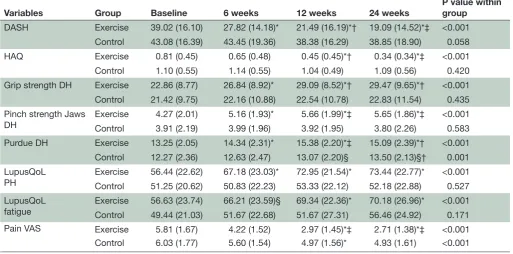
Comparisons of the absolute values of tested parame-ters during the observation period showed a statistically significant difference from baseline to 12 and 24 weeks for all test parameters in the exercise group (p<0.001) (table 2). More specifically, the DASH and HAQ scores improved more than double from baseline to 12 and 24 weeks (p<0.001). Pairwise comparisons between 0, 6 and 12 weeks showed a statistically significant difference for all variables, but not between 12 and 24 weeks (table 2). In the control group, only the purdue score showed statistically significant change between 0 and 12, 0 and 24, 6 and 24 weeks (p=0.001).
on May 7, 2020 by guest. Protected by copyright.
http://rmdopen.bmj.com/
Figure 1 The exercise programme of participants in exercise group. (A) Strengthening and stretching exercises with a stick. (B) Strengthening and stretching finger exercises. (C) Strengthening and stretching exercises with therapeutic putty.
on May 7, 2020 by guest. Protected by copyright.
http://rmdopen.bmj.com/
Figure 2 Trial profile.
Comparison of the absolute changes of the HAQ sub- items, related to the upper limb functionality, ‘dress your-self, including shoelaces and buttons’ and ‘cut your own meat’, during the observation period, showed a statisti-cally significant difference from baseline to 12 and 24 weeks, in the exercise group (p<0.001).
Comparison of percent changes of tested parameters from baseline between compared groups
There was statistically significant difference between the comparison groups (exercise vs control) in rela-tion to percentage change of DASH variable from base-line to 6 weeks (−33.72% vs −1.25%, p<0.001), 12 weeks (−43.41% vs −11.23%, p<0.001) and 24 weeks (−51.86% vs −7.10%, p<0.001) (figure 3A). Similarly, there was significant difference between the two groups in relation to percentage change of HAQ variable from baseline to 6 weeks (−20.00% vs 0.00%, p<0.05), 12 weeks (−55.00% vs −9.72%, p<0.001) and 24 weeks (−69.75% vs −9.13%, p<0.001) (figure 3B). Moreover, all percent changes of grip strength, pinch strength and LupusQoL (physical
health and fatigue domains) were significantly higher in the exercise group compared with control group at all- time points (figure 3C, D, F and G). Moreover, the percentage change of purdue was significantly higher in the exercise group compared with control group from baseline to 12 weeks (p<0.05) (figure 3E). Finally, the percent change of pain VAS was significantly higher in the exercise group compared with control group at all- time points (p≤0.001) (figure 3H).
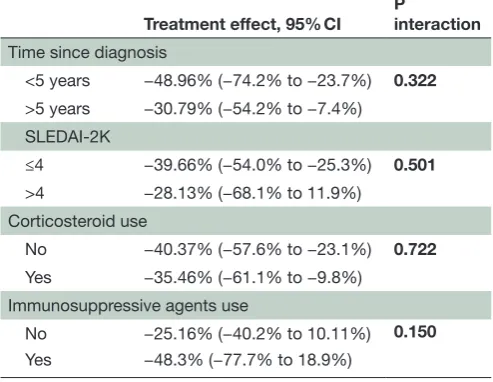
There was no interaction between intervention and disease duration, disease activity, corticosteroid and immunosuppressive use at baseline (table 3). Predniso-lone dosage remained stable at 12 weeks in 80% of 30 remaining patients in both groups, was decreased in 16.7% of patients in both groups and was increased in 3.3% of patients in both groups (p=1.000). The use of immunosuppressive agents remained stable during the whole observation period.
No harms and adverse reactions occurred in the exer-cise group related to the exerexer-cise programme during
on May 7, 2020 by guest. Protected by copyright.
http://rmdopen.bmj.com/
Table 1 Baseline characteristics
Exercise group n=32 Control group n=30 P value Demographics
Age (years), mean (SD) 43.34 (8.90) 48.77 (12.38) 0.062
Female, n (%) 31 (96.9) 27 (90) 0.346
Marital status n (%) Single/married
10 (31.3)/19 (59.4) 6 (20)/20 (66.7) 0.580
Education n (%)
Secondary/university 30 (93.8)/2 (6.3) 28 (93.3)/2 (6.7) 1.000
In employment, n (%) 25 (78.12) 19 (63.33) 0.200
Dominant right hand, n (%) 32 (100) 27 (90) 0.107
Disease- related characteristics
Disease duration, median (IQR) 6 (10) 11 (15) 0.065
SLEDAI- 2K, mean (SD) 4.25 (3.24) 4.20 (3.58) 0.937
LLDAS (%) 18 (56.3) 13 (43.3) 0.446
SLICC mean (SD) 0.34 (0.60) 0.63 (0.93) 0.242
Symptomatic joint count, median (IQR) 10 (11) 11 (7) 0.587
Swollen joint count, mean (SD) 1.39 (3.05) 1.43 (2.53) 0.509
Arthritis n (%) 5 (15.62) 6 (20) 0.652
Fibromyalgia n(%) 4 (12.5) 3 (10) 0.756
VAS score, mean (SD) 5.81 (1.67) 6.03 (1.77) 0.616
Corticosteroid use (%) 20 (54.1) 17 (46.0) 0.640
Prednisolone dosage (mg) mean (SD) 4.63 (5.55) 4.97 (5.80) 0.884
Hydroxycloroquine use (%) 26 (81.3) 25 (83.3) 0.985
Immunosuppressive agents use (%) 15 (46.9) 15 (50.0) 0.806
Biologic agents use (%) 1 (3.1) 3 (10) 0.271
Procedure parameters
DASH score, mean (SD) 39.02 (16.10) 43.08 (16.39) 0.330
HAQ score, mean (SD) 0.81 (0.45) 1.10 (0.55) 0.029
Grip strength DH mean (SD) 22.86 (8.77) 21.42 (9.75) 0.542
Pinch strength Jaws DH, mean (SD) 4.27 (2.01) 3.91 (2.19) 0.509
Purdue DH, mean (SD) 13.25 (2.05) 12.27 (2.36) 0.084
LupusQoL PH, mean (SD) 56.44 (22.62) 51.25 (20.62) 0.346
LupusQoL fatigue, mean (SD) 56.63 (23.74) 49.44 (21.03) 0.213
DASH, Disabilities of Arm, Shoulder and Hand; DH, dominant hand; HAQ, Health Assessment Questionnaire; Jaws, three point pinch; LLDAS, lupus low disease activity state; LupusQoL, Lupus Quality of Life; PH, physical health; SLEDAI- 2K, systemic lupus erythematosus disease activity index 2000; SLICC, Systemic Lupus International Collaborating Clinics; VAS, Visual Analogue Scale.
the intervention period. Twopatients reported adverse events not related to the study intervention. There was one hospital admission in the control group for cholecys-tectomy and one patient in the exercise group was diag-nosed with influenza and treated with oseltamivir.
dIsCussIOn
Based on the results of this study, we confirmed the hypothesis that upper limb exercise programme, in patients with SLE, would result in improvements in hand strength, dexterity, performance of daily activi-ties and quality of life, as adjunct to ongoing routine care. This study demonstrates for the first time that an
individualised upper limb exercise programme signifi-cantly improved hand function, daily performance, pain and quality of life of patients with SLE, independently of SLE activity and medication use or dosage at baseline and during the observation period.
Previous studies have shown that SLE patients face hand or general health problems causing disability in a wide range of daily life activities, including household tasks, work, studies and childcare with consequent effect in their quality of life.1 3 5 18 19 A small number of studies examined the effects of exercise on different aspects of the patient daily life, and the majority reported beneficial responses. Almost all studies involved general or full body programmes focusing on
on May 7, 2020 by guest. Protected by copyright.
http://rmdopen.bmj.com/
Table 2 Comparison of absolute values of tested parameters during the observation period for each group
Variables Group Baseline 6 weeks 12 weeks 24 weeks
P value within group
DASH Exercise 39.02 (16.10) 27.82 (14.18)* 21.49 (16.19)*† 19.09 (14.52)*‡ <0.001
Control 43.08 (16.39) 43.45 (19.36) 38.38 (16.29) 38.85 (18.90) 0.058
HAQ Exercise 0.81 (0.45) 0.65 (0.48) 0.45 (0.45)*† 0.34 (0.34)*‡ <0.001
Control 1.10 (0.55) 1.14 (0.55) 1.04 (0.49) 1.09 (0.56) 0.420
Grip strength DH Exercise 22.86 (8.77) 26.84 (8.92)* 29.09 (8.52)*† 29.47 (9.65)*† <0.001
Control 21.42 (9.75) 22.16 (10.88) 22.54 (10.78) 22.83 (11.54) 0.435
Pinch strength Jaws
DH ExerciseControl 4.27 (2.01)3.91 (2.19) 5.16 (1.93)*3.99 (1.96) 5.66 (1.99)*‡3.92 (1.95) 5.65 (1.86)*‡3.80 (2.26) <0.0010.583
Purdue DH Exercise 13.25 (2.05) 14.34 (2.31)* 15.38 (2.20)*‡ 15.09 (2.39)*† <0.001
Control 12.27 (2.36) 12.63 (2.47) 13.07 (2.20)§ 13.50 (2.13)§† 0.001
LupusQoL PH
Exercise 56.44 (22.62) 67.18 (23.03)* 72.95 (21.54)* 73.44 (22.77)* <0.001
Control 51.25 (20.62) 50.83 (22.23) 53.33 (22.12) 52.18 (22.88) 0.527
LupusQoL
fatigue ExerciseControl 56.63 (23.74)49.44 (21.03) 66.21 (23.59)§51.67 (22.68) 69.34 (22.36)*51.67 (27.31) 70.18 (26.96)*56.46 (24.92) <0.0010.171
Pain VAS Exercise 5.81 (1.67) 4.22 (1.52) 2.97 (1.45)*‡ 2.71 (1.38)*‡ <0.001
Control 6.03 (1.77) 5.60 (1.54) 4.97 (1.56)* 4.93 (1.61) <0.001
All values are presented as mean (SD). *p<0.005 6, 12, 24 weeks vs baseline. †p<0.05 12, 24 weeks vs 6 weeks. ‡p<0.005 12, 24 weeks vs 6 weeks. §p<0.05, 6, 12, 24 weeks vs baseline.
DASH, Disabilities of Arm, Shoulder and Hand; DH, dominant hand; HAQ, Health Assessment Questionnaire; Jaws, three point pinch; LupusQoL, Lupus Quality of Life; PH, physical health; VAS, Visual Analogue Scale.
aerobic fitness.20–23 A systematic review10 of six randomised controlled trials (RCTs) and five quasi- RCTs of the effective-ness of full body exercise and physical activity programme in SLE concluded that therapeutic exercise was safe and well tolerated and was associated with improvements in physical fitness, fatigue and depression.
A wide range of studies has evaluated the effective-ness of hand exercise on other rheumatic disorders. Lamb et al6 studied the efficacy of a home hand exercise programme in 246 patients with RA compared with 244 patients in usual care. They showed significant improve-ment in hand function, dexterity, grip and pinch strength, pain and ROM. Subsequently, a systematic review of Hammond and Prior24 concluded that home hand exer-cise programmes improve hand function, grip strength and pain in RA. Similarly, Roger- Sylva et al8 studied the efficacy of resistance exercise in 20 patients with psori-atic arthritis compared with 21 patients of usual care. They concluded that resistance exercises are effective in improving functional capacity, disease activity and the general quality of life of patients with psoriatic arthritis. A Cochrane systematic review concluded that exercise may reduce hand pain and finger joint stiffness and may improve hand function in patients with hand OA.25
To our knowledge, this is the first study that evalu-ated the impact of upper limb exercise on function and quality of life in patients with SLE. We recruited patients who were stable on a drug regimen and thus in symptoms
control, before the initiation of exercise programme, in order to achieve better adherence to the programme. Moreover, their disease activity was mild to moderate; their mean SLEDAI- 2K score was 4.25, and half of them were on LLDAS.
In our study, DASH and HAQ scores, reflecting the performance of everyday activities, improved more than double in the exercise group. Significant improvement was also detected in grip strength, pinch strength, dexterity and quality of life at 6, 12 and 24 weeks compared with baseline in the exercise group. Interestingly, at 24- week reevaluation, the scores were better than or equal to scores at 12 weeks, when the exercise programme was completed, probably due to improved grip and pinch strength and dexterity duration for longer than exercise programme leading in better performance of activities of daily living. These findings were in accordance with the results of Lamb et al for RA patients.6 Another important finding was that the exercise group presented a signifi-cant decrease of pain in all time points compared with control group, in accordance with the results of other studies in SLE patients26 or RA patients.27–29 However, some studies failed to present post- exercise decrease in pain in SLE patients30 and RA patients,31 32 likely due to different types of the exercise programme. Our results are consistent with other studies showing that exercise in SLE patients is safe and well tolerated10 and results in improved function and quality of life.
on May 7, 2020 by guest. Protected by copyright.
http://rmdopen.bmj.com/
Figure 3 Median percentage change from baseline of (A) DASH, (B) HAQ, (C) grip strength DH, (D) pinch strength DH, (E) purdue (Jaws) DH, (F) LupusQoL physical health, (G) LupusQoL fatigue and (H) pain VAS. DASH, Disabilities of Arm, Shoulder and Hand; DH: dominant hand; HAQ, Health Assessment Questionnaire; Jaws: three point pinch; LupusQoL, Lupus quality of life.
on May 7, 2020 by guest. Protected by copyright.
http://rmdopen.bmj.com/
Table 3 No interaction between intervention and disease duration, disease activity and medications
Treatment effect, 95% CI P interaction Time since diagnosis
<5 years −48.96% (−74.2% to −23.7%) 0.322 >5 years −30.79% (−54.2% to −7.4%)
SLEDAI- 2K
≤4 −39.66% (−54.0% to −25.3%) 0.501 >4 −28.13% (−68.1% to 11.9%)
Corticosteroid use
No −40.37% (−57.6% to −23.1%) 0.722 Yes −35.46% (−61.1% to −9.8%)
Immunosuppressive agents use
No −25.16% (−40.2% to 10.11%) 0.150 Yes −48.3% (−77.7% to 18.9%)
SLEDAI- 2K, systemic lupus erythematosus disease activity index 2000; VAS, Visual Analogue Scale.
Interestingly, small, not statistically significant improve-ment in all parameters (except for purdue test) was also observed in the control group, due to the initiation of patient training in alternative methods of performing daily activities, use of aids, joint protection, and energy conservation.
One of the strengths of our study is that it is the first RCT that evaluated the impact of upper limb exercise in a number of parameters in SLE patients. In addition, the exercise programme was individually tailored to each patient, and the exercise programme is easy enough to be adopted in all outpatient rheumatology clinics. Τhis study had some limitations. First, participants and therapists were unmasked as in most intervention studies, but the indepen-dent completion of questionnaires limited the risk for bias. Clinicians were masked in group allocation. Second, our patients were primarily Caucasians; thus the results may not be generalised to other racial groups. Third, patients of this study had mild to moderate disease activity. The results may not apply to patients with severe disease activity.
Although the HAQ score was lower in the exercise group compared with the control group at baseline, this difference could not bias the results because there were no significant differences in all other baseline demo-graphic, disease- related characteristics and all procedure parameters (except HAQ score) between the two groups. Furthermore, the median percentage changes from base-line after 6, 12 and 24 weeks, respectively, were calculated in order to examine the two interventions adjusted for any baseline difference. Finally, the difference was due to sub- items unrelated to upper limb functionality such as ‘climb up five stairs’, ‘walk outdoors on flat ground’, ‘bend down to pick up clothing from the floor’ and ‘get in and out of a car’.
An application with videos demonstrating exercises, with monitoring of frequency of performing the exercise
programme and with goals setting is being developed to achieve better adherence and help patients with SLE to continue performing exercise long term, as has been suggested for RA patients.24
In conclusion, the introduction of a 30- min session of therapeutic exercise for the upper limbs, as an adjunct to routine care, can improve hand function, dexterity, performance of activities of daily life and quality of life in patients with SLE.
Contributors MgT had full access to all the data in the study and takes
responsibility for the integrity of the data and the accuracy of the data analysis. study concept and design: MgT, KK, ca. acquisition, analysis or interpretation of data: KK, MgT, PPs, eK, ca, ag. Drafting of the manuscript: KK, MgT, ca, ag. critical revision of the manuscript and approval of the manuscript: KK, ca, eK, PPs, MgT.
Funding The authors have not declared a specific grant for this research from any
funding agency in the public, commercial or not- for- profit sectors.
Competing interests PPs has received consulting fees and/or grants from abbVie,
Pfizer, MsD, roche, UcB, gsK and novartis deposited to the special account for research Funding (elKe) of the national and Kapodistrian University of athens Medical school. MgT has received consulting fees and/or grants from abbVie, gsK, MsD, UcB, novartis and Pfizer deposited to the elKe of the national and Kapodistrian University of athens Medical school.
Patient consent for publication not required.
ethics approval The research ethics committee of ‘laiko’ and ‘Thriasio’ hospitals
approved this study and all participants provided written informed consent in accordance with the principles of the Declaration of helsinki.
Provenance and peer review not commissioned; externally peer reviewed.
data availability statement Data are available upon reasonable request. The
protocol and data sets generated for this study are available on request to the corresponding author.
Open access This is an open access article distributed in accordance with the
creative commons attribution non commercial (cc BY- nc 4.0) license, which permits others to distribute, remix, adapt, build upon this work non- commercially, and license their derivative works on different terms, provided the original work is properly cited, appropriate credit is given, any changes made indicated, and the use is non- commercial. see: http:// creativecommons. org/ licenses/ by- nc/ 4. 0/.
ORCId ids
Kyriaki Keramiotou http:// orcid. org/ 0000- 0001- 5172- 0866 Maria g Tektonidou http:// orcid. org/ 0000- 0003- 2238- 0975
RefeRences
1 Malcus Johnsson P, Sandqvist G, Nilsson J-Å, et al. Hand function and performance of daily activities in systemic lupus erythematosus: a clinical study. Lupus 2015;24:827–34.
2 Schmeding A, Schneider M. Fatigue, health- related quality of life and other patient- reported outcomes in systemic lupus erythematosus.
Best Pract Res Clin Rheumatol 2013;27:363–75.
3 Malcus Johnsson P, Sandqvist G, Bengtsson A, et al. Hand function and performance of daily activities in systemic lupus erythematosus.
Arthritis Rheum 2008;59:1432–8.
4 Bağlan Yentür S, Tuna Z, Mete O, et al. Hand functions in systemic lupus erythematosus: a comparative study with rheumatoid arthritis patients and healthy subjects. Turk J Med Sci 2018;48:840–4. 5 Ekblom- Kullberg S, Kautiainen H, Alha P, et al. Education,
employment, absenteeism, and work disability in women with systemic lupus erythematosus. Scand J Rheumatol 2015;44:157–62. 6 Lamb SE, Williamson EM, Heine PJ, et al. Exercises to improve
function of the rheumatoid hand (SARAH): a randomised controlled trial. Lancet 2015;385:421–9.
7 Bergstra SA, Murgia A, Te Velde AF, et al. A systematic review into the effectiveness of hand exercise therapy in the treatment of rheumatoid arthritis. Clin Rheumatol 2014;33:1539–48.
8 Roger- Silva D, Natour J, Moreira E, et al. A resistance exercise program improves functional capacity of patients with psoriatic arthritis: a randomized controlled trial. Clin Rheumatol
2018;37:389–95.
9 Stoffer- Marx MA, Klinger M, Luschin S, et al. Functional consultation and exercises improve grip strength in osteoarthritis of the hand - a randomised controlled trial. Arthritis Res Ther 2018;20:253.
on May 7, 2020 by guest. Protected by copyright.
http://rmdopen.bmj.com/
10 O'Dwyer T, Durcan L, Wilson F. Exercise and physical activity in systemic lupus erythematosus: a systematic review with meta- analyses. Semin Arthritis Rheum 2017;47:204–15.
11 Petri M, Orbai A- M, Alarcón GS, et al. Derivation and validation of the systemic lupus international collaborating clinics classification criteria for systemic lupus erythematosus. Arthritis Rheum
2012;64:2677–86.
12 Hammond A, Prior Y, Tyson S. Linguistic validation, validity and reliability of the British English versions of the disabilities of the arm, shoulder and hand (DASH) questionnaire and QuickDASH in people with rheumatoid arthritis. BMC Musculoskelet Disord 2018;19:118. 13 Bruce B, Fries JF. The Stanford health assessment questionnaire:
a review of its history, issues, progress, and documentation. J Rheumatol 2003;30:167–78.
14 Barbier O, Penta M, Thonnard J- L. Outcome evaluation of the hand and wrist according to the International classification of functioning, disability, and health. Hand Clin 2003;19:371–8. vii.
15 McElhone K, Abbott J, Sutton C, et al. Sensitivity to change and minimal important differences of the LupusQoL in patients with systemic lupus erythematosus. Arthritis Care Res 2016;68:1505–13. 16 Perrot S, Bouhassira D, Fermanian J, et al. Development and
validation of the fibromyalgia rapid screening tool (first). Pain
2010;150:250–6.
17 Moseley GL. Do training diaries affect and reflect adherence to home programs? Arthritis Rheum 2006;55:662–4.
18 Greco CM, Rudy TE, Manzi S. Effects of disease activity, pain, and distress on activity limitations in patients with systemic lupus erythematosus. J Rheumatol 2004;31:260–7.
19 Katz P, Morris A, Trupin L, et al. Disability in valued life activities among individuals with systemic lupus erythematosus. Arthritis Rheum 2008;59:465–73.
20 Boström C, Elfving B, Dupré B, et al. Effects of a one- year physical activity programme for women with systemic lupus erythematosus - a randomized controlled study. Lupus 2016;25:602–16.
21 Abrahão MI, Gomiero AB, Peccin MS, et al. Cardiovascular training vs. resistance training for improving quality of life and physical function in patients with systemic lupus erythematosus: a randomized controlled trial. Scand J Rheumatol 2016;45:197–201.
22 Tench CM, McCarthy J, McCurdie I, et al. Fatigue in systemic lupus erythematosus: a randomized controlled trial of exercise.
Rheumatology 2003;42:1050–4.
23 Miossi R, Benatti FB, Lúciade de Sá Pinto A, et al. Using exercise training to counterbalance chronotropic incompetence and delayed heart rate recovery in systemic lupus erythematosus: a randomized trial. Arthritis Care Res 2012;64:1159–66.
24 Hammond A, Prior Y. The effectiveness of home hand exercise programmes in rheumatoid arthritis: a systematic review. Br Med Bull 2016;119:49–62.
25 Østerås N, Kjeken I, Smedslund G, et al. Exercise for hand osteoarthritis: a Cochrane systematic review. J Rheumatol
2017;44:1850–8.
26 Timóteo RP, Silva AF, Micheli DC, et al. Increased flexibility, pain reduction and unaltered levels of IL-10 and CD11b + lymphocytes in patients with systemic lupus erythematosus were associated with kinesiotherapy. Lupus 2018;27:1159–68.
27 Manning VL, Hurley MV, Scott DL, et al. Education, self-
management, and upper extremity exercise training in people with rheumatoid arthritis: a randomized controlled trial. Arthritis Care Res
2014;66:217–27.
28 Rønningen A, Kjeken I. Effect of an intensive hand exercise programme in patients with rheumatoid arthritis. Scand J Occup Ther 2008;15:173–83.
29 Buljina AI, Taljanovic MS, Avdic DM, et al. Physical and exercise therapy for treatment of the rheumatoid hand. Arthritis Rheum
2001;45:392–7.
30 Carvalho MRPde, Sato EI, Tebexreni AS, et al. Effects of supervised cardiovascular training program on exercise tolerance, aerobic capacity, and quality of life in patients with systemic lupus erythematosus. Arthritis Rheum 2005;53:838–44.
31 Brorsson S, Hilliges M, Sollerman C, et al. A six- week hand exercise programme improves strength and hand function in patients with rheumatoid arthritis. J Rehabil Med 2009;41:338–42.
32 Rapoliene J, Krisciūnas A. The effectiveness of occupational therapy in restoring the functional state of hands in rheumatoid arthritis patients. Medicina 2006;42:823–8.
on May 7, 2020 by guest. Protected by copyright.
http://rmdopen.bmj.com/