Knowledge and Behavior Assessment about the Use of Disposable Plastic
Containers amongst Medical Sciences Students in Northeastern Iran in 2016
Sima Nourbakhsh
1, Monavvar Afzal-Aghaee
2, Elham Rahmanpour Salmani
*3, Mohammad Naderi
1,
Reihane Zangi
1, Reihane Feizi
11) Research Committee, School of Health, Mashhad University of Medical Sciences, Mashhad, Iran
2) Department of Statistics and Epidemiology, School of Health, Mashhad University of Medical Sciences, Mashhad, Iran 3) Environmental Health Engineering, Graduated from Mashhad University of Medical Sciences, Mashhad, Iran
*Author for Correspondence: [email protected]
Received: 25 Nov. 2016, Revised: 28 Jan. 201, Accepted: 06 Feb. 2017
ABSTRACT
Disposable Plastic Containers (DPCs) are widely in use in our daily life in many locations and times. Despite their great advantages including low cost, easy access, convenient transferring and no need to clean up, the indiscriminate use of them can be a concern, if they are not applied in the correct way of usage. This study aimed to assess the students' knowledge, and behavior regarding the correct use of DPCs. A questionnaire was designed using scientific literatures and health expert consultation. The resulting 26-item scale which included questions for sample characteristics (N=4), knowledge (N=19), and behavior (N=3) was approved in terms of reliability regarding Cronbach's alpha score of 0.8. Developed instrument was administered to a cross section of 200 students of Mashhad University of Medical Sciences in mid-2016. Data was analyzed using SPSS 16.0. Results indicated that 59.3% of the individuals had used DPCs more than once. Only 5.8% of the respondents were familiar with safety codes on the bottom of DPCs. The differences in the mean score of knowledge were not statistically significant in terms of gender, marriage status, level of education, and college. Considering total knowledge score of 18 on the designed scale, the maximum score of knowledge was observed in men (5.88±2.26), in married ones (6.11±2.55), in PhD students (6.5±2.39), and in dental college (6.31±2.65). According to the results, the students’ knowledge regarding the safe use of DPCs was very low (less than one third of the ideal knowledge) and their usage behavior was also relatively false.
Keywords:
Disposable Plastic Containers, Knowledge, Mashhad University of Medical Sciences, Usage BehaviorINTRODUCTION
In the worldwide scale, the production of plastics has surpassed from 300 million tons per year, since 2010. Plastics were made for the first time in prehistoric Mesoamerica at 1600 B.C. when humans shaped objects using natural rubber. After many centuries, in 1839, vulcanized rubber and polystyrene were discovered and introduced as the starting point of the exploitation of plastics in the modern age. Plastics are synthetic polymers made of long-chain molecules. Many links are needed to make a chain and every link is composed of carbon, hydrogen, oxygen and/or silicon. To create plastic resins of different characteristics, monomers, the building blocks of polymers, combine in different manners [1]. The raw materials used to make monomers are extracted from the main sources of energy including oil, coal and natural gas [2]. Since plastics are mostly manufactured from byproducts of the petroleum processes, they are inexpensive and can be found in different objects made for various purposes in current
life. Plastics are also extensively used in the production of disposable items [3]. Disposable food grade containers are one kind of these products. Currently, Iran is one of the top 10 countries in the use of disposable containers. Only in 2006, more than 570 thousand tons of disposable containers were consumed in Iran. This means that approximately 10kg of oil per one person-year were converted to disposable plastics. In recent years, disposable containers can be seen everywhere, in juice shops, ice cream stores, pizzerias, self-service of offices and universities, birthday parties, celebrations, and votive food distribution events. Actually, the cheap price, easy transportation, ease of use, saving time and quick access are the main reasons for the indiscriminate consumption of DPCs [4].
of these polymers various additives such as emollients, stabilizers, lubricants, antioxidants, fillers, antistatic materials, opaque materials [6, 7], colorings and plasticizers (plastic softeners) are applied to improve their performance [1]. The phthalic acid esters also called phthalates are one of the most applied plasticizers [8]. Phthalates are strongly susceptible to leaching because they are not covalently bound to the polymer matrix. These plastic softeners are applied at major percentages in plastics [9]. According to literatures, phthalate can cause endocrine disruption, human immune response, and mal effects on the male reproductive system such as genital abnormalities and testicular cancer [1]. Bisphenol A (BPA) and nonylphenol (NP) are two other compounds used in large volumes in the production of DPCs [10]. BPA is the main monomer in the structure of PC plastics and also is a frequently used additive in the manufacturing of PVC resins. As in the polymerization of BPA, some monomers remain unbound; a remarkable fraction of BPA mass can be released from the body of the container and come into contact with food and beverage over time [1]. BPA is an estrogen mimic which can disrupt the endocrine function of organisms such as human pituitary and thyroid glands and may also cause abnormal sexual development, decreased immune function, and negative effects on fetus [10]. NP is a degradation product of nonylphenol ethoxylate, frequently used nonionic surfactants in various industrial and agricultural processes [11]. It has been classified as an endocrine disrupting chemical and has shown mal effects on the hormonal system of many organisms, has interfered with the male reproduction activity, has increased the feminization and has caused more rates of death among adolescents [12]. In addition to the cited chemical compounds, a considerable quantity of PS foam which is constituted from styrene monomers is also used in the production of food-contact goods [13], especially the single-use glasses [14]. The food and drug administration of America (FDA) has paid special attention to the levels of distribution and transfer of styrene monomer. Damage to the central nervous system, liver, respiratory system and digestive tracts are some of the probable effects of styrene in persons exposed to this monomer [15]. The chemical compounds in the structure of disposable food containers are not the only threat to the health of consumers, as some studies have shown that a remarkable number of produced DPCs have microbial contamination before reaching the hands of consumers [16].
It should be considered that problems resulted from excessive uses of plastic containers are not limited only to health concerns. The increased use of plastics
has added substantial amounts of them to the natural environment which caused contamination of a variety of aquatic and terrestrial habitats and also the fresh water resources [3]. According to Barnes et al. [17] plastics are the predominant groups of debris, almost 50-80% of the total wastes in the shorelines. Aesthetic problems of this debris can adversely influence on the tourism and fishing [18]. There are also several reports regarding the effect of plastic residuals on the wildlife species such as plastics ingestion or become entangled in plastic residuals [19]. How to effectively deal with plastic wastes is one of the key questions in the area of waste management that matters from different aspects including environment, economy, and policy [20]. Given that plastic recycling is relatively an expensive option of waste management in Iran, this solution is rarely selected to manage the plastic wastes in this country. On the other hand, burning such wastes cannot be recommended mainly because of the environmental pollution from toxic gas emissions due to this act. In this situation, the only practicable remained option is disposal of plastic wastes in landfill sites which does not seem to be the optimal choice of plastic waste management, because regardless of the great need for land via this way of waste disposal, hundreds of years must be passed for these wastes to be destroyed [5]. Furthermore, the improved stability and durability of plastics over time has led to their more resistance to biodegradation. [2].
Undoubtedly, the students who are studying in the medical and health scope will be on the front line of health protection and promotion programs of community after graduating. Hence, the lack of awareness or unhealthy behaviors on their behalf regarding the health affecting issues pervasive in the society not only will threaten their own health but also will overshadow the public health. In fact, such students as custodians of community health can be considered as useful and informative tools for raising awareness of public, so primarily they should be healthy and aware. This study aimed to assess the knowledge and behavior of students on the use of DPCs in Mashhad University of Medical Sciences which is known as a center of excellence in the field of Medical Sciences in Iran.
MATERIALS AND METHODS
stratified random sampling from all faculties and participated in the trial. In current research, stratified random method was adopted and subjects were selected following two stages. In the first step regarding different schools with unequal populations at various education levels, sampling strata were determined through stratified proportional sampling method according to the school and level. Then a simple random sampling was performed in each stratum. Data collection was performed through a researcher made questionnaire. The study tool was initially examined at Health school (n=20) prior to the study in order to evaluate reliability and clarity of the information using the test-retest method. After 1 month, the questionnaire was redistributed for reliability among the same participants and Cronbach’s alpha coefficient was achieved by 0.8. Instrument validity was also approved by health experts. The questionnaire consisted of 3 sections containing demographic, knowledge, and behavior questions. Out of 26 questions in the questionnaire, 4 questions were about demographic information including gender, marital status, school, and grade, 19 items were related to awareness, while 3 remained were specified for behavior. Data were analyzed
using descriptive statistics, independent t-test, and ANOVA through SPSS software (version 16). The significance level was determined at P-Value < 0.05.
RESULTS
Sample Characteristics
200 students participated in the survey, of whom 57% (114) were female and 43% (86) were male, 16.5% (33) were married while 83.5% (167) were unmarried; 46% (92) of individuals were general PhD students, 37% (74) were undergraduate ones, 12% (24) of participants were studying in MA, while remain 5% (10) were PhD students. Students were participated from 6 colleges of Mashhad University of Medical Sciences: 36.5% (73) from Medical school, 19% (38) from the school of Nursing and Midwifery, 14% (28) from the school of Allied Medical Sciences, 11.5 % (23) from the school of Pharmacy, 11% (22) from the school of Health, and 8% (16) from the school of Dentistry. Detailed information regarding frequency of each education level and college in the current survey are presented in Table 1.
Table 1: Detailed information of education level and college of students
Level of
education
Total number of students
Total number of
distributed questionnaire
Frequency of participants based on college Medical Nursing and
Midwifery
Allied Medical Sciences
Pharmacy Health Dentistry
Undergraduate 2107 74 0 30 26 0 18 0
MA 838 24 12 6 1 1 4 0
General PhD 2783 92 56 0 0 20 0 16
PhD 294 10 5 2 1 2 0 0
Total 6022 200 73 38 28 23 22 16
Knowledge of students
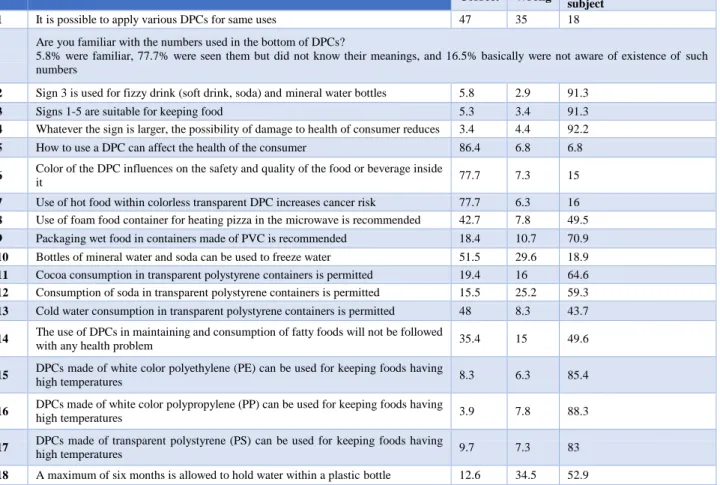
Items designed for knowledge assessment and the frequency of answers regarding correct, wrong, and lack of awareness to the questions are simplified and presented by Table 2. Relying on Table 2, less than half of the individuals (47%) knew that various DPCs must not be applied for same purposes. In the following, students were asked about whether or not they were familiar with numbers placed at the bottom of DPCs. It was observed that only 5.8% of students were familiar with the numbers, while 77.7% said that they have seen such numbers but do not know what they mean and 16.5% of participants basically had no information about the existence of such signs. Then this issue was detailed through the next three questions. Accordingly, 5.8% of respondents were aware that container having symbol 3 is not indicative of bottles of mineral water and fizzy drinks,
94.7% of students did not know that containers having abbreviations 1 to 5 are suitable for storage of
use transparent polystyrene containers for water drinking or not, while they were allowed. 35.4% of students with certainty stated that the use of DPCs in keeping and consumption of fatty foods is problematic for health. Prohibiting the use of DPCs made of white polyethylene (PE) and transparent polystyrene (PS) for keeping foods of high temperature was announced by 8.3% and 9.7% of
total population respectively, while 3.9% knew that they can use DPCs made of white Polypropylene (PP)for this purpose. 34.5% of individuals wrongly believed that a plastic bottle can be used more than 6 months to hold water, while 52.9% of students stated that basically they do not have any knowledge about this issue.
Table 2: Frequency of responses to each item designed for knowledge assessment
Row Item
Frequency of answers (%)
Correct Wrong Lack of knowledge on the
subject
1 It is possible to apply various DPCs for same uses 47 35 18
-
Are you familiar with the numbers used in the bottom of DPCs?
5.8% were familiar, 77.7% were seen them but did not know their meanings, and 16.5% basically were not aware of existence of such numbers
2 Sign 3 is used for fizzy drink (soft drink, soda) and mineral water bottles 5.8 2.9 91.3
3 Signs 1-5 are suitable for keeping food 5.3 3.4 91.3
4 Whatever the sign is larger, the possibility of damage to health of consumer reduces 3.4 4.4 92.2 5 How to use a DPC can affect the health of the consumer 86.4 6.8 6.8
6 Color of the DPC influences on the safety and quality of the food or beverage inside
it 77.7 7.3 15
7 Use of hot food within colorless transparent DPC increases cancer risk 77.7 6.3 16 8 Use of foam food container for heating pizza in the microwave is recommended 42.7 7.8 49.5 9 Packaging wet food in containers made of PVC is recommended 18.4 10.7 70.9
10 Bottles of mineral water and soda can be used to freeze water 51.5 29.6 18.9 11 Cocoa consumption in transparent polystyrene containers is permitted 19.4 16 64.6 12 Consumption of soda in transparent polystyrene containers is permitted 15.5 25.2 59.3
13 Cold water consumption in transparent polystyrene containers is permitted 48 8.3 43.7
14 The use of DPCs in maintaining and consumption of fatty foods will not be followed
with any health problem 35.4 15 49.6
15 DPCs made of white color polyethylene (PE) can be used for keeping foods having high temperatures 8.3 6.3 85.4
16 DPCs made of white color polypropylene (PP) can be used for keeping foods having
high temperatures 3.9 7.8 88.3
17 DPCs made of transparent polystyrene (PS) can be used for keeping foods having
high temperatures 9.7 7.3 83
18 A maximum of six months is allowed to hold water within a plastic bottle 12.6 34.5 52.9
To better evaluate the knowledge of subjects, knowledge scores were calculated. The overall score of knowledge in the developed questionnaire was 18. The obtained scores in relation to the sexuality and marital status are presented in Fig. 1. Fig. 2 provides the scores gained by students in different levels of education, while knowledge scores corresponding to various colleges can be seen in Fig. 3. Considering significance level of p-value<0.05, there was not any significant difference between the knowledge scores based on the sexuality, marital status, levels of education, and the faculty of education. Furthermore, the observed scores of knowledge were very weak and almost in all cases lower than one third of the total score of the scale. However, married
individuals, Ph.D. students, and dentistry college gained better scores in comparison to the unmarried ones, lower educated students, and other faculties.
Behavior of students
20.8% of the studied population expressed that they use such containers more for food consumption. Use of DPCs for storing water in the refrigerator, storing food in the refrigerator, and storing food in the freezer were in the next ranks with a proportion equal to 14.6%, 9.2%, and 4.4%. Finally, they were asked to determine how they pour hot food into a DPC; they pour it in the DPC instantly, or they wait until its temperature decreases. Ones who reported the wrong behavior of pouring a hot food into the container was 16.5% and a worse condition was observed among 27.2% of individuals who stated that they basically do not care about the temperature of food that must be poured into a DPC.
Fig.1: Differences in the mean score of students’
knowledge based on the sexuality and marital status
Fig.2: Differences in the mean score of students’
knowledge based on the level of education
Fig.3: Differences in the mean score of students’
knowledge in different colleges
DISCUSSION
The results showed that the marriage, the higher level of education, and the schools where people were trained there, had no significant effect on the usage behavior of individuals, whether male or female. Results indicated that students’ awareness was different on the basis of the difficulty level of every question.
Although with regards to the calculated
knowledge scores it can be stated that the
students had weak awareness in terms of the
studied subject.
Items of the questionnaire had been designed in such a way to be able to assess the students' awareness and practice from different aspects. Questions related to awareness were begun with a general question whether subjects consider any difference between various types of DPCs or not. The results were disappointing because the frequency of the respondents who believed that different containers are produced for various applications was less than half. According to the second to fourth questions that were developed to measure the knowledge of people about the safety signs of DPCs, an average of 4.83% demonstrated their exact knowledge in this regard. Obviously, awareness towards various labels used in the bottom of DPCs (recycling symbols) can create a barrier against the improper use of them. Table 3 illustrates each symbol at its determined consumptions [21]. Recycling signs were designed for the first time in 1970 by Gary Anderson, a student at the University of Southern California in Los Angeles and then were presented at the international conference of designing as part of a national competition among high schools and colleges in America. Competition was held5.46 5.88 6.11 5.6
18
0 2 4 6 8 10 12 14 16 18 20
Women Men Married Unmarried
Gender Marital status Total
score Effect of sex and marital status on knowledge
score
T
h
e
S
co
re
o
f
Kn
o
w
le
d
g
e
6.5
5.67 5.62 5.59 18
0 2 4 6 8 10 12 14 16 18 20
Effect of education level on knowledge score
T
h
e
S
co
re
o
f
Kn
o
w
le
d
g
e
0 2 4 6 8 10 12 14 16 18 20
Knowledge Scores in different faculties
Th
e
S
co
re
s
o
f
K
n
o
w
led
g
concerning response to the growing awareness of consumer and sustainability advocates and also to celebrate the first Earth Day. Based on the definitions provided by G. Anderson, each of the three arrows in a recycling symbol represents one stage of the three-stage process of the closed recycle loop [22]. These safety signs are inserted in the bottom surface of plastics primarily to guide the consumers in terms of the allowed use of the product. They show the polymers from which the plastic containers are made. Each of these codes specifies the material used in the production process of each container in order to guide the recyclers to sort them out. If the sign inserted, is a number from 1 to 5, the container can be used for eating and drinking. As the numbers on DPCs getting bigger, the possibility of migration of chemicals from the body of the container into the material inside it increases.
Items numbered at 2, 10, and 18 in Table 2 explored the knowledge of students regarding water bottles from different aspects. According to Table 3, the symbol number 1 on a bottle shows its applicability for water and fizzy drink. Some experts believe that depending on how you use the container and the temperature in which the PETE plastics have been made, the function of endocrine glands may be disrupted. So, they have suggested that in order to achieve more safety, water bottles should be used only once, should not be placed in the freezer, and pouring hot liquids into them should be avoided [4]. In the research performed by Najafpoor et al. [4] to explore the knowledge of housewives regarding the use of DPCs, almost 41% of the studied women had used mineral water bottles for freezing water that was nearly close to 48.5% obtained in the present work. Although some health experts believe that single-use water bottles can be used for storing water in the refrigerator, but they also have noted that the maintenance duration should not be longer than 6 months, because drinking water has a lot of minerals which can react chemically with polymers of DPC [23]. Moreover, some of the Iranian shop-owners do not keep mineral water bottles at the standard conditions which cause bottles to be exposed at risk of some environmental factors such as temperature and consequently under such circumstances the possibility of chemical substances migration increases remarkably [10].
The importance of the proper use of bottles becomes clearer when you refer to the results of the practice assessment in current study where more proportion of those surveyed (65.6%) had expressed that they apply DPCs more for drinking or storage of water in comparison to the food consumption.
It has been assured that DPCs made of PP can withstand high temperatures without harm to health, although at temperatures around 80° C they can alter the taste of tea and food (item 16). Unlike PP containers, the use of PE containers at temperatures above 65°C is not recommended (item 15) [5]. According to the study conducted by Kazemi et al. [10] the incorrect maintenance condition of mineral water bottles causes migration of BPA, especially in the warm weather condition. The results of the investigations conducted by Le et al. [24] and Li et al. [25] were also indicating the higher rates of BPA migration in the mineral water bottles with the increase of ambient temperature. It must be considered that the release of chemical compounds does not happen only at elevated temperatures, since based on some studies reports like findings of Howdeshell et al. [26] researches, migration also occurs at room temperature.
DPCs made of PS should not be used for drinking soda, cocoa, and edible substances having high temperatures (items 11, 12, & 17). Fatty hot drinks must not be consumed in PS containers. Khaksar and Ghazi-Khansari [27] studied the migration of styrene monomer from PS disposable cups into fat drinks. They indicated that fat content of drinks is a determining factor in the migration rate of monomers as the level of styrene monomer derived in the examined samples was more than standard values recommended by USEPA.
Table 3: Recycling symbols on plastics
symbols uses
Polyethylene terephthalate ethylene, used for fizzy drink bottles, juice and water containers.
High density polyethylene, used in opaque plastic milk and washing up liquid bottles.
Polyvinyl chloride, used for cling wrap, plastic squeeze bottles, cooking oil, peanut butter and Shampoo containers.
Low density polyethylene, used in bread and vegetables packaging, grocery store bags, most plastic wraps, and some bottles.
Polypropylene, used as syrup and yogurt containers, straws and other clouded plastic containers, including baby feeding bottles.
Polystyrene, used in styrofoam food trays, egg cartons, disposable cups and bowls, coffee cups, foam meat or fish trays, carry-out containers and opaque plastic cutlery.
This is a catch-all category for plastics that don’t fall into any of the above categories. A label of #7-PC it is unsafe to use as it contains polycarbonate because of possible BPA leach.
CONCLUSION
The current survey was conducted to evaluate the knowledge and practice of medical and health scope students regarding the correct way of DPCs usage. According to the results, it can be concluded that: I. It is tragic to state that, more than half of the students had used a single-use container more than once.
II On average, more than 94% of the studied population definitely had no knowledge about the safety signs inserted in the bottom surface of DPCs, although more than half of them had expressed that they had seen such symbols.
III. Various DPCs which are manufactured using different polymers and thus must be used for different types of consumption had been supplied by the respondents for the same usages.
IV. A large proportion of the studied group was not familiar with the requirements of the correct usages of DPCs. For example, they were not caring about the nature (being fatty or not) and temperature of foods and also the color and structure of the containers.
ETHICAL ISSUES
Authors completely observed their work for ethical issues including: plagiarism, informed consent, misconduct, data fabrication and/or falsification, double publication and/or submission, redundancy, etc.
COMPETING OF INTEREST
There is not any conflict of interest to be reported by authors.
AUTHORS’CONTRIBUTIONS
Rahmanpour Salmani, and Afzal-Aghaee prepared the research proposal and designed the questionnaire. Nourbakhsh determined the size of sample, conducted test-retest method for reliability assessment of the developed instrument and performed all the statistical analyzes. Rahmanpour salmani conducted scientific searches, and prepared the manuscript. Naderi, Zangi, and Feizi collected data of the study.
FUNDING/SUPPORTING
This study was financially supported by Mashhad University of Medical Sciences as a result of approved research proposal with code of 922715.
REFERENCES
[1] Halden RU. Plastics and health risks. Annual review of public health. 2010;31: 179-94.
[2]
Shah AA, Hasan F, Hameed A, Ahmed S.
Biological
degradation
of
plastics:
A
comprehensive
review.
Biotechnology
Advances. 2008;26 (3):246-65.
[3] Thompson RC, Moore CJ, Vom Saal FS, Swan SH. Plastics, the environment and human health: current consensus and future trends. Philosophical Transactions of the Royal Society B: Biological Sciences. 2009;364(1526):2153-66.
[4] Najafpoor AA, Salmani ER, Paseban Z, Golestani M, Mostafazadeh A. Evaluating the level of knowledge and the way of behavior of housewives in the use of plastic containers in Mashhad. Seventeenth national conference of Iran environmental health, Iran, Bushehr, 2014[In Persian].
[5] Esmaeeli M. The harmful effects of the use of disposable containers. Seventh Conference of Iranian Chemical Education; Iran, Zanjan, Zanjan University2011[In Persian].
[8] Bošnir J, Puntarić D, Škes I, Klarić M, Šimić S, Zorić I. Migration of phthalates from plastic products to model solutions. Collegium antropologicum. 2003;27(1):23-30.
[9]
] Buchta C, Bittner C, Heinzl H, Höcker P,
Macher M, Mayerhofer M, Schmid R, Seger C,
Dettke M. Transfusion‐related exposure to the
plasticizer di (2‐ethylhexyl) phthalate in patients
receiving
plateletpheresis
concentrates.
Transfusion. 2005;45(5):798-02.
[10] Kazemi A, Younesi H, Bahramifar N. Migration of bisphenol A and nonylphenol from mineral water bottles and disposable plastic containers into water at different temperatures. Journal of Health and Environment. 2014;6(4):515-22 [In Persian].
[11] Roig B, Cadiere A, Bressieux S, Biau S, Faure S, De Santa Barbara P. Environmental concentration of nonylphenol alters the development of urogenital and visceral organs in avian model. Environment international. 2014; 62:78-85.
[12] Symsaris EC, Fotidis IA, Stasinakis AS, Angelidaki I. Effects of triclosan, diclofenac, and nonylphenol on mesophilic and thermophilic methanogenic activity and on the methanogenic communities. Journal of hazardous materials. 2015; 291:45-51.
[13] Lickly TD, Lehr KM, Welsh GC. Migration of styrene from polystyrene foam food-contact articles. Food and Chemical Toxicology. 1995;33(6):475-81. [14] Tawfik MS, Huyghebaert A. Polystyrene cups and containers: styrene migration. Food Addit Contam. 1998;15(5):592-99.
[15] Ghazi-Khansari M, Khaksar M, Ebrahimzadeh-Mosave SA, Cheraghali A, Javade SH. Determination of migration of polystyrene (PS) from GPPS (General Purpose Polystyrene) cups to hot drinks. Journal of School of Public Health and Institute of Public Health Research. 2005;3(3):9-18 [In Persian]. [16] Rashidi A, Lotphiyar M, Seifrabie MA, Mihani F, Alikhani MY. Microbial contamination and antibiotic resistance of bacterial isolates from disposable food containers in Hamadan. Pajouhan scientific journal. 2015;13(4):27-33[In Persian]. [17] Barnes DK, Galgani F, Thompson RC, Barlaz M. Accumulation and fragmentation of plastic debris in global environments. Philosophical Transactions of the Royal Society of London B: Biological Sciences. 2009; 364(1526):1985-98.
[18] Moore CJ. Synthetic polymers in the marine environment: a rapidly increasing, long-term threat. Environmental research. 2008; 108(2):131-39. [19] Gregory MR. Environmental implications of plastic debris in marine settings—entanglement, ingestion, smothering, hangers-on, hitch-hiking and alien invasions. Philosophical Transactions of the Royal Society B: Biological Sciences. 2009; 364(1526):2013-25.
[20] Esmaeali H, Batmani M, Anvaripour B. Thermal pyrolysis, a suitable method for plastic waste management. The first international conference on oil, gas, petrochemical and power plant. The International Conferences Center of Olympic Hotel, Tehran, 2012 [In Persian].
[21] IATP. Smart plastics guide. Available from: http://www.iatp.org/files/421_2_102202.pdf
[22] Dyer JC. The history of the recycling symbol. Available from:
http://www.dyerconsequences.com/recycling_symbol .html
[23] Ramezani R, Karbasi A. The effect of different packaging and lighting conditions on the stability of refined sunflower oil. Journal of Science and Technology of Agriculture and Natural Resources, Soil and Water Sciences. 2009;6(2):1-20 [In Persian]. [24] Le HH, Carlson EM, Chua JP, Belcher SM. Bisphenol A is released from polycarbonate drinking bottles and mimics the neurotoxic actions of estrogen in developing cerebellar neurons. . Toxicology letters. 2008;176(2):149-56.
[25] Li X, Ying G-G, Su H-C, Yang X-B, Wang L. Simultaneous determination and assessment of 4-nonylphenol, bisphenol A and triclosan in tap water, bottled water and baby bottles. Environment International. 2010;36(6):557-62.
[26] Howdeshell KL, Peterman PH, Judy BM, Taylor JA, Orazio CE, Ruhlen RL, et al. Bisphenol A is released from used polycarbonate animal cages into water at room temperature. Environmental Health Perspectives. 2003;111(9):1180-87.