Vol. 6 Issue 7, July 2016, pp. 57~69
ISSN(O): 2249-3905, ISSN(P) : 2349-6525 | Impact Factor: 6.573 | Thomson Reuters ID: L-5236-2015
International Journal of Research in Engineering & Applied Sciences
Email:- [email protected], http://www.euroasiapub.org
57
PMMA USAGE in a HYPERBARIC PET CHAMBER: A CONTRIBUTION to DESIGN and COMPARATIVE
COST ANALYSIS for DIFFERENT MATERIALS
Tahir ALTINBALIK*
Tolga KABAK**
Article history:
Abstract
Received July 4th, 2016; Approved July 20th , 2016; Available online: Aug 2st, 2016.
Pressure vessels appear in both industry and the private sector as diving cylinder, compressed air receivers, domestic hot water storage tanks, nuclear reactor vessel, recompression chamber and hyperbaric oxygen therapy chamber for humans and pets. A hyperbaric chamber is a specific pressure vessel. Hyperbaric oxygen therapy is a treatment in which the human or animal patient is placed inside a hyperbaric chamber, where atmospheric pressure is increased about one-and-a-half to three times that of the normal atmosphere. Hyperbaric chambers for pets are still rarely found in veterinary hospitals, but the popularity of the treatment will increase when more hospitals integrate chambers into their practices because of reported health benefits. In this study, using three different materials for the production of a hyperbaric pet chamber was investigated in terms of various aspects. Cases where stresses in the cabin wall are based on instead of corrosion tolerance included into formulas for sheet metal thickness calculations of metal-based materials were analyzed by SolidWorks. The selection of sheet metal thickness is necessary to provide a safety factor of 1.5, considering the yield strength of the material instead of corrosion tolerance. It is apparent for three materials that sheet metal thicknesses selected according to stresses provide an advantage in terms of weight and cost. Thus, thicknesses suggested by authors are more reliable than those presented numerically. Advantages of PMMA used for the production of these types of cabins are well presented. PMMA cabins are lighter and cheaper than metal-based cabins and because they are transportable. For material thicknesses suggested by authors, PMMA cabins are lighter than steel and aluminum cabins by 74% and 48%, respectively. Furthermore, the use of PMMA instead of steel decreases the total cost by 74%.
Keywords:
Pressure vessel, Hyperbaric chamber, PMMA, Cost analysis, SolidWorks
2395-7492© Copyright 2016 The Author. Published by International Journal of Engineering and Applied Science. This is an open access article under the
All rights reserved.
Tahir ALTINBALIK * ,Trakya University, Engineering Faculty, Mechanical Engineering Department Edirne / TURKEY
International Journal of Research in Engineering & Applied Sciences
Email:- [email protected], http://www.euroasiapub.org
58
Introduction
Structures such as pipes or bottles capable of holding internal pressure have been very important in the history of science and technology. There is no strict definition of what constitutes a pressure vessel, however, it is generally accepted that any closed vessel over 150 mm diameter subject to a pressure difference of more than 0.5 bar should be designed as a pressure vessel. These vessels commonly have the form of cylinders, spheres, cones, ellipsoids, tori, or composites of these. A common design is a cylinder with end caps called heads. The heads are typically hemispherical, ellipsoidal or torispherical (Moss, 2004). Pressure vessels are used to store and transmit liquids, vapours and gases under pressure. The pressure of these finds will exert pressure equally in all direction on the walls and ends of the pressure vessels. Pressure vessels appear in both industry and the private sector as diving cylinder, compressed air receivers, domestic hot water storage tanks, nuclear reactor vessel, recompression chamber, distillation towers and hyperbaric oxygen therapy chamber for humans and pets (Ravinder et al., 2013). A common design is a cylinder with end caps called heads. Head shapes are frequently either hemispherical or torispherical. The pressure vessels, according to their dimensions, may be classified as thin shell or thick shell. If the wall thickness of the shell (t) is less than 1/10 of the diameter of the shell (d), then it is called a thin shell, otherwise it is said to be a thick shell.
International Journal of Research in Engineering & Applied Sciences
Email:- [email protected], http://www.euroasiapub.org
59
A hyperbaric chamber is a specific pressure vessel. Hyperbaric oxygen therapy is a treatment in which the human or animal patient is placed inside a hyperbaric chamber, where atmospheric pressure is increased about one-and-a-half to three times that of the normal atmosphere. The hyperbaric chamber is a steel, aluminium or acrylic room. Its efficacy has been validated by extensive clinical experience and scientific studies for burns, crush injuries, head injuries, spinal cord injuries, reconstruction surgeries, gas poisonings, carbon monoxide intoxication, decompression sickness and high-altitude illnesses (Sun et al., 2015). Those health benefits are being passed on to animals with more and more veterinary schools and animal hospitals treating patients using hyperbaric oxygen therapy. Hyperbaric chambers for pets are still rarely found in veterinary hospitals, but the popularity of the treatment will increase when more hospitals integrate chambers into their practices because of reported health benefits. Some pet insurance providers are even beginning to cover hyperbaric oxygen therapy. Although there are several studies for different forms of hyperbaric oxygen chamber (Khalilpasha and Albermani, 2013: Shimada et al., 1996), HBO chambers especially suitable for animal experimental purposes are scarce. According to author’s knowledge only Rech et al. (2008) and Djasim et al. (2012) have recently published a similar study on a HBO chamber for animal use.
Design of a HBO Chamber for Pets
In this paper a hyperbaric oxygen chamber that was developed specifically for animal experimental purposes as seen in Fig.1. The cylindrical HBO chamber is 1000 mm in diameter and 2000 mm long. The HBO chamber has a volume of 1570 lt. The HBO chamber is mobile and can be easily transported if necessary. The HBO chamber was designed to fit the animals, ranging from small size animals such as rabbits to midsize animals such as dogs. Besides it is large enough to accommodate multiple animals simultaneously. It was capable of supporting a maximum of hydrostatic pressure test of 9.35 BAR and maximum working pressure of 5.5 BAR. The HBO chamber will be used in temperature range of 18-45oC and humidity of 40-70%.
International Journal of Research in Engineering & Applied Sciences
Email:- [email protected], http://www.euroasiapub.org
60
Material Selection
Portable chambers for animal use can be constructed from steel, aluminium alloy and plexiglas. In the presented study, P275 GH coded vessel steel, the most popular choice in multiplace hyperbaric chambers, 5454-H111 aluminium alloy and PMMA (poly methyl methacrylate) was chosen as cabin material. The chemical composition of both the steel and the aluminium are given in Table 1.
Table 1. Chemical compositions of steel and aluminium
P275 GH is one of the most popular fine grain steel grades which intended for use in welded pressure vessels and has excellent notch toughness and is extensively used in both pressure vessels and industrial boilers. But the sanding and painting works are necessary for P275 GH steel and bacterial adhesion can be seen. However having less bacteria or having no bacteria is important the hyperbaric cabins used at hospitals.
Alloy 5454 is a non-heat treatable alloy of aluminium and magnesium. It has very good corrosion resistance, in particular to seawater and general environmental conditions. This alloy contains good cold working and hot working characteristics and may be strengthened by cold working. It is capable of being welded by all the commercial welding methods. This alloy is primarily used in areas where good formability is required and is an excellent choice for pressure vessels, manufacture of welded structures and in marine service.
PMMA, also known as acrylic as well as by the trade names Plexiglas, Lucite, is a transparent thermoplastic often used in sheet form as a lightweight or shatter-resistant alternative to glass. PMMA is an economical alternative lot of metallic or non-metallic materials when extreme strength is not necessary. It is often preferred because of its easy handling and processing, and low cost. PMMA acrylic glass is commonly used in many areas such as commercial aquariums, viewing ports, lenses of exterior lights of automobiles, billboards, basketball hoops, shoes, rear-lights, HBO chambers and so on.
Thickness Optimization
a) Main Body
Although there are different formulas for determining the sheet thickness of main body in order to AD 2000 MERKBLATT standard the thickness is determined as below:
Grad e
C Si Mn P S Cr Mo Ni Mg Zn Ti C
u Fe P275
GH
0.18 0.4 0.5-1.4
0.03 0.02 0.3 0.08 0.5 - - - - balan
ce 5454
-H111
- 0.25 0.5-1.0
- -
0.05-0.20
-
2.4-3.0
0.25 0. 2
0. 1
International Journal of Research in Engineering & Applied Sciences
Email:- [email protected], http://www.euroasiapub.org
61
( )
Geometrical dimensions and technical data of such a pet cabin are given below:
P=5.5 Bar (Maximum Allowable Working Pressure)
P=9.35 Bar (Maximum Allowable Pressure)
D=1000 mm
L=2000 mm
KP275GH= 275 MPa
Kaluminium= 180 MPa
KPMMA= 43.6 MPa
V= 1 (welding factor)
s= 1.7 (safety factor)
c1= 0.5 mm (tolerance factor)
c2= 3 mm (corrosion factor)
By using the Eq.1 the sheet thickness of the main body for P275 GH steel is:
( )
Then, 6 mm. sheet thickness is chosen as a standard product.
By using the Eq.1 the sheet thickness of the main body for aluminium is calculated as:
( )
8 mm. sheet thickness is chosen as a standard product.
By using the Eq.1 the sheet thickness of the main body for PMMA is calculated as:
International Journal of Research in Engineering & Applied Sciences
Email:- [email protected], http://www.euroasiapub.org
62
As seen the corrosion factor c2 in the Eq.1 is not valid for PMMA, therefore 14 mm sheet thickness can be chosen.
b) Determination of Head Thickness
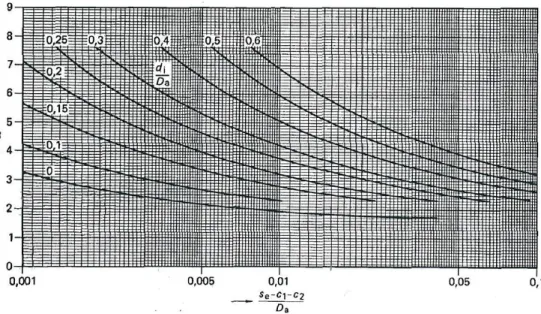
The graph in Figure 2 and the formulation in equation 2 are used to calculate the thickness of the chamber (Verlag, 2000). The formulation in equation 2 and β coefficient are present on the apsis and ordinate axes of Figure 2, respectively. First operation of calculation is to predict Se value and insert it into the equation 2, and the β corresponding to the Se value in the graph is read. For finding the design factor β from Fig.2, the lower curve di/Da=0 applies, because the area outside is not weakened with the openings. After that, the S value is calculated by inserting β into the equation 3. Assuming the calculated S value as Se, it is again inserted into the equation 2 and a predictor-corrector cycle is formed. This iteration is continued until the difference between the allowable value and final value becomes less than 0.1.
Fig 2. Design factor for domed ends
( )
International Journal of Research in Engineering & Applied Sciences
Email:- [email protected], http://www.euroasiapub.org
63
From Fig.2 β= 1.99 and then;
( )
After the 3rd iteration S=6.11 mm is obtained and this value inserted in Eq.2 as Se. Then S=6.15 mm. is obtained and 8 mm. is chosen as standard product.
Same calculations are repeated for aluminium material and Se=10 mm is chosen also.
From Fig.2 β= 1.99 and then it is calculated as;
( )
After the 3rd iteration S=7.18 mm is obtained and this value inserted in Eq.2 as Se. Then S=7.22 mm. is obtained and 8 mm. is chosen as standard product.
Se=10 mm. is chosen for PMME but corrosion factor is not inserted into equation also.
From Fig.2 β= 1.81 and then according to Eq. 3 it is calculated as;
( )
Operation steps as described for steel and aluminium are repeated for PMME. After the 4th iteration the difference between the allowable value and final value becomes less than 0.1 and is obtained as S=12.06. Head thickness is chosen as 14 mm. in order to avoid to disparity of main body thickness.
Results and Discussion
International Journal of Research in Engineering & Applied Sciences
Email:- [email protected], http://www.euroasiapub.org
64
expressions were examined, it was observed that a 3 mm corrosion tolerance for metal-based materials was included in the empirical equations. The use of a 3 mm corrosion tolerance may be correct for cabins used for plunger cabins and petroleum platforms subject to severe corrosive environments. However, in the present study, a hyperbaric pet chamber was designed to operate in a closed environment with a temperature range of 18-45oC and a humidity range of 40-70%. Moreover, metal cabins are subject to painting also. The selection of sheet metal thickness is necessary to provide a safety factor of 1.5, considering the yield strength of the material instead of corrosion tolerance. This contributes greatly to both cost and weight savings.
SolidWorks simulation of the steel cabin with a 6 mm thickness based on its geometrical dimensions and internal pressure is clearly seen in Figure 3.a. When color scale is examined it is observed that the highest equivalent stress value is approximately 110 MPa. Considering that flow stress of the material is 275 MPa, it can be said that the selected material thickness has a safety factor of 2.5 and is appropriate. SolidWorks analysis of the steel cabin with a 4 mm sheet metal thickness is seen in Figure 3.b. The highest Von-Misses equivalent stress is around 130 MPa and the cabin has a safety factor of approximately 2 under internal pressure. Furthermore, during SolidWorks analyses the maximum allowable pressure value was used but normally the cabin will be subject to the maximum allowable working pressure. Maximum allowable pressure (MAP) value is the maximum unit pressure permitted in a given material used in a chamber. Maximum allowable working pressure (MAWP) for a chamber is the maximum internal or external pressure permissible at the top of the vessel in its normal operating position. As indicated above, cabins are not vulnerable to corrosive environments because sandblasting and painting will be applied to them. Thus it can be said that a 3 mm corrosion tolerance is considered because the standard is not completely necessary for a hyperbaric pet chamber.
Fig. 3. Stress analysis results of steel chamber a) s=6 mm (calculated) b) s=4 mm (suggested)
International Journal of Research in Engineering & Applied Sciences
Email:- [email protected], http://www.euroasiapub.org
65
Fig. 4. Stress analysis results of aluminium chamber a) s=8 mm (calculated) b) s=6 mm (suggested)
SolidWorks simulation of the PMMA chamber with a 14 mm thickness based on its geometrical dimensions and internal pressure is clearly seen in Figure 5.a. As it can be seen on the color scale it is observed that the highest equivalent stress value is approximately 16 MPa and the selected material thickness has a safety factor of 2.5 because the flow stress of the PMMA is 43.6 MPa. SolidWorks analysis of the PMMA chamber with a 8 mm thickness is seen in Figure 5.b. According to color scale of Figure 5.b. the highest Von-Misses equivalent stress is around 28 MPa and the chamber has a safety factor of approximately 1.6 under internal pressure. This result is also appropriate. It was previously explained that there was no corrosion concern for acrylic cabins. Superior characteristics of hyperbaric acrylic cabins compared to metal-based ones are as follows:
1. There is no welded production in acrylic cabins, eliminating the necessity of non-destructive tests, as well as time and cost losses.
2. The density of acrylic is lower than that of steel and aluminum by 6.6 and 2.3 times, respectively. This lightness of acrylic makes hyperbaric pressure chamber a light, portable cabin.
3. Acrylic is transparent. As indicated in Figure 5, patient monitoring ports are not present in acrylic cabins. In metal cabins, ports welded to cabin walls are subject to Radiographic or ultrasonic tests, resulting in higher costs.
4. Cylinders of acrylic cabins have a given lifetime. When the lifetime is finished, the acrylic part is exchanged and all maintenance is done. Therefore, maintenance time, cost and potential risks are minimized.
5. There are no passivation, sandblasting and painting costs for acrylic cabins.
International Journal of Research in Engineering & Applied Sciences
Email:- [email protected], http://www.euroasiapub.org
66
Fig. 5. Stress analysis results of PMMA chambera) s=14 mm (calculated) b) s=8 mm (suggested)
Table 2. Comparison of the weight values
Material AD 2000 Suggested Differences (kg-ratio) P275 GH 333 kg 222 kg 111 kg – 33% 5454-H111 141 kg 109 kg 32 kg - 22%
PMMA 97 kg 56 kg 41 kg – 42%
International Journal of Research in Engineering & Applied Sciences
Email:- [email protected], http://www.euroasiapub.org
67
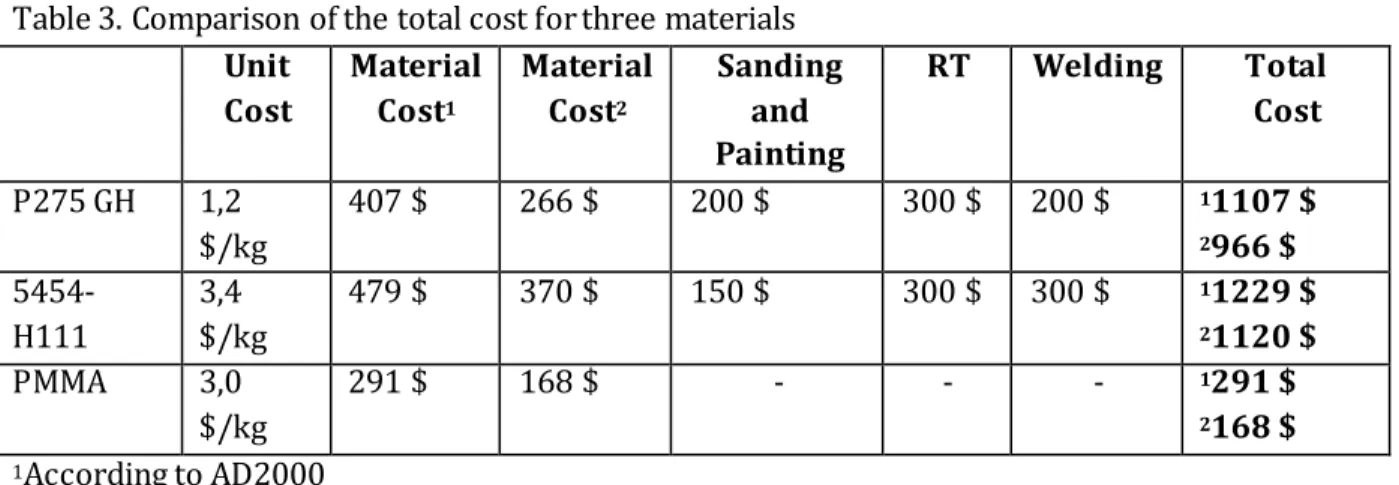
Table 3. Comparison of the total cost for three materialsUnit Cost Material Cost1 Material Cost2 Sanding and Painting
RT Welding Total
Cost
P275 GH 1,2 $/kg
407 $ 266 $ 200 $ 300 $ 200 $ 11107 $ 2966 $
5454-H111
3,4 $/kg
479 $ 370 $ 150 $ 300 $ 300 $ 11229 $ 21120 $ PMMA 3,0
$/kg
291 $ 168 $ - - - 1291 $
2168 $
1According to AD2000 2Suggested by the authors
Table 3 needs to be carefully examined to better understand the advantages of PMMA as the hyperbaric pet cabin material. Production costs of PMMA cabins are low thanks to being light and not requiring any operation (welding, radiographic-ultrasonic control, painting and sandblasting) necessary for metal-based materials. Table 3 reveals that the total cost of a steel hyperbaric pet cabin is $1107 while it is $1229 in the case of aluminum. When PMMA is used the total cost is only $291. The use of PMMA instead of steel decreases the total cost by 74%. When sheet metal thicknesses suggested by authors are considered, total cost decreases by 83%. As a result, it is clearly observed that using PMMA offers great advantages over steel and aluminum in terms of lightness and production cost.
Conclusions
In this study, using three different materials for the production of a hyperbaric pet chamber was investigated in terms of various aspects. Cases where stresses in the cabin wall are based on instead of corrosion tolerance included into formulas for sheet metal thickness calculations of metal-based materials were analyzed by SolidWorks. Because metal-based cabins are subject to passivation and painting, it was revealed that cabins could be confidently produced for sheet metal thicknesses lower than calculations based on standards. Moreover, a safety factor is included in empirical calculations. Thus, thicknesses suggested by authors are more reliable than those presented numerically in the study. Advantages of PMMA used for the production of these types of cabins are well presented. PMMA cabins are lighter than metal-based cabins and because they are transportable the use of PMMA in hyperbaric pet cabins is advantageous and strongly suggested.
References
Ravinder, S., Prakash, S., Raju, S.V., Raju, S., Ramulu, P. and Narendar, S., 2013, Design and analysis of pressure vessel assembly for testing of missile canister sections under differential pressures, Procedia Engineering, 64, pp.1040-1047.
International Journal of Research in Engineering & Applied Sciences
Email:- [email protected], http://www.euroasiapub.org
68
Mackerle, J., 2005, Finite elements in the analysis of pressure vessels and piping, an addendum: A bibliography (2001-2004), Int.J.of Press. Ves. and Piping, 82, pp.571-592.
Middleton, J. and Owen, D.R.J., 1977, Automated design optimization to minimize shearing stress in axisymmetric pressure-vessels, Nuclear Eng and Des., 44(3), pp.357-366.
Wilczynski, B., 1998, Shape optimization of thin elastic shell of revolution with axisymmetric loading, 16th Conf Poliopt CAD Koszalin, pp.396-403.
Kedziora, S. and Kubiak, T., 1999, Application of FEM for calculation of stresses and strains in pressure tanks, Dozor Techniczny, 4, pp. 83.85.
Widera, G. and Wei, Z., 1999, Parametric finite element analysis of large diameter ratio shell intersections subjected to internal pressure, Transactions of the 15th Int Conf on Structural Mechanics in reactor Technology-SMIRT15, Seoul.
Magnucki, K., 2000, Optimal design of cylindrical vessels understrength and stability constraints, Transactions of the 9th Int Conf Pressure Vessel Tech, Sydney, pp. 867-874.
Magnucki, K., Szyc, W. and Lewinski, J., 2002, Minimization of stress concentration factor in cylindrical pressure vessels with ellipsoidal heads, Int.J.of Press. Ves. and Piping, 79, pp.841-846.
Mackenzie, D., Camilleri, D. and Hamilton, R., 2008, Design by analysis of ductile failure and buckling in torispherical pressure vessel heads, Thin-Walled Structures, 46, pp.963-974.
Jeyakumar, M. and Christopher, T., 2013, Influence of residual stresses on failure pressure of cylindrical pressure vessels, Chinese Journal of Aeronautics, 26(6), pp.1415-1421.
Lu, M.H., Yu, J.S. and Chen, J.J., 2014, the effect of analysis model on the stress intensity calculation for the nozzle attached to pressure vessel under internal pressure loading, Int.J.of Press. Ves. and Piping, 117-118, pp.9-16.
Al-Gahtani, H., Khathlan, A., Sunar, M. and Naffa’a M., 2014, Local pressure testing of spherical vessels, Int.J.of Press. Ves. and Piping, 114-115, pp.61-68.
Altınbalık, M.T. and Kabak, T., 2015, Strength and cost analysis of stainless steel uses in the multiplace hyperbaric chambers, Proc. of 15th Int Scientific Conf. UNITECH’15, Gabrovo, 3, pp.137-143.
Sun, L., Ding, M., Cai, T., Fan, H., and Zhang J., 2015, Development and preliminary test of a new plateau hyperbaric chamber, American J of Emergency Medicine, 33, pp.1497-1500.
International Journal of Research in Engineering & Applied Sciences
Email:- [email protected], http://www.euroasiapub.org
69
Shimada, H., Morita, T., Kunimoto, F. and Saito, S., 1996, Immediate application of hyperbaric oxygen therapy using a newly devised transportable chamber, American J of Medicine, 14(4), pp.412-415.
Rech, F., Fagundes, D., Hermanson, R., Rivoire, H. and Fagundes, A., 2008, A proposal of multiplace hyperbaric chamber for animal experimentation and veterinary use, ACTA Cirurgica Brasileira, 23(4), pp.384-390.
Djasim, U.M., Spiegelberg, L., Wolvius E.B. and van der Wal, K.G.H., 2012, A hyperbaric oxygen chamber for animal experimental purposes, Int J of Oral&Maxillofacial Surgery, 41, pp.271-274.
Moss, D., (2004). Pressure vessel design manual, 3rd edition, Gulf Professional Publishing, Elsevier.