The Relationship between Spatial and Musical
Intelligences and EFL Learners’ Learning Styles
and Vocabulary Knowledge
Hassti Gholam-Shahbazi
Islamic Azad University South Tehran Branch, Iran
Abstract—This study investigated the relationship between spatial and musical intelligences and learning styles of EFL learners and their vocabulary knowledge. Accordingly, relationship between spatial intelligence, musical intelligence and vocabulary knowledge, visual learning style, auditory learning style, and kinesthetic learning style with vocabulary knowledge, listening and vocabulary knowledge, and finally spatial, musical intelligence, visual, auditory kinesthetic learning style as independent variables and vocabulary knowledge s dependent variable was examined. This study is an experimental and applied research using four texts to specify participants intelligence their learning styles, vocabulary knowledge and listening knowledge. For this reason, four texts including MIDAS Test of Shearer (1996) the Persian of Spatial, and Musical Intelligence VAK Learning Style Test (Visual, Auditory, Kinesthetic), Vocabulary Levels Test of Nation (2001) One listening Test from the IELTS 5 book were applied. In this study, 200 Iranian senior BA EFL learners from Islamic Azad Universities of Tehran, Male and Female, 22 to 30 years old, majoring in TEFL were examined. Result of data analysis showed that there is a significant relationship between spatial and musical intelligences and learning styles of Iranian EFL learners and their vocabulary knowledge. Also, multiple intelligence plays a significant role in learning vocabulary, as the nature of intelligence represents this issue and shows that learning is a psychological issue and human’s different aspects of learning depends of different aspect of intelligence.
Index Terms—spatial intelligence, musical intelligence, learning style, vocabulary knowledge
I. INTRODUCTION
The systematic study of how people learn a foreign language is a fairly recent phenomenon. Most of the theories of learning and intelligence models are all attempts to describe universal human traits in learning which means that the cognitive domain of human behavior is of key importance in the acquisition of both first and second language. It is argued that different types of intelligence might be in work while speaking about individuals learning styles. Intelligence is not a single entity, it is made of different intelligences, the different abilities that different people have, and it cannot be measured by only an IQ test, because it is combined of different intelligences. The idea of Multiple Intelligences, The Theory of Intelligence first came by Howard Gardner (1983) indicated that “the traditional notion of intelligences as measured by I.Q testing is far too limited, and there are not just 2 ways to be intelligent, but many ways” (Gardner, 1983, p.51). “Intelligence as the ability to solve problems or to create fashion products that are valued in one’s own culture or society.” (Gardner & Hatch, 1989, p. 4-9). “All of the people have all different intelligences, but their degrees and levels are different” (Gardner,1999, p. 23). “The theory of MI creates a new way to consider individual differences in education and educational settings”(Yenice & Aktamis 2010, p. 43). “Commonality of Gardner’s MI theory in education led many teachers to take it as a basis from which to promote curriculum, syllabus and methodology” (Sauer, 1998, p. 84). But how individuals with different types of intelligence may have different types of styles has been assumed as a basis assumption in this study.
The general approaches that students use in acquiring a new language or in learning any other subject (Celcia-Murcia, 2001).“Without grammar, very little can be conveyed, without vocabulary nothing can be conveyed” (Sener, 2005). ''An important predictor of efficient reading and of academic success in general, is vocabulary size" (Tschirner, 2004, p. 27). In spite of the fact that there have been lots of theses and studies about relationship between MI and aspects of language learning, and learning style, none of them was about the relationship between MI, and learning style of Iranian EFL learners and their vocabulary learning. So the purpose of the present study is to find out the relationship between the Spatial Intelligence, and Musical Intelligence, and learning style of Iranian EFL learners and their vocabulary learning. In the present study 200 Iranian senior BA EFL learners from Islamic Azad University of Tehran, North Branch were selected for this study in which were examined to answer the following research questions:
To achieve the purpose of the present study, the following research questions are proposed:
1. Is there any relationship between Spatial Intelligence and vocabulary knowledge of Iranian EFL learners? 2. Is there any relationship between musical intelligence and vocabulary knowledge of Iranian EFL learners? 3. Is there any relationship between visual learning style and vocabulary knowledge of Iranian EFL learners? 4. Is there any relationship between auditory learning style and vocabulary knowledge of Iranian EFL learners? 5. Is there any relationship between kinesthetic learning style and vocabulary knowledge of Iranian EFL learners? 6. Is there any relationship between listening and vocabulary knowledge of Iranian EFL learners?
7. Is there any significant regression relationship between spatial, musical intelligence, visual, auditory kinesthetic learning style as independent variables and vocabulary as dependent variable?
II. REVIEW OF THE RELATED LITERATURE
Gardner (1993) indicated that death knell for formal education will finally occur and it would be difficult job to teach intelligence. There are seven types of intelligence and it is hard enough to teach even when anything can be taught, also it is asked what to do if there are distinct limits and strong constraints on human cognition and learning.
Generally it is believed that multiple intelligences consist of three domains: the analytical, introspective and interactive domains. These three domains serve as an organizer for understanding the fluid relationship of the intelligences and how the intelligences work with one another (McKenzie, 2002).
According to McKenzie (2002) the analytic domain consists of the logical, musical, and naturalist intelligences. These are the intelligences that promote analysis of knowledge that is presented to the learner. These three intelligences are considered analytic because they promote the processes of analyzing and incorporating data into existing schema, even though they may have other components. The analytical intelligences are by their nature heuristic processes. McKenzie (2002) indicates that the interactive domain consists of the linguistic, interpersonal and kinesthetic intelligences. These are the intelligences that learners typically employ to express themselves and explore their environment. These three intelligences are regarded as interactive because they typically invite and encourage interaction to achieve understanding. Even if a student completes a task individually, s/he must consider others through the way s/he writes, creates, constructs and makes conclusion. The interactive intelligences are by their nature social processes (McKenzie, 2002). The introspective domain consists of existential, intrapersonal, and visual intelligences. These are the intelligences that have a distinctly affective component to them. These intelligences are characterized as introspective because they require a looking inward by the learner, an emotive connection to their own experiences and beliefs in order to make sense of new learning. The introspective intelligences are by their nature affective processes (as cited in Babu & Bindhu, 2016).
Gardner defined spatial intelligence as the ability to recognize both large and small visual patterns. He suggested that navigators and pilots would possess high levels of spatial intelligence, as would sculptors, surgeons, chess players, and architects.
Previous research in the domain of spatial abilities suggests that spatial visualization and spatial scanning are two important and distinct aspects of that domain. Spatial visualization refers to the ability to imagine the movement of an object and is typically measured with mental rotation tasks. Carroll (1993) noted that visualization tasks generally form a first-stratum factor, and one that tends to be highly g-loaded. Spatial scanning is the ability to scan a field quickly, to follow paths visually, and to reject false leads. Carroll (1993) tentatively identified this capacity as a first-order factor, but stated that further research was necessary before it could be considered independent and interpreted accordingly. Tasks assessing spatial visualization and spatial scanning tend to load on a second-stratum factor of broad visualization ability, which corresponds also to Thurstone's (1938) spatial ability factor.
and tone would appear to be core aspects of these narrow factors of musical ability, measures of the abilities to discriminate between rhythms and between tones would be important elements in the assessment of Gardner's musical intelligence.
Howard Gardner’s multiple intelligences theory (MIT) (1983, 1999) is an important contribution to cognitive science and constitutes a learner-based philosophy which is “an increasingly popular approach to characterizing the ways in which learners are unique and to developing instruction to respond to this uniqueness” (Richards & Rodgers, 2001, p. 123).
MIT describes nine different intelligences. It has evolved in response to the need to reach a better understanding of how cognitive individual differences can be addressed and developed in the classroom. Gardner (1999) identified the mathematical-logical, the verbal-linguistic, the musical-rhythmic, the bodily-kinaesthetic, the interpersonal, the intrapersonal, the visual-spatial, the naturalist and the existential intelligences.
The different intelligences are of neutral value; none of them is considered superior to the others. In their basic form, they are present to some extent in everyone, although a person will generally be more talented in some than in others. Each of these frames is autonomous, changeable and trainable and they interact to facilitate the solution of daily problems (Gardner, 1999).
Learning style is important for many reasons; however, there are three vital ones. First of all, people’s learning styles will vary because everyone is different from one another naturally. Secondly, it offers the opportunity to teach by using a wide range of methods in an effective way. Sticking to just one model unthinkingly will create a monotonous learning environment, so not everyone will enjoy the lesson. In other words, learning and teaching will be just words and not rooted in reality. Thirdly, we can manage many things in education and communication if we really recognize the groups we are called to. Of course, we may not know every detail; however, being aware of our students’ learning styles, psychological qualities and motivational differences will help us regulate our lessons appropriately and according to the conditions (Mc Carthy, 1982; Felder, Silverman, 1988; Coffield et al., 2004).
Learning styles are the ways that learners understand and get the new information and process it. “A term that describes the variations among learners in using one or more senses to understand, organizes, and retains experience”. (Dunn and Dunn ,1979). “The manner in which individuals perceive and process information in learning situations” (Brown, 2000).
Amongst the earliest attempts aimed at delineating the term learning styles, one might refer to the definition set forth by Pham (2000) where learning style is referred to as the “stable and pervasive characteristics of an individual, expressed through the interaction of one’s behavior and personality as one approaches a learning task” (p.11). In a similar vein, Kalsbeek (1989) defines the term as “a person’s preferred approach to information processing, idea formation, and decision making; the attitudes and interests that influence what is attended to in a learning situation; and a disposition to seek learning environments compatible with these personal profiles” (p. 32). Furthermore, according to Pham (2000), learning styles are the learners‟ fixed methods for responding to and working with the existing stimuli in learning circumstances. Carbo (1980) points out that determining the unique learning styles of students and making necessary arrangements to adjust our instruction to such learner differences might help boost the educational accomplishments of our learners.
Interestingly enough a high proportion of the studies on learning styles seem to have been conducted in the domain of higher education (e.g. Biggs, 2001; Busato, Prines, Elshout, and Hamaker, 2000; Coffield, Moseley, Hall, & Ecclestone, 2004). Although these studies classify different learning types and/or styles in different ways, their aims and approaches are, more or less, similar. Dunn & Dunn (1978) studied the learning styles of school age children, and he found that 20-30 % of school age children learning style are auditory, learning style of 40 % of them is visual, and 20-30-40 of them are tactile/kinesthetic learners.
Nation (2001) indicated that vocabulary learning strategies are thought as part of language learning strategies. In learning any language it is believed that vocabulary is the center focal point of acquisition. As put forward by McCarthy (1992) without words communication in L2 cannot happen in any meaningful way (p.50). Vocabulary would be gradually recognized as crucial to language use in which insufficient vocabulary knowledge of the learners led to difficulties in second language learning.
Carbo (1983) in a study found that visual and auditory students are good readers. In this regard Felder (1998) indicated that since the instructional approaches around the cycle of learning models are similar, it is not important, which learning styles instrument has been chosen in each investigation. Among the various learning style theories available, the delineation put forth by Kolb (1984) characterizing the learning styles as the process in which knowledge is created through the transformation of experience knowledge results from the combination of grasping and transforming experience, has been adopted in the current study. There have also been some Iranian studies on the learning styles like: Lous (2012) examined the relationship between the emotional intelligence and learning English language vocabulary. The results of her study showed a low and negative correlation between the students’ emotional intelligence and vocabulary knowledge.
between students’ MI scores and listening scores is then analyzed, determining whether their MI was improved by CALL instruction, and if so, which MI and to what degree. The result of this study showed that CALL software can be effectively used to enhance the many kinds of human intelligences employed when learning languages.
Arnold and Fonscca (2004) Intelligence Theory and Foreign Language Learning: A Brain-based Perspective found that it is possible to motivate learners by activating multiple ways of meaning-making through the use of tasks relating to the different intelligences and found that it possible to engage multiple memory pathways necessary to produce sustained deep learning.
As teaching intelligences is not totally possible and students are responsible for their learning in this way a study was conducted by Po-ying (2007) entitled as “How students react to the power and responsibility of being decision makers in their own learning” as such students feel unsure of how to organize their own learning. Result of this study emphasize on students ability to use their multiple intelligences regarding their own learning.
III. METHOD
To come up with justifiable answer to the research questions and to fulfill the aforementioned objectives of the study 200 Iranian senior BA EFL learners from Islamic Azad Universities of Tehran, Male and Female, 22 to 30 years old, majoring in TEFL, Translation, and Literature were the participated in this study. All participants were examined using four testing instruments as follows:
MIDAS Test
MIDAS Test of Shearer (1996) the Persian of Spatial, and Musical Intelligence parts of this test which are equivalent to the original was used to measure the learners Spatial, and Musical Intelligences.
VAK Test
VAK Learning Style Test (Visual, Auditory, Kinesthetic), a self-assessment questionnaire by Chislett & Chapman 2005, was used to define the learners learning styles .VAK (Visual, Auditory, and Kinesthetic) model is one of most popular models for gauging the learners‟ different learning styles. Based on this model, all learners draw on one of the three major modalities, i.e. Visual, Auditory, or Kinesthetic, to acquire and learn new information and experiences. The claim set forth by this model is that one or two of these styles might be dominant in a learner, which, in turn, signifies the best way through which a learner takes in the new information by filtering what is to be learned. Thus, Visual, Auditory and Kinesthetic (VAK) model says there are only three types of learning styles that all learner are said to possess.
Vocabulary Test
Vocabulary Levels Test of Nation (2001) version A, was used to measure the learners' vocabulary knowledge. In this test there is a 14,000 version containing 140 multiple-choice items, with 10 items from each 1000 word family level. A learner’s total score needs to be multiplied by 100 to get their total receptive vocabulary size.
Permission is not required to use these tests in research, although acknowledgement in any thesis or publication is appreciated. The reference for the 14,000 level test is Nation, I.S.P. & Beglar, D. (2007) A vocabulary size test. The Language Teacher, 31(7), 9-13. (Check Publications on Paul Nation’s web site for current information on publications). The test measures knowledge of written word form, the form-meaning connection, and to a smaller degree concept knowledge. The test measures largely decontextualized knowledge of the word although the tested word appears in a single non-defining context in the test.
Listening Test
One listening Test from the IELTS 5 book, examination papers from University of Cambridge ESOL examinations, 2006 was used .
Data was collected by giving the EFL learners these 4 tests, first the Spatial, and Musical Intelligences parts of the MIDAS Test were given to the students by 30 minutes time, then the VAK learning style test by 30 minutes times, and after that the Nations vocabulary levels test by 30 minutes for the 100 item tests, and at last the listening test by 30 minutes time were given to the students. The purpose of completing the questionnaires was explained to the learners before any act, and they were told that the information will be used for research purpose only. The data was analyzed by SPSS software and Pearson product moment correlation for finding the relationship between the variables. Correlations was used to find out whether there was a relationship between the variables of the study, Spatial and Musical Intelligences and Learning Styles of Iranian EFL learners and their vocabulary knowledge or not.
IV. RESULTS
TABLE I
DESCRIPTIVE STATISTICS FOR LISTENING AND VOCABULARY
Variables Mean Std.
Deviation
Variance Minimum Maximum valid Missing
Listening 200 0 17.02 5.613 31.502 0 28
vocabulary 200 0 31.05 9.623 92.601 9 60
TABLE II
FREQUENCY OF DISTRIBUTION FOR LISTENING AND VOCABULARY
Frequency Percent Valid Percent Cumulative Percent
Listening 0-12 46 23.0 23.0 23.0
13-27 151 75.5 75.5 98.5
28-40 3 1.5 1.5 100.0
Total 200 100.0 100.0
Vocabulary 0-25 60 30.0 30.0 30.0
26-50 134 67.0 67.0 97.0
51-75 6 3.0 3.0 100.0
Total 200 100.0 100.0
Intelligence Musical 63 31.5 31.5 31.5
Spatial-Musical 33 16.5 16.5 48.0
Spatial 104 52.0 52.0 100.0
Total 200 100.0 100.0
Learning style type
Auditory-Visual 9 4.5 4.5 4.5
Auditory 124 62.0 62.0 66.5
kinesthetic 15 7.5 7.5 74.0
Visual-kinesthetic 3 1.5 1.5 75.5
Visual 49 24.5 24.5 100.0
Total 200 100.0 100.0
For listening variable the central tendency, mean and dispersion, standard deviation, variance, minimum and maximum listening value was achieved as shown in table 1. The mean level of listening is 17.02 and the minimum and maximum degrees are 0 and 28, respectively. Frequency distribution table for listening variable is classified in three levels: from 0 to 13, from 13 to 27 and from 28 to 40. Result shows that 75.5% participants gain a score from 13 to 27 and 1.5% the same individuals gain a listening score from 28 to 40.
For vocabulary the table (1) represents central tendency, mean and dispersion, standard, deviation, variance, minimum and maximum values. The mean level of gaining vocabulary score is 31.05% and the minimum and maximum scores are 9 and 60, respectively.
Frequency distribution table for vocabulary variable shows that scores for vocabulary test is divided into three categories: from 0 to 25, from 26 to 50 and from 51 to 75. Result shows that 67% of participants gain a score from 26 to 50 and 3% of participants gain score from 51 to 75.
Intelligence is one of the variables that consist of different types, that in this study, two types of them are analyzed, namely musical and spatial intelligence. The compound of spatial and musical intelligence is tested as a new category. Result shows that 52% of participants are better in spatial intelligence and 31.5% of participants better achieved in musical intelligence. Also, 16.5% of participants benefit the compound of spatial-musical intelligence.
Learning style is the next variable that includes auditory-visual, auditory, kinesthetic, visual kinesthetic and visual variable. Frequency distribution table for learning style variable shows that 62% of apprentices are better in auditory learning style, and 7.5% of them are good in kinesthetic and 24.5% of apprentices are better in visual learning style.
A. Result of Hypotheses
H1: There is a significant relationship between spatial intelligence and vocabulary knowledge of Iranian EFL learners. H0: There is no significant relationship between spatial intelligence and vocabulary knowledge of Iranian EFL learners.
TABLE III.
CORRELATION COEFFICIENT BETWEEN SPATIAL INTELLIGENCE AND VOCABULARY Title Spearman's rho
Spatial Vocabulary
Correlation Coefficient Sig. (2-tailed) N Correlation Coefficient
Sig. (2-tailed) N
Spatial 1.000 . 200 -.373(**) .000 200
vocabulary -.373(**) .000 200 1.000 . 200
** Correlation is significant at the 0.01 level (2-tailed).
H1: There is a significant relationship between musical intelligence and vocabulary knowledge of Iranian EFL learners.
H0: There is no significant relationship between musical intelligence and vocabulary knowledge of Iranian EFL learners.
The following table represents correlation coefficient between Musical Intelligence and vocabulary knowledge of Iranian EFL learners. Correlation coefficient between musical intelligence and vocabulary knowledge is.287 and the Sig level (2tailed) is less than 0.01 (sig=.000). Therefore, H0 is rejected and there is significant relationship between musical intelligence and vocabulary knowledge of Iranian EFL learners with 99% confidence.
TABLE IV.
CORRELATION COEFFICIENT BETWEEN MUSICAL INTELLIGENCE AND VOCABULARY
Title Spearman's rho
Intelligence Vocabulary
Correlation Coefficient Sig. (2-tailed) N Correlation Coefficient
Sig. (2-tailed) N
Intelligence 1.000 . 200 .287(**) .000 200
vocabulary .287(**) .000 200 1.000 . 200 ** Correlation is significant at the 0.01 level (2-tailed).
H1: There is a significant relationship between visual learning style and vocabulary knowledge of Iranian EFL learners.
H0: There is no significant relationship between visual learning style and vocabulary knowledge of Iranian EFL learners
The following table represents correlation coefficient between visual learning style and vocabulary knowledge of Iranian EFL learners. Correlation coefficient between visual learning style and vocabulary knowledge is -0.253 and the Sig level (2tailed) is less than 0.01 (sig=.001). Therefore, H0 is rejected and there is significant relationship between visual learning style and vocabulary knowledge of Iranian EFL learners with 99% confidence.
TABLE V.
CORRELATION COEFFICIENT BETWEEN VISUAL LEARNING STYLE AND VOCABULARY KNOWLEDGE Title Spearman's rho
Visual learning style Vocabulary Correlation Coefficient Sig. (2-tailed) N Correlation
Coefficient
Sig. (2-tailed) N
Visual learning style
1.000 . 200 -.253(**) .001 200
vocabulary -.253(**) .001 200 1.000 . 200
** Correlation is significant at the 0.01 level (2-tailed).
H1: There is a significant relationship between auditory learning style and vocabulary knowledge of Iranian EFL learners.
H0: There is no significant relationship between Auditory learning style and vocabulary knowledge of Iranian EFL learners.
TABLE VI.
CORRELATION COEFFICIENT BETWEEN AUDITORY LEARNING STYLE AND VOCABULARY KNOWLEDGE
Title Spearman's rho
Auditory learning style Vocabulary Correlation Coefficient Sig. (2-tailed) N Correlation
Coefficient
Sig. (2-tailed) N
auditory learning style
1.000 . 200 -.410(**) .007 200
vocabulary -.410(**) .007 200 1.000 . 200 ** Correlation is significant at the 0.01 level (2-tailed).
H1: There is a significant relationship between kinesthetic learning style and vocabulary knowledge of Iranian EFL learners.
H0: There is no significant relationship between kinesthetic learning style and vocabulary knowledge of Iranian EFL learners.
The following table represents correlation coefficient between kinesthetic learning style and vocabulary knowledge of Iranian EFL learners. Correlation coefficient between kinesthetic learning style and vocabulary knowledge is 0.381, and the Sig level (2tailed) is less than 0.01 (sig=.000). Therefore, H0 is rejected and there is significant relationship between kinesthetic learning style and vocabulary knowledge of Iranian EFL learners with 99% confidence.
TABLE VII
CORRELATION COEFFICIENT BETWEEN KINESTHETIC LEARNING STYLE AND VOCABULARY KNOWLEDGE
Title Spearman's rho
kinesthetic learning style Vocabulary Correlation Coefficient Sig. (2-tailed) N Correlation
Coefficient
Sig. (2-tailed) N
kinesthetic learning style
1.000 . 200 .381(**) .000 200
vocabulary .381(**) .000 200 1.000 . 200
** Correlation is significant at the 0.01 level (2-tailed).
H1: There is a significant relationship between listening and vocabulary knowledge of Iranian EFL learners. H0: There is no significant relationship between listening and vocabulary knowledge of Iranian EFL learners. The following table represents correlation coefficient between listening and vocabulary knowledge of Iranian EFL learners. Correlation coefficient between listening and vocabulary knowledge is 0.362, and the Sig level (2tailed) is less than 0.01 (sig=.000). Therefore, H0 is rejected and there is significant relationship between listening and vocabulary knowledge of Iranian EFL learners with 99% confidence.
TABLE VIII.
CORRELATION COEFFICIENT BETWEEN LISTENING AND VOCABULARY KNOWLEDGE
Title Spearman's rho
listening Vocabulary
Correlation Coefficient Sig. (2-tailed) N Correlation Coefficient
Sig. (2-tailed) N
listening 1.000 . 200 .362(**) .000 200
vocabulary .362(**) .000 200 1.000 . 200 ** Correlation is significant at the 0.01 level (2-tailed)
H1: There is a significant regression relationship between spatial, musical intelligence, visual, auditory kinesthetic learning style as independent variables and vocabulary as dependent variable.
H0: There is no significant regression relationship between spatial, musical intelligence, visual, auditory kinesthetic learning style as independent variables and vocabulary as dependent variable.
TABLE IX.
MODEL SUMMARY OF REGRESSION MODE Model R R Square Adjusted R
Square
Std. Error of the Estimate
1 .375(a) .141 .119 9.035
a: Predictors: (Constant), kinesthetic learning style, musical intelligence, visual learning style, spatial intelligence, auditory learning style
spatial intelligence and vocabulary knowledge and H0 about special intelligence is rejected. Other variables significant level for musical intelligence (0.293), visual learning style (0.380), auditory learning style (0.351), and kinesthetic learning style (0.662) are higher than the standard level (0.01) and there is no significant regression relationship with vocabulary knowledge and H0 is approved about relationship between Musical intelligence, visual learning style, auditory learning style, and kinesthetic learning style.
TABLE X.
REGRESSION COEFFICIENTS AND SIG(A)
title
Unstandardized Coefficients Standardized Coefficients t Sig. B Std. Error Beta B Std. Error (Constant) 36.178 3.494 10.355 .000 spatial intelligence -5.413 2.025 -.262 -2.673 .008 musical intelligence 1.947 1.845 .101 1.055 .293 visual learning style -2.323 2.643 -.111 -.879 .380
auditory learning style -2.646 2.829 -.130 -.935 .351 kinesthetic learning style 1.454 3.320 .042 .438 .662
a: Dependent Variable: vocabulary
B. Discussion
Findings related to the hypotheses are discussed in this section and supportive indications from previous studies have been presented. Results of the study indicated that there is a positive relationship between special intelligence and vocabulary knowledge that is in line with the result of study by Louis (2012) who found a positive relationship between spatial and visual intelligence and academic achievement. Also, result of studies by Kassaian (2007) is in line with result of this hypothesis that maintains there is a positive and significant relationship between spatial and visual learning style and fostering vocabulary items. Po-ying, 2007), Arnold and Fonscca (2004), Kim (2009), Louis (2012) in similar studies found that there is a positive relationship between special and visual learning style and recalling vocabulary. While none of the previous studies were against this study regarding positive relationship between special intelligence and vocabulary knowledge.
Musical intelligence is the ability to recognize tones, sounds and rhythms. Vocabulary has musical sounds, stress, and intonation. Result of this study showed that those who have greater musical intelligence have greater vocabulary knowledge. Result of this hypothesis is in line with the result of study by McKenzie (2002) indicating that musical intelligence promotes vocabulary knowledge, because they promote the processes of analyzing and incorporating data into existing schema and consequently result in better recalling of items and vocabulary.
The two groups of visual-linguistic learners and visual-spatial learners are imagined for this type of learning style. Visual-linguistic learners believed to be better in written language and also reading and writing tasks. And visual-spatial learners believed to have problem with written language and are better with charts, and demonstration, videos and visual materials. Result of this study proved that individuals with better visual learning style have better vocabulary knowledge while learning foreign language. Result of this hypothesis is in line with the result of studies by Po-ying, 2007), Arnold and Fonscca (2004), Kim (2009), Louis (2012) indicating that there is a positive relationship between visual learning style and vocabulary knowledge of learners.
Auditory learning styles represent the skills of learning through listening conversations and films and audiotapes. The result of this hypothesis showed that students with better auditory learning style have better vocabulary knowledge in the process of learning foreign language. Result of this hypothesis is in line with result of studies performed by Oxford and Burry-Stock (1995) with respect to participation in the classroom and consequently better knowledge of vocabulary. Also, Dunn and Dunn (1978) studying learning styles found that 20 to 30% of learning ability in children is due to auditory learning style. In addition, result of this hypothesis is in line with result of studies by Louis (2012) and Chislett & Chapman (2005) indicating that auditory learning style aids individuals to learn new information and experiences.
Kinesthetic learning style refers to learning through touch, handle, manuscript manuals and body language. The result of this hypothesis is in line with result of studies by Louis (2012), (Chislett & Chapman, 2005), indicating that kinesthetic learning style has a positive impact of on English language teaching and learning vocabulary.
V. CONCLUSION
vocabulary, as the nature of intelligence represents this issue and shows that learning is a psychological issue and human’s different aspects of learning depends of different aspect of intelligence.
Familiarity with different types of intelligence and their influence on language learning helps instructors to measure the students’ talents and to apply some courses that are on the basis of their talents and abilities. Intelligence also helps students and language learners to select the best method of practice and language learning. Results of this study help both teachers and students. Having higher visual learning helps individuals to have higher memorization through eyes. Learning through different senses with help of different types of intelligence can be achieved. Therefore, human senses and intelligence hand in hand foster the learning and foreign language acquisition.
As Gardner (1999) noted, the different intelligences are of neutral value and none of them is considered superior to the others. Intelligences are present to some extent in everyone, although a person will generally be more talented in some than in others. No matter if student is better in which intelligent, it is very important to identify intelligences in individuals and to foster every person’s specific intelligence that is better in. Generally speaking this study was achieved to help pedagogical planners different issues even intelligences in planning the courses to help better learning foreign languages.
REFERENCES
[1] Arnold, J. & Fonscca, M. (2004). Intelligence Theory and Foreign Language Learning: A Brain-based Perspective. TESOL quarterly. 4 (1), 119-136.
[2] Babu, B, & Bindku, K. (2016). Research Journal of Kings University, 1(1).
[3] Biggs, J. (2001). Enhancing Learning: A Matter of Style or Approach? In: Sternberg, R.J. And Zhang, L. Perspectives on thinking, learning and cognitive styles, Erlbaum,73-102.
[4] Brown, H.D. (2007). Principles of language learning and teaching (5th Ed). New York: Pearson Education Inc.
[5] Brown, H.D. (2000). Principles of Language Learning and Teaching. (4th ed.) New York: Longman (Formerly New Jersey: Prentice Hall).
[6] Busato,V.V., Prins, F.J., Elshout, J.J., & Hamaker, C. (2000). Intellectual ability, learning style, personality, achievement motivation and academic success of psychology students in higher education. Personality and Individual Differences, 29, 1057-1068.
[7] Carbo, M. (1983). Research in reading and learning style: Implications for exceptional children, Exceptional children, 49,486-494.
[8] Carbo,M.(1980) An analysis of the relationship between the modality preferences of kindergartners and selected reading treatments as they effect the learning of a basic sight-word vocabulary. Dissertation abstracts international, 41, 1389A. [9] Carroll, J.B. (1983). Human cognitive abilities: a survey of factor analytic studies. Cambridge: Cambridge University Press. [10] Celce-Murcia, M. (2001). Teaching English as a second or foreign language. 3rd edition, Hinle & Heinle publishers, Boston. [11] Coffield, F., Moseley, D., Hall, E., & Ecclestone, K. (2004). Should we be using learning styles? What research has to say to
practice. http://www. Isda.org.uk/files/PDF/1540.pdf retrieved on 15/10/2009.
[12] Chislett, V. & Chapman, A. (2005). VAK Learning Styles Self-test. http://www. Businessballs.com/Vaklearningstylestest.htm. [13] Chou, H., & Wang, T. (2000). The influence learning style and training method on self -efficacy and Learning performances in
www Homepage Design training. International Journal of information Management, 20, 455-472.
[14] Dunn, R., & Dunn, K. (1978). Teaching students through their individual learning styles. A practical Approach. Prentice Hall, Reston, VA., ISBN:10:0879098082.336.
[15] Felder, R. M., & Silverman, L. K. (1988). Learning and Teaching Styles in Engineering Education. Engineering Education, 78, 674-681.
[16] Gardner, H. (1999). Intelligence reframed: multiple intelligences for the 21st century. New York: Basic Books. [17] Gardner, H. (1993). Frames of Mind: The Theory of Multiple Intelligence (10th ed). New York, NY: Basil Books.
[18] Gardner,H., & Hatch, T. (1989). Multiple intelligences go to school: educational implications of the Theory of multiple intelligences. Educational researcher, 18(8), 4-9.
[19] Gardner, H. (1983). Frames of Mind. New York: Basic Books INC.
[20] Gregorc, A.F. (1979). Learning/ teaching styles: Potent forces behind them. Educational Leadership, 5, 234-237.
[21] Kalsbeek.D.H.(1989).linking learning style theory with retention research: the trails project. Association for institutional research, 32.
[22] Kassaian, Z. (2007). Learning styles and lexical presentation modes. ELIA, 7, 53-78.
[23] Kim, I.S. (2009). The Relevance of Multiple Intelligences to CALL Instruction. The Reading Matrix. 9(1), 1-21.
[24] Kolb, D. A. (1984). Experiential learning: Experience as the source of learning and development. New Jersey: Prentice-Hall [25] Louis, M. (2012). Relationship between Emotional Intelligence and Vocabulary Learning. TESOL quarterly. 1(13), 49-64. [26] MacKeracher, D. (2004). Making sense of adult learning. (2th ed.). Canada: University of Toronto Press Incorporated. [27] McCarthy, B. (1982). Improving staff development through CBAM and 4MAT. Educ. Leadership, 40, 20-25. [28] Mccarthy, M. (1992). Vocabulary. Oxford: Oxford University press.
[29] Mckenzie, W. (2002). Multiple intelligences and instructional technology. Eugene, OR: ISTE Publications. [30] Nation, I.S.P. & Beglar, D. (2007). A vocabulary size test. The language Teacher, 31(7), 9-13.
[31] Nation, I.S.P. (2001). Learning Vocabulary in another language. Cambridge: Cambridge University Press.
[32] Nosratinia, M. (2011). The effect of personality type, learning styles and strategies on Iranian MA EFL learners. Islamic Azad University, Central Tehran Branch, Tehran-Iran.
[33] Oxford, R.L., & Burry-Stock, J.A. (1995). Assessing the use of language learning strategies Worldwide with the ESL/EFL version of the strategy inventory for language learning (SILL). System, 23(1), 1-23.
[35] Po-ying, Ch.(2007). How students react to the power and responsibility of being decision makers in their own learning.
Language Teaching Research, 11(2), 225-241.
[36] Richards, J., & Rodgers. T. (2001). Approaches and methods in language teaching. Cambridge: Cambridge University Press. [37] Sauer, C. (1998). Developing a survey for multiple intelligences. In J.M. Reid (Ed), understanding Learning styles in the
second language classroom (pp.100-106). Upper Sandle River, NJ: Prentice Hall Regents.
[38] Sener, S. (2005).The Relationship between Vocabulary Learning Strategies and Vocabulary Size of Turkish EFL Students. Retrieved from http: //yadem. Com.Edu. Tr/ 3rdeltkonf/ spkr_Sabriye_Sener.htm (January 14, 2017).
[39] Shearer, C.B. (1996). The MIDAS: Professional manual. Kent, ohio: MI Research and consulting, Inc.
[40] Sistani, M. & Hashemian, M. (2016). Investigating the Role of Multiple Intelligences in Determining Vocabulary Learning Strategies for L2 Learners. English Language Teaching, 9 (6).
[41] Tschirner, E. (2004). Breadth of vocabulary and advanced English study: An empirical investigation. Electronic Journal of Foreign Language Teaching, 1(1), 27-39.
[42] Thurstone, L.L. (1938). Primary mental abilities. Chicago: University of Chicago Press.
[43] Witkin, D.B. (1973).The role of cognitive style in academic performance and in teacher-student relations. Research Bulletin, Educational Testing Service, Princeton, NJ, 73-101.
[44] Yenice, N., & Aktamis, H. (2010). Determination of multiple intelligence domains and learning styles of the teacher candidates.
Procedia Social and Behavioral Sciences, 2, 3274-3281.
Hassti Gholam-Shahbazi was born in Toronto, Canada in 1994. She holds an M.A in TEFL from Islamic Azad University South Tehran branch (2018) and a B.A in English Literature from Islamic Azad University North Tehran branch (2016).
English Major Undergraduates’ Needs and
Perceptions of Business English Activities and
Resources in a Chinese University
Qing Xie
Jiangnan University, Wuxi, China
Abstract—This article explores English major undergraduates’ views on business English skills and topics, and investigates their perceptions of the meaningful activities and resources in one Chinese university context. The main research instruments are questionnaires containing rating and open-ended questions, and researcher’s participant observation with 149 English major undergraduates enrolling in Business English courses in 2016. The results show that participants most often require improvement in note-taking skills, public speaking and need to learn business communication topics. Participants value communicative teaching methodologies, including role plays, oral presentation, theme-based discussion, games and group work. Participants more often rely on electronic media resources, such as videos, internet and mobile applications than the print media resources such as library, books and dictionaries. This study serves as basis for further business English curriculum development and resources provision in the higher education setting. The study also indicates the potential for business English resources development and exploitation in China within the international education environment.
Index Terms—English major undergraduate, needs, perceptions, business English activities and resources, Chinese university
I. INTRODUCTION
Business English or English for business purposes is a major type of English for occupational purposes which is one of the two sub-branches under English for specific purposes (Dudley-Evans and St John, 1998, p.6). Business English can be further classified as “English for general business purposes” and “English for specific business purposes” (Dudley-Evans and St John, 1998, p.55). In the English for specific purposes research, understanding “learners’ expectations” is an important area for academic study, which are varied among business professionals and university students (Dudley-Evans and St John, 1998, p.65). The focus of this study is to understand English major learners’ expectations of English for general business purposes teaching activities and resources.
The development of business English teaching content requires authentic input as it links students closer to the real world of business. Frendo (2005, p. 52) summarizes that useful authentic content includes business communication documents, audio-visual materials such as “TV adverts and company sales videos” and internet. Ellis and Johnson (2002, p.162) also recommend recording “live events on audio or video” as sources of authentic learning content. According to Frendo (2005), various reading, writing, listening and discussion activities can be designed based on authentic materials to mirror the workplace interaction. The typical activities include “role play, simulation and case study” (p.54) to develop business English reading, writing, listening and speaking skills in meaningful settings. Donna (2000, p.126) mentions that business English courses should include “contextualized practice”, which links with the authentic workplace settings. The development of business English activities should also consider whether students are able to complete the tasks. As Hutchinson and Waters (1987) summarize, the methodology design should follow second language learning principles. Moreover, Mishan (2013, p. 287) indicates that technological innovation transforms delivery modes. The evolution ranges from the traditional “teacher talk”, to “blended learning, online chatting, mobile based language learning, to self-access computer assisted learning”. There is no doubt that the technological advancement also transforms business English activities and resources, making their access easier and the content more diverse for learners.
In light of the trend, this study aims to explore the changes of learners’ needs and perceptions of business English activities and resources under technological reforms. The investigation focuses on English major undergraduates in the Chinese university context, who are learning English language and literature as their academic development priority.
II. RESEARCH QUESTIONS
1. What are English major undergraduates’ needs of business English skills and topics in the Chinese university context?
2. What are English major undergraduates’ perceptions of business English activities in the Chinese university context?
3. How do English major undergraduates locate and use business English resources in the Chinese university context?
III. REVIEW OF LITERATURE
A. Understanding Business English Activities and Resources in the International Context
According to Emmerson and Hamilton (2005, p.1), business English activities can integrate speaking and writing tasks. They are designed to focus on particular business or communication topics. They could be designed to “review vocabulary”, “lead-in” discussion or round-off the class. The length of the business English activities varies, depending on the functions in the curriculum.
Studies on business English activities and resources can be found in various contexts. In the study of Pratoomrat and Rajprasit (2014) on business English instruction in the Thai university context, students and teachers’ perceptions of business English instruction are investigated using syllabus analysis and questionnaires. The results show that participants are positive towards the business English instruction. However, there is inconsistency between the needs and the curriculum content. It is suggested that a needs analysis should be conducted to bridge the gap between the business English courses and professional needs. In another context, Edwards’ study (2000, p.293) on a business English training for German bankers has chosen “deductive presentations” and “communicative” language exercises based on authentic texts from the business magazines and video records drawn from the workplaces.
Moreover, in the English for specific purposes context, Dudley-Evans and St John (1998, p. 204) have mentioned that the use of technology in learning beyond classroom enriches the English language teaching content and provides more resources and opportunities in enhancing learning outcomes. The technology advancement consists of “multimedia resources, the internet, electronic mails, CALL (Computer Assisted Language Learning) materials and computer-based corpora”. Robinson (1991, p. 62) mentions that the teaching resources can consist of “visual and mechanical aids, videos and computers”. In the recent literature, the use of corpora in teaching has been a growing trend (Flowerdew, 2011).
Through three years of experiences in designing and implementing English for Specific Purposes program for mixed level students, Yogman and Kaylani (1996, p. 321) summarize that mini-projects, technology such as video, ESL situation such as communicating with native speakers and a portfolio approach should be adopted. In view of the lack of correct understanding about computer assisted language learning in business English teaching, Vallance (1998) has developed the internet resource of Business Meeting and gathered feedback from learners worldwide. The internet resources prove useful and receive positive comments from both learners and English Language Teaching (ELT) professionals. Effective individualized learning can be achieved. It can be summarized that in the current trend of business English teaching, various technological innovations have been well incorporated into the curricula and the technological resources should be exploited.
B. Business English Activities and Resources in the Chinese Context
In the Chinese context, Lu (2015) indicates that multimedia technology can be better used to collect teaching materials for both teacher and students. It can optimize teacher-student interaction and nurture student creativity and independence. Liu (2015) further elaborates that the use of internet learning resources should be fully utilized in business English teaching. It can bring the real business situation to the classroom and diversify teaching models. Teacher should introduce learning resources to students and establish instant communication and self-access learning platforms. In view of the weaknesses in business English teaching practice in China, Hu (2015) summarizes that using internet resources can enhance learners’ listening, speaking and writing skills development. Moreover, in the context of Hong Kong, China for business English teaching, Evans’ study (2012) intends to bridge the gap between the classroom and the workplace by designing email tasks based on the qualitative interview data, case studies and email samples collected from the workplaces which have strong pedagogical implications.
Moreover, there is a recent trend that the newly developed Chinese teaching theory on the production-oriented teaching approach (Wen, 2016) has been introduced into the business English courses. According to Wen (2016, p.4), the production-oriented approach is “learning centered” and has a focus on “holistic development”. It integrates learning and teaching and follows the process of “motivating, enabling and evaluating”. It mainly focuses on the development of output skills such as speaking, writing and translating, based on the comprehensible input of reading and listening materials. Sun (2017) has applied this production oriented approach in teaching business English vocabulary in the university context, based on corpus data and cognitive theories.
teaching materials. Software can be downloaded for language learning. Students can visit interesting language learning websites and browse the e-library. Using e-learning tools can enhance students’ speaking and writing skills. In the Chinese context, it is also seen that various technological reforms and authentic resources have been integrated into business English teaching.
C. Investigating Learner Perceptions of English Language Activities and Resources for Various Contexts
As well documented in literature, McGrath (2013, p. 158) summarizes that English language teaching resources can also be based on coursebooks and authentic materials. The sources of teaching resources can include “TV, magazine, advertisement and popular music”. Internet can also provide additional materials for English language teaching. In addition, students may have different preferences of the teaching activities, such as “small group work, pair work, discussion and role play”. However it is indicated that results of the studies may vary as they may be context and student specific. Previous studies explore from different angles learner perceptions of English language activities and resources for various contexts.
In Barcelona, Spain, Block (1994) differentiates teacher’s and learners’ perceptions of activities in an English as a foreign language class. The teacher and learners differ in viewing the purposes of the activities. It is suggested that teacher orients the activities more in line with learners’ preferences. Based on the conception of learner-centered curriculum, Barkhuizen (1998) investigates about 60 South African high school students’ perceptions of 15 English learning activities using a multi-method approach, combining questionnaire, composition, observation and interviews. The results show that teacher and students’ perceptions do not match.
In the Chinese university context, Wei (2004) investigates 192 English major undergraduates’ perceptions of 20 oral English teaching activities regarding their effectiveness in improving oral communicative competence and whether students consider them as interesting methods. Teacher guided practice is considered more effective while free talk and practice is seen as more interesting. Simulated practices using drills are considered the least effective and interesting.
In Open University of Hong Kong, Zhang, Perris and Yeung (2005) explore students’ perceptions of the use of technology and internet in course learning, as well as the online tutorial support. The study concludes that while students have positive perceptions of the use of internet and technology, the focus should be shifted from the issue of access towards “language and interaction” (p. 803). Jackson (2003) explores case-based teaching in the Chinese university of Hong Kong by investigating the views of twenty business professors and 589 students by questionnaires and follow-up interviews. The study reveals that while business professors generally consider Asian students as reticent, the students raise the inadequacy of English language preparation for case-based discussion as the constraint factor. It is suggested that group work should be used to facilitate the sharing of ideas in class.
However, it can be found that previous studies on learner perceptions of English language resources and activities have not been focused on business English teaching for English major undergraduates. Previous studies did not compare and contrast the usefulness of various business English teaching activities, as well as traditional and technological resources, based on students’ perceptions.
IV. METHODOLOGY
Investigating learner needs of business English skills and topics and exploring their perceptions of activities and resources require both quantitative and qualitative methodologies (Brown, 2014). It is considered that the combination of quantitative and qualitative approaches would provide a more comprehensive understanding of the issue under study (Creswell, 2014). The data collection, participant information and data analysis procedures are thus explained in the following sections.
A. Data Collection
The study mainly adopts paper-based questionnaires as the data collection instruments. The questionnaires containing 13 rating and open-ended questions were administered in September 2016 in the first week of the course Business English to English major undergraduates in a Chinese university. The course focuses on business English communication skills at intermediate level. The course has 32 teaching hours within a 4-month period. The content of the course is mainly based on the coursebooks Further Ahead: A Communication Skills Course for Business English
(Jones-Macziola & White, 2003) and Chinese Companies versus Foreign Companies: A Practical Business English Reader (Yang, 2012). The 13 questions in the questionnaire are designed based on the instruments developed by Hedge (2002, p. 344), Basturkmen (2010, p. 30) and Harding (2007, p. 20). It aims to gather participant views on business English skills and topics for improvement, perceptions of business English activities and resources from different angles. The data collection process follows the ethical principles of second language research (Dörnyei and Taguchi, 2011, p.80). Participants consent was obtained prior to the data collection process. The confidentiality of the participant and organization identity has been protected and pseudonym is used for this study.
Moreover, researcher also delivered the course and conducted participant observation for the business English learning process to triangulate the findings from paper-based questionnaires with insider perspectives.
This study chooses one Chinese university with a School of Foreign Studies which hosts a four-year bachelor program of English language and literature, consisting of different modules, such as English foundation, translation and interpretation, literature and business English. The modules are being upgraded regularly, with the aims to train language professionals with diverse competence including professional communication skills.
149 English major undergraduates in their second year of the English program in the Chinese university were valid participants of the study. All of them enrolled in an elective Business English in September 2016. Twenty-two participants were male and 127 were female. Their age range was 18~22 years old. The average age was 19.4 years old. Less than half of the participants had passed College English Test (CET)-Band 4. There were four advanced learners who took International English Language Test System (IELTS) examination and one even obtained a high score of 8.
In order to know participants’ prior business English learning experiences, participants self-assessed their business English levels. Beginner level takes up the largest group of 68.46% of the participants. The rest of the participants are almost equally spread in higher beginner, intermediate and low intermediate levels.
In order to understand participants’ strengths and weaknesses in specific English communication skills, participants also examined their own language abilities in listening, speaking, reading and writing, which are described through a 1~4 rating scale, with 4 being the highest level of language ability. It was found that reading had the highest mean of 2.62 while speaking was the lowest at 2.12. Listening and writing were in the medium at around 2.2. It indicates that speaking should be the priority area for further improvement.
For motivation of learning English, 62.42% of the participants claimed medium level motivation while 31.54% of the participants held high level motivation. There were only a few participants who had low level motivation.
For reasons to study business English, 31.54% of the participants linked business English learning to finding job or career preparation. There were 14.09% of the participants who had clear objectives of working for international organization or foreign company, such as “German company”. 12.75% of the participants had more general purposes such as to learn knowledge, broaden horizon and improve ability. They may also hope to develop professional communication skills. 8.05% of the participants considered business English as useful or they were interested in the subject. A few participants hoped to know cultures of different countries. There were also practical learners who hope to pass Business English Certificate (BEC) tests.
C. Data Analysis
The participants’ needs of the business English topics and skills are measured by the frequency of the main themes in the responses and their percentages of the participants as learners of English language and literature as their major academic study area. The participants’ learning needs are also measured by means of a range of 1~4 regarding how often they do the different types of writing in their study. The frequency and percentage of participants’ perceptions of activities and resources are also calculated. The differences of needs and perceptions of male and female participants, as well as advanced and average learners are compared and shown in the following graphs, which add more substance to the results. Theories of individual differences in second language learners have also revealed that gender and language aptitude are two of the differentiating factors (Hou, 2008), which this study is focusing on. For qualitative information, major themes are analyzed and best quotes (Guest, MacQueen & Namey, 2012) drawn from participants’ responses to open-ended questions. The insights gained by the researcher through participant observation supplement the results from paper-based questionnaires.
V. RESULTS
A. Participants’ Needs of Business English Skills and Topics in the Chinese University Context
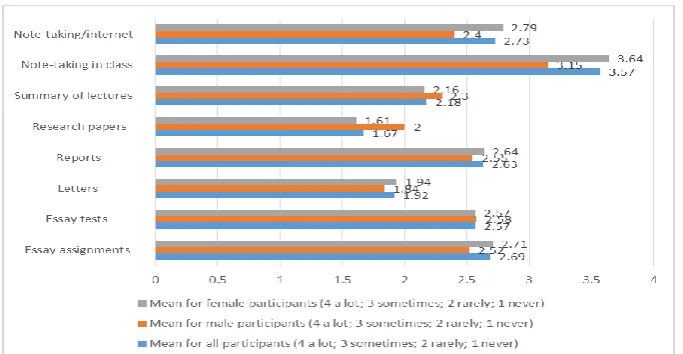
Participants’ major writing tasks in the program study are summarized in Figure 1, in a range of 1~4, with 4 meaning a lot while 1 indicating never. The analysis shows that note-taking in class has the highest mean of 3.57, with male participants at 3.15 and female participants at 3.64, which clearly indicates note-taking as an important learning skill for these English major learners. Essay assignments, essay tests, reports and note-taking/internet have means for all participants at over 2.5, which are occasional writing activities conducted by the participants. Summary of lectures, letters and research papers become less frequent writing tasks for participants. Male participants have lower means in all types of writing than female participants, except in the item of research papers, which has higher mean than their female counterparts. For advanced learners, essay assignment has the highest mean of 3.5, while research papers and summary of lectures have the lowest mean of 1.5, same as the other participants.
The business English skills, categorized as specific speaking, reading, writing and speaking tasks, participants would like to improve in their study are summarized in Figure 2. For speaking, over 75% of the participants hoped to improve public speaking, with over 77% of male participants and over 74% of female participants. Staying on a topic and persuasive questioning take up around 30% of the participants, with over 13% male participants and more than 37% female participants. Public speaking can be a priority area for business English teaching.
For reading, over 60% of all participants needed to improve quick reading skills and understand articles, journals, abstracts and trade publication. Over 35% of all participants needed to improve skills for reading reports and over 22% of all participants also hoped to learn to read correspondence. For reading skills, the priority should be given to quick reading, articles, journals, abstracts and trade publication.
For writing, more than 50% of all participants needed to improve writing reports, business letters, and applications, proposals and invoices, which should be the focus of business English curriculum. Over 49% of all participants hoped to improve note-taking on talks. Around 33% of all participants hoped to improve writing skills for emails, cover letters and CVs. Memo writing takes up around 25% of the participants.
For listening, over 74% of all participants listened to radio, TV and internet broadcasts with over 68% of male participants and more than 75% of female participants, which seems to be the main source of audio input. Over 60% of all participants also needed to listen to natural speech. Over one third of all participants also indicated the need to improve listening skills for the main idea/key points and to people from non-English speaking countries.
Figure 2: The business English skills to improve
Participants’ views for the business English topics to learn are summarized in Figure 3. Around 30% of all participants mentioned business communication as the key topic for learning, with over 31% of male participants and over 29% of female participants. These could vary from business report, email, CVs, business etiquette to attending job interview. The following two participants have demonstrated how they should be trained for business communication skills with a pragmatic focus.
I wish to learn how to act well when I was interviewed in a big company, how to leave a deep impression to others. (Participant A)
time. (Participant B)
More than 10% of all participants mentioned world trade and finance and marketing including advertising. Banking is a frequent word. Around 6% of all participants hoped to learn about negotiation. These are mostly mentioned by female participants. Participant C had the following explanation.
I wish I can learn negotiation and how should we prepare if we want to hunt for a job in a foreign company. (Participant C)
Over 3% of all participants raised business vocabulary such as business English wordlist and usage as important topics. Around 2% of all participants also mentioned the topics of corporate history, Chinese businesses, cross-cultural communication including politics, jobs and statistics as they preferred. These are again all female participants. For example, participant D had the following elaboration.
I am interested particularly in China’s business development, with companies such as the growth of JD.com, Huawei and Wanda etc. (Participant D)
For the advanced learners in the group, their needs for business English topics range from drama to business practice needs. Participant E mentioned “how to dress well in formal occasions/how to interpret some professional words”. Other advanced learners also mentioned the needs to learn business subject knowledge such as marketing and to prepare for BEC test, which are similar to the other participants.
Figure 3: Business English topics to learn
B. Participants’ Perceptions of Business English Activities in the Chinese University Context
Participants’ favorite activities in English classes are summarized in Figure 4. Over 15% of all participants considered role play as meaningful activities with over 4% of male participants and over 17% of female participants. Over 14% of all participants also mentioned group work/debating, oral presentation, and watching videos/movies as useful learning activities. Participants F, G had the following elaboration.
I like group work. Many students sit together and then discuss about the topic. (Participant F)
When teachers show us films and play music, I feel more relaxed and focus more on English study. (Participant G)