© 2019 by the Serbian Biological Society How to cite this article: Jevremović S, Lazarević J, Kostić M, Krnjajić S, Ugrenović 665 V, Radonjić A, Kostić I. Contact application of lamiaceae botanicals reduces bean
weevil infestation in stored beans. Arch Biol Sci. 2019;71(4):665-76.
Contact application of Lamiaceae botanicals reduces bean weevil infestation in stored beans
Stojan Jevremović1,*, Jelica Lazarević2, Miroslav Kostić3, Slobodan Krnjajić4, Vladan Ugrenović1, Anđa Radonjić5 and Igor Kostić4
1Research-Development Center, “Institute Tamiš“, Novoseljanski put 33, 26000 Pančevo, Serbia
2University of Belgrade, Institute for Biological Research “Siniša Stanković” - National Institute of Republic of Serbia, Bulevar Despota Stefana 142, 11000 Belgrade, Serbia
3Institute for Medicinal Plant Research “Dr Josif Pančić”, Tadeuša Košćuška 1, 11000 Belgrade, Serbia
4University of Belgrade, Institute for Multidisciplinary Research, Kneza Višeslava 1a, 11000 Belgrade, Serbia
5University of Belgrade, Faculty of Agriculture, Institute of Phytomedicine, Department of Entomology and Agricultural Zoology, Nemanjina 6, 11080 Belgrade, Serbia
*Corresponding author: [email protected]
Received: June 17, 2019; Revised: July 17, 2019; Accepted: August 14, 2019; Published online: August 30, 2019
Abstract: The bean weevil (Acanthoscelides obtectus, Say) is a serious pest of stored bean seeds. Bean weevil control relies
heavily on the use of synthetic insecticides. In the search for a sustainable alternative, the residual contact toxicity and anti-oviposition activity of thyme (Thymus vulgaris L.), rosemary (Rosmarinus officinalis L.) and basil (Ocimum basilicum L.) essential oils as well as their dominant components (thymol, α-pinene, 1,8-cineole and linalool) were tested against A. obtectus adults. Out of the seven tested botanicals, T. vulgaris oil, thymol and linalool exhibited the highest toxic potential (>90% mortality). Females were less susceptible than males. The insecticidal activity of these botanicals was much greater when they were applied on glass compared to direct application to the bean. All tested botanicals reduced oviposition by bean weevil females. T. vulgaris oil, thymol and α-pinene also deterred bean weevil oviposition, as revealed by a two-choice test. Our research shows that T. vulgaris oil and thymol are promising and sustainable alternatives to synthetic pesticides for protecting stored beans against the bean weevil.
Keywords: terpenes; residual toxicity; oviposition deterrence; oviposition inhibition
INTRODUCTION
The bean weevil Acanthoscelides obtectus (Say) is a cosmopolitan pest of the common bean (Phaseolus vulgaris L.). Its ability to infest beans in the field (pre-harvest) and in storage (post-(pre-harvest), combined with the ability to develop up to 45 larvae in one seed [1,2], make it the most damaging pest in bean granaries. It causes severe losses (20-40%) in storage; in developing countries, where weevil management is often poor, it can destroy the entire yield in a few months [3-5]. The use of synthetic insecticides, such as phosphine, ethyl formate, sulfuryl fluoride, carbonyl sulfide, organo-phosphates and pyrethroids is still the predominant method of bean weevil management [6]. However, is-sues such as the evolution of insect resistance, hazards to human health and to the environment accompany
the usage of these compounds. These are the main reasons that push the development of more sustain-able methods, e.g. the use of natural plant compounds for pest management [7].
and make them suitable alternatives for controlling insect pests [9].
Thyme (Thymus vulgaris L.), rosemary ( Rosmari-nus officinalis L.) and basil (Ocimum basilicum L.) belong to the Lamiaceae family. Herbs of this family exhibit significant antioxidant, anticancer and anti-microbial activities, and they are utilized in cosmetic, food and pharmacological industries [10]. Thyme, rosemary and basil EOs, as well as their dominant components (DCs), thymol, α-pinene, 1,8-cineole and linalool, demonstrate repellent and insecticidal effects (both fumigant and contact) on major store insect pests, including Tribolium castaneum (Herbst), T. con-fusum (Jacquelin du Val), Callosobruchus maculatus
(F.), Sitophilus zeamais (Motschulsky) and Rhyzoper-tha dominica (F.) [11-15]. Several studies have ana-lyzed the bioactivity of the same EOs and their DCs on the bean weevil. So far, these studies demonstrated fumigant toxicity to eggs, larvae and adults, as well as repellent activity and reproductive inhibition of the oils and their DCs against the bean weevil [16-20]. However, there are no data that describe insecticidal and anti-oviposition effects of applying these botani-cals by contact.
Being a small insect with limited flying ability, the bean weevil mainly walks into storehouses, finds the bean to lay eggs or a female to mate with. Knowledge about the contact effects of botanicals could be valu-able for bean weevilmanagement because application of a protective compound on storehouse windows as well as on the stored commodity would have a pre-ventative, in addition to the solely curative effect that fumigants typically display. Several recent studies have demonstrated that EOs from plants belonging to the Amaranthaceae, Cupressaceae, Myrtaceae, Lauraceae and Rutaceae families can exhibit good residual con-tact toxicity and repellent effects when applied to bean [21-25]. In the present work, we tested three Lami-aceae EOs and their DCs, both on the common bean and on glass, in order to determine potential differ-ences in biological activity. To better understand their full toxic potential and anti-oviposition activity, we screened thyme, rosemary and basil EOs and several of their DCs, namely thymol, α-pinene, 1,8-cineole and linalool for residual contact toxicity as well as oviposition deterrent and oviposition inhibition ef-fects of treated bean seeds.
MATERIALS AND METHODS
Essential oil acquisition and chemical analysis
EOs of thyme, rosemary and basil, and their DCs (thymol, α-pinene, 1.8-cineole and linalool) were pur-chased from Sigma-Aldrich (St Louis, MO, USA). The EOs were purchased in order to avoid variation in the chemical composition due to geographic and climate conditions. The analysis of EOs was performed using a Shimadzu QP2010 plus gas chromatography-mass spectrometry (GC-MS) system (Shimadzu, Kyoto, Japan), equipped with autosampler AOC-5000 and ZB-1 column (Phenomenex Inc. California, USA), 30 m, 0.25 mm i.d., 0.50 µm film thickness. The column temperature was initially set to 40°C and then gradu-ally increased to 260°C at a rate of 4°C min-1. The carrier gas was helium of 99.999% purity at a flow rate of 1 mL min-1. Injector and ion source temperatures were set at 250°C and 280°C, respectively. The GC-MS operated in electron ionization (EI) mode with an ionization energy of +70 eV. Samples were diluted in
n-hexane (HPLC grade, Fisher Chemical by Thermo Fisher Scientific Inc, UK) (1:200, v/v) and 1 µL of the diluted samples were injected automatically in split mode (1:30). Mass spectra were scanned from 40 to 400 amu range (SCAN mode) together in a single ion monitoring (SIM) mode. Identification of the con-stituents was based on comparison with data from mass spectra Shimadzu’s libraries (Wiley8, NIST05
and FFNSC1.2). Quantitative data were obtained from GC peak area percentages by the method of area nor-malization. All analyses were performed in triplicate. The sample injection volume was 1 µL.
Insect culture
Bean weeviladults were obtained from laboratory cul-tures of the Institute for Biological Research, Belgrade, Serbia. They were maintained on the white variety (“Gradištanac”) of the common bean, without expo-sure to any insecticide.
Screening on residual contact toxicity
modifications. Two separate experiments, one where the test compounds were applied on glass and another where they were applied to the bean, were set up. Oils and DCs were dissolved in 96% ethanol and applied on the glass bottom of a 9-cm-diameter Petri dish, or directly to bean seeds (10 g of bean seeds placed on the Petri dish). We applied 0.5% v/v (correspond-ing to 0.024 µL/cm2 of glass and 150 µL/kg of bean), 1.0% (0.048 µL/cm2 of glass and 300 µL/kg of bean) and 1.5% v/v (0.072 µL/cm2 of glass and 450 µL/kg of bean) of EOs and DCs, except thymol, as it was only available in solid form, and for which we applied the same concentrations but expressed in w/v. As a control, 96% ethanol was applied to bean seeds and glass. Bean seeds were treated with EO/DC solutions in a glass jar, which was when closed and shaken thoroughly for 5 min to ensure a uniform distribution of the solution. In order to test whether evaporation affected the efficacy of EOs and DCs, the Petri dishes with treated beans or glass were left open to allow the EOs or compounds to evaporate for 20 min (standard evaporation time or SET) or 120 min (prolonged evaporation time or PET). For each treatment, 5 replicates (Petri dishes) with 10 female or male adults of the bean weevil (1 day old) were set up. The number of dead insects was recorded after 24, 48 and 72 h of exposure.
Anti-oviposition assays
Choice and no-choice tests were performed to evalu-ate the activities of thyme, rosemary and basil EOs and their DCs on oviposition. The choice test was performed in 9-cm-diameter Petri dishes with two wooden sticks attached to opposite sides. These sticks formed an obstacle to prevent mixing of control seeds treated with 96% ethanol and seeds treated with EOs or DCs at rates 0.5%, 1.0% and 1.5%. Four bean seeds were placed on each side of the Petri dish and one mated female was placed in the middle of each Petri dish. Prior to introduction of females to the Petri dish-es, in both tests they were kept for 48 h with males to ensure that mating took place.
In the no-choice test, only four bean seeds and one inseminated female were placed in each Petri dish. Bean seeds were treated with EO or DC solutions at the same rates as in the choice test, while the control seeds were treated with 96% ethanol. Since the
num-ber of treated seeds was about five times lower than in the toxicity tests, it caused no mortality during the observed period. Accordingly, we evaluated the effects of sublethal EO/DC concentrations on oviposition.
The numbers of eggs were counted daily for seven days. Each treatment comprised 20 replicates. For cal-culating the oviposition deterrent index (ODI), in the choice test we used the formula:
ODI = (NT-NC)/(NT+NC),
where NC and NT stand for the number of eggs laid on control and EO/DC-treated seeds, respectively. Values of the ODI scale are between -1.00 and +1.00. Values of ODI that are ≤-0.3 indicate that EOs and DCs possess an oviposition deterrent effect. ODI values that range between -0.3 and +0.3 indicate a neutral effect and ODI values ≥+0.3 point to an at-tracting effect. In the no-choice test we calculated the percentage of oviposition inhibition (%OI) according to the formula:
%OI=[(NC-NT)/NC]x100 [27].
Statistical analysis
RESULTS
Chemical composition of essential oils
The GC-MS analysis identified a to-tal of 15 components of T. vulgaris, 23 components of R. officinalis and 26 components of O. basilicum EO. Major components of thyme EO were thymol (43.52%) and p-cymene (31.65%). Rosemary EO was domi-nated by 1,8-cineole (22.08%), cam-phor (13.85%), α-pinene (13.54%) and β-pinene (13.07%). For basil EO, the major constituents were es-tragole (69.2%) and linalool (20.58%) (Table 1). Since estragole displayed genotoxic and carcinogenic effects on mammals [28,29] and exhibited a much lower fumigant toxic effect on the bean weevil than linalool [17], we tested only linalool as a dominant component of basil oil.
Residual contact toxicity on bean
Of the seven tested compounds, only thyme oil and its DC thymol exhib-ited significant residual contact tox-icity against A. obtectus females and males in the on-bean experiments, whereas other compounds had very little effect (up to 4% mortality; Tables 2 and 3). The toxic effect of thyme oil and thymol depended on the exposure time and the tested con-centration. The highest thymol dose killed all test weevils 24 h after expo-sure in the SET experiment. The SET assay for thymol on beans revealed a lower susceptibility of female than male weevils (a significant sex effect: F1, 16=14.40; P=0.0016), higher mor-tality after exposure to 1 than 0.5% concentration (concentration effect: F1, 16=48.86; P<0.0001), without any interactions among the two main
fac-Table 1. Retention time (Rt) and percent concentration (%) of chemical constituents of the essential oils of Thymus vulgaris, Rosmarinus officinalis and Ocimum basilicum. The percentages of dominant components in each essential oil are marked in bold.
No (min)Rt Compound name T. vulgaris% R. officinalis% O. basilicum%
1 11.338 Tricyclene - 0.25
-2 11.560 α-Pinene 2.69 13.54 0.23
3 12.326 Camphene 0.68 5.52
-4 13.115 5-hepten 2 on 6 methyl - - 0.32
5 13.234 Sabinene - 0.87
-6 13.425 β-Pinene 0.09 13.07 0.09
7 13.917 Myrcene 1.60 1.98 0.18
8 14.796 3-Carene - 0.17
-9 14.814 α-Thujene - 0.68 0.03
10 15.092 p-Cymene 31.65 7.97 0.20
11 15.400 1,8-Cineole 1.29 22.08
-12 15.485 Limonene - - 0.43
13 16.152 Ocimene - - 0.08
14 16.588 γ-Terpinene 2.12 -
-15 16.748 4-Thujanol - 0.15
-16 16.775 Octanol - - 0.09
17 17.368 Fenchone - - 0.03
18 17.800 Terpinolene 0.05
-19 18.041 Linalool 5.38 1.38 20.58
20 19.436 Camphor 1.47 13.85
-21 20.234 Isoborneol 0.83 -
-22 20.556 Borneol 2.08 8.65
-23 20.898 Menthol - - 0.26
24 21.053 Terpinen-4-ol 0.56 1.53
-25 21.462 α-Terpineol - 2.55
-26 21.682 Estragole - - 69.20
27 21.777 Verbenone - 0.24
-28 22.907 Nerol - - 0.07
29 23.096 Neral - - 0.52
30 23.800 Geraniol - - 0.11
31 24.131 Geranial - - 1.40
32 25.024 Thymol 43.52 -
-33 25.148 Bornyl-acetate - 2.07
-34 25.334 Carvacrol 5.11 -
-35 25.791 Isopinocarveol - 0.13
-36 29.013 α-Copaene - 0.19 0.09
37 30.468 β-Caryophyllene - 2.69 0.29
38 30.919 Bergamotene - - 0.91
39 31.343 Farnesene - - 0.37
40 31.563 α-Humulene - - 0.34
41 33.154 β-Bisabolene - - 0.17
42 33.689 p-Methoxycinnamaldehyde - - 0.62
43 34.152 α-Bisabolene - - 2.85
Table 2. Percentage mortality of adult female and male A. obtectus after 24-, 48- and 72-h exposure to common bean seeds treated with botanicals evaporated for 20 min (standard evaporation time or SET). Experimental groups were compared by one-way ANOVA (F and P values). Different letters following numbers denote significant differences in mortality within time point as revealed by Duncan’s post hoc test (P<0.05).
EO/DC Concen-tration (%)
Female mortality (%) Male mortality (%)
24 h 48 h 72 h 24 h 48 h 72 h
X– ± SE X– ± SE X– ± SE X– ± SE X– ± SE X– ± SE
0.50 2.0 ± 2.00b 2.0 ± 2.00b 2.0 ± 2.00b 0 ± 0 4.0 ± 2.45d 6.0 ± 4.00d
thyme oil 1.00 2.0 ± 2.00b 4.0 ± 4.00b 4.0 ± 4.00b 8.0 ± 2.00c 22.0 ± 2.00c 34.0 ± 2.45c
1.50 16.0 ± 2.45a 18.0 ± 2.00a 18.0 ± 2.00a 66.0 ± 10.30a 74.0 ± 7.48a 86.0 ± 5.10a
0.50 0 ± 0 0 ± 0 2.0 ± 2.00b 2.0 ± 2.00c 4.0 ± 2.45d 12.0 ± 4.90d
thymol 1.00 8.0 ± 2.00a 18.0 ± 3.74a 30.0 ± 5.48a 38.0 ± 3.74b 46.0 ± 5.10b 66.0 ± 9.80b
1.50 100.0 ± 0 100.0 ± 0 100.0 ± 0 100.0 ± 0 100.0 ± 0 100.0 ± 0
0.50 0 ± 0 0 ± 0 0 ± 0 0 ± 0 0 ± 0 0 ± 0
rosemary oil 1.00 0 ± 0 0 ± 0 0 ± 0 0 ± 0 0 ± 0 0 ± 0
1.50 0 ± 0 0 ± 0 0 ± 0 0 ± 0 2.0 ± 2.00d 4.0 ± 4.00d
0.50 0 ± 0 0 ± 0 0 ± 0 0 ± 0 0 ± 0 0 ± 0
α-pinene 1.00 0 ± 0 0 ± 0 0 ± 0 0 ± 0 2.0 ± 2.00d 2.0 ± 2.00d
1.50 0 ± 0 0 ± 0 0 ± 0 0 ± 0 0 ± 0 2.0 ± 2.00d
0.50 0 ± 0 0 ± 0 0 ± 0 0 ± 0 0 ± 0 0 ± 0
1,8-cineole 1.00 0 ± 0 0 ± 0 0 ± 0 0 ± 0 0 ± 0 2.0 ± 2.00d
1.50 0 ± 0 0 ± 0 0 ± 0 2.0 ± 2.00c 4.0 ± 2.45d 4.0 ± 2.45d
0.50 0 ± 0 0 ± 0 0 ± 0 0 ± 0 0 ± 0 0 ± 0
basil oil 1.00 0 ± 0 0 ± 0 0 ± 0 0 ± 0 0 ± 0 0 ± 0
1.50 0 ± 0 0 ± 0 0 ± 0 0 ± 0 0 ± 0 2.0 ± 2.00d
0.50 0 ± 0 0 ± 0 0 ± 0 0 ± 0 0 ± 0 0 ± 0
linalool 1.00 0 ± 0 0 ± 0 2.0 ± 2.00b 0 ± 0 0 ± 0 2.0 ± 2.00d
1.50 0 ± 0 0 ± 0 2.0 ± 2.00b 0 ± 0 0 ± 0 0 ± 0
Control 0.00 0 ± 0 0 ± 0 0 ± 0 0 ± 0 0 ± 0 0 ± 0
F3, 16 = 8.11 F3, 16 = 10.52 F6, 28 = 11.12 F4, 20 = 22.64 F7, 32 = 25.36 F11, 48 = 25.71
P = 0.0017 P = 0.0005 P <0.0001 P <0.0001 P <0.0001 P <0.0001
Table 3. Percentage mortality of adult female and male A. obtectus on the common bean after 24-, 48- and 72-h exposure to bean seeds treated with botanicals that were evaporated for a prolonged time (PET) of 120 min. F and P values from one-way ANOVA show signifi-cance among group differences. Different letters following numbers denote significant differences in mortality within the time point as revealed by Duncan’s post hoc test (P<0.05).
EO/DC Concen-tration (%)
Female mortality (%) Male mortality (%)
24 h 48 h 72 h 24 h 48 h 72 h
X– ± SE X– ± SE X– ± SE X– ± SE X– ± SE X– ± SE
0.50 0 ± 0 0 ± 0 0 ± 0 0 ± 0 0 ± 0 0 ± 0
thyme oil 1.00 0 ± 0 0 ± 0 0 ± 0 0 ± 0 0 ± 0 0 ± 0
1.50 0 ± 0 0 ± 0 2.0 ± 2.00b 0 ± 0 2.0 ± 2.00b 4.0 ± 2.45b
0.50 0 ± 0 0 ± 0 0 ± 0 0 ± 0 2.0 ± 2.00b 8.0 ± 3.74b
thymol 1.00 0 ± 0 2.0 ± 2.00b 2.0 ± 2.00b 6.0 ± 2.45b 10.0 ± 3.16b 18.0 ± 7.35b
1.50 10.0 ± 3.16 14.0 ± 4.00a 26.0 ± 2.45a 88.0 ± 3.74a 94.0 ± 4.00a 96.0 ± 2.45a
Control 0.00 0 ± 0 0 ± 0 0 ± 0 0 ± 0 0 ± 0 0 ± 0
- F1, 8 = 6.33 F2, 12 = 24.19 F1, 8 = 84.51 F3, 16 = 69.91 F3, 16 = 41.72
Table 4. Percentage mortality of adult female and male A. obtectus after 24-, 48- and 72-h exposure to glass treated with botanicals evapo-rated for 20 min (standard evaporation time or SET). Experimental groups were compared by one-way ANOVA (F and P values). Different letters following numbers denote significant differences in mortality within the time point as revealed by Duncan’s post hoc test (P<0.05).
EO/DC Concen-tration (%)
Female mortality (%) Male mortality (%)
24 h 48 h 72 h 24 h 48 h 72 h
X– ± SE X– ± SE X– ± SE X– ± SE X– ± SE X– ± SE
0.50 0 ± 0 0 ± 0 0 ± 0 0 ± 0 0 ± 0 0 ± 0
thyme oil 1.00 86.0 ± 9.27a 92.0 ± 5.83a 98.0 ± 2.00b 94.0 ± 6.00b 100.0 ± 0 100.0 ± 0
1.50 100.0 ± 0 100.0 ± 0 100.0 ± 0 100.0 ± 0 100.0 ± 0 100.0 ± 0
0.50 100.0 ± 0 100.0 ± 0 100.0 ± 0 100.0 ± 0 100.0 ± 0 100.0 ± 0
thymol 1.00 100.0 ± 0 100.0 ± 0 100.0 ± 0 100.0 ± 0 100.0 ± 0 100.0 ± 0
1.50 100.0 ± 0 100.0 ± 0 100.0 ± 0 100.0 ± 0 100.0 ± 0 100.0 ± 0
0.50 0 ± 0 0 ± 0 2.0 ± 2.00c 0 ± 0 0 ± 0 0 ± 0
rosemary oil 1.00 0 ± 0 0 ± 0 0 ± 0 2.0 ± 2.00c 2.0 ± 2.00c 2.0 ± 2.00b
1.50 0 ± 0 0 ± 0 0 ± 0 2.0 ± 2.00c 2.0 ± 2.00c 4.0 ± 2.45b
0.50 0 ± 0 0 ± 0 0 ± 0 0 ± 0 0 ± 0 0 ± 0
α-pinene 1.00 0 ± 0 0 ± 0 0 ± 0 0 ± 0 0 ± 0 2.0 ± 2.00b
1.50 0 ± 0 0 ± 0 2.0 ± 2.00c 0 ± 0 2.0 ± 2.00c 4.0 ± 2.45b
0.50 0 ± 0 0 ± 0 0 ± 0 0 ± 0 0 ± 0 0 ± 0
1,8-cineole 1.00 0 ± 0 0 ± 0 0 ± 0 2.0 ± 2.00c 2.0 ± 2.00c 2.0 ± 2.00b
1.50 0 ± 0 0 ± 0 0 ± 0 4.0 ± 2.45c 4.0 ± 2.45c 6.0 ± 4.00b
0.50 0 ± 0 0 ± 0 0 ± 0 0 ± 0 2.0 ± 2.00c 2.0 ± 2.00b
basil oil 1.00 0 ± 0 0 ± 0 0 ± 0 0 ± 0 0 ± 0 2.0 ± 2.00b
1.50 0 ± 0 0 ± 0 0 ± 0 0 ± 0 0 ± 0 2.0 ± 2.00b
0.50 0 ± 0 0 ± 0 0 ± 0 0 ± 0 0 ± 0 0 ± 0
linalool 1.00 46.0 ± 9.27b 64.0 ± 12.08a 68.0 ± 9.69a 74.0 ± 4.00a 80.0 ± 3.16b 92.0 ± 3.74a 1.50 76.0 ± 12.08ab 86.0 ± 9.27a 90.0 ± 10.00b 94.0 ± 4.00b 96.0 ± 2.45a 98.0 ± 2.00a
Control 0.00 0 ± 0 0 ± 0 0 ± 0 0 ± 0 0 ± 0 0 ± 0
F2, 12 = 4.19 F2, 12 = 2.09 F4, 20 = 42.53 F6, 28 = 71.08 F7, 32 = 73.09 F10, 44 = 54.21
P = 0.0417 P = 0.1663 P <0.0001 P <0.0001 P <0.0001 P <0.0001
Table 5. Percentage mortality of adult female and male A. obtectus on common bean after 24-, 48- and 72-h exposure to glass treated with botanicals evaporated for prolonged time (PET) of 120 min. F and P values from one-way ANOVA show significance of among group differences. Different letters following numbers denote significant differences in mortality within the time point as revealed by Duncan’s post hoc test (P<0.05).
EO/DC Concen-tration (%)
Female mortality (%) Male mortality (%)
24 h 48 h 72 h 24 h 48 h 72 h
X– ± SE X– ± SE X– ± SE X– ± SE X– ± SE X– ± SE
0.50 0 ± 0 0 ± 0 0 ± 0 0 ± 0 0 ± 0 0 ± 0
thyme oil 1.00 0 ± 0 0 ± 0 0 ± 0 0 ± 0 2.0 ± 2.00a 2.0 ± 2.00c
1.50 0 ± 0 2.0 ± 2.00a 2.0 ± 2.00a 0 ± 0 0 ± 0 28.0 ± 9.16a
0.50 0 ± 0 0 ± 0 0 ± 0 2.0 ± 2.00a 2.0 ± 2.00a 2.0 ± 2.00c
thymol 1.00 0 ± 0 2.0 ± 2.00a 2.0 ± 2.00a 2.0 ± 2.00a 6.0 ± 4.00a 12.0 ± 3.74ab
1.50 100.0 ± 0 100.0 ± 0 100.0 ± 0 100.0 ± 0 100.0 ± 0 100.0 ± 0
Control 0.00 0 ± 0 0 ± 0 0 ± 0 0 ± 0 0 ± 0 0 ± 0
- F1, 8 = 0 F1, 8 = 0 F1, 8 = 0 F4, 20 = 0.34 F5, 24 = 6.29
tors (concentration×sex interaction term: F1, 16=0.72; P=0.4073). A significant effect of sex and botanical concentration on weevil mortality after 72 h was also obtained in the PET assay for thymol (sex: F1, 16=59.29, P<0.0001; concentration: F1, 16=92.26; P<0.0001) and SET assay for thyme oil (sex: F1, 24=60.34, P<0.0001; concentration: F2, 24=48.61, P<0.0001). In these assays, sexual dimorphism was more expressed at higher con-centrations (significant interaction term: F1, 16=13.81; P=0.0019 for PET thymol assay and F1, 16=11.38; P=0.0003 for SET thyme oil assay).
Residual contact toxicity on glass
In the on-glass SET test, thyme oil, thymol and linalool displayed significant toxic effects on A. obtectus adults, while other botanicals exhibited a minimal effect (up to 6% mortality) (Tables 4 and 5). The most effective compound was thymol; all three concentrations caused total mortality of the tested insects 24 h after treatment. The same effect was achieved by the highest concen-tration of thyme oil, while its middle concenconcen-tration caused high mortality to both weevil sexes.
High mortality in male weevils was also caused by medium and high concentrations of linalool, whereas only its highest concentration exhibited high mortal-ity to females. At the end of the SET assay, two-way ANOVA revealed a significant effect of linalool con-centrations (F1, 16=4.96; P=0.0406) on weevil mortality. On average, females and males had similar mortality
rates (sex effect: F1, 16=2.89; P=0.1084), as well as a similar sensitivity to changes in linalool concentration (interaction term: F1, 16=0.89; P=0.3608).
Prolonged evaporation time decreased the effect of the tested botanicals in the on-glass test, similarly to the on-bean test. In the on-glass PET test, only the highest concentration of thymol caused total mortal-ity of the tested insects, while other concentrations of thymol had a low effect on bean weevil mortality. The lowest concentration of thyme oil and linalool were ineffective against bean weevil adults both in SET and PET assays. Overall, the effect of the tested botanicals was considerably stronger when applied to on glass compared to on-bean tests.
Choice test
Thyme oil, thymol and α-pinene were deterrents against A. obtectus females according to ODI val-ues, which were lower or equal to -0.30 (Fig. 1). The strongest deterrent effect was achieved with the high-est dose of thyme oil. Significant differences between number of eggs laid on control and treated bean seeds were revealed for 1.0% (t=2.84, P=0.0109) and 1.5% thyme oil (t=3.52, P=0.0038) and 0.5% α-pinene (t=2.52, P=0.0214). Other botanicals had neutral or slightly attractant effects. Two-way ANOVA showed this variation in ODI depended on the type of bo-tanical. On average, thyme oil exhibited a greater de-terrent effect than linalool (P=0.0188) and rosemary
Fig. 1. Oviposition deterrent index (ODI; choice test) by essential oils (EOs) and their dominant components (DCs) in
Acanthos-celides obtectus females. Values≤-0.3 for ODI mean that the tested
botanicals possess an oviposition deterrent effect. P values from 2-way ANOVA testing significance of EO/DC, concentration (C) and their interaction (EO/DC×C) on the oviposition deterrent effect are displayed. Different letters denote significant differences as revealed by Duncan’s post hoc test (P<0.05).
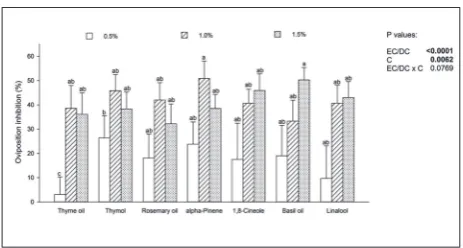
Fig. 2. Percentage of oviposition inhibition (OI; no-choice test) by essential oils (EOs) and their dominant components (DCs) in
Acanthoscelides obtectus females. P values from 2-way ANOVA
(P=0.0071), whereas α-pinene was a much better deterrent in comparison to rosemary oil (P=0.0295).
No-choice test
At the lowest concentration, thymol was the most effective botanical. Intermediate concentrations of α-pinene and the highest concentration of basil oil achieved the strongest effect and reduced oviposi-tion by half when compared to the control (Fig. 2). Results of the two-way ANOVA revealed a signifi-cant contribution of both compound type and com-pound concentration on oviposition inhibition dif-ferences. The lowest concentration evoked the lowest response, which was significantly lower than the re-sponse with middle (P<0.001) and high concentra-tions (P=0.0023). Thyme oil was significantly different from the other tested compounds since it caused the lowest inhibition effect at 0.5% concentration.
DISCUSSION
Out of seven tested botanicals, only thyme oil and thymol possessed residual contact toxicity, oviposition deterrent and inhibitory effects against A. obtectus. The toxic effect of these botanicals was dose-depend-ent and was greater when applied on glass, compared to the common bean. Furthermore, thyme oil toxicity depended on evaporation time and was significantly lower in PET assays while the highest dose of thymol retained its toxic potential even in PET experiments. The efficiency of EOs depends on their chemical composition, which differs among plant species and chemotypes, harvest times and climatic conditions of plant habitats [9]. The GC-MS analysis showed that thyme oil was dominated by thymol and p-cymene; rosemary oil mainly consisted of 1,8-cineole, camphor, α-pinene and β-pinene; while the main constituents of basil oils were estragole and linalool. Therefore, the thyme and basil oil used in our experiment be-long to thymol [30] and estragole [31] chemotypes, respectively, while rosemary oil does not seem to be ascribable to a well-defined chemotype according to Napoli et al. [32].
The highest contact toxicity response in our ex-periment was obtained with thyme oil and its DC,
thymol. Treatment of bean seeds and glass with the highest concentration of thymol provoked total mor-tality of beetles in SET assays. Such high insecticidal efficiency was retained after prolonged evaporation (PET) for males in the on-bean assay and for both sexes in the on-glass assay. In contrast, it appeared that the effect of thyme oil was more sensitive to evapora-tion time and became quite inefficient after 120 min of evaporation. However, compared to pure thymol, our thyme oil contained only 43.52% thymol, which could explain its poor efficiency. Contact toxicity of thyme oil and thymol were studied in other pests as well. In screening assays of residual contact toxicity for vari-ous Eos, thyme oil was found to be the most efficient against Meligethes aeneus (F.) [33] and Trichoplusia ni
(Hübner) [34]. Also, screening for contact toxicity in
Spodoptera littoralis (Boisduval) confirmed the high efficiency of phenolic monoterpenes such as thymol over other monoterpenes [35].
Our results show that contact toxicity also depends on the method of application, whether directly to the seeds or on a glass surface. Linalool was the only com-pound that exhibited strong residual contact toxicity when applied on the glass, and at the same time had a minimal effect when applied on the bean. Furthermore, thyme oil and thymol were found to be more effective when applied on glass compared to the common bean. This was the case because the total surface of 10 g of beans is larger than the surface of the 9-cm Petri dish and thus the amount of botanicals per surface area was lower in the bean test. Consequently, it is also possible that EOs and DCs applied on beans evaporated faster and were more subject to oxidative degradation [36]. Part of EOs and DCs could be absorbed by seeds [37], which would make them less available for contact with beetles moving over the seeds.
bioavail-ability in contact toxicity tests. For example, 24 h of fumigation with 2 µL/L of rosemary EO killed about 4 times more bean weevils than the same concentration of thyme oil [12,40]. In contrast, all beetles survived in our SET contact toxicity assays with rosemary EO, while thyme oil resulted in high mortality. This is in accordance with the observation that thyme oil is more lipophilic [41] and has a lower vapor pressure (90 Pa at 20°C) than rosemary oil (283 Pa at 20°C).
Another result of our experiment is that, com-pared to males, female bean weevils were far less sus-ceptible to the toxic effect of thyme oil and thymol in several tests. Similar results were found in studies that tested the fumigant toxicity of thyme, rosemary and basil EOs and some DCs such as thymol, 1,8-cineole, α-pinene and linalool [16-18,38]. The lower sensitiv-ity of female weevils is probably due to their body size and composition. Females are larger, live longer and are generally less susceptible to stress than males [42]. Moreover, females have more fat and thus more energy that can be allocated towards detoxification of EOs. Sonmez and Gulel [43] determined an aver-age amount of lipids per bean weevil and concluded that female bean weevils possess more stored fat than males. In addition, females are much less active than males and therefore conserve more energy. In that way, they are much less exposed to EOs and their DCs’ toxic residues. Additionally, differences in integument structure between the sexes [44] may affect the ef-ficiency of botanical penetration through the integu-ment and thus its contact toxicity.
Aside from direct mortality caused by the botani-cals, we studied the sublethal changes in bean wee-vil oviposition, which may have a significant impact on pest population increase. Thyme oil, thymol and α-pinene deterred oviposition in choice tests, with thyme oil exhibiting the strongest deterrent effect. On the other hand, all tested compounds had a significant effect on the inhibition of oviposition in the no-choice test, especially at 1.0 and 1.5% concentrations. These results correspond to previous studies in which the anti-oviposition effects of these compounds against
A. obtectus were recorded. Regnault-Roger and Ham-raoui [16] reported that fumigant application of 0.05 µL/cm3 rosemary and basil EOs completely stopped oviposition, whereas thyme oil lowered the number of eggs laid 5-7-fold. Another study of these authors
on the anti-oviposition fumigant effect of various monoterpenes in A. obtectus showed a strong effect of linalool and thymol (98% oviposition inhibition at 6 µM) [17]. However, our results for seeds treated with α-pinene are in accordance with the results of fumi-gation with this bicyclic monoterpene (65% oviposi-tion inhibioviposi-tion), showing a similarly good oviposioviposi-tion inhibition effect.
Compounds tested in this study also exhibited anti-oviposition effects on other insect species. Pas-cual and Ballesta [45] tested a germplasm collection of 18 O. basilicum essential oils against storage pest C. maculatus. The authors reported that basil EOs with high methyl chavicol (estragole) and/or linalool con-tents significantly inhibited oviposition. Screening for anti-oviposition activity of EO/DCs in Bemisia tabaci
(Gennadius) revealed thyme oil as the most efficient [46]. In addition, choice tests in Lasioderma serricorne
(F.) [47], M. aeneus [33] and S. zeamais [14] revealed the strongest repellency for thyme oil and oils rich in thymol.
CONCLUSION
dam-age [58]. In addition, oral LD50 values in rats for thyme oil and thymol were reported to be 4.7 g/kg and 980 mg/kg bodyweight, respectively [59,60]. Taking into account their low persistence as displayed in our PET assays, as well as the fact that their highest insecticidal concentration used in our experiments was far below levels toxic for mammals, we can consider contact ap-plication of these botanicals safe for human nutrition.
Funding: This work was supported by the Serbian Ministry of Education, Science and Technological Development, Grant No. III43010.
Acknowledgments: The authors are grateful to Milena Dimitrijević and Jelena Dumanović from the Institute for Mul-tidisciplinary Research, Belgrade, Serbia, for their help with es-sential oil chemical analyses.
Author contributions: SJ and JL contributed equally to the paper; SJ, JL, SK and IK conceived and designed the research; SJ, MK and IK conducted the experiments; SJ and JL analyzed the data and wrote the manuscript; VU and AR critically reviewed the manu-script. All authors have read and approved the final manumanu-script.
Conflict of interest disclosure: The authors declare that they have no conflict of interest.
REFERENCES
1. Tucic N, Stojkovic O, Gliksman I, Milanovic D, Seslija D. Laboratory Evolution Of Life-History Traits In The Bean Weevil (Acanthoscelides obtectus): The Effects Of Den-sity-Dependent And Age-Specific Selection. Evolution. 1997;51:1896-909.
2. Ogendo JO, Deng AL, Birech RJ, Bett, PK. Plant-based prod-ucts as control agents of stored-product insect pests in the tropics. In: Bhat R, Alias AK, Paliyath G, ediotrs. Progress in Food Preservation. London: John Wiley & Sons; 2012. p. 581-601.
3. Schmale I, Wäckers FL, Cardona C, Dorn S. Field infestation of Phaseolus vulgaris by Acanthoscelides obtectus (Coleop-tera: Bruchidae), parasitoid abundance, and consequences for storage pest control. Environ Entomol. 2002;31:859-63. 4. Alvarez N, Mckey D, Hossaert-Mckey M, Born C, Mercier
L, Benrey B. Ancient and recent evolutionary history of the bruchid beetle, Acanthoscelides obtectus Say, a cosmopolitan pest of beans. Mol Ecol. 2005;14:1015-24.
5. Paul VU, Lossini SJ, Edwards JP, Hilbeck A. Effectiveness of products from four locally grown plants for the management
of Acanthoscelides obtectus (Say) and Zabrotes subfasciatus
(Boheman) (both Coleoptera: Bruchidae) in stored beans under laboratory and farm conditions in Northern Tanzania. J Stored Prod Res. 2009;45:97-107.
6. Mohapatra D, Kar A, Giri SK. Insect Pest Management in Stored Pulses: an Overview. Food Bioprocess Tech. 2015;8:239-65.
7. Mossa ATH. Green Pesticides: Essential Oils as Biopes-ticides in Insect-pest Management. Environ Sci Technol. 2016;9:354-78.
8. Pavela R, Benelli G. Essential Oils as Ecofriendly Biopes-ticides? Challenges and Constraints. Trends Plant Sci. 2016;21:1000-7.
9. Regnault-Roger C, Vincent C, Arnason TJ. Essential Oils in Insect Control: Low-Risk Products in a High-Stakes World. Annu Rev Entomol. 2012;57:405-24.
10. Trivellini A, Lucchesinib M, Magginib R, Mosadegha H, Vil-lamarinb SST, Vernierib P, Mensuali-Sodia A, Pardossib A. Lamiaceae phenols as multifaceted compounds: bioactivity, industrial prospects and role of ”positive-stress”. Ind Crop Prod. 2016;83:241-54.
11. Stamopoulos DC, Damos P, Karagianidou G. Bioactiv-ity of five monoterpenoid vapours to Tribolium confusum (du Val) (Coleoptera: Tenebrionidae). J Stored Prod Res. 2007;43:571-7.
12. Bittner ML, Casanueva ME, Arbert CC, Aguilera MA, Her-nandez VJ, Becerra JV. Effects of essential oils from five plant species against the granary weevils Sitophilus zeamais and
Acanthoscelides obtectus (Coleoptera), J Chilean Chem Soc.
2008;53:1455-9.
13. Erler F, Erdemir T, Ceylan FO, Ter C. Fumigant toxicity of three essential oils and their binary and tertiary mixtures against the pulse beetle, Callosobruchus maculatus F. (Cole-optera: Bruchidae). Fresenius Environ Bull. 2009;18:975-81. 14. Nerio LS, Olivero-Verbel J, Stashenko EE. Repellent activity
of essential oils from seven aromatic plants grown in Colom-bia against Sitophilus zeamais Motschulsky (Coleoptera). J Stored Prod Res. 2009;45:212-4.
15. Ukeh AD, Umoetok BAS. Repellent effects of five monoter-penoid odours against Tribolium castaneum (Herbst) and
Rhyzopertha dominica (F.) in Calabar, Nigeria. Crop Prot.
2011;30:1351-5.
16. Regnault-Roger C, Hamraoui A. Inhibition of reproduction
of Acanthoscelides obtectus Say (Coleoptera), a kidney bean
(Phaseolus vulgaris) bruchid, by aromaticessential oils. Crop
Prot. 1994;13:624-8.
17. Regnault-Roger C, Hamraoui A. Fumigant Toxic Activity and Reproductive Inhibition Induced By Monoterpenes
on Acanthoscelides obtectus (Say) (Coleoptera), a Bruchid
of Kidney Bean (Phaseolusvulgaris L.). J Stored Prod Res. 1995;31:291-9.
18. Papachristos DP, Stamopoulos DC. Repellent, toxic and reproduction inhibitory effects of essential oil vapours on
Acanthoscelides obtectus (Say) (Coleoptera: Bruchidae). J
Stored Prod Res. 2002a;38:117-28.
19. Papachristos DP, Stamopoulos DC. Toxicity of vapours of three essential oils to the immature stages of Acanthoscelides
obtectus (Say) (Coleoptera: Bruchidae). J Stored Prod Res.
2002;38:365-73.
20. Papachristos DP, Stamopoulos DC. Fumigant toxicityof three essential oils on the eggs of Acanthoscelides obtectus (Say) (Coleoptera: Bruchidae). J Stored Prod Res. 2004;40:517-25. 21. Tapondjou LA, Adler CLAC, Bouda H, Fontem DA. Efficacy
22. Ndomo AF, Ngamo LT, Tapondjou LA, Tchouanguep FM, Hance T. Insecticidal effects of the powdery formulation based on clay and essential oil from the leaves of Clausena
anisata (Willd.) JD Hook ex. Benth.(Rutaceae) against
Acan-thoscelides obtectus (Say) (Coleoptera: Bruchidae). J Pest Sci.
2008;81:227-34.
23. Ndomo AF, Tapondjou LA, Ngamo LT, Hance T. Insecticidal activities of essential oil of Callistemon viminalis applied as fumigant and powder against two bruchids. J Appl Entomol. 2010;134:333-41.
24. Jumbo LOV, Faronib RAL, Oliveira EE, Pimentel AM, Silva NG. Potential use of clove and cinnamon essential oils to control the bean weevil, Acanthoscelides obtectus Say, in small storage units. Ind Crop Prod. 2014;56:27-34. 25. Bett PK, Deng AL, Ogendo JO, Kariukia ST,
Kamatenesi-Mugishad M, Mihalee JM, Tortof B. Residual contact toxicity and repellence of Cupressus lusitanica Miller and
Eucalyp-tus saligna Smith essential oils against major stored product
insect pests. Ind Crop Prod. 2017;110:65-74.
26. Jovanovic Z, Kostic M, Popovic Z. Grain-protective proper-ties of herbal extracts against the bean weevil Acanthoscelides
obtectus Say. Ind Crop Prod. 2007;26:100-4.
27. Chiluwal K, Kim J, Bae SD, Park CG. Essential oils from selected wooden species and their major components as repellents and oviposition deterrents of Callosobruchus
chi-nensis (L.). J Asia Pac Entomol. 2017;20:1447-53.
28. RCHAS. Evidence on the Carcinogenicity of Estragole. Reproductive and Cancer Hazard Assessment Section, Office of Environmental Health Hazard Assessment, Cali-fornia Environmental Protection Agency; 1999. 42 p. 29. SCF [Scientific Committee on Food]. Opinion of Scientific
Committee on Food on Estragole (1-Allyl-4- Methoxybe-zene). Report of Health and Consumer Protection Director-ate-General, European Commission Series 10. 2001. 30. Thompson JD, Chalchat JC, Michet A, Linhart YB, Ehlers B.
Qualitative and quantitative variation in monoterpene co-occurrence and composition in the essential oil of Thymus
vulgaris chemotypes. J Chem Ecol. 2003;29:859-80.
31. Telci I, Bayram E, Yılmaz G, Avcı B. Variability in essential oil composition of Turkish basils (Ocimum basilicum L.). Biochem Syst Ecol. 2006;34:489-97.
32. Napoli EM, Curcuruto G, Ruberto G. Screening of the essen-tial oil composition of wild Sicilian rosemary. Biochem Syst Ecol. 2010;38:659-70.
33. Pavela R. Insecticidal and repellent activity of selected essen-tial oils against of the pollen beetle, Meligethes aeneus (Fabri-cius) adults. Ind Crop Prod. 2011a;34:888-92.
34. Jiang ZL, Akhtar Y, Zhang X, Bradbury R, Isman MB. Insec-ticidal and feeding deterrent activities of essential oils in the cabbage looper, Trichoplusia ni (Lepidoptera: Noctuidae). J Appl Entomol. 2012;36:191-202.
35. Pavela R. Antifeedant and larvicidal effects of some pheno-lic components of essential oils lasp lines of introduction against Spodoptera littoralis (Boisd.). J Essent Oil Bear Pl. 2011;14:266-73.
36. Turek C, Stintzing FC. Stability of essential oils: a review. Compr Rev Food Sci Food Saf. 2013;12: 40-9.
37. Ketoh GK, Koumaglo HK, Glitho IA, Auger J, Huignard J. Essential oils residual effects on Callosobruchus maculatus
(Coleoptera: Bruchidae) survival and female reproduc-tion and cowpea seed germinareproduc-tion. Int J Trop Insect Sc. 2005;25:129-33.
38. Papachristos DP, Karamanoli KI, Stamopoulos DC, Men-kissoglu‐Spiroudi U. The relationship between the chemi-cal composition of three essential oils and their insecticidal activity against Acanthoscelides obtectus (Say). Pest Manag Sci. 2004;60:514-20.
39. Syombua ME. Effects of essential oils of Lantana camara and two ocimum species on bean weevil (Acanthoscelides
obtectus) and their chemical compositions [dissertation].
Nairobi: School of Pure and Applied Sciences, Kenyatta University; 2015.
40. Sertkaya E. Fumigant Toxicity of the Essential Oils from Medicinal Plants Against Bean Weevil, Acanthoscelides
obtectus (Say) (Coleoptera: Bruchidae). Asian J Chem.
2013;25:553-5.
41. Pauli A. Relationship between lipophilicity and toxicity of essential oils. Int J Essen Oil Ther. 2008;2:60-8.
42. Šešlija-Jovanović D, Đorđević M, Savković U, Lazarević. The effect of mitochondrial complex I inhibitor on longevity of short-lived and long-lived seed beetles and its mitonuclear hybrids. Biogerontology. 2014;15:487-501.
43. Sönmez E, Gülel A. Effects of different temperatures on the total carbohydrate, lipid and protein amounts of the bean beetle, Acanthoscelides obtectus Say (Coleoptera: Bruchidae). Pak J Biol Sci. 2008;11:1803-8.
44. Savković U, Vučković I, Stojković B. The growth on differ-ent stored legume species affects the profiles of cuticular hydrocarbon (CHC) in Acanthoscelides obtectus (Say). J Stored Prod Res. 2012;50:66-72.
45. Pascual M, Ballesta M. Chemical variation in an Ocimum
basilicum germplasm collection and activity of the
essen-tial oils on Callosobruchus maculatus. Biochem Syst Ecol. 2003;31:673-9.
46. Yang N-W, Li A-L, Wan F-H, Liu W-X, Johnson D. Effects of plant essential oils on immature and adult sweet potato whitefly, Bemisia tabaci biotype B. Crop Prot. 2010;29:1200-7. 47. Hori M. Repellency of essential oils against the cigarette beetle, Lasioderma serricorne (Fabricius) (Coleoptera: Ano-biidae). Appl Entomol Zool. 2003;38:467-73.
48. Ketoh GK, Glitho AI, Huignard J. Susceptibility of the Bru-chid Callosobruchus maculatus (Coleoptera: Bruchidae) and its Parasitoid Dinarmus basalis (Hymenoptera: Pteromali-dae) to Three Essential Oils.J Econ Entomol. 2002;95:174-82.
49. Ketoh GK, Koumaglo HK, Glitho IA. Inhibition of
Calloso-bruchus maculatus (F.) (Coleoptera: Bruchidae) development
with essential oil extracted from Cymbopogon schoenanthus L. Spreng. (Poaceae), and the wasp Dinarmus basalis (Ron-dani) (Hymenoptera: Pteromalidae). J Stored Prod Res. 2005b;41:363-71.
50. Sanon A, Dabire C, Huignard J, Monge JP. Influence of
Hyp-tis suaveolens (Lamiaceae) on the Host Location Behavior of
the Parasitoid Dinarmus basalis (Hymenoptera: Pteromali-dae).Environ Entomol. 2006; 35:718-24.
three components, carvacrol, thymol and p-cymene. Biore-sour Technol. 2008;99:8788-895.
52. Synowiec A, Kalemba D, Drozdek E, Bocianowski J. Phyto-toxic potential of essential oils from temperate climate plants against the germination of selected weeds and crops. J Pest Sci. 2017;90:407-19.
53. Braga PC, Dal Sasso M, Culici M, Galastri L, Marceca MT, Guffanti EE. Antioxidant Potential of Thymol Determined by Chemiluminescence Inhibition in Human Neutrophils and Cell-Free Systems. Pharmacology. 2006;76:61-8. 54. Stahl-Biskup E. Venskutonis RP. Thyme. In: Peter KV, editor.
Handbook of herbs and spices. Oxford: Woodhead Publish-ing; 2012. p. 499-525.
55. Zani F, Masimo G, Benvenuti S, Biachi A, Albasini A, Melegari M, Vampa G, Belloti A, Mazza P. Studies on the genotoxic properties of essential oils with Bacillus subtilis rec-assay and Salmonella/microsome reversion assay. Planta Med. 1991;57:237-41.
56. Azizan A, Blevins RD. Mutagenicity and antimutagenicity testing of six chemicals associated with the pungent proper-ties of spices as revealed by Ames Salmonella/microsomal assay. Arch Environ Contam Toxicol. 1995;28:248-58. 57. Stammati A, Bonsi P, Zucco F, Moezalaar R, Alakomi H-L,
von Wright A. Toxicity of selected plant volatiles in micro-bial and mammalian short-term assays. Food Chem Toxicol. 1999;37:813-23.
58. Aydın S, Basaran AA, Basaran N. The effects of thyme vola-tiles on the induction of DNA damage by the heterocyclic amine IQ and mitomycin C. Mutat Res. 2005;581:43-53. 59. Jenner PM, Hagan EC, Taylor JM, Cook EL, Fitzhugh OG.
Food flavorings and compounds of related structure I. Acute oral toxicity. Food Cosmetics Toxicol. 1964;2:327-43. 60. Tisserand R, Young R. Essential Oil Safety: A Guide for