UC Davis Previously Published Works
Title
Subthreshold Psychosis in 22q11.2 Deletion Syndrome: Multisite Naturalistic Study
Permalink
https://escholarship.org/uc/item/7bf8368m
Journal
SCHIZOPHRENIA BULLETIN, 43(5)
ISSN
0586-7614
Authors
Weisman, O Guri, Y Gur, RE et al.
Publication Date
2017-09-01
DOI
10.1093/schbul/sbx005
Peer reviewed
© The Author 2017. Published by Oxford University Press on behalf of the Maryland Psychiatric Research Center. All rights reserved. For permissions, please email: [email protected]
Subthreshold Psychosis in 22q11.2 Deletion Syndrome: Multisite Naturalistic Study
Omri Weisman1,2, Yael Guri1, Raquel E. Gur3,4, Donna M. McDonald-McGinn5,6, Monica E. Calkins3,
Sunny X. Tang3, Beverly Emanuel5,6, Elaine H. Zackai5,6, Stephan Eliez7, Maude Schneider7, Marie Schaer7,
Wendy R. Kates8, Kevin M. Antshel9, Wanda Fremont8, Vandana Shashi10, Stephen R. Hooper11,
Marco Armando7,12, Stefano Vicari12, Maria Pontillo12, Leila Kushan13, Maria Jalbrzikowski14,
Carrie E. Bearden13, Joseph F. Cubells15,16, Opal Y. Ousley15,16, Elaine F. Walker17, Tony J. Simon18,
Joel Stoddard18, Tara A. Niendam18, Marianne B. M. van den Bree19, and Doron Gothelf*,1,2;
International Consortium on Brain and Behavior in 22q11.2 Deletion Syndrome
1The Behavioral Neurogenetics Center, Edmond and Lily Safra Children’s Hospital, Sheba Medical Center, Tel Hashomer, Israel; 2Sackler Faculty of Medicine and the Sagol School of Neuroscience, Tel Aviv University, Tel Aviv, Israel; 3Neuropsychiatry,
Department of Psychiatry, Perelman School of Medicine, University of Pennsylvania, Philadelphia, PA; 4Department of Child &
Adolescent Psychiatry, Children’s Hospital of Philadelphia, Philadelphia, PA; 5Division of Human Genetics, Children’s Hospital of
Philadelphia, Philadelphia, PA; 6Department of Pediatrics, Perelman School of Medicine, University of Pennsylvania, Philadelphia, PA; 7Developmental Imaging and Psychopathology Lab, Faculty of Medicine, University of Geneva, Geneva, Switzerland; 8Department
of Psychiatry and Behavioral Sciences, State University of New York at Upstate Medical University, Syracuse, NY; 9Department
of Psychology, Syracuse University, Syracuse, NY; 10Department of Pediatrics, Duke University Medical Center, Durham, NC;
11Department of Allied Health, University of North Carolina at Chapel Hill, Chapel Hill NC; 12Child and Adolescence Neuropsychiatry
Unit, Department of Neuroscience, Children Hospital Bambino Gesu, Rome, Italy; 13Department of Psychiatry and Behavioral Sciences
and Psychology, Semel Institute for Neuroscience and Human Behavior, University of California, Los Angeles, CA; 14Department of
Psychiatry, University of Pittsburgh, Pittsburgh, PA; 15Department of Human Genetics, Emory University School of Medicine, Atlanta,
GA; 16Emory Autism Center, Department of Psychiatry and Behavioral Sciences, Emory University School of Medicine Atlanta, GA; 17Department of Psychology, Emory University, Atlanta, GA; 18Department of Psychiatry and Behavioral Sciences, University of
California Davis, Sacramento, CA; 19MRC Centre for Neuropsychiatric Genetics and Genomics, Institute of Psychological Medicine and
Clinical Neurosciences, Cardiff University, Cardiff, UK
*To whom correspondence should be addressed; The Behavioral Neurogenetics Center, The Edmond and Lily Safra Children’s Hospital, Sheba Medical Center, Tel Hashomer 52621, Israel; tel: 972-3-530-2663, fax: 972-77-349-8317, e-mail: [email protected]
Nearly one-third of individuals with 22q11.2 deletion syn-drome (22q11.2DS) develop a psychotic disorder during life, most of them by early adulthood. Importantly, a full-blown psychotic episode is usually preceded by subthresh-old symptoms. In the current study, 760 participants (aged 6–55 years) with a confirmed hemizygous 22q11.2 microde-letion have been recruited through 10 medical sites world-wide, as part of an international research consortium. Of them, 692 were nonpsychotic and with complete measure-ment data. Subthreshold psychotic symptoms were assessed using the Structured Interview for Prodromal Syndromes (SIPS). Nearly one-third of participants met criteria for positive subthreshold psychotic symptoms (32.8%), less than 1% qualified for acute positive subthreshold symp-toms, and almost a quarter met criteria for negative/disor-ganized subthreshold symptoms (21.7%). Adolescents and young adults (13–25 years) showed the highest rates of sub-threshold psychotic symptoms. Additionally, higher rates of anxiety disorders and attention deficit/hyperactivity dis-order (ADHD) were found among the study participants
with subthreshold psychotic symptoms compared to those without. Full-scale IQ, verbal IQ, and global functioning (GAF) scores were negatively associated with participants’ subthreshold psychotic symptoms. This study represents the most comprehensive analysis reported to date on sub-threshold psychosis in 22q11.2DS. Novel findings include age-related changes in subthreshold psychotic symptoms and evidence that cognitive deficits are associated with sub-threshold psychosis in this population. Future studies should longitudinally follow these symptoms to detect whether and how early identification and treatment of these manifesta-tions can improve long-term outcomes in those that eventu-ally develop a psychotic disorder.
Key words: velocardiofacial syndrome/subthreshold
Introduction
22q11.2 deletion syndrome (22q11.2DS) is a genetic disor-der that occurs in about 1 in 4000 live births.1 Psychiatric comorbidities are highly prevalent in 22q11.2DS, affect-ing three-quarters of all diagnosed individuals.2 Notable among these are Schizophrenia-spectrum disorders; about a third of 22q11.2DS individuals develop a psychotic dis-order during life, most of them by early adulthood.3 Thus, a diagnosis of 22q11.2DS constitutes a 30-fold increased risk of developing psychosis over the general population and a 10-fold elevated risk over other populations with neurodevelopmental disabilities.4 Therefore, 22q11.2DS is currently the strongest known risk factor for psycho-sis and a promising model for studying the etiology of schizophrenia and early signs of psychosis proneness.5,6
As in individuals without 22q11.2DS, psychotic symp-toms develop gradually in those with 22q11.2DS, and psychosis is usually preceded by subthreshold sympto-mology.7,8 Few studies have assessed subthreshold psy-chotic symptoms in 22q11.2DS reporting prevalence rates ranging from 20% to 56.5%.5,9–12 Small sample sizes, differences in participants’ age, various definition of “prodromal symptoms” used (ie, including positive symptoms, negative/disorganized symptoms, or both), and the assessment tool employed, may contribute to the variability in reported rates.
These inconsistencies call for additional investigation into the incidence and characteristics of subthreshold psychotic symptoms in 22q11.2DS from early childhood through adulthood. An analysis that is based on a large cohort of participants undergoing comparable clinical assessments is likely to provide answers to some of the questions that arise due to the limitations in the literature.
Several well-validated diagnostic tools are applied for assessing subthreshold psychotic symptoms, includ-ing the Structured Interview for Prodromal Syndromes (SIPS).13 Originally developed for the evaluation of sub-threshold psychotic symptoms in the general popula-tion,14 the SIPS has good psychometric properties,13 and criteria for a clinical high-risk state have been shown to predict conversion to psychosis in populations without 22q11.2DS (~20% by 1-year and 33% by 3-years).15,16 The SIPS has been effectively administered to individuals with 22q11.2DS in several studies.5,9–12
Several factors may contribute to developing psycho-sis in individuals with 22q11.2DS. Among these are lon-gitudinal decline in verbal IQ (VIQ),17,18 lower baseline IQ,3,8,19 the presence of comorbid anxiety disorders,7,8,20 and lower global functioning.21,22 However, the comor-bidity of these conditions with subthreshold psychotic symptoms has not been sufficiently explored. Moreover, assessment of this phenomenon in 22q11.2DS individu-als of various ages is vital for elucidating the rate and nature of subthreshold psychotic symptoms across devel-opment in this population.
Accordingly, the aims of the current study are: (1) to determine the rates of positive and negative/disorganized subthreshold psychotic symptoms in the largest cohort of 22q11.2DS individuals published to date; (2) to investigate (cross-sectional) changes in the prevalence of different definitions of subthreshold symptoms across develop-ment—from early childhood throughout adulthood; (3) To determine whether higher rates of psychiatric comor-bidities and lower intellectual and global functioning co-occur with subthreshold psychotic symptoms.
Methods Participants
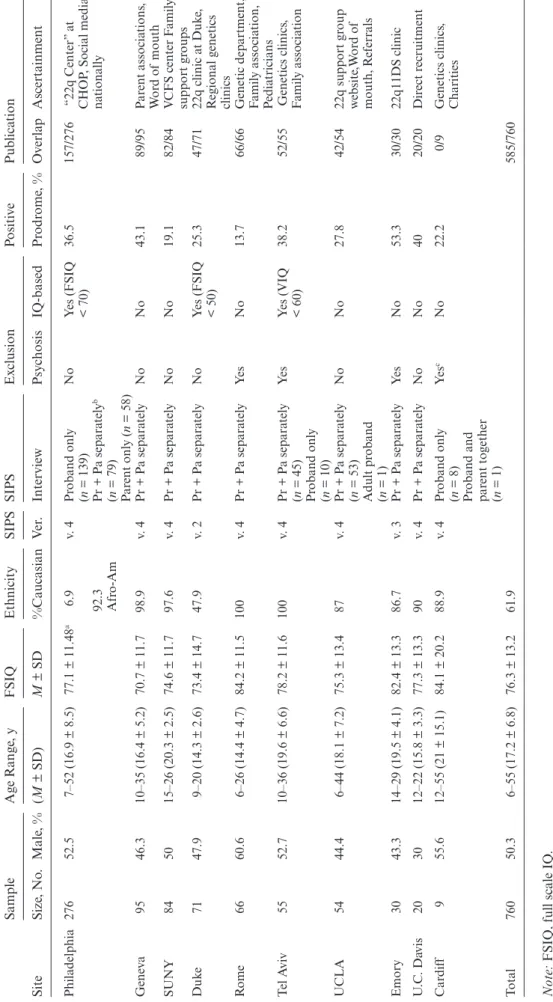
This study represents the collaborative efforts of research-ers across 10 independent medical centresearch-ers worldwide, 6 in the United States, 3 in Europe, and 1 in Israel (table 1 lists the demographics and enrollment specifications for each site). The sites are part of the International 22q11.2 Deletion Syndrome Brain Behavior Consortium (IBBC). Participants had a 22q11.2 microdeletion confirmed by molecular testing, underwent a structured clinical assess-ment of psychiatric psychopathologies, and completed the SIPS interview for evaluating subthreshold psychotic symptoms. Of the 839 individuals originally enrolled in the study, 79 were excluded due to missing data on the SIPS positive symptoms (>9%), resulting a total of 760 participants aged 6–55 years (mean age = 17.1 ± 6.8).
Of the study sample (n = 760), 56 participants (7.4%) were on antipsychotic medication, 118 participants (15.5%) were taking antidepressants, 26 participants (3.4%) were taking a mood-stabilizer, 34 participants (4.5%) were tak-ing an anxiolytic medication and 104 participants (13.7%) were taking stimulants.
Each site received approval from its local ethics com-mittee (institutional review board; IRB), and each partic-ipant or his or her legal caregiver gave written informed consent prior to study entry.
SIPS Administration and Scoring
Participants were evaluated for the presence of subthresh-old psychotic symptoms by a well-trained Bachelor’s, Master’s, Doctoral, or Post-doctoral/Resident-level inter-viewers skilled in using the SIPS Scale of Prodromal Symptoms (SOPS).13 Furthermore, all interviewers were routinely supervised by psychiatry and psychology fac-ulty, knowledgeable in using the SIPS, at each of the participating sites.
T
able 1.
Descripti
ve Da
ta of
the 22q11.2 Deletion Syndr
ome Cohort f
or Each P
articipa ting Site Site Sample Age R ange , y FSIQ Ethnicity SIPS SIPS Ex clusion Positi ve Pub lica tion Siz e, No . Male , % (M ± SD) M ± SD %Caucasian Ve r. Intervie w Psy chosis IQ-based Pr odr ome , % Ov er la p Ascertainment Philadelphia 276 52.5 7–52 (16.9 ± 8.5) 77.1 ± 11.48 a 6.9 v. 4 Pr oband onl y (n = 139) No Y
es (FSIQ < 70)
36.5 157/276 “22q Center” a t CHOP
, Social media
na
tionall
y
92.3 Afr
o-Am
Pr + P
a separ atel y b (n = 79) P ar ent onl y (n = 58) Gene va 95 46.3 10–35 (16.4 ± 5.2) 70.7 ± 11.7 98.9 v. 4
Pr + P
a separ atel y No No 43.1 89/95 P ar ent associa tions , W or d of mouth SUNY 84 50 15–26 (20.3 ± 2.5) 74.6 ± 11.7 97.6 v. 4
Pr + P
a separ atel y No No 19.1 82/84 V
CFS center F
amil y support gr oups Duk e 71 47.9 9–20 (14.3 ± 2.6) 73.4 ± 14.7 47.9 v. 2
Pr + P
a separ
atel
y
No
Y
es (FSIQ < 50)
25.3
47/71
22q clinic a
t Duk e, R egional genetics clinics R ome 66 60.6 6–26 (14.4 ± 4.7) 84.2 ± 11.5 100 v. 4
Pr + P
a separ atel y Ye s No 13.7 66/66
Genetic department, Famil
y associa tion, P edia tricians T el A vi v 55 52.7 10–36 (19.6 ± 6.6) 78.2 ± 11.6 100 v. 4
Pr + P
a separ atel y (n = 45) Ye s Y
es (VIQ < 60)
38.2 52/55 Genetics clinics , F amil y associa tion Pr oband onl y (n = 10) UCLA 54 44.4 6–44 (18.1 ± 7.2) 75.3 ± 13.4 87 v. 4
Pr + P
a separ atel y (n = 53) No No 27.8 42/54
22q support gr
oup w ebsite ,W or d of mouth, R eferr als Adult pr oband (n = 1) Emory 30 43.3 14–29 (19.5 ± 4.1) 82.4 ± 13.3 86.7 v. 3
Pr + P
a separ atel y Ye s No 53.3 30/30 22q11DS clinic U .C . Da vis 20 30 12–22 (15.8 ± 3.3) 77.3 ± 13.3 90 v. 4
Pr + P
a separ atel y No No 40 20/20 Dir ect r ecruitment Car dif f 9 55.6 12–55 (21 ± 15.1) 84.1 ± 20.2 88.9 v. 4 Pr oband onl y (n = 8) Ye s c No 22.2 0/9 Genetics clinics , Charities Pr oband and par ent to gether (n = 1) Total 760 50.3 6–55 (17.2 ± 6.8) 76.3 ± 13.2 61.9 585/760 Note:
FSIQ, full scale IQ
.
aIQ scor
es fr
om the Philadelphia site w
er
e a
vaila
ble f
or 52 participants
. IQ scoring f
or the r
est of
the sample w
as deri
ved fr
om participants’
perf
or
mance in the CNB test
ba
ttery
.
bPr + P
a separ
atel
y = pr
oband and par
ent intervie
w
ed separ
atel
y.
cAdults (a
ge >17 y) with a dia
gnosis of
psy
chotic spectrum disor
der w
er
e e
xcluded. Y
outh subjects (a
ge 6–17) w
er
e included r
egar
dless of
dia
gnosis
Some items of the SIPS are more entangled with non-psychotic comorbidities. For example, D3, “trouble with focus and attention,” overlaps significantly with ADHD, and N5, poor “ideational richness,” overlaps with reduced intellectual ability. In these cases, we considered that these symptoms nevertheless might represent sub-threshold psychotic symptoms. Therefore, we rated these SIPS items based on their presence and without regard to other comorbidities. As such, dual scoring was given for the same symptom of inattention in the SIPS and in the ADHD section of the K-SADS. This is consistent with the original intention of the SIPS, that items be rated without regard to diagnostic etiology.23
In the majority of cases, separate interviews were con-ducted with probands and their caregivers, usually moth-ers. The SIPS was administered separately from the child to all parents of children younger than 18 years of age, as well as for parents of adult participants when possible. Younger probands (aged 6–10 years) underwent clini-cal evaluations probing for subjective and characteristic symptoms (including delusional and bizarre ideas, suspi-ciousness, grandiosity, perceptual abnormalities, disorga-nized speech, social anhedonia, and avolition). Probands aged 11 years and older received the full SIPS. Whenever there were discrepancies in the provided information, each responder was asked for clarification.
Establishing Reliability in Assessing Subthreshold Psychotic Symptoms Between Two Participating Sites: Philadelphia and Israel
The Tel Aviv and Philadelphia sites are funded, as part of a binational prospective research project, to study psy-chosis risk in 22q11.2DS. Thus, the 2 centers conducted training sessions to ensure the consistency of SIPS administration and scoring methodology. The high inter-rater reliability achieved suggests that multisite studies that aim to reliably assess subthreshold psychotic symp-toms in individuals with 22q11.2DS are feasible. This is especially important in the context of administering the SIPS—which was originally developed for use in the gen-eral population—to individuals with neurodevelopmental and neurogenetic conditions, such as 22q11.2DS. The low IQ (and, respectively, the poor ideational richness) that characterizes many 22q11.2DS individuals makes SIPS administration a challenging task that requires skilled personnel. The international 22q11.2 Deletion Syndrome consortium is a multicenter study geared toward char-acterization of a large cohort of existing data sets. The retrospective nature of the project therefore focused on data harmonization and reliability is currently pursued in several sites. The following paragraph details the efforts of 2 sites.
The Israeli team was trained by the PI from the Philadelphia site (R.E.G) to administer the SIPS in the same manner that it is being conducted in the Philadelphia
22q11.2DS study. Consequently, in both sites the SIPS interview was conducted separately for participants and caregivers. Whenever discrepancies emerged between the 22q11.2DS and collateral informants, a combined rating was given in a consensus meeting. Four cases from the Israeli cohort were independently evaluated and given SIPS scores by R.E.G. and the clinical psychologist from the Israeli site (Y.G.).
The between-site weighted kappa intraclass correlation coefficients (ICC) for the SIPS items presented for both centers in this study ranged between very good to excel-lent (besides the ICC for N5, “ideational richness”): P1, “unusual thought content/delusional ideas” (ICC = 0.99); P2, “suspiciousness/persecutory ideas” (0.98); P3, “gran-diosity” (0.98); P4, “perceptual abnormalities/hallucina-tions” (1.00); P5, “disorganized communication” (0.98); N1, “social anhedonia” (0.95); N2, “avolition” (0.95); N3, “expression of emotion” (0.98); N4, “experience of emotions and self” (1.00); N5, “ideational richness” (0.00); N6, “occupational functioning” (1.00); D1, “odd behavior or appearance” (0.97); D2, “dysphoric mood” (1.00); D3, “trouble with focus and attention” (0.89); and D4, “personal hygiene” (0.95).
Subthreshold Psychotic Symptoms Definitions
The spectrum of subthreshold psychotic symptoms, consistent with the literature, was defined in 4 catego-ries.5,16,24 Positive subthreshold psychotic symptoms— having one or more positive symptoms rated 3–5; acute positive subthreshold psychotic symptoms—having at least one positive symptom rated 6 without fulfilling criteria for a psychotic spectrum disorder; negative/ disorganized subthreshold psychotic symptoms—hav-ing at least 2 negative/disorganized symptoms rated 3–6 (without the presence of positive subthreshold symp-toms); positive and negative/disorganized subthresh-old psychotic symptoms—having one or more positive symptoms rated 3–5 and at least 2 negative/disorganized symptoms rated 3–6.
Psychiatric Evaluation
Probands and their caregivers were interviewed by trained psychiatrists or psychologists using the Schedule for Affective Disorders and Schizophrenia for School-Aged Children, Present and Lifetime (K-SADS-PL)25 in 8 centers, the Diagnostic Interview for Children and Adolescents (DICA)26 in one center (Geneva), and the Child and Adolescent Psychiatric Assessment (CAPA)27 in another center (Cardiff). Adult participants were inter-viewed using the Structured Clinical Interview for Axis I DSM-IV (SCID)28 in 9 centers and the PAS-ADD clini-cal interview for adults29 in one center (Cardiff).
and Statistical Manual of Mental Disorders (DSM-IV).30 Nearly all of the participants underwent clinical evalu-ation for the presence of schizophrenia spectrum disor-ders (n = 756; 64 fulfilled the criteria), anxiety disordisor-ders (n = 757; 310 fulfilled the criteria), mood disorders (n = 760; 133 fulfilled the criteria), attention deficit/hyper-activity disorders (ADHD; n = 732; 257 fulfilled the crite-ria), oppositional defiant and conduct disorders (n = 731; 26 fulfilled the criteria), and substance-related disorders (n = 626; 15 fulfilled the criteria). Prevalence rates of psy-chotic disorders and other psychiatric comorbidities are detailed in supplementary table S1.
Of the 760 participants with complete data on the SIPS positive items, 68 were excluded from the statistical analysis due to fulfillment of the criteria for schizophrenia spectrum disorders (n = 64), or not completing clinical evaluation (n = 4). Consequently, the final study cohort included 692 participants aged 6–55 years (mean age = 16.9 ± 6.7). Of them, 350 participants were males (50.6%), 429 Caucasians (62%), 235 Afro-Americans (34%), 10 of mixed ethnicity (1.4%), and 9 Hispanic (1.3%).
Intellectual Functioning
Age-appropriate Wechsler intelligence scales were used for assessment of intellectual functioning, including the Wechsler Preschool and Primary Scale of Intelligence (WPPSI),31 the Wechsler Intelligence Scale for Children-Revised (WISC-R),32 the Wechsler Intelligence Scale for Children-Third Edition (WISC-III),33 the Wechsler Abbreviated Scale of Intelligence-Second Edition (WASI-II),34 and the Wechsler Adult Intelligence Scale-Third Edition (WAIS-III).35 A total of 521 participants (68.4%) completed the evaluation. The mean full-scale IQ (FSIQ) was 76.3 ± 13.2 points, and the mean VIQ (assessed in 507 participants) was 79.8 ± 13.7 points. There were 187 individuals (35.9%) with a FSIQ ≤70, consistent with intellectual disability. Age was not sig-nificantly associated with FSIQ score (Pearson r = .03,
P = .45).
Statistical Analysis
Statistical analysis was conducted using SPSS Version 20.0. To compare the rates of subthreshold psychotic symptoms at different stages of development, the cohort was divided into 4 age groups: 6–12 years (children), 13–17 years (adolescents), 18–25 years (young adults), and 26 years and above (older adults). The prevalence rates of positive subthreshold psychotic symptoms (ie, having one or more positive symptoms rated 3–5) and the combined subgroup of symptoms (ie, having one or more positive symptoms rated 3–5 and/or at least 2 nega-tive/disorganized symptoms rated 3–6) were compared between the four different age groups using the χ2 test and with Fisher exact test when the χ2 test assumptions were
not met. A significant difference between all 4 groups was followed by post hoc contrast analysis comparing the group with the highest rates of subthreshold symptoms (Adolescents, aged 13–17 years) to all other groups. The false discovery rate (FDR) method for adjustment of significance level was computed using SAS for Windows version 9.4.
Univariate analysis of variance (ANOVA) was applied to examine differences in the scores of individual SIPS items between the age groups. Bonferroni post hoc com-parisons were conducted only for the items that reached statistical significance at the level of P < .003 (0.05/15, with 15 representing the number of comparisons/number of SIPS items).
Next, independent t-tests were calculated to compare between (a) 22q11.2DS with positive subthreshold psy-chotic symptoms (ie, having one or more positive symp-toms rated 3–5) vs those without positive subthreshold symptoms or acute positive subthreshold symptoms, and (b) 22q11.2DS with negative/disorganized subthreshold psychotic symptoms (ie, having at least 2 negative/disor-ganized symptoms rated 3–6) vs those without positive or negative/disorganized subthreshold symptoms. Analyses were corrected for multiple comparisons (P value lower than .0062 was regarded as significant). The positive and negative/disorganized subthreshold symptoms were chosen as each of them is a risk factor for the evolution of psychotic disorders in individuals with- and without-22q11.2DS. Potential contribution of research sites to the variability in individual items between the age groups was controlled for by including site as covariate (supplemen-tary table S3).
Results
Prevalence of Subthreshold Psychotic Symptoms
Nearly one-third of participants met criteria for posi-tive subthreshold psychotic symptoms (228/692; 32.8%), less than 1% qualified for acute positive subthreshold psychotic symptoms (6/692), and almost a quarter of participants met criteria for negative/disorganized sub-threshold psychotic symptoms where positive subthresh-old psychotic symptoms were not present (140/641; 21.7%). Finally, one-fourth of participants (160/692; 25.6%) met criteria for both positive and negative/disor-ganized subthreshold psychotic symptoms.
Notably, 66.3% of the participants did not meet cri-teria for either positive or acute positive subthreshold psychotic symptoms (459/692). Of this group, the major-ity (65.9%) did not meet criteria for the negative/disorga-nized definition either.
The most prevalent subthreshold symptom was poor ideational richness, followed by trouble with focus and attention, avolition, and occupational functioning. The least prevalent symptoms were grandiosity and bizarre thinking. Individual item scores and subthreshold rates in the entire 22q11.2DS cohort are described in table 2.
Subthreshold Psychotic Symptoms From Early Childhood Throughout Adulthood
Significant differences between the age groups were found in the positive subthreshold psychotic symptoms sub-group and the combined (positive and negative/disorga-nized) subthreshold psychotic symptoms subgroup. Post hoc contrast analysis using FDR for adjustment of sig-nificance level revealed significantly higher rates of posi-tive subthreshold symptoms in adolescents compared to children, FDR = 0.039, χ2(1) = 6.07, P < .02, η2 = .12, and older adults, FDR = 0.047, χ2(1) = 4.47, P < .03, η2 = .12. In the same vein, a post hoc contrast analysis conducted for the combined subthreshold symptoms subgroup revealed higher rates in adolescence compared to children, FDR = 0.027, χ2(1) = 9.30, P < .003, η2 = .18, and older adults, FDR = 0.013, χ2(1) = 8.34, P < .005, η2 = .20. The acute positive symptom subgroup has been diagnosed in a limited number of individuals, and it was present in children and adolescents but absent among adults (table 3).
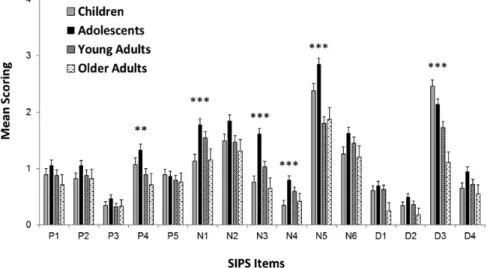
Age-related differences in mean scores of positive, neg-ative, and disorganized symptoms emerged. Specifically, adolescents scored higher on items: P4, “perceptual abnormalities/hallucinations,” F(3, 686) = 6.20, P < .001,
η2 = .02; N1, “social anhedonia,” F(3, 616) = 6.94,
P < .001, η2 = .03; N3, “expression of emotion,” F(3,
617) = 17.00, P < .001, η2 = .07, N4, “experience of emotions and self”, F(3, 597) = 6.11, P < .001, η2 = .03, and, N5, poor “ideational richness”, F(3, 617) = 17.33,
P < .001, η2 = .08, compared to all or most other age
groups. Finally, children and adolescents scored signifi-cantly higher on item D3, “trouble with focus and atten-tion”, F(3, 620) = 16.92, P < .001, η2 = .08, compared to the young adults and older adults groups (see figure 1 and supplementary table S2 for details).
Psychiatric Comorbidities, Intellectual Functioning, and Global Functioning in Affected Vs Nonaffected Individuals
The rates of anxiety disorders has been significantly higher in participants with positive subthreshold psychotic symptoms compared to those without (55.1% vs 35.1%, χ2(1) = 25.54, P < .001, η2 = .19; table 4). In addition, intel-lectual functioning (FSIQ) and global functioning (GAF) scores were lower in subjects with positive subthreshold symptoms compared to those without (FSIQ, 74.4 ± 12.0 vs 78.2 ± 13.3, t(467) = 3.01, P = .002; GAF, 57.4 ± 12.1 vs 69.4 ± 46.6, t(664) = 3.83, P < .001) (table 4).
The rates of anxiety disorders and ADHD have been significantly higher in subjects with negative/disorganized subthreshold psychotic symptoms compared to those without (43.6% vs 29.6%, χ2(1) = 7.94, P = .006, η2 = .14, and 44.0% vs 27.3%, χ2(1) = 10.75, P = .001, η2 = .16, respectively; table 4). Intellectual functioning (FSIQ, VIQ) and global functioning (GAF) scores have been lower in subjects with negative/disorganized subthreshold symptoms compared to those without (FSIQ, 75.8 ± 12.3 vs 80.7 ± 12.8, t(268) = 3.12, P = .002; VIQ, 78.3 ± 12.7 vs 83.3 ± 13.7, t(258) = 1.77, P = .004; GAF, 60.4 ± 14.8 vs 71.4 ± 11.35, t(384) = 8.13, P < .001, respectively).
Table 2. Individual SIPS Item Scoring and Subthreshold Rates of 22q11.2 Deletion Syndrome Participants Without Psychotic Disorder
Item Description Mean ± SD Median Range Subthreshold, %a
P1 Unusual thought content/delusional ideas 0.96 ± 1.29 0 0–6 13.4 P2 Suspiciousness/persecutory ideas 0.93 ± 1.21 0 0–6 13.7
P3 Grandiosity 0.38 ± 0.87 0 0–6 4.5
P4 Perceptual abnormalities/hallucinations 1.11 ± 1.47 0 0–6 18.8 P5 Disorganized communication 0.85 ± 1.15 0 0–5 10.1
N1 Social anhedonia 1.49 ± 1.51 1 0–6 21.9
N2 Avolition 1.59 ± 1.51 1 0–6 31.0
N3 Expression of emotion 1.14 ± 1.38 1 0–6 19.1 N4 Experience of emotions and self 0.59 ± 1.08 1 0–5 7.5 N5 Ideational richness 2.31 ± 1.65 2 0–6 48.5 N6 Occupational functioning 1.45 ± 1.51 1 0–6 23.4 D1 Odd behavior or appearance 0.62 ± 1.04 0 0–5 7.9
D2 Bizarre thinking 0.40 ± 0.84 0 0–5 3.8
D3 Trouble with focus and attention 2.00 ± 1.44 2 0–5 39.9
D4 Personal hygiene 0.76 ± 1.18 0 0–5 10.8
Discussion
This multisite study represents the largest cohort and the most comprehensive analysis reported to date on subthreshold psychotic symptoms in individuals with 22q11.2DS. The novel aspects of our study include an examination of the development of subthreshold psy-chotic symptoms by age groups, and evidence that cogni-tive deficits are associated with subthreshold psychosis in this population. Specifically, we show that the peak prevalence of positive subthreshold psychotic symptoms occurs during adolescence and young adulthood (aged 13–25 years), which is similar or slightly later than the peak occurrence of subthreshold syndrome reported in non-help-seeking typically developing individuals.36 Furthermore, our findings indicate that FSIQ scores are significantly lower in 22q11.2DS individuals with vs without subthreshold psychotic symptoms. Of note,
lower IQ has been associated with psychotic disorders2 and with the risk for developing psychotic disorders in 22q11.2DS.7
Psychiatric comorbidities in 22q11.2DS are common,2 and our study provides additional evidence that condi-tions of subthreshold psychosis are characterized by an extent of psychiatric symptomology, including anxiety and mood disorders and higher rates of ADHD,37 coupled with lower FSIQ scores. These comorbidities are similar to those reported in individuals without 22q11.2DS.38,39 Findings in individuals without 22q11.2DS show that psychiatric disorders tend to be less specific in early stages and more so with progression.39 Notably, the majority of individuals without 22q11.2DS showing subthreshold psychotic symptoms do not develop schizophrenia spec-trum disorders.40 Many patients with subthreshold psy-chotic symptoms progress to develop other psychiatric disorders such as anxiety and affective disorders.
Table 3. Subthreshold Psychotic Symptoms Across the Life Span in 22q11.2 Deletion Syndrome Participants Without Psychotic
Disorder
Definitions
No. (%)a
Children
(n = 184) Adolescents (n = 276) Young Adults (n = 231) Older Adults (n = 67) χ2 P ES
Positive subthreshold symptoms 48/175 (27.4) 97/251 (38.5) 69/203 (33.9) 13/55 (23.6) 8.31 .04 .11 Negative/disorganized subthreshold
symptoms 34/126 (27.0) 55/142 (38.7) 40/143 (28.0) 11/47 (23.4) 6.81 .08 .12 Positive + negative/disorganized
subthreshold symptoms 31/123 (25.2) 69/156 (44.2) 52/155 (33.5) 8/44 (18.2) 16.50 <.001 .19 Acute positive subthreshold symptoms 1/175 (<0.5) 5/159 (3.1) 0/134 (0) 0/42 (0) 6.82 .08 .12
Note: ES, effect size Eta-squared (η2).
a% of valid cases (participants for whom the SIPS negative/disorganized symptoms were missing were withdrawn from the relevant
analysis; n = 67); Statistical analysis conducted with chi-square tests (χ2); Children, aged 6–12 years, mean age 10.3 ± 1.4; Adolescents,
13–17 years, 14.9 ± 1.4; Young adults, 18–25 years, 20.7 ± 2.2; Older adults, 26 years and above, mean age 33.0 ± 6.5; Male/female ratio did not differ between the 4 age groups, χ2(3) = 4.94, P = .18.
Fig. 1. Comparison of the mean scores of individual SIPS items between the four 22q11.2 deletion syndrome age groups; mean + SEM;
It is plausible that the subthreshold psychotic symp-toms in 22q11.2DS are not pathognomonic since only a portion of the individuals with 22q11.2DS develop psychosis while many others will evolve to other psychi-atric morbidities such as anxiety disorders and depres-sion. An answer to this question will be provided by longitudinal studies that have only begun to examine the outcome of 22q11.2DS individuals with subthresh-old psychotic symptoms.41 Besides the need to find the proportion of subthreshold 22q11.2DS individuals who will develop full-blown psychosis, it is also impor-tant to determine the proportion of the subthreshold 22q11.2DS individuals who will continue to cope with or will develop mood disorders, anxiety disorders and ADHD,37 as these disorders have been shown to nega-tively affect the quality of life and functioning of indi-viduals with 22q11.2DS.42–44
The collective prevalence rates of those with positive subthreshold symptoms (32.8%) and those with negative/ disorganized subthreshold symptoms (21.7%) sum up to 54.5%, which is similar to the 54% who met criteria for “psychosis-proneness” in the research conducted by Tang
et al.5 Similarly, the rates of negative/disorganized
sub-threshold symptoms found in our cohort parallel those reported in several previous studies with 22q11.2DS
individuals, suggesting that negative symptoms are com-mon in this population.11,22
Negative symptoms are considered important predic-tors of the likelihood to convert to psychosis in high-risk populations without 22q11.2DS.11,45 For example, mod-erate and severe subthreshold negative symptoms were highly abundant in individuals at high risk for psychosis in the North American Prodrome Longitudinal Study (NAPLS), and the severity and persistence of these symp-toms were positively associated with transition rates into a psychotic state at 6- and 12-months post-baseline vis-its.45 Another study which assessed negative subthreshold psychotic symptoms in typically developing youths found significant associations with the participants’ neurocog-nitive performance and functions that are central to the evolution of psychosis.46 Taken together, the accumulat-ing evidence suggest that 22q11.2DS individuals with sub-threshold negative symptoms in our study are at higher risk of transitioning into full-blown psychotic disorders.
Nevertheless, in 22q11.2DS literature, negative symp-toms, most notably, ideational richness and trouble with focus and attention (ie, ADHD), have been suggested as features of the general phenotype of the syndrome,47 regardless of the degree of the risk for psychosis. This indicates that negative symptoms may not yield the
Table 4. Comparing Rates of Psychiatric Comorbidities and Level of Intellectual and Global Functioning in 22q11.2 Deletion
Syndrome Participants With Subthreshold Psychotic Symptoms Vs Those Without
Variables
No. (%)a
Positive Subthreshold
Psychotic Symptoms Non-Subthreshold Psychotic Symptoms t/χ2 P ES
Any anxiety disorder 125/227 (55.1) 161/459 (35.1) 25.54 <.001 .19 Any mood disorder 45/227 (19.8) 65/459 (14.2) 3.66 .06 .07 Any ADHD 89/218 (40.8) 153/447 (34.2) 2.75 .10 .06 Any disruptive disorder 7/218 (3.1) 15/447 (3.3) .01 .92 .001 Substance-related disorder 5/188 (2.6) 7/375 (1.9) .38 .54 .02 FSIQ, mean ± SD 74.4 ± 12.1 78.2 ± 13.3 3.16 <.01 .30 VIQ, mean ± SD 78.8 ± 12.7 81.2 ± 13.7 1.86 .06 .18 GAF, mean ± SD 57.4 ± 12.1 69.4 ± 46.6 3.83 <.001 .35
Negative/disorganized
Subthreshold Symptoms Non-Subthreshold Symptoms t/χ2 P ES
Any anxiety disorder 61/140 (43.6) 80/270 (29.6) 7.64 <.01 .14 Any mood disorder 26/140 (18.6) 35/270 (12.9) 2.29 .13 .07 Any ADHD 59/134 (44.0) 73/264 (27.3) 10.75 <.001 16 Any disruptive disorder 4/134 (2.9) 6/264 (2.3) .18 .67 .02 Substance-related disorder 3/119 (2.5) 4/255 (1.5) .41 .52 .03 FSIQ, mean ± SD 75.8 ± 12.3 80.7 ± 12.8 3.13 <.01 .39 VIQ, mean ± SD 78.3 ± 12.7 83.3 ± 13.7 2.92 <.01 .38 GAF, mean ± SD 60.4 ± 14.8 71.4 ± 11.3 7.63 <.001 .84
Note: ADHD, attention deficit hyperactivity disorder; FSIQ, full-scale IQ; VIQ, verbal IQ; GAF, global assessment of functioning; ES,
effect size (Eta-squared [η2] for chi-square; Cohen’s d for t-test).
a% of valid cases (excluding those with missing data); Statistical analysis was conducted with Chi-square tests (χ2) in case of rates
predictive power that positive symptoms may yield, par-ticularly in adolescents who are more likely to endorse negative symptoms than children and, in some cases, adults.48 Accordingly, future studies should examine whether, and at what ages, the presence of negative subthreshold symptoms also predicts the emergence of psychosis in the 22q11.2DS population. Prospective mul-ticenter studies are needed to adapt the SIPS to neurode-velopmental disorders with below-average IQ and excess psychiatric comorbidities (including ADHD), as is the case with most individuals with 22q11.2DS.
A limitation of the current analysis might be related to the lack of establishing cross-site reliability of the SIPS. However, the Tel Aviv and Philadelphia sites conducted joint training sessions to ensure the consistency of SIPS administration and scoring methodology (as detailed in the Methods section). The inter-rater reliability scores achieved were excellent (besides N5, kappa scores ≥ 0.89), indicating the feasibility of multisite studies that aim to reliably assess subthreshold psychotic symptoms in indi-viduals with 22q11.2DS. The pilot inter-site reliability obtained in this study encourage conducting interna-tional multisite training and reliability.
Another limitation may relate to the cross-sectional rather than longitudinal nature of the current study design. As such, it was not possible to identify predictive factors of symptom progression over time. The predic-tive value of the SIPS in terms of the likelihood of those presenting with subthreshold symptoms to transition to psychosis constitutes an important topic with marked clinical implications, and studies that examine this ques-tion are currently underway.
Moreover, there was no information on the age at onset or worsening of subthreshold psychotic symptoms in the current cohort, which undermines the ability to deter-mine whether those with subthreshold symptoms qualify for clinical high risk or ultra-high risk status. In addition, since we used dual scoring for subthreshold psychotic symptoms measured by the SIPS and for psychiatric symptoms measured by the K-SADS the reported rates of negative/disorganized symptoms might have been inflated and the associations between subthreshold symp-toms and higher rates of ADHD and lower FSIQ scores can therefore be biased. Nevertheless, at this early stage of applying the SIPS to individuals with a neurogenetic disorder, we ought to adhere to the standard procedures. Prospective studies will need to examine these issues when adapting the SIPS to neurodevelopmental disorders con-sidering relevant characteristics. Additionally, while the feasibility and utility of applying the SIPS to individuals with 22q11.2DS at various stages of development were supported by this study, there is still a need to standardize the methodology of its administration and verify its reli-ability in the context of 22q11.2DS subthreshold psycho-sis before it can be recommended for widespread clinical implementation.
In conclusion, the present study indicates that nearly a third of 22q11.2DS individuals meet criteria for positive subthreshold psychotic symptoms and almost a quar-ter meet criquar-teria for negative/disorganized subthreshold symptoms, with adolescents and young adults showing the highest rates of subthreshold symptoms. We found that 22q11.2DS individuals with subthreshold psychotic disorders have high rates of anxiety disorders and ADHD lower IQ and more impaired functioning. Future longi-tudinal studies would demonstrate the predictive value of 22q11.2DS subthreshold psychotic symptoms and its associated features in the context of the propensity to transition to psychosis.
Supplementary Material
Supplementary data are available at Schizophrenia
Bulletin online.
Funding
National Institute of Mental Health (U01MH-101722 to the International Brain and Behavior Consortium, MH087626, MH087636, and MH101719 to R.E.G., R01MH085953 to C.E.B., U01MH-101724-01 to M.V.D.B., and MH064824 to W.R.K); Swiss National Science Foundation (FNS 324730_144260, FNS 324730_121996 to S.E.); National Center of Competence in Research (NCCR) “Synapsy-The Synaptic Bases of Mental Diseases” (to S.E.); Binational Science Foundation (2011378 to R.E.G. and D.G.); R.W. Woodruff Foundation grant (to J.C. and O.O.); Wellcome Trust Institutional Strategic Support Fund (ISSF) and Wellcome Trust Strategic Award “DEFINE - Defining Endophenotypes from integrated neuroscience” (22795 to M.V.D.B.); the Brain and Behavior Research Foundation (formerly NARSAD; 21278 to M.A.); Fellowship by the Sagol School of Neuroscience, Tel Aviv University (to O.W.).
Acknowledgement
The contribution of Hayley Moss, Stefanie Linden, and Ffion Evans of the Cardiff site is also acknowledged. Special thanks to Prof. Jeremy Hall, Prof. David Linden and Prof. Sir Mike Owen for their invaluable contribution to the adult study that is taking place at the Cardiff site. Additional thanks go to Sarah Menghetti and Léa Chambaz for their help in the study coordination in Geneva.
References
1. Botto LD, May K, Fernhoff PM, et al. A population-based study of the 22q11.2 deletion: phenotype, incidence, and con-tribution to major birth defects in the population. Pediatrics. 2003;112:101–107. doi:10.1542/peds.112.1.101.
syndrome: results from the International Consortium on Brain and Behavior in 22q11.2 Deletion Syndrome. Am J
Psychiatry. 2014;171:627–639.
3. Green T, Gothelf D, Glaser B, et al. Psychiatric disorders and intellectual functioning throughout development in velocardiofacial (22q11.2 deletion) syndrome. J Am Acad
Child Adolesc Psychiatry. 2009;48:1060–1068. doi:10.1097/
CHI.0b013e3181b76683.
4. Morgan VA, Leonard H, Bourke J, Jablensky A. Intellectual disability co-occurring with schizophrenia and other psy-chiatric illness: population-based study. Br J Psychiatry. 2008;193:364–372. doi:10.1192/bjp.bp.107.044461.
5. Tang SX, Yi JJ, Moore TM, et al. Subthreshold psychotic symptoms in 22q11.2 deletion syndrome. J Am Acad Child
Adolesc Psychiatry. 2014;53:991.e2–1000.e2. doi:10.1016/j.
jaac.2014.05.009.
6. Bassett AS, Chow EW. Schizophrenia and 22q11.2 dele-tion syndrome. Curr Psychiatry Rep. 2008;10:148–157. doi:10.1007/s11920-008-0026-1.
7. Gothelf D, Feinstein C, Thompson T, et al. Risk factors for the emergence of psychotic disorders in adolescents with 22q11.2 deletion syndrome. Am J Psychiatry. 2007;164:663– 669. doi:10.1176/appi.ajp.164.4.663.
8. Gothelf D, Schneider M, Green T, et al. Risk factors and the evolution of psychosis in 22q11.2 deletion syndrome: a lon-gitudinal 2-site study. J Am Acad Child Adolesc Psychiatry. 2013;52:1192.e3–1203.e3. doi:10.1016/j.jaac.2013.08.008. 9. Stoddard J, Niendam T, Hendren R, Carter C, Simon TJ.
Attenuated positive symptoms of psychosis in adolescents with chromosome 22q11.2 deletion syndrome. Schizophr Res. 2010;118:118–121. doi:10.1016/j.schres.2009.12.011.
10. Shapiro DI, Cubells JF, Ousley OY, Rockers K, Walker EF. Prodromal symptoms in adolescents with 22q11.2 deletion syndrome and schizotypal personality disorder. Schizophr
Res. 2011;129:20–28. doi:10.1016/j.schres.2011.03.030.
11. Schneider M, Van der Linden M, Glaser B, et al. Preliminary structure and predictive value of attenuated negative symptoms in 22q11.2 deletion syndrome. Psychiatry Res. 2012;196:277–284. doi:10.1016/j.psychres.2011.08.017. 12. Antshel KM, Shprintzen R, Fremont W, Higgins AM,
Faraone SV, Kates WR. Cognitive and psychiatric predictors to psychosis in velocardiofacial syndrome: a 3-year follow-up study. J Am Acad Child Adolesc Psychiatry. 2010;49:333–344. doi:10.1097/00004583-201004000-00008.
13. Miller TJ, McGlashan TH, Rosen JL, et al. Prodromal assess-ment with the structured interview for prodromal syndromes and the scale of prodromal symptoms: predictive validity, interrater reliability, and training to reliability. Schizophr Bull. 2003;29:703–715. doi:10.1093/oxfordjournals.schbul.a007040. 14. Miller TJ, McGlashan TH, Rosen JL, et al. Prospective diag-nosis of the initial prodrome for schizophrenia based on the Structured Interview for Prodromal Syndromes: prelimi-nary evidence of interrater reliability and predictive valid-ity. Am J Psychiatry. 2002;159:863–865. doi:10.1176/appi. ajp.159.5.863.
15. Woods SW, Addington J, Cadenhead KS, et al. Validity of the prodromal risk syndrome for first psychosis: find-ings from the North American Prodrome Longitudinal Study. Schizophr Bull. 2009;35:894–908. doi:10.1093/schbul/ sbp027.
16. Fusar-Poli P, Borgwardt S, Bechdolf A, et al. The psy-chosis high-risk state: a comprehensive state-of-the-art review. JAMA Psychiatry. 2013;70:107–120. doi:10.1001/ jamapsychiatry.2013.269.
17. Gothelf D, Eliez S, Thompson T, et al. COMT genotype predicts longitudinal cognitive decline and psychosis in 22q11.2 deletion syndrome. Nat Neurosci. 2005;8:1500–1502. doi:10.1038/nn1572.
18. Vorstman JA, Breetvelt EJ, Duijff SN, et al. Cognitive decline preceding the onset of psychosis in patients with 22q11.2 deletion syndrome. JAMA Psychiatry. 2015;72:377–385. doi:10.1001/jamapsychiatry.2014.2671.
19. Schneider M, Schaer M, Mutlu AK, et al. Clinical and cog-nitive risk factors for psychotic symptoms in 22q11.2 dele-tion syndrome: a transversal and longitudinal approach.
Eur Child Adolesc Psychiatry. 2014;23:425–436. doi:10.1007/
s00787-013-0469-8.
20. Gothelf D, Frisch A, Munitz H, et al. Clinical character-istics of schizophrenia associated with velo-cardio-facial syndrome. Schizophr Res. 1999;35:105–112. doi:10.1016/ S0920-9964(98)00114-5.
21. Yi JJ, Calkins ME, Tang SX, et al. Impact of psychiatric comorbidity and cognitive deficit on function in 22q11.2 deletion syndrome. J Clin Psychiatry. 2015;76:e1262–e1270. doi:10.4088/JCP.14m09197.
22. Armando M, Girardi P, Vicari S, et al. Adolescents at ultra-high risk for psychosis with and without 22q11 deletion syndrome: a comparison of prodromal psychotic symptoms and general functioning. Schizophr Res. 2012;139:151–156. doi:10.1016/j.schres.2012.04.020
23. Rosen JL, Miller TJ, D’Andrea JT, McGlashan TH, Woods SW. Comorbid diagnoses in patients meeting criteria for the schizophrenia prodrome. Schizophr Res. 2006;85:124–131. doi:10.1016/j.schres.2006.03.034.
24. Cannon TD, Cadenhead K, Cornblatt B, et al. Prediction of psychosis in youth at high clinical risk: a multisite longitudinal study in North America. Arch Gen Psychiatry. 2008;65:28–37. doi:10.1001/archgenpsychiatry.2007.3.
25. Kaufman J, Birmaher B, Brent D, et al. Schedule for Affective Disorders and Schizophrenia for School-Age Children-Present and Lifetime Version (K-SADS-PL): initial reliabil-ity and validreliabil-ity data. J Am Acad Child Adolesc Psychiatry. 1997;36:980–988. doi:10.1097/00004583-199707000-00021. 26. Reich W. Diagnostic interview for children and adolescents
(DICA). J Am Acad Child Adolesc Psychiatry. 2000;39:59–66. doi:10.1097/00004583-200001000-00017.
27. Angold A, Prendergast M, Cox A, Harrington R, Simonoff E, Rutter M. The Child and Adolescent Psychiatric Assessment (CAPA). Psychol Med. 1995;25:739–753. doi:10.1017/ S003329170003498X.
28. First MB, Spitzer RL, Gibbon M, Williams JBW. Structured
Clinical Interview for DSM-IV Axis I Disorders, Clinician Version (SCID-CV). Washington, DC: American Psychiatric
Press, Inc., 1996.
29. Prosser H, Moss S, Costello H, Simpson N, Patel P, Rowe S. Reliability and validity of the Mini PAS-ADD for assessing psychiatric disorders in adults with intellectual disability. J
Intellect Disabil Res. 1998;42(Pt 4):264–272.
30. American Psychiatric Association. DSM-IV. 2000.
31. Wechsler D. Wechsler Preschool and Primary Scale of
Intelligence (WPPSI). San Antonio, TX: Psychol Corp; 2002.
32. Wechsler D. Wechsler Intelligence Scale for Children-Revised
(WISC-R). San Antonio, TX: Psychol Corp; 1974.
33. Wechsler D. Wechsler Intelligence Scale for Children. 3rd ed. San Antonio, TX: Psychol Corp; 1991.
(WASI-II). J Psychoeduc Assess. 2012;31:337–341. doi:10.1177/0734282912467756.
35. Wechsler D. WAIS‐III Administration and Scoring Manual.
San Antonio, TX: Psychol Corp; 1997.
36. Schimmelmann BG, Michel C, Martz-Irngartinger A, Linder C, Schultze-Lutter F. Age matters in the prevalence and clini-cal significance of ultra-high-risk for psychosis symptoms and criteria in the general population: findings from the BEAR and BEARS-kid studies. World Psychiatry. 2015;14:189–197. doi:10.1002/wps.20216.
37. Tang SX, Moore TM, Calkins ME, et al. The psychosis spec-trum in 22q11.2 deletion syndrome is comparable to that of nondeleted youths. Biol Psychiatry. 2016. doi:10.1016/j. biopsych.2016.08.034.
38. Fusar-Poli P, Carpenter WT, Woods SW, McGlashan TH. Attenuated psychosis syndrome: ready for DSM-5.1?
Annu Rev Clin Psychol. 2014;10:155–192. doi:10.1146/
annurev-clinpsy-032813-153645.
39. Wigman JT, van Nierop M, Vollebergh WA, et al. Evidence that psychotic symptoms are prevalent in disorders of anxiety and depression, impacting on illness onset, risk, and sever-ity—implications for diagnosis and ultra-high risk research.
Schizophr Bull. 2012;38:247–257. doi:10.1093/schbul/sbr196.
40. Lin A, Wood SJ, Nelson B, Beavan A, McGorry P, Yung AR. Outcomes of nontransitioned cases in a sample at ultra-high risk for psychosis. Am J Psychiatry. 2015;172:249–258. doi:10.1176/appi.ajp.2014.13030418.
41. Schneider M, Armando M, Pontillo M, et al. Ultra high risk status and transition to psychosis in 22q11.2 deletion syndrome. World Psychiatry. 2016;15:259–265. doi:10.1002/ wps.20347.
42. Swillen A, McDonald-McGinn D. Developmental trajec-tories in 22q11.2 deletion. Am J Med Genet C Semin Med
Genet. 2015;169:172–181. doi:10.1002/ajmg.c.31435.
43. Stephenson DD, Beaton EA, Weems CF, Angkustsiri K, Simon TJ. Identifying patterns of anxiety and depression in children with chromosome 22q11.2 deletion syndrome: comorbidity predicts behavioral difficulties and impaired functional communications. Behav Brain Res. 2015;276: 190–198. doi:10.1016/j.bbr.2014.05.056.
44. Niarchou M, Martin J, Thapar A, Owen MJ, van den Bree MB. The clinical presentation of attention deficit-hyper-activity disorder (ADHD) in children with 22q11.2 dele-tion syndrome. Am J Med Genet B Neuropsychiatr Genet. 2015;168:730–738. doi:10.1002/ajmg.b.32378.
45. Piskulic D, Addington J, Cadenhead KS, et al. Negative symp-toms in individuals at clinical high risk of psychosis. Psychiatry
Res. 2012;196:220–224. doi:10.1016/j.psychres.2012.02.018.
46. Gur RC, Calkins ME, Satterthwaite TD, et al. Neurocognitive growth charting in psychosis spectrum youths. JAMA Psychiatry. 2014;71:366–374. doi:10.1001/ jamapsychiatry.2013.4190.
47. Schneider M, Van der Linden M, Menghetti S, Glaser B, Debbané M, Eliez S. Predominant negative symptoms in 22q11.2 deletion syndrome and their associations with cog-nitive functioning and functional outcome. J Psychiatr Res. 2014;48:86–93. doi:10.1016/j.jpsychires.2013.10.010.