FUNCTIONAL ALIPHATIC POLYESTERS BASED ON CYCLOADDITION METHODOLOGIES
Andrew H. Brown
A dissertation submitted to the faculty of the University of North Carolina at Chapel Hill in partial fulfillment of the requirements for the degree of Doctor of Philosophy in the
Department of Chemistry.
Chapel Hill 2008
Approved by:
Advisor: Dr. Valerie Sheares Ashby
Chair: Dr. Maurice S. Brookhart
Dr. Michel R. Gagné
Dr. Jeffrey S. Johnson
ABSTRACT
ANDREW H. BROWN: Functional Aliphatic Polyesters Based on Cycloaddition Methodologies
(Under the direction of Dr. Valerie Sheares Ashby)
To Mom and Dad & Jason and Jenny: for being there. To Jonathan: for steadfast friendship.
TABLE OF CONTENTS
LIST OF TABLES ...viii
LIST OF FIGURES...ix
LIST OF ABBREVIATIONS...xi
LIST OF SYMBOLS...xiv
Chapter 1: LITERATURE REVIEW OF FUNCTIONAL ALIPHATIC POLYESTERS ...1
1.1 Background ...2
1.2 Protection-deprotection methodologies ...4
1.2.1 Incorporation of carboxylic acids ...5
1.2.2 Incorporation of amines...12
1.2.3 Incorporation of alcohols...18
1.3 Functional group transformation methodologies...25
1.3.1 Halogen transformations ...25
1.3.2 Unsaturation transformations...29
1.3.3 Ketone transformations ...35
1.4 Direct functionalization methodologies ...37
1.4.1 Ester-forming reactions ...38
1.4.3 Direct modifications...52
1.5 Conclusions ...54
1.6 Dissertation organization ...55
1.7 References ...56
Chapter 2: AMORPHOUS UNSATURATED ALIPHATIC POLYESTERS DERIVED FROM DICARBOXYLIC MONOMERS SYNTHESIZED BY DIELS-ALDER CHEMISTRY ...67
2.1 Introduction ...68
2.2 Experimental Section...71
2.3 Results and Discussion ...81
2.4 Conclusions ...94
2.5 References ...95
Chapter 3: EVALUATION OF AMINE-CONTAINING POLYESTERS AS GENE DELIVERY VECTORS SYNTHESIZED USING “CLICK” CHEMISTRY...97
3.1 Introduction ...98
3.2 Experimental Section...100
3.3 Results and Discussion ...111
3.4 Conclusions ...123
3.5 References ...123
Chapter 4: HYDROLYTIC DEGRADATION OF AMORPHOUS ELASTOMERS DERIVED FROM HYDROPHOBIC DIELS-ALDER POLYESTERS...126
4.2 Experimental Section...129
4.3 Results and Discussion ...130
4.4 Conclusions ...133
4.5 References ...133
Chapter 5: GENERAL CONCLUSIONS...134
Appendix A: SUPPLEMENTAL MATERIALS FOR CHAPTER 2 ...139
LIST OF TABLES
1.1 Structure and intended purpose of functional groups
incorporated in aliphatic polyesters ...3 1.2 Esters of malolactone studied for copolymerization with PMLABn...6 2.1 Polyesters formed from the reaction of the indicated monomer
with 1,8-octanediol in the presence of 1 mol % of tin octanoate
catalyst for 24h at 160 °C at 30 mmHg...85 2.2 Solubility characteristics of unsaturated polyester and ether-
functionalized unsaturated polyester ...86 2.3 Polyesters formed from the reaction of the indicated monomers
with 1,8-octanediol in the presence of 1 mol % of tin octanoate
catalyst for 24h at 160 °C at 30 mmHg...88 2.4 Sol-gel data for elastomeric materials ...91 2.5 Properties of elastomers formed by thermal crosslinking of
Polyester 4 for 24h using 5 wt % AIBN at the given temperature ...92 2.6 Properties of sol-removed elastomers...93 2.7 Cytotoxicity results of elastomers formed by thermal crosslinking ...94 3.1 Properties of azide-functionalized polyesters synthesized
by lipase catalysis from N3A and the listed diol...113 3.2 Solubility characteristics of azide-containing polyesters...114 3.3 Properties of azide-functionalized copolymers synthesized
by lipase catalysis from N3A and diethyl adipate with 1,8-octanediol ...115 3.4 Properties of amine-grafted polyesters derived
from a common precursor, poly(N3A:OD) ...119 4.1 Properties of elastomers formed by thermal crosslinking
LIST OF FIGURES
1.1 Structures of pendant ester-containing monomers ...9 1.2 Functionalized monomers derived from lysine ...15 1.3 Benzyl-protected monomers used as precursors to
alcohol functionalized polyesters ...19 1.4 Ketal- and acetal-functionalized carbonate and lactone monomers ...23 1.5 Halogen-containing lactone monomers ...26 1.6 Unsaturated lactones leading to double bonds in the
main chain of resultant polyesters ...29 1.7 Allylic lactones and their derivatives...31 1.8 Structure of γ-acryloyloxy-ε-caprolactone...33 1.9 Propargyl-functionalized monomers synthesized to
study click reactions in polyesters ...34 1.10 Cyclic monomers employed in the synthesis of
ether-containing polyesters ...39 1.11 Polyol monomers incorporated into functional polyesters
by enzymatic polymerizations...42 1.12 Amine-containing polyesters synthesized by conjugate addition ...46 2.1 Comparison of water droplet spreading between unsaturated
polyester and ether-functionalized unsaturated polyester...87 2.2 1H NMR spectra of Copolymer 5, 50 : 50 feed ratio of Diacid III : IV...89 3.1 DSC thermograms of homopolymers and copolymers
of N3A:DEA:OD listed by mole fraction of N3A
repeat units in the polyester...116 3.2 Gel permeation chromatograms of parent azide
3.3 Relative toxicity of alkylamino polyesters and PEI
control as determined by the MTS assay ...120 3.4 Transfection efficiency of HeLa cells with pCMV-Luc
LIST OF ABBREVIATIONS
ADMET Acyclic diene metathesis AIBN 2,2′-Azobis(2-methylpropionitrile) ATRP Atom transfer radical polymerization BCA Bicinchoninic acid assay
Bn Benzyl Boc tert-Butoxylcarbonyl
BPO Benzoyl peroxide
εCL ε-Caprolactone
mCPBA meta-Chloroperbenzoic acid D-A Diels-Alder
DBU 1,8-Diazabicyclo[5.4.0]undec-7-ene DCC Dicyclohexylcarbodiimide
DEA Diethyl adipate
DMF N,N-Dimethyl formamide
DPBS Dulbecco’s phosphate buffered saline DSC Differential scanning calorimetry DXO 1,5-Dioxepan-2-one FBS Fetal bovine serum
LLA L-Lactic acid
LDA Lithium diisopropylamide
MALDI-TOF Matrix-assisted laser desorption ionization time-of-flight mass spectrometry MDO 2-Methylene-1,2-dioxepane
MEM Mimimum essential medium MLABn Benzyl β-malolactonate
MR Mass remaining
MTS 2H-tetrazolium
MWD Molecular weight distribution N3A Diethyl 2,5-diazidoadipate NMR Nuclear magnetic resonance OCA O-Carboxyanhydride
OD 1,8-Octanediol PCL Poly(ε-caprolactone)
pCMV-Luc Plasmid cytomegalovirus; luciferase
PDI Polydispersity index
PDLLA Poly(DL-lactic acid)
PDMAEMA Poly[2-(dimethylamino)ethyl methacrylate] PDXO Poly(1,5-dioxepan-2-one)
PEG Poly(ethylene glycol)
PEI Poly(ethylene imine)
PEO Poly(ethylene oxide)
PHEMA Poly(2-hydroxylethyl methacrylate)
PLA Poly(lactic acid)
PLGA Poly(lactic acid-co-glycolic acid) PLLA Poly(L-lactic acid)
PMLA Poly(β-malic acid)
PMLABn Poly(benzyl β-malolactonate) PMMA Poly(methyl methacrylate) PS Polystyrene
PTMO Poly(tetramethylene oxide) RCM Ring-closing metathesis
RI Refractive index
RLU Relative light units
ROMP Ring-opening metathesis polymerization ROP Ring-opening polymerization
TBDMS tert-Butyldimethylsiloxy
TGA Thermogravimetric analysis THF Tetrahydrofuran
TOSUO 1,4,9-Trioxaspiro[4.6]-9-undecanone δVL δ-Valerolactone
Z Benzyloxycarbonyl
2EG Diethylene glycol
3EG Triethylene glycol
LIST OF SYMBOLS
‹Mn› Number-average molecular weight ‹Mw› Weight-average molecular weight Tg Glass transition temperature
Tm Crystalline melting temperature Tcure Curing reaction temperature
∆Hm Enthalpy of melting
fav Average degree of monomer functionality R Universal gas constant
Qs Percent soluble fraction ν Crosslinking density
E Young’s modulus
σ Ultimate stress
Chapter 1
1.1 Background
Aliphatic polyesters such as poly(lactic acid) (PLA), poly(glycolic acid) (PGA), and poly(ε-caprolactone) (PCL) hydrolytically degrade in aqueous environments to molecules that can be metabolized by the body. This degradation, coupled with favorable mechanical properties and availability in high molecular weight, accounts for the use of these materials in temporary medical devices for the past several decades. Initial research in poly(β-hydroxy acid)s derived from bacterial fermentation yielded absorbable surgical sutures.1 These synthetic materials were designed to replace catgut and other tissue-based materials whose properties can be inconsistent from batch to batch. Laboratory synthesis and processing of PGA2 and PLLA3 sutures led the way for temporary biomedical devices synthesized from aliphatic polyesters.
As the field advanced, the types of devices synthesized from aliphatic polyesters expanded greatly. Drug delivery devices4-6 and tissue engineering matrices7 are among the most widely investigated applications of these materials, and researchers have sought specific polymer properties to improve device performance. Some of the parameters that require precise control are thermal properties, mechanical strength, solublility in water or organic solvents, degradation rates and drug release profiles.
properties, devices degrade on the order of months or years in vivo, often with a burst profile due to autocatalysis by acidic degradation byproducts.4, 9 Also, these polymers have no reactive functional groups along the chains, preventing the covalent binding of drugs, oligopeptides, or signaling ligands.
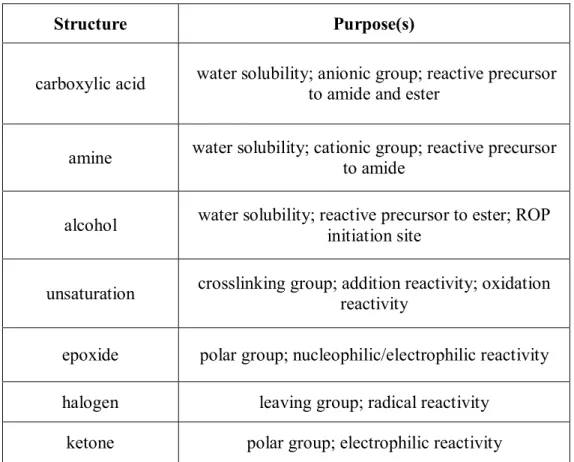
The incorporation of polar functional groups has been studied to expand this set of properties. Several strategies exist to functionalize the end-groups of each polyeseter molecule, but this survey will only be concerned with efforts to include pendant functional groups. Some of the groups that have been incorporated into aliphatic polyester repeat units are listed in Table 1.1 with their intended purposes.
Table 1.1. Structure and intended purpose of functional groups incorporated in aliphatic polyesters
Structure Purpose(s)
carboxylic acid water solubility; anionic group; reactive precursor to amide and ester
amine water solubility; cationic group; reactive precursor to amide
alcohol water solubility; reactive precursor to ester; ROP initiation site
unsaturation crosslinking group; addition reactivity; oxidation reactivity
epoxide polar group; nucleophilic/electrophilic reactivity halogen leaving group; radical reactivity
fluorine polar group; surface energy modification alkyne / azide cycloaddition reactivity
ether polar group
Many different types of monomer syntheses, polymer syntheses, and post-polymerization methodologies have been used to incorporate these pendant functional groups into the repeat units of polyesters. The first method is to form a protected monomer that can be polymerized and then deprotected to yield the functionalized polymer. The second strategy is to form a monomer that contains a functional group that is unreactive during the polymerization event, but that can be transmuted to a more desired functionality. Lastly, there are several examples of the direct incorporation of desired reactive functionalities using specialized polymerization techniques or post-polymerization modifications. In some cases, homopolymers that contain the desired group on each repeat unit can be formed, but often it is sufficient to form a copolymer that contains a few mole percent of the functionality or contains additional orthogonal functional groups.
1.2 Protection-deprotection methodologies
groups is the synthesis of a protected lactone or cyclic diester. This ring monomer can then be reacted in a ring-opening polymerization and subsequently deprotected to yield the desired polymer.
1.2.1 Incorporation of carboxylic acids
One of the first examples of a synthetic polyester containing reactive, polar functionality was the production of poly(β-malic acid) (PMLA) by Lenz and Vert in 1979.10 Their synthetic target was a carboxylate-functionalized polyester that was known to be produced in nature by several microorganisms.11 In order to produce high molecular weight PMLA synthetically, a ring-opening polymerization was conducted on the benzyl ester of β -malolactone (MLABn), as depicted in Scheme 1.1. The monomer synthesis was based on bromosuccinic acid and resulted in the racemic product in three synthetic steps. After base- or acid-promoted ring-opening polymerization to form the ester-protected poly(β-malic acid) (PMLABn) and subsequent catalytic hydrogenation, the neutral polymer or carboxylate polyanion was isolated (PMLA). This polymer degraded rapidly to malic acid12 but could be stored for long periods of time in frozen aqueous solutions.
O
O O O
Ph
ROP
O
O O O
Ph
MLABn PMLABn
H2
Pd/C O
O O OH
PMLA
The partial deprotection of the benzyl ester led to amphiphilic structures13 that were later shown to be blocky in nature due to the use of heterogeneous catalysis in the deprotection step.14 Optically active polyesters were synthesized using a single isomer of aspartic acid as the starting material for the monomer synthesis.15 These studies helped to define the stereochemistry of naturally occurring PMLA, and it was observed that polymers containing either the R or S stereoisomers degraded at the same rate.16 Several studies were undertaken to increase the enantiomeric excess17 and purity18 of the MLABn monomer. By rigorously purifying each intermediate in the monomer synthesis, it was found that PMLABn could be synthesized with number-average molecular weight in excess of 1.5 x 10⁵ g/mol (GPC in dioxane; PS standards).18 Modified monomer syntheses were designed to form other esters of malolactone which could be copolymerized with MLABn, as shown in Table 1.2. These monomers were used to form amphiphilic polymers containing strongly hydrophobic repeat units, biologically active structures, or reactive sites.
Table 1.2. Esters of malolactone studied for copolymerization with PMLABn
O
O O O
R
-OR Reference Notes
methyl ester 17
iso-pentyl ester 17, 19
Cl
O Cl
Cl
O NH Cl
Cl OH
O2N
O 20 antibiotic O 21 H N O O 21 O O
22 biological recognition
O 22 biological recognition
O 22 biological recognition
O 22 biological recognition
cholesteryl ester 22 biological recognition
O
O 22 increase hydrophilicity
O O O 22 crosslinker O O O 6 22
molecular weight of 7.0 x 10⁴ g/mol and polydispersity of 1.6, while the α,α’-dimethyl MLABn was allowed to react under the same conditions and resulted in polyester with number-average molecular weight of 1.7 x 10⁵ g/mol and molecular weight distribution of 1.1. The new lactone could also be synthesized with allyl, sec-butyl, and n-hexyl esters instead of benzyl esters. The hexyl lactone and benzyl lactones were copolymerized randomly or in sequential monomer addition reactions to form polymer micelles.25, 26
O O OBn O Nu O O OBn O desired
ROP Nu O
O BnO O PMLABz Nu O O OBn O H undesired
chain transfer NuH BnO
O O
O
α,α',β-trisubstituted malolactone A
B
Scheme 1.2. (A) Chain transfer to monomer in PMLABn synthesis (B) Structure of α,α ’-dimethyl MLABn
Protected malolactones have also been copolymerized with other lactones and lactides. Poly(β-malic acid-co-ε-caprolactone) was formed using tin octanoate catalyst and was found to have a random structure of repeat units.27 It was also possible to create random copolymers of MLABn and L-lactide using the same catalyst.28, 29 By using an alcohol
were formed.30 Mikto-arm star triblock copolymers of poly(ethylene glycol), poly(ε -caprolactone), and poly(benzyl malolactone) were also formed by the use of a difunctional macroinitiator.31
Figure 1.1. Structures of pendant ester-containing monomers
O O O
O BnO2C
CO2Bn O O O
O
CO2Bn O O O
O
O O
CO2Bn
O O
CO2tBu O
NH O
O
CO2Bn
A B C
E F G O NH O O
CO2Bn
D
CO2Bn
resulting in copolymers whose final compositions correlated poorly to the monomer feed ratios. Other researchers attempted to create materials with fewer carboxylic acid groups by creating a monomer that would result in poly(α-malic acid-alt-glycolic acid).34 This cyclic diester is depicted in Figure 1.1 B, and it was later copolymerized with L-lactide to form copolymers that had good feed/composition fidelity.35 A later report showed the synthesis and polymerization of a glutamic acid based lactide (Figure 1.1, compound C).36 This monomer was successfully incorporated into homopolymers and random copolymers with L
-lactic acid.
A similar strategy was employed in the synthesis of morpholine-2,5-diones derived from amino acids. The resulting polyesters from the ROP of monomers D and E in Figure 1.1 are alternating poly(ester-amides) with pendant benzyl esters.37, 38 The homopolymers were often isolated in low molecular weights with broad PDIs, but copolymerization with L
-lactide often resulted in more controlled reactions.
In 2000, Trollsås, et al., reported the synthesis of a series of functionalized ε -caprolactone monomers, including two that could be deprotected to yield carboxylic acid functionality (Figure 1.1 F & G).39 The benzyl and t-butyl ester functionalized monomers were polymerized, but high molecular weight polymer was difficult to obtain. Upon deprotection of these monomers, a GPC peak shift was noted after ester cleavage, indicating degradation of the main chain as well as the side groups. However, NMR analysis indicated only minimal molecular weight loss.
poly(ester-amide)s that bear benzyl ester side groups.40 Unfortunately, little characterization of the polymer was reported, and the deprotection of the polymer was not described.
Many of the protected monomers that have been discussed suffer from reduced reactivity relative to lactones, glycolide, or lactide. One exemplary monomer based on benzyl-protected glutamic acid has been reported to have very high reactivity, and was in fact slightly more reactive than its lactide counterpart (Scheme 1.3). The synthesis of O-carboxyanhydride activated lactic acid (L-lacOCA) allowed for the production of high molecular weight polyesters in minutes at room temperature using organic catalysts.41 The enhanced reactivity of this 5-membered ring towards opening is attributed to increased enthalpic (ring strain) and entropic (CO2 release) driving forces. This living polymerization was then applied to a benzyl glutamate derivative of the OCA monomer.42 Structural studies indicated that the L-gluOCA monomer had similar ring strain to the L-lacOCA, and thus it was able to polymerize rapidly to high molecular weight (‹Mn› 1.8 x 10⁴ g/mol; PDI 1.18; 90 mins). Block and random copolymers were also synthesized. Kinetic studies of copolymerizations indicated that the consumption of L-gluOCA was only slightly faster than
L-lacOCA, allowing for clean incorporation of desired amounts of each repeat unit at any
O O O R O Nu O O Nu O R O R'OH
Nu O C O
OH R'O
O
R
R = Me;L-lacOCA
R = (CH2)2CO2Bn;L-gluOCA
H2N OH
O BnO2C
1.) NaNO2
2.) Cy2NH
diphosgene PS-DIEA
O O O
O
BnO2C DMAP
ROH
CH2Cl2
r.t. O
H RO
O
CO2Bn
1.) Ac2O
2.) H2
Pd/C O
Ac RO
O
CO2H
Scheme 1.3. (A) Mechanism of OCA ring-opening polymerization (B) Synthesis of L
-gluOCA and poly(glutamic acid ester)
1.2.2 Incorporation of amines
The protection-deprotection strategy was also applied to the synthesis of polyesters with pendant amine functionality. In 1990, the first publication of this sort reported the synthesis of a serine-based lactone whose amines were protected with benzyloxycarbonyl (Z) groups.43 This monomer was polymerized using tetraethylammonium benzoate as initiator to yield polymer with a number-average molecular weight near 9.0 x 10³ g/mol. The low molecular weights were attributed to chain transfer, while the use of a tert-butoxylcarbonyl (Boc) protecting group helped decrease the side reaction. The resulting poly(serine ester) was isolated after acidic deprotection or catalytic hydrogenation, although chromatographic molecular weight determination proved difficult due to poor organic solubility.
molecular weight of 3.0 x 10⁴ g/mol. After deprotection, however, the molecular weight fell to 6.5 x 10³ g/mol, with an increased PDI, indicating ester cleavage.
In 1992, poly(serine ester) was again synthesized, but this time from the step-growth polymerization of an activated ester of N-protected serine.45 First, serine was protected with Z, Boc, p-methoxybenzylcarbonyl or p-nitrobenzylcarbonyl groups. Then the ester was activated with 1-hydroxybenzotriazole using carbodiimide coupling. The yield of this step was 90 %, a considerable advantage over the synthesis of lactone monomers that allowed access to the same polymer repeat unit. Finally, the bulk polymerization of the activated esters yielded protected polyesters with number-average molecular weights up to 2.0 x 10⁴ g/mol with narrow polydispersity (PDI < 1.5).
O O NHR RHN OH O HO ring closing O O RHN ROP poly(serine ester) activate RHN O O HO
N NN
polymerize polymerize
directly
mesyl chloride O
O
NH3 deprotect
R = Z, Boc, trityl, etc
Scheme 1.4. ROP and step-growth routes to poly(serine ester)s
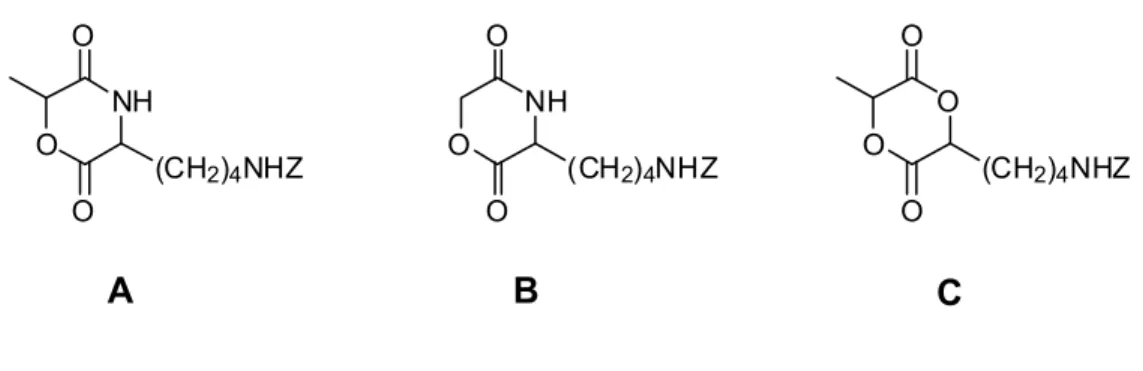
Langer, et al., also reported the synthesis of amine-bearing polyesters, but their methodology relied on incorporation of lysine repeat units.47 A Z-protected amine-containing morpholine-2,5-dione was synthesized in 4 steps (Figure 1.2 A). It was copolymerized with L-lactide using a tin(II) catalyst to yield a polymer with number-average
polymer with a weight-average molecular weight of 9.5 x 10⁴ g/mol and 2.4 mole % of the protected lysine repeat unit was isolated. This synthetic improvement allowed for further studies of the degradation behavior of these materials.
Figure 1.2. Functionalized monomers derived from lysine
NH O
O
(CH2)4NHZ O
NH O
O
(CH2)4NHZ O
O O
O
(CH2)4NHZ O
A B C
A similar strategy was employed by Ouchi, et al., but the resulting repeat unit was poly(lysine-alt-glycolide) instead of poly(lysine-alt-lactide). The monomer shown in Figure 1.2 B was copolymerized with L-lactic acid to yield polymers of modest molecular weights
(‹Mn› 3 – 10 x 103 g/mol), but no degradation was observed after deprotection using HBr/acetic acid to remove the benzoxycarbonyl groups.49 Further reports detailed the synthesis of diblock copolymers of the N-protected morpholine-2,5-dione and L-lactide.50
A similar monomer (Figure 1.2 C) was synthesized and polymerized by Weck, et al. This cyclic diester bore a Z-protected lysine side chain and could be homopolymerized or copolymerized with L-lactic acid.36 In the case of the homopolymer, a fairly low
A few step-growth polymerizations have employed the amine protection-deprotection strategy as well. The first example is based on a monomer derived from hydroxyproline, an uncommon amino acid.51 After Z-protection of the amine, a high temperature AB step-growth polymerization, shown in Scheme 1.5 A, gave the protected polyester in relatively low molecular weight (‹Mn› 5.3 x 10³ g/mol; PDI 1.7; GPC). Deprotection yielded a polymer with a similar molecular weight (Mp 4.6 x 10³ g/mol; MALDI-TOF). To determine the extent of degradation in the deprotection step chromatographically, the polymer was protected again and subjected to subsequent GPC analysis. The results were similar (‹Mn› 6.6 x 10³ g/mol; PDI 1.3), and the difference in the results was attributed to fractionation of the polymer during the work-up. This amine-containing polymer degraded very quickly to a natural product, and was used to study the delivery of DNA. A second study of this polymerization yielded higher molecular weights at room temperature by using 200 mole % of N,N’-dicyclohexylcarbodiimide (DCC) as a coupling agent.52 The protected polymer had a weight-average molecular weight of 7.9 x 10³ g/mol.
N HO
O OH
Z
120 - 180 °C vacuum or DCC/DMAP r.t. N O O O Z O O O NHZ
+ diol O
R O NHZ O O
A
B
The second step-growth polymerization of N-protected monomers was an AA-BB reaction of N-Z-aspartic anhydride and 1,4-cyclohexanedimethanol.53 Protected aspartic acid was allowed to react with excess acetic anhydride to yield the desired amine-containing monomer (Scheme 1.5 B). Upon acid-catalyzed polycondensation with the diol, polymers with moderate molecular weights were isolated (‹Mw› 1 – 5 x 10³ g/mol). To increase the molecular weight and hydrophilicity of the final material, poly(ethylene glycol)s with different molecular weights were also condensed with the protected anhydride.54
N O O
O CF3
Al(OiPr)3
N O
O
O CF3
N H
O O
NaBH4
Scheme 1.6. Amine-containing ε-caprolactone polymerization and deprotection
1.2.3 Incorporation of alcohols
In spite of the success of the previous strategies and the wide scope of known alcohol protecting groups, the first synthesis to apply this methodology to prepare alcohol-functionalized polyesters did not occur until the late 1980’s, with very few publications following until the late 1990’s. This may be attributed to the fact that deprotection conditions required for most alcohol protecting groups require fluorinated reagents, acids, or bases, all of which degrade polyesters. Pitt, et al., reported the synthesis of γ -tert-butyldimethylsiloxy-ε-caprolactone and its copolymerization with ε-caprolactone, δ -valerolactone, and a diester crosslinker monomer (Scheme 1.7).55 The desired elastomers were deprotected using acetic acid, but the removal of the silyl ether groups also led to a drastic decrease in the modulus of the material. In one example, 70 % conversion of the TBDMS deprotection led to a decrease in modulus from 1.62 MPa to 0.56 MPa.
O O
TBDMSO
O O
O O
O O O
O
alcohol functionalized
elastomer 1.) polymerize
2.) deprotect
Scheme 1.7. Synthesis of alcohol functionalized elastomers via silyl ether protecting groups
degraded the polymers, but if the deprotection was conducted using 2 % HF in acetonitrile for only 30 minutes at 20 °C, polymer with 23 mol % of alcohol (82 % conversion from ether to alcohol) was isolated with 6 % molecular weight loss. In the second example, the revealed alcohol groups were used to form ester bonds with carboxylic acid-terminated poly(ethylene glycol)s, resulting in graft copolymers.
Considering the success of the benzyl ester as a protecting group for carboxylic acids, John et al., first used benzyl ethers to mask hydroxyl functionality.58 The morpholine-2,5-dione synthesis began with benzyl-protected serine and afforded the cyclic monomer in only two steps. The polymerization of this monomer, whose structure is shown in Figure 1.3 A, resulted in the benzyl ether functionalized polyester. Upon hydrolytic cleavage (H2; Pd/C), alcohol functionality was revealed. A subsequent step provided polyesters with pendant crosslinkable groups by reaction with acryloyl chloride. The protected monomer could be copolymerized with εCL59 or LLA60 to result in crosslinked networks.
Figure 1.3. Benzyl-protected monomers used as precursors to alcohol functionalized polyesters O O O O OBn O NH O O OBn O O O O OBn O O O OBn O O O OBn O O O OBn O O O
Et CH2OBn
A B C D
Another synthesis that took advantage of the benzyl protecting group was reported for an analogue of MLABn.61 In this case, the side-chain ester was terminated with a benzyl group that would reveal the desired alcohol functionality. This polymer was studied as a neutrally charged analogue for PMLA. After ring-opening the monomer (Figure 1.3 B) for 15 days, polymer with a number-average molecular weight of 4.7 x 10³ g/mol was isolated. After deprotection, a water-soluble polyester was isolated with the same molecular weight. The copolymerization of this monomer was also studied with a few of the malolactone monomers shown in Table 1.2.
Another poly(γ-hydroxy-ε-caprolactone) synthesis was reported using benzyl protection, rather than the previous silyl ether.39 The monomer, shown in Figure 1.3 C, was polymerized and then deprotected using the traditional hydrogenation conditions. Unfortunately, these conditions led to a significant decrease in the molecular weight of the polyesters.
A step-growth polymerization exhibited the efficient polymerization of a protected alcohol containing diester.62 Monomer D in Figure 1.3 was copolymerized with dimethyl succinate and 1,4-butanediol to yield high molecular weight polyesters (‹Mn› 1.5 – 3.1 x 10⁴ g/mol) with high dispersities (PDI 4.4 – 6.4). After deprotection, malic acid-based repeat units were revealed, but at the expense the molecular weight of the original polyesters.
A final example of benzyl protected polyesters was shown in 2006 by Gerhardt.36 In this report, a functionalized lactide (Figure 1.3 G) was homopolymerized or copolymerized with LLA. The resulting polymers were similar to previously described
poly(serine-alt-lactide)s, but in this case it was easier to include higher quantities of the alcohol functionality while still maintaining high molecular weights.
O O O O O O + Al(OiPr)3 O O O O O O O O O O O
CPh3BF4
O O O O OH NaBH4
Scheme 1.8. Polymerization of TOSUO and subsequent post-polymerization reactions to reveal alcohol functionality
Figure 1.4. Ketal- and acetal-functionalized carbonate and lactone monomers
O O
O
O O
O
A B C D
O O O O O O O O R O O O O O O Ph O O O O O OBn O
R = H, Me
The synthesis of isopropylidene-protected monomers was also reported. Chen and Gross synthesized monomer A in Figure 1.4, which was successfully copolymerized with
LLA to form poly(ester carbonate)s.69 These polymers were obtained in very high molecular weights (‹Mn› 7.8 x 10⁴ g/mol; PDI 1.9; 7 mol % A). Upon cleavage of the ketal with trifluoroacetic acid, the alcohol-functionalized copolymer could be isolated. Unfortunately, these conditions degraded the backbone of the poly(ester carbonate), and only partial deprotection was possible. Another example from the same group described the synthesis of a carbonate monomer with orthogonal ketal and benzyl ether protecting groups.70 This monomer (B in Figure 1.4) behaved similar to compound A in copolymerizations with lactide, but deprotection of one or both of the protecting groups was possible without substantial molecular weight loss.
The syntheses of the cyclic diesters in Figure 1.4 C were based on partially protected gluconic acid, and each monomer bore two ketal protecting groups.71, 72 The glycolide- and lactide-based forms of this monomer were synthesized and polymerized, although the glycolide form (R = H) was more successful. Homopolymers could be synthesized to high
macromolecules. It was noted that the deprotection conditions (acetic acid/water/acetone or iodine/acetone/methanol) tended to degrade the polyester backbone while only liberating a fraction of the 1,2-diols. Even still, this polymer was successfully coupled with naphthoyl chloride to form a fluorescently labeled polyester.73
An acetal-based ε-caprolactone (Figure 1.4 D) was synthesized in an effort to improve the previous synthesis of hydroxy-functionalized PCL.39 Removal of the benzylidine protecting group in a single post-polymerization step revealed a 1,3-diol, rather than a single hydroxyl group. Also, the primary alcohols were expected to be more reactive than the secondary alcohols that had been incorporated previously. The homopolymer was synthesized to fairly high molecular weight (‹Mn› 1.2 x 10⁴ g/mol; PDI 1.4), and NMR analysis revealed no degradation after deprotection via catalytic hydrogenolysis.
1.3 Functional group transformation methodologies
Given these aspects of the protection-deprotection methodology, other strategies have been explored that allow simpler monomer syntheses and milder post-polymerization reactions. The next approach relies on the design of monomers whose functional groups are orthogonal to esterification reactions. The key criteria of this approach are that the chosen functional group does not interfere in the polymerization reaction, that the functional group can be transformed into a useful moiety in post-polymerization reactions, and that the conditions of the subsequent reactions do not detrimentally affect the ester bonds of the backbone. Key monomer structures that allow for functional aliphatic polyesters by this methodology include halogens, azides, double bonds, triple bonds and ketones. These groups are unreactive in most ring-opening and step-growth polymerization conditions, but they can be usefully transformed afterwards. The utility of a bromine or chlorine atom as a leaving group for substitution and elimination reactions is immediately obvious, and recent advances in atom transfer radical reactions74, 75 also make the functionality attractive. Unsaturated polyesters can participate in a wide range of addition reactions and can be oxidized to epoxides, alcohols, diols, and carboxylic acids. Azide- and alkyne-bearing polyesters capable of cycloadditions have also been synthesized. Ketone-bearing polyesters have been described in Section 1.2.3, but methodologically distinct post-polymerization addition reactions result in grafted polyesters.
1.3.1 Halogen transformations
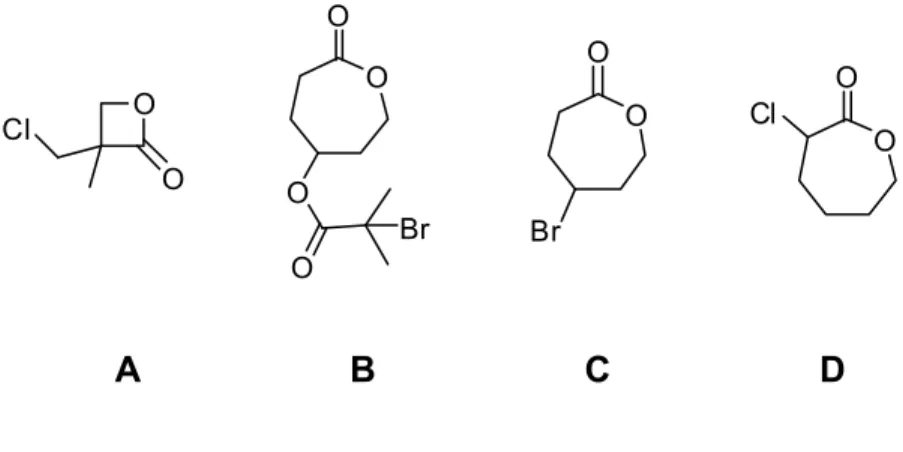
1999, and was based on a chlorine functionalized propiolactone, shown in Figure 1.5 A.76 A highly crystalline homopolymer was isolated, and copolymers with εCL were also produced.77 The subsequent substitution of the primary halide with pyridine was reported to reduce the molecular weight by about 25 %, but this transformation allowed for a more hydrophilic polyester.
Figure 1.5. Halogen-containing lactone monomers
O
O
Cl O
O
Br O
O
O
O
Br
O O Cl
A B C D
complementary ATRP monomer and ROP initiation site.79 Linear copolymers with εCL were subjected to substitution with pyridine or elimination with 1,8-diazabicyclo[5.4.0]undec-7-ene (DBU). In substitution reactions, the resulting quaternary amine-containing polyesters suffered molecular weight loss due to nucleophilic side reactions with the ester groups. After dehydrohalogenation, the resulting acrylate-functionalized polyesters became precursors to crosslinked polyesters.80
A similar monomer, γ-bromo-ε-caprolactone (Figure 1.5 C) was synthesized and studied in living polymerization reactions.81 The homopolymer could be formed in relatively high molecular weights (‹Mn› 1.6 x 10⁴ g/mol; PDI 1.15), or higher molecular weight macromolecules could be produced in copolymerization reactions with εCL. The living nature of these ROP reactions was demonstrated by the use of sequential monomer addition to produce diblock copolyesters. Moreover, the resulting polymers were exposed to the previously discussed post-polymerization reactions with greater success.80 The pyridine substitution could be conducted at lower temperatures, preventing molecular weight loss. The dehydrohalogenation of this polyester led to three isomeric repeat units with double bonds in the α, β or γ positions. Further manipulations of these unsaturated polyesters are discussed in Section 1.3.2.
scope of the ATRA reaction revealed that the success of the reaction depended greatly on the structure of the substrate.83 The grafting of unsaturated carboxylic acids, epoxides, or alcohols often required extended reaction times to proceed to moderate conversion. These conditions resulted in the degradation of the polyester when 3-buten-1-ol was used as the ATRA substrate. Despite this limitation, this strategy was later employed to form heterograft copolymers.84 The chlorine-bearing polyester was first used to graft allylic poly(ethylene glycol), and then the remaining halogens were used to initiate the ATRP of styrene.
1.3.2 Unsaturation transformations
As was previously discussed, unsaturated repeat units of PCL could be obtained by the dehydrohalogenation of poly(γ-bromo-ε-caprolactone). This led researchers to study the synthesis of unsaturated lactones and their polymerizations.80 The mixture of α-, β-, and γ -unsaturated ε-caprolactones (Figure 1.6) was synthesized and polymerized. The degree of reactivity in the polymerization reaction was found to be B > C > A. The chromatographic purification of A was possible, but efforts to separate B and C were unsuccessful. The resultant unsaturated copolymers were oxidized with 3-chloroperbenzoic acid to yield epoxidized polyesters. The acrylic type repeat units that resulted from the incorporation of monomer A were unable to participate in this reaction due to the electron withdrawing character of the ester group.
Figure 1.6. Unsaturated lactones leading to double bonds in the main chain of resultant polyesters
O O
O O
O O
A B C
whose double bonds were not in conjugation with the carbonyl group. This polyester was oxidized to the epoxide, as had been previously demonstrated. Further functionalization of the polymer was possible by nucleophilic ring-opening of the epoxide. The use of a mild thiol nucleophile ensured that degradation of the polyester backbone would not occur. The double bond in lactone B was also exploited to form ester-containing copolymers by ring-opening methathesis polymerization (vide infra).90
A step-growth polymerization allowed for the synthesis of similar unsaturated polyesters from commercially available monomers.91 Polycondensation of trans-β -hydromuconic acid (HMA) with a diol resulted in linear polyesters whose thermal properties could be varied by the choice of diol, as shown in Scheme 1.9. The unsaturation in these polyesters could similarly be oxidized to the epoxide, but no subsequent reaction was reported. Radical curing reactions were reported for liquid, amorphous prepolymers formed from HMA and ether-containing diols.92
HO OH
O
O
HO-R-OH O
R O O
O
Scheme 1.9. Step-growth polymerization of unsaturated polyesters
functionalized by bromination, epoxidation, or hydrosilylation to yield polar, reactive polyesters.
Figure 1.7. Allylic lactones and their derivatives
O O O
O
A B C D
O O O O O O O O 6 O O O O E F
Since they are less reactive, there was no degradation as was previously observed. The resultant polyester was coupled to carboxylic acid-terminated poly(ethylene glycol)s, allowing formation of a hydrophilic graft copolymer.
In order to synthesize an unsaturated polyester that degrades to absorbable byproducts, an allyl-functionalized glycolide monomer (Figure 1.7 D) was prepared.96 The copolymerization of this compound with LLA resulted in unsaturated polyesters that were
oxidized in subsequent steps. In one case, the allyl group was reacted with mCPBA to prepare epoxide functionalized materials without degradation of the polyester backbone. In a second attempt, the polyester was oxidized with OsO4 to the diol, but the group reported degradation of the polyester during the reaction or the work up. This observation is attributed to the idea that lactide or glycolide-type backbones are more susceptible to degradation during post-polymerization reactions than δVL- or εCL- type repeat units.
Poly(hydroxyalkanoate)s with unsaturated side chains have been obtained either from natural fermentation or chemical synthesis. Polymers containing repeat unit E in Figure 1.7 were synthesized by microbial fermentation of undecenoic acid. Once in hand, these high molecular weight polyesters were studied in post-polymerization reactions. The first example was the oxidation of the double bond to a carboxylic acid using OsO4 and Oxone®.97 Quantitative conversion was observed with only a slight decrease in the number average molecular weight. Another oxidation was undertaken using the hydroboration reaction.98 While each unsaturation was converted to a primary alcohol group, chromatographic analysis of the final product was not possible.
The resultant alcohol-functionalized polyester was used as a multifunctional macroinitiator for the ROP of εCL to form brush copolymers.
More reactive double bonds were incorporated by synthesizing acrylate-functionalized polyesters, as described by Mecerreyes, et al., in 2000.100 The structure of the monomer used in these studies, γ-acryloyloxy-ε-caprolactone, is shown in Figure 1.8. Initial studies of ATRP and ROP living polymerizations of this monomer demonstrated the utility of this compound’s orthogonal reactivities. Crosslinking of copolyesters containing the pendant acrylate groups in radical reactions was successful in forming both bulk materials and intramolecularly crosslinked particles.101 PCL copolymers with pendant acrylate groups were also grafted onto metallic surfaces by an electrochemically initiated crosslinking reaction.102 Detailed mechanistic investigations revealed that the two ester groups of the monomer compete in ROP catalyzed by aluminum isopropoxide,103 yet the utility of these polyesters was demonstrated repeatedly. For example, the acrylate groups are strongly reactive to Michael additions by thiols under very mild conditions.104 This monomer was also used to create advanced polymer architectures via intramolecular crosslinking.57, 87
Figure 1.8. Structure of γ-acryloyloxy-ε-caprolactone
O O
O
While all of the previous examples of unsaturated polyesters have focused on double bond containing polymers, there are two examples of propargyl-functionalized polyesters. The first such report came from Emrick, et al., in 2005.105 The monomer, α-propargyl-δ -valerolactone, is similar to the group’s previously described allylic compounds (Figure 1.9 A). This monomer is of interest because of the ability of the propargyl group to participate in mild [3+2] cycloaddition reactions with azides. The homopolymer of A and copolymers with εCL were formed. The subsequent coupling of these alkyne-containing polyesters with
azide-terminated poly(ethylene glycol) and GRGDS oligopeptide sequences allowed for water soluble, biologically active polyesters. The sequential grafting of an azide-modified camptothecin derivative and PEG allowed for the production of water soluble bioconjugates.106
Figure 1.9. Propargyl-functionalized monomers synthesized to study click reactions in polyesters
O O
O O O
A B
O
O O O
O O
C
PDI 1.5), and the coupling of PEG and long alkyl chains allowed for the formation of degradable, thermally-responsive polymers exhibiting lower critical solution temperatures.
Functionalized trimethylene carbonate monomers are often employed because they are relatively simple to synthesize, and they copolymerize well with lactides (Section 1.2.3). An alkyne-containing carbonate monomer (Figure 1.9 C) was synthesized and copolymerized with LLA. The resulting poly(ester-carbonate)s had up to 20 mol % of the functional repeat
units, and had molecular weights around 1.0 x 10⁴ g/mol.108 The resulting polymers were grafted with azide-modified saccharides108 and proteins,109 allowing these bioconjugates to specifically bind to lectins and antibodies, respectively.
1.3.3 Ketone transformations
The final functional group that has been incorporated into monomers to allow for selective post-polymerization reactions is the ketone. The first ketone-containing polyester was derived from a ketal-containing monomer.64-66 The goal of these syntheses was to obtain alcohol-functionalized polyesters, and this methodology has been addressed in Section 1.2.3 (also see Scheme 1.8). The reports that address the ketone functionality with respect to addition reactions are reviewed here.
O O O O O O O O O
+εCL
1.) polymerize 2.) deprotect
O O
+εCL
1.) polymerize O
R O NH2
O O N O O O R
Scheme 1.10. Synthesis of ketone-containing polyesters and subsequent functionalization reactions
polyesters were also coupled with hydrazines to yield polyesters bearing pendant primary alcohols.114
The study of monomers that contain functional groups whose reactivity is orthogonal to polymerization conditions has advanced the scope of functional aliphatic polyesters significantly. Instead of relying on post-polymerization deprotection steps, these strategies exploit a wide scope of mild, selective functionalization reactions, including substitution, elimination, addition, oxidation, pericyclic reactions, and radical reactions. These monomers often can be formed into homopolymers, or can be copolymerized cleanly with simple aliphatic monomers. In some cases, a series of two or more post-polymerization reactions are required to obtain polyesters that contain the most desirable reactive functional groups (namely carboxylic acids, alcohols, amines or biological functionality).
1.4 Direct functionalization methodologies
1.4.1 Ester-forming reactions
The first example of an aliphatic polyester that contained a polar functional group was poly(1,4-dioxan-2-one). The monomer (Figure 1.10 A) contains the unreactive ether group, which is well-tolerated in polymerization reactions. The increased polarity of the resulting repeat units imparts unique solubility and thermal properties to these polyesters. The polymer first appeared in the patent literature115-117 as a material that could increase the hydrophilicity of degradable sutures relative to other polyesters.118-120 Further research into different initiator systems,121 block copolymer synthesis,122 and the polymerization mechanism123 further elucidated the properties of this polyester.
outer PDXO blocks. Shorter blocks of PDXO degraded more slowly, as in the case of the random and multiblock copolymers, although their degradation was much faster than PCL. The synthesis of copolymers containing 4-methyl-1,5-dioxepan-2-one (Figure 1.10 C) repeat units also led to polyesters that degraded more quickly than the parent materials.136, 137
Figure 1.10. Cyclic monomers employed in the synthesis of ether-containing polyesters
O O O
O O O
O O O
O O
O O
O
A B C
D E
O
O
As previously mentioned, trans-β-hydromuconic acid can be condensed with a variety of diols to form aliphatic polyesters (Scheme 1.9).91 The inclusion of ether-containing glycols in the step-growth polymerization allowed for amorphous poly(ester-ether)s that exhibited low glass transition temperatures. These liquid polymers could be formed into shape-specific elastomers with very short degradation times and mechanical properties on par with soft tissues.92
functionality in polyesters is to synthesize a polyester grafted with polyethylene glycol. An early example of this strategy made use of an epoxide-terminated PEG (Figure 1.10 D) that was copolymerized with LLA.138 Later examples examined the synthesis of a
lactone-terminated PEG (Figure 1.10 E) designed to have a similar degree of reactivity with εCL in polyesterification reactions.139, 140
OH OH OH OH OH OH TrCl Pyridine OTr OH OH OH OH OTr MeI NaOH OTr O O O O OTr TSA MeOH OH O O O O OH (COCl)2 DMSO O O O O O O H H Jones O O O O O O OH HO SOCl2
CH2Cl2
O O O O O O Cl Cl Shvo's catalyst Na2CO3
CHCl3 O O OMe MeO MeO MeO A A B A C
Scheme 1.11. Permethoxylated monomers synthesized for step-growth and chain-growth polymerization
step-growth polymerization of A and B and living ring-opening polymerization of C. The resultant polyesters showed very good resistance to fibrinogen and lysozyme binding, demonstrating that protein absorption can be reduced by increasing the hydrophilicity.141, 142
This body of literature shows that ether functionality can be incorporated easily into polyester backbones and side chains. While this group can impart drastic changes in the polymer solubility and thermal properties, the incorporation of reactive functional groups is a more substantial challenge. In order to accomplish this task, new polymerization reactions were needed that could produce linear aliphatic polyesters from multifunctional monomers. Specialized catalysts and monomer substrates have allowed the implementation of this strategy, although these methods have yet to be robustly developed.
O O HO OH
O O
OH
lipase
O O
O
4
O
OH x
x = 1,2 or 4
x
4 + OH
O (g)
Scheme 1.12. Enzymatic polymerization employed to produce linear, alcohol-functionalized polyesters in a single step
with weight-average molecular weights from 3,000 to 14,000 g/mol. Divinyl esters were chosen to allow for the facile removal of the condensate at the low reaction temperatures used. The selectivity of the enzyme was high, although esterification of some of the secondary alcohols was observed, leading to polydispersity indices between 2.2 and 3.1.
This approach was expanded to include sugar-based polyols. Sorbitol was condensed with divinyl sebacate using lipase catalysis to form linear polyesters with a high degree of alcohol functionality on each repeat unit.144 The final polymer was isolated in relatively high molecular weight with a controlled distribution, although it was isolated in moderate yields. (‹Mn› 9.8 x 10³ g/mol; PDI 2.1; 64 % yield)
Figure 1.11. Polyol monomers incorporated into functional polyesters by enzymatic polymerizations H OH HO H H OH H OH HO OH
sorbitol erythritol xylitol
HO H HO H H OH H OH HO OH H OH H OH HO OH H OH HO H HO H H OH HO OH mannitol galactitol H OH HO H H OH HO OH ribitol H OH H OH H OH HO OH
By varying the ratio of polyol to octanediol in copolymerization reactions, very high molecular weight polyesters with a controlled amount of alcohol functionality could be isolated in high yields. Other sugar-based polyols were also incorporated into the polyesters, and it was found that the stereochemistry of the secondary alcohols had a pronounced effect on the final molecular weight of the polyesters.148 Unfortunately, no clear correlations between the polyol monomers used (Figure 1.11) and final molecular weights could be deduced.
A similar enzymatic polymerization was used to produce polyesters bearing carboxylic acid groups.149 In this case, bis(hydroxymethyl)butyric acid allowed for the formation of copolymers with a limited amount of carboxylic acid functionality. The reactivity of this diol was poor, and therefore homopolymerizations were not reported. An copolymer derived from adipic acid and an equimolar mixture of bis(hydroxymethyl)butyric acid and 1,8-octanediol had a number-average molecular weight of only 1.2 x 10³ g/mol.
HO OH O R1 R2 O HO OH R3
R1, R2= H or OH
n
n = 1, 4, 7, or 9 R3= H or OH
Sc(OTf)3 bulk 60 - 80 °C
O O O R1 R2 O R3 n
Scheme 1.13. Synthesis of linear polyesters having hydroxyl groups via selective Lewis acid catalysis
While these techniques allow the formation of functional linear polyesters in a single step in high molecular weight, the scope of these methodologies is quite narrow. The results of any given reaction are highly substrate dependant and require expensive catalysts and stringent reaction conditions.
1.4.2 Ester-containing monomers
In order to form degradable functional polyesters directly in a single step, the synthesis and polymerization of ester-containing monomers has been investigated. Conjugate additions, radical ring-opening polymerizations, and metathesis reactions are all tolerant of a variety of functional groups, including esters, and each has been used to this end.
polyamide research, and the polyester work lay dormant for many years, despite the fact that this attractive step-growth polymerization takes place under mild heating without catalyst and without generating any reaction byproducts.
O
O O
O
HN NH O O N
O
O
N
Scheme 1.14. Conjugate addition reaction used to synthesize amine-containing aliphatic polyester in a single step
Figure 1.12. Amine-containing polyesters by conjugate addition
O
O O
O
N N O O
O
O
N N
O
O O
O
N N
One of the primary disadvantages of this reaction was the small number of commercially available secondary diamines that could be incorporated, which inherently limited the diversity of structures that could be studied. The conjugate addition polymerization strategy was expanded to include primary amines, which greatly increased the types of functional groups that could be included in aliphatic polyesters.155, 156 A library of 140 polymers was synthesized in parallel by reacting each diacrylate and amine comination in methylene chloride at 45 °C for 5 days. Later, this synthesis was expanded to a library of 94 amines and 25 diacrylates (2350 unique polymers), including those containing with ether, alcohol, siloxane, thio-ether, amide, heterocyclic, and fluorinated alkane groups.157
polymerizations in bulk at 100 °C for 5 h, polymers were isolated with weight-average molecular weights between 4 – 18 x 103 g/mol and either acrylate or amine end groups. It was found that materials with acrylate end groups were ineffective in transfection experiments, and that the materials with the highest molecular weight performed the best. One of these polymers, C32, was further studied as a transfection agent in vivo (Scheme 1.15).159 The end groups of C32 were varied by first synthesizing an acrylate-terminated polymer, and then reacting it with excess amines.160, 161 Again, it was found that the structure of the end groups had a pronounced effect; those with hydrophobic spacers terminated in primary amines or alcohols worked best.
O(CH2)4O O
H2N OH
bulk
90 °C O(CH2)4O
O
N
HO
O
O(CH2)4O O O
O
O(CH2)4O O
N
HO
O
O(CH2)4O O O
excess HNR1R2
N N R1
R2 R1
R2
C32
Scheme 1.15. Synthesis of poly(β-amino ester) C32 with a variety of end groups
competing side reaction to ring-opening. In order to reduce the amount of ring addition, monomers that stabilize the propagating radical at a secondary or benzylic carbon were synthesized and copolymerized with styrene, 4-vinyl anisole, methyl methacrylate, vinyl acetate, and 4-vinyl pyridine.163-165 Later reports have shown that MDO can form copolymers with vinyl phosphonic acid,166 dimethyl vinylphosphonate,166 N-vinylpyrrolidinone,167 methyl acrylate,168 N-isopropylacrylamide,169 diacrylamides,169 and vinyl monomers with fluorinated side chains.170 The main drawback of this strategy is that MDO is generally much less reactive in free-radical polymerizations than other monomers, resulting in difficulty controlling the repeat unit composition and distribution. Despite this disadvantage, this method has allowed the single-step synthesis of degradable polymers that contain a wide range of functional groups.
HO OH O O
Cl O O Cl KOH O O O O R O O R isomerization ring addition M O O R R O O M R O O etc. etc. R O O MDO PCL +
Another acetal monomer that can participate in radical ring-opening polymerization contains a vinylcyclopropane group.171-174 The resulting polymer structure is likewise dependant on the size of the ring; monomers containing five- or six-membered acetals result in ring addition polymers, while seven-membered rings result primarily in unsaturated polyesters from ring opening (Scheme 1.17). Again, the use of alkyl or aryl side chains to create a more stable propagating radical enhanced the degree of ring-opening.175
O O R
O O R
O O R
n = 1, 2 n = 3
O O
n
O O
n
n n n
Scheme 1.17. Radical ROP of vinylcyclopropane cyclic acetal monomers
negative neighboring group effect, which hypothesized that either the olefin is polarized by the ester group, or that the carbonyl comes in close proximity to the metal, which allows Lewis acid coordination and deactivation of the catalyst.
O O
O O
+ C2H4 catalyst
O
O catalyst
no polymer formation
Scheme 1.18. ADMET of ester-containing dienes to form unsaturated polyesters
Later mechanistic studies hypothesized that high molecular weight polymers formed by ADMET of ester-containing dienes could undergo cyclodepolymerization to form oligomers and macrocylic oligomers.178, 179 By conducting these reactions at high concentrations, linear polymers were favored over cyclic oligomers by an entropy-driven ring-opening polymerization.
In order to form polymers with a variety of structural groups, chiral unsaturated poly(ester-co-amide)s with isopropyl or isobutyl side groups were synthesized by ADMET.180 Again, the negative neighboring group effect was observed, but monomers with a sufficient number of methylene spacers between the ester or amide groups and the olefin were successfully polymerized to high molecular weights.
molecular weight segmented multiblock copolymer.181 The final number-average molecular weight of the copolymer was 2.4 x 10⁴ g/mol; PDI 1.4. However, the aliphatic polyester hard segment had inferior thermal properties to polycarbonate or aromatic polyester based materials.
Metathesis reactions were crucial in the preparation of mechanically interlocked polymers.182 Initial steps formed a mechanically interlocked dimer by ring-closing methathesis. Terminal alcohol groups on these “daisy-chain” type molecules were transformed to esters with 4-pentenoic acid, resulting in terminal dienes. The high functional group tolerance of the ADMET process allowed these interlocked monomers to be condensed into polyesters with a very unique structure.
One final example of the use of metathesis polymerization relies on ring-opening of a previously discussed unsaturated ε-caprolactone, shown in Figure 1.6 B.90 This monomer was polymerized by ROMP to a number-average molecular weight of 6.0 x 10⁴ g/mol; PDI 2.1. The monomer could also participate in copolymerizations with norbornene, 1-cyclooctaene, and 1,5-cyclooctadiene.
1.4.3 Direct modifications
Given the sometimes narrow scope of functional monomer techniques, researchers have turned to more robust methods for easily functionalizing polyesters, especially modifying the surface properties of polyesters. Several procedures have been developed that rely on the irradiation of a polymer to induce surface reactions or crosslinking. Often the irradiation is conducted in the presence of a small molecule or vinyl monomer, which results in a functionalized surface or graft copolymer. Several combinations of irradiation techniques and small molecule grafting partners have been demonstrated, and a few noteworthy examples are discussed.
Gamma rays have been used to grow polystyrene from poly(3-hydroxybutyrate) and poly(3-hydroxyvalerate) surfaces.183 Polylactide184, 185 and PLGA186 have been exposed to microwave ammonia plasma to generate amide and amine-functionalized surfaces. PLLA was exposed to hydrogen peroxide solutions under UV light to generate radical macroinitiation sites, after which the surface was exposed to hydroxyethyl methacrylate, methacrylic acid, or acrylamide to form functional surfaces.187 Gas plasma has also been used to modify the surface roughness of PDLLA.188 Crosslinking has been accomplished by exposure of PLA to gamma rays189 or e-beam.190 Electron beam techniques have also been used to form a poly(acrylic acid)-grafted PCL copolymer which was later studied in cell culturing experiments.191
surface modification was described in which PLLA can be grafted with acrylamide, maleic anhydride, or N-vinyl pyrrolidinone in a single step. Briefly, the polymer was exposed to the vapor of the desired monomer and benzophenone, and the entire system was exposed to UV light.192, 193 GPC analysis was conducted both on polymers exposed to these conditions and to e-beam methods,191 and it was found that the monomer vapor technique degraded the polymer to a lesser extent. Later studies showed that PLLA or PCL could be successfully modified this way to create surfaces favorable for incubation of mesenchymal stem cells.194
advance with a halogen end group. Upon formation of the carbanionic PCL, the polyamide chains were grafted onto the main chain by substitution reactions. Alternatively, the poly(enolate) could be formed, and each nucleophilic site acted as an initiator for the activated lysine monomer to form a poly(N-Z-lysine) chain.
Scheme 1.19. Synthesis of graft polymers by poly(enolate) formation
These direct modification procedures are attractive because they use commercially-available polymers and are able to vastly change the properties of these degradable materials. These technologies are not yet broadly applicable, but are especially attractive for surface modifications.
1.5 Conclusions
The utility of aliphatic polyesters like PLA, PGA, and PCL comes from their biological compatibility and degradability. Since these materials are inherently limited in their thermal, mechanical, and solubility properties, prolific research has been conducted to modify these properties by forming the corresponding functional polymers. The drive to increase the hydrophilicity of the polymers and to include sites for grafting useful small
O O LDA T HF O O NH O O O H N Z n
PCL-g-P-N-Z -Lys H
N Br
O
(CH2)4NHZ O
PCL-g-P-N-Z -Lys
molecules has yielded materials with reactive carboxylic acids, amines, and alcohols. These have been largely derived from monomers containing protected functional groups. Other functional groups that have been exploited include halogens, azides, olefins, alkynes, and ketones; these groups have the distinct advantage of not requiring a deprotection step after the polymerization reaction, although their transformation to a more desired functionality can require multiple steps. Other advanced techniques have sought to incorporate the desired functional groups into the polyester in a single step. Examples of ester-forming polymerizations or ester-containing monomers polymerized by other bond-forming techniques have allowed for the controlled synthesis of functional polymers in one step. Several techniques for the direct modification of aliphatic polyesters have been demonstrated, although control of these reactions can often be a limiting factor.
1.6 Dissertation Organization
the dissertation with a discussion of the research and its possible future directions. Supplemental data, including spectra, chromatograms, and thermal characterization, are included in the appendices. Chapter two has been published in Macromolecules,197 and chapters three and four will be submitted for publication in peer-reviewed journals.
1.7 References
1.) Baptist, J. N.; Ziegler, J. B. U.S. Patent 3,225,766, 1965. 2.) Schmitt, E. E.; Polistina, R. A. U.S. Patent 3,297,033, 1967. 3.) Schneider, A. K. U.S. Patent 3,636,956, 1972.
4.) Uhrich, K. E.; Cannizzaro, S. M.; Langer, R. S.; Shakesheff, K. M. Chem. Rev. 1999,
99, 3181-3198.
5.) Duncan, R. Nat. Rev. Drug Discovery 2003, 2, 347-360.
6.) Upton, C. E.; Kelly, C. A.; Shakesheff, K. M.; Howdle, S. M. Polym. Int. 2007, 56, 1457-1460.
7.) Amsden, B. Soft Matter 2007, 3, 1335-1348.
8.) Domb, A. J. Polym. Prepr. (Am. Chem. Soc., Div. Polym. Chem.) 2007, 48, 640-641. 9.) Li, S. J. Biomed. Mater. Res., Part B 1999, 48, 342-353.
10.) Vert, M.; Lenz, R. W. Polym. Prepr. (Am. Chem. Soc., Div. Polym. Chem.) 1979, 20, 608-611.
11.) Coulembier, O.; Degée, P.; Hedrick, J. L.; Dubois, P. Prog. Polym. Sci. 2006, 31, 723-747.
12.) Braud, C.; Bunel, C.; Vert, M. Polym. Bull. 1985, 13, 293-299.
13.) Braud, C.; Bunel, C.; Garreau, H.; Vert, M. Polym. Bull. 1983, 9, 198-203. 14.) Caron, A.; Braud, C.; Bunel, C.; Vert, M. Polymer 1990, 31, 1797-1802. 15.) Guérin, P.; Vert, M.; Braud, C.; Lenz, R. Polym. Bull. 1985, 14, 187-192.
17.) Cammas, S.; Renard, I.; Boutault, K.; Guérin, P. Tetrahedron: Asymmetry 1993, 4, 1925-1930.
18.) Cammas, S.; Renard, I.; Langlois, V.; Guérin, P. Polymer 1996, 37, 4215-4220. 19.) Boutault, K.; Cammas, S.; Huet, F.; Guérin, P. Macromolecules 1995, 28,
3516-3520.
20.) Leboucher-Durand, M.; Langlois, V.; Guérin, P. Polym. Bull. 1996, 36, 35-41. 21.) Moine, L.; Cammas, S.; Amiel, C.; Guérin, P.; Sebille, B. Polymer 1997, 38,
3121-3127.
22.) Bizzarri, R.; Chiellini, F.; Solaro, R.; Chiellini, E.; Cammas-Marion, S.; Guérin, P. Macromolecules 2002, 35, 1215-1223.
23.) Barbaud, C.; Guerrouache, M.; Guérin, P. Tetrahedron Lett. 2002, 43, 9513-9515. 24.) Barbaud, C.; Faÿ, F.; Abdillah, F.; Randriamahefa, S.; Guérin, P. Macromol. Chem.
Phys. 2004, 205, 199-207.
25.) Ouhib, F.; Randriamahefa, S.; Guérin, P.; Barbaud, C. Des. Monomers Polym. 2005,
8, 25-35.
26.) Ouhib, F.; Randriamahefa, S.; Wintgens, V.; Guérin, P.; Barbaud, C. Macromol. Biosci. 2005, 5, 299-305.
27.) He, B.; Chan-Park, M. B. Macromolecules 2005, 38, 8227-8234. 28.) He, B.; Bei, J.; Wang, S. Polymer 2003, 44, 989-994.
29.) He, B.; Wan, Y.; Bei, J.; Wang, S. Biomaterials 2004, 25, 5239-5247.
30.) Coulembier, O.; Degee, P.; Cammas-Marion, S.; Guerin, P.; Dubois, P. Macromolecules 2002, 35, 9896-9903.
31.) Rieger, J.; Coulembier, O.; Dubois, P.; Bernaerts, K. V.; DuPrez, F. E.; Jérôme, R.; Jérôme, C. Macromolecules 2005, 38, 10650-10657.
32.) Fujino, T.; Ouchi, T. Polym. Prepr. Jpn. 1985, 35, 2330.
33.) Ouchi, T.; Fujino, A. Macromol. Chem. Phys. 1989, 190, 1523-1530.
34.) Kimura, Y.; Shirotani, K.; Yamane, H.; Kitao, T. Macromolecules 1988, 21, 3338-3340.