c
Journal “Algebra and Discrete Mathematics”
On the generators of the kernels
of hyperbolic group presentations
Vladimir Chaynikov
Communicated by A. Yu. Olshanskii
A b s t r a c t . In this paper we prove that ifRis a (not
nec-essarily finite) set of words satisfying certain small cancellation condition in a hyperbolic groupGthen the normal closure ofRis free. This result was first presented (for finite setR) by T. Delzant [Delz] but the proof seems to require some additional argument. New applications of this theorem are provided.
1. Introduction
In the founding paper [Gro] M. Gromov defined the notion of hyperbolic groups and outlined a number of research directions in this (now well established) area. In particular, one finds the following Statement 5.3E in [Gro]:
There exists a constant m=m(k, δ) such that for every k hyperbolic elements x1, . . . , xk in a word δ–hyperbolic group G the normal subgroup
generated by xm1 1 , . . . , x
mk
k is free for all mi ≥m.
Although not correct in full generality (as a counter-example in the appendix to [Delz] shows) the following theorems are true:
Theorem 1.1 (Delzant [Delz], Theoreme I). Let G be a non-elementary hyperbolic group. There exists an integer N such that for any elements f1, . . . , fn such that [[fi]] = [[fj]] ≥ 1000δ (where [[f]] = limn→∞|f
n|
n ),
the normal subgroup N(fkN
1 , . . . , fnkN) is free for every k. Moreover, (for
every k) the group G/N(fkN
1 , . . . , fnkN) is hyperbolic.
The author is grateful to Aleksander Olshanskii for his guidance and many valuable suggestions and to Denis Osin for his comments.
The Theorem 1.1 is obtained in [Delz] from Theorem 1.2 by arguing that for sufficiently large N (independent of choice fi) the system of relationsfN
1 , . . . , fnN can be completed to that satisfying small cancellation
C′(µ) (see definition 2.9).
Theorem 1.2 (Delzant [Delz], Theoreme II). Let R be a finite set of elements satisfying the the small cancellation condition C′(µ). A normal
subgroupN(R)generated byRis free. The quotientG/N(R)is hyperbolic.
However we think that the proof of Theorem 1.2 requires some addi-tional arguments. To be more precise, the proof of the Theorem 2.1 (iii) [Delz] pp 677-678 (stating that if a (finite) system Rsatisfies condition
C′(µ), µ <1/8 then the normal subgroupN(R) generated by Ris free) is incomplete. We provide a proof of essentially the same fact in somewhat different setting (in particular, the set Rcan be infinite) using both tech-niques of Delzant (such as Lemmas 2.11, 2.15) and diagram techtech-niques of A. Olshanskii from [Olsh], [Olsh93]. We would like to note that the Lemma 5.10 of this paper provides justification for the formula on top of page 678 of [Delz]. One may replace Theorem 1.2 with the following statement:
Theorem 1.3. There exists µ0>0 such that for anyµ < µ0 there are ǫ
andρsuch that ifRis a set of geodesic words satisfyingC˜(ǫ, µ, ρ–condition (see Definition 3.9) in the hyperbolic group G then:
(i) the normal subgroup N =N(R) is free;
(ii) if G is non-elementary and R is finite then G/N(R) is non-elementary hyperbolic.
As a corollary we get:
Theorem 1.4. LetGbe a non-elementary hyperbolic group. For any finite set of elementsx1, . . . , xm there exists an integer N such that the normal
closureN =N(xs1N
1 , . . . , xsmmN) in G of elementsxs11N, . . . , xsmmN is free
for any integersi>0 and the quotientG/N is non-elementary hyperbolic.
Let us note that in our result 1.4, the choice of constant N depends on the elements x1, . . . , xm rather then being an absolute constant as in Theorem 1.1. On the other hand we do not assume any significant restrictions on the set of elementsx1, . . . , xm.
The following corollary somewhat strengthens the theorem proved by T. Delzant and A. Olshanskii independently (see [Delz], [Olsh95]) stating that every non-elementary hyperbolic group is SQ–universal.
Corollary 1.5. Let Gbe a hyperbolic group. Then:
In conclusion we would like to mention the following
Open problem ([Kour], 15.69).Does every hyperbolic group G have a free normal subgroup N such that the quotient G/N is a torsion group of bounded exponent?
The above problem is motivated by the result of Ivanov and Olshanskii [IvOl] stating that for every non-elementary hyperbolic group Gthere is a number n=n(G) such that the quotient group G/Gn is infinite.
2. Hyperbolic spaces and hyperbolic groups
Hyperbolic Spaces. We recall some definitions and properties from the founding article of Gromov [Gro]. Let (X,| |) be a metric space. We sometimes denote the distance |x−y|between x, y∈X byd(x, y). We assume thatX is geodesic, i.e. every two points can be connected by a geodesic line. We refer to a geodesic between some point x, y of X as [x, y]. For convenience we denote|x|distance|x−y0|to some fixed point
y0 (usually the identity element of the group).
For a path γ in X we denote the initial (terminal) vertex of γ by
γ− (γ+), denote by kγk the length of path γ and by |γ| the distance
|γ+−γ−|. Recall that if0< λ≤1andc≥0then a pathγ inX is called (λ, c)–quasigeodesic if for every subpath γ1 ofγ the following inequality is
satisfied:
kγ1k ≤ λ1|γ1|+c.
We call the path γ geodesic up to c, if it is(1, c)-quasigeodesic. Define a scalar (Gromov) product of x, ywith respect to zby formula
hx, yiz =
1
2(|x−z|+|y−z| − |x−y|).
We call the spaceX δ–hyperbolic if there exists a non-negative integer
δ such that the following inequality holds:
∀x, y, z, t∈X, hx, yiz≥min(hx, tiz,hy, tiz)−δ.
We will need a few properties of hyperbolic groups and Gromov prod-ucts:
Lemma 2.1 ([Delz], Lemma 1.3.3). Let K be a nonnegative real number,
[x, y] and [x′, y′] – two segments in aδ–hyperbolic space of length at least
2K+ 20δ and suppose that |x−x′| ≤K, |y−y′| ≤K. Choose pointsu andv on [x, y]at distance K+ 2δ from x andy respectively. Then every point P on [u, v]is in the 6δ-neighborhood of the segment [x′, y′].
We will use the following easy remark.
Remark 2.3. LetX be a hyperbolic space. Then:
(i) In the notations of Lemma 2.1 it is immediate that the segment [x, y]is withinK+ 2δ+ 6δ–neighborhood of [x′, y′].
(ii) Suppose γ is a path, geodesic up to somec≥0in X, and ois an arbitrary point onγ. Then
hγ−, γ+io≤c/2. (1)
Combining the previous inequality with Lemma 2.2 we get that:
d(o,[γ−, γ+])−δ≤c/2. (2)
We recall the notion of the metric tree T ([Ghys], Chapter 2, §1). LetT′ be a tree (i.e. graph without cycles), we construct the geometric realization T in the following way. For every edge a of T′ we choose a real positive numberl(a). Then there exists a unique (up to isometry) metricdonT maximal with respect to the following condition: edgeais isometric to interval[0, l(a)]on the real line. Then T with the metric dis a metric tree.
Various versions of the following Gromov’s theorem provide an ap-proximation of a finite set of geodesics in hyperbolic space by metric trees:
Theorem 2.4 ([Ghys], Chapter 2, Theorem 12). LetF be aδ-hyperbolic metric space. Suppose that F = ∪n
i=1Fi, where each Fi = [w, wi] is a
geodesic and n≤2k.
Then there exists a metric tree T and functionΦ :F →T such that (i)|[Φ(x),Φ(w)]|=|[x, w]|, ∀x∈F;
(ii)|x−y| −2(k+ 1)δ≤ |Φ(x)−Φ(y)| ≤ |x−y| for all x, y∈F.
It is clear that if xis some vertex in a metric graph T in the theorem above then either
(i) there exist some indexes i, j such that the images of Fi and Fj underΦdepart at x:Φ([w, wi])∩Φ([w, wj]) = [Φ(w), x](in this case we call vertexx a branching point), or
(ii) there exists some index i such that Φ(wi) = x or Φ(w) = x. In this case we callx a leaf (because it is adjacent to a single vertex).
When we talk about an approximation tree for a set of vertices
w, w1, . . . , wn in the hyperbolic space X, we mean an approximation of the setF =∪n
i=1Fi in the sense of the previous theorem.
By a tripod we mean a metric tree with one branching point (center
Remark 2.5 ([Ghys] Chapter 2, §1). Let x, y, z be some points in a
δ–hyperbolic spaceX, and o1 be a point on [x, y]at distances≤ hy, zix from x, o2 be on[x, z] at distancesfrom x. Then there exists a tripod T
and a mapΦ : [x, y]∪[x, z]−→T such that:
(i) a restriction of the mapΦon each segment[x, y],[x, z]is an isometry which sends x, y, z to different ends of pods ofT and Φ(o1) = Φ(o2);
(ii) Φ, T satisfies the previous theorem.
Hyperbolic Groups. Let G be a finitely presented group with pre-sentation gp(S|D). We considerGas a metric space with respect to the distance function |g−h|=
gh−1
for every g andh. We denote by |g| the length of a minimal (geodesic) word with respect to the generators S
equal tog. The notation hg, hiis the Gromov producthg, hie with respect to the identity vertex1.
We denote the (right) Cayley graph of the group by Cay(G). Graph
Cay(G) has a set of verticesG, and a pair of vertices g1, g2 is connected
by an edge of length 1 labeled by s if and only if g1−1g2 = s in G for
somes∈S±1. We define a label function on paths in Cay(G). By a path in Cay(G) we mean a path p = p1. . . pn, where pi is an edge between somegi, gi+1 for every 1≤i≤n. We can define a labellab(p)(a word in
alphabetS±1) by:
lab(p) =lab(p1). . . lab(pn).
It is clear thatCay(G)may be considered as a geodesic space: we may identify every edge ofCay(G) with interval [0,1]and choose a maximal metric dwhich agrees with metric on every edge.
We have assigned a unique word lab(p) to the path pinCay(G). On the other hand for every wordwin alphabetS±1there exists a unique path
p inCay(G) starting from the identity vertex with label w. Hence there is a one-to-one correspondence between paths with initial vertex1 (the identity vertex inG) and words in alphabetS±1, so we will not distinguish between a word in the alphabetS±1 and it’s image inCay(G) – a path
starting from the identity vertex. Thus, when considering some words
X, Y, Z in the alphabetS±1, we can talk about the pathγ =XY Z in the
Cayley graph ofGoriginating in the identity vertex 1. To distinguish a pathY with initial vertex1from the subpath ofγ with labelY we denote the latter as γY (similar notations will be used for paths in van Kampen diagrams, see Section 3). We will talk about values|X|,kXk for a word
X in alphabet overS±1 meaning these values on corresponding paths in
Cay(G).
A group Gis calledδ-hyperbolic for someδ ≥0, if it’s Cayley graph is
In this section we recall some definitions and lemmas from [Delz], but with certain modifications. We would like to formulate all the statements in the language of (geodesic) and cyclically reduced words rather then group elements and cyclically reduced group elements (elementg of the groupGis calleda cyclically reduced element if ghas a minimal length in it’s conjugacy class in G). The proofs of these lemmas can be repeated while changing the terminology.
We first recall the following lemmas:
Lemma 2.6 ([Delz], Lemma 1.2.1). Let V, W be geodesic words in G; their scalar product is an integer or 12 times integer. If V ≡AB such that |A|= [hV, Wi1] and C is defined by equality AC =W in G then the path
AC is geodesic up to constant 2δ (we denote by [x] a maximal integer smaller or equal to x).
Lemma 2.7 ([Delz] Lemma 1.5.1). Let V be a geodesic word in Gwhich is shortest in it’s conjugacy class and of length no less then 20δ. Assume that W is conjugate to V. Then there exists a geodesic word U and a cyclic conjugate V′ ofV such thatW =U V′U−1 and the pathU V′U−1
is geodesic up to 10δ.
Let us mention the following property of metric trees with finite number of vertices. If a metric tree T is a union ofn segments∪n
i=1[l0, li] originating from a fixed vertexw0, it is easy to see that an addition of a
new segment[l0, ln+1]toT can increase the number of edges by at most 2.
To be more precise we can prove by induction on nthat |E(T)| ≤2n−1, whereE(T) is a set of edges in T.
The proposition below provides a "pull-back" of the tree approximation
T for the setF in the situation of Theorem 2.4 in the original hyperbolic spaceX. It will be formulated for hyperbolic groups. In order to formulate this proposition we need to add some edges of zero length to E(T). The reason for this adjustment is that a trivial edge in T may correspond to a nontrivial group word ("edge in the pullback tree") in the Proposition 2.8. For every k ≤ n we consider a subtree Tk = Φ(∪ks=1[w0, ws]). For every i ≤ n, if Φ(wi) ∈ Ti−1, then we add to the set of edges E(T) a
new edge of zero length[Φ(wi),Φ(wi)]. The inequality |E(T)| ≤2n−1 still holds if we take into account edges of zero length. We choose an (arbitrary) orientation on every edge α ∈ E(T). When we consider a
segment [Φ(wi),Φ(wj)] = αǫs11. . . α
ǫm
sm (αsi ∈ E(T)) in Proposition 2.8
such that a zero length edge was defined fori(for j), we assume thatαs1
is the edge[Φ(wi),Φ(wi)] (respectively, αsm is the edge[Φ(wj),Φ(wj)]).
After described conventions, we may formulate the following:
Proposition 2.8 ([Delz] Lemma 1.3.2). Let g0, g1, . . . , gn be elements
function provided by Theorem 2.4. Denote by E(T) = {α1, . . . , α2n−1}
the set of edges of T. Let W be a geodesic word such that W = g0−1g1
in G. Then there exist geodesic words A1, . . . , A2n−1 in G satisfying the
following properties:
(i)||αi| − |Ai|| ≤2δ(k+ 1) + 2.
(ii) If the geodesic [Φ(gi),Φ(gj)] is a path αǫs11. . . α
ǫm
sm in the tree T,
then g−i 1gj =Aǫs11. . . A
ǫm
sm in G , ǫi =±1 and A
ǫ1
s1. . . A
ǫm
sm is geodesic up
to n(2δ(k+ 1) + 2). (iii) The word Aǫ1
s1. . . A
ǫm
sm defined in (ii) for g
−1
0 g1 is geodesic and
W ≡Aǫ1
s1. . . A
ǫm
sm.
Small cancellation properties on the Cayley graph of hyperbolic groups. The following definitions can be found in [LSch]. We call the set of words Rsymmetrized if it is a set of freely cyclically reduced words in alphabetS±1, i.e.
(i) R∈ R =⇒R−1∈ R,
(ii)R∈ R, R≡R1R2 =⇒R2R1 ∈ R.
We will sometimes talk about cyclic word R meaning R or one of it’s cyclic conjugates. Denote by G1 the factor groupG/N(R) of G by
the normal closure (in G) of the setR. For a pair of wordsX, Y in the alphabet S±1 let us denote by X ≡ Y a letter-by-letter equality of X
and Y.
Definition 2.9. Let R be a symmetrized set of geodesic words in the δ–hyperbolic groupG and µ <1/8. Assume furthermore that every R∈ R is a cyclically reduced element of G. The family R satisfies a small cancellation condition C′(µ) if:
(i) For every words A, B in G , |A|,|B| ≤ 100δ, ∀R1, R2 ∈ R, if
hAR1B, R2i> µmin(|R1|,|R2|), then R2 =AR1A−1 in G;
(ii) minR∈R(|R|)≥5000δ/(1−8µ).
The previous definition is essentially the same as that in [Delz], 2.1 up to some adjustment of constants (the difference between them is that
b= 1in [Delz]).
Definition 2.10 ([Delz]). We say that a geodesic wordU of G contains more then half of a relation if there exists R≡r1r2 fromR such that
(i) R≡r1r2 is geodesic,|r1| ≥ |r2|+ 60δ and
(ii) U equals to the word U1r1U2 in G, which is geodesic up to 50δ.
We denote the set of all geodesic words U which do not contain more then half of a relation by U.
Figure 1:
✲
ai bi
X ✲ Y ✲ Z
✻
bj
V
✻
aj
U
The proof of the Lemma 2.11 follows immediately from the remark below.
Remark 2.12. (i) Suppose that a geodesic wordU contains more then half of a relation (i.e. U = U1r1U2 for some geodesic words U1, U2, r1
satisfying Definition 2.10). Then
U RU−1 = (U
1r1r2U1−1)[(U1r2−1U2)R(U1r2−1U2)−1](U1r1r2U1−1)−1 in
Gand, evidently,
U1r2−1U2−1
,|U1|<|U|.
(ii) Suppose thatR ∈ R, andU RU−1 is not geodesic up to10δ. Then by Lemma 2.7 there existsR′ ∈ R (so|R|=|R′|) and a geodesic wordV such thatU RU−1 =V R′V−1 inGandV R′V−1 is geodesic up to 10δ.
We introduce some notation and conventions. Let gbe an element in the normal closure ofR, choosen minimal such that
g=U1R1U1−1. . . UnRnUn−1 withUiRiUi−1 ∈ X.
Then we denote: g0 = 1, g1 = U1R1U1−1, . . . , gn = g. Also we set ai =
gi−1Ui andbi =aiRi =giUi.
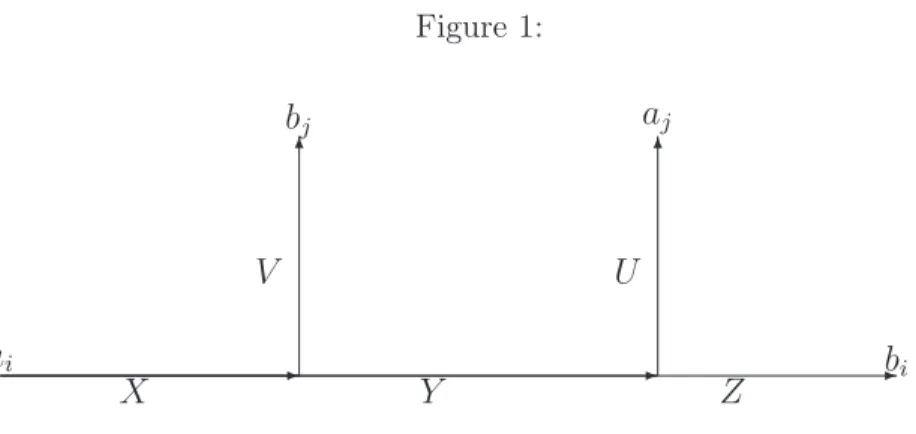
Assume that for some indices i < j the approximation tree T for for vertices ai, bi, aj, bj is of shape on the Figure 1 (T is provided by Gromov’s theorem 2.4 wherew=ai, k= 2, n= 3). For convenience we label vertices of the tree on Figure 1 by corresponding group elements. Proposition 2.8 provides us with with five geodesic words X, Y, Z, U, V
such thatRi =XY Z, whereXY Zis geodesic andRj =U−1Y−1V, where
U−1Y−1V is geodesic up to 3(2·3δ+ 2) = 18δ+ 6. We label edges of the treeT with X, Y, Z, U, V for convenience of the reader. Note that Φ andT determine the exponents of X, Y, Z, U, V in equalities for Ri,Rj uniquely.
Lemma 2.13 ([Delz], Lemma 2.3). Suppose that a fixed element g is equal to a word W = U1R1U1−1. . . UnRnUn−1 in G and that for some
indices i < j the tree approximation of vertices ai, bi, aj, bj in Cay(G)
(with geodesic words X, Y, Z, U, V provided by Proposition 2.8) has the shape on Figure 1.
(i) Assume that n is a minimal possible number among all words W equal to g. Then the following inequality holds:
|Y| ≤µmin(|Ri|;|Rj|) + 10δ+ 3. (3)
(ii) If the equality (3) is violated thennis not minimal and the following equality holds in G:
Ui+1Ri+1Ui−+11 . . . Uj−1Rj−1Uj−−11=UiRiUi−1. . . UjRjUj−1. (4)
Proof. Assume that the inequality (3) does not hold. In notations used in Figure 1 we have Ri =XY Z and XY Z is geodesic, Rj =U−1Y−1V, where the right-hand side is geodesic up to 3(2·3δ + 2) = 18δ + 6. We consider the conjugate R′
i = Y ZX of Ri, which is also geodesic:
|R′
i| ≥ |Ri| (sinceRi is a cyclically reduced geodesic word), but on the other hand |R′
i| ≤ |Y|+|Z|+|X| = |Ri|. Consider also the conjugate
Rj′ =Y U V−1 of Rj−1 which is geodesic up to3(2·3δ+ 2) = 18δ+ 6 (we
have |Rj| ≤ R
′ j
≤ |Y|+|U|+|V| ≤ |Rj|+ 18δ+ 6).
By Lemma 2.7, there exists a geodesic wordR′′=AR′jA−1 cyclically
conjugate toRj such that 2|A|+|R′′| ≤ R
′ j
+ 10δ and|R
′′|=|R
j|. Now the computation
2|A|+ R′′
≤
R′j
+ 10δ≤ |Rj|+ 28δ+ 6
implies that |A| ≤ 14δ + 3. We also have that R′′ ∈ R: it is a cyclic conjugate ofRj.
By definition of hyperbolicity, we have that
hRi′, R′ji ≥min(hY, Rj′i,hRi′, Yi)−δ.
Both Gromov products on the right side of the last equation are not greater then |Y|and the second is actually equal to |Y| becauseR′
i =Y ZX is geodesic. So hR′
i, R′ji ≥ hY, R′ji −δ =|Y| −δ− h1, R′jiY, where the last equality follows from hY, R′
ji1 +h1, R′jiY = |Y|. Since R′j = Y U V−1 is geodesic up to18δ+ 6we have by inequality (1) thath1, R′
jiY ≤9δ+ 3 and finally
hR′i, R′ji ≥ |Y| −10δ−3.
We hence obtained that hAR′′A−1, R′
condition C′(µ) we get that A−1R′′A = Y U V−1 = R′
i = Y ZX. Thus
U V−1=ZX, henceZ−1U =XV and sobi−1aj =a−i1bj, which in turn is equivalent toUi−1gi−1gj−1Uj =Ui−1gj−−11gjUj and henceg−i 1gj−1 =gi−−11gj. Rewriting the last equality in the explicit form, we get precisely equation (4).
The left-hand side of the last equality contains fewer elements of X
contrary to the minimality of numbernfor g. Contradiction.
The following definition utilizes the lemma
Definition 2.14 ([Delz]). A word (or, equivalently, a path in Cay(G)) U1R1U1−1. . . UnRnUn−1 is called reduced if for every pair of indices i < j
such that the approximating tree forai, bi, aj, bj is of shape on Figure 1, the
inequality (3) holds. If for a pair of indexes i < j the tree approximation is of shape on Figure 1, the inequality (3) is violated, then we calli < j a
reducible pair of indexes.
Note that if we switch the labelsaj andbj on Figure 1, the pairi < j will no longer be a reducible pair. The following corollary summarizes [Delz] Lemma 2.4.
Lemma 2.15. Suppose G is hyperbolic and R satisfies C′(µ), µ≤1/8. Let γ =Qni=1UiRiUi−1 be a reduced path in Cay(G), UiRiUi−1 ∈ X and
denote by γ¯ some geodesic between γ−, γ+. Then there exist an index
1 ≤ i0 ≤ n, a subsegment x of geodesic segment γRi0 such that x is in
30δ-neighborhood ofγ¯ and |x| ≥(1−3µ)|Ri0| −1500δ.
3. Diagrams and small cancellation
Suppose we are given a hyperbolic groupG with a combinatorial presen-tationG=gp(S|D). For technical purposes we assume thatD contains all relations of the groupG.
Forǫ≥0a subwordU is called anǫ-pieceof a wordRin a symmetrized setR with respect toGif there exists a word R′ ∈ R such that
(i) R≡U V, R′ ≡U′V′ for someU′, V′, V;
(ii)U′ =Y U Z inGfor some words Y, Z wherekYk,kZk ≤ǫ; (iii) Y RY−16=R′ in the groupG.
We say that the system R satisfies the C(ǫ, µ, ρ)–condition (with respect toG) for some ǫ≥0, µ≥0, ρ≥0if
(i)kRk ≥ρ for any R∈ R; (ii) any wordR∈ R is geodesic;
(iii) for anyǫ-piece of any wordR∈ R the inequalitieskUk,kU′k<
Definition 3.1. Consider a finite, two dimensional complex∆ with di-rected edges such that:
(i) The underlying topological space of complex M is a disc with a boundary P.
(ii) For any path in ∆ there defined a label functionφ(∗). If x is an edge in ∆, φ(x)∈S∪S−1∪1 and φ(x−1) =φ(x)−1. For a path q in ∆, q=q1...qn, where qi is an edge for everyi, we defineφ(q) =φ(q1)...φ(qn).
If q is a simple closed path we choose a base vertex o and read off the labels of edges in the clockwise direction.
(iii) A boundary label of any 2-cell of M is either an element of R (then we call it an R-face) or has a label Dwhere D= 1 in the hyperbolic group G(D-face).
We call the triple (M, φ(∗), P) a (disc) diagram ∆ with respect to gp(S|D ∪ R) with a boundary pathP.
Similarly we may define notions of annular or spherical diagrams. For convenience we often fix a base pointoof the diagram∆– a vertex on one of the boundary components of ∆. We may also choose a base point o1 on the boundary of a face Π and write∂o1Π = r where r is a
simple closed boundary path ofΠ with a initial (terminal) vertex o1.
Consider a path γ in ∆as a path in the underlying topological space
M. We say that γ is a simple path in ∆ if for every open set U in M
containing γ there exists a homotopy (in U) from γ to a simple curve
γ′ =γ′(U). A simple closed path γ in∆bounds a subdiagram ∆1 with
boundary ∂∆1 =γ consisting of all edges, vertices and faces which are
inside the simple closed curveγ′=γ′(U) for every open set U containing
γ. Subdiagrams ∆1,∆2 are called disjoint if for every neighborhood of
∂∆1∪∂∆2 (in the underlying space for∆) there exists a homotopy inside
U of ∂∆1 to a simpleγ1 such that∆2∩γ1 =∅.
The following operations (and their inverses) are referred to as ele-mentary transformations of diagram∆over G1:
1. Let Π1,Π2 be D-faces in ∆ with a common boundary subpath p.
Then we can erase p makingΠ1,Π2 into a singleD-face.
2. Let p be a simple path in∆. Then we cut the diagram ∆ alongp (i.e. consider the path pp−1 as a new boundary component) and glue in a D-face labeled by φ(p)φ(p)−1.
It is clear that elementary transformations define an equivalence rela-tion on the set of all reduced diagrams overG1. We say that∆is equivalent
to∆′ if there exists a finite sequence of elementary transformations starting from∆ and ending with∆′.
Definition 3.2 ([Olsh93]). LetΠ1,Π2 be different R–faces of a diagram
∆ having boundary labels R1, R2 reading in a clockwise direction, starting
patht in ∆ such that t− =o1, t+=o2. Call Π1,Π2 opposite (with respect
to the path t) if the following equality holds:
φ(t)−1R1φ(t)R2= 1 in G. (5)
If a diagram∆ contains no opposite faces then we call it reduced.
Lemma 3.3 (van Kampen, see [Olsh93]). Letw0 be an nonempty word
in the alphabetS. Then w0 = 1 inG1 if and only if there exists a reduced
disc diagram overgp(S|D ∪ R) with boundary label equal to w0.
Let p be a path in ∆ over G, define kpk = kφ(p)k and |p|= |φ(p)|. We call a path pgeodesic ifkpk=|p|(recall that|p|equals the distance
|p+−p−|inG).
One can define a mapφ′ (see [Olsh93], §5) from a disc diagram∆over
Gwith the base point oto Caley graphCay(G). Set φ′(o) = 1, where 1 is the identity vertex ofCay(G). For an arbitrary vertexain ∆we define
φ′(a)to be the vertex ofCay(G)labeled by the geodesic wordφ(p) where
p is a path in ∆ connecting o and a (it follows from the van Kampen Lemma thatφ′(a) does not depend on the choice of p). If pis an edge in ∆ labeled by s∈ S±1, then define φ′(p) to be the edge labeled by sin Cayley graphCay(G)with verticesφ′(p−), φ′(p+). Ifφ(p)≡1for an edge
p of ∆ then φ′(p) = φ′(p−) = φ′(p+). One can verify that |p|= |φ′(p)|,
kpk=kφ′(p)kfor any pathpin diagram∆ overG([Olsh93], Lemma 5.1). When∆is a diagram over G1 we still use functionskpk,|p|, where p
is a path in ∆.
In the following remark we translate some hyperbolic properties of
Cay(G) into the context of diagrams over G.
Remark 3.4. (i) Suppose ∆is a reduced diagram overG, p1 andp2 are
disjoint paths in ∆, vertices (pi)± are on the boundary ∂∆. Then there exists a diagram∆′ equivalent to ∆, such that ∂∆′ =∂∆, vertices (p
i)± are connected by a geodesic path p′i for i = 1,2, and paths p′1, p′2 are disjoint. Furthermore, a pointx of the pathp′
i is on ∂∆′ if and only if it is an initial or terminal vertex of p′i.
(ii) SupposeΓis a diagram overG,∂Γ =p1q1p2q2, whereqiare geodesic inG andkpik ≤K,|qi| ≥2K+ 20δ for i= 1,2 and some K ≥0. Then (after elementary transformations) there exists a subdiagram Γ′ in Γwith boundary ∂Γ′ =p′1q1′p′2q′2 such thatkp′ik ≤6δ,qi′ are geodesic subpaths ofqi and |(q1)+−(q′1)+|=|(q1)−−(q1′)−|=K+ 2δ. In particular,
q1′
=|q1| −2K−4δ.
(iii) If a subdiagramΓ satisfies the conditions of part (ii), then every vertex xof q1 is at distance not greater then K+ 8δ fromq2 (i.e. there
Proof. (i) Consider the mapφ′ from diagram ∆toCay(G). For i= 1,2 we pick a geodesic in Cay(G) with label Pi′ between vertices φ′(pi±) in
Cay(G). We apply an elementary transformation of type (ii) topi: cut∆ alongpi to get a new boundary componentpip˜i,φ(˜pi) =φ(pi)−1 inGand glue inside a D-faceΠi with boundarypip˜i. Then apply the inverse type (ii) to Πi: replace it with a pair of facesΠi1,Πi2 with common subpath
p′i labeled byPi′ (∂Πi1 =pip′−i 1, ∂Πi2 =p′ip˜i). We have constructed the desired diagram∆′. It remains to notice that no vertex belongs to both closed pathsp1p˜1 andp2p˜2 sincepi,p˜i are copies of disjoint paths pi in ∆. Also, all vertices of p′
i except forp′i± are interior in a subdiagram bounded by pip˜i, and the remark is proved completely.
(ii) We consider φ′(Γ), and apply Lemma 2.1 to the pair of geodesic pathsφ′(q1), φ′(q2)in Cay(G)to find the subpath q1′′ of φ′(q1) such that
|(q′′
1)±−φ′((q1′)±)|=K+ 2δ and vertices (q1′)± are in6δ–neighborhood of geodesic φ′(q2). Define a subpath q2′′ of φ′(q1′) so that the inequality
|(q′′
1)±−(q2′′)±| ≤ 6δ holds. It remains to choose a subpath q′i on qi satisfying equality φ′(q′i) =qi′′. Now apply part (i) to two pairs of points (q′
2)+,(q1′)− and (q′1)+,(q′2)− in Γ which provides paths p′i and observe that the pathp′1q1′p′2q′2 bounds the desired diagramΓ′.
(iii) Follows from remark 2.3 and properties of the mapping φ′.
We will need the following:
Lemma 3.5. Suppose we have a diagram∆ consisting of cells Π1,Π2, a
simple patht between them such that Π1,Π2 is pair of opposite cells with
respect to a path t. Then, for any vertices o1, o2 on ∂Π1, ∂Π2 respectively,
there exists a path s1ts2 such that φ(s1ts2) = P φ(a) in G, where |a| ≤ 1
2|∂Π2|, P is a geodesic word and|P| ≤ |t|+ 8δ, si is a subpath of ∂Πi
(i= 1,2), a is a subpath of ∂Π2 and s1− =o1, s2+ = o2. Moreover, the
following equality holds in G:
(P φ(a))−1φ(∂o1Π1)(P φ(a))φ(∂o2Π2) = 1 in G. (6)
Proof. We denoter1to be the boundary path∂t−Π1,r2to be the boundary
path ∂t+Π2. By definition of an opposite pair (bounded byr1tr2t−1) and
the van-Kampen Lemma, there exists a diagramΓ overGwith boundary
r1tr2t−11, where φ(t1) =φ(t). Since each pathri is geodesic, by Remark 3.4 (iii) the distance between a vertex on r1 and r2 is not greater then
|t|+ 8δ, hence there exists a vertexo′1 onr2 such that|o1−o′1| ≤ |t|+ 8δ.
Consider a subpath of the form s1t′s′2 on∂Γ, wheres1 is a subpath of
r1±1,s′2 is a subpath of r2±1,(s1)−=o1,(s′2)+=o1′,t′ is either tor t1.
Let P be a geodesic word equal inGto the label of the paths1t′s′2, so
|P| ≤ |t|+ 8δ. Now we considers1t′s′2 as a subpath of boundary ∂∆, sot′
Figure 2:
Γ q2
q1
p1
p2
u2
u1
|a| ≤ 12|∂Π2|. Define the path s2 to be s′2a after elimination of returns,
henceφ(s′
2a) =φ(s2) in a free group generated by S. Since the boundary
labels of∆andΓare the same, we may consider the paths1t′s′2 as a path
s1ts′2 in ∆. We have that φ(s1ts′2) = P in G, and so the following first
two equalities hold in the free group generated by S while the last one holds inG:
φ(s1ts2) =φ(s1t′s′2s) =φ(s1ts′2)φ(a) =P φ(a).
To establish (6), we observe that the path (s−11∂o1Π1s1)t(s2∂o2Π2s
−1 2 )t−1
coincide with(∂t−Π1)t(∂t+Π2)t
−1 after the elimination of returns. Thus
φ((s−11∂o1Π1s1)t(s2∂o2Π2s
−1
2 )t−1) = (∂t−Π1)t(∂t+Π2)t
−1= 1 inG,
which after conjugation providesφ−1(s1ts2)φ(∂o1Π1)φ(s1ts2)φ(∂o2Π2) = 1
inGproviding (6).
The following notion of ǫ-contiguity subdiagram will be used exten-sively. Let∆ be a diagram overG1. Letu1 andu2 be a pair of paths in∆
with subpathsq1 andq2 respectively, such that there exists a pair of simple
pathsp1, p2,|p1|,|p2| ≤ǫand suppose that a pathp1q1p2q2 bounds a disc
diagram Γwhich does not contain any R–faces (see Figure 2). Then we callΓanǫ-contiguity subdiagram between pathsu1 andu2. When we talk
about the contiguity subdiagramΓbetween u1 andu2 we use the formula
∂(u1,Γ, u2) =p1q1p2q2 to define notation for arcs of Γ. In this case q1, q2
are referred to ascontiguity arcs andp1, p2 asside arcs of theǫ-contiguity
subdiagram Γ. We usually consider contiguity subdiagrams between a pair ofR–faces or between anR–face and a boundary path (i.e.u1 is the
boundary path of R–face Π1 and u2 is the boundary path of R–faceΠ2
or is a subpath of the boundary of∆). If u1 is the boundary of anR–face
Π1,u2 is a path of a boundary of anR–faceΠ2 withǫ-contiguity diagram
Γdescribed above then we define the degree of contiguity of Π1 to Π2 to
be(Π1,Γ,Π2) = kkΠ1q1kk (or, ifu2 is a boundary subpath of∆, the degree of
The next two lemmas provide the basic connection between the notions of small cancellation and diagrams over hyperbolic groups.
Lemma 3.6 ([Olsh93], Lemma 5.2). (i) If the symmetized system R satisfies the C(ǫ, µ, ρ)–condition, then for any reduced diagram∆ and any ǫ-contiguity subdiagram Γ of a face Π1 to another face Π2 the following
inequalities hold:
kq1k< µk∂Π1k, kq2k< µk∂Π2k,
where ∂(Π1,Γ,Π2) =p1q1p2q2 for any reduced diagram∆ over G1.
(ii) Suppose a diagram ∆ has a pair of R–faces Π1,Π2 and an ǫ
-contiguity subdiagram Γ (∂Γ =p1q1p2q2) such that
max{(Π1,Γ,Π2),(Π2,Γ,Π1)} ≥µ.
ThenΠ1,Π2 are opposite with respect to each of the pathsp1, p2.
Note that part 2 of the above lemma is an immediate corollary of small cancellation property.
Lemma 3.7 ([OlOsSa], Lemma 4.6). For any hyperbolic group G there exists µ0 >0 such that for any 0< µ≤µ0 there are ǫ≥0 and ρ (it is
suffice to choose ρ > 10µ6ǫ) with the following property:
Let the symmetized system Rsatisfy the C(ǫ, µ, ρ)-condition and fur-thermore let ∆ be a reduced disc diagram over G1 whose boundary ∂∆
is decomposed into geodesic sections q1, . . . , qr, where 1≤r≤12. Then,
provided ∆ has an R–face, there exists a reduced diagram ∆′ equivalent to∆, an R–face Π in∆ and disjoint ǫ-contiguity subdiagrams Γ1, . . . ,Γr
(some of them can be absent) of Π toq1, . . . , qr respectively such that
(Π,Γ1, q1) +· · ·+ (Π,Γr, qr)>1−23µ.
The following lemma is a special case of that in [Olsh93]:
Lemma 3.8. ([Olsh93], Lemmas 6.7, 7.4) LetG be a non-elementary hyperbolic group. There exists µ0>0such that for any 0< µ≤µ0 there
existsǫ≥0 such that for everyN >0there existsρ >0with the following property:
if R is finite and satisfies C(ǫ, µ, ρ) then G1 is a non-elementary
hyperbolic group and W = 1 inG1 iffW = 1 inG for every wordW with
kWk ≤N.
Definition 3.9. We say that a system R of geodesic words satisfies the
˜
Figure 3: C(ǫ, µ, ρ) => C′(2µ)
a
r11
q1 aR1
aR1b
R2
p2
q2
p1
r21
4. Condition C′(µ) and connection to C(ǫ, µ, ρ)–condition
Remark 4.1. Suppose the system of geodesic wordsRsatisfiesC˜(ǫ, µ, ρ– condition, µ <1/100,ǫ≥ǫ0 ≥6δ,ρ > µ(1500−8δµ). ThenR satisfiesC′(2µ).
Proof. Take arbitrary words R1, R2 ∈ R. We denote by M the
mini-mum min(|R1|,|R2|). To check the condition C′(2µ) we assume that
haR1b, R2i>2µM for some a, b∈Gsuch that|a|,|b| ≤100δ.
We denote byW a geodesic equal toaR1b, by ν a path R2 and byγ
a pathaR1bin the Cayley graph Cay(G).
Consider vertices o2 onν ando3 on the geodesicW at distance[2µM]
from identity vertex1. By Remark 2.5 (part 1), we have thatΦ(o2) = Φ(o3)
and (by part 2) |o2−o3| ≤ 4δ. Now we may apply Lemma 2.1 (for
K = 100δ) to segments γR1, W and hence there exists a subsegment
[u, v]of W such that |u−e| ≤102δ, |v−γ+| ≤102δ and[u, v]is within
6δ–neighborhood of γR1. Vertex o3 lies on [u, v] because on one hand
|o3−e|= [2µM]>2K+ 20δ and on the other hand
|o3−γ+| ≥ |R1| − |a| − |b| −[2µM]≥(1−3µ)M >2K+ 20δ.
We get that o3 is within6δ–neighborhood of some vertex o1 on path
γR1.
We consider two subsegments [e, o2] and [(γa)+, o1] of ν and γR1
respectively and apply Lemma 2.1 to get that there exists a subsegment
q2 ofR2 between eand o2 such that
|q2| ≥[2µM]−200δ−4δ >
3
2µM+ 20δ
which is within 6δ–neighborhood from γR1. Now defineq1 to be a
We have that
|qi|>
3
2µmin(|R1|,|R2|) for i=1,2. (7)
Definep1 (p2) to be a geodesic path betweenq2−, q1− (q1+, q2+), see
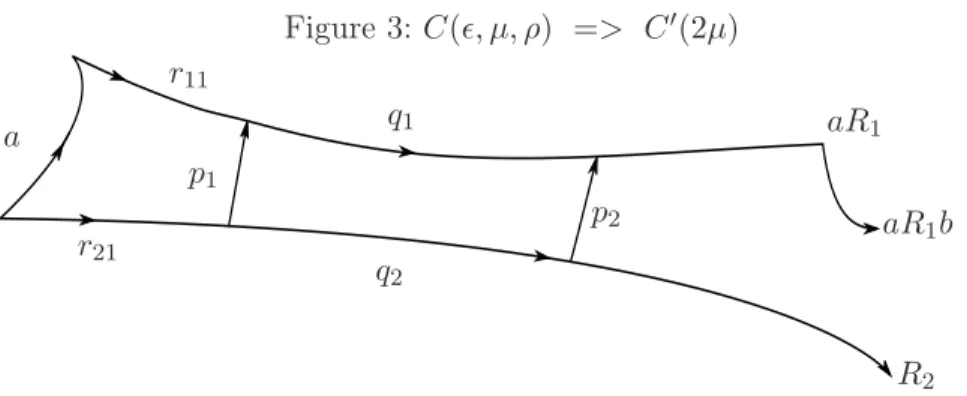
Figure 3. To justify the Figure 3, we must show that |(γa)+−(q1)−|<
|(γa)+−(q1)+|(this inequality follows from [Olsh93] Lemma 1.10, but we
include the argument here). By triangle inequality and definition of q1,
we have that
|(γa)+−(q1)−| ≤ |a|+|p1|+|e−(q1)−| ≤100δ+ 6δ+ 102δ= 208δ;
on the other hand,
|(γa)+−(q1)+| ≥ |e−(q2)+| − |p2| − |a|=|e−(q2)−|+|q2| − |p2| − |a| ≥
102δ+3
2µM + 20δ−100δ−6δ > µM ≥500δ and hence we got |(γa)+−(q1)−|<|(γa)+−(q1)+|, as desired.
We denote labels of qi and pi asQi andPi respectively. Define four subpaths rij, i, j ∈ {1,2} by equalities γR1 = r11r12, ν = r21r22 and
(r11)+ = (p1)+,(r21)+ = (p1)−. Define words Rij, Q′, Q′′ by equalities
lab(rij) = Rij, R12R11 ≡ Q1Q′,R22R21 ≡ Q2Q′′. We have that Q2 =
P1Q1P2−1, kPik ≤ 6δ, and taking into account the inequality (7) we conclude by C˜(ǫ, µ, ρ–condition thatP1R12R11P−1 =R22R21, which in
turn is equivalent to (R21P1R−111)(R11R12)(R11P1−1R−211) = R21R22. It
remains to observe that a= (R21P1R−111)and so aR1a−1=R2.
Corollary 4.2. Suppose Rsatisfies C˜(ǫ, µ, ρ–condition and n≥1,
n Y
k=1
UkRkUk−1 = 1 in G, where UkRkUk−1 ∈ X. (8)
Then (i) There exists a reducible pair i < j in the sense of Definition 2.14 and
Ui+1Ri+1Ui−+11 . . . Uj−1Rj−1Uj−−11 =UiRiUi−1. . . UjRjUj−1in G. (9)
(ii) For every reducible pair i < j in (8), there exists a van-Kampen diagram∆′ over G with the boundary γ′ labeled by the word
U1R1U1−1. . . UnRnUn−1 and a subdiagram Γin ∆′ with boundaryp1q1p2q2
such that q1 is a subpath of γ′Ri, q2 is a subpath of γ′Rj, |pi| ≤11δ+ 3
and max(|q1|
|Ri|,
|q2|
|Rj|) ≥2µ− 10δ+3
ρ . The only vertices of paths pi that are
(iii) Consider the diagram ∆′ from part (ii) and let ν′ be any of the
four paths given by the formulaν′=γ′(Ui±1)s1p1−1s2γ′(Uj±1), wheres1 is
a subpath of γ′Ri,s2 is a subpath of γ′Rj. Then
φ((γ′Ui)±1s1p1−1s2(γ′Uj±1)) =
j−c Y
k=i+d
UkRkUk−1 in G,
where c, dtake values 0 or 1 depending on the path ν′ and (c, d)6= (0,0).
Moreover, depending on values c and d, the word H ≡Qjk−=di+cUkRkUk−1
conjugates UiRiUi−1 to UjR±j1Uj−1, namely:
H−1UiRiUi−1H=UjRejUj−1, wheree∈ {±1}.
Proof. By Remark 4.1,C˜(ǫ, µ, ρ–condition implies the condition C′(2µ). The product Qnk=1UkRkUk−1 equals to identity in Gso by Lemma 2.15 it is not reduced in the sense of Definition 2.14. Hence there exists a reducible pairi < j (in particular, we have that|Ri|=|Rj|) such that the approximation tree for ai, bi, aj, bj is of shape on Figure 1 and by Lemma 2.13 the corresponding geodesic word Y satisfies:
|Y| ≥2µM+ 10δ+ 3, whereM =|Ri|. (10)
Lemma 2.13 also provides the equation (4) and thus (i) is proved.
Diagram∆′ overGwith boundaryγ′ labeled byQnk=1UkRkUk−1 exists by van-Kampen Lemma. Consider the mapφ′ : ∆′ 7−→Cay(G). We denote
φ′(γ′) as γ′′ (a path in Cay(G) with label Qnk=1UkRkUk−1). We adopt notations from the definition of a reducible pair i < j and Figure 1. Consider a geodesic pathα inCay(G) starting fromai with labelXY Z (hence it ends atbi) and a geodesic up to18δ+6pathβinCay(G)starting fromaj with labelU−1Y−1V ( it ends atbj). By definition ofX, Y, Z, U, V, we have(αY)−1 =β Y−1. From the fact thatXY Z is geodesic, it follows from Remark 2.3 (ii) that there exists a subpath q1′ of γ′′Ri such that:
αY−−q1′− ,
αY+−q1+′
≤δ, (11)
which implies that:
q1′
≥ |Y| −2δ. (12)
Similarly, we consider the path β geodesic up to 18δ+ 6 and apply again Remark 2.3 (ii) to obtain that there exists a subpath q′
2 of γ′′Rj such that:
αY−−q2+′
,
αY+−q′2−
and hence :
q′2
≥ |Y| −20δ−6. (14)
The inequalities (11), (13) imply also that
q1′−−q2+′ ,
q′1+−q′2− ≤
11δ+ 3.
Consider subpaths q1 ofγRi andq2 ofγRj in the boundary∂∆′ such that φ′(qi−) = q′i−, φ′(qi+) = qi′+. The Remark 3.4 implies that (after
some elementary transformations) there exists a subdiagram Γin ∆′ with boundaryp1q1p2q2, vertices ofpiare interior except for initial and terminal ones and |pi| ≤11δ+ 3. Equations (12), (14), (10) provide that:
max(|q1|
|Ri|,
|q2|
|Rj|) ≥
|Y|−20δ−6
M ≥
2µM+10δ+3−20δ−6
M ≥ 2µ− 10 δ+3
M . Part (ii) is proved.
To justify part (iii) we look at each of the 4 options for the path
ν′. For example, if ν′ = (γ′Ui)s1p1−1s2(γ′Uj−1) then φ′ maps the vertex ν− = (γ′Ui)− of ∆′ to the vertex gi−1 = Qik−=11 UkRkUk−1 in Cay(G),
ν+′ = (γ′Uj−1)+ to the vertex gj = Qjk=1UkRkUk−1 in Cay(G). Hence lab(φ′(ν′)) =gi−−11gj =Qjk=iUkRkUk−1.
A direct computation using the relation (9) yields that for every possible value ofc anddthe word H conjugates UiRiUi−1 to UjR±j1Uj−1. For example, H ≡ Ui+1Ri+1Ui−+11 . . . UjRjUj−1 conjugates UiRiUi−1 to
UjR−j1Uj−1:
Ui+1Ri+1Ui−+11 . . . UjRjUj−1UjR−j1Uj−1(Ui+1Ri+1Ui−+11 . . . UjRjUj−1)−1 =
Ui+1Ri+1Ui−+11 . . . Uj−1Rj−1Uj−−11(Ui+1Ri+1Ui−+11 . . . UjRjUj−1)−1=
UiRiUi−1. . . UjRjUj−1(Ui+1Ri+1Ui−+11 . . . UjRjUj−1)−1 =UiRiUi−1,
where the last inequality holds by (9). It remains to notice that by relation (9), in the word H the parameters c=d= 0 may be replaced byc=d= 1.
Definition 4.3. For every reducible pair i < j consider the diagram
∆′ from Corollary 4.2, identify each edge of γ′Us with corresponding
edge of γ′Us−1 and fill in the R-faces Πs to get a van-Kampen diagram
∆ over G1 which has a (11δ + 3)-contiguity subdiagram Γ such that
max{(Πi,Πj),(Πj,Πi)} ≥2µ−10δρ+3. We will refer to a described diagram
∆ as a standard diagram for relation (8). We denote the image of γ′ in ∆
by γ.
Figure 4: Standard Diagram
R1 R2
Rk
U1 U2
Uk
... 1
O
Remark 4.4. According to the identifications made in the definition of the standard diagram∆, any of the four paths ν′ in ∆′ corresponds to a closed path in ∆with labelν= (γUi)r1p1r2(γUj−1), where ri correspond to si. One can observe that different paths ν′ have different images in ∆, but we will not use this fact later. Note that the subpaths(γ′Ui)±1 and
(γ′Uj)±1 ofν′ in∆′ correspond respectively to subpaths γUi andγUj ofν.
5. Generators of a free normal subgroup in G
In this section we assume that the set R satisfies C˜(ǫ, µ, ρ–condition, where the parameters ǫ, µ, ρ are chosen according to Lemma 3.7 and satisfy inequalitiesǫ > ǫ0 = 19δ+ 3,µ <1/100,ρ > 6µ(1500−ǫ8µ).
It is well known (see [Gro]2.2A) that a hyperbolic group contains only finitely many conjugacy classes of torsion elements. So, given a groupG, we may choose the constant ρ to be larger then the length of shortest representative in each conjugacy class of torsion elements. Thus we will assume in the sequel that for values of ρ large enough:
Remark 5.1. The set Rconsists of elements of infinite order.
Definition 5.2. We call a (reduced) diagram ∆ an octagon diagram if ∂∆ =l1j1. . . l4j4, where li are geodesic in G, andkjik ≤ǫ.
satisfies the condition U∆(κ) if for every diagram∆′ equivalent to ∆ and
every R–faceΠin∆′ such that there is a contiguity subdiagramΓbetween
Π and li, we have the inequality(Π,Γ, li)< κ.
It is clear that if li has a subpathl which is a boundary arc of some subdiagram∆1 of ∆thenl satisfiesU∆1(κ) as well.
Lemma 5.4. Let ∆ be an arbitrary octagon diagram andφ(l1) =U ∈ U,
then (in notations of Definition 5.2) l1 satisfies U∆(12 +15µ).
Proof. Note that by definition ofρwe have that 2ǫ+34ρ δ < 15µ. We suppose that there exists an octagon diagram ∆, with boundary arc l1,φ(l1) =
U ∈ U. Assume that (after elementary transformations) there exists an
R–faceΠin ∆ and a corresponding subdiagramΓ betweenΠandl1 with
boundary∂(Π,Γ, l1) =p1q1p2q2 such that(Π,Γ, l1)≥ 12+ 2ǫ+34ρ δ. Now we may apply Remark 3.4(ii) to the diagramΓand conclude that (after elementary transformations) there exists a subdiagramΓ′ ofΓwith
boundaryp′1q′1p′2q′2 such thatqi′ are subpaths ofqi and:
p′i
≤6δ,
q1′
=|q1| −2ǫ−4δ. (15)
By definition of q′
1, we have |q1′| = |q1| −2ǫ−4δ ≥ 12|∂Π|+ 30δ and
it’s complement q3′ (∂Π =q′1q3′) satisfies |q′
3| ≤ 12|∂Π| −30δ. Thus the
condition (i) of definition 2.10 is satisfied.
We define paths l′, l′′ such thatl1 =l′q′2l′′. The equality U =φ(l1) =
φ(l′p′
1q1′p′2l′′) holds in G, moreover, by inequalities (15), we have:
l′
+
p′1
+
q1′
+
p′2
+ l′′ ≤ l′ + 2 p′1
+
q′2
+ 2
p′2
+
l′′
≤ |l1|+ 4·6δ.
Hence the condition (ii) of definition 2.10 is checked for the factorization
φ(l′p′
1)φ(q′1)φ(p′2l′′) of the word U.
By Definition 2.10, the wordU does contain more then half of a relation and thusU /∈ U contrary to our assumption.
Definition 5.5. Consider a reduced octagon diagram ∆ with boundary l1j1. . . l4j4. Denote for simplicity of notation u = l1 and v−1 = l3,
a=j3l4j4,b=j1l2j2 and define the base point of ∆ to beo= (l1)−.
Con-sider anR–faceΠand disjoint contiguity subdiagramsΓu,ΓvofΠto
bound-ary arcsu, v, define boundary arcs ofΓu,Γv by∂(Π,Γu, u) =p1uqΠup2uqu,
∂(Π,Γv, v) =p1vqΠvp2vqv and define q1, q2 by equality ∂Π =qΠ−v1q1q−Πu1q2
(see Figure 5). We say that a subdiagram ∆0 = ∆0(∆,Π)with a
bound-ary path p2uqup1uq2p2vqvp1vq1 (u, v)–bond (through Π) if both values
(Π,Γu, u),(Π,Γv, v) are greater then µ. We define subdiagrams ∆1 =
∆1(∆,Π), ∆2 = ∆2(∆,Π) of ∆ with boundaries u1p−2u1q1p−1v1v−11a and
Figure 5: Bond Betweenu And v
∆1
∆2
u1
p2u
p1u
qu
qΠu
a b
v
q2 q1
qΠv
p2v
qv
p1v
Π
and v2 (u2) is a terminal subpath ofv (u) (recall that the orientation of
the boundary is clockwise).
For an arbitrary reduced octagon diagram ∆,∂∆ =l1j1. . . l4j4, where
liare geodesic inG,kjik ≤ǫ, there exist a pair of (possibly empty) setsV =
{Π1, . . .Πm}ofR–faces andΣ(∆) ={Γ1,u,Γ1,v, . . . ,Γm,u,Γm,v}of disjoint
ǫ-contiguity subdiagrams, whereΓi,u,Γi,v are contiguity subdiagrams such that ∆0(Πi) = Πi∪Γiu∪Γiv is a (u, v)–bond. We call a pair(V,Σ(∆))a
system of bonds betweenu and v.
Remark 5.6. (i) It is clear that in a non-empty system of (u, v)–bonds (V,Σ(∆))for a reduced diagram∆ there exists a unique face ΠinV such that the associated (see definition 5.5) paths u1 and v1 are the longest.
Moreover, any other faceΠ′ ∈V belongs to∆
1(Π).
(ii) For every faceΠ inV we have that
|u1| ≤ |u| −(Π,Γu, u)|∂Π|+ 2ǫ, |v1| ≤ |v| −(Π,Γv, v)|∂Π|+ 2ǫ. (16)
The following remark will allow us to extend systems of bonds of subdiagrams∆i to the diagram∆.
Remark 5.7. Consider a reduced octagon diagram ∆ over G1 and
as-sume that there is a (u, v)–bond∆0(Π) = Π∪Γu∪Γv in ∆ satisfying
(Π,Γu, u),(Π,Γv, v) ≥ µ and two systems of (ui, vi)–bonds (Vi,Σ(∆i)) in ∆i = ∆i(Π,∆), i = 1,2. Then the sets V = V1 ∪V2 ∪ {Π} and
Σ(∆) = Σ(∆1)∪Σ(∆2)∪ {Γu,Γv} comprise the system of(u, v)–bonds
Lemma 5.8. Let∆be a reduced octagon diagram with at least one R–face with boundary ∂∆ =aj1uj2bj3v−1j4, where u, v, a satisfy the condition
U∆(12 +µ5),b satisfies U∆(µ) and |jk| ≤ǫfor every k.
(i) Then ∆ has a non-empty system of (u, a)–,(v, a)– or(u, v)–bonds. (ii) Assume in addition that ∆ does not have (u, a)– or (v, a)–bonds. Then, for the set V consisting of all R–faces, there exists a system of
(u, v)–bonds (V,Σ(∆)) such that for every R–face Π in ∆ there exist subdiagrams Γu,Γv ∈Σ(∆) satisfying:
(Π,Γu, u) + (Π,Γv, v)>1−26µ; (17)
max[(Π,Γu, u),(Π,Γv, v)]>
1
2−13µ; (18)
min[(Π,Γu, u),(Π,Γv, v)]>
1
2 −27µ. (19)
Proof. (i) On the one hand we may consider anR–faceΠsatisfying Lemma 3.7 such that(Π,Γa, a)+(Π,Γb, b)+(Π,Γu, u)+(Π,Γv, v)>(1−23µ)−|4∂·3Πǫ| (note that (Π,Γji, ji)|∂Π| ≤3ǫbecause|ji| ≤ǫ). Together with condition
on bit means that
(Π,Γa, a) + (Π,Γu, u) + (Π,Γv, v)>(1−24µ)−
4·3ǫ
|∂Π| (20)
On the other hand each summand on the left-hand side of (21) is smaller then 12 +µ5. Hence at least two of them are larger then 12µ.
(ii) We continue the considerations in the proof of part (i). We cannot have(Π,Γa, a)≥µ because at least one of the other summands in (20) is larger then12µand we would get a (u, a)– or (v, a)–bond involving a
which is impossible. Hence we get that
(Π,Γu, u) + (Π,Γv, v)>(1−25µ)−
4·3ǫ
|∂Π| (21)
and so the inequality (17) holds for Π. The inequality
max[(Π,Γu, u),(Π,Γv, v)]>
1 2−
25 2 µ−
2·3ǫ |∂Π|
follows immediately since µ <1/100, while for
min[(Π,Γu, u),(Π,Γv, v)]>
1 2−26
1 5µ
it is enough to recall that |qu|,|qv| < (12 + 15µ)|∂Π|. We have proved the formulas (17)–(19) for the face Πsatisfying Lemma 3.7, taking into account that (by definition ofρ): |4∂·3Πǫ| ≤ 4·3ǫ
ρ <
Whenn= 1, the diagram ∆has a single R–face Π and we are done by the argument above.
We induct on a numbern ofR-faces in the octagon diagram ∆with base n= 1. Ifn >1we consider subdiagrams ∆i = ∆i(∆,Π) for the face
Π(we follow notations of Definition 5.5 here). It is clear that diagrams∆i satisfy the induction assumption. Each has a number ofR–faces strictly less thenn because neither contains the faceΠ, the arcs piu, piv on the boundary of ∆i are not longer then ǫ. The boundary arcs qi of∆i satisfy the conditionU∆i(µ) by Lemma 3.6 because they are boundary arcs of
the R–face Π in the reduced diagram ∆. As we mentioned before the proof of the lemma, conditionsU∆i(µ)forqiimply that there are no bonds involvingqi in∆i. The induction assumption is now checked for∆i, hence there exist systems of (ui, vi)–bonds (Vi,Σ(∆i)) in ∆i satisfying the conclusion of the lemma. Finally we are in position to apply the Lemma 5.7 to ∆relative to the bond∆0(Π): we obtain a system of(u, v)–bonds
(V,Σ(∆))such thatV contains allR–faces and the setΣ(∆)is comprised ofΣ(∆i) for i= 1,2 andΓu,Γv. The inequalities (17)–(19) hold for every
R–face in∆except for the face Π by induction assumption, and for the faceΠ we have obtained them above.
We denote wordsU RU−1 by AR,U. Ifuis a path in some diagram ∆, we write AR,u for AR,φ(u).
Definition 5.9. Define a weight of a wordAR,U byψ(AR,U) =|R|+4|U|.
Lemma 5.10. Let∆ be a reduced diagram over the group G1 with
bound-ary uj1aj2v−1, where u, v, a satisfy the condition U∆(12 +µ5), |ji| ≤ǫfor
i= 1,2 and there are no (u, a)– or (v, a)–bonds. Then φ(uj1aj2v−1) =
Qn
i=1ARj,Uj′ inG, where max1≤j≤nψ(ARj,Uj′)<4max(|u|,|v|).
Proof. We proceed by induction on the numbernof R–faces in∆. The conclusion of the lemma holds fork= 0because φ(uj1aj2v−1) = 1inG
and there are no AR,U’s.
Assume that the lemma is true for n−1. Consider a faceΠ satisfying the Remark 5.6. By Lemma 5.8(ii), theR–faceΠ of∆ is in the set V for some system of (u, v)–bonds (V,Σ(∆)), and inequalities (17)–(19) hold for Π. We recall the inequality (18) and assume that
(Π,Γu, u)>(
1
2 −13µ), (22)
in the other case proof is the same.
By the choice of Π, we have that every other R–face of∆ is in the subdiagram∆1(∆i= ∆i(∆,Π)) and the subdiagram∆2is a diagram over
provided by Lemma 5.8. Denote a subdiagram of ∆consisting of∆2,∆0
by∆′. It contains a singleR–faceΠ, so we get the following equations in the groupG:
φ(∂u1+∆
′) =φ(∂
u1+∆0) =φ(p
−1
2u(∂p2u−Π)p2u). (23)
Now notice that paths∂u−∆andu1(∂u1+∆
′)u−1
1 (∂u−∆1)coinside after
the elimination of returns in the latter path, so their labels are equal in the free group generated byS. We get that
φ(∂u−∆) =φ(u1(∂u1+∆
′)u−1
1 (∂u−∆1)) =φ(u1(∂u1+∆
′)u−1
1 )φ(∂u−∆1), (24) and taking into account (23),
φ(u1p−2u1)φ(∂(p2u)−Π)φ(u1p −1
2u)−1φ(∂u−∆1) = 1 inG1,
where the number of faces in the diagram ∆1, bounded by the path
u1p−2u1q1−1p−1v1v1−1, isn−1. For convenience we denote φ(∂(p2u)−Π)by R1. By induction assumption, we have the following equality in G for the boundary of ∆′:
φ(u1p−2u1q1−1p1vv1−1) =
n Y
i=2
ARj,uj,
where for every 1< j≤nwe haveψ(ARj,uj)<4max(|u1|,|v1|).
By Remark 5.6 part (ii), we have that max(|u1|,|v1|)< max(|u|,|v|).
By inequalities (16) and (22), we have u1p−2u1
≤ |u| −(Π,Γu, u)|∂Π|+
2ǫ+ǫ <|u| −(12−13µ)|∂Π|+ 3ǫ <|u| −14|∂Π|, hence
ψ(AR1,u1p−1
2u) =|∂Π|+ 4
u1p−2u1
<|∂Π|+ 4|u| − |∂Π|= 4|u|.
Remark 5.11. Let ∆ be a reduced octagon diagram with boundary
∂∆ =l1j1. . . l4j4. Assume that φ(l1) is a subword of some R ∈ R and
|l1| ≤ 12|R|. Then l1 satisfiesU∆(12+ µ5).
Proof. Suppose on the contrary, there exists anR–faceΠand a contiguity subdiagram Γ such that(Π,Γ, l1)≥ 12+ µ5,∂(Π,Γ, l1) =p1q1p2q2. Then,
by C˜(ǫ, µ, ρ–condition, R and φ(∂Π) are conjugate so|∂Π|=|R|. Hence we get
1
2|∂Π| ≥ |l1| ≥ |q1| −2ǫ≥( 1 2 +
For technical reasons we introduce a notation
NR,U =gphAR′,U′|ψ(AR′,U′)< ψ(AR,U)i.
We say that AR′,U′ is equivalent (≈) to AR,U iffψ(AR′,U′) =ψ(AR,U) and there exists a word H inNR,U such that HAR′,U′H−1=AR,U inG. To prove that the relation≈is a correctly defined equivalence it is enough to notice thatNR,U =NR′,U′ whenever ψ(AR′,U′) =ψ(AR,U). It is clear that equivalence classes with respect to≈ are finite.
Definition 5.12. Let A be a maximal set of words AR,U where R ∈
R, U ∈ U such that (i) AR,U ∈/NR,U;
(ii) if AR′,U′ ≈A±R,U1 , then at most one of them belongs to A.
Lemma 5.13. (i) Suppose that some geodesic wordU contains more then half of a relation, then for every R∈ R we have that AR,U ∈ NR,U.
(ii) IfU RU−1 is not geodesic up to10δthen there exists a geodesic up to
10δ wordV R′V−1 such thatAR,U =AR′,V inGandψ(AR,U)> ψ(AR′,V).
(iii) A is a subset of X from Lemma 2.11.
(iv) A generatesN(R), moreover everyAR,U is a product of elements
of A±1 with weights not larger then ψ(A
R,U).
Proof. Pick some wordAR,U.
(i) Assume that U contains more then half of a relation, then (using notations and statement of Remark 2.12(i)) we have
AR,U =Ar1r2,U1AR,U1r−1 2 U2A
−1
r1r2,U1, whereU =U1r1U2, r1r2∈ R, (25)
and the following inequalities hold:
|r1|+|U1|+|U2| ≤ |U|+ 50δ, |r1| ≥ |r2|+ 60δ. (26)
It follows from 2.12(i) that ψ(AR,U1r−1
2 U2) < ψ(AR,U). Now we use
in-equalities (26) to estimate:
ψ(Ar1r2,U1) =|r1r2|+ 4|U1|=|r1|+|r2|+ 4|U1| ≤
2|r1|+ 4|U1|= 2(|r1|+|U1|) + 2|U1| ≤
≤2(|U|+ 50δ) + 2(|U|+ 50δ− |r1|)≤4|U|+ 200δ−ρ <4|U|.
Hence AR,U is equal to the product (25) such that both ψ(Ar1r2,U1)
andψ(AR,U1r−1
2 U2) are strictly less then ψ(AR,U) and we conclude that
(ii) Suppose that AR,U is not geodesic up to10δ. The Remark 2.12 (ii) implies that then there exists R′ ∈ R and a geodesic word V such that U RU−1 = V R′V−1 in G. By the same remark, the word V R′V−1
is geodesic up to10δ and |R|=|R′|and so |U|>|V|. Thus we have got inequalityψ(AR,U)> ψ(AR′,V) contradicting the choiceAR,U ∈ Aagain.
(iii) Follows from (i) and (ii) by definition of X in Lemma 2.11. (iv) By Lemma 2.11, if g ∈ N then g = Qns=1UsRsUs−1 for some
UsRsUs−1∈ X. Hence it is enough to show that everyAR,U ∈ X is equal to a product of elements ofA. We proceed by induction on possible values of k=ψ(∗) on the setX.
If AR0,1 ∈ X has minimal weightψ(AR0,1), we have thatNR0,1 ={1}
and so AR0,1 ∈ N/ R0,1. By maximality of the set A, the exists a word
AR′,U′ ∈ A such thatAR0,1 ≈AR±′1,U′ which implies that AR0,1 =A±R′1,U′ inG.
Now pick AR,U ∈ X such thatψ(AR,U) =k. There are two cases. CASE 1. AR,U ∈ NR,U. In this case AR,U is a product of words
AR′,U′ such thatψ(AR′,U′)< ψ(AR,U)and we are done by the induction assumption.
CASE 2. AR,U ∈ N/ R,U. Consider all wordsAR′,U′ such thatAR′,U′ ≈ AR,U. Clearly,AR′,U′ ∈ N/ R,U =NR′,U′. By maximality of the setA, there exists a word AR′,U′ ∈ A and by Corollary 4.2 (iii) we have that there exists H ∈ NR,U such that HA±R1′,U′H−1 = AR,U in G. By induction assumption,H is a product of elements ofA with weights smaller then
ψ(AR,U), while ψ(AR,U) =ψ(AR′,U′).
Lemma 5.14. Let∆ be a reduced diagram over the group G1 with
bound-ary upav−1 where |p| ≤ǫ, φ(u), φ(v)∈ U , φ(a)−1A′ ≡R∈ R for some word A′ and|φ(a)| ≤ 12|R|.
(i) Suppose that there exist an R–face Π and contiguity subdiagrams
Γa,Γv such that (Π,Γa, a),(Π,Γv, v)≥µ. Then AR,v ∈ A/ ±1.
(ii) Suppose that there exist an R–face Π and disjoint contiguity sub-diagramsΓa,Γu such that(Π,Γa, a),(Π,Γu, u)≥µ. In addition assume
thatφ(p)A′φ(a)−1φ(p)−1=R′ in Gfor some R′∈ R. Then AR′,u ∈ A/ ±1.
Proof. (i) We define arcs of Γa,Γv by equalities∂(Π,Γv, v) =
p1vqΠvp2vqv,∂(Π,Γa, a) =p1aqΠap2aqaand defineq1,q2 by equality∂Π =
qΠ−v1q1q−Πa1q2. We also definev1, v2 by equalityv =v1qv−1v2 (see Figure 6).
Consider a subdiagram ∆′ with boundaryp−2v1q2−1p−1a1a2v−21. Observe
thatq2satisfiesU∆′(µ)by Lemma 3.6 (because it is a boundary subpath of theR–faceΠin the reduced diagram∆),|p1v|,|p1a| ≤ǫanda2, v2 satisfy
U∆′(1
2+
µ
5)(they are subpaths ofa, vandasatisfiesU∆( 1 2+
µ
5)by Lemma
Figure 6:
u p
a
v Π
p2a p1a
qΠa
Γa
∆′ a2
v2
v1
p1v
qΠv
p2v
Γv
qv
q1
O
qa
q2
faceΠ′ such that the diagram∆2(Π′,∆′)does not haveR–faces. The face
Π′ is inV so in order to simplify the notation we assume thatΠ′ = Πand ∆′ itself is a diagram overG(i.e. it does not contain R–faces).
Consider an R–face Π¯ disjoint from ∆ and glue Π¯ and∆ together alonga. Define∂Π =¯ a−1a′ so thatφ(a−1a′)≡R. Since(Π,Γ
a, a)≥µwe have thatΠ,Π¯ comprise a pair of opposite faces with respect top1ahence
φ((∂(p1a)+Π)p−1a1(∂(qa)+Π)¯ p1a) = 1inG. (27)
Now notice thatφ(p1a) =φ(a2v−21qvp1vqΠvq2−1)in the groupGbecause it bounds the diagrams∆′andΓ
v overG. We plug in the latter expression into the equation (27) and then conjugate by φ(p1vqΠvq2−1) to obtain
φ(p1v[qΠvq2−1(∂(p2a)+Π)q2q−Πv1]p −1
1vqv−1v2[a−21(∂(qa)+Π)¯ a2]v2−1qv) = 1inG.
The paths in the square brackets are equal after elimination of returns to∂(p1v)+Π and∂v+Π¯ respectively. DenoteR′ =φ(∂(p1v)+Π), recall that
R=φ(∂v+Π)¯ . Thus we have obtained that AR′,p1vAR,q−1
Π v2 = 1in Gand,
conjugating by v1, we get:
But on the other hand we have that|R|=|R′|(because they are labels of oppositeR–faces in ∆) and, using inequality (16),
|v1p1v| ≤ |v1|+|p1v|=|v| − |qv| − |v2|+|p1v| ≤
≤ |v| −((Π,Γv, v)|∂Π| −2ǫ) +ǫ <|v|.
Hence we get ψ(AR′,v1p1v)< ψ(AR,v) and so AR,v ∈ A/ ±1.
Proof of part (ii) repeats part (i) with obvious changes in notation.
Recall that in the beginning of section 5 we chose constants ǫ, µ, ρ
according to Lemmas 3.7, 3.8. Hence part (ii) of Theorem 1.3 follows imme-diately from aforementioned lemmas (and is due to Olshanskii [Olsh93]). We prove part (i) below:
Theorem 5.15. The subgroupN =N(R)is freely generated by the setA.
Proof. Agenerates N by lemma 5.13(iv).
We have to show that the set A generates N freely. We define a partial short-lex ordering on all words in alphabet A±1. Let W =
Aǫ1
R1,U1. . . A
ǫk
Rk,Uk (ǫi ∈ ±1), W
′ = ˜Aǫ′1
R′
1,U1′. . .
˜ Aǫk′
R′
k′,Uk′′, we say that W ≻ W′ if either
(i) k > k′ or
(ii) length ofW is equal to length ofW′ (k=k′) and there existsm0 ≤
ksuch thatψ(ARm,Um) =ψ( ˜AR′m,Um′ )for anym < m0andψ(ARm0,Um0)>
ψ( ˜AR′
m0,Um′0).
Let W(A) ≡ Aǫ1
R1,U1. . . A
ǫn
Rn,Un be a nontrivial freely reduced word
(in alphabet A) such that W = 1 in G, assume that it is minimal with respect to the above ordering ≻. We are in position to apply Corollary 4.2 and consider the corresponding standard diagram ∆for the word W, a reducible pair of indexes i < j, the standard contiguity subdiagram Γ between Πi and Πj with |p1|<11δ+ 3. We apply Lemma 3.5 to faces
Πi,Πj, pathp1 and verticeso1= (γUi)+, o2 = (γUj)+. It provides the path
s1p1s2 in ∆such that φ(s1p1s2) =P φ(a) in Gwith |P| ≤11δ+ 3 + 8δ,
|a| ≤ 1
2|∂Πj|, ais a subpath of ∂Πj and (using formula (6)) provides the
equality (P φ(a))−1Rǫi
i (P φ(a))R ǫj
j = 1 inGor, equivalently,
P−1Rǫi
i P[φ(a)R ǫj
j φ(a)−1] = 1inG, (29)
where the the word [φ(a)Rǫj
j φ−1(a)] is a cyclic conjugation of R ǫj
j so
Rǫj
j ≡φ−1(a)A′ for some A′.
We have that the path γUis1p1s2(γUj)−1 is closed in the standard diagram∆by Remark 4.4 and we have chosen s1p1s2 so that
Consider a reduced diagram∆˜ with boundary upa1v−1 such thatφ(u) =
Ui, φ(p) = P,φ(a1) = A, where A = φ(a), a∈ ∆,φ(v) = Uj. We will show that in fact it satisfies conditions of Lemma 5.10. We first check conditions of Lemma 5.14: we have that paths u, v are in U, thus they satisfy condition U∆˜(12 + µ5) by Lemma 5.4 and so does the path a1 by
Lemma 5.11. We also have thatφ(v)Rǫj
j φ−1(v)∈ A±1 by definition of v andRǫi
i =P A′φ−1(a1)P−1 by equation (29), so Lemma 5.14 provides us that there are no(u, a1)– or (v, a1)–bonds in∆˜. We have just checked the
conditions of Lemma 5.10 for the diagram ∆˜ and conclude that:
φ(ua1sv−1) =
k Y
m=1
AR′
m,Um′ inG,
wheremax1≤m≤kψ(AR′
m,Um′ )<4max(|u|,|v|).
The last relation together with (30) implies that φ(γUis1p1s2γUj−1) belongs to at least one of the groupsNRi,Ui,NRj,Uj. By Corollary 4.2(iii),
we have that φ(γUis1p1s2γUj−1) =H in G (where H ≡ Qj−c
k=i+dA ǫk
Rk,Uk,
(c, d)6= (0,0),c, d∈ {0,1}) and that
H−1Aǫi
Ri,UiH=A
e
Rj,Uj inG for somee∈ {±1}. (31)
Suppose thatARi,Ui ≻ARj,Uj, then both wordsH and ARj,Uj belong to
NRi,Ui. HenceARi,Ui ∈ NRi,Ui, contradiction.
It remains consider the case whenψ(ARi,Ui) =ψ(ARj,Uj). By equation
(31),ARi,Ui ≈A
e
Rj,Uj and since they are both inAwe have thatUi≡Uj,
Ri ≡Rj. Thus we can glue together the pathsu andv of the boundary of
˜
∆and obtain a diagram with boundarypa1 (we will also call it ∆˜). For
every R–face Π in ∆˜ we now have that (Π,Γp, p) ≤3ǫ because|p| ≤ ǫ and(Π,Γa1, a1)≤
1
2 +15µ thus
(Π,Γa1, a1) + (Π,Γp, p)≤
1 2+
µ
5 + 3ǫ <1−23µ,
which contradicts Lemma 3.7. Hence there are no R–faces in ∆˜ and
H = φ(pa1) = 1 in G. But the wordH ≡ Qjk−=ci+dARk,Uk is a subword
of W which is strictly shorter thenW so W ≻H andH = 1in G. By minimality of W, we have equality H ≡ 1 which can only happen if
i+ 1 =j soAǫi
Ri,UiA
ǫi+1
Ri+1,Ui+1 is a subword ofW,Ui ≡Uj,Ri ≡Rj and
by the relation (9) inG:
UiRǫiiUi−1Ui+1Rǫi+1i+1Ui−+11 ≡UiRǫiiUi−1UiRǫii+1Ui−1= 1,
which is equivalent to Rǫi+ǫi+1