Analysis of Pre-Engineered building and Conventional building
using Primavera software
Stania I Patra
1, Melitia D’Mello
2*(Department of Civil Engineering, Shree Devi college of Engineering & Technology, VTU, Mangaluru, India) ** (Asst. Professor, Department of Civil Engineering , Shree Devi college of Engineering & Technology, VTU,
Mangaluru, India)
I. INTRODUCTION
The existence of pre-cast concrete industry are numerous, successfully executed construction project, its uses not disputed and it’s the proof that the manufacturing and production technology is practical and cost-effective. The growing requirements of architectural design at building construction raise progress of stable and constant development of the industries as this is a new technology.
Primavera program an article is planned to approve managing projects at greater extent at once. This accepted tool is used to approve the needs of project teams working at unusual locations and at different stages of the company. The basic abstract idea of project management is to plan, observe and control projects.
II. OBJECTIVES
To study various aspects related to planning, scheduling, project monitoring, analysis of cost and time management
Structuring the project
Implementing the schedule
Updating and managing the schedule
To find out the over allocated resource for all activities
To find out the efficiency of the project as per the planned schedule and levelling
To know, the efficiency of the project by the application of techniques adapted and quality aspect.
III. METHODOLOGY
Layout: A Gantt chart is represented at top and activity table at bottom of the layout. Here the description of work can be modified and saved. The layout consists of: Activity table, Gantt chart, Activity spreadsheet, Activity usage spreadsheet, Activitynetwork, Activitydetails, Resource usage spreadsheet, Activity usage profile, Resource usage profile, Trace logic.
Enterprise project structure (EPS) is tool to assemble and observe work accessed in an organization.
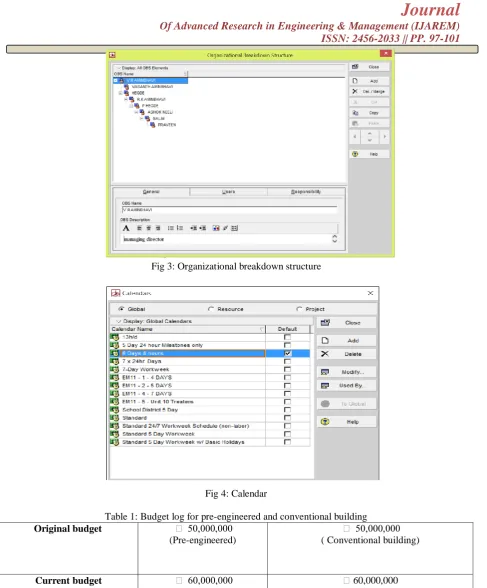
Organizational breakdown structure: The plans and specifications of construction are converted into physical structure and facilities. They involve organization and co-ordination of all the resources required for project. Calendar: calendar is regarded separately to assets and work. There are three types: Global, Project and
Resource calendar
Activities: The principle elements of a project work is called as activities. These have lowest position in work breakdown structure and are the lowest divisions of a project that is considered from an example. Resources: Resources include the people employed in organization and machinery that perform task on
activities across projects
Roles: Roles are project personnel job titles or skills.
Budget: Budget consist determined attempt of the total estimate and the cash flow needed, to complete a project.
This includes:
a) Establishing budgets
b) Establishing a monthly spending plan c) Tracking Budgets:
Proposed budget = Original budget + Approved budget changes +Ending budget changes Current budget = Original budget + Approved budget changes
Earned value management:Earned value is a technique for measuring project performance according the project costs and the schedule. It is calculated by;Earned value = Budget at completion (BAC) * Performance % Complete
IV. RESULTS
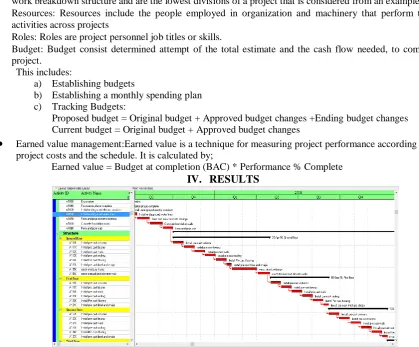
Fig 1: Layout, to left represents the activity table, and to the right activity network
Fig 3: Organizational breakdown structure
Fig 4: Calendar
Table 1: Budget log for pre-engineered and conventional building Original budget ₹ 50,000,000
(Pre-engineered)
₹ 50,000,000 ( Conventional building)
Current budget ₹ 60,000,000 ₹ 60,000,000
Table 2: Budget summary for pre-engineered and conventional building
Pre-engineered building Conventional building
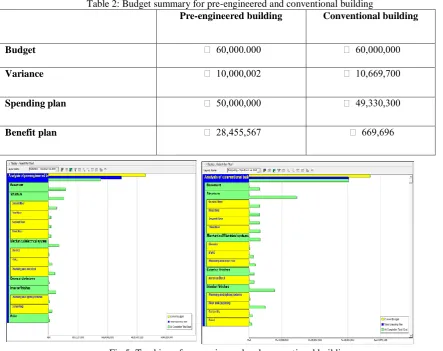
Budget ₹ 60,000.000 ₹ 60,000,000
Variance ₹ 10,000,002 ₹ 10,669,700
Spending plan ₹ 50,000,000 ₹ 49,330,300
Benefit plan ₹ 28,455,567 ₹ 669,696
Fig 5: Tracking of pre-engineered and conventional building
Table 3: Estimate to complete for pre-engineered and conventional building
Project budget (BAC) ₹21,544,432 ₹ 49,330,300
Planned budget ₹ 50,000,000 ₹ 50,000,000
Earned value
₹ 5,361,108 ₹ 24,665,150
Cost performance index(CPI)=EV/PV 0.10 0.49
PF=1/CPI 10 2.04
Estimate to complete(ETC)=PF*(BAC-EV)
₹ 1.61 crores (pre-engineered building)
V. CONCLUSION
The main aim of the study is to interpret the detail examination of the elements of pre-engineered building and conventional building. The study concluded as follows:
Pre-engineered building proves to be most efficient than conventional building in aspects of monitoring, minimal number of resource, time managing and cost.
Pre-engineered building is easy to construct as some of the methods implemented in conventional buildings are eliminated.
Pre-engineered building saves time as advance techniques are used, whereas in conventional buildings detailing work is must.
The requirements of resources in case of pre-engineered building are less than conventional buildings. The overall cost of pre-engineered building is low compared with conventional buildings.
Earned value of pre-engineered building is less than conventional buildings.
The project duration of pre-engineered building takes considerably less time than conventional buildings as only installing of pre-fabricated elements are done as they are factory produced.
Pre-engineered building requires minimum labor units than conventional buildings. The resources cost is minimum for pre-engineered building than conventional buildings.
Dismantling of structure is easy in case of pre-engineering building, whereas in conventional building the structure need to be demolished.
Quality control in pre-engineering building, the elements are inspected and then installed, in conventional building most of the cases thumb rules are followed.
Pre cast technology is a newer technology and achievable in Indian conditions.
The comparison of pre-engineered building and conventional building proved that pre-engineered buildings have various advantages than the conventional buildings.
REFERENCES
[1] Prof Dr S Seetharaman, “Construction engineering and management”, Published by “Umesh
publications”, 2005.
[2] Primavera, “EduCADD Training material’’, published by “EduCADD learning solutions Pvt.ltd”,
2005.
[3] Andrew Fernans Tom, Sachin Paul, “Project monitoring and control using Primavera”, “Journal of
innovativeResearch in science, engineering and technology”, Volume 2, Issue 3, PP.762-771, 2013.
[4] Kim S Elliot, “Pre-cast concrete structures”, published by “Butterworth Heinemann, an imprint of Elsevier science”, 225 wildwood Avenue Woburn, Ma 018101-2041, 2013.
[5] Milind Bhojkar, Milind Darade, “Comparison of pre-engineering building and steel building with cost and time effectiveness”. “International journal innovative science, engineering and technology”, Volume 1, Issue10, PP.487-490, 2014.
[6] Pradeep V, Papa Rao G, “Comparative study of pre-engineered and conventional industrial building”,
“International journal of engineering trends and technology”, Volume 9, Number 1, PP.1-6, 2014.
[7] Sagar wankhande, Prof Dr. P S Pajgade, “Review paper on comparison of conventional steel building andpre-engineering building”, “ International journal of research in advent technology”, Volume 2, Number 5,PP.271-276,2014.
[8] Abhyuday Titikish, Abhinav Dewangan, Ankur Khandewal, “Comparative study of conventional steel building and pre-engineering to be used as an industrial shed’’, “International journal of engineering and applications”, Volume 5, Issue 2(Part-2),PP.25-28, 2015.
[9] N.Dineshkumar, P.Kathirvel, “Comparative study on pre-fabrication construction with cast in situ
construction of residential buildings”, “International journal innovative science, engineering and technology”, Volume 2, Issue 4, PP.527-532, 2015.