Development of Teaching Materials Based on
Indonesian Folktale in Gowa District
Ulfa Tenri Batari
Universitas Negeri Makassar, Jln. Bonto Langkasa, Kampus Gunung Sari, Makassar, South Sulawesi, Indonesia
Achmad Tolla
Universitas Negeri Makassar, Jln. Bonto Langkasa, Kampus Gunung Sari, Makassar, South Sulawesi, Indonesia
Muhammad Rafi Tang
Universitas Negeri Makassar, Jln. Bonto Langkasa, Kampus Gunung Sari, Makassar, South Sulawesi, Indonesia
Anshari
Universitas Negeri Makassar, Jln. Bonto Langkasa, Kampus Gunung Sari, Makassar, South Sulawesi, Indonesia
Abstract—The purpose of the research was to develop learning materials of Bahasa Indonesia based on folklore in Gowa District for III grade students in the primary school. The type of research was research development with design development through the development of the teaching model of Four-D Model namely defines, design, develops, and disseminates. Data was collected through observation sheets, validation sheet, questionnaire, and the test results from the study. The data were analyzed using validity diagnosis, practicality and effectiveness. The result was proved that the overall validation criteria contained in the validation sheets syllabus, Lesson Plan, and Worksheet rated valid by the team of experts, practitioners, colleague friends. The three validation device's material that otherwise met the eligibility standards to use in learning Bahasa Indonesia in primary schools, in particular, in III grade. A small group of trial results was proved that materials meet these terms so no need more revision and deserve to be tried out in a large group or field trial. The test results from the scale field trials these are terms of practicability material, and effectiveness material has been met. So learning materials based on folklore in Gowa District was declared eligible to serve as learning materials of Bahasa Indonesia for III grades in primary school.
Index Terms—development of teaching materials, learning of Bahasa, and folklore
I. INTRODUCTION
The teacher is an honorable and noble profession. Teachers ideally looks professional with the primary task is to educate, guide, train, and develop curriculum. Teacher in the era of information and communication technologies is not just to teach, but must be the manager of learning. The teacher is expected to create challenging learning conditions, creativity and activity of learners, motivate learners, using multimedia, multi-method and multi-source (teaching materials) to achieve the expected learning goals.
Teaching materials is one component of a learning system that has an important role in helping learners to achieve Standard Competence and Basic Competence or learning objectives that have been determined. An elementary school teacher must prepare to teach material of Bahasa Indonesia. Bahasa Indonesia is a central role in the development of intellectual, social, and emotional learners and supporting the success of study in all subjects. Learning Bahasa Indonesia is expected to help students to understand themselves, their culture and other cultures, ideas and feeling, participate in society use the language, and find and use analytical skills and imaginative to the self of learners.
Competency standards subjects of Bahasa in elementary school, or Ibtidaiyah madrasah, namely: listening, speaking, reading, and writing. The four skills are presented in an integrated and not obtained at once. However, the ability gradually awakened. Interpret this, the teacher can focus on the development of language competence of learners by providing a variety of language activities and learning resources. Which then provides a variety of language activities and learning resources that are adapted to the conditions and peculiarities of the area, but still consider the national interest. Talk about the conditions and peculiarities of the area, the Capital Gowa District, Sungguminasa, is one of the potential areas to create teaching materials. The process of maintaining cultural traditions and customs made through oral tradition (folklore) and literary works, such as the Chronicle, mysticism, songs, tales, and lontarak.
Indonesian folklore, Gowa District in III grade students in primary school. This research can provide benefits for students as a source of learning that can motivate students to learning the language, literature and culture of Makassar. Moreover, enrich the knowledge, insight, and experience in learning literature to increase the sensitivity to appreciate the emotions of learners in work of literature. For teachers, this research is useful as a guide to carrying out the teaching and learning activities and simultaneously motivate to improve the performance of teachers in planning, implementing, and evaluating learning of Bahasa Indonesian. For policy makers, the results of this research into quality assurance instrument learning Bahasa Indonesia based on local wisdom.
Based on the above, it will set out the process for the development of teaching materials based on the folklore of Gowa district in the third-grade students in elementary school.
A. Learning Material
Kemediknas (2008) provide an understanding of some of the definitions of learning materials as follows:
a. Teaching materials are information, tools and texts that must be required of teacher/instructor for the planning and reviewing of implementation of learning.
b. Teaching materials are all forms of materials that used to help teachers/instructors in implementing the teaching and learning activities into the classroom.
c. Learning materials are written or unwritten material. (National Center for Vocational Education Research Ltd/National Center for Competency-Based Training).
d. Learning material is a set of material that arranged in a systematic matter, whether written or unwritten to create the environment/atmosphere that allows learners to learn.
Sulistyowati (2009) suggested that the use of teaching materials served as a guide for teachers to direct their activities within the learning process as well as a substance skill for students, guidance for learners to direct their activities within the learning process as well as a substance skill, and assessment tools, achievement or mastery of learning outcomes.
Step for the selection of teaching materials according to Rudianto (2011) namely (1) Identify the aspects contained within the standard of competence (core competencies) and basic competence; (2) Identify the types of learning materials; (3) Select the type of material in accordance with the standards and basic competencies.
According to Mulyasa (2006, p. 154) there are needed to be considered during the development of teaching materials, namely:
1. Validity
Aspect relating to the suitability of the material to achieve a level of competency, It is necessary to consider the validity of the material and scientifically.
2. Significance
It relates to the level of interest and significance so that the material is important to learn and relate directly to the formation of competencies.
3. Utility
Teaching materials should provide benefits for students, both academic and non-academic in continuing education at a higher level/working and living within the community, and develop learners by the principle of lifelong education.
4. Learnability
It relates to the possibility of the material to be learned in terms of feasibility, availability and ease to obtain it. 5. Interest
Teaching materials must be able to evoke the spirit of learners and encourage them to undertake a further study.
B. Learning Bahasa in Elementary Schools
Bahasa Indonesia is a subject that teaches students to communicate properly. This communication can be done either oral or written. Bahasa Indonesia is a communications tool that become one of the hallmarks of Indonesia and used as a national language. Learning Bahasa has a very important role in shaping the habits, attitudes, and the ability of learners to the next stage of development.
Learning Bahasa implementation based on KTSP 2006, based on the standards of competence. In the curriculum, 2013, subject of Bahasa in elementary school is taught by integrating the subject of Bahasa with science and social science. Subjects of Bahasa material aspects indeed to be open because that will be built is the language competence, but not necessarily all the subjects included in Bahasa.
There are various methods of teaching and learning languages such as oral method, mimicry method, memorization, and others. Some approaches to language learning, in principle, be used for the teaching of Bahasa, namely:
1. Formal or Traditional Approach
This approach considers language learning is a conventional routine, by following the ways that have been used to do based on experience.
2. Functional Approach
The functional approach assumes that to learn a language should make direct contact with the public or people who use the language.
This approach embraces the idea that language teaching should be something that is multi-dimensional, in the sense of many factors to be considered in teaching.
4. Socio Linguistic Approach
The sociolinguistic approach is a language teaching approach that utilizes the results of a sociolinguistic study. Sociolinguistics is the study of the relationship of symptoms to symptoms of a language community.
5. Psychological Approach
It looked at the psychological approach to language teaching is concerned with the science that examines how learners learn, and how learners as complex individuals.
6. Psycholinguistic Approach
This approach is relying on theories about how the process that going on in the minds of children when starting to learn the language, and how its development.
7. Behavioristic Approach
Skinner pioneered this approach about 1957. The behavioristic approach can be controlled from the outside, namely the stimulus and response. The environment provides stimulus or stimuli, whereas learners to respond.
8. Classroom Management Approach
Classroom management approach can be done through a variety of other approaches, namely the authoritarian approach, permissive, changing behavior, socio-emotional climate approach, and the approach to the group process.
9. Communicative Approach
This approach was born as a result of dissatisfaction with the practitioners or language teachers for the results achieved using the grammar translation method. It is because only prioritize mastery of grammar rules, rules out the ability to communicate as the expected final form of language learning.
C. Folklore
Traditional literature consists of various types such as myths, legends, fables, folklore (folktale, folklore), folk songs, and others. Mitchell (2003, p. 228) argues that the distinction types of customary literature not clear yet, there is an element of overlap characteristics among the various types of traditional literature. Fang (1976, p. 1) distinguishes the elderly Malay folk literature into five types, namely the story of the origin, the story of animals, the story of funnies, th e story of solace and rhymes. So Fang did not reveal of myths and legends into old Malay folk literature but referred to them as the origin story in which can be both myths and legends. Even more important to note is the meaning of the content, messages or morals offered by different types of stories.
Various folklores contained in the province of South Sulawesi, those are Putri Tandampalik, I Laurang, Ambo Upe dan Burung Beo, Lamaddukelleng, Sawerigading, La Upe, Nenek Pakandeso and others. Folklore originating from Gowa district is Lamaddukelleng. The stories that serve as folklore have a deep meaning, and cultural values are very high. Through the characteristics and nature of the characters, learners can feel and appreciate the meaning of life is applied in real life from the meaning that learners can find the values that shape attitudes and behavior.
II. METHODOLOGY
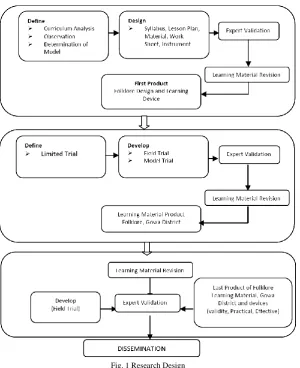
This research was research development (Research and Development). The design of the development was done through the development of teaching models by Thiagarajan (1974, p. 5), that known as the Four-D models namely define, design, develops, and disseminate.
Fig. 1 Research Design
Data were collected in the form of oral and written. Data were also obtained from the verbal suggestions/criticism orally on products by experts (content) based on teaching material of folklore, expert design (media) instructional literature, practitioners (teachers) and learners. Data was formulated in the form of spoken correction/feedback/suggestions in writing directly to the product that obtained from the experts (content) learning, instructional design expert literature, practitioners (teachers) and learners. The results of data were collected from a validation sheet, observation sheets, questionnaires, and achievement test. Data analysis was performed to assess the validity, practicality, and effectiveness. The following analysis of the data presented in the form:
A. Analysis Validity Instructional Materials
To measure the validity of the Bahasa based on folklore teaching materials, Gowa District, do the following steps quoted from Nurdin (2007).
1. Calculate the average of the results from the validation of all validator for each criterion by the formula
With
= Average Criterion to i
Vij = Scores the results of an assessment of the criteria to i by a validator to j N = Number of Validator
3. Calculate the total average ( ) with formula
= Total Average
= Average aspect to i n = Number of aspect
4. Assign categories validity of each criterion or aspect or overall aspect by comparing the average criteria ( ) or mean aspect criteria ( ) or mean total ( ) of the following categories:
3,5 ≤ M ≤ 4 very valid
2,5 ≤ M ≤ 3,5 valid
1,5 ≤ M ≤ 2,5 quite valid
M < 0,5 not valid Description:
GM = to find the validity of each criterion M = to find the validity of every aspect M = to find the validity of all aspects
To determine the validity of the models used inadequate criteria if:
"quite valid," and
2 _(i ) for every aspect of the minimum is in the category of "valid". If found aspects those are not valid criteria, it will be revised and re-tested until it reaches the level valid.
B. Data Analysis of the Practicability of Learning Materials
Practicability analysis aims at measuring the components of exhaustiveness Bahasa learning material based on folklore in Gowa District and many supporters. The practicability of learning materials to be analyzed with the following steps.
1. Calculate the mean observation every aspect of each meeting with the formula
with
= Average aspect to i meet to m
= Observation result for aspect i criterion to to j n = Number of criterion in aspect to i
2. Calculate the average of each aspect of the observation with the formula:
= average aspect to i
= average aspect to i meet to m
3. Calculate the average total with the formula
= average of all aspects = average aspect to i n = number of aspects
4. Determining the feasibility category of each aspect or all aspects of learning materials by matching the average of each aspect ( ) or average total of aspect ( using categories as follows:
,5 ≤ M ≤ 2,0 z 0,5 ≤ M ≤ ,5 z
0,0 ≤ M ≤ 0,5 z Description:
M = to find the validity of each aspect M = to find the validity of the overall aspect.
Learning the feasibility of learning materials of Bahasa Indonesia based on folklore is said to be adequate if value and minimum in the partly materialize category. It means that the materials are not revised. If it does not meet these criteria, then the corresponding aspect should be revised and re-tested until it reaches adequate levels.
The effectiveness of the Bahasa learning materials based on folklore is determined through the analysis of: learning outcomes of learners, the activity of learners, the response of learners to materials, and the ability of the teacher to manage of material.
1. Analysis of the learner learning outcome
Learner learning outcomes that measured by the achievement criteria of minimal exhaustiveness of 2.67 and classical x v . L w d d w v ≥ 2.67. T d w d b v ≥ 85%, q v 2.67.
2. Data analysis of learners' activity
Learner activities were analyzed by calculating the Average of frequency and percentage of time that spent in performing the activity during learning activities. The following analysis procedure for each component that is quoted from Nurdin (2007):
a. Learner activity on each indicator in a single meeting specified the frequency and then search the average frequency by two observers. It further determined the frequency than the average from the average frequency of the meeting for several times;
b. Looking for the percentage frequency of each indicator by dividing the magnitude in the frequency by the number of frequencies for all indicators. Results of division multiplied by 100%. Moreover, then looking for the average percentage of time for several times and put on a table of average percentage.
3. Data Analysis of Learners' Response Application Materials
Learner assessed the response include: (1) response to the materials, (2) response to the learners' book, and (3) response to Worksheet. Analysis of the response from the students was done through the following procedures.
a. Calculate the frequency and percentage of learners who gave a positive response. b. Determine categories for learners' positive response based on the following categories.
3,5 ≤ ≤ 4 v v 2,5 ≤ < 3,5 v ,5 ≤ < 2,5 v 0,5 ≤ < ,5 v
< 0,5 very poor positive response
The students have expressed a positive response if: (1) response to the materials, (2) response to the learners' book. Moreover, (3) response to Worksheet is more than 50% of the students who gave a positive response to at least 70% of the amount of the stated aspects.
4. Data Analysis of Application Materials
It analyzes of the application to the learning materials are based on the data of the two observers. Based on an assessment of both the mean values, defined observer KG from KG1 and KG2. Where KG1 is the average value of the results from the assessment of the first observer. KG2 is the average value of the results from the assessment of the second observer.
The KG value then confirmed by the determination of interval categories of teachers' ability to manage material, namely (Nurdin, 2007)
KG < 1,5 very poor ,5 ≤ KG < 2,5 poor 2,5 ≤ KG < 3,5 3,5 ≤ KG < 4,5 4,5 ≤ KG v
The ability of teachers applying learning materials revealed the adequate minimum value of KG, if the value is in the high category. It means the appearance of teachers can be maintained. If the value of KG was in the other category, then the teacher must improve its ability to recapitulate the aspects assessed less. Moreover, then do a re-observation of teachers' ability in applying learning materials.
III. RESULT AND ANALYSIS
The implementation of this development research was conducted in February 2015. The results obtained in each phase of development, based on the development of Four-D with respect in the process of developing of learning materials based on the folklore of Gowa District as follows:
1. Description of the results of the Definition Phase (Define)
This section begins with the initial observation in SD Negeri Paccinongang, SD Inpres Lambengi and SD Negeri Anasappu, Gowa District. The information was obtained that the material by teachers today refer to culture or values and wisdom in the area outside of the local area and culture, particularly, Gowa District and South Sulawesi in General. The Educational Unit Level Curriculum (KTSP/Kurikulum Tingkat Satuan Pendidikan) was used in three schools. It contains a set of plans and arrangements for the purpose, content and learning materials and how was used guide for learning activities to achieve the goal of education.
The format was used in accordance to KTSP. Syllabus material is arranged into the shape on the table. Lesson Plans (RPP/Rencana Pelaksanaan Pembelajaran) includes identity, standards competence, basic competence, indicators, purpose, subject matter, learning experience (early activity, main activity, and final activity), method, sources/materials/learning tools, and assessment. The worksheet was designed concerning elemental competency and standard competency in KTSP. Practitioner validator (teacher) was selected three people from three schools that designated in the study. The teachers were selected as the validator that determined by the consideration that the teachers have the feasibility to assess learning materials. The three teachers experienced in designing learning materials in a workgroup master (KKG/Kelompok Kerja Guru) as well as experienced in the following learning material design for the competition. The overall criteria contained in the validation sheet syllabus, RPP and Worksheet were rated validity by three practitioners (teacher). Average total results of validation material syllabus, RPP, and worksheet validator of the practitioner (teacher) sequences were 4.43, 4,46 and 4,70. The third devices validation material with a very valid category.
Based on those results, the practitioner (teacher) assessed of the syllable, RPP, and worksheet that developed by researchers has met the feasibility for use in learning Bahasa in primary schools, in particular, in III grade. Colleague friend validator selected to assess the learning materials based on the folklore of these three people. Three colleague friends were chosen with the consideration that they have sufficient knowledge of the materials. Also, the three colleague friends are people who struggled in the field of education, as a teacher, principal, and superintendent. Average total results of validation material syllabus, RPP, and worksheet from validator (three colleague friends) sequence are 4,43, 4,46 and 4,70. The three devices validation materials with a very valid category. Based on those results, the validator rate that syllabus, RPP, and worksheet developed by researchers already meet the feasibility for use in learning Bahasa in primary schools, in particular, in III grade.
The expert team validator was designated as many as three people. The three validators were lecturer of Universitas Negeri Makassar (UNM) and Universitas Muhammadiyah Makassar on Education of Language and Literature of Bahasa Indonesia.
3. Description of the results of learning material development Phase (Develop)
Types of folklore are used in the form of Fables, Legends, and stories. Folklore that used in Bahasa learning materials for III grade, it was folklore that stems of Gowa District namely I Manyambungi, Sobekan Jala Buaya Putih, Garuda dan Empat Bersaudara, Danau Mawang, Anak yang Giat Mencari Nafkah, Pohon Taeng, Manusia Berdada Emas, Si Manusia Udang, Kucing dan Tikus serta Si Kera, Si Ayam Hutan dan Raja Kepiting.
Stories that serve as a folklore have been meaning, and cultural values are very high. Through the characters and characteristics, learners can experience and live up to the meaning of life. It is applied in real life, from the meaning that the learners can find values that are capable of shaping the attitudes and behavior. Local cultural values were about to be introduced and cultivated in the students through the learning materials based on folklore, such as passamaturukang, sipakalabbirik, sipakaingak, sipakatau, sipakalalo, sikatutui, and Sikapaccei. Furthermore, folklore, materials developed by displaying several images that support the story.
The validator designated to assess these materials is as much as three people, aspects of which will be validated in the learning materials covering materials, media, and literature. Validation of these materials has endured for two phases. It was because on Phase I, there were many shortcomings or errors from the aspect of material and media. While the literary aspect of the very valid votes by the validator with an average over 5.00.
The stories that used as the materials were the kind of original stories and the folklore from society in Gowa District. This folklore does not contain intimidation against tribal, religious and racial, pornographic or violent, so it is feasible to use. Furthermore, intrinsic and extrinsic elements of folklore are also complete and contain many aesthetic values and the character of the regional society in the Gowa District. Moreover, the excess of which belonged to the folklore materials, it was used in validator argued that such materials be fit for used at both the national and local scale. It because the local cultural society in Gowa is sublime. Because of the very valid rates, then no aspect of literary worthiness is not validated and revised again in phase II.
All errors or shortcomings that were found in the content and media in the phase I was made as a reflection for the consummation of learning materials in phase II. Presentation of material phase II was declared the comprehensive average with the very valid aspects of ( ) 4.71. Graphic material phase II was declared very valid also with an overall average ( ) of 4.51. The language-learning material was used in Phase II very valid or otherwise has been viable with the average overall aspects of ( ) 4.90. It shows that in terms of content, the graphic (medium), and language-learning materials have been tested and qualified to learn Bahasa Indonesia in elementary school III grade.
4. Description of the results of Dissemination Phase (Disseminate)
This phase was the phase through the use of materials and devices that have been developed on a broader scale, in other schools, and by other teachers. The goal is to prove the learning effectiveness through the use of folklore materials for the learning activities. Terms of worthiness test with small groups.
IV. CONCLUSION
1. In the definition, the phase was done to check and define the terms of the development of learning materials by KTSP, and then the preliminary study was done. Those are: 1) analysis of the beginning until the end (preliminary analysis), (2) analysis of the learners, (3) material analysis, (4) task analysis and (5) specification of learning objectives. 2. Design phase of Bahasa Indonesia learning materials based on folklore on III grade learner in the primary school has many design activities; such as (a) designing the syllabus; (b) designing the RPP; (c) designing the material; (d) designing the worksheet; and (e) designing the instrument. After the draft is completed, the next step is a validation plan. After the design is completed, the next step is to do a validation plan. The result was proved that the overall validation criteria contained in the syllabus, RPP, and worksheets rated valid by three practitioners (teachers). Provided that if the value of the mean validation criteria ( ) was equal to or greater than 3.5, then any aspect stated was valid. It was similar to the results shown in the table above. Validation value was the lowest 3.67, and the highest was 5.00 with a very valid category. Therefore, there was no aspect that should be revised. Average total material syllabus, RPP, and Worksheet from practitioner validator (teacher) sequences were 4,43, 4,46 and 4,70. The result of three devices validation materials with a very valid category. Based on those results, the practitioner (teacher) assessing that the syllable, RPP, and Worksheet, that developed by the researcher already meet the eligibility standards to use in learning Bahasa Indonesia in primary schools, in particular, in III grade. For the design of materials or materials, validated by the three people who were the expert in the content, materials, and literature. The first validation result was proved that the design deserves to be materials used both in terms of content, media, and literary.
3. The development phase is the trial phase of small group or model. A small group of trial results was proved that materials meet these terms so no need more revisions and deserve to be tried out in a large group or field control.
4. Dissemination phase is the final stage of learning materials. The test results from the scale field trial were a term of practicability materials, and effectiveness materials have been met. So learning materials based on folklore was declared eligible to serve as Bahasa Indonesia learning materials for III grades in elementary school.
REFERENCES
[1] Abdul Majid. (2007). Perencanaan Pembelajaran: Mengembangkan Standar Kompetensi Guru. Bandung: PT. Remaja Rodsakarya.
[2] Brady, Laure. (1991). Children and Their Books: The Right Book for the Right Child I. Melbourne: The Macmillan Company. [3] Brown, James D. (1995). The Elements of Language Curriculum. Boston: Heinle & Heinle Publishers.
[4] Byram, Michell & Gerundy Peter. (2003). Context and Culture in Language Teaching and Learning. Australia: Short Run Press ltd.
[5] Coleman, James. A & Klapper John. (2005). Effective Learning & Taeching in Modern Languages. London: Routledge. [6] Dahar, Ratna Wilis. (2011). Teori-Teori Belajar dan Pembelajaran. Jakarta: Erlangga.
[7] Danandjaja, James. (1997). Folklore Indonesia, Ilmu Gosip, Dongeng, dan lain-lain. Jakarta: Pustaka Utama Grafiti. [8] Endraswara, Suwardi. (2009). Metodologi Penelitian Folklore: Konsep, Teori, dan Aplikasi. Yogyakarta: Media Pressindo. [9] Fachruddin, A. E. (1981). Sastra Lisan Bugis. Jakarta: Depdikbud.
[10] Fang, Liaw Yock. (1976). Sejarah Kesusastraan Melayu Klasik. Singapura: Pustaka Nasional.
[11] Huck, Charlotte S, Susan Hepler, & Janet Hickman. (1987). Children's Literature in the Elementary School. New York: Holt, Rinehart and Winston.
[12] Lennox Sandra. (2012). Language, Literature, and Literacy, Authentic Engagement in the Early Years: Practically Primary 17.2, 33-36.
[13] Mulyasa, E. (2006). Menjadi Guru Profesional Menciptakan Pembelajaran Kreatif dan Menyenangkan. Bandung: Remaja Rosdakarya Office.
[14] Oemar Hamalik. (1990). Perencanaan Pengajaran Berdasarkan Pendekatan Sistem. Bandung: PT. Citra Aditya Bakti.
[15] Poerwanto, Harry. (2007). Peningkatan Pembelajaran Apresiasi Sastra melalui Pendekatan Konstruktivisme untuk Siswa Sekolah Dasar. Jurnal Ilmu Pendidikan, 34.2, 144-151.
[16] Pannen, Purwanto, P. (2001). Penulisan Bahan Ajar. Jakarta: Dirjen Dikti Depdiknas.
Ulfa Tenri Batari on June 5, 1986 in Sungguminasa, Indonesia. She is an executor of elementary school in Gowa District. She graduated her Diploma in Universitas Muhammadiyah Makassar in 2002-2004. And then she continued her bachelor in Universitas Muhammadiyah Makassar in 2004-2006. And then she continued her Master Degree in Universitas Negeri Makassar in 2008-2010.
Ulfa Tenri Batari has some scient b , :”P d P d d k ” 2008, “T R N F 2009, “M v S d L ” 20 0.
Achmad Tolla, was born on March 21, 1949 in Leling-Mamuju, Indonesia. He is a lecturer at the Faculty of Languages and literature at State University of Makassar.
Prof. Dr. Achmad Tolla, M.Pd has some scientific publications, namely: (1) Shifting of languages as the result of a merging of different ethnic, in 2007, (2) Language shift in environmental migrants in Luwuk, 2004, and (3) The development of communicative language Indonesia test device for primary school Pupils in the city of Makassar, in 2003. He has been the Chairman of the Indonesian Language Education Program studies S-2 and S-3 since 2009-present.
Muhammad Rafi Tang, was born in Soppeng in 1960. He graduated his doctoral program in Universitas Negeri Malang, Department of Bahasa Indonesia. He is professor of Language Education and Literature of Faculty of Language Education and Literature in Universitas Negeri Makassar. His scientific paper is La Dado Lele Angkuru-e, Sastra Bugis Klasik (philology study). Lecturer in subject of philology and introduction to Literature, classic literature. His book is Pengantar Kajian Kesusastraan.
Anshari, was born in 1964, 29 April in Enrekang, South Sulawesi, Indonesia. He graduated his undergraduate in IKIP Ujung Pandang in 1988. He assumed his magister title in the field of Humanities in Hasanuddin University in 1999. He graaduated his doctoral program in State University of Malang in 2007.
He started his carreer as a lecturer in Faculty of Language and Literature in IKIP ujung Pandang since in 1989. He lecturing in Postgraduate program in State University of Makassar since in 2007 until present. He asssumed his Professor in 2010. Present he active as writer in some print media in Makassar, as well as k v v . P d “Tidang Sipulung” M z 2009-present.