Provision of health services to microfinance clients: An analysis of evidence and future directions
By Somen Saha
A Master’s Paper submitted to the faculty of the University of North Carolina at Chapel Hill
In partial fulfillment of the requirements for the degree of Master of Public Health in
the Public Health Leadership Program. Chapel Hill
2009
___________________________ Advisor
________________________________ Second Reader
Page 2 of 31
Abstract
Introduction
The growth of microfinance as an effective tool for poverty reduction provides a mechanism to extend health services to the poor and needy. Of the 3,552 reported microfinance institutions (MFI), 226 MFIs also provides health services to their clients in Latin America (53), Africa (43) and South Asia (130). There are limited systematic efforts to understand the sector, except for evaluation of individual programs. This paper attempts to develop a broader understanding of the microfinance and health sector by collecting views from senior MFI practitioners about their experiences in offering health services to clients.
Methods
Identification of microfinance institutions with self-reported health programs in Africa, Latin America and South Asia was done through exploring the Microfinance and Information Exchange (MIX) database. A self-administered questionnaire was designed to collect experiences from identified MFI practitioners with health programs. After an initial poor response from general emailing of the questionnaire to the MFIs, a selective approach was taken through approaching several intermediary organizations to encourage MFIs to participate in the survey.
Findings
Fourteen MFIs completed the survey to date with ongoing follow-up efforts underway. MFI health programs can be classified into four broad categories, according to their primary goals: raising client awareness of health-related issues, facilitating access to health services, provision of health services, and removing financial barriers. Hygiene and sanitation, childhood illnesses, maternal health, HIV/AIDS and water & sanitation dominate the health needs addressed by MFIs. Although preventive health programs dominate the agenda of MFIs, curative services are also offered through means such as referring to formal health care providers and financing health services through extending health micro insurance and providing health loans at the individual level.
Conclusions
This study is a first of its kind effort to document the experiences of microfinance practitioners with health programs through a survey. The study confronts the general belief that MFIs offer health services to protect their business interest because of clients falling sick and being unable to repay loans. The key conclusion of the study is that the MFIs appear to be motivated by the lack of client awareness about health issues. Also, MFIs struggle to design appropriate
Page 3 of 31
Glossary
BRAC: Bangladesh Rural Advancement Committee
CARD: Center for Agriculture and Rural Development
CHC: Cambodia Health Center
GK: Grameen Kalyan
ID: Initiative for Development
ILO: International Labor Organization
MFI: Microfinance Institution
MDG: Millennium Development Goals
MIX: Microfinance and Information Exchange
NGO: Non Government Organization
NHIS: National Health Insurance Scheme
SEWA: Self Employed Women's Association
STUP: Specially Targeted Ultra Poor
UNFPA: United Nations Fund for Population
Page 4 of 31
Introduction
Microfinance, the extension of small loans to groups of poor people for the purpose of
investing in self-employment programs, pioneered by Muhammad Yunus in Bangladesh during
1970s, has proved to be an effective and powerful tool for poverty reduction. Evidence shows
the positive impact of microfinance on poverty reduction as it relates to the first six out of eight
Millennium Development Goals1 (Morduch and Haley 2001). As of December 31, 2007, 3,552
microfinance institutions reported reaching 154,825,825 clients, 106,584,679 of whom were
among the poorest when they took their first loan. Of these poorest clients, 83.4 percent, or
88,726,893, were women. Approximately 90.1 percent of the poorest clients reported were in
Asia, a continent that is home to approximately 63.5 percent of the world’s people living on less
than US$1 a day (Sam 2009). The microfinance industry is increasingly becoming part of the
larger financial framework and microfinance institutions (MFIs) are emerging as social
businesses within this framework, catering to an untapped market segment while creating
value for their members, through access to low cost financial services. This assimilation into
the routine financial infrastructure allows for greater innovation in financial instruments,
delivery channels and business partnerships that overcome the legal and market-related
constraints in reaching out to the poor. What once started as a purely philanthropic endeavor
has now attracted attention of several mainstream corporate players. In 2007, JP Morgan
launched a microfinance unit as part of its emerging markets strategy. Pierre Omidyar, founder
of eBay, gave $100 million to Tufts University in 2005 with the stipulation that the donation be
Page 5 of 31 used to create a fund seeking its returns only through investments in microfinance. According
to the Microcredit Summit Campaign report, by end of December 2007, the total cash turnover
of these institutions worldwide is estimated at $2.5 billion.
However, provision of credit alone cannot mitigate poverty. A poor woman who generates
income through microfinance but who does not have adequate access to health care for herself
and her family, and who lacks essential information about health and nutrition is still living in
poverty. There is a greater reduction in poverty when microfinance programs are combined
with increased access to basic social services than when the programs focus on credit alone
(Nigam and Mohiuddin 2008). The unmet demands as well as the social and business rationale
for microfinance institutions (MFI) to diversify into provision of health services are discussed in
the following sections. The aim is to highlight the growing interest among microfinance
institutions to offer health services as products to protect poor clients from health related
morbidity. The paper is organized in nine sections. The first two sections discuss broadly the
microfinance sector and scope for integrating health services into microfinance; the third
section discusses the types of health services. The remaining sections (four through nine)
describe a study that was undertaken to collect information directly from MFIs that have health
programs. The fourth section discusses the study design and methods. The fifth section
discusses the characteristics of survey respondents. The sixth section discusses the limitations
of the study. Findings are discussed in the seventh section, followed by a discussion section
Page 6 of 31
Integrating Health Services into Microfinance Program
There are multiple arguments for integrating microfinance and health services. At a macro
level, Microfinance is poised to become an effective tool to address the growing public health
concerns for developing economies with 3 out of 8 Millennium Development Goals directly
relating to health;
i. Reduce child mortality: Reduce by two-thirds, between 1990 and 2015, the under-five
mortality rate
ii. Improve maternal health: Reduce by three-quarters, between 1990 and 2015, the maternal
mortality ratio
iii. Combat HIV/AIDS, Malaria and other diseases: Have halted by 2015 and begun to reverse the
spread of HIV/AIDS
From the business perspective, a number of studies have demonstrated the effectiveness of
combining microfinance and other development tools in increasing client outreach (i.e. the
more clients it serves) and maximizing benefits to the clients of MFI (Oxfam GB 1999, Smith and
Jain 1999, Johnson and Ben 1997, Marcus and Harper 1999, Wright 2000). A 15 month
microfinance and health integration pilot project in southern India by Freedom from Hunger in
partnership with the Microcredit Summit Campaign and with financial support from Johnson &
Johnson, demonstrated that MFIs were willing and able to pay for health education training
that expanded client services and improved clients’ health (Sam 2009). There is a strong
business rationale for integrating health services into microfinance program. Among Grameen
Bank clients, illness and related expenditures are the leading cause for micro-business failures
Page 7 of 31 found that out of 2338 loans taken during 2005- 2006, 11% were taken for health care purpose
(Gopalan 2007).
Other benefits of integrating health services into microfinance include economic
empowerment, social empowerment, and reduced gender based violence. In one of the rare
randomized control trials in the area, Kim et. al. (2006) demonstrated the impact of
microfinance-based intervention on women’s empowerment and the reduction of intimate
partner violence in South Africa.
Types of health services by MFI
Microfinance organizations have experimented with different types of health programs
depending on their client needs and institutional strategic interests. Programs range from
preventive to curative services. Prevention includes promoting health awareness, education
and advocacy to provision of health insurance; health loans, and savings. Curative services
include home based health services as well as formalizing linkages with public and private
healthcare providers. Different models of health provision exist. While in some cases MFIs
have formally contracted with healthcare providers to provide services to their clients
(Mamun 2007, Siegel et al. 2001, Hauck 1997) in other cases they have set up a specialized
agency within their own structure to directly deliver health services (CIDEF 1998). Multilateral
and bilateral agencies as well as philanthropists like UNFPA, USAID, ILO, Bill & Melinda Gates
Foundation supported MFIs to diversify, adding health to their portfolios (Sam 2009, Siegel et
al. 2001). Technical support agencies like Freedom from Hunger have implemented projects to
Page 8 of 31 programs (Sam 2009, Dunford et al 2006). With this background in mind, a study was
undertaken to collect more detailed information about MFIs which have health programs.
Study Objective, Design & Methods
The objective of the study is to understand practices of MFI practitioners, in Africa, Latin
America and South Asia, who have integrated health component into their MFI program. These
three regions represent two-third of MFIs registered globally.
This study has two parts:
I. Identifying MFIs which have health programs
II. Surveying a sample of such MFIs to understand their practices
The study was conducted as part of a master’s thesis in the Gillings School of Global Public
Health, University of North Carolina at Chapel Hill. This study is part of a larger effort
entitled "Integrating Microcredit with Global Public Health", which is supported through a
Gillings Award at the UNC Gillings School of Global Public Health. Specific objectives were to
understand the health program of each respondent MFI; program goals, design, customer
practices, program implementation processes, and success factors.
1. Identification of MFIs with health programs
We identified the existence of health programs in microfinance institutions in Africa, Latin
America and South Asia, through exploring the Microfinance and Information Exchange (MIX)
Page 9 of 31 provides broad information about the microfinance industry/sector; microfinance institutions
(MFIs) worldwide, public and private funds that invest in microfinance, MFI networks,
raters/external evaluators, advisory firms, and governmental and regulatory agencies. The MIX
MARKET currently provides data on 1374 MFIs, 104 investors and 182 partners (MIX Market
2009). The following search terms were used: health, health services, health loan, health
insurance, health program. Forty Three MFIs in Africa, 53 MFIs in Latin America, and 130 MFIs
in South Asia have been identified through this process as having health programs. These 226
programs vary widely from small scale health awareness programs to large and complex health
programs delivering complex clinical services.
2. Questionnaire Survey
A brief self-administered questionnaire was developed and forwarded to the 226 MFIs
identified through the above process. A copy of the questionnaire is provided in Appendix 1.
The questionnaire was designed in three languages: English, French, and Spanish. The
questionnaire was designed to measure: health needs addressed by the health program, health
interventions, principal motivations for offering health services, goals of the discrete offered
health programs, design and duration of health program, clients outreach, and key
performance indicators. The questionnaire included objective questions, multiple choice
questions with provision for additional response, and open ended questions. In conclusion, the
respondents were asked if they have done an evaluation of their health programs, and their
willingness to share such materials. Those MFIs which have consented to participate in a case
Page 10 of 31 later period. Both offline (MS Word) and online (Qualtrics software) questionnaires were used
for collecting responses from participants with questionnaire emailed to MFIs. A total of 27
MFIs (11%) showed interest in the survey of which 14 completed the survey. Analysis
presented in the following sections is based on responses from 14 MFIs who completed the
survey. A list of MFIs completing the survey is given in appendix 2.
Limitations
The methods discussed above have three major limitations:
1. The MIX market database does not explicitly list health services of MFI. However, this is
chosen as the primary search tool because it enlists 1374 of the 3552 reported MFIs. There
is no known database, to the author, which reports MFIs by health program. To validate
our search and to have additional information about MFIs offering health services, personal
communications were made with recognized leaders in the microfinance and health sector,
like Freedom from Hunger, and Microcredit Enterprise.
2. Being a self-reported questionnaire, primarily shared through email among the MFI
community, the initial response rate predictably was low at around 6%, even after two
reminders. In the language of social exchange theory, the costs of responding are perceived
to be much higher than any anticipated rewards for doing so. Hence, organizations with
good presence and working relations with the MFI community were approached to
encourage MFIs to participate in the survey. Freedom from Hunger and Microcredit
Enterprise facilitated the survey response collection through forwarding and encouraging
Page 11 of 31 expected to increase the response rate further through ongoing follow-up. This limitation
underlies the importance of intermediaries in seeking participation from senior managers of
MFIs.
3. The 14 survey responses represent a convenience sample of highly motivated MFIs who
agreed to participate. Hence the results do not present the complete representative
picture of MFIs having health programs. However, characteristic of the respondents, as
discussed in the sample characteristics section, do indicate that the limited sample does
have some representation geographically, and represent views of MFIs reaching out to a
total of half a million population with health services.
Characteristics of Respondents
Duration of health program
Fifty seven per cent of MFIs have health programs which are 1-3 years old, suggesting health is
a recent program addition for more than half of sampled microfinance community. However,
14% of the MFIs have programs which are more than 15 years old. This suggests that while the
majority of MFIs are new in health services, there are some with a long history of offering
Page 12 of 31 Figure 1: Years of health program in MFI
Client outreach
Together the 14 MFIs, completing the survey reach out to 464,164 clients with health services.
Figure 2 shows the distribution of MFIs, responding to survey by region. Half of the MFI
response came from African region, with the rest shared between Latin America (21%) and
Southeast Asia (29%). Although the geographical distribution of the respondents varies from
the actual distribution of MFIs in the above region, this distribution shows adequate
representation of MFIs from the three regions under study.
1-3 years 57% 4-7 years
15% 8-15 years
14% More than 15
years 14%
Page 13 of 31 Figure 2: MFI responding to the survey by Region
Findings
Health program goals
Program goals vary widely across MFIs. While some health program goals are meant to address
a single health need, such a reduction of tuberculosis or improving health insurance coverage,
other programs were meant to address broader goals accompanied by provision of a bundle of
services. The following illustrates the variability of goals;
• To have a maximum of our beneficiaries (borrowers and savers) registered with Ghana's
National Health Insurance Scheme (NHIS) either through us or by themselves – ID, Ghana
• To reduce TB prevalence by reducing poverty – CHC Limited
• To furnish to the members of the timeliness of apprenticeship in the health domains,
nutrition and family Planning in order to reinforce the techniques of family planning –
Nyesigiso, Mali
Southeast Asia 29%
Africa 50% Latin America
21%
Page 14 of 31
• To contribute the prevention of childhood illness and of the woman of the groups that we
work – Prisma, Peru
• To provide groups of women financial services combined with informal education sessions
about health (HIV/AIDS, Diarrhea, malaria, breasfeeding) – Kondo Jigima, Mali
• To provide preventive health care in the form of education and access to primary healthcare
at clinics, free medical screening camps and hospital OPDs. Insulate the poor from financial
"health shocks". Ensure high quality service delivery by all healthcare service providers. –
Ujjivan, India
• To provide health protection services to clients and their families to achieve healthy
microfinance clients. – CARD, Philippines
• To contribute to the improvement in the life conditions of women from rural and semi-urban
communities utilizing two simultaneous products: to provide credit and savings services and
to provide education to members in the area of health, nutrition, and micro-business
management. – FUCEC, Togo
• To offer members health trainings that are dialogue-based in groups of clients. These
trainings have the goal of protecting clients from illnesses such as malaria, HIV/AIDS and
childhood illnesses as well as the change in attitude, behavior and beliefs of the members. –
Kondo Jigima, Mali
• To provide preventive health education and ambulatory services to our clients. – Fundacion
Page 15 of 31 Health needs
MFIs were asked to identify the specific health needs of their clients that they seek to address
through the health program. Hygiene and sanitation (30%) dominates the health needs
addressed by the MFIs. Other major health needs include childhood illnesses (26%), maternal
health (26%), HIV/AIDS (19%), and water & sanitation (15%) (Figure 4). Tertiary care of
patients, herbal medicine plants, tuberculosis, malaria, family planning, and sexually
transmitted infection are health needs MFIs mentioned under category of “others”. MFIs often
address more than one health need.
Figure 4: Health Needs addressed by MFI
Health Program Delivery
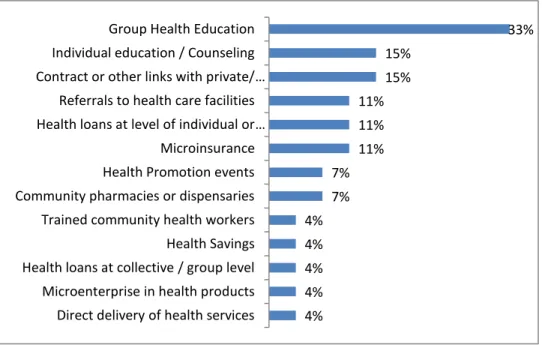
Awareness and health education is an important program goal for MFIs to generate client
awareness. One-third of all MFIs responding to the survey used group based health education
session to spread health awareness among its clients, followed by individual counseling
7% 11% 11% 11%
15% 19%
26% 26%
30%
Page 16 of 31 sessions (15%). Fifteen per cent MFIs facilitate provision of health services through contracting
with public/private health care providers, while 11% facilitate referral to health facilities. A fifth
of MFIs who responded to the survey offer financial services in the form of health loans (11%),
and micro insurance (11%). Other health programs include conducting health promotion
events, community pharmacy or dispensary services; training community health workers,
financial products like health savings and health loans at group level, provision of health
services through direct delivery and microenterprise through health product distribution by
clients.. MFIs often implement combinations of programs to address the health needs (Figure
5).
Figure 5: Health Program Delivery
Program design
The design of health programs varies according to client needs. Based on responses received
from MFIs, a broad typology of different health programs is discussed in Figure 6. These are
4% 4% 4% 4% 4% 7% 7% 11% 11% 11% 15% 15% 33%
Direct delivery of health services Microenterprise in health products Health loans at collective / group level Health Savings Trained community health workers Community pharmacies or dispensaries Health Promotion events Microinsurance Health loans at level of individual or …
Referrals to health care facilities Contract or other links with private/ …
Page 17 of 31 followed by selected quotes of responses to open-ended questions in the questionnaire.
Broadly health programs can be classified into four categories: raising awareness of clients;
facilitating access to services; provision of services; and removing financial barrier. MFIs often
implement programs on a pilot basis before establishing a routine set of programs to be
pursued. This shows the need for and lack of evidence to effectively tailor-make health
programs according to the need of clients, requiring each MFI to learn on its own rather than to
be able to adopt and adapt “tried and true” approaches. This also underlies the role and need
for technical assistance to help MFIs design effective, but evidence based health programs.
Also from a sector perspective, this reinforces the need for effective demonstration projects
Page 18 of 31 Figure 6: Broad typology of health program
“We give training about the benefits of health insurance on a regular basis. Once a sufficient number of beneficiaries are willing to enroll for NHIS in one of our 7 branches, we organize with the Health Ministry's government agent a registration session in our branch premises and registration happens in bulk over a couple of hours...” – ID, Ghana
“The Credit withEducation is delivered during weekly center meetings on topics such as dengue and other health topics such as health insurance and the Using Health Services.
• Health education; , hygiene, nutrition, family planning • Reducing misconception about TB, HIV/AIDS
• Training on health insurance Raising Awareness of Clients
• Facilitating registration in National Health Insurance Scheme (NHIS) • Preferred provider network
Facilitating access to services
• Ambulatory services • Organizing eye camp
Provision of Services
• Health Loan • Solidarity fund • Health Insurance
Page 19 of 31
The Preferred Provider program is a partnership with private practicing health providers in the area who are willing to give discounts on their services to CARD members and qualified
dependents. They are from different fields such as general medicine, pediatrics, surgery, obstetrics and gynecology, medical technology.
The CARD health loan is a loan provided to qualified and interested members who want
insurance coverage. Like the other loans of CARD, it is paid on a weekly basis thus making payments easier for them… Currently, CARD is looking for a model fit for CARD and CARD members.” – CARD, Philippines
“…The main focus of CHC NGO is to reduce tuberculosis and HIVs by reducing poverty. However healing and providing them medicine alone could not reach its goal… The fund was limited and the need was huge and this kind of activities would not be able to stay long-term sustainable … CHC-Limited gives support to the CHC-NGO by introducing the sick to them and CHC-NGO gives helps back with the health education training like TB prevention, General health care based and HIVS’ prevention to the CHC-Limited’ clients.” – CHC Ltd., Cambodia
“… We organized free Eye Camps with one of the top Opthalmic hospitals in Bangalore, since December 2006. The camps run monthly; sequentially at each of the Ujjivan Branches for the customers and their families. Low cost eye glasses and cataract surgeries are provided and if patients cannot pay, they are done free. Similarly with the more serious eye operations - customers pay what they can, we find donors for rest of the cost.
We had launched a microhealth insurance product with one of the major insurance companies in India in June 2007. Sadly the quality of service by the primary provider (hospitals) was way below standard and we shut it down in July 2008...” – Ujjivan, India
“ Providewomen credit services and savings in order to increase their savings and income. Provide
Page 20 of 31
“This initiative (Microfinance and Health) provide members of credit unions a range of financial products and services such as health savings and loans and solidarity funds aimed at caring for the individual and community health needs. The education and advocacy activities accompany the financial products.” – RCPB, Burkino Faso
“Health education sessionsare carried out through two educational modules of Freedom from Hunger: 1) main illnesses/sicknesses that affect our children and 2) family planning… The clients (female) de ESPIOR meet every fifteen days during the payment meetings and the preventative health education will be carried out as well as business education… The clients (women) and their families can receive
ambulatory services to take care of their health in our doctor’s office through a symbolic monthly
payment. ” – Fundacion Espoir, Ecuador
Principal motivations for offering health services
Respondents were asked to rate their principal motivation for offering health services in their
microfinance program, and respondents could chose more than one motivation. Among the 14
MFIs who responded to the question, the principal motivation appears to be acknowledgement
of the lack of knowledge about health issues (56%) on the part of the MFI clients, followed by
the difficulty in getting preventive care (48%), difficulty in getting care when sick (37%), inability
to pay for or unaffordable medicines (37%), and inability to pay for care when sick (33%).
Interestingly although the motivation to provide health services is often attributed to a business
interest, the concern about repayment of the client’s business loan, being compromised by
Page 21 of 31 Figure 7: Motivation behind implementing health programs
Key performance indicators
The questionnaire prompted MFIs to list their key performance indicators through an open ended question. As a guide the survey was designed with a list of key performance indicators from review of literature and personal experience.
Major performance indicators collected by MFIs can be classified into three categories: outreach indicators, behavioral indicators, and outcome indicators. The major performance indicators in order of frequency of reporting are listed below.
Outreach Indicators:
1. Number of microfinance clients
2. Number of clients with access to health loans 3. Number of clients with access to health insurance
4. Number of clients with access to public private partnership
Behavioral Indicators:
1. Improvement in health seeking behavior of clients 2. Improvement in nutrition of children
3. Decrease in misconception about AIDS
4. Improvement in women using family planning methods
5. Improvement in percentage of women who have had pap smears test
7% 15%
33% 37% 37%
48% 56%
Other (please specify): Concern about repayment of micro …
Inability to pay for care when sick Inability or unaffordable of medicines Difficulty in getting care when sick Difficulty in getting preventive care Lack of knowledge about health issues
Page 22 of 31 Outcome Indicators:
1. Increase in vaccination
2. Decrease in complications during pregnancy 3. Decrease in cases of diarrhea
4. Increase in rate of breastfeeding
5. Increase in level of food security among population
Discussion
The responses from the MFIs participating in the survey have highlighted several emerging
issues about MFI participation in offering health-related services. Though a small number of
MFIs reported in this survey, it does represent the views of MFIs reaching out to half a million
clients in 11 countries on 3 continents. There is a wide range of experience among MFIs that
responded to the survey; some with recent introduction of health programs, while other MFIs
have conducted health programs for well over a decade. A combination of survey responses
and review of the literature leads to the following emerging issues as summarized below:
1. MFIs are governed by their client needs in deciding to offer health services. Their concern
about financial viability is rated low.
2. Although preventive health programs dominate the agenda of MFIs offering health services,
curative services are also being promoted by MFIs. These include referring to formal health
care provider and financing health services through extending health micro insurance and
health loans at the individual level.
3. The majority of MFI’s health programs focus on just group health education. However,
there is a large unmet need in the sector to test out a wider range of innovative health
Page 23 of 31 providers, health savings through community savings account, community pharmacies, and
contracting arrangements with community providers and government programs to offer
affordable and accessible health services.
4. There is a dearth of effective referable databases to understand the MFIs implementing
health programs. This becomes essential given the emerging evidence that extending
health services to the poor through microfinance programs is associated with improved
health awareness, behaviors and associated health outcomes.
5. Often MFIs struggle to design appropriate community sensitive health programs which can
result in failures. This underlies the necessity to build effective technical capacity in
program design and implementation. Also the lack of evidence sharing in the sector, calls
for more systematic efforts to strengthen evaluation and applied research. This observation
is corroborated by two recommended actions outlined in UNFPA (2006) i. identify,
collaborate with and support institutions – both practitioners and international technical
assistance providers; and ii. Organize donor symposiums on the topic featuring leaders from
a variety of institutions, such as BRAC, Grameen Bank, Pro Mujer, CRECER and Freedom
from Hunger.
Conclusions
This study is the first of its kind effort to document the experiences of microfinance
practitioners with health programs through a survey. Although the data and conclusion are
Page 24 of 31 the microfinance and health sector has been obtained. These data are valid to the extent that
MFIs responding to the survey are representative of the larger population of MFIs.
Literature shows that MFI s offer health services to fulfill twin agendas: a social agenda to
protect poor households against risk, and the commercial agenda to enhance stability and
profitability of poor household, thus protecting the long-term sustainability of MFIs (Roth et.al.
2005, Brown 2000). In contrast, lack of client awareness about health issues is listed as the
primary motivation to initiate health program by MFIs. The study confirms observations by
Dunford (2002) on the importance of group-based delivery mechanisms for health services to
microfinance clients. The struggle and instances of failure of MFIs in designing appropriate
community sensitive health program was in confirmation with findings of Brown (2000)"... for
every successful example of a micro-insurance product (linked to MFIs) there are several
examples of spectacular failures that often leave clients without an protection (despite having
paid their premiums) and the providing institution bankrupt." Many questions remain as to the
most viable and effective approaches for integrating microfinance and health access strategies.
There is a growing interest in the inter-sectoral approach of combining microfinance with
health interventions to meet the needs of the poor in low income countries but there is no
industry consensus how to respond (Sebstad and Cohen 2000). .
Clearly more information is needed to fully understand the current and future trends in the
sector and it is hoped that there will be an opportunity to follow-up with more detailed case
studies of some of the participating MFIs as well as to increase the numbers of institutions
Page 25 of 31
Reference
1. Brown W. (2000, February 29). Why MFIs are providing insurance to low income people?
Presentation at the International Discussion Forum on Micro-Insurance. Dhaka.
2. Brown, W. (2000) “Prospects and Perils of Microinsurance: Four Questions MFIs Should Ask Before
Developing a Microinsurance Product.” Paper presented at World Bank Workshop on “Risks, Poverty
and Insurance: Innovations for the Informal Economy” Workshop Proceedings, September 6, 2000.
3. CIDEF (1998) “Mutual Health Organizations as a Health Care Financing Mechanism Source: The
Actual and Potential Contribution of Mutuelles/Mutual Health Organizations (MHOs) as a Health
Care Financing Mechanism for Africa. Presented at CIDEF Meeting, Paris, May 27-29, 1998.
4. Dunford, C. et al. (2006). How microfinance can work for poor. The case for integrating microfinance
with education and health services. Freedom from Hunger Newsletter.
5. Dunford, C. (2002). “Building better lives: Sustainable integration of microfinance with education in
Child Survival, Reproductive Health, and HIV/AIDS Prevention for the Poorest Entrepreneurs.” In
Sam Daley-Harris(ed.) Pathways Out of Poverty, pp. 82.
6. Gopalan, S.S. (2007) Micro Finance as a Health Care Financing Option in Kerala, India. iHEA 6th
World Congress: Explorations in Health Economics Paper. Available at SSRN:
http://ssrn.com/abstract=993660
7. Grameen Connections.( 2000). The Newsletter of Grameen Foundation USA, Vol. 3, No. 4.
8. Hauck, K. (1997) “The Social Security Program of the Self-Employed Women’s Association
Ahmedabad, India.” World Health Organization: Geneva. draft
9. Harris S et. al. (2009). State of Microcredit Summit Campaign Report 2009.
Page 26 of 31
11. Kim, J. et. al. (2007). Understanding the Impact of a Microfinance-Based Intervention on Women’s
Empowerment and the Reduction of Intimate Partner Violence in South Africa. Am J Public Health,
97, 1794–1802.
12. Mamun M.Z. 2007. Contribution of Micro insurance in augmenting the poverty alleviation role of
microfinance: A case study of Bangladesh. A Draft Paper Prepared for the 11th APRIA Conference at
National Chengchi University, Taipei, Taiwan (July 25-28, 2007)
13. Marcus, R. B.P., & Harper, C. (1999). Money Matters: Understanding Microfinance. Save the
Children. 1999. London.
14. Morduch, J. & Haley, B. (2001). Analysis of the Effects of Microfinance on Poverty Reduction. CIDA.
15. MIX (2009). The MIX Market. Available at http://www.mixmarket.org/en/about_mix_market. asp.
Accessed on 11 March 2009.
16. Nigam A., &Mohiuddin, M. (2008). Microcredit: Lessons learned from UNICEF experiences and
principles for support.Division of Evaluation, Policy and Planning, UNICEF New York.
17. Ohri, CG. (2004). Microfinance and Health, A case for integrating service delivery. Working Paper #
4. Social Enterprise Associates.
18. Oxfam GB Policy Department for UNICEF (1999). From Unsustainable Debt to Poverty Reduction:
Reforming the Heavily Indebted Poor Countries Initiative. August. Available at:
http://www.oxfam.org.uk/policy/papers/hipcref/hipcref.htm
19. Rose, K. ( 1992). Where Women are Leaders: The SEWA Movement in India. New Delhi: Vistaar
Publications.
20. Roth J., Churchill C, Ramm G., & Namreta (2005). Microinsurance and Microfinance Institutions.
Evidence from India. CGAP Working Group on Microinsurance Good and Bad Pactices. ILO Case
Study No. 15.
Page 27 of 31
22. Sebstad J., & Cohen M. (2000). Microfinance, Risk Management and Poverty. Synthesis report
generated under the AIMS (Assessing the Impact of Microenterprise Services) project at
Management Systems International for USAID, March 2000.
23. Siegel P. et al (2001). Viewing Micro insurance as a social risk management instrument. Social
protection discussion paper series. World Bank.
24. Smith, S. C., & Jain, S. (1999). Village Banking and Maternal and Child Health: Theory and Evidence
from Ecuador and Honduras. Working Paper. George Washington University Department of
Economics. Washington, DC. (also found on the Microfinance Gateway at
www.ids.ac.uk/cgap/static/ 1821).
25. Shams, MK. (2009). Accelerating poverty reduction in Bangladesh through the Grameen family of
companies. Building social enterprises as business ventures. Grameen Foundation Publication Series.
January 2009.
26. UNFPA, & Microcredit Summit Campaign (2006). From Microfinance to Macro Change: Integrating
Health Education and Microfinance to Empower Women and Reduce Poverty.
27. Wright, A. N. (2000) Microfinance Systems: Designing Quality Financial Services for the Poor. 2000.
Page 28 of 31
Appendix 1: Questionnaire
1. Our research indicates that your MFI has an active or past (within the past 3 years)
health program. Is this correct?
Yes _____ No _____
2. What type of health-related activities is your MFI currently involved in?
We want to understand the type of health needs and problems you are addressing and the types of health programs or interventions you have implemented. To provide examples, we have listed sample health needs under list A below and sample health programs under list B ; these are suggestive and not complete.
List A. Types of Health needs that programs are designed to address;
1. Child illness
2. Hygiene and Sanitation 3. Women’s Health 4. Malaria
5. Respiratory Illness 6. HIV/AIDS
List B. Types of Health Interventions
Education Group health education Individual education/ counseling
Health promotion events; ex health fairs, screening
Linkages to Health care services and products Direct delivery of health services (ex. Clinics) Contracts or other links with private/public providers Facilitated referrals to care
Mobile services for remote locations Microenterprise in health-related products
Financial Health loans at level of individual or household
Health loans at collective/group level Microinsurance
Health savings Health vouchers
Community resourcing Trained community health workers
Community pharmacies or dispensaries Water and sanitation
Please list the health needs that you are addressing through your health program
1. List the health need/problem in Column A
Page 29 of 31 Some programs may address more than one health needs.
Please list all of your programs and services;
Health Need Program
3. What were the principal motivations for your MFI to offer health services?
a. Clients have a lack of knowledge about health issues
b. Clients have difficulty in getting preventive care
c. Client have difficulty in getting care when sick
d. Clients cannot afford essential medicines
e. Clients are unable to pay for care when sick
f. Concern about repayment of micro loan due to illnesses
g. Others (Please specify)
4. Please provide some additional information on the programs and services you listed
above. If you have multiple programs, please describe the 2-3 that have existed longest and have demonstrated results.
The goal of the program (please describe in 2-3 sentences)
How many years has the program been in existence?
How many clients have access to your health program in what geographic areas?
The design of the program (please describe in a paragraph)
5. Please provide us with the key performance indicators that you have used to assess the
Page 30 of 31
We list some suggestive indicators below for your reference only. Please draw from this list of appropriate and add others.
a. Total number of microfinance clients
b. Total number of clients with access to your health program
c. Percentage of total MFI clients with access to your health services d. Number of clients in your target areas receiving health education e. Number of clients with MFI-facilitated linkages to health providers
f. Estimated number of clients with MFI-facilitated access to health microinsurance
g. Estimated number of clients with access to health savings accounts
h. Estimated number of clients with access to individual health loans
i. Number of clients with outstanding individual health loans
j. Increase in immunizations
k. Decrease in complications due to pregnancy l. Reduced diarrheal illness
m. Better child nutrition n. Increased breastfeeding
o. Reduced misconception about HIV/AIDS p. Increased uptake of PMTCT program
________________________________________________________________________ ________________________________________________________________________
6. What are the principle sources of funding for the program?
7. Is there any written evaluation or case study available on the health related programs?
Yes
No
8. Would your organization be willing and interested to participate as a detailed case
study?
YES --- NO---
9. Please provide the name, designation, address, telephone number and/or email of the
key contact person of your organization, whom we can contact for future reference.
Page 31 of 31
Appendix 2: List of MFIs completing the survey
MFI Country Region
CARD Philippines Southeast Asia
PADME Benin Africa
Kondo Jigima Mali Africa
Nyesigiso Mali Africa
PRISMA Peru Latin America
FUCEC Togo Africa
RCPB Burkina Faso Africa
Fundacion Espoir Ecuador Latin America
Manuela Ramos Credit Mujer Peru Latin America
CHC Limited Cambodia Southeast Asia
Ujjivan India Southeast Asia
Initiative Development Ghana Africa
Famer Microfinance Togo Africa
Development Action for