63
Copyright © 2018. IJEMR. All Rights Reserved.
Volume-8, Issue-4, August 2018
International Journal of Engineering and Management Research
Page Number: 63-71
The Scope of Newspaper as a Futuristic Medium for Publicity
Dr. K. R. Subramanian
Professor of Management & Senior Consultant - Operations, Credait.com
Corresponding Author: [email protected]
ABSTRACT
The news paper as a medium for publicity and Advertisements is losing its luster and relevance in America and some western countries. But the same medium has shown remarkable growth in India. Circulation increased by more than 23 million copies a day between 2006 and 2016, according to a new report from India's Audit Bureau of Circulation. That's average growth of nearly 5% per year. Meanwhile, circulation came down in major Western countries including the U.S. 3%), France 6%), Germany (-9%) and the U.K. (-12%). Despite the strong growth of digital media in India, the traditional formats of television and print still account for the largest portion of total media ad expenditure. India remains somewhat unusual in that print revenues continue to grow, with newspapers specifically still serving as an effective way for advertisers to reach a significant audience. The research reports point out that newspaper growth was really coming from papers published in Hindi and in other local languages and dialects—generally referred to collectively as “vernacular” papers. English is used in India’s largest cities, leaving readers in smaller cities and rural areas with an appetite for content in their local languages. The scope of the present research paper is to identify reasons for this and futuristic scope for news paper as a medium for publicity.
Keywords-- Publicity media and news paper, Growth in India defying the trends in western countries, Scope of research to find out why
I.
INTRODUCTION
"India is one of the brightest spots [for] print media," The audit bureau of circulation said. To back up its claim, the bureau cited data from the World Association of Newspapers and News Publishers that show India's paid newspaper circulation grew 32% between 2013 and 2015. India is likely helped by the fact that it has more paid publications (7,871) than all those countries combined, with most being published in one of its dozens of regional languages. Only one English language newspaper -- the Times of India -- ranks among the country's top 10 by sales. More readers also means more revenue for publishers. Indian print publications are forecast to pull in advertising revenue worth almost 300 billion rupees ($4.5 billion) by 2021, up from an estimated 200 billion rupees ($3.1 billion) in 2016. By then, according to the bureau's forecast, India's print media industry will be worth around $6.7 billion. Warren Buffett says India has 'incredible'
potential .
64
Copyright © 2018. IJEMR. All Rights Reserved.
E-Marketer‘s recently updated forecasts estimate TV ad spending will account for 39.3% of total media ad outlays this year, with newspapers making up 33.9%. Ad
revenue figures from KPMG and the Federation of Indian Chambers of Commerce (FICCI) roughly align with those estimates.
Figure 2: print revenues in India
Research from the two entities found that print advertising generated INR201.3 billion ($3.0 billion) in revenues in 2016, while TV was responsible for INR201.2 billion ($3.0 billion). The research from KPMG/FICCI found that newspapers generated INR289.9 billion ($4.3 billion) in overall revenues—including advertising and circulation—in 2016, while magazine revenues declined, hitting INR13.4 billion ($199.5 million) last year. Unlike in markets with a more developed digital ecosystem, newspaper revenue streams in India have not yet faced a serious challenge from digital content channels. KPMG/FICCI found that the continued adoption of internet-enabled devices (mostly smart phones), as well as the falling price of 4G data in an increasingly competitive mobile service market, has left newspaper publishers understandably worried about the threat digital media will inevitably present to their bottom lines.
II.
OBJECTIVES AND RESEARCH
METHODOLOGY
The current environment is characterized by the availability of several media alternatives for news, publicity and promotion. Traditionally news papers, TV and bill boards were used as mass media for informing and updating the public, bring to them various happenings in and around their surroundings, developments in the other distant parts of the country and the world. People got accustomed to reading a news paper along with the morning cup of Tea or Coffee to know what is happening in and around them. Mainly information about social happenings and weather, schools and colleges, marriages, obituary, late arrivals of trains, stock price movements and
sport events etc are given. With the advent of digital medium, Advertisements in news papers have taken a beating in many developed and developing countries as they have switched over to other media. Most of the digital media in India are also developing and progressing, but the print has not lost its luster. This research paper will investigate the reasons for this and chart out a futuristic course of action plans. For the purpose of the current research paper following specific objectives have been identified.
1. Environmental developments resulting in the current situation for news papers in other countries.
2. Reasons for flourishing of print and news media in India.
65
Copyright © 2018. IJEMR. All Rights Reserved.
III.
REVIEW OF LITERATURE
Contrary to much of the conventional understanding of how people learn about their communities, Americans turn to a wide range of platforms to get local news and information, and where they turn varies considerably depending on the subject matter and their age, according to a survey by the Pew Research Center‘s Project for Excellence in Journalism and Internet & American Life Project, produced in association with the John S. and James L. Knight Foundation that asks about local information in a new way. Most Americans, including more tech-savvy adults under age 40, also use a blend of both new and traditional sources to get their
information. The survey echoes longstanding research conclusion that more Americans report watching local TV news than any other source. The survey also sheds light on the emerging role of the internet as people seek local news and information. The internet is defined here as web-only online destinations.
The local news and information environment is changing in different ways that most people believe makes it easier for them to get the specific information they want about their communities. More than half of Americans (55%) say it is easier today to get the local information they want than it was five years ago. Just 12% say it is harder, and 30% say they have noticed no change over that time.
Figure 3: Popularity of news topics
One of the newer developments of this environment is that people now have greater ability to get material on the subjects that most matter to them and not bother with those that don‘t. It is clear from this survey that not all local topics are equally popular. The survey ( conducted by Pew Research ,USA) asked a nationally- representative sample of adults whether they ever get news and information about 16 different local topics ( see Figure 3). Data show that while some local topics are followed by the large majorities of adults (weather, breaking news, politics and crime), others (zoning and development, social services, job openings) interest much smaller segments of adults. Moreover, the demographic portrait of the audience changes by topic, and often in turn reflects the platforms they rely on. For instance, if a subject is particularly appealing to older consumers, traditional platforms such as television news and newspapers are often the primary
sources. On the other hand, if the subject is particularly relevant to younger adults, then the internet is likely to be the top source for that information.
Perceptions of the importance of local newspapers
66
Copyright © 2018. IJEMR. All Rights Reserved.
information, local social services, and real estate/housing. This dependence on newspapers for so many local topics sets it apart from all other sources of local news. The internet, which was cited as the most relied upon source for five of the 16 topics, was a distant second to newspapers in terms of widespread use and value. Generational preferences add yet another layer of complexity. For adults under age 40, newspapers do not hold nearly the same appeal. Consider this stark difference: among all adults, newspapers are the clear top source for seven local topics (and tied with the internet as the top source for four other topics). For all ages, the strength of newspapers comes from aggregating an audience by offering a wide range of information, even if each subject or story has limited audience. That model may be vital from a civic standpoint, but it is traditionally expensive and it is not clear what the incentive is to replicate it if newspapers were to disappear.
The plunging newspaper circulation numbers and widespread report of layoffs that have come with the spread of the World Wide Web, stirring anguish in newsrooms and crippling once-mighty media groups across the globe, are a distant concern for India‘s many newspaper men. A story from The Wall Street Journal recently explains in depth why India has been spared from the slaughter as the Internet has radically changed how news and advertisements are produced, distributed and consumed. India has been a safe haven for old-school; physical papers because it has a growing middle class that has yet to discover the Internet and a growing group of consumer goods companies that want to reach them in rural and semi urban areas. The growth and popularity of Indian newspapers also demonstrates the vitality of the country‘s smaller towns and rural areas. Companies want to reach a new world of consumers that live outside the megacities like Mumbai, New Delhi and Kolkata and newspapers are the best way to access them.
Figure 4: Popularity of Indian Newspapers
More than 40% of advertising dollars in India goes to newspapers. The print share of advertising is much lower and shrinking almost everywhere else. In mature markets, like Japan and the United States, and developing
ones, like Brazil and South Africa, less than 20% of ad revenues go to newspapers. India is the one of the few places where newspapers still capture more ad money than any other media.
Figure 5: Newspaper Advertisement Revenues
While many papers around the world are trying to get their subscribers to pay more (because their advertisers
67
Copyright © 2018. IJEMR. All Rights Reserved.
expected to make up around 72% of revenues at Indian papers by 2019, up from 65% in 2010. Indian papers have rock-bottom prices. Just 10 cents will get you a Times of India, the country‘s largest-selling English newspaper. The
Wall Street Journal costs $3 at the newsstand. Newspaper circulation in India is rising, and is rising fast: total circulation more than doubled between 2010 and 2014.
Figure 6: Newspaper Advertising Revenues are skyrocketing
India‘s newspaper market used to be dominated by English publications but that‘s changing fast. In 2017, total revenues at both Hindi and vernacular papers have overtaken revenues at English papers for the first time. In the current world of media, India stands as an anomaly. While newspapers in the United States have hemorrhaged profits in the past decade, with print-advertising revenues now at their lowest point since 1950, the situation in India is quite different. The growth of digital and print media, the rise in revenues and the sheer amount of newspapers that circulate daily in the world‘s second-most populous nation all make for a striking picture.
Part of the reason for India‘s robust print popularity is that in many parts of the country, especially the rural regions, Internet connectivity is still a development issue. Only 3 percent of Indians say they have home Internet access, in large part because of a lack of infrastructure. That is not to say that Indians are not online — just that many of them are getting access through
wireless connections and mobile networks. According to the KPMG report, of the 214 million Internet users in India, 130 million, or about 61 percent, get access through mobile. The report predicts that mobile users will top 350 million by the end of 2018 — about 71 percent of what is by then expected to be a total of 494 million Internet users. A combination of factors has gotten India to this place. The first and most obvious is a growing population that‘s also increasingly literate. According to a 2012 study by UNESCO, India‘s literacy rate, which was less than 50 percent in 1990, is projected to be about 71 percent by 2015. ―When someone is literate, the first thing he or she wants to do is to be able to read a newspaper,‖ Magdoom Mohamed of the World Association of Newspapers and News Publishers told The World Post, ―and show to the world that he or she reads a newspaper.‖ Mohamed pointed out that a lot of the media growth seen in India is coming from areas where Internet connectivity is low, and where news media is just starting to penetrate.
68
Copyright © 2018. IJEMR. All Rights Reserved.
The possibilities for Indian media are enormous, but the industry‘s rapid growth hasn‘t come without challenges. The watchdog organization Freedom House notes that journalists in India face a variety of pressures, from legal action undertaken by the government to violent attacks and killings carried out by extremists, criminals and police. The Freedom House report also expresses concern over recent instances where ―the political interests of media owners‖ have appeared to ―compromise the independence of their outlets.‖ India‘s vast network of newspapers and online outlets provides an incredible means for telling important stories and reaching people across the country. As the country prepares to enter a new era of mobile, digital media consumption, it‘s a fascinating time to watch how the nature of news will change.
In a global climate of declining newspaper sales, Indian newspaper sales appear to be growing. The daily
circulation has increased from 150 million in 2002 to 264 million in 2014 and is expected to grow further. The growth of Technology and availability of imported printing equipment has propelled the growth in vernacular dailies in addition to English. Increasing literacy in rural areas has seen smart increase in circulation of vernacular newspapers. In contrast to increasing economic power newspaper has increased the power of speech and the voice from rural areas is strong and stormy particularly in election times. Advertisement revenues for newspapers increase many fold during this time. By reading newspapers people are participating more in civic and political activities. Kerala is an example of high literacy rates I the country. This would indicate that newspapers are rather a mass medium of the rural folk who are becoming increasingly sophisticated.
Figure8: The day starts with newspaper reading
Low pricing and accessibility have contributed to exponential growth of newspaper medium for publicity in rural areas. Print media is growing in India despite its decline in all the other markets, says the Audit Bureau of Circulation‘s (ABC) latest report. The (compound annual growth rate) CAGR for the sector is pegged at 4.87 per cent, says the report presented by ABC member and CEO of IPG Mediabrands, Shashi Sinha, in Mumbai in May. 2017. Two major reasons for the growth of print include low pricing and the fact that newspapers are easily accessible and available at home, said Sinha. India is among those very few countries where there is easy distribution; the newspapers are delivered at the doorstep. The competitive pricing of newspapers is also the cheapest in the world.
69
Copyright © 2018. IJEMR. All Rights Reserved.
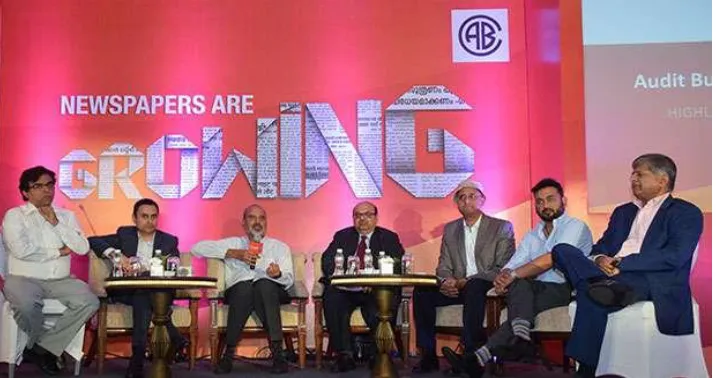
Figure 9: newspapers are growing
While digital is growing big and a lot of people feel that it is a threat to print, the media owners are not looking troubled by the thought. The world is preparing for coexistence. There is a new medium coming in and everyone thinks that it is fashionable to come under digital, which is good. But this medium (print) is growing, it is robust
IV.
ANALYSIS AND FINDINGS
It is seen from the detailed and extensive review of literature that the environment for newspaper reading and advertisement and publicity through the medium of newspaper has considerably changed all over the world, particularly in the developed countries. The digital media has revolutionized various aspects of life, including reading habits, in developed countries and it is spreading to developing and under developed countries as well. While texting and communication through mobile telephones have increased, the newspaper has remained the mainstay for information on the happenings around the country, surroundings and the world for the upwardly mobile rural population in India.
The habit of reading a newspaper over the morning cup of coffee is very much ingrained in the suburban and interior communities of India. The impact of the digital media, though felt, it has not eroded the popularity and credibility of the news media through vernacular news. The literacy (defined as the ability to read and write and not necessarily in English as well) rate is quite growing in villages and small towns and the people are well aware of and interested in developments around them. Kerala is often quoted as a state with a 100% literacy along with Maharashtra and Gujarat not far behind. The local language news papers in these regions are doing well and the readership as well as Advertisement revenues are on the rise. With an estimated growth of over
4.5% (or more in some vernacular papers) in circulation of these news papers, there seems to be no looking back for the news media.
The central and local governments have given priority for education in all states (due to political and other reasons the vernacular education has grown much faster, boosting the general literacy rates).This trend is not likely to abate and in all probabilities will be further accelerated. The circulation figures of local news papers are mind boggling and the foreign media and press are sitting up and watching. In the meantime multinational companies who have set up shops in India are closely monitoring the media for advertising and promoting their products. It is not as if the digital revolution has not caught up in India, it definitely has caught up with the younger generation. A very interesting phenomenon is that the youngsters are texting in vernacular language using English alphabets and words for spicing!
So, what are the media companies, corporations and politicians doing? This million dollar question is not hard to answer if one closely follows the Indian ethos. As far as Corporate companies and multinationals are concerned, they are most certainly interested and watching the bottom lines and profits. Many of them are innovating their products and promotions through local media advertisements and making use of digital proliferation. Many mobile service providers have developed and adopted local scripts for texting and messaging through mobiles. This is the next revolution waiting in the wigs and watching for further action.
70
Copyright © 2018. IJEMR. All Rights Reserved.
communication devices along with full page advertisements in the news papers.
V.
CONCLUSIONS AND SUGGESTION
The conclusions from data analysis are clear and needs no explanations. We cannot write off the news paper medium in India for now or in the near future. The development that needs to be monitored and watched is the progress of local and vernacular newspapers. The news papers like the ‗Dhainic Jagaran‘( Hindi), Malayala Manorama (Malayalam), the Daily Thanthi (Tamil) and a host of other vernacular papers and even English news papers like ‗The Times of India‘ are growing in circulation and it is not only for local politicians but also for media planners and marketers to watch and monitor. In conclusion, we can say that the development in news paper circulation and consumption and pricing in India cannot be compared with western and other developing countries. There is a window of opportunities for local manufacturers to advertise for their products and services to gain a strong foot hold in their own territory, so to say. The local radio (FM for example) is very popular and people listen to programs. Of course it depends on the popular personality who would sing or dance or just give a forceful talk. Many local brands of washing soaps and toiletries have become national brands. The starting point and the direction of travel seem to have been reversed in India, thanks to creativity and capitalization of local resources. The journey has only begun, much more needs to be done and I am sure, Indians will do it and set example for international and multinational marketers!
REFERENCES
A. Print & Publications
[1] Wirtz B.W. (2011). Media and internet management. Germany: Gabler Verlag.
[2] Agarwal, A., Hosanagar, K., & Smith, M. (2011). Location, location, location: An analysis of profitability of position in online advertising markets. Journal of Marketing Research, 48(6), 1057-1073.
[3] Angelucci, Charles & Julia Cagé. (2016). Newspapers in times of low advertising revenues. CEPR Discussion, Paper No. 11414.
[4] Abernethy, Avery M. & David N. Laband. (2004). The impact of trademarks and advertisement size on yellow pages call rates. Journal of Advertising Research, 44(1), 119-125.
[5] Boczkowski, Pablo J. (2002). The development and use of online Newspapers: What research tells us and what we might want to know. In L.Lievrouw & S.Livingdtone (Eds.), The Handbook of New Media, London: Sage.
[6] Barnes, James G. (1975). Factors influencing consumer reaction to retail newspaper ‗sale‘ advertising. American Marketing Association, 471-477.
[7] Bhatia, Tej K. (2000). Advertising in rural India:
Language, marketing communication, and consumerism.
Institute for the Study of Languages and Cultures of Asia and Africa. Tokyo University of Foreign Studies. Japan: Tokyo Press.
[8] De Waal, E., Schönbach, K., & Lauf, E. (2005). Online newspapers: A substitute or complement for print newspapers and other information channels?
Communications, 30(1), 55-72.
[9] Dijkstra M., Buijtels H., & Van Raaij F. (2005). Separate and joint effects of medium type on consumer responses: A comparison of television, print, and the internet. Journal of Business Research, 58(3), 377-386. [10] Chyi, H. I, & Lasorsa, D. (1999). Access, moving beyond "Just the Facts": The influence of online news on the content and structure of public affairs knowledge.
Communication Research, 31(1), 82-108.
[11] O Westlund. (2013). MOBILE NEWS - A review and model of journalism in an age of mobile media. Digital Journalism, 1(1), 6-26.
[12] Glen, Ward Scott. (2006). Mapping mediamorphosis: How print newspaper circulation influences features of audience participation at online news sites. School of Journalism and Mass communication, University of North
Carolina, 38-104. Available at:
https://cdr.lib.unc.edu/indexablecontent/uuid:d11e8853-f12d-4782-bd08-e847413da64f
[13] Kovach, Bill, & Tom Rosenstiel. (2001). The
Elements of Journalism. New York: Crown Publishers.
[14] Jones, J. (1985). Is total advertising going up or down? International Journal of Advertising, 4(1), 47-64. [14] Kaiser Ulrich & Song Minjae. (2009). Do media consumers really dislike advertising? An empirical assessment of the role of advertising in print media markets. International Journal of Industrial Organization, 27(2), 292–301.
[15] Li, X ed. (2006). Internet newspapers: the making of
a mainstream medium. New Jersey: Lawrence Erlbaum
Associates.
[16] Peng, Foo Yeuh, Tham, Naphtali Irene, & Xiaoming, Hao. (1999). Trends in Online Newspapers: A look at the US web. Newspaper Research Journal, 20(2), 52.
[17] Riley, P, Keough, C.M, Christiansen, T, Meilich, & Pierson, J. (1998). Community or colony: The case of online newspapers and the Web. Journal of
Computer-Mediated Communication, 4(1). Available at:
https://academic.oup.com/jcmc/article/4/1/JCMC415/4584 365.
71
Copyright © 2018. IJEMR. All Rights Reserved.
[19] Wurff, R. V. D, & Lauf, Edmund, ed. (2005). Print and online newspapers in Europe: A comparative analysis in 16 countries. Amsterdam: Het Spinhuis publishers. [20] Vukanovic, Z. (2011). New media business models in social and web media. Journal of Media Business Studies, 8(3), 51-67.
[21] Masini, E. & Vasquez, J. M. (2000). Scenarios as Seen from a Human and Social Perspective. Technological Forecasting and Social Change 65(1), 49–66.
[22] Gentzkow, Matthew, Jesse Shapiro, & Michael Sinkinson. (2011). The effect of newspaper entry and exit on electoral politics. American Economic Review, 101(7), 2980-3018,
[23] Casero-Ripollés, A. & Izquierdo-Castillo, J. (2013). Between decline and a new online business model: The case of the spanish newspaper industry. Journal of Media Business Studies 10(1), 63-78.
[24] Della, L. J., Eroglu, D., Bernhardt, J.M., Edgerton, E. & Nail, J. (2008). Looking to the Future of new media in health marketing: Deriving propositions based on traditional theories. Health Marketing Quarterly, 25(1/2), 147-174.
[25] Doyle, G. (2013). Re-invention and survival: newspapers in the era of digital multiplatform delivery.
Journal of Media Business Studies, 10(4), 1-20.
[26] Wurff, R., Bakker, P., & Picard, R. (2008). Economic growth and advertising expenditures in different media in different countries. Journal of Media Economics, 21, 28-52.
B. Web References
[1] http://www.questia.com/PM.qst?a=o&d=5002320220 [2] http://crx.sagepub.com/cgi/reprint/31/1/82
[3] http://vvww.questia.com/PM.qst?a=o&d=5002320220 [4] http://jcmc.indiana.edu/vol4/ issue /keough.html [5] http://www.highbeam.corn/ doc/ I G1-71190366.html [6]
https://www.researchgate.net/publication/235966593_Gro wth_and_Development_of_Online_Newspapers_with_Spe cial_Reference_to_India
[7]
http://latimesblogs.latimes.com/technology/2012/01/advert isingspending-online-expected-to-surpass-print-this-year.html