ORIGINAL ARTICLE
Finite Element Method on Shape Memory
Alloy Structure and Its Applications
Bo Zhou
*, Zetian Kang, Zhiyong Wang and Shifeng Xue
Abstract
It is significant to numerically investigate thermo-mechanical behaviors of shape memory alloy (SMA) structures undergoing large and uneven deformation for they are used in many engineering fields to meet special requirements. To solve the problems of convergence in the numerical simulation on thermo-mechanical behaviors of SMA struc-tures by universal finite element software. This work suppose a finite element method to simulate the super-elasticity and shape memory effect in the SMA structure undergoing large and uneven deformation. Two scalars, named by phase-transition modulus and equivalent stiffness, are defined to make it easy to establish and implement the finite element method for a SMA structure. An incremental constitutive equation is developed to formulate the relation-ship of stress, strain and temperature in a SMA material based on phase-transition modulus and equivalent stiffness. A phase-transition modulus equation is derived to describe the relationship of phase-transition modulus, stress and temperature in a SMA material during the processes of martensitic phase transition and martensitic inverse phase transition. A finite element equation is established to express the incremental relationship of nodal displacement, external force and temperature change in a finite element discrete structure of SMA. The incremental constitutive equation, phase-transition modulus equation and finite element equation compose the supposed finite element method which simulate the thermo-mechanical behaviors of a SMA structure. Two SMA structures, which undergo large and uneven deformation, are numerically simulated by the supposed finite element method. Results of numeri-cal simulation show that the supposed finite element method can effectively simulate the super-elasticity and shape memory effect of a SMA structure undergoing large and uneven deformation, and is suitable to act as an effective computational tool for the wide applications based on the SMA materials.
Keywords: Shape memory alloy, Incremental constitutive equation, Finite element equation, Phase-transition modulus, Applications
© The Author(s) 2019. This article is distributed under the terms of the Creative Commons Attribution 4.0 International License (http://creat iveco mmons .org/licen ses/by/4.0/), which permits unrestricted use, distribution, and reproduction in any medium, provided you give appropriate credit to the original author(s) and the source, provide a link to the Creative Commons license, and indicate if changes were made.
1 Introduction
Shape memory alloys (SMAs) have been widely used in many various engineering fields [1–4] because they possess two special thermo-mechanical characters, shape memory effect and super-elasticity [5–8]. There are four characteristic temperatures in a SMA at a free-stress state. They are named as martensitic starting temperature, indicated by Ms, martensitic finishing
tem-perature, indicated by Mf, austenitic starting
tempera-ture, indicated by As and austenitic finishing temperature,
indicated by Af, respectively [9–12]. They are generally
satisfied with the relationship Mf < Ms < As < Af.
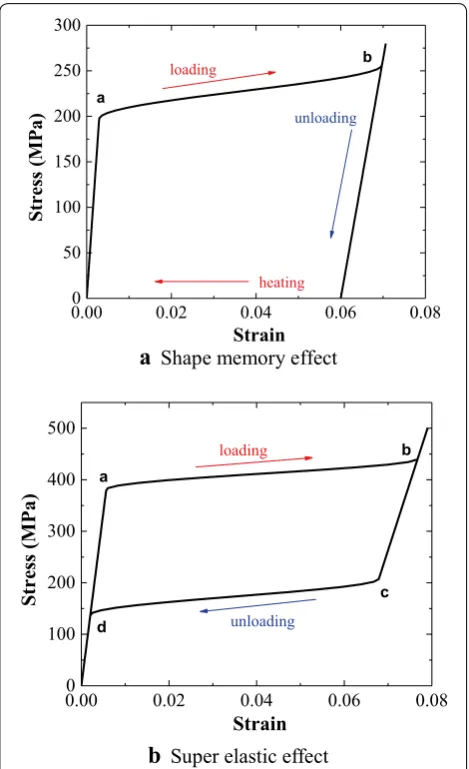
The shape memory effect can be expressed by the stress–strain curve in Figure 1(a), where a large nonlin-ear strain upon loading becomes a residual strain after unloading at a constant temperature below As. However
the residual strain can be fully recovered by heating to a high temperature above Af. The super-elasticity can
be expressed by the stress–strain curve in Figure 1(b), where the large nonlinear strain upon loading will grad-ually vanish during the process of unloading at a con-stant temperature above Af. Both shape memory effect
and super-elasticity are the macroscopic phenomena of martensitic phase transition and martensitic inverse
Open Access
*Correspondence: [email protected]
phase transition, which are induced by applied stress and temperature change in a SMA material [13, 14].
In order to design and analyze a SMA structure effi-ciently, a numerical simulation method which can effectively predict the thermo-mechanical behaviors of SMA should be established. As a classical numeri-cal computational method, finite element method has been successfully used to solve many problems related to solid and/or fluid mechanics. Many universal finite element software have been successfully applied in dif-ferent practical fields related to the conventional mate-rials. Some universal finite element software, such as ABAQUS, ANSYS, and so on, have good secondary development functions, which make them can also sim-ulate the problems related to a new materials, such as SMA through calling a user material subroutine. Some
researchers [15–17] implemented finite element analy-sis on SMA structures based on the secondary devel-opment functions of ANSYS. Many researchers [18–21] implemented finite element simulation on SMA struc-tures using the secondary development functions of ABAQUS. Although some universal finite element soft-ware can simulate the thermo-mechanical behaviors of SMA based on their secondary development func-tions, the problems of convergence often occur when a SMA structure undergoes large and uneven deforma-tions. However many products or structures made from SMA need undergo large and uneven deformations to meet special requirements. Therefor it is necessary to develop a finite element method and its computer pro-gram to simulate the thermo-mechanical behaviors of a SMA structure undergoing large and uneven defor-mation. Zhou [22] established a finite element program to predict the martensite and plastic zone of SMA thin plate with a hole considering the plastic deformation. However, the super-elasticity and shape memory effect of SMA structures during the thermo-dynamic load-ing-unloading process haven’t been numerically simu-lated in the work.
To avoid the problems of convergence in the numerical simulation on the thermo-mechanical behaviors of SMA structures with complex boundary conditions and exter-nal loads. This work suppose a finite element method to simulate the macroscopic thermo-mechanical responses of super-elasticity and shape memory effect in a SMA structure undergoing large and uneven deformation. In order to make it easy to develop and implement the finite element method for a SMA structure, two scalars named by phase-transition modulus and equivalent stiffness are defined respectively. A concisely incremental constitu-tive equation formulating the relationship of stress, strain and temperature in a SMA material is derived based on phase-transition modulus and equivalent stiffness. A phase-transition modulus equation is developed to describe the evolution law of phase-transition modulus during the processes of martensitic phase transition and its inverse phase transition in a SMA material. A finite element equation is established to express the incremen-tal relationship of nodal displacement, external force and temperature change in a finite element discrete structure of SMA. The incremental constitutive equation, phase-transition modulus equation and finite element equation compose the element finite method which simulates the thermo-mechanical behaviors of a SMA structure. Two SMA structures are numerically simulated by the sup-posed finite element method, which illustrates that it can accurately simulate the super-elasticity and shape memory effect in a SMA structure undergoing large and uneven deformation. Therefor the supposed finite
0.000 0.02 0.04 0.06 0.08
50 100 150 200 250 300
unloading
heating
b
loading
a
Stress (MPa
)
Strain
0.000 0.02 0.04 0.06 0.08
100 200 300 400 500
d
c
unloading
b loading
a
Stress (MPa
)
Strain
a
Shape memory effectb
Super elastic effectFigure 1 Schematic diagram of shape memory effect and
element method is suitable to act as an effective compu-tational tool for the wide applications based on the SMA materials.
2 Incremental Constitutive Equation
Thermo-mechanical constitutive equation of a material is the important basis to investigate the thermo-mechanical behaviors of a SMA material and/or structure. Many con-stitutive equations have been developed to describe the thermo-mechanical behaviors of SMA material [23–26]. Some constitutive equations from practical viewpoints played important roles in practical applications of SMA [27–30]. In order to make it easy to establish and imple-ment the finite eleimple-ment method for a SMA structure undergoing large and uneven deformation, a concisely incremental constitutive equation should be formulated to describe the thermo-mechanical behaviors of a SMA material.
According to the diagram of shape memory effect and super-elasticity of a SMA, shown in Figure 1, the incre-ment of strain tensor of SMA dεij can be decomposed as
where dεEij , dεTij and dεPij stand for the increments of
elas-tic strain tensor, thermal expansion strain tensor and phase-transition strain tensor, respectively.
According to generalized Hooke’s law, the increment of stress tensor of SMA dσij reads as
where Dijkl is the material stiffness tensor. The increment
of thermal expansion strain tensor can be expressed as
where Λij and dT are the thermal expansion tensor of a
SMA and the increment of temperature respectively. In this paper a SMA is assumed to be an isotropic material, therefor its stiffness tensor and thermal expan-sion tensor are formulated as
and
where E, v and α are elastic modulus, Poisson’s ratio and thermal expansion coefficient of SMA respectively. The elastic modulus can be expressed as
(1)
dεij=dεEij+dεijT+dεPij,
(2) dσij =DijkldεklE,
(3) dεijT =ΛijdT,
(4a) Dijkl=
E
1+v
1
2(δikδjl+δilδjk)+
v
1−2vδijδkl
,
(4b) Λkl =αδkl,
(4c) E =EA−(EA−EM)ξ,
where ξ, EA and EM are martensitic volume fraction,
aus-tenitic elastic modulus and martensitic elastic modulus respectively.
Using Eqs. (1), (2) and (3), we can have
In this paper, the increment of phase-transition strain tensor is formulated as
where σ¯ and dε¯P are the equivalent stress and the
incre-ment of equivalent phase-transition strain respectively. According to solid mechanics, the equivalent stress reads as
The incremental relationship of equivalent stress and equivalent phase-transition strain can be expressed as
where H¯ is called as phase-transition modulus in this
paper. The phase-transition modulus is a scalar which describes the incremental relationship of equivalent stress and equivalent phase-transition strain in a SMA material. The evolution law of phase-transition modulus is derived in Section 3.
On the other hand, the increment of equivalent stress can also be expressed as
according to Eq. (7). Using Eqs. (6), (8) and (9), we can have
From Eqs. (10) and (5), we obtain the incremental con-stitutive equation of a SMA, expressed as
where
In Eq. (12),
(5)
dσij =Dijkl(dεkl−ΛkldT−dεPkl).
(6) dεklP = ∂σ¯
∂σkldε¯
P,
(7) ¯
σ =
3
2
σij−
1
3σkk
σij−
1
3σkk
.
(8) dσ¯ = ¯Hdε¯P,
(9)
dσ¯ = ∂σ¯ ∂σijdσij
(10) dεklP = ∂σ¯
∂σkl
∂σ¯ ∂σij
dσij ¯ H .
(11) dσij =Cijkldεkl−LijdT,
(12a) Cijkl=
¯ H ¯
H+ ¯DDijkl,
(12b) Lij =
¯
H
¯
is called as equivalent stiffness in this paper. The equiv-alent stiffness is a scalar which depends on the stiffness tensor and stress state of a material.
The incremental constitutive equation, Eq. (11), is more conveniently used to establish and implement the finite element method for a SMA structure than those constitutive equations of SMA mentioned above, which is due to the definition of phase-transition modulus and equivalent stiffness. During the process of numerical simulation, the values of phase-transition modulus and equivalent stiffness can be calculated according to the current stress state by Eq. (12), and then the increment of stress can be calculated according to the increments of strain and temperature by Eq. (11).
3 Phase‑Transition Modulus Equation
Based on the cosine-type martensitic phase-transition equation [9], the relationship between martensitic vol-ume fraction and equivalent stress can be expressed as
and
during the processes of martensitic phase transition and martensitic inverse phase transition, respectively.
In Eq. (14a),
where σms and σmf are called as martensitic starting stress
and martensitic finishing stress respectively. They can be expressed by the martensitic starting temperature and martensitic finishing temperature as
where CM is a material constant describing the
relation-ship of stress and temperature during the process of mar-tensitic phase transition in a SMA material.
In Eq. (14b),
where σas and σaf are called as austenitic starting stress
and austenitic finishing stress respectively. They can be
(13) ¯
D=Dijkl ∂σ¯ ∂σkl
∂σ¯ ∂σij
(14a) ξ = 1
2cos[ϕ1(σ )¯ ] + 1
2,
(14b) ξ = 1
2cos[ϕ2(σ )] +¯ 1
2,
(15a) ϕ1(σ )¯ =
¯ σ−σmf
σms−σmf
·π,
(15b) σ
ms=CM(T−Ms), σmf =CM(T −Mf),
(15c) ϕ2(σ )¯ = σ¯−σas
σaf −σas
·π,
expressed by the austenitic starting temperature and aus-tenitic finishing temperature as
where CA is a material constant describing the
relation-ship of stress and temperature during the process of mar-tensitic inverse phase transition in a SMA material.
The incremental relationship of the equivalent phase-transition strain and the martensitic volume fraction can be expressed as
According to Eqs. (8) and (16), we can have
Substituting Eq. (14a) into Eq. (17), we can express the phase-transition modulus as
during the process of martensitic phase transition in a SMA material. Substituting Eq. (14b) into Eq. (17), we can express the phase-transition modulus as
during the process of martensitic inverse phase transition in a SMA material.
Eq. (18) is the phase-transition modulus equation expressing the evolution law of phase-transition modu-lus, i.e., the relationship of phase-transition modumodu-lus, stress and temperature, during the processes of martensi-tic phase-transition and martensimartensi-tic inverse phase-transi-tion occurring in a SMA material.
4 Finite Element Equation
According to the stress–strain curves of SMA, shown in Figure 1, both super-elasticity and shape memory effect of a SMA belong to the problem of large deforma-tion. Therefor the Total-Lagrange method suitable for the problem of large deformation is used to develop the finite element equation for a SMA structure. Consider-ing one point in a loaded body, the displacement, Green-Lagrange strain and Piola-Kirchhoff stress at the time t and t + Δt are respectively expressed as
and ui+�ui, εij+�εij, σij+�σij.
They can also be respectively expressed as
(15d) σ
as=CA(T −As), σaf =CA(T−Af),
(16) dε¯P=εLdξ.
(17) ¯
H =
εL
dξ
dσ¯
−1
.
(18a) ¯
H = −2(σms−σmf) εLsin[ϕ1(σ )]¯ ,
(18b)
¯
H = − 2(σaf −σas)
εLsin[ϕ21(σ )¯ ] ,
and
by the form of matrix. The increment of strain can be expressed as
which is also expressed as
by the form of matrix, where ΔεL0 is corresponding with the first and second terms, ΔεL1 is corresponding with the third and fourth terms, and ΔεN is corresponding
with the fifth term in the right hand of equality sign in Eq. (20) respectively.
At the time t + Δt, the virtual work equation of a finite
element discrete structure reads as
where δ is the symbol of variation, Ve and Se express the
volume and surface of an element, and f and q stand for body force array and surface force array respectively. The increment of displacement array at one point in an ele-ment can be expressed by the increele-ment of nodal dis-placement array of the element as
where ue is the increment of nodal displacement array of the element and N is the shape function matrix of the element, respectively.
Operating the variation operation on Eq. (22) leads to
The increment of strain array is formulated by the increment of nodal displacement array as
where B is the strain matrix of element. It includes BL0, BL1 and BN, which are with respect to the ΔεL0, ΔεL1 and ΔεN in Eq. (20), respectively. According to Eqs. (19) and
(24), if the higher order small term is ignored, the varia-tion of the increment of strain can be expressed as
u,ε,σ
u+u, ε+ε,σ+σ
(19) �εij =
1
2[�uj,i+�ui,j+uk,i�uk,j+
�uk,iuk,j+�uk,i�uk,j],
(20) ε=εL0+εL1+εN
(21)
e
Ve
δ�εT(σ+�σ)dVe=
e
Ve
δ�uTfdVe+
e
Se
δ�uTqdSe,
(22) u=Nue,
(23)
δ�u=Nδ�ue.
(24) �ε=B�ue=(BL0+BL1+BN)�ue,
(25) δ�ε=Bδ�ue=(BL0+BL1)δ�ue.
In order to establish finite element equation for a SMA structure, we express the incremental constitutive equa-tion, Eq. (11), with the form of matrix as
Substituting Eqs. (22)–(26) into Eq. (21) and carrying out the necessary derivations and reductions, we can have
where
The ΔU and δΔU in Eq. (28) denote the increment of nodal displacement array and its virtual displacement array of the finite element discrete structure respectively. The PF in Eq. (28e) is the equivalent nodal loads array
reduced from external force. The PT in Eq. (28d) is the
equivalent nodal loads array reduced from the change of temperature. The Pσ in Eq. (28a) is the equivalent nodal
loads array reduced from non-equilibrium force.
The nodal virtual displacement array δΔU should be arbitrary, so Eq. (27) can be arranged and reduced as
where KL and KN express structural stiffness
matri-ces which relate with small deformation and large
(26) σ =Cε−LT.
(27) −δ�UTPσ +δ�UTKL�U+
δ�UTKN�U−δ�UTPT =δ�UTPF,
(28a) δ�UTPσ = −
e
Ve
δ�ueT(BTL0+B T L1)σdVe,
(28b) δ�UTKL�U =
e
V
δ�ueT×
(BTL0+B T
L1)C(BL0+BL1)�uedVe,
(28c)
δ�UTKN�U =
e
V
δ�ueT×
(BTL0+B T
L1)CBN�uedVe,
(28d) δ�UTPT =
e
Ve
δ�ueT(BTL0+B T
L1)L�TdVe,
(28e)
δ�UTPF =
e
Ve
δ�ueTNTfdVe
+
e
Se
δ�ueTNTqdSe.
(29)
deformation respectively. The nonlinear equation, Eq. (29), is the finite element equation which describes the relationship of the nodal displacement, external force and temperature change in a finite element discrete structure of SMA. This non-linear equation is solved by the New-ton-Raphson method during the processes of finite ele-ment simulations on the SMA structures in this paper.
The incremental constitutive equation, Eq. (11), the phase-transition modulus equation, Eq. (18), and the finite element equation, Eq. (29), compose the supposed finite element method, which simulate the thermo-mechanical macroscopic response of super-elasticity and shape memory effect occurring in a SMA structure.
5 Applications
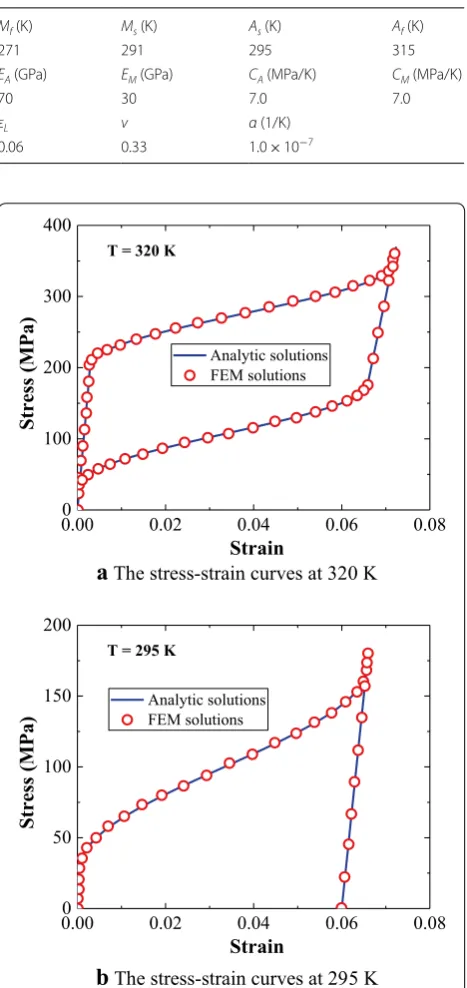
In order to operate finite element simulations on the thermo-mechanical response of a SMA structure using the supposed finite element method mentioned above, a MATLAB program is compiled based on finite element equation, Eq. (29), incremental constitutive equation, Eq. (11), and phase-transition modulus equation, Eq. (18). A uniform tensile SMA bar, shown in Figure 2(a), is numer-ically simulated to verify the MATLAB program. The material parameters of SMA [23] used for the numeri-cal simulations are listed in Table 1. Figure 2(b) plots the finite element mesh of the SMA bar, which include 42 plane strain four-node elements. The numerical results at integral point 1 of the shaded element, shown in Fig-ure 2(b), are used to compare with the analytic solutions [9] to illustrate the validity of the supposed finite element method in this paper.
Figure 3(a) plots the stress–strain curve of the integral point 1, shown in Figure 2(b), at a constant temperature above austenitic finishing temperature Af. The large
non-linear phase-transition strain produced in the loading
process is fully recovered during the unloading process, which illustrates the super-elasticity of a SMA material. Figure 3(b) shows the stress–strain curve of the integral point 1, shown in Figure 2(b), at a constant temperature below austenitic finishing temperature Af. The large
non-linear phase-transition strain produced in the loading
Figure 2 A SMA tensile bar and its finite element mesh
Table 1 Material parameters of SMA [23]
Mf (K) Ms (K) As (K) Af (K)
271 291 295 315
EA (GPa) EM (GPa) CA (MPa/K) CM (MPa/K)
70 30 7.0 7.0
εL v α (1/K)
0.06 0.33 1.0 × 10⁻⁷
0.000 0.02 0.04 0.06 0.08
100 200 300 400
Analytic solutions FEM solutions
T = 320 K
Stress (MPa
)
Strain
-strain curves at 320 K
0.000 0.02 0.04 0.06 0.08
50 100 150 200
Analytic solutions FEM solutions
T = 295 K
Stress
(MPa
)
Strain
a
The stressb
The stress-strain curves at 295 KFigure 3 Stress–strain curves of SMA at various constant
process becomes residual strain after the unloading process. The residual strain can be fully recovered upon heating to a high temperature above Af, which illustrates
the shape memory effect of a SMA material.
According to the curves in Figure 3(a) and Figure 3(b), the results from the supposed finite element method in this paper have a good agreement with that from the ana-lytic solutions [9]. Therefore the supposed finite element method in this paper can effectively simulate the thermo-mechanical macroscopic responses of super-elasticity and shape memory effect occurring in a SMA structure.
5.1 Thermo‑mechanical Behaviors of SMA Bar
Figure 4 shows a deformation mechanism for a SMA bar, which includes two punch heads, one die and one sup-port. The moments of force applied on the punch head make the punch head rotate around the rotation point and generate a large and uneven bending deformation in the SMA bar. The SMA bar has length of 28 mm, width of 2 mm and thickness of 4 mm. The radius of arc in the punch head is 6 mm, and the radius of the head in the die is 8 mm. During the numerical simulations the SMA bar is meshed by the 4-node plane strain element, and the total number of element is 224. The punch head and die are assumed to be rigid body. The friction-free contacts are set between punch head and SMA bar and between punch head and SMA bar. The material constants of SMA bar are listed in Table 1.
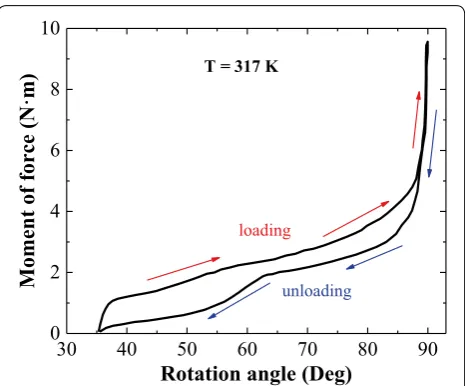
Figure 5 plots the relational curve between the moment of force and the rotation angle of punch head at a con-stant temperature of 317 K. During the loading process there is a nonlinear curve segment occurring, which is the results of martensitic phase transition occurring in some materials of the SMA bar. During the unloading process there is a non-linear curve segment occurring, which is the result of martensitic inverse phase transition
occurring in the materials having experienced marten-sitic phase transition in the loading process. There is a hysteresis loop occurring in the curve, which illustrates the super-elasticity of the SMA bar. Figure 6 plots the relational curve between the moment of force and the rotation angle of punch head at a constant temperature of 300 K. During the loading process there is also a non-linear curve segment occurring, which is also the result of martensitic phase transition occurring in some mate-rials of SMA bar. However there is not a hysteresis loop occurring in the curve after the unloading process.
Figure 4 A deformation mechanism for a SMA bar
30 40 50 60 70 80 90
0 2 4 6 8 10
unloading
loading T = 317 K
ecr
of
fo
tn
e
mo
M(
N·
m
)
Rotation angle (Deg)
Figure 5 Curve of the moment of force versus the rotation angle of
punch head at 317 K
30 40 50 60 70 80 90
0 2 4 6 8 10
unloading loading
T = 300K
ecr
of
fo
tn
e
mo
M
(N·m)
Rotation angle (Deg)
Figure 6 Curve of the moment of force versus the rotation angle of
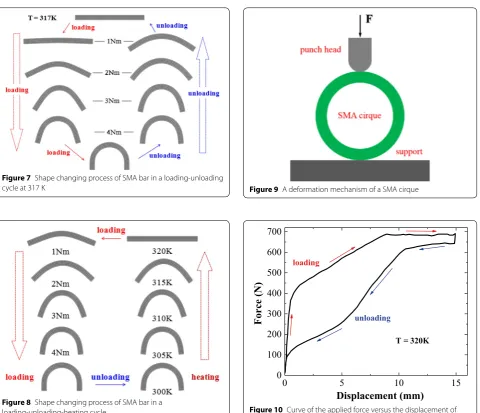
Figure 7 shows the shape changing process of SMA bar at a constant temperature of 317 K in the loading-unloading cycle. The deformed shapes of SMA bar at the same moment of force during the processes of loading and unloading are different. This is because the loading-path does not coincide with the unloading-loading-path, which is results from the hysteresis loop shown in Figure 5. Fig-ure 8 shows the shape changing process of SMA bar in the loading-unloading-heating cycle. The deformation of SMA bar, which is induced by the martensitic phase transition upon loading, becomes the residual tion after the unloading process. The residual deforma-tion in the SMA bar is fully recovered by heating it from 300 K to 320 K, which illustrates the shape memory effect of SMA bar.
5.2 Thermo‑mechanical Behaviors of SMA Cirque
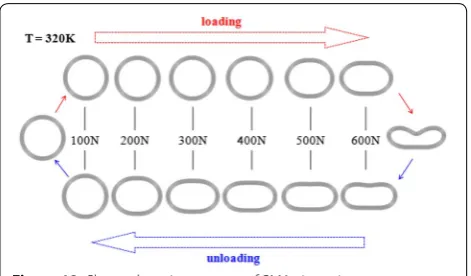
Figure 9 shows a deformation mechanism for a SMA cirque, which includes a punch head and a support. The applied force makes the punch head move down and produce large and uneven deformation in the SMA cirque. The radius of punch head bottom is 2 mm. The inside radius and outer radius of SMA cirque are 10 mm and 12 mm respectively. The thickness of SMA cirque is 4 mm. During the numerical simulations the SMA cirque is meshed by the 4-node plane strain element, and the total number of element is 544. The punch head is assumed to be a rigid body. The friction-free contacts are set between the punch head and SMA cirque. The mate-rial parameters of SMA cirque are listed in Table 1.
Figure 7 Shape changing process of SMA bar in a loading-unloading
cycle at 317 K
Figure 8 Shape changing process of SMA bar in a
loading-unloading-heating cycle
Figure 9 A deformation mechanism of a SMA cirque
0 5 10 15
0 100 200 300 400 500 600 700
unloading loading
T = 320K
Force (N
)
Displacement (mm)
Figure 10 Curve of the applied force versus the displacement of
Figure 10 plots the relational curve between the applied force and the displacement of punch head at a constant temperature of 320 K. During the loading pro-cess there is a nonlinear curve segment due to the mar-tensitic phase transition occurring in some materials of the SMA cirque. During the unloading process there is also a nonlinear curve segment occurring, which is the result of martensitic inverse phase transition occurring in the materials having experienced martensitic phase transition in the loading process. There is a hysteresis loop occurring in the curve after unloading, which illustrates the super-elasticity of SMA cirque. Figure 11 plots the relational curve between the applied force and the displacement of punch head at a constant tem-perature of 295 K. During the loading process there is a nonlinear curve segment due to the martensitic phase transition occurring in some materials of SMA cirque. There is not a hysteresis loop occurring in the curve after unloading.
Figure 12 shows the shape changing process of SMA cirque in a loading-unloading cycle at a constant tem-perature of 320 K. The deformed shapes of SMA cirque corresponding with the same applied force during the processes of loading and unloading are different because the loading-path does not coincide with the unloading-path, as shown in Figure 10. Figure 13 shows the shape changing process of SMA cirque in the load-ing-unloading-heating cycle. The deformation of SMA cirque, which is induced by the martensitic phase tran-sition upon loading, becomes the residual deformation after unloading. However, the residual deformation in the SMA cirque is fully recovered by heating it from
295 K to 320 K, which illustrates the shape memory effect of SMA cirque.
On the whole, the supposed finite element method has good accuracy and convergence in the simulation on both super-elasticity and shape memory effect in a SMA structure, and is suitable to be an effective com-putational tool for the wide applications based on a SMA material.
6 Conclusions
Two scalars, phase-transition modulus and equivalent stiffness, are defined to establish and implement the finite element method. The super-elasticity and shape memory effect of SMA bar and cirque are respectively simulated by the supposed finite element method. Accordingly, sev-eral conclusions are presented as follows.
1) The concisely incremental constitutive equation describing the relationship of stress, strain and tem-perature in a SMA material is developed based on phase-transition modulus and equivalent stiffness.
0 5 10 15
0 100 200 300 400 500 600 700
unloading loading
T = 295K
Force (N
)
Displacement (mm)
Figure 11 Curve of the applied force versus the displacement of
punch head at 295 K
Figure 12 Shape changing process of SMA cirque in a
loading-unloading cycle at 320 K
Figure 13 Shape changing process of SMA cirque in a
2) The phase-transition modulus equation expressing the relationship of phase-transition modulus, stress and temperature during the processes of martensitic phase transition and martensitic inverse phase tran-sition in a SMA material is presented.
3) The finite element equation formulating the incre-mental relationship of nodal displacement, external force and temperature change in a finite element dis-crete structure is established to simulate the thermo-mechanical behaviors of a SMA structure.
4) The supposed finite element method, which includes the incremental constitutive equation, phase-transi-tion modulus equaphase-transi-tion and finite element equaphase-transi-tion, can effectively simulate both processes of super-elas-ticity and shape memory effect in a SMA structure, and is suitable to act as an effective computational tool for the wide applications based on a SMA mate-rial.
Authors’ Contributions
BZ was in charge of the whole trial; ZK and ZW compiled the calculation pro-grams and wrote Section 5; SX wrote Section 4. All authors read and approved the final manuscript.
Authors’ Information
Bo Zhou, born in 1972, is currently a professor and a doctoral supervisor at Department of Engineering Mechanics, College of Pipeline and Civil Engineering, China University of Petroleum, China. His research interests include intelligent materials and structural mechanics, computational mechanics and engineer-ing mechanics of oil and gas wells.
Zetian Kang, born in 1992, is currently a PhD candidate at China University of Petroleum, China. He received his bachelor degree from China University of Petroleum, in 2014. His research interest is intelligent materials and structural mechanics.
Zhiyong Wang, born in 1992, is currently a graduate student at China University of Petroleum, China. He received his bachelor degree from China University of Petroleum, China, in 2017. His research interest is intelligent materi-als and structural mechanics.
Shifeng Xue, born in 1963, is currently a professor and a doctoral supervi-sor at Department of Engineering Mechanics, College of Pipeline and Civil Engineering, China University of Petroleum, China. His research interests include computational mechanics, fracture mechanics and engineering mechanics of oil and gas wells.
Acknowledgements
The authors of this paper sincerely thank to the supports from the China University of Petroleum (East China).
Competing Interests
The authors declare that they have no competing interests.
Funding
Supported by National Key Research and Development Program of China (Grant No. 2017YFC0307604), and the Talent Foundation of China University of Petroleum (Grant No. Y1215042).
Received: 5 December 2018 Revised: 3 June 2019 Accepted: 14 October 2019
References
[1] N Choudhary, D Kaur. Shape memory alloy thin films and heterostruc-tures for MEMS applications: A review. Sensors and Actuators A: Physical, 2016, 242: 162-181. https ://doi.org/10.1016/j.sna.2016.02.026 [2] Y Zheng, Y Dong, Y H Li. Resilience and life-cycle performance of smart
bridges with shape memory alloy (SMA)-cable-based bearings. Construc-tion and Building Materials, 2018, 158: 389-400. https ://doi.org/10.1016/j. conbu ildma t.2017.10.031
[3] W T Jhou, C Wang, S Li, et al. TiNiCuAg shape memory alloy films for biomedical applications. Journal of Alloys and Compounds, 2018, 738: 336-344. https ://doi.org/10.1016/j.jallc om.2017.12.194
[4] P B C Leal, M A Savi. Shape memory alloy-based mechanism for aero-nautical application: Theory, optimization and experiment. Aerospace Science and Technology, 2018, 76: 155-163. https ://doi.org/10.1016/j. ast.2018.02.010
[5] B Zhou. A macroscopic constitutive model of shape memory alloy considering plasticity. Mechanics of Materials, 2012, 48: 71-81. https ://doi. org/10.1016/j.mechm at.2012.02.001
[6] B Zhou, Z Y Wang, S F Xue. Mechanical model for super-elastic helical spring of shape memory alloy. Journal of Mechanical Engineering, 2019, 55(8): 56-64. https ://doi.org/10.3901/JME.2019.08.056 (in Chinese) [7] Z T Kang, B Zhou, S F Xue. Mechanical behaviors of functionally graded
shape memory alloy composite beam. Acta Materiae Compositae Sinica, 2019, 36(08): 1901-1910. https ://doi.org/10.13801 /j.cnki.fhclx b.20181 114.003 (in Chinese)
[8] J Wang, Z Moumni, W H Zhang, et al. A thermomechanically coupled finite deformation constitutive model for shape memory alloys based on Hencky strain. International Journal of Engineering Science, 2017, 117: 51-77. https ://doi.org/10.1016/j.ijeng sci.2017.05.003
[9] C Liang, C Rogers. One-Dimensional Thermo-mechanical Constitutive Relations for Shape Memory Materials. Journal of Intelligent Material Systems and Structures, 1990, 35: 207-234. https ://doi.org/10.1177/10453 89X90 00100 205
[10] L C Brinson. One-Dimensional Constitutive Behavior of Shape Memory Alloys: Thermo-mechanical Derivation with Non-Constant Mate-rial Functions and Redefined Martensite Internal Variable. Journal of Intelligent Material Systems and Structures, 1993, 4: 229-242. https ://doi. org/10.1177/10453 89X93 00400 213
[11] C Cisse, W Zaki, T Ben Zineb. A review of constitutive models and modeling techniques for shape memory alloys. International Journal of Plasticity, 2016, 76: 244-284. https ://doi.org/10.1016/j.ijpla s.2015.08.006 [12] X Chen, T Liu, R Li, et al. Molecular dynamics simulation on the shape
memory effect and superelasticity in NiTi shape memory alloy. Com-putational Materials Science, 2018, 146: 61-69. https ://doi.org/10.1016/j. comma tsci.2018.01.026
[13] B Zhou, S Yoon, J S Leng. A three-dimensional constitutive model for shape memory alloy. Smart Materials and Structures, 2009, 18: 9-16. https ://doi.org/10.1088/0964-1726/18/9/09501 6
[14] B Zhou, Y J Liu, J S Leng, et al. A macro-mechanical constitutive model of shape memory alloys. Science in China, 2009, 52(9): 1382-1391. https ://doi. org/10.1007/s1143 3-009-0173-3
[15] P Terriault, F Viens, V Brailovski. Non-isothermal finite element mod-eling of a shape memory alloy actuator using ANSYS. Computational Materials Science, 2006, 36: 397-410. https ://doi.org/10.1016/j.comma tsci.2005.05.010
[16] H S Lei, Z Q Wang, B Zhou, et al. Simulation and analysis of shape memory alloy fiber rein-forced composite based on cohesive zone model. Materials and Design, 2012, 40: 138-147. https ://doi.org/10.1016/j. matde s.2012.03.037
[17] D D Gu, B B He. Finite element simulation and experimental investiga-tion of residual stresses in selective laser melted Ti-Ni shape memory alloy. Computational Materials Science, 2016, 117: 221-232. https ://doi. org/10.1016/j.comma tsci.2016.01.044
[18] E A P Hernandez, B Kiefer, D J Hartl, et al. Analytical investigation of structurally stable configurations in shape memory alloy-actuated plates. International Journal of Solids and Structures, 2015, 69-70: 442-458. https :// doi.org/10.1016/j.ijsol str.2015.05.007
[20] X Long, X Peng, T Fu, et al. A micro-macro description for pseudo-elastic-ity of NiTi SMAs subjected to non-proportional deformations. Interna-tional Journal of Plasticity, 2017, 90: 44-65. https ://doi.org/10.1016/j.ijpla s.2016.12.003
[21] Z T Kang, B Zhou, S F Xue. Finite element numerical simulation on thermo-mechanical coupling behavior in shape memory alloy pipe con-nection. Journal of Mechanical Engineering, 2018, 54(18): 68-75. https :// doi.org/10.3901/JME.2018.18.068 (in Chinese)
[22] B Zhou. Finite element method of shape memory alloy and its applica-tions. China Mechanics Conference 2017 & The 60th Anniversary of China Mechanics Society. Beijing: China Academic Journal Electronic Publishing House, 2017. (in Chinese)
[23] D C Lagoudas, Z H Bo. Thermo-mechanical modeling of polycrystalline SMAs under cyclic loading, Part II: Material characterization and experi-mental results for a stable transformation cycle. International Journal of Engineering Science, 1999, 37: 1141-1173. https ://doi.org/10.1016/S0020 -7225(98)00114 -1
[24] F Auricchio, E Bonetti, G Scalet, et al. Theoretical and numerical modeling of shape memory alloys accounting for multiple phase transformations and martensite reorientation. International Journal of Plasticity, 2014, 59: 30-54. https ://doi.org/10.1016/j.ijpla s.2014.03.008
[25] C Yu, G Z Kang, Q H Kan. A micromechanical constitutive model for aniso-tropic cyclic deformation of super-elastic NiTi shape memory alloy single crystals. Journal of the Mechanics and Physics of Solids, 2015, 82: 97-136. https ://doi.org/10.1016/j.jmps.2015.05.012
[26] B Wang, G Z Kang, Q H Kan, et al. Molecular dynamics simulations to the pseudo-elasticity of NiTi shape memory alloy nano-pillar subjected to cyclic compression. Computational Materials Science, 2017, 131: 132-138. https ://doi.org/10.1016/j.comma tsci.2017.01.045
[27] J G Boyd, D C Lagoudas. A thermodynamical constitutive model for shape memory materials. Part I. The monolithic shape memory alloy. International Journal of Plasticity, 1996, 12: 805-842. https ://doi. org/10.1016/S0749 -6419(96)00030 -7
[28] F Auricchio, E Sacco. A one-dimensional model for super-elastic shape-memory alloys with different elastic properties between austenite and martensite. International Journal of Non-Linear Mechanics, 1997, 32: 1101-1114. https ://doi.org/10.1016/S0020 -7462(96)00130 -8
[29] M J Ashrafi, J Arghavani, R Naghdabadi, et al. Theoretical and numerical modeling of dense and porous shape memory alloys accounting for coupling effects of plasticity and transformation. International Journal of Solids and Structures, 2015, 88: 248-262. https ://doi.org/10.1016/j.ijsol str.2016.03.003