International Journal of Scientific Research in Computer Science, Engineering and Information Technology © 2016 IJSRCSEIT | Volume 1 | Issue 1 | ISSN : 2456-3307
A Survey on Space-Division Multiple-Access (SDMA)
Performance with Scheduling
1*Srihari Chintha,
2Dr. Sudhir Dawra
1Research Scholar , Department of Computer Science & Engineering, Sunrise University, Alwar, Rajasthan ,India 2Supervisor, Department of Computer Science & Engineering, Sunrise University, Alwar, Rajasthan,India
ABSTRACT
Efficient exploitation of spatial diversity is essentially vital to resource essential wireless applications. during this paper, we initial study the performance of intelligent scheduling for space-division multiple-access (SDMA) wireless networks. Supported the prevailing scheme, we propose a brand new medium access protocol (MAC) for multimedia SDMA/time-division-multiple-access (TDMA) packet networks. The improved protocol performs planning supported users’ special characteristics and quality-of-service parameters to realize output multiplication and packet delay reduction. Performance of SDMA with planning is evaluated beneath mixed audio and information traffic patterns and results show that important improvement in network performance is achieved beneath the new protocol.
Keywords: Antenna Array, Packet Networks, Scheduling,Space-Division Multiple-Access.
I.
INTRODUCTION
PACKET SWICTCED networks are seen as the generic network architecture for future wireless systems that must support mixed traffic in an efficient manner. In the presence of multimedia traffic and environmental changes, it is required that a medium access control (MAC) can effectively adapt to changing channel conditions and traffic requirements. Many innovative MAC protocols have been proposed in the past decade [6]–[8]. Most schemes, however, inherit some architectural features of wire-line systems and treat “layers” as uncoupled entities [9], [10]. For example, data link/media-access protocols have been frequently designed and analyzed without sufficient regard to design details at the physical layer.
One of the key resources in wireless communication is the spatial diversity provided by antenna arrays. While inherently rich, the spatial resource is highly irregular
and, thus, is difficult to deal with at the MAC level. For this reason exploitation of the spatial diversity has been limited to the physical layer using techniques such as spatial beam forming. However, if the MAC protocol is
designed without adaptability to the channel conditions, it has to be designed for the worst-case scenario and as a result, there will be too much signal level margin and a significant waste of network resources.
The need for coordinated MAC and physical layers in a system architecture is pronounced in antenna array networks. Only limited results are available to date, one of which is the so-called space-division multiple-access (SDMA) scheme that attempts to multiply the throughput of a wireless local area network (WLAN) by incorporating spatial channels [4], [5], [11], [12]. The SDMA scheme is particularly suitable for fixed wireless networks where the spatial characteristics are
relatively stable. For a system with antenna elements, the underlying idea is to divide each time-division multiple-access (TDMA) slot into space slots so that the total number of no interfering slots is increased by fold.
one with an unfavorable spatial configuration will experience significant throughput disadvantages. Since the effectiveness of spatial separation depends on the base station array responses (often referred to as the spatial signatures) of all co-slot terminals, the instantaneous signal-to-noise ratio (SNR) of beam forming outputs can vary dramatically. This problem is investigated by Ward and Compton [5] where collision
due to unresolvable packets (when the arrival angles of multiple packets are within a threshold ) is accounted for. Although the analysis is somewhat simplified, since in the presence of multipath the capability of reception algorithms may not be a sole function of the arrival angles, the study reveals the limitations of the basic SDMA scheme.
A fundamental solution to the above problem is a “channel-aware” MAC that controls the traffic based on the spatial char-acteristics of the terminals. In SDMA in particular, the perfor-mance of the system can be enhanced with spatial signature based scheduling (e.g., assigning the “most orthogonal” termi-nals to the same time slot to increase the traffic throughput). Such a MAC treatment allows a system to exploit the spatial diversity in an efficient manner with fixed-complexity phys-ical layer processing. Several dynamic scheduling algorithms are proposed and studied in [13]. All of them assume a static homogeneous traffic with terminals transmitting packets at all times. It is shown that under steady traffic, the scheduling al-gorithm provides a minimum performance gap between the av-erage and the worst case throughput among the terminals, indi-cating a maximum capacity improvement in worst case limited applications.
In most real scenarios, however, the network traffic is bursty and heterogeneous due to mixture of voice, video and data, each with different quality-of-service (QoS) parameters. In this case, the MAC protocol has to take the traffic dynamics and QoS re-quirements into account. Based on the existing scheduling algorithm, we propose an enhanced scheme for multimedia packet networks. In this protocol, not only the terminals’ spatial sig-natures, but also their QoS parameters are considered in order to optimize the system performance. Simulation shows that a substantial improvement can be obtained than the best effort scheme in which all traffics are treated homogeneously.
Figure 1. A typical array system.
II.
ANTENNA ARRAY PACKET NETWORKS
A.Spatial BeamformingAntenna array processing has been an active topic in wireless communications for more than a decade. Through controlling its beam pattern, an antenna array can improve some key operation parameters such as the signal-to-interference-plus-noise-ratio (SINR) over single antenna wireless system. Fig. 1 depicts a typ-ical antenna array system where the spatial diversity is exploited for multiple access communications. In the absence of noise, the response of an -element antenna array to a narrowband source can be written as
where T denotes transposition, and a =
is the array response vector that
captures the spatial characteristics
(direction-of-arrivals, number of multipath reflections, and
attenuation) associated with the terminal. In some
literature the array response vector is referred to as
the spatial signature.
where is an additive noise vector and is defined as the array manifold whose columns are the spatial signatures. To fa-cilitate our presentation in the remainder of this paper, we as-
sume 1) all signals have unit power and (i.e., perfect power control) and 2) the noise is i.i.d. with strength . Under these assumptions the covariance matrix of the array output has the form of
In most practical situations, spatial signatures of different ter-minals are different, allowing the base station to decouple su-perimposed signals through spatial separation. To retrieve individual signals, e.g.,
, from the antenna outputs, outputs of the antenna array are weighted and summed with a set of weight coefficients
with { } so designed to constructively combine the signal of interest and destructively combine the in-terference-plus-noise. This processing is referred to as spatial beamforming
[14]. The optimum weight vector
that minimizes the mean squared error (MSE) of the signal estimate is given by
in which case the output MSE and SINR, respectively, of the th signal estimate are
It can be shown that through spatial beamforming, up to co-channel terminals can be perfectly separated in the absence of noise. The capability of simultaneous communications with multiple terminals using an antenna array makes SMDA very attractive to resource critical wireless applications.
B. SDMA/TDMA Packet Networks
Before we review the concept of SDMA/TDMA, let us de-scribe the packet radio network under consideration. The slotted packet network consists of radio
terminals actively commu-nicating with a basestation. Information is transmitted in blocks of symbols called
packets. The time axis is divided into time frames of fixed length. Each frame is evenly divided into time slots through which multiple packets can be transmitted. Each terminal transmits packets in one out of the slots at a fixed data rate.
Assume that the basestation has total control of the network traffic. When a terminal has packets to transmit, it places an admission-request packet through a reserved request slot, from which the basestation obtains the spatial signature and traffic information of the terminal. The basestation then assigns cer-tain time slots to the terminal depending on the request and the traffic situation. The focus of this paper is on how to schedule
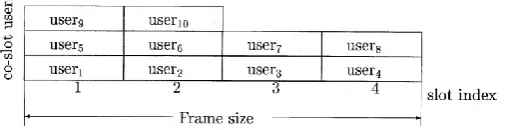
Fig. 2. SDMA without scheduling.
packet transmissions after the terminals are admitted. We do not emphasize access initiation in this work.
In most practical situations . SDMA/TDMA accommodates these terminals in both the space and the time domain. Fig. 2 illustrates how this objective is achieved in a 4-slot, 10-terminal SDMA/TDMA network [4], [5]. Built upon the slotted TDMA network, the SDMA expands the capacity by allowing multiple (up to ) terminals in each slot, and within each slot spatial beamforming is performed to acquire packets from multiple terminals. In essence, SDMA adds another dimension to the spectrum resource by expanding each slot
exploited. Note that the scheduling criteria depends heavily on the system configuration. Thus there is no single “optimal” solution for all the systems. In the following, we focus on a TDMA-based single-cell system with perfect power control. We try to develop scheduling al-gorithms to accommodate packets with fixed size into the time slots to improve the system performance.
C. Scheduling Algorithms
Assume that the transmission data rate of each terminal is fixed. Then the terminal has to operate above certain SINR
threshold to avoid excessive packet errors. The threshold depends on the coding and modulation scheme and the packet PER requirement. In the scheduling process, a terminal is allocated to a time slot as long as the resulting SINR after beamforming is above the threshold
Shad et al. [13] studied several scheduling algorithms to im-prove the frame capacity. Among all algorithms studied, the Best Fit algorithm has the best performance.
The best-fit scheduling algorithm first pick a terminal randomly from the terminal pool (to ensure the fairness among terminals). The algorithm tests the current unal-located terminal by calculating the SINRs for all co-slot terminals in the current time co-slot as if the candidate terminal were to be added.
D. Performance of Scheduling SDMA
Let be the spatial signatures of the terminals in the system and
denote the array manifold of the co-slot terminals in the th slot. The basestation performs spatial beamforming on the re-ceived co-slot signals as described in Section II-A. According to Poor and Verdu [15], the residual interference and noise of the MMSE beamforming output has a Gaussian-like character-istic, allowing us to calculate the bit-error rate (BER) based on the output SINR in (5)
P(E)=Q(SINER)
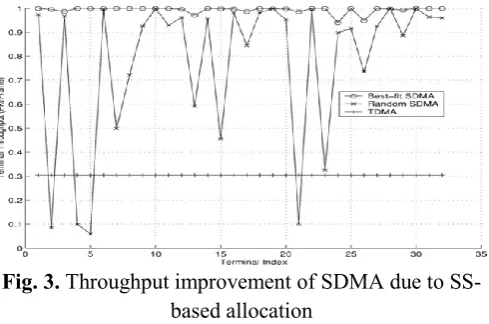
Fig. 3. Throughput improvement of SDMA due to SS-based allocation
Assuming the error c control and the spatial signatures are generated as independent Gaussian vectors (normalized to unit power). The SNR is set at 20 dB and SINR threshold is 10 dB. Clearly, SDMA/TDMA is fundamentally better than pure TDMA in that each terminal has four times the chance to transmit successfully. However, the worst case performance of random SDMA could be even worse than pure TDMA due to high possibility of collisions of co-channel terminals. With simple MAC layer planning, the system throughput of best-fit SDMA/TDMA increases substantially across the board. More importantly, the variance of the terminals’ throughput becomes very small, one can prac-tically use the average throughput as the design parameter for the system capacity. This is particularly important to wireless applications whose capacity is usually worst case limited.
SCHEDULING PROTOCOL FOR MULTIMEDIA TRAFFIC
1. SINR;
2. Packet timeout; 3. Packet loss rate.
We consider a single-cell network with one base station and mobile terminals. Fixed-length packets arrive at the mobiles according to bursty random processes. The packets are buffered at the mobile terminals until they are transmitted to the base station.
When a mobile terminal has packets to transmit, it sends an access packet in the access slot using ALOHA random access. After the basestation successfully receives an access packet from a mobile terminal, it obtains information from the mobile terminal which includes the QoS class of the packets and the spatial signature of the terminal. Based on received information, the basestation then grants certain time slots to the terminal ac-cording to a desired packet transmission policy. The transmit permission is broadcasted in the following downlink frame.
The mobile terminal listens to the downlink frame, when it hears the permission, it begins to transmit in the next uplink frame. Each time a mobile terminal transmits a packet, it also includes a Piggybacking Request to indicate whether it has more packets backlogged. The basestation checks the Piggy-backing Request, and updates the mobile terminal information accordingly.
Now our focus is on how to design a packet scheduling policy so that the mobile terminals share the limited communications bandwidth in an efficient manner: maximizing throughput and minimizing packet loss. To accommodate the different QoS requirement, a packet scheduler is added to the protocol to schedule packet transmissions in such a way that the spatial resource can be used efficiently. The ensuing sections describe Correction capability of a coded packet of bits is , i.e., a maximum number of bits in error is correctable, the packet success probability is
Where is the beamforming output SINR of the th ter-minal. The throughput of each terminal in SDMA can be defined accordingly.
Definition 1: The terminal frame throughput is defined as the packet throughput of the th terminal in a frame. Let be the total number of time slots in a frame. Note that in a given time slot, the th terminal can transmit at most one packet. Denote the packet success probability of the th terminal in the th slot. If the terminal dose not transmit in this slot, . Then,
is the summation of all
In cases where the frame length is variable, the average number of packets can be successfully transmitted in a time slot is a better performance measure. The average slot throughput is defined as
III. SCHEDULING PROTOCOL FOR
MULTIMEDIA TRAFFIC
In the presence of multimedia traffic, different traffic class may have different QoS requirements. For example, the voice traffic is sensitive to delay, but can tolerate certain degree of packet loss. However, the data traffic must not have any missing packet, but can endure longer delay. Therefore, it is beneficial for the MAC protocol to take the specific QoS parameters of each traffic class into account. In the following, we describe a scheduling protocol that significantly increases the performance of a multimedia SDMA network by incorporating the following QoS parameters:
4. SINR;
5. Packet timeout;
6. Packet loss rate.
We consider a single-cell network with one base station and mobile terminals. Fixed-length packets arrive at the mobiles according to bursty random processes. The packets are buffered at the mobile terminals until they are transmitted to the base station.
When a mobile terminal has packets to transmit, it sends an access packet in the access slot using ALOHA random access. After the basestation successfully receives an access packet from a mobile terminal, it obtains information from the mobile terminal which includes the QoS class of the packets and the spatial signature of the terminal. Based on received information, the basestation then grants certain time slots to the terminal ac-cording to a desired packet transmission policy. The transmit permission is broadcasted in the following downlink frame.
The mobile terminal listens to the downlink frame, when it hears the permission, it begins to transmit in the next uplink frame. Each time a mobile terminal transmits a packet, it also includes a Piggybacking Request to indicate whether it has more packets backlogged. The basestation checks the Piggy-backing Request, and updates the mobile terminal information accordingly.
Now our focus is on how to design a packet scheduling policy so that the mobile terminals share the limited communications bandwidth in an efficient manner: maximizing throughput and minimizing packet loss. To accommodate the different QoS requirement, a
packet scheduler is added to the protocol to schedule packet transmissions in such a way that the spatial resource can be used efficiently. The ensuing sections describehow the scheduler prioritizes and organizes the transmission of packets by taking these criteria into consideration.
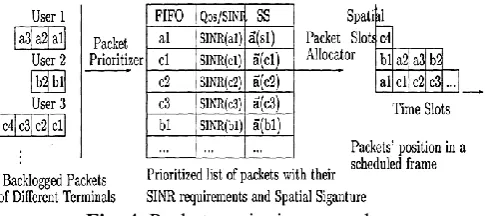
Fig. 4. Packets assigning procedure
The main objective of the scheduler is to maximize throughput and minimize packet loss. This is achieved in two steps:
1) determine packet priorities;
2) allocate prioritized packets into SDMA/TDMA slots.
These tasks are performed by a packet prioritizer and a
packet allocator, respectively [16]. In particular, the packet prioritizer minimizes the packet loss, while the packet allocator maximizes the throughput. The basic protocol is illustrated in Fig. 4.
A. Packet Prioritizer
There are many ways to define packet priorities [16]– [18]. Here, we consider the case where each terminal only supports one type of traffic (voice, data, or video). However, terminals can be easily configured to support heterogeneous traffics by maintaining multiple first-in– first-out (FIFO) queues for dif-ferent traffics. Since the packets in each queue are of the same type, the priority values can be determined based on their time out requirements.
transmit at a minimal constant rate so that it can finish transmission before timeout, the rate of
the th packet is . The aggregate transmission rate
at current frame is thus . It indicates how many
slots are required by this terminal at current frame. We can use the aggregate transmission rate as the
measurement of priority.
Definition 2: The priority of a packet is defined as the aggre-gate transmission rate of this packet and the remaining packets backlogged after it. So the priority of the th packet in th ter-minal queue can be calculated as
If a packet cannot be transmitted before its time out, it is simply discarded. is a monotonic decreasing function of Its value reflects how urgent one packet must be transmitted, because a higher value indicates a higher probability of packet loss. The value also indicates the average transmission rate this terminal should have. If the value is greater than one, it means more than one slot should be assigned to this terminal to avoid possible packet loss. So the priority definition adopted here has the following properties: 1) the priorities of each queues are cal-culated independently such that it has much lower complexity;
2)the priority based on timeout value gives advantage to the more time sensitive packets (voice, video); 3) the priority values indicate how many slots should be allocated to a terminal in the current frame; and 4) the priority values are calculated based on all buffered packets so that the longer queues which subject to higher packet loss rate can have more advantage. The pri-ority defined here is not optimal because the optimal solution would require to consider all the existing queues jointly. How-ever, given the desirable properties described above, it works well as we will show in the simulations.
After prioritization, the packets are put into a FIFO (an or- dered list according to their priority values). Notice that the frame length is . So one terminal can be assigned up to time slots. So one terminal can have at most priority values, and it can appear in the
list for up to times. As will be explained next, the list is used by the packet allocator to determine if a terminal should be granted transmission privileges for the next frame, and if so, the number of packets that will be allowed to send. After each frame, the packet prioritizer updates the pri-ority list for the next frame.
B. Multimedia Best-Fit Packet Allocator
After prioritization, each ordered packet enters the buffer with an associated SINR/data rate requirement and a spatial signa-ture. The objective of the packet allocator is to arrange packets that have the highest priority into SDMA/TDMA frames so that the throughput in the next frame is maximized. Toward this end, we modify the best-fit algorithm to accommodate the heteroge-neous traffic. First of all, the order of t the backlogged packets are determined by the prioritizer. In addition, we allow one ter-minal to have more than one slot to transmit packets within each
frame. The list implicitly contains information of the number of packets that the packet allocator should allow a terminal to send. Furthermore, packets belong to different traffic classes may be assigned to one time slot, as long as their own SINR requirements are all satisfied. Taking these factors into consideration, a QoS-aware SDMA scheduling algorithm is summarized as follows.
Multimedia Best-Fit SDMA/TDMA:
The algorithm picks packets in the order given by list L Each packet is associated with its SINR requirement determined by its QoS class. The scheduling starts with the first packet in . The algorithm tries to assign the current packet into one of the time slots.
The algorithm tests the current unallocated packet by calculating the SINR for all co-slot packets in current time slot as if the candidate packet were to be added. The SINR margins of co-slot packets are calculated by subtracting their SINR requirements from the SINR they experienced. Assume there are terminals in current slot, The SINR margin of the th terminal in this slot is: . The SINR margin of this slot is
with largest SINR margin provide that the margin is greater than zero. Otherwise, the packet is ignored.
The algorithm moves to next packet and continues to search for appropriate slot to insert. The process continues until all packets are tested. The packet prioritized orders the packets according to their priority. The packet allocation then searches and allocates packets according to their priority order. The throughput is maximized for the given packet priority order.
IV. CONCLUSION
In this paper, we have investigated the efficiency of an SDMA/TDMA scheduling protocol. An improved scheduling scheme (multimedia best-fit SDMA) has been proposed for SDMA/TDMA with multimedia traffic. The protocol prioritizes the incoming packets based on their QoS/timeout requirements and 2) judiciously selects co-channel terminals based on their spatial signatures to enable significant improve-ment in the system throughput-delay characteristics. We also showed the significant performance improvement of the new protocol by simulations.
V.
REFERENCES
[1]. G. V. Tsoulos, "Smart antennas for mobile communication systems: Benefits and channenges," Electron. Commun. Eng. J., vol. 11, Apr. 1999.
[2]. B. Suard, G. Xu, H. Liu, and T. Kailath, "Uplink channel capacity of space-division-multiple-access schemes," IEEE Trans. Inform. Theory, vol. 44, pp. 1469-1476, July 1998.
[3]. C. Farsakh and J. A. Nossek, "On the mobile radio capacity increase through SDMA," in Accessing, Transmission, Networking Proceedings: 1998 International Zurich Seminar on Broadband Communications, 1998, pp. 293-297.
[4]. G. Xu and S. Q. Li, "Throughput multiplication of wireless LAN’s for multimedia services: SDMA protocol design," in IEEE Proc. GLOBECOM’94 , vol. 3, 1994, pp. 1326-1332. [5]. J. Ward and R. T. Compton, "High throughput
slotted ALOHA packet radio networks with adaptive arrays," IEEE Trans. Commun., vol. 41, pp. 460-470, Mar. 1993.
[6]. S. Nanda, D. J. Goodman, and U. Timor, "Performance of PRMA: A packet voice protocol for cellular systems," IEEE Trans. Veh. Technol., vol. 40, pp. 584-598, Aug. 1991
[7]. M. J. Karol, Z. Liu, and K. Y. Eng, "Distributed-queueing request up-date multiple access(DQRUMA) for wireless packet(ATM) networks," in IEEE Proc. ICC’95 , 1992, pp. 1224-1231.
[8]. A. E. Brand and A. H. Aghvami, "Multidimensional PRMA with priori-tized bayesian broadcast - A MAC strategy for multiservice traffic over UMTS," IEEE Trans. Veh. Technol., vol. 47, pp. 1148-1161, Nov. 1998.
[9]. J. Geier, Wireless LANs. New York: Macmillan, 1999.
[10]. S. Kumar and D. R. Vaman, "An access protocol for supporting multiple classes of service in a local wireless environment," IEEE Trans. Veh. Technol., vol. 45, pp. 288-302, May 1996. [11]. J.-P. M. Linnartz, "Imperfect sector antenna
diversity in slotted ALOHA mobile network," IEEE Trans. Commun., vol. 44, pp. 1322-1328, Oct. 1996.
[12]. S. Ghez, S. Verdu, and S. C. Schwartz, "Optimal decentralized control in the random access multipacket channel," IEEE Trans. Automat. Contr., vol. 34, pp. 1153-1163, Nov. 1989. [13]. F. Shad, T. D. Todd, V. Kezys, and J. Litva,
"Indoor SDMA capacity using a smart antenna base station," in IEEE Proc. ICUPC’97 , 1997,868-872.
[14]. D. H. Johnson and D. E. Dudgeon, Array Signal Processing: Concepts and Techniques. Englewood Cliffs, NJ: Prentice-Hall, 1993.