Available online: https://edupediapublications.org/journals/index.php/IJR/ P a g e | 1315
Using Circuit Cipher text-Policy Hybrid Encryption with Data
Sharing in Cloud Computing
K.Moulika, S . Neelima , Dr.Ch.N.Santhosh Kumar
1M-Tech, Dept. of CS, SwarnaBharthi Institute Of Science and Technology (SBIT),Khammam.
2Associate Professor,Dept. of CSE, SwarnaBharthi Institute Of Science and
Technology(SBIT),Khammam.
3HOD &Professor,Dept. of CSE, SwarnaBharthi Institute Of Science and Technology(SBIT),Khammam.
Abstract
In this Project first, we indicate how Circuit Cipher content arrangement pattern predicated prolongs. The Utilizer Revocation mapping with a various leveled structure to improve the adaptability, while in the meantime acquires the element of fine-grained get to control. Second, we show how to actualize an undeniable to get control conspire for cloud computing.[1] The plan gives full help to various leveled utilizer
allow, record engenderment, document
destruction, and utilizer denial in distributed computing. Third, we formally demonstrate the security of the proposed scheme predicated on the security. Cloud registering is a rising figuring worldview in which assets of the processing foundation are given as housing over the Internet. As capable as it may be, this worldview withal delivers numerous nascent difficulties for information security andto get control. Clients outsource touchy information for sharing the cloud servers, which are not inside an indistinguishable put stock in area
from information proprietors. To keep touchy utilizer information classified against un-put stock in servers, subsisting arrangements usually apply cryptographic techniques by unveiling information decoding keys just toauthorized clients. Notwithstanding, in doing as such, these
arrangements ineluctably present at
powerfullawkward(embarrassed) calculation
overhead the information proprietor for key circulation and information administration. When fine grained information to get control is require, and along these lines don't scale well. [3]The predicament of all the while accomplishing finegrainedness, versatility, and information classification to get the control is truly still stays uncertain. This project tends to this testing open issue by, on one hand,
characterizing and authorizing access
arrangements based on information
characteristics, and then again,
Available online: https://edupediapublications.org/journals/index.php/IJR/ P a g e | 1316
associated with fine grained information to get control to un trusted cloud servers without uncovering the hidden information substance. KeyWords:Cloud Computing, ABE, CP-ABE, KP-ABE, CIA, IBE, Cloud stockpiling.
1. INTRODUCTION
Distributed computing is novel handling framework that is predicated on virtualization, parallel and dispersed figuring, utility preparing and convenience arranged engineering. [2]In the previous decades, dispersed processing has created as a champion among the most convincing perfect models in the IT business, and has pulled in expansive thought from both the academic world and industry. Regardless, the
individual customer essentials may be
contrasting and require various sorts of outsourced count, while current PVC supports a solitary structure. Clients may wish to definitively order estimations from an all out server or requesting an enormously goliath pool servers. To get the arrangement is plenarily in perception of endorse relationship where the relationship is between utilizer traits(characters) and resource properties. The properties may contain information of the customer's business, work segments which is given and that is used to submit the access.[4] However, to get a huge mob layout segment system there are various troubles to overcome some of them are (1)
Utilizer can exchange any remotely data, for example, content, media and so on (2) It can give any number of qualities and consequently at least two customers may have same attributes. (3) Any individual may remarkable and remotely access to any number of customers. This procedure authorizes the customer to realize that they get control over their data completely in content sharing settlement in lieu of focal manager. To offer a mind boggling access the approach part, we require versatile and diverse cryptographic key organization estimations. For improving these damages, we are using property predicated encryption. Accordingly, we utilized CPABE (Cipher Text-Policy Attribute Based Encryption) strategy as an answer for the previously mentioned situation.In CP-ABE, the receiver can decrypt the exact data when the customer assets is perfect,get the strategy.
2.RELATED WORK 2.1Existing System
Available online: https://edupediapublications.org/journals/index.php/IJR/ P a g e | 1317
reacting them that they are unworthy. In fact, to get strategies may not be sufficiently adaptable along with the encryption.
2.2Proposed System
The proposed framework, outline a circuit figure content arrangement property predicated half and half encryption with irrefutable appointment conspire. In this plan the circuits are used which express the most fiery type to get control policy.[5] The k-multilinear Decisional Diffie-Hellman hypothesis demonstrates the proposed plot is secure. On the other hand, this plan can be utilized over the integers, along with assignment processing. An utilizer could approve whether the cloud server reacts right changed figure content to benefit him/her unscramble the figure message immediately and correctly.
3.IMPLEMENTATION 3.1Attribute Authority:
Attribute authority will require to give the key, as indicated by the customer's key sales. Every customer's sales must be raised to authority to get the key by means of mail. There are two co-relative sorts of attribute based encryption.[7] One is key policy attribute based encryption (KP-ABE) and the other is ciphertext-policy attribute based encryption (CPABE). In a KP-ABE system, the choice is to get the plan is made by the key transport instead of the
en-figure, which require the practicability and encourage of profit for the structure in down tothe earth applications. In the event that the unscrambling is mistaken then that record will be blocked.
3.2Data Owner
Data owner will require to register at first to getthe profile.[10] Information Owner will exchange the cloud server to store the mixed game plan. Random encryption key period is going on while storing the document to the cloud Scrambled record will be secured on the cloud. Encrypted documentwill be stored on the cloud.
3.3Cloud server
Cloud server will approach the document which isuploaded by the data owner. Cloud server needs to decrypt the archives under their permission.[9] Moreover, data consumer will require to decrypt the data to get to the original text by giving the specific key. Record has been decoded strongly and suited for customer. This procedure is done simply after the cloud is confirm.
3.4Data Consumer:
Available online: https://edupediapublications.org/journals/index.php/IJR/ P a g e | 1318
consumer can check and decrypt the data from the cloud.
Fig 1 Architecture Diagram 4.EXPERIMENTAL RESULTS
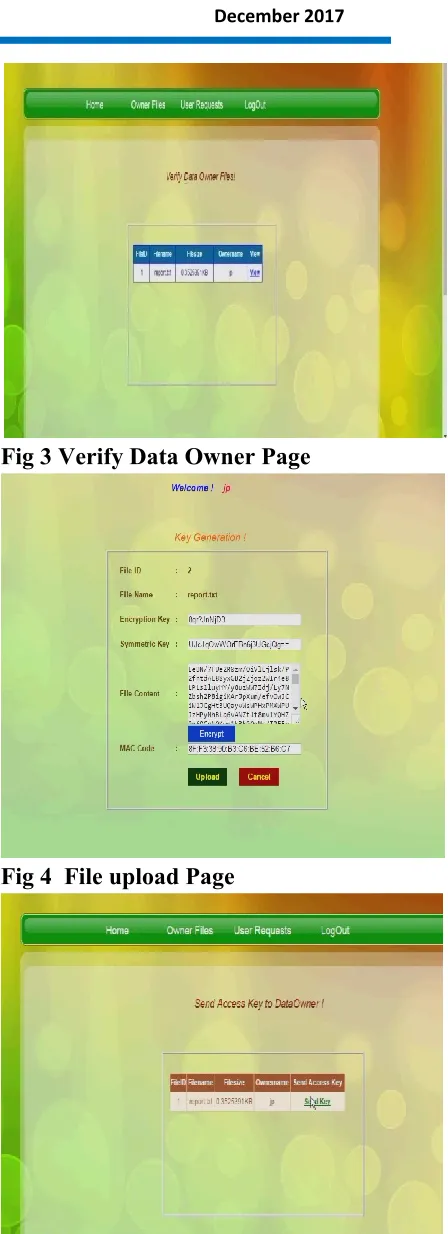
Fig 2 Registration Page
Fig 3 Verify Data Owner Page
Fig 4 File upload Page
Available online: https://edupediapublications.org/journals/index.php/IJR/ P a g e | 1319
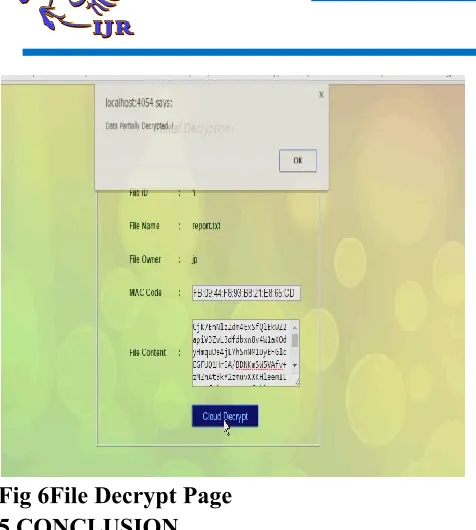
Fig 6File Decrypt Page 5.CONCLUSION
In this project, we likely to weight the issue of characteristic denial for the property predicated
frameworks. Specifically, semi-trustable
intermediary servers are accessible, and proposed a plan stimulating client's trait(quality) renouncement schema.[8] One of a kind property, our proposed plot is that it places airrelevant load on authority upon the event in client's rejection. We accomplished this by interestingly cumulating the intermediary
re-encryption system with CPSBAE and
empowered the authority to designate the most
persistent assignments to intermediary
servers.The proposed scheme is proven to be secure based on k-multilinear decisional diffie-hellman assumption. In advisement, we demonstrated the appropriateness of our technique to the KP-ABE plot. A test
configuration demonstrates the possibility and ability of our proposed work.
6.REFERENCE
[1] JieXu, Qiaoyan Wen, Wenmin Li, and ZhengpingJin”CircuitCiphertext-Policy Attribute-Based HybridEncryption with Verifiable Delegation in CloudComputing” EEE transactions on parallel and distributed systems, vol. 27, no. 1, january 2016 . [2] M. Green, S. Hohenberger and B. Waters,”Outsourcing the Decryption of ABE Ciphertexts,” inProc. USENIX Security Symp., San Francisco, CA,USA, 2011.
[3] J. Lai, R. H. Deng, C. Guan and J.
Weng,”Attribute-Based Encryption with
VerifiableOutsourced Decryption,” in Proc. IEEE Transactionson information forensics and security, vol. 8, NO. 8,pp.1343-1354, 2013.
[4] A. Lewko and B. Waters, ”Decentralizing
Attribute-Based Encryption,” in Proc.
EUROCRYPT, pp.568-588, Springer-Verlag Berlin, Heidelberg, 2011.
[5] B. Waters, ”Ciphertext-Policy Attribute-Based Encryption: an Expressive, Enficient, and Provably Secure Realization,” in Proc. PKC, pp.53-70, Springer-Verlag Berlin, Heidelberg, 2011.
[6] B. Parno, M. Raykova and V. Vaikuntanathan, ”How to Delegate and Verify in Public: verifiable computation from attribute-based encryption,” in Proc. TCC, pp.422-439, Springer-Verlag Berlin, Heidelberg, 2012.
Available online: https://edupediapublications.org/journals/index.php/IJR/ P a g e | 1320
CCA Security and Anonymous Predicate
Authentication,” in Proc. PKC, pp.243-261, Springer-Verlag Berlin, Heidelberg, 2012.
[8] J. Han, W. Susilo, Y. Mu and J. Yan, ”Privacy-Preserving Decentralized Key-Policy Attribute-Based Encryption,” in Proc. IEEE Transactions on Parallel and Distributed Systems, 2012.
[9] S. Garg, C. Gentry, S. Halevi, A. Sahai and B. Waters, ”Attribute-Based Encryption for Circuits from Multilinear Maps,” in Proc. CRYPTO, pp.479-499, Springer-Verlag Berlin, Heidelberg, 2013. [10] S. Gorbunov, V. Vaikuntanathan and H. Wee, ”Attribute-Based Encryption for Circuits,” in Proc. STOC, pp.545-554, ACM New York, NY, USA, 2013.
Authors Profiles
K.Moulika Pursuing Master’s Degree in
Department of Computer Science in
SwarnaBharathi Institute of Science and Technology, Khammam. I obtained my Bachelor’s Degree in Computer Science and Engineering from SwarnaBharathi College of Engineering affiliated to Jntuh in 2015.
Mrs. S. Neelima, working as an Associate professor in the department of Computer Science and Engineering. Her research areas include Data Mining, Cloud Computing, Computer Networks and Network Security, Operating Systems.
Dr.Ch.N.Santhosh Kumar is Head of the