ISSN(Online): 2319-8753 ISSN (Print): 2347-6710
I
nternational
J
ournal of
I
nnovative
R
esearch in
S
cience,
E
ngineering and
T
echnology
(A High Impact Factor, Monthly, Peer Reviewed Journal)
Visit: www.ijirset.com
Vol. 8, Issue 2, February 2019
Evolutionary Ai Algorithm for Health Risk
Prediction
Anup Agrawal1, Mayur Gajarmal2, Sahil Nadaf3, Niraj Kumar4, Prof. Anjali Devi5
B. E Student, Department of Computer Engineering, Jayawantrao Sawant College of Engineering
Hadapsar Pune, Savitribai Phule Pune University, Pune India1,2,3,4
Professor, Department of Computer Engineering, Jayawantrao Sawant College of Engineering
Hadapsar Pune, Savitribai Phule Pune University, Pune India5
ABSTRACT: In our society, humans have more attention to their own fitness. Personalized fitness service is regularly rising. The lack of skilled doctors and physicians, maximum healthcare corporations cannot meet the clinical call for of public. Public want extra accurate and on the spot result. Thus, increasingly more facts mining packages are evolved to provide humans extra custom designed healthcare provider. It is a good answer for the mismatch of insufficient clinical assets and growing medical demands. We advocate an AI-assisted prediction device which leverages information mining strategies to show the relationship between the everyday physical examination information and the capability fitness danger given through the consumer or public. The Main Concept to decide clinical illnesses in step with given signs and symptoms & every day Routine whilst User search the sanatorium then given the closest medical institution of their cutting-edge area. The machine gives a user-friendly interface for examinees and medical doctors. Examinees can recognise their symptoms which amassed in frame which set as the at the same time as medical doctors can get a fixed of examinees with capacity hazard. A comments mechanism could shop manpower and improve overall performance of gadget mechanically. The doctor should restoration prediction result via an interface, which will accumulate medical doctors’ enter as new training information. An more training technique might be caused every day the use of those facts. Thus, our machine ought to enhance the overall performance of prediction model mechanically.
KEYWORDS: Data Mining, Machine Learning and diseases prediction
I. INTRODUCTION
Many healthcare companies (hospitals, medical facilities) in China are busy in serving humans with quality-attempt healthcare carrier. Nowadays, humans pay extra interest on their bodily situations. They need higher first-class and more customized healthcare provider. However, with the limitation of number of skilled medical doctors and physicians, most healthcare agencies cannot meet the need of public. How to offer better first-class healthcare to more people with restrained manpower turns into a key problem. The healthcare environment is usually perceived as being ‘facts wealthy’ but ‘understanding bad’. Hospital facts structures usually generate big amount of records which takes the form of numbers, text. . There is lots of hidden records in these data untouched. Data mining and predictive analytics goal to reveal patterns and policies through applying advanced facts analysis strategies on a large set of facts for descriptive and predictive purposes. Data mining is suitable for processing large datasets from hospital records machine and locating family members amongst facts features. It takes only some researchers to investigate information from sanatorium records.. The Main Concept to determine medical sicknesses consistent with given signs & every day Routine whilst User seek the health center then given the closest health center in their modern location. The machine provides a person-pleasant interface for examinees and medical doctors. Examinees can know their signs and symptoms which accumulated in frame which set as the while docs can get a fixed of examinees with capacity chance. A comments mechanism could shop manpower and enhance performance of device robotically
ISSN(Online): 2319-8753 ISSN (Print): 2347-6710
I
nternational
J
ournal of
I
nnovative
R
esearch in
S
cience,
E
ngineering and
T
echnology
(A High Impact Factor, Monthly, Peer Reviewed Journal)
Visit: www.ijirset.com
Vol. 8, Issue 2, February 2019
1. Previous medical examiner only used basic symptoms of particular diseases but our application examiner examines on the word count, laboratory results and diagnostic data.
2. A feedback mechanism could save manpower and improve performance of system automatically. The doctor could fix prediction result through an interface, which will collect doctors’ input as new training data. An extra training process will be triggered everyday using these data. Thus, our system could improve the performance of prediction model automatically.
3. When the user visits hospital physically, then user’s personal record is saved and then that record is added to the examiner data set. It consumes lot of time.
1.2 Aim & Objective:-
1. The Main concept is to determine medical diseases according to given symptoms and daily routine and when user search the hospital, the hospital which is nearest to their current location is given.
2. Determine medical diseases according to given symptoms & daily Routine. 3. Prediction is done on the word count, laboratory results and diagnostic data.
II. RELATED WORK
1]. “Applications of Data Mining Techniques in Healthcare and Prediction of Heart Attacks” Author,-Srinivas K, Rani B K, Govrdhan A. The healthcare environment is generally perceived as being ‘information rich’ yet ‘knowledge poor’. There is a wealth of data available within the healthcare systems. However, there is a lack of effective analysis tools to discover hidden relationships and trends in data. Knowledge discovery and data mining have found numerous applications in business and scientific domain. Valuable knowledge can be discovered from application of data mining techniques in healthcare system. In this study, we briefly examine the potential use of classification based data mining techniques such as rule based, decision tree, naïve bayes and artificial neural network to massive volume of healthcare data. The healthcare industry collects huge amounts of healthcare data which, unfortunately, are not “mined” to discover hidden information. For data preprocessing and effective decision making One Dependency Augmented Naïve Bayes classifier (ODANB) and naive creedal classifier 2 (NCC2) are used. This is an extension of naïve Bayes to imprecise probabilities that aims at delivering robust classifications also when dealing with small or incomplete data sets. Discovery of hidden patterns and relationships often goes unexploited. Using medical profiles such as age, sex, blood pressure and blood sugar it can predict the likelihood of patients getting a heart disease. It enables significant knowledge, e.g. patterns, relationships between medical factors related to heart disease, to be established.
Disadvantage :
For predicting heart attack significantly 15 attributes are listed
Besides the 15 listed in medical literature we can also incorporate other data mining techniques, e.g., Time Series, Clustering and Association Rules.
categorical data is used
Text mining is not used for of unstructured data .
2]. “Grand challenges in clinical decision support” Author- Sittig D, Wright A, Osheroff J, et al.
ISSN(Online): 2319-8753 ISSN (Print): 2347-6710
I
nternational
J
ournal of
I
nnovative
R
esearch in
S
cience,
E
ngineering and
T
echnology
(A High Impact Factor, Monthly, Peer Reviewed Journal)
Visit: www.ijirset.com
Vol. 8, Issue 2, February 2019
for sharing executable CDS modules and services; combine recommendations for patients with co-morbidities; prioritize CDS content development and implementation; create internet-accessible clinical decision support repositories; use free text information to drive clinical decision support; mine large clinical databases to create new CDS. Identification of solutions to these challenges is critical if clinical decision support is to achieve its potential and improve the quality, safety and efficiency of healthcare
Disadvantage:-
Identification of solutions to these challenges is critical if clinical decision support is to achieve its potential and improve the quality, safety and efficiency of healthcare
3]. “Using Electronic Health Records for Surgical Quality Improvement in the Era of Big Data” Author-Anderson J E, Chang D C. Many healthcare facilities enforce security on their electronic health records (EHRs) through a corrective mechanism: some staff nominally have almost unrestricted access to the records, but there is a strict ex post facto audit process for inappropriate accesses, i.e., accesses that violate the facility’s security and privacy policies. This process is inefficient, as each suspicious access has to be reviewed by a security expert, and is purely retrospective, as it occurs after damage may have been incurred. This motivates automated approaches based on machine learning using historical data. Previous attempts at such a system have successfully applied supervised learning models to this end, such as SVMs and logistic regression. While providing benefits over manual auditing, these approaches ignore the identity of the users and patients involved in a record access. Therefore, they cannot exploit the fact that a patient whose record was previously involved in a violation has an increased risk of being involved in a future violation. Motivated by this, in this paper, we propose a collaborative filtering inspired approach to predicting inappropriate accesses. Our solution integrates both explicit and latent features for staff and patients, the latter acting as a personalized “finger-print” based on historical access patterns. The proposed method, when applied to real EHR access data from two tertiary hospitals and a file-access dataset from Amazon, shows not only significantly improved performance compared to existing methods, but also provides insights as to what indicates an inappropriate access.
4]. “Data Mining Techniques into Telemedicine Systems” Author-Gheorghe M, Petre R providing care services through telemedicine has become an important part of the medical development process, due to the latest innovation in the in-formation and computer technologies. Meanwhile, data mining, a dynamic and fast-expanding domain, has improved many fields of human life by offering the possibility of predicting future trends and helping with decision making, based on the patterns and trends discovered. The diversity of data and the multitude of da-ta mining techniques provide various applications for data mining, including in the healthcare organization. Integrating data mining techniques into telemedicine systems would help improve the efficiency and effectiveness of the healthcare organizations activity, contributing to the development and refinement of the healthcare services offered as part of the medical development process.
5]. “Query recommendation using query logs in search engines” Author-R. Baeza-Yates, C. Hurtado, and M. Mendoza In this paper we propose a method that, given a query submitted to a search engine, suggests a list of related queries. The related queries are based in previously issued queries, and can be issued by the user to the search engine to tune or redirect the search process. The method proposed is based on a query clustering process in which groups of semantically similar queries are identified. The clustering process uses the content of historical preferences of users registered in the query log of the search engine. The method not only discovers the related queries, but also ranks them according to a relevance criterion. Finally, we show with experiments over the query log of a search engine the effectiveness of the method.
ISSN(Online): 2319-8753 ISSN (Print): 2347-6710
I
nternational
J
ournal of
I
nnovative
R
esearch in
S
cience,
E
ngineering and
T
echnology
(A High Impact Factor, Monthly, Peer Reviewed Journal)
Visit: www.ijirset.com
Vol. 8, Issue 2, February 2019
the healthcare sector and to reduce the complexity of the study of the healthcare data transactions. Also presents a comparative study of different data mining applications, techniques and different methodologies applied for extracting knowledge from database generated in the healthcare industry. Finally, the existing data mining techniques with data mining algorithms and its application tools which are more valuable for healthcare services are discussed in detail.
7]. “Detecting Inappropriate Access to Electronic Health Records Using Collaborative Filtering” Author-Aditya Krishna Menon ,Many healthcare facilities enforce security on their electronic health records (EHRs) through a corrective mechanism: some staff nominally have almost unrestricted access to the records, but there is a strict ex post facto audit process for inappropriate accesses, i.e., accesses that violate the facility’s security and privacy policies. This process is inefficient, as each suspicious access has to be reviewed by a security expert, and is purely retrospective, as it occurs after damage may have been incurred. This motivates automated approaches based on machine learning using historical data. Previous attempts at such a system have successfully applied supervised learning models to this end, such as SVMs and logistic regression. While providing benefits over manual auditing, these approaches ignore the identity of the users and patients involved in a record access. Therefore, they cannot exploit the fact that a patient whose record was previously involved in a violation has an increased risk of being involved in a future violation. Motivated by this, in this paper, we propose a collaborative filtering inspired approach to predicting inappropriate accesses. Our solution integrates both explicit and latent features for staff and patients, the latter acting as a personalized “finger-print” based on historical access patterns. The proposed method, when applied to real EHR access data from two tertiary hospitals and a file-access dataset from Amazon, shows not only significantly improved performance compared to existing methods, but also provides insights as to what indicates an inappropriate access.
8]. “Text data mining of aged care accreditation reports to identify risk factors in medication management in Australian residential aged care homes” Author-Tao Jiang &SiyuQian, This study aimed to identify risk factors in medication management in Australian residential aged care (RAC) homes. Only 18 out of 3,607 RAC homes failed aged care accreditation standard in medication management between 7th March 2011 and 25th March 2015. Text data mining methods were used to analyse the reasons for failure. This led to the identification of 21 risk indicators for an RAC home to fail in medication management. These indicators were further grouped into ten themes. They are overall medication management, medication assessment, ordering, dispensing, storage, stock and disposal, administration, incident report, monitoring, staff and resident satisfaction. The top three risk factors are: “ineffective monitoring process” (18 homes), “noncompliance with professional standards and guidelines” (15 homes), and “resident dissatisfaction with overall medication management” (10 homes).
9]. “Evaluation of radiological features for breast tumour classification in clinical screening with machine learning methods” Author-Tim W. Nattkempera,, Bert ArnrichThe k-means clustering and self-organizing maps (SOM) are applied to analyze the signal structure in terms of visualization. We employ k-nearest neighbor classifiers (k-nn), support vector machines (SVM) and decision trees (DT) to classify features using a computer aided diagnosis (CAD) approach.
ISSN(Online): 2319-8753 ISSN (Print): 2347-6710
I
nternational
J
ournal of
I
nnovative
R
esearch in
S
cience,
E
ngineering and
T
echnology
(A High Impact Factor, Monthly, Peer Reviewed Journal)
Visit: www.ijirset.com
Vol. 8, Issue 2, February 2019
III. EXITING SYSTEM
System, leverages data mining methods to reveal the relationship between the regular physical examination records and the potential health risk. It can predict examinees’ risk of physical status next year based on the physical examination records this year.. Examinees can know their potential health risks while doctors can get a set of examinees with potential risk. It is a good solution for the mismatch of insufficient medical resources and rising medical demands. They apply various supervised machine learning methods, including decision tree,XG Boost to predict potential health risks of examinees using their physical examination records.Examinees can know their symptoms which accrued in body which set as the (potential health risks according) while doctors can get a set of examinees with potential risk.
IV. PROPOASED SYSTEM
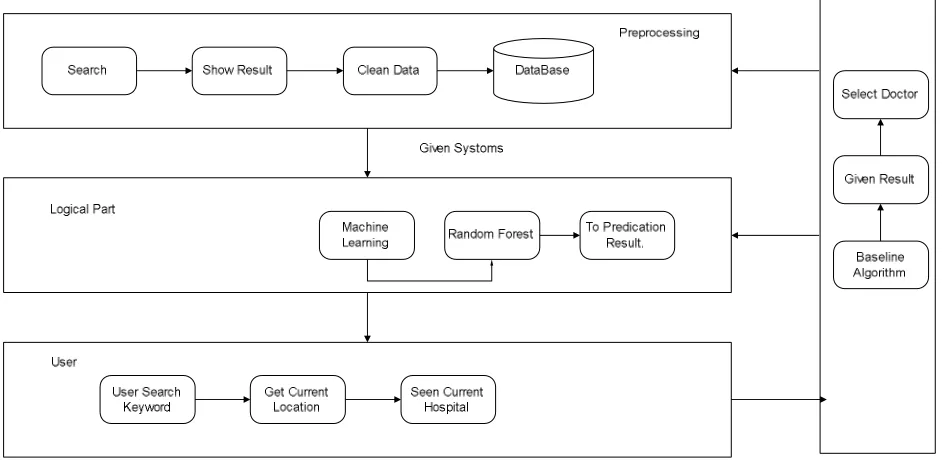
The Main Concept to determine medical diseases according to given symptoms & daily Routine when User search the hospital then given the nearest hospital of their current location. The system provides a user-friendly interface for examinees and doctors. Examinees can know their symptoms which accrued in body which set as the while doctors can get a set of examinees with potential risk. A feedback mechanism could save manpower and improve performance of system automatically. The doctor could fix prediction result through an interface, which will collect doctors’ input as new training data. An extra training process will be triggered everyday using these data. Thus, our system could improve the performance of prediction model automatically.
Fig 1: System Overview
Advantages are:
Increases human-computer interactions
Location of User is detected.
ISSN(Online): 2319-8753 ISSN (Print): 2347-6710
I
nternational
J
ournal of
I
nnovative
R
esearch in
S
cience,
E
ngineering and
T
echnology
(A High Impact Factor, Monthly, Peer Reviewed Journal)
Visit: www.ijirset.com
Vol. 8, Issue 2, February 2019
Provided medicine for diseases which is predicted .
Fast Prediction system
Scalable , Low-cost
Comparable quality to experts
V. CONCULSION
This project implements an AI-assisted prediction system which leverages data mining methods to reveal the relationship between the regular physical examination records and the potential health risk given by the user or public Different machine learning algorithms are applied to predict physical status of examinee will be in danger of physical deterioration next year. In our System user or patient search the hospital, then results are given according to the nearest location of current location of user/patients. User / Patients gives symptoms and the system will predict the diseases and will give the medicines. We also design a feedback mechanism for doctors to fix classification result or input new training data, and the system will automatically rerun the training process to improve performance every day
REFERENCES
[1] ZhaoqianLan, Guopeng Zhou, YichunDuan , Wei Yan , “AI-assisted Prediction on Potential Health Risks with Regular Physical Examination Records”, IEEE Transactions On Knowledge And Data Science ,2018.
[2] Srinivas K, Rani B K, Govrdhan A. “Applications of Data Mining Techniques in Healthcare and Prediction of Heart Attacks”. International Journal on Computer Science & Engineering, 2010.
[3] Sittig D, Wright A, Osheroff J, et al. “Grand challenges in clinical decision support”. Journal of Biomedical Informatics, 2008.
[4] Anderson J E, Chang D C. “Using Electronic Health Records for Surgical Quality Improvement in the Era of Big Data”[J]. Jama Surgery, 2015. [5] Gheorghe M, Petre R. “Integrating Data Mining Techniques into Telemedicine Systems” InformaticaEconomica Journal, 2014.
[6] R. Baeza-Yates, C. Hurtado, and M. Mendoza, “Query recommendation using query logs in search engines,” in Proc. Int. Conf. Current Trends Database Technol., 2004, pp. 588–596.
[7] Koh H C, Tan G. Data mining applications in healthcare.[J]. Journal of Healthcare Information Management Jhim, 2005, 19(2):64-72. [8] Menon A K, Jiang X, Kim J, et al. Detecting Inappropriate Access to Electronic Health Records Using Collaborative Filtering[J]. Machine
Learning, 2014, 95(1):87-101.
[9] Accreditation Reports to Identify Risk Factors in Medication Management in Australian Residential Aged Care Homes[J]. Studies in Health Technology & Informatics, 2017, 245:892.
[10] Nattkemper T W, Arnrich B, Lichte O, et al. Evaluation of radiological features for breast tumour classification in clinical screening with machine learning methods[J]. Artificial Intelligence in Medicine, 2005, 34(2):129- 139.