Efficient Handling of
N
-gram Language Models
for Statistical Machine Translation
Marcello Federico
Fondazione Bruno Kessler - IRST I-38050 Trento, Italy
Mauro Cettolo
Fondazione Bruno Kessler - IRST I-38050 Trento, Italy
Abstract
Statistical machine translation, as well as other areas of human language processing, have recently pushed toward the use of large scalen-gram language models. This paper presents efficient algorithmic and architec-tural solutions which have been tested within
theMosesdecoder, an open source toolkit
for statistical machine translation. Exper-iments are reported with a high perform-ing baseline, trained on the Chinese-English NIST 2006 Evaluation task and running on a standard Linux 64-bit PC architecture. Comparative tests show that our representa-tion halves the memory required by SRI LM Toolkit, at the cost of 44% slower translation speed. However, as it can take advantage of memory mapping on disk, the proposed implementation seems to scale-up much bet-ter to very large language models: decoding with a 289-million 5-gram language model runs in 2.1Gb of RAM.
1 Introduction
In recent years, we have seen an increasing interest toward the application of n-gram Language Mod-els (LMs) in several areas of computational lin-guistics (Lapata and Keller, 2006), such as ma-chine translation, word sense disambiguation, text tagging, named entity recognition, etc. The origi-nal framework ofn-gram LMs was principally au-tomatic speech recognition, under which most of the standard LM estimation techniques (Chen and
Goodman, 1999) were developed. Nowadays, the availability of larger and larger text corpora is stress-ing the need for efficient data structures and algo-rithms to estimate, store and access LMs. Unfortu-nately, the rate of progress in computer technology seems for the moment below the space requirements of such huge LMs, at least by considering standard lab equipment.
Statistical machine translation (SMT) is today one of the research areas that, together with speech recognition, is pushing mostly toward the use of huge n-gram LMs. In the 2006 NIST Machine Translation Workshop (NIST, 2006), best perform-ing systems employed 5-grams LMs estimated on at least 1.3 billion-word texts. In particular, Google Inc. presented SMT results with LMs trained on 8 trillion-word texts, and announced the availabil-ity of n-gram statistics extracted from one trillion of words. The n-gram Google collection is now publicly available through LDC, but their effective use requires either to significantly expand computer memory, in order to use existing tools (Stolcke, 2002), or to develop new ones.
This work presents novel algorithms and data structures suitable to estimate, store, and access very large LMs. The software has been integrated into a popular open source SMT decoder called
Moses.1 Experimental results are reported on the
Chinese-English NIST task, starting from a quite well-performing baseline, that exploits a large 5-gram LM.
This paper is organized as follows. Section 2 presents techniques for the estimation and
represen-1http://www.statmt.org/moses/
tation in memory ofn-gram LMs that try to optimize space requirements. Section 3 describes methods implemented in order to efficiently access the LM at run time, namely by the Moses SMT decoder. Section 4 presents a list of experiments addressing specific questions on the presented implementation.
2 Language Model Estimation
LM estimation starts with the collection ofn-grams and their frequency counters. Then, smoothing pa-rameters are estimated (Chen and Goodman, 1999) for eachn-gram level; infrequentn-grams are possi-bly pruned and, finally, a LM file is created contain-ingn-grams with probabilities and back-off weights.
2.1 N-gram Collection
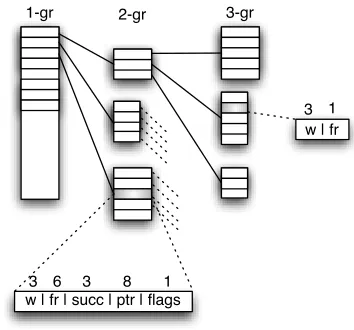
Clearly, a first bottleneck of the process might occur if all n-grams have to be loaded in memory. This problem is overcome by splitting the collection ofn -grams statistics into independent steps and by mak-ing use of an efficient data-structure to collect and storen-grams. Hence, first the dictionary of the cor-pus is extracted and split intoKword lists, balanced with respect to the frequency of the words. Then, for each list, onlyn-grams whose first word belongs to the list are extracted from the corpus. The value ofK is determined empirically and should be suffi-ciently large to permit to fit the partialn-grams into memory. The collection of each subset ofn-grams exploits a dynamic prefix-tree data structure shown in Figure 1. It features a table with all collected 1-grams, each of which points to its 2-gram succes-sors, namely the 2-grams sharing the same 1-gram prefix. All 2-gram entries point to all their 3-gram successors, and so on. Successor lists are stored in memory blocks allocated on demand through a memory pool. Blocks might contain different num-ber of entries and use 1 to 6 bytes to encode fre-quencies. In this way, a minimal encoding is used in order to represent the highest frequency entry of each block. This strategy permits to cope well with the high sparseness of n-grams and with the pres-ence of relatively few highly-frequentn-grams, that require counters encoded with 6 bytes.
The proposed data structure differs from other im-plementations mainly in the use of dynamic alloca-tion of memory required to store frequencies ofn
-3
w | fr | succ | ptr | flags 6 3 8 1
3 w | fr
1 1-gr 2-gr 3-gr
Figure 1: Dynamic data structure for storing n -grams. Blocks of successors are allocated on de-mand and might vary in the number of entries (depth) and bytes used to store counters (width). Size in bytes is shown to encode words (w), frequen-cies (fr), and number of (succ), pointer to (ptr) and table type of (flags) successors.
grams. In the structure proposed by (Wessel et al., 1997) counters ofn-grams occurring more than once are stored into 4-byte integers, while singleton n -grams are stored in a special table with no counters. This solution permits to save memory at the cost of computational overhead during the collection ofn -grams. Moreover, for historical reasons, this work ignores the issue with huge counts. In the SRILM toolkit (Stolcke, 2002),n-gram counts are accessed through a special class type. Counts are all repre-sented as 4-byte integers by applying the following trick: counts below a given threshold are represented as unsigned integers, while those above the thresh-old, which are typically very sparse, correspond in-deed to indexes of a table storing their actual value. To our opinion, this solution is ingenious but less general than ours, which does not make any assump-tion about the number of different high order counts.
2.2 LM Smoothing
For example, smoothing statistics for a 5-gram (v, w, x, y, z) are computed by means of statistics that are local to the subset ofn-grams starting with v. Namely, they are the countersN(v, w, x, y, z), N(v, w, x, y), and the numberD(v, w, x, y)of dif-ferent words observed in context(v, w, x, y).
Finally, K LM files are created, by just read-ing through then-gram files, which are indeed not loaded in memory. During this phase pruning of in-frequentn-grams is also permitted. Finally, all LM files are joined, global 1-gram probabilities are com-puted and added, and a single large LM file, in the standard ARPA format (Stolcke, 2002), is generated. We are well aware that the implemented smooth-ing method is below the state-of-the-art. However, from one side, experience tells that the gap in per-formance between simple and sophisticated smooth-ing techniques shrinks when very large corpora are used; from the other, the chosen smoothing method is very suited to the kind of decomposition we are applying to the n-gram statistics. In the future, we will nevertheless address the impact of more sophis-ticated LM smoothing on translation performance.
2.3 LM Compilation
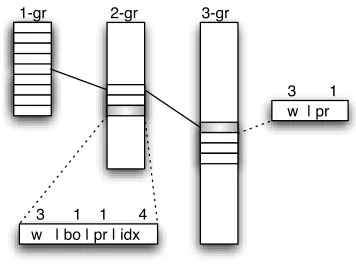
The final textual LM can be compiled into a binary format to be efficiently loaded and accessed at run-time. Our implementation follows the one adopted by the CMU-Cambridge LM Toolkit (Clarkson and Rosenfeld, 1997) and well analyzed in (Whittaker and Raj, 2001). Briefly, n-grams are stored in a data structure which privileges memory saving rather than access time. In particular, single com-ponents of each n-gram are searched, via binary search, into blocks of successors stored contigu-ously (Figure 2). Further improvements in mem-ory savings are obtained by quantizing both back-off weights and probabilities.
2.4 LM Quantization
Quantization provides an effective way of reducing the number of bits needed to store floating point variables. (Federico and Bertoldi, 2006) showed that best results were achieved with the so-called binning
method. This method partitions data points into
uni-formly populated intervals or bins. Bins are filled in in a greedy manner, starting from the lowest value. The center of each bin corresponds to the mean value
1-gr 2-gr 3-gr
3
w | bo | pr | idx 1 1 4
w | pr 3 1
Figure 2: Static data structure for LMs. Number of bytes are shown used to encode single words (w), quantized back-off weights (bo) and probabilities (pr), and start index of successors (idx).
of all its points. Quantization is applied separately at each n-gram level and distinctly to probabilities or back-off weights. The chosen level of quantiza-tion is 8 bits (1 byte), that experimentally showed to introduce negligible loss in translation performance. The quantization algorithm can be applied to any LM represented with the ARPA format. Quantized LMs can also be converted into a binary format that can be efficiently uploaded at decoding time.
3 Language Model Access
One motivation of this work is the assumption that efficiency, both in time and space, can be gained by exploiting peculiarities of the way the LM is used by the hosting program, i.e. the SMT decoder. An analysis of the interaction between the decoder and the LM was carried out, that revealed some impor-tant properties. The main result is shown in Figure 3, which plots all calls to a 3-gram LM byMoses dur-ing the translation from German to English of the following text, taken from the Europarl task:
ich bin kein christdemokrat und glaube daher nicht an wunder .
doch ich m¨ochte dem europ¨aischen
parlament , so wie es gegenw¨urtig
beschaffen ist , f¨ur seinen
grossen beitrag zu diesen arbeiten danken.
Figure 3: LM calls during translation of a German text: each point corresponds to a specific 3-gram.
access the LMn-grams in nonuniform, highly local-ized patterns. Locality is mainly temporal, namely the first call of an n-gram is easily followed by other calls of the samen-gram. This property sug-gests that gains in access speed can be achieved by exploiting a cache memory in which to store al-ready calledn-grams. Moreover, the relatively small amount of involvedn-grams makes viable the access of the LM from disk on demand. Both techniques are briefly described.
3.1 Caching of probabilities
In order to speed-up access time of LM probabilities different cache memories have been implemented through the use of hash tables. Cache memories are used to store all finaln-gram probabilities requested by the decoder, LM states used to recombine theo-ries, as well as all partialn-gram statistics computed by accessing the LM structure. In this way, the need of performing binary searches, at every level of the LM tables, is reduced at a minimum.
All cache memories are reset before decoding each single input set.
3.2 Memory Mapping
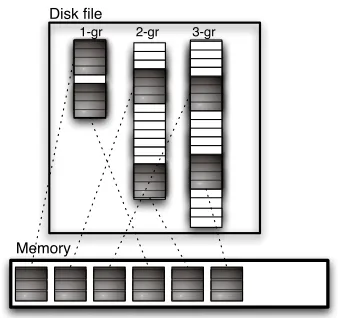
Since a limited collection of all n-grams is needed to decode an input sentence, the LM is loaded on demand from disk. The data structure shown in Fig-ure 2 permits indeed to efficiently exploit the so-called memory mapped file access.2 Memory map-ping basically permits to include a file in the address
2POSIX-compliant operating systems and Windows support
some form of memory-mapped file access.
Memory
1-gr 2-gr 3-gr
Disk file
Figure 4: Memory mapping of the LM on disk. Only the memory pages (grey blocks) of the LM that are accessed while decoding the input sentence are loaded in memory.
space of a process, whose access is managed as vir-tual memory (see Figure 4).
During decoding of a sentence, only those n -grams, or better memory pages, of the LM that are actually accessed are loaded into memory, which re-sults in a significant reduction of the resident mem-ory space required by the process. Once the decod-ing of the input sentence is completed, all loaded pages are released, so that resident memory is avail-able for the n-gram probabilities of the following sentence. A remarkable feature is that memory-mapping also permits to share the same address space among multiple processes, so that the same LM can be accessed by several decoding processes (running on the same machine).
4 Experiments
In order to assess the quality of our implementa-tion, henceforth named IRSTLM, we have designed a suite of experiments with a twofold goal: from one side the comparison of IRSTLM against a pop-ular LM library, namely the SRILM toolkit (Stol-cke, 2002); from the other, to measure the actual impact of the implementation solution discussed in previous sections. Experiments were performed on a common statistical MT platform, namelyMoses, in which both the IRSTLM and SRILM toolkits have been integrated.
set type |W|
source target large parallel 83.1M 87.6M
giga monolingual - 1.76G
NIST 02 dev 23.7K 26.4K
NIST 03 test 25.6K 28.5K
NIST 04 test 51.0K 58.9K
NIST 05 test 31.2K 34.6K
NIST 06 nw test 18.5K 22.8K NIST 06 ng test 9.4K 11.1K NIST 06 bn test 12.0K 13.3K
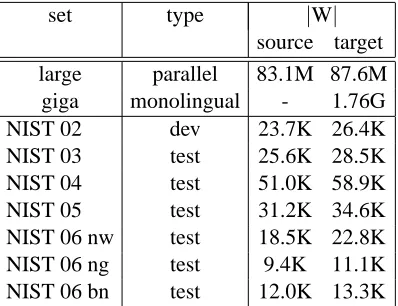
Table 1: Statistics of training, dev. and test sets. Evaluation sets of NIST campaigns include 4 ref-erences: in table, average lenghts are provided.
which our experiments aim to answer.
Assessing Questions
1. Is LM estimation feasible for large amounts of data?
2. How does IRSTLM compare with SRILM w.r.t.:
(a) decoding speed? (b) memory requirements? (c) translation performance?
3. How does LM quantization impact in terms of (a) memory consumption?
(b) decoding speed?
(c) translation performance? (d) tuning of decoding parameters?
4. What is the impact of caching on decoding speed?
5. What are the advantages of memory mapping?
Task and Experimental Setup
The task chosen for our experiments is the transla-tion of news from Chinese to English, as proposed by the NIST MT Evaluation Workshop of 2006.3 A translation system was trained according to the
large-data condition. In particular, all the allowed
bilingual corpora have been used for estimating the phrase-table. The target side of these texts was also employed for the estimation of three 5-gram LMs, henceforth named large. In particular, two LMs
3www.nist.gov/speech/tests/mt/
were estimated with the SRILM toolkit by prun-ing sprun-ingletons events and by employprun-ing the Witten-Bell and the absolute discounting (Kneser and Ney, 1995) smoothing methods; the shorthand for these two LMs will be “lrg-sri-wb” and “lrg-sri-kn”, re-spectively. Another large LM was estimated with the IRSTLM toolkit, by employing the only smoothing method available in the package (Witten-Bell) and by pruning singletonsn-grams; its shorthand will be “lrg”. An additional, much larger, 5-gram LM was instead trained with the IRSTLM toolkit on the so-called English Gigaword corpus, one of the allowed monolingual resources for this task.
Automatic translation was performed by means of
Moseswhich, among other things, permits the
con-temporary use of more LMs, feature we exploited in our experiments as specified later.
Optimal interpolation weights for the log-linear model were estimated by running a minimum error training algorithm, available in theMoses toolkit, on the evaluation set of the NIST 2002 campaign. Tests were performed on the evaluation sets of the successive campaigns (2003 to 2006). Concern-ing the NIST 2006 evaluation set, results are given separately for three different types of texts, namely newswire (nw) and newsgroup (ng) texts, and broad-cast news transcripts (bn).
Table 1 gives figures about training, development and test corpora, while Table 2 provides main statis-tics of the estimated LMs.
LM millions of
1-gr 2-gr 3-gr 4-gr 5-gr lrg-sri-kn 0.3 5.2 5.9 7.1 6.8 lrg-sri-wb 0.3 5.2 6.4 7.8 6.8 lrg 0.3 5.3 6.6 8.4 8.0 giga 4.5 64.4 127.5 228.8 288.6
Table 2: Statistics of LMs.
CPU 3.20GHz with 8Gb RAM. Experiments run on dual Intel/Xeon CPUs 3.20GHz/8Gb RAM.
4.1 LM estimation
First of all, let us answer the question (number 1) on the feasibility of the procedure for the estima-tion of huge LMs. Given the amount of training data employed, it is worth to provide some details about the estimation process of the “giga” LM. According to the steps listed in Section 2.1, the whole dictio-nary was split intoK = 14frequency balanced lists. Then, 5-grams beginning with words from each list were extracted and stored. Table 3 shows some fig-ures about these dictionaries and 5-gram collections. Note that the dictionary size increases with the list index: this means only that more frequent words were used first. This stage run in few hours with 1-2Gb parallel processes.
list dictionary number of 5-grams: index size observed distinct non-singletons
0 4 217M 44.9M 16.2M
1 11 164M 65.4M 20.7M
2 8 208M 85.1M 27.0M
3 44 191M 83.0M 26.0M
4 64 143M 56.6M 17.8M
5 137 142M 62.3M 19.1M
6 190 142M 64.0M 19.5M
7 548 142M 66.0M 20.1M
8 783 142M 63.3M 19.2M
9 1.3K 141M 67.4M 20.2M
10 2.5K 141M 69.7M 20.5M
11 6.1K 141M 71.8M 20.8M
12 25.4K 141M 74.5M 20.9M 13 4.51M 141M 77.4M 20.6M total 4.55M 2.2G 951M 289M
Table 3: Estimation of the “giga” LM: dictionary and 5-gram statistics (K = 14).
The actual estimation of the LM was performed with the scheme presented in Section 2.2. For each collection of non-singletons 5-grams, a sub-LM was built by computing smoothedn-gram (n = 1· · ·5) probabilities and interpolation parameters. Again, by exploiting parallel processing, this phase took only few hours on standard HW resources. Finally, sub-LMs were joined in a single LM, which can be stored in two formats: (i) the standard textual ARPA
LM format quantization file size lrg-sri-kn textual n 893Mb lrg-sri-wb textual n 952Mb
lrg textual n 1088Mb
y 789Mb
binary n 368Mb
y 220Mb
giga textual n 28.0Gb
y 21.0Gb
binary n 8.5Gb
y 5.1Gb
Table 4: Figures of LM files.
format, and (ii) the binary format of Section 2.3. In addition, LM probabilities can be quantized accord-ing to the procedure of Section 2.4.
The estimation of the “lrg-sri” LMs, performed by means of the SRILM toolkit, took about 15 min-utes requiring 5Gb of memory. The “lrg” LM was estimated as the “giga” LM in about half an hour demanding only few hundreds of Mb of memory.
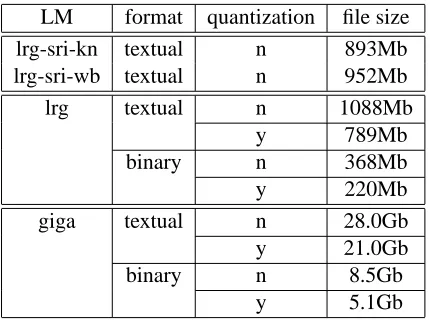
Table 4 lists the size of files storing various ver-sions of the “large” and “giga” LMs which differ in format and/or type.
4.2 LM run-time usage
Tables 5 and 6 shows BLEU and NIST scores, re-spectively, measured on test sets for each specific LM configuration. The first two rows of the two ta-bles regards runs ofMoses with the SRILM, that uses “lrg-sri” LMs. The other rows refer to runs of
Moseswith IRSTLM, either using LM “lrg” only,
or both LMs, “lrg” and “giga”. LM quantization is marked by a “q”.
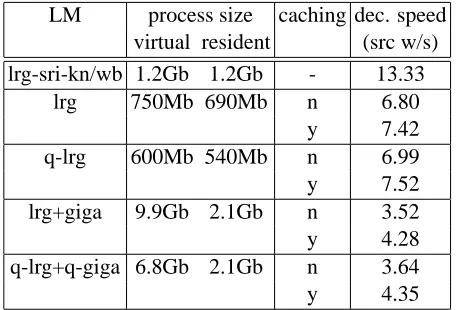
Finally, in Table 7 figures about the decoding pro-cesses are recorded. For each LM configuration, the process size, both virtual and resident, is provided together with the average time required for translat-ing a source word with/without the activation of the caching mechanism described in Section 3.1. It is to worth noticing that the “giga” LM (both original and quantized) is loaded through the memory map-ping service presented in Section 3.2.
Table 7 includes most of the answers to question number 2:
LM NIST test set
03 04 05 06 06 06
nw ng bn
lrg-sri-kn 28.74 30.52 26.99 29.28 23.47 27.27 lrg-sri-wb 28.05 29.86 26.52 28.37 23.13 26.37 lrg 28.49 29.84 26.97 28.69 23.28 26.70 q-lrg 28.05 29.66 26.48 28.58 22.64 26.05 lrg+giga 30.77 31.93 29.09 29.74 24.39 28.50 q-lrg+q-giga 30.42 31.47 28.62 29.76 24.28 28.23
Table 5: BLEU scores on NIST evaluation sets for different LM configurations.
LM NIST test set
03 04 05 06 06 06
nw ng bn
lrg-sri-kn 8.73 9.29 8.47 8.98 7.81 8.52 lrg-sri-wb 8.52 9.14 8.27 8.96 7.90 8.34 lrg 8.73 9.21 8.45 8.95 7.82 8.47 q-lrg 8.60 9.11 8.32 8.88 7.73 8.31 lrg+giga 9.08 9.49 8.80 8.92 7.86 8.66 q-lrg+q-giga 8.93 9.38 8.65 9.05 7.99 8.60
Table 6: NIST scores on NIST evaluation sets for different LM configurations.
translation than IRSTLM (13.33 vs. 6.80 words/s). Anyway, IRSTLM can be sped-up to 7.52 words/s by applying caching.
2.b IRSTLM requires about half memory than SRILM for storing an equivalent LM during decoding. If the LM is quantized, the gain is even larger. Concerning file sizes (Table 4), the size of IRSTLM binary files is about 30% of the corresponding textual versions. Quantiza-tion further reduces the size to 20% of the orig-inal textual format.
2.c Performance of IRSTLM and SRILM on the large LMs smoothed with the same method are comparable, as expected (see entries “lrg-sri-wb” and “lrg” of Tables 5 and 6). The small differences are due to different probability val-ues assigned by the two libraries to out-of-vocabulary words.
Concerning quantization, gains in terms of memory space (question 3.a) have already been highlighted (see answer 2.b). For the remaining points:
3.b comparing “lrg” vs. “q-lrg” rows and
LM process size caching dec. speed virtual resident (src w/s) lrg-sri-kn/wb 1.2Gb 1.2Gb - 13.33
lrg 750Mb 690Mb n 6.80
y 7.42
q-lrg 600Mb 540Mb n 6.99
y 7.52
lrg+giga 9.9Gb 2.1Gb n 3.52
y 4.28
q-lrg+q-giga 6.8Gb 2.1Gb n 3.64
y 4.35
Table 7: Process size and decoding speed with/wo caching for different LM configurations.
“lrg+giga” vs. “q-lrg+q-giga” rows of Ta-ble 7, it results that quantization allows only a marginal decoding time reduction (1-3%) 3.c comparing the same rows of Tables 5 and 6, it
can be claimed that quantization doesn’t affect translation performance in a significant way 3.d no specific training of decoder weights is
re-quired since the original LM and its quan-tized version are equivalent. For example, by translating the NIST 05 test set with the weights estimated on the “lrg+giga” configu-ration, the following BLEU/NIST scores are got: 28.99/8.79 with the “q-lrg+q-giga” LMs, 29.09/8.80 with the “lrg+giga” LMs (the latter scores are also given in Tables 5 and 6). Em-ploying weights estimated on “q-lrg+q-giga” scores are: 28.58/8.66 with “lrg+giga” LMs, 28.62/8.65 with “q-lrg+q-giga” LMs (again also in Tables 5 and 6). Also on other test sets differences are negligible.
Table 7 answers the question number 4 on caching, by reporting the decoding speed-up due to this mechanism: a gain of 8-9% is observed on “lrg” and “q-lrg” configurations, of 20-21% in case also “giga/q-giga” LMs are employed.
The answer to the last question is that thanks to the memory mapping mechanism it is possible run
Moses with huge LMs, which is expected to
NIST test set
03 04 05 06 06 06
nw ng bn
BLEU
ci 33.62 35.04 31.92 32.74 26.18 32.43 cs 31.44 32.99 29.95 30.49 24.35 31.10 NIST
ci 9.27 9.75 9.00 9.24 8.00 8.97 cs 8.88 9.40 8.64 8.82 7.69 8.77
Table 8: Case insensitive (ci) and sensitive (cs) scores of the best performing system.
“lrg” LM. The SRILM-based decoder would require a process of about 30Gb to load the “giga” LM; on the contrary, the virtual size of the IRSTLM-based decoder is 6.8Gb, while the actual resident memory is only 2.1Gb.
4.3 Best Performing System
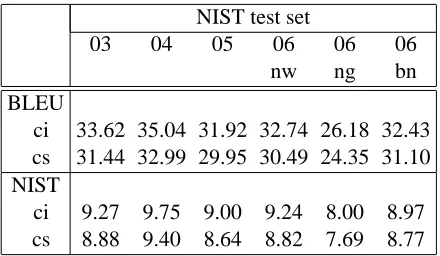
Experimental results discussed so far are not the best we are able to get. In fact, the adopted setup fixed the monotone search and the use of no reordering model. Then, in order to allow a fair comparison of the IRSTLM-basedMosessystem with the ones participating to the NIST MT evaluation campaigns, we have (i) set the maximum reordering distance to 6 and (ii) estimated a lexicalized reordering model on the large parallel data by means of the training option “orientation-bidirectional-fe”.
Table 8 shows BLEU/NIST scores measured on test sets by employing the IRSTLM-based Moses
with this setting and employing “q-lrg+q-giga” LMs. It ranks at the top 5 systems (out of 24) with respect to the results of the NIST 06 evaluation cam-paign.
5 Conclusions
We have presented a method for efficiently estimat-ing and handlestimat-ing large scale n-gram LMs for the sake of statistical machine translation. LM estima-tion is performed by splitting the task with respect to the initial word of then-grams, and by merging the resulting sub-LMs. Estimated LMs can be quan-tized and compiled in a compact data structure. Dur-ing the search, LM probabilities are cached and only the portion of effectively used LMn-grams is loaded in memory from disk. This method permits indeed
to exploit locality phenomena shown by the search algorithm when accessing LM probabilities. Results show an halving of memory requirements, at the cost of 44% slower decoding speed. In addition, loading the LM on demand permits to keep the size of mem-ory allocated to the decoder nicely under control.
Future work will investigate the way for includ-ing more sophisticated LM smoothinclud-ing methods in our scheme and will compare IRSTLM and SRILM toolkits on increasing size training corpora.
6 Acknowledgments
This work has been funded by the European Union under the integrated project TC-STAR - Technol-ogy and Corpora for Speech-to-Speech Translation - (IST-2002-FP6-506738, http://www.tc-star.org).
References
S.F. Chen and J. Goodman. 1999. An empirical study of smoothing techniques for language modeling. Computer Speech and Language, 4(13):359–393.
P. Clarkson and R. Rosenfeld. 1997. Statistical language mod-eling using the CMU–cambridge toolkit. In Proc. of Eu-rospeech, pages 2707–2710, Rhodes, Greece.
M. Federico and N. Bertoldi. 2006. How many bits are needed to store probabilities for phrase-based translation? In Proc. of the Workshop on Statistical Machine Translation, pages 94–101, New York City, June. Association for Computa-tional Linguistics.
R. Kneser and H. Ney. 1995. Improved backing-off for m-gram language modeling. In Proc. of ICASSP, volume 1, pages 181–184, Detroit, MI.
M. Lapata and F. Keller. 2006. Web-based models for natu-ral language processing. ACM Transactions on Speech and Language Processing, 1(2):1–31.
NIST. 2006. Proc. of the NIST MT Workshop. Washington, DC. NIST.
A. Stolcke. 2002. SRILM - an extensible language modeling toolkit. In Proc. of ICSLP, Denver, Colorado.
F. Wessel, S. Ortmanns, and H. Ney. 1997. Implementation of word based statistical language models. In Proc. SQEL Workshop on Multi-Lingual Information Retrieval Dialogs, pages 55–59, Pilsen, Czech Republic.
E. W. D. Whittaker and B. Raj. 2001. Quantization-based Lan-guage Model Compression. In Proc. of Eurospeech, pages 33–36, Aalborg.