Learning Domain-Specific Information Extraction Patterns from the Web
Siddharth Patwardhan and Ellen Riloff
School of Computing University of Utah Salt Lake City, UT 84112
{sidd,riloff}@cs.utah.edu
Abstract
Many information extraction (IE) systems rely on manually annotated training data to learn patterns or rules for extracting in-formation about events. Manually anno-tating data is expensive, however, and a new data set must be annotated for each domain. So most IE training sets are rel-atively small. Consequently, IE patterns learned from annotated training sets of-ten have limited coverage. In this paper, we explore the idea of using the Web to automatically identify domain-specific IE patterns that were not seen in the training data. We use IE patterns learned from the MUC-4 training set as anchors to identify domain-specific web pages and then learn new IE patterns from them. We compute the semantic affinity of each new pattern to automatically infer the type of informa-tion that it will extract. Experiments on the MUC-4 test set show that these new IE patterns improved recall with only a small precision loss.
1 Introduction
Information Extraction (IE) is the task of identi-fying event descriptions in natural language text and extracting information related to those events. Many IE systems use extraction patterns or rules to identify the relevant information (Soderland et al., 1995; Riloff, 1996; Califf and Mooney, 1999; Soderland, 1999; Yangarber et al., 2000). Most of these systems use annotated training data to learn pattern matching rules based on lexical, syntactic, and/or semantic information. The learned patterns are then used to locate relevant information in new texts.
IE systems typically focus on information about events that are relevant to a specific domain, such as terrorism (Sundheim, 1992; Soderland et al., 1995; Riloff, 1996; Chieu et al., 2003), man-agement succession (Sundheim, 1995; Yangarber et al., 2000), or job announcements (Califf and Mooney, 1999; Freitag and McCallum, 2000). Supervised learning systems for IE depend on domain-specific training data, which consists of texts associated with the domain that have been manually annotated with event information.
The need for domain-specific training data has several disadvantages. Because of the manual la-bor involved in annotating a corpus, and because a new corpus must be annotated for each domain, most annotated IE corpora are relatively small. Language is so expressive that it is practically impossible for the patterns learned from a rela-tively small training set to cover all the different ways of describing events. Consequently, the IE patterns learned from manually annotated train-ing sets typically represent only a subset of the IE patterns that could be useful for the task. Many recent approaches in natural language processing (Yarowsky, 1995; Collins and Singer, 1999; Riloff and Jones, 1999; Nigam et al., 2000; Wiebe and Riloff, 2005) have recognized the need to use unannotated data to improve performance.
While the Web provides a vast repository of unannotated texts, it is non-trivial to identify texts that belong to a particular domain. The difficulty is that web pages are not specifically annotated with tags categorizing their content. Nevertheless, in this paper we look to the Web as a vast dynamic resource for domain-specific IE learning. Our ap-proach exploits an existing set of IE patterns that were learned from annotated training data to auto-matically identify new, domain-specific texts from
the Web. These web pages are then used for ad-ditional IE training, yielding a new set of domain-specific IE patterns. Experiments on the MUC-4 test set show that the new IE patterns improve cov-erage for the domain.
This paper is organized as follows. Section 2 presents the MUC-4 IE task and data that we use in our experiments. Section 3 describes how we cre-ate a baseline IE system from the MUC-4 training data. Section 4 describes the collection and pre-processing of potentially relevant web pages. Sec-tion 5 then explains how we use the IE patterns learned from the MUC-4 training set as anchors to learn new IE patterns from the web pages. We also compute the semantic affinity of each new pattern to automatically infer the type of information that it will extract. Section 6 shows experimental re-sults for two types of extractions, victims and tar-gets, on the MUC-4 test set. Finally, Section 7 compares our approach to related research, and Section 8 concludes with ideas for future work.
2 The MUC-4 IE Task and Data
The focus of our research is on the MUC-4 infor-mation extraction task (Sundheim, 1992), which is to extract information about terrorist events. The MUC-4 corpus contains 1700 stories, mainly news articles related to Latin American terrorism, and associated answer key templates containing the in-formation that should be extracted from each story. We focused our efforts on two of the MUC-4
string slots, which require textual extractions:
hu-man targets (victims) and physical targets. The MUC-4 data has proven to be an especially dif-ficult IE task for a variety of reasons, including the fact that the texts are entirely in upper case, roughly 50% of the texts are irrelevant (i.e., they do not describe a relevant terrorist event), and many of the stories that are relevant describe mul-tiple terrorist events that need to be teased apart. The best results reported across all string slots in MUC-4 were in the 50%-70% range for re-call and precision (Sundheim, 1992), with most of the MUC-4 systems relying on heavily hand-engineered components. Chieu et al. (2003) re-cently developed a fully automatic template gen-erator for the MUC-4 IE task. Their best system produced recall scores of 41%-44% with precision scores of 49%-51% on the TST3 and TST4 test sets.
3 Learning IE Patterns from a Fixed Training Set
As our baseline system, we created an IE system for the MUC-4 terrorism domain us-ing the AutoSlog-TS extraction pattern learn-ing system (Riloff, 1996; Riloff and Phillips, 2004), which is freely available for research use. AutoSlog-TS is a weakly supervised learner that requires two sets of texts for training: texts that are relevant to the domain and texts that are irrel-evant to the domain. The MUC-4 data includes relevance judgments (implicit in the answer keys), which we used to partition our training set into rel-evant and irrelrel-evant subsets.
AutoSlog-TS’ learning process has two phases. In the first phase, syntactic patterns are applied to the training corpus in an exhaustive fashion, so that extraction patterns are generated for (lit-erally) every lexical instantiation of the patterns that appears in the corpus. For example, the syn-tactic pattern “<subj> PassVP” would generate
extraction patterns for all verbs that appear in the corpus in a passive voice construction. The sub-ject of the verb will be extracted. In the terrorism domain, some of these extraction patterns might be: “<subj> PassVP(murdered)” and “<subj>
PassVP(bombed).” These would match sentences
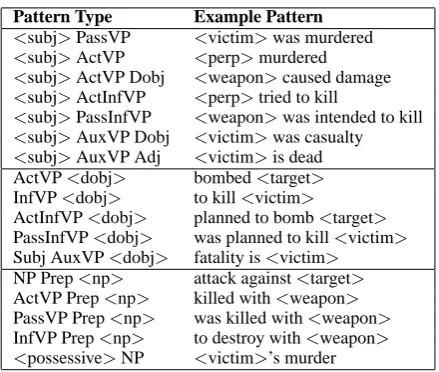
such as: “the mayor was murdered”, and “the em-bassy and hotel were bombed”. Figure 1 shows the 17 types of extraction patterns that AutoSlog-TS currently generates. PassVP refers to passive voice verb phrases (VPs), ActVP refers to active voice VPs, InfVP refers to infinitive VPs, and AuxVP refers to VPs where the main verb is a form of “to be” or “to have”. Subjects (subj), di-rect objects (dobj), PP objects (np), and posses-sives can be extracted by the patterns.
In the second phase, AutoSlog-TS applies all of the generated extraction patterns to the training corpus and gathers statistics for how often each pattern occurs in relevant versus irrelevant texts. The extraction patterns are subsequently ranked based on their association with the domain, and then a person manually reviews the patterns, de-ciding which ones to keep1and assigning thematic roles to them. We manually defined selectional restrictions for each slot type (victim and target)
1Typically, many patterns are strongly associated with the
Pattern Type Example Pattern
<subj>PassVP <victim>was murdered <subj>ActVP <perp>murdered
<subj>ActVP Dobj <weapon>caused damage
<subj>ActInfVP <perp>tried to kill
<subj>PassInfVP <weapon>was intended to kill
<subj>AuxVP Dobj <victim>was casualty
<subj>AuxVP Adj <victim>is dead ActVP<dobj> bombed<target>
InfVP<dobj> to kill<victim>
ActInfVP<dobj> planned to bomb<target>
PassInfVP<dobj> was planned to kill<victim>
Subj AuxVP<dobj> fatality is<victim>
NP Prep<np> attack against<target>
ActVP Prep<np> killed with<weapon>
PassVP Prep<np> was killed with<weapon>
[image:3.595.72.292.59.245.2]InfVP Prep<np> to destroy with<weapon> <possessive>NP <victim>’s murder
Figure 1: AutoSlog-TS’ pattern types and sample IE patterns
and then automatically added these to each pattern when the role was assigned.
On our training set, AutoSlog-TS generated 40,553 distinct extraction patterns. A person man-ually reviewed all of the extraction patterns that
had a score ≥ 0.951 and frequency ≥ 3. This
score corresponds to AutoSlog-TS’ RlogF metric, described in (Riloff, 1996). The lowest ranked pat-terns that passed our thresholds had at least 3 rel-evant extractions out of 5 total extractions. In all, 2,808 patterns passed the thresholds. The reviewer ultimately decided that 396 of the patterns were useful for the MUC-4 IE task, of which 291 were useful for extracting victims and targets.
4 Data Collection
In this research, our goal is to automatically learn IE patterns from a large, domain-independent text collection, such as the Web. The billions of freely available documents on the World Wide Web and its ever-growing size make the Web a potential source of data for many corpus-based natural lan-guage processing tasks. Indeed, many researchers have recently tapped the Web as a data-source for improving performance on NLP tasks (e.g., Resnik (1999), Ravichandran and Hovy (2002),
Keller and Lapata (2003)). Despite these
suc-cesses, numerous problems exist with collecting data from the Web, such as web pages contain-ing information that is not free text, includcontain-ing ad-vertisements, embedded scripts, tables, captions, etc. Also, the documents cover many genres, and it is not easy to identify documents of a particular genre or domain. Additionally, most of the
doc-uments are in HTML, and some amount of pro-cessing is required to extract the free text. In the following subsections we describe the process of collecting a corpus of terrorism-related CNN news articles from the Web.
4.1 Collecting Domain-Specific Texts
Our goal was to automatically identify and collect a set of documents that are similar in domain to the MUC-4 terrorism text collection. To create such a corpus, we used hand-crafted queries given to a search engine. The queries to the search engine were manually created to try to ensure that the ma-jority of the documents returned by the search en-gine would be terrorism-related. Each query con-sisted of two parts: (1) the name of a terrorist or-ganization, and (2) a word or phrase describing a terrorist action (such as bombed, kidnapped, etc.). The following lists of 5 terrorist organizations and 16 terrorist actions were used to create search en-gine queries:
Terrorist organizations: Al Qaeda, ELN, FARC, HAMAS, IRA
Terrorist actions: assassinated,
assas-sination, blew up, bombed, bombing, bombs, explosion, hijacked, hijacking, injured, kidnapped, kidnapping, killed, murder, suicide bomber, wounded.
We created a total of 80 different queries repre-senting each possible combination of a terrorist or-ganization and a terrorist action.
We used the Google2 search engine with the
help of the freely available Google API3 to lo-cate the texts on the Web. To ensure that we re-trieved only CNN news articles, we restricted the
search to the domain “cnn.com” by adding the
“site:” option to each of the queries. We also
restricted the search to English language
docu-ments by initializing the API with the lang en
option. We deleted documents whose URLs con-tained the word “transcript” because most of these were transcriptions of CNN’s TV shows and were stylistically very different from written text. We ran the 80 queries twice, once in December 2005 and once in April 2005, which produced 3,496 documents and 3,309 documents, respectively. After removing duplicate articles, we were left
2
http://www.google.com
with a total of 6,182 potentially relevant terrorism articles.
4.2 Processing the Texts
The downloaded documents were all HTML doc-uments containing HTML tags and JavaScript in-termingled with the news text. The CNN web-pages typically also contained advertisements, text for navigating the website, headlines and links to other stories. All of these things could be problem-atic for our information extraction system, which was designed to process narrative text using a shal-low parser. Thus, simply deleting all HTML tags on the page would not have given us natural lan-guage sentences. Instead, we took advantage of the uniformity of the CNN web pages to “clean” them and extract just the sentences corresponding to the news story.
We used a tool called HTMLParser4 to parse
the HTML code, and then deleted all nodes in the HTML parse trees corresponding to tables, com-ments, and embedded scripts (such as JavaScript or VBScript). The system automatically extracted news text starting from the headline (embedded in an H1 HTML element) and inferred the end of the article text using a set of textual clues such as
“Feedback:”, “Copyright 2005”, “contributed to this report”, etc. In case of any ambiguity, all of
the text on the web page was extracted.
The size of the text documents ranged from 0
bytes to 255 kilobytes. The empty documents
were due to dead links that the search engine had indexed at an earlier time, but which no longer ex-isted. Some extremely small documents also re-sulted from web pages that had virtually no free text on them, so only a few words remained af-ter the HTML had been stripped. Consequently, we removed all documents less than 10 bytes in size. Upon inspection, we found that many of the largest documents were political articles, such as political party platforms and transcriptions of po-litical speeches, which contained only brief refer-ences to terrorist events. To prevent the large doc-uments from skewing the corpus, we also deleted all documents over 10 kilobytes in size. At the end of this process we were left with a CNN terrorism news corpus of 5,618 documents, each with an av-erage size of about 648 words. In the rest of the paper we will refer to these texts as “the CNN ter-rorism web pages”.
4http://htmlparser.sourceforge.net
5 Learning Domain-Specific IE Patterns from Web Pages
Having created a large domain-specific corpus from the Web, we are faced with the problem of identifying the useful extraction patterns from these new texts. Our basic approach is to use the patterns learned from the fixed training set as seed
patterns to identify sentences in the CNN
terror-ism web pages that describe a terrorist event. We hypothesized that extraction patterns occurring in the same sentence as a seed pattern are likely to be associated with terrorism.
Our process for learning new domain-specific IE patterns has two phases, which are described in the following sections. Section 5.1 describes how we produce a ranked list of candidate extraction patterns from the CNN terrorism web pages. Sec-tion 5.2 explains how we filter these patterns based on the semantic affinity of their extractions, which is a measure of the tendency of the pattern to ex-tract entities of a desired semantic category.
5.1 Identifying Candidate Patterns
The first goal was to identify extraction patterns that were relevant to our domain: terrorist events. We began by exhaustively generating every pos-sible extraction pattern that occurred in our CNN terrorism web pages. We applied the AutoSlog-TS system (Riloff, 1996) to the web pages to automat-ically generate all lexical instantiations of patterns in the corpus. Collectively, the resulting patterns were capable of extracting every noun phrase in the CNN collection. In all, 147,712 unique extrac-tion patterns were created as a result of this pro-cess.
Next, we computed the statistical correlation of each extraction pattern with the seed patterns based on the frequency of their occurrence in the same sentence. IE patterns that never occurred in the same sentence as a seed pattern were dis-carded. We used Pointwise Mutual Information (PMI) (Manning and Sch¨utze, 1999; Banerjee and Pedersen, 2003) as the measure of statistical corre-lation. Intuitively, an extraction pattern that occurs more often than chance in the same sentence as a seed pattern will have a high PMI score.
<subj>killed sgt <subj>destroyed factories
<subj>burned flag explode after<np>
sympathizers of<np> <subj>killed heir
<subj>kills bystanders <subj>shattered roof rescued within<np> fled behind<np>
Table 1: Examples of candidate patterns that are highly correlated with the terrorism seed patterns
but many of them are not useful to our IE task (for this paper, identifying the victims and physical tar-gets of a terrorist attack). For example, the pattern
“explode after<np>” will not extract victims or
physical targets, while the pattern “sympathizers
of<np>” may extract people but they would not
be the victims of an attack. In the next section, we explain how we filter and re-rank these candidate patterns to identify the ones that are directly useful to our IE task.
5.2 Filtering Patterns based upon their Semantic Affinity
Our next goal is to filter out the patterns that are not useful for our IE task, and to automatically assign the correct slot type (victim or target) to the ones that are relevant. To automatically deter-mine the mapping between extractions and slots, we define a measure called semantic affinity. The semantic affinity of an extraction pattern to a se-mantic category is a measure of its tendency to extract NPs belonging to that semantic category. This measure serves two purposes:
(a) It allows us to filter out candidate patterns that do not have a strong semantic affinity to our categories of interest.
(b) It allows us to define a mapping between the extractions of the candidate patterns and the desired slot types.
We computed the semantic affinity of each can-didate extraction pattern with respect to six seman-tic categories: target, victim, perpetrator,
organi-zation, weapon and other. Targets and victims are
our categories of interest. Perpetrators, organiza-tions, and weapons are common semantic classes in this domain which could be “distractors”. The other category is a catch-all to represent all other semantic classes. To identify the semantic class of each noun phrase, we used the Sundance package (Riloff and Phillips, 2004), which is a freely avail-able shallow parser that uses dictionaries to assign semantic classes to words and phrases.
We counted the frequencies of the semantic cat-egories extracted by each candidate pattern and applied the RLogF measure used by AutoSlog-TS (Riloff, 1996) to rank the patterns based on their affinity for the target and victim semantic classes. For example, the semantic affinity of an extraction pattern for the target semantic class would be cal-culated as:
affinitypattern= ftarget
fall
·log2ftarget (1)
where ftarget is the number of target semantic
class extractions and fall = ftarget +fvictim +
fperp+forg+fweapon+fother. This is essentially a probabilityP(target)weighted by the log of the frequency.
We then used two criteria to remove patterns that are not strongly associated with a desired se-mantic category. If the sese-mantic affinity of a pat-tern for categoryC was (1) greater than a thresh-old, and (2) greater than its affinity for the other category, then the pattern was deemed to have a
semantic affinity for category C. Note that we
intentionally allow for a pattern to have an affin-ity for more than one semantic category (except for the catch-all other class) because this is fairly common in practice. For example, the pattern
“at-tack on <np>” frequently extracts both targets
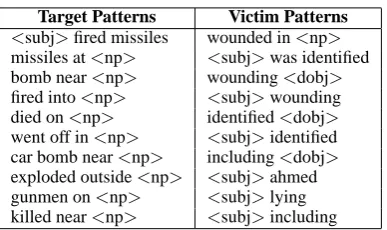
(e.g., “an attack on the U.S. embassy”) and vic-tims (e.g., “an attack on the mayor of Bogota”). Our hope is that such a pattern would receive a high semantic affinity ranking for both categories. Table 2 shows the top 10 high frequency (f req ≥ 50) patterns that were judged to have a strong semantic affinity for the target and victim categories. There are clearly some incorrect en-tries (e.g., “<subj>fired missiles” is more likely
to identify perpetrators than targets), but most of the patterns are indeed good extractors for the de-sired categories. For example, “fired into<np>”, “went off in<np>”, and “car bomb near<np>”
are all good patterns for identifying targets of a terrorist attack. In general, the semantic affinity measure seemed to do a reasonably good job of filtering patterns that are not relevant to our task, and identifying patterns that are useful for extract-ing victims and targets.
6 Experiments and Results
Target Patterns Victim Patterns
<subj>fired missiles wounded in<np>
missiles at<np> <subj>was identified bomb near<np> wounding<dobj>
fired into<np> <subj>wounding died on<np> identified<dobj>
went off in<np> <subj>identified car bomb near<np> including<dobj>
[image:6.595.86.280.59.174.2]exploded outside<np> <subj>ahmed gunmen on<np> <subj>lying killed near<np> <subj>including
Table 2: Top 10 high-frequency target and victim patterns learned from the Web
domain-independent text collection, such as the
Web. Although many of the patterns learned
from the CNN terrorism web pages look like good extractors, an open question was whether they would actually be useful for the original IE task. For example, some of the patterns learned from the CNN web pages have to do with behead-ings (e.g., “beheading of<np>” and “beheaded
<np>”), which are undeniably good victim
ex-tractors. But the MUC-4 corpus primarily con-cerns Latin American terrorism that does not in-volve beheading incidents. In general, the ques-tion is whether IE patterns learned from a large, di-verse text collection can be valuable for a specific IE task above and beyond the patterns that were learned from the domain-specific training set, or whether the newly learned patterns will simply not be applicable. To answer this question, we evalu-ated the newly learned IE patterns on the MUC-4 test set.
The MUC-4 data set is divided into 1300 devel-opment (DEV) texts, and four test sets of 100 texts
each (TST1, TST2, TST3, and TST4).5 All of
these texts have associated answer key templates. We used 1500 texts (DEV+TST1+TST2) as our training set, and 200 texts (TST3+TST4) as our test set.
The IE process typically involves extracting information from individual sentences and then mapping that information into answer key tem-plates, one template for each terrorist event de-scribed in the story. The process of template gen-eration requires discourse processing to determine how many events took place and which facts cor-respond to which event. Discourse processing and
5The DEV texts were used for development in MUC-3
and MUC-4. The TST1 and TST2 texts were used as test sets for MUC-3 and then as development texts for MUC-4. The TST3 and TST4 texts were used as the test sets for MUC-4.
template generation are not the focus of this paper. Our research aims to produce a larger set of extrac-tion patterns so that more informaextrac-tion will be ex-tracted from the sentences, before discourse anal-ysis would begin. Consequently, we evaluate the performance of our IE system at that stage: after extracting information from sentences, but before template generation takes place. This approach di-rectly measures how well we are able to improve the coverage of our extraction patterns for the do-main.
6.1 Baseline Results on the MUC-4 IE Task
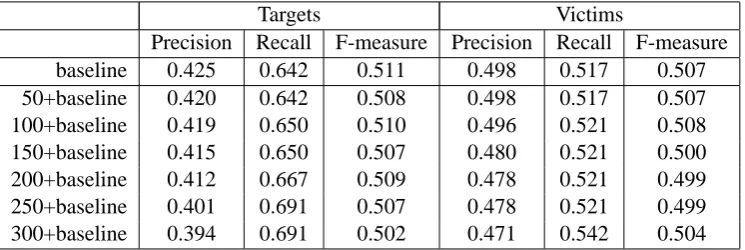
The AutoSlog-TS system described in Section 3 used the MUC-4 training set to learn 291 target and victim IE patterns. These patterns produced 64% recall with 43% precision on the targets, and 50% recall with 52% precision on the victims.6
These numbers are not directly comparable to the official MUC-4 scores, which evaluate tem-plate generation, but our recall is in the same ball-park. Our precision is lower, but this is to be ex-pected because we do not perform discourse anal-ysis.7 These 291 IE patterns represent our
base-line IE system that was created from the MUC-4
training data.
6.2 Evaluating the Newly Learned Patterns
We used all 396 terrorism extraction patterns learned from the MUC-4 training set8 as seeds to identify relevant text regions in the CNN terrorism web pages. We then produced a ranked list of new terrorism IE patterns using a semantic affinity cut-off of 3.0. We selected the topN patterns from the
ranked list, with N ranging from 50 to 300, and
added theseN patterns to the baseline system. Table 3 lists the recall, precision and F-measure for the increasingly larger pattern sets. For the
tar-6We used a head noun scoring scheme, where we scored
an extraction as correct if its head noun matched the head noun in the answer key. This approach allows for different leading modifiers in an NP as long as the head noun is the same. For example, “armed men” will successfully match “5 armed men”. We also discarded pronouns (they were not scored at all) because our system does not perform corefer-ence resolution.
7Among other things, discourse processing merges
seem-ingly disparate extractions based on coreference resolution (e.g., “the guerrillas” may refer to the same people as “the armed men”) and applies task-specific constraints (e.g., the MUC-4 task definition has detailed rules about exactly what types of people are considered to be terrorists).
8This included not only the 291 target and victim patterns,
Targets Victims
Precision Recall F-measure Precision Recall F-measure
baseline 0.425 0.642 0.511 0.498 0.517 0.507
50+baseline 0.420 0.642 0.508 0.498 0.517 0.507
100+baseline 0.419 0.650 0.510 0.496 0.521 0.508
150+baseline 0.415 0.650 0.507 0.480 0.521 0.500
200+baseline 0.412 0.667 0.509 0.478 0.521 0.499
250+baseline 0.401 0.691 0.507 0.478 0.521 0.499
[image:7.595.114.487.62.187.2]300+baseline 0.394 0.691 0.502 0.471 0.542 0.504
Table 3: Performance of new IE patterns on MUC-4 test set
get slot, the recall increases from 64.2% to 69.1% with a small drop in precision. The F-measure drops by about 1% because recall and precision
are less balanced. But we gain more in recall
(+5%) than we lose in precision (-3%). For the victim patterns, the recall increases from 51.7% to 54.2% with a similar small drop in precision. The overall drop in the F-measure in this case is neg-ligible. These results show that our approach for learning IE patterns from a large, diverse text col-lection (the Web) can indeed improve coverage on a domain-specific IE task, with a small decrease in precision.
7 Related Work
Unannotated texts have been used successfully for a variety of NLP tasks, including named entity recognition (Collins and Singer, 1999), subjectiv-ity classification (Wiebe and Riloff, 2005), text classification (Nigam et al., 2000), and word sense disambiguation (Yarowsky, 1995). The Web has become a popular choice as a resource for large
quantities of unannotated data. Many research
ideas have exploited the Web in unsupervised or weakly supervised algorithms for natural language processing (e.g., Resnik (1999), Ravichandran and Hovy (2002), Keller and Lapata (2003)).
The use of unannotated data to improve
in-formation extraction is not new. Unannotated
texts have been used for weakly supervised train-ing of IE systems (Riloff, 1996) and in boot-strapping methods that begin with seed words or patterns (Riloff and Jones, 1999; Yangarber
et al., 2000). However, those previous
sys-tems rely on pre-existing domain-specific
cor-pora. For example, EXDISCO (Yangarber et
al., 2000) used Wall Street Journal articles for training. AutoSlog-TS (Riloff, 1996) and Meta-bootstrapping (Riloff and Jones, 1999) used the
MUC-4 training texts. Meta-bootstrapping was also trained on web pages, but the “domain” was corporate relationships so domain-specific web pages were easily identified simply by gathering corporate web pages.
The KNOWITALLsystem (Popescu et al., 2004) also uses unannotated web pages for information
extraction. However, this work is quite
differ-ent from ours because KNOWITALL focuses on
extracting domain-independent relationships with
the aim of extending an ontology. In contrast,
our work focuses on using the Web to augment a domain-specific, event-oriented IE system with new, automatically generated domain-specific IE patterns acquired from the Web.
8 Conclusions and Future Work
We have shown that it is possible to learn new extraction patterns for a domain-specific IE task by automatically identifying domain-specific web pages using seed patterns. Our approach produced a 5% increase in recall for extracting targets and a 3% increase in recall for extracting victims of ter-rorist events. Both increases in recall were at the cost of a small loss in precision.
Acknowledgments
This research was supported by NSF Grant IIS-0208985 and the Institute for Scientific Comput-ing Research and the Center for Applied Scientific Computing within Lawrence Livermore National Laboratory.
References
S. Banerjee and T. Pedersen. 2003. The Design, Im-plementation, and Use of the Ngram Statistics Pack-age. In Proceedings of the Fourth International Conference on Intelligent Text Processing and Com-putational Linguistics, pages 370–381, Mexico City, Mexico, February.
M. Califf and R. Mooney. 1999. Relational Learning of Pattern-matching Rules for Information Extrac-tion. In Proceedings of the Sixteenth National Con-ference on Artificial Intelligence, pages 328–334, Orlando, FL, July.
H. Chieu, H. Ng, and Y. Lee. 2003. Closing the Gap: Learning-Based Information Extraction Rival-ing Knowledge-EngineerRival-ing Methods. In Proceed-ings of the 41st Annual Meeting of the Association for Computational Linguistics, pages 216–223, Sap-poro, Japan, July.
M. Collins and Y. Singer. 1999. Unsupervised Models for Named Entity Classification. In Proceedings of Joint SIGDAT Conference on Empirical Methods in Natural Language Processing and Very Large Cor-pora, pages 100–110, College Park, MD, June.
D. Freitag and A. McCallum. 2000. Informa-tion ExtracInforma-tion with HMM Structures Learned by Stochastic Optimization. In Proceedings of the Sev-enteenth National Conference on Artificial Intelli-gence, pages 584–589, Austin, TX, August.
F. Keller and M. Lapata. 2003. Using the Web to Obtain Frequencies for Unseen Bigrams. Compu-tational Linguistics, 29(3):459–484, September.
C. Manning and H. Sch¨utze. 1999. Foundations of Statistical Natural Language Processing. The MIT Press, Cambridge, MA.
K. Nigam, A. McCallum, S. Thrun, and T. Mitchell. 2000. Text Classification from Labeled and Un-labeled Documents using EM. Machine Learning, 39(2-3):103–134, May.
A. Popescu, A. Yates, and O. Etzioni. 2004. Class Ex-traction from the World Wide Web. In Ion Muslea, editor, Adaptive Text Extraction and Mining: Papers from the 2004 AAAI Workshop, pages 68–73, San Jose, CA, July.
D. Ravichandran and E. Hovy. 2002. Learning Surface Text Patterns for a Question Answering System. In
Proceedings of the 40th Annual Meeting on Associ-ation for ComputAssoci-ational Linguistics, pages 41–47, Philadelphia, PA, July.
P. Resnik. 1999. Mining the Web for Bilingual Text. In Proceedings of the 37th meeting of the Associa-tion for ComputaAssocia-tional Linguistics, pages 527–534, College Park, MD, June.
E. Riloff and R. Jones. 1999. Learning Dictionar-ies for Information Extraction by Multi-Level Boot-strapping. In Proceedings of the Sixteenth National Conference on Artificial Intelligence, pages 474– 479, Orlando, FL, July.
E. Riloff and W. Phillips. 2004. An Introduction to the Sundance and AutoSlog Systems. Technical Report UUCS-04-015, School of Computing, University of Utah.
E. Riloff. 1996. Automatically Generating Extraction Patterns from Untagged Text. In Proceedings of the Thirteenth National Conference on Articial Intelli-gence, pages 1044–1049, Portland, OR, August.
S. Soderland, D. Fisher, J. Aseltine, and W. Lehnert. 1995. CRYSTAL: Inducing a Conceptual Dictio-nary. In Proceedings of the Fourteenth International Joint Conference on Artificial Intelligence, pages 1314–1319, Montreal, Canada, August.
S. Soderland. 1999. Learning Information Extraction Rules for Semi-Structured and Free Text. Machine Learning, 34(1-3):233–272, February.
B. Sundheim. 1992. Overview of the Fourth Message Understanding Evaluation and Conference. In Pro-ceedings of the Fourth Message Understanding Con-ference (MUC-4), pages 3–21, McLean, VA, June.
B. Sundheim. 1995. Overview of the Results of the MUC-6 Evaluation. In Proceedings of the Sixth Message Understanding Conference (MUC-6), pages 13–31, Columbia, MD, November.
J. Wiebe and E. Riloff. 2005. Creating Subjective and Objective Sentence Classifiers from Unanno-tated Texts. In Proceedings of the 6th International Conference on Computational Linguistics and Intel-ligent Text Processing, pages 486–497, Mexico City, Mexico, February.
R. Yangarber, R. Grishman, P. Tapanainen, and S. Hut-tunen. 2000. Automatic Acquisition of Domain Knowledge for Information Extraction. In Proceed-ings of the 18th International Conference on Com-putational Linguistics, pages 940–946, Saarbr¨ucken, Germany, August.