STUDY OF ASSOCIATED RISKS FACTORS FOR THE CLOUD COMPUTING ADOPTION BY IT COMPANIES
Gaurav Kumar1, Dr.Rajeev Kumar2
Department of Computer Science and Engineering 1,2,
Himalayan University, Arunachal Pradesh (India) Abstract
While much-hyped, cloud computing offers earlyadopters potentially significant benefits however,
important barriers to reception have likewise been recognized. This paper peddles and talks about
the 'condition of play' of distributed computing dangers. The paper audits and looks at 'condition of
practice' perspectives on distributed computing reception dangers with 'condition of workmanship'
research, in view of editorial prove in an example of websites, industry squeeze articles, white
papers and industry introductions and a specimen of research diary articles, separately, distributed
from January 2009 to September 2010. Crevices between the two are distinguished and examined
and conclusions drawn about distributed computing reception, appropriation dangers, and research
headingsntary evidenced in a sample of blogs, industry press articles, white papers and industry
presentations and a sample of research journal articles, respectively, published from January 2009
to September 2010. Gaps between the two are identified and discussed and conclusions drawn
about cloud computing adoption, adoption risks, and research directions.
Keywords-cloud computing, adoption, risks, barriers, benefits
1. INTRODUCTION
Distributed computing as an IT sourcing
choice, their inclination was for organization
of non-basic frameworks. KPMG's view is that
distributed computing use for basic
frameworks and information is five to ten
years out [1]. Gartner, in any case, is more
bullish. It sees distributed computing being
endeavor prepared by 2015. Gartner predicts
that development will be in three stages: by
2011 early adopters will connect with the
cloud for strategic tasks; 2010 to 2013 will be
about market solidification, and; 2012 to 2015
will see standard minimum amount and
commoditization, and across The board
selection starting to happen. Gartner trusts
that open source cloud innovations will rise
by 2014. Around then, distributed computing
will be the favored however not elite decision
for the larger part of "crafty and structurally
basic application advancement endeavors" by
Global 2000 undertakings.
Distributed computing reception chance has
writing. This paper considers obstructions to
appropriation (dangers) by auditing
suppositions by industry observers (speaking
to the 'condition of practice') and contrasting
them with late distributed computing
research (speaking to the 'condition of
workmanship'). Holes are distinguished and
talked about, and conclusions are drawn
about the 'condition of play' of distributed
computing appropriation. The paper plans to
cross-illuminate practice and research of
every others' issues of center and give
guidance in settling appropriation hindrances
[2].
2. STATE OF PRACTICE
This section examines practice-based
adoption barriers.
A. Research Method
Distributed computing background is
immature up 'til now in the scholarly writing.
Moreover, as it emerges, it may not
completely mirror the uplifted desires
('buildup') of distributed computing found in
the more extensive media. In along these
lines, for the state of practice, the survey
drew on an extent of 'social publication'
about circulated registering assignment from
web diaries, industry crush articles and
presentations, and white papers. A comfort
test was browsed messages got by the creator
from different listserve and other online
memberships identifying with material
distributed between January 2009 and
September 2010, comprehensive. A sum of
320 things was analyzed from which 109 were
chosen as significant to the subject. Chosen
things examined at least one danger, issues or
hindrances related with distributed
computing selection (altogether alluded to
here as 'dangers').
They chose things were analyzed for
occasions of these dangers, which were
incorporated in a spreadsheet. A sum of 437
hazards considers occasions were found the
example things. The elements were then
bunched into variable classes. Ten primary
hazard classifications rose up out of this
examination as a reasonable set for
correlation and introduction. The classes’
bunch related hazard considers as takes after:
1. Security – security, privacy,
confidentiality, accesscontrol,
visibility, transparency (data and
applications).
2. Lock-in – merchant and innovation
secure, permitting, relocation,
interoperability, measures, design.
3. Control – control, observing, administration, trust.
lawful, contracts, review.
5. Service – benefit arrangement,
benefit level assertions (SLAs),
bolster, accessibility, unwavering
quality.
6. Performance – inertness, reaction time, execution time.
7. Cost – cost, financial aspects,
charging, charge-back, expense.
8. Governance – possession, duty, business hazard, due ingenuity,
arrangement.
9. Competencies – abilities, information, encounter, aptitudes, learning.
10. Industry – industry structure and justification.
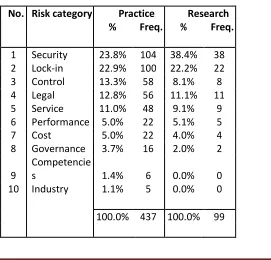
Table I demonstrates the frequencies and
recurrence rates of the 10 chance component
classes, positioned from most to minimum
regular for the practice-based example.1
B. State of Practice Findings
Table I demonstrates that the main five
dangers represent just about 84% of
distributed computing appropriation
concerns. The main two dangers (Security
and Lock-in), record for almost 47% of the
aggregate (about 24% and 23% individually),
while the following three dangers (Control,
Legal and Service), represent a further 37%
(approx. 13%, 13% and 11% separately). The
rest of the selection concerns involve
Performance, Cost, Governance,
Competencies and Industry elements.
Table I: Cloud computing adoption risk frequencies
No. Risk category Practice Research
% Freq. % Freq.
1 Security 23.8% 104 38.4% 38
2 Lock-in 22.9% 100 22.2% 22
3 Control 13.3% 58 8.1% 8
4 Legal 12.8% 56 11.1% 11
5 Service 11.0% 48 9.1% 9
6 Performance 5.0% 22 5.1% 5
7 Cost 5.0% 22 4.0% 4
8 Governance 3.7% 16 2.0% 2
9
Competencie
s 1.4% 6 0.0% 0
10 Industry 1.1% 5 0.0% 0
The full list of risk factors (spreadsheet) and
sample sources (references) for the state of
practice dataset are available from the author
upon request.
The practice information involves a blend of
master suppositions, industry studies, gossip
and experience-based perception and
discourse that is accommodated a scope of
inspirations including educating, prompting
and impacting. All things considered, it speaks
to a wide range of perspectives about
dangers, issues and obstructions to embracing
distributed computing reflecting general
current social and industry supposition [3].
Key dangers inside every class are delineated
after.
1. Security.Security is commonly positioned the top distributed computing reception
concern. Key risks include: harming and
loathsome utilize; flimsy interfaces and APIs;
poisonous insiders; shared advancement
issues; data mishap or spillage; record or
organization seizing, and; general shakiness
due to 'security bylack of definition.
Potential security assaults incorporate
disavowal of administration assaults, side
channel assaults, validation assaults,
man-in-the center cryptographic assaults, spyware
and trojans [4]. For instance, specialists
connected a disavowal of administration
assault on a customer organization from
contracted EC2 occurrences, which was not
identified by Amazon. Likewise, analysts
found that EC2 was powerless to
side-channel-assaults. Snappy simple access for
clients likewise implies speedy simple access
for assailants. All the more honestly, cloud
occasions have been found to contain
confirmation enters in the reserves and
Mastercard information, and additionally the
potential for malevolent code to be covered
up inside the framework [5].
Because of abnormal amounts of
deliberation, it is troublesome for clients to
recognize what their frameworks are doing in
an open cloud and how they are being
ensured. The client's requirement for
perceivability and straightforwardness of
operation are inconsistent with the specialist
organization's have to productively oversee
whole server farms and keep up mystery over
its safety efforts.
The Cloud Security Alliance [6] recommends
that the issue differs with the cloud benefit
show used. The let down the administration
stack you go (SaaS, PaaS, IaaS), the more
noteworthy the duty regarding security that
the client must accept:
integrated offering,including a high
level of security, with the least
customer extensibility.
PaaS is typically more extensible than
SaaS, however offers less client
prepared components, including
security elements and abilities,
empowering/requiring the client to
layer-in required security.
IaaS gives huge extensibility however
few if any application-level
components. Here, the client must
oversee and secure the execution
condition. At last, an extra test is to
coordinate cloud-construct security
with in light of start security. This
raises issues of interoperability and
norms, talked about next.
2. Lock-in.This class consolidates a few basic dangers with qualities that could be situated
along a range traversing completely exclusive
through to institutionalized administrations.
They incorporate merchant secure,
innovation secure, movement,
interoperability, engineering, authorizing and
norms. Because of the quick rise of
distributed computing through the activities
of individual organizations, most offerings are
exceptionally restrictive in nature. This makes
challenges in relocating information and
applications to the cloud, or exchanging cloud
suppliers, and puts clients at huge hazard if
the need emerges for frameworks to
interoperate crosswise over cloud and
in-house conditions or to recover information or
potentially applications if a cloud supplier
pulls back from the market. Besides, SaaS
information may not be completely
retrievable and applications created on one
PaaS may not be compact to, or executable
on, another. There are few, assuming any,
prepared components to relocate information
and applications to different conditions.
Similarity issues tend to increment up the
administration stack, as depicted above,
mirroring the level of supplier provided
coordination (and, in this way, restrictive
arrangements and interfaces).Trading costs
are high. Thus, seller/innovation secures [7].
3. Control.This classification involves dangers
coming about because of the truth that
control over an association's information and
frameworks execution eventually goes to an
outsider specialist organization in distributed
computing. This can raise critical concerns
and obstructions to cloud selection on the
grounds that an adjustment in control implies
an adjustment in hazard. These worries speak
to some portion of the drawback to the regale
of distributed computing, coming about
because of not owning the foundation. What
consents (rights) allowed by the specialist
organization.
4. Legal.Legitimate dangers incorporate consistence with jurisdictional laws and
controls, lawful risk, contracts and reviews.
Contingent upon the way of the information
(and it could be as straightforward as
messages) and the purview, directions may
apply to where information is put away, how
it is taken care of, and the methods under
which it might be gotten to or seized by the
courts or governments. Uncommon controls
regularly apply, for instance, to individual
subtle elements, budgetary information, and
wellbeing records, or a necessity may exist for
information to stay inside a particular nation.
Cloud virtualization can make information be
moved around cloud situations, setting it
under various state and national laws and
even outcome, unconsciously, in the
proprietor getting to be distinctly obligated
for rupturing controls. IaaS providers, for
instance, Amazon Web Benefit (AWS), usually
let the customer decide the territory in which
data is to be secured; thusly easing some of
this peril yet this alternative is not really
consistently given over the administration
stack or by all specialist co-ops [8].
5. Service. This class identifies with administration elements and levels, benefit
accessibility and dependability, and support.
Obviously, quality and congruity of
administration are critical contemplations in
receiving and keeping on utilizing cloud
administrations. Lamentably, because of the
utility way of distributed computing,
administrations and administration levels are
product like in nature, with iron-clad
assurances on administrations, accessibility,
unwavering quality and support once in a
while gave. Normally, cloud benefit level
understandings (SLAs) are deficient,
unyielding or nonexistent. Additionally,
benefit scope fluctuates between suppliers,
halfway therefore of contrasts in
administration show offerings and mostly
because of varying business arrangements.
Restricted alternatives exist, assuming any,
for customization of administrations.
6.Execution. Mastermind inaction, data get to
and limit latency, and general response and
execution times are indispensable issues for a
couple of customers and applications, given
the view that system execution is slower in
the cloud and more factor than in
on-introduce situations. Execution is compelled
by Internet speeds; arrange quality and the
separation between the client and the
different cloud specialist co-ops. Tests
demonstrate that idleness increments with
separation [9]. All the more alarmingly,
shifts considerably, by up to a variable of 20,
contingent upon the season of day the
administration is gotten to. Execution is
additionally impacted by different
components, for example, application outline
(they should be virtualized to work
productively in a cloud situation). Architecting
applications for execution and adaptability in
the cloud is a non-inconsequential practice.
Along these lines, if execution is basic in your
administration level necessities, the cloud
might be an unsafe choice.
7. Cost.One of the considerable advantages
touted for the cloud model is that you just
need to pay for what you utilize when you
utilize it. Is it that straightforward by and by?
Precisely anticipating and measuring spend is
more troublesome under an 'on-request'
costing model. Knowing who utilized what
administrations when in a huge association is
additionally hard to track. Add to that the
vulnerability about whether the required
occasions were over-subscribed or
under-used makes costing hugely troublesome. The
hazard exists for firms to lose control and
spend more than they have to under this
model. Suggestions for charge-back to cost
focuses reach out from these troubles. Also,
current expenses are low, as venders follow
bit of the pie. In any case, as the market
creates and customers get the opportunity to
be secured, expenses may rise. Finally,
pay-per-use has money related and charge
recommendations, as IT costs change from
capex to opex, which can have positive and
negative effects.
8.Administration: Organization incorporates issues of proprietorship, decision rights,
commitment, duty, business shot, due
consistency and business procedure, (for
instance, relating to the control of fragile data
and the usage of gages).Distributed
computing upsets customary IT
administration game plans since a great part
of the control moves to outsiders. It can
likewise change the inner structure of IT in
client associations, decentralizing a great part
of the basic leadership. This spots weight on
the key capacity of IT at the inside (head) of
associations in any case, these issues don't
really debilitate interior administration. Or
maybe, they change its shape (its parts and
obligations). Reporters contend that powerful
administration is a critical section prerequisite
to profit by the utilization of cloud
administrations.
9. Competencies.While distributed computing
draws on legacy customer server and
administration arranged structures, it speaks
to another packaging of previous innovations.
Most potential adopters don't have the
cloud applications as fast and proficiently as
the buildup proposes is conceivable. There is
a lofty expectation to absorb information with
this registering model. Besides, cloud benefit
models and stages contrast in their
specialized cosmetics and utilization
prerequisites so experiential-based learning
can be an obstruction to acknowledging
benefits through cloud appropriation.
10. Industry.At last, a few observers take note of that distributed computing, as an industry,
is youthful so is probably going to change
after some time as industry justification
happens. Costing, benefit models and cloud
structures/foundations may change. Suppliers
(little or huge) may come up short, pull back
or be obtained, speaking to administration
congruity dangers for clients. Chance loath
buyers may embrace a 'keep a watch out'
system before joining the cloud advertises
[10].
3. CONCLUSION
A couple of conclusions can be drawn about
the state of play: To begin with, the
deterrents to determination of circulated
registering, as by and by observed issues and
perils, are high. Be that as it may, the
potential points of interest are honest to
goodness, baiting and huge.This is probably
going to incite the slow evacuation of
numerous obstructions. It is likely in this
manner that administration development and
industry adjustment will see the advancement
of a scope of valuable administrations to
address the issues of a wide range of IT
clients. Second, current practice-based
dangers speak to a scope of genuine dangers
through to potential issues contingent on the
administration display embraced and the level
of "sharp" of the adopter. Amid these early
years of the cloud item life cycle, effective
adopters of distributed computing
administrations will be educated and have
sensible desires. They will have contributed
the time and exertion important to
comprehend the abilities of distributed
computing (rather than the buildup), and the
dangers, and have recognized a reasonable
engagement procedure.
REFERENCES
1. ATSE, “Cloud computing:
Opportunities and challenges for Australia”, Australian Academy of Technological Sciences and Engineers, 2010, accessed October 2010 at http://www.atse.org.au/component/r emository/ATSE-Reports/Information- Technology/CLOUD-COMPUTING- Opportunities-and-Challenges-for-Australia-2010/.
2. P. Bannerman, “Smoothing
Innovation Discontinuities”, Proc. Int. Conf. Comms. (ICC’08), IEEE, May
2008, pp. 5458-5462, DOI:
3. P. Brebner and A. Liu, “Modeling cloud cost and performance”, Proc. Cloud Computing and Virtualization Conference, May 2010.
4. CSA, “Security Guidance for Critical Areas of Focus in Cloud Computing
V2.1”, Cloud Security Alliance,
December 2009, accessed September
2010 at
http://www.cloudsecurityalliance.org /csaguide.pdf.
5. CSA, “Top threats to cloud computing
V1.0”, Cloud Security Alliance, March 2010, accessed September 2010 at http://www.cloudsecurityalliance.org /topthreats/csathreats.v1.0.pdf.
6. ENISA, “Benefits, risks and
recommendations for information security”, European Network and
Information Security Agency,
November 2009, accessed September
2010 at
http://www.enisa.europa.eu/act/rm/ files/deliverables/cloud-computing-
risk-assessment/at_download/fullReport.
7. Gregg, M., “10 security concerns for cloud computing”, Global Knowledge
Training LLC, 2010, accessed
September 2010 at
http://viewer.media.bitpipe.com/107 8177630_947/1268847180_5/W P_VI_10SecurityConcernsCloudComp uting.pdf.
8. ISACA, “2010 ISACA IT risk/reward
barometer – Oceania edition”, July 2010, accessed September 2010 at
http://www.isaca.org/About- ISACA/Press-room/Documents/2010- ISACA-Risk-Reward-Barometer-Results-Oceania.pdf.
9. KPMG, “From cost to value: 2010
global survey on the cio agenda”, 2010, accessed August 2010 at https://www.kpmg.com/AU/en/Issue
sAndInsights/ArticlesPublication s/Documents/From-cost-to-value-CIO-Agenda-V2.pdf.
10. R. Lemos, “5 lessons from dark side of
cloud computing”, CIO, 7 August