Open Access
Research
Fibrin sealant does not decrease seroma output or time to drain
removal following inguino-femoral lymph node dissection in
melanoma patients: A randomized controlled trial (NCT00506311)
Melinda M Mortenson
1, Yan Xing
1, Storm Weaver
1, Jeffrey E Lee
1,
Jeffrey E Gershenwald
1, Anthony Lucci
1, Paul F Mansfield
1, Merrick I Ross
1and Janice N Cormier*
1,2Address: 1Department of Surgical Oncology, The University of Texas M. D. Anderson Cancer Center, Houston, Texas, USA and 2Associate Professor of Surgery and Biostatistics, Department of Surgical Oncology-Unit 444, The University of Texas M. D. Anderson Cancer Center, 1515 Holcombe Boulevard, Houston, TX 77030-1402, USA
Email: Melinda M Mortenson - [email protected]; Yan Xing - [email protected]; Storm Weaver - [email protected]; Jeffrey E Lee - [email protected]; Jeffrey E Gershenwald - [email protected]; Anthony Lucci - [email protected];
Paul F Mansfield - [email protected]; Merrick I Ross - [email protected]; Janice N Cormier* - [email protected] * Corresponding author
Abstract
Background: This study assessed the impact of closed suction drains and evaluated whether the intraoperative use of a fibrin sealant decreased time to drain removal and wound complications in melanoma patients undergoing inguino-femoral lymph node dissection.
Methods: A pilot study (n = 18) assessed the impact of a closed suction drain following inguino-femoral lymph node dissection. A single-institution, prospective trial was then performed in which patients were randomized to a group that received intraoperative application of a fibrin sealant following inguino-femoral lymph node dissection or to a control group that did not receive sealant.
Results: The majority of the patients enrolled felt the drains caused moderate or severe discomfort and difficulties with activities of daily living. Thirty patients were then randomized; the median time to drain removal in the control group (n = 14) was 30 days (range, 13–74) compared to 29 days (range, 11–45) in the fibrin sealant group (n = 16; P = 0.6). Major and minor complications were similar in the two groups.
Conclusion: Postoperative closed suction drains were associated with major patient inconvenience. Applying a fibrin sealant at the time of inguino-femoral lymph node dissection in melanoma patients did not reduce the time to drain removal or postoperative morbidity. Alternative strategies are needed.
Background
Therapeutic inguino-femoral lymph node dissection (ILND) has been associated with clinically significant
postoperative morbidities [1-3], including infections, skin flap complications, and lower extremity lymphedema, leading to extended hospitalizations, reduced quality of
Published: 18 June 2008
World Journal of Surgical Oncology 2008, 6:63 doi:10.1186/1477-7819-6-63
Received: 9 April 2008 Accepted: 18 June 2008
This article is available from: http://www.wjso.com/content/6/1/63
© 2008 Mortenson et al; licensee BioMed Central Ltd.
life, and delayed return to normal activities [4,5]. A 50% incidence of complications following ILND in melanoma patients has been reported, and some studies have indi-cated that the incidence of short-term (within 30 days of surgery) and long-term morbidity from ILND may be as high as 75% [4-7]. Patients who have comorbidities that compromise their ability to walk, patients who have had complicated incisions for previous operations, obese patients, or patients who have locally advanced disease may experience even higher rates of postoperative mor-bidity. Despite these risks, therapeutic lymphadenectomy is generally performed for patients with confirmed node-positive stage III melanoma because it is the only poten-tially curative treatment.
Currently, closed suction drains (CSDs) are inserted at the time of ILND to decrease seroma formation, wound dehiscence, and infection. However, CSDs are not without consequence: they require a high level of maintenance, cause discomfort, interfere with mobility, and serve as potential routes for infection when drainage is prolonged. Therefore, strategies that can be used to prevent postoper-ative fluid accumulation, thereby reducing the length of time CSDs are in place or even eliminating the use of the drains, potentially will decrease morbidity and increase the quality of life of patients undergoing ILND for melanoma.
One such strategy may be the use of fibrin sealants, which have been used to provide hemostasis as well as tissue apposition and sealing in a wide variety of surgical appli-cations including reconstructive, breast, cardiac, gastroin-testinal, and head and neck procedures [8]. While the role of fibrin sealants as hemostatic agents has been well doc-umented [9-11], these substances' ability to reduce fluid accumulation in dissected spaces through tissue adhesion remains unknown. Several mechanisms have been pro-posed such as the prevention of seromas by sealing open lymphatic channels and adherence of the elevated skin flaps to eliminate surgically created dead spaces [12].
TIS-SEEL® VH Fibrin Sealant (Baxter Healthcare Corporation,
Westlake Village, CA) is a fibrin sealant composed of fibrinogen/factor XIII and thrombin. When the two sub-stances are combined with calcium chloride and applied topically, they produce a fibrin matrix that promotes hemostasis by mimicking the last step of the physiological coagulation cascade [13] and tissue adhesion by stimulat-ing the exudative phase of wound healstimulat-ing [14].
We postulated that applying a fibrin sealant, such as TIS-SEEL, in patients undergoing ILND for melanoma might decrease the time needed for CSDs, thereby reducing the incidence of postoperative complications and subse-quently improving patient comfort. The primary objective of the study was to determine whether the use of a fibrin
sealant applied to the operative bed following ILND would result in earlier postoperative drain removal. The secondary objectives were to determine the postoperative morbidity associated with fibrin sealant following ILND and to assess patient valuation of outcomes by perform-ing a cost-benefit analysis usperform-ing a willperform-ingness-to-pay model.
Methods
Prior to the accrual of patients for the randomized study, a pilot study was performed to assess the patient-reported impact of a CSD following ILND. A survey was given to a group of 18 patients who had undergone ILND at The University of Texas M. D. Anderson Cancer Center within the 6 preceding months. The survey focused on short-term lifestyle changes, aversion behaviors, and expenditures related to having a CSD. Patients were asked to judge the drain's effect on their daily activities on a scale of 1–5, with 1 being "not a problem" and 5 being "a severe prob-lem." The survey also presented patients with several hypothetical scenarios and asked patients to value, in dol-lars, their willingness-to-pay for potential reductions in the time to drain removal using standard methods [15,16].
Patients
Following the pilot study, we performed a single-institu-tion, phase III randomized trial. Approval from M. D. Anderson's Institutional Review Board was obtained prior to patient recruitment. Written informed consent was obtained. Patients were eligible for the study if they were scheduled to undergo a superficial ILND with or without a concurrent deep pelvic (iliac/obturator) lymph node dissection or limb perfusion for the treatment of melanoma. Patients were not eligible if they had known hypersensitivity to bovine proteins, had received prior radiation therapy to the operative site, were pregnant or lactating, had been steroid-dependent within the past 6 months, used aspirin or other anti-platelet drugs (exclud-ing celecoxib) within 7 days of the operation, or had pre-existing lymphoma or other pre-pre-existing medical condi-tions as per the discretion of the principal investigator.
Technique of lymph node dissection
fatty, node bearing tissue is removed and the saphenous vein is divided at the apex of the femoral triangle. Dissec-tion is maintained in the plane of the femoral vessels up to the level of the fossa ovalis. The saphenous vein is suture-ligated at the saphenofemoral junction and the specimen is removed. A frozen-section examination is performed of the lowest iliac node (Cloquet's node). The saphenous vein can be spared in the presence of minimal disease but should be taken in the presence of gross dis-ease in close proximity to or surrounding the vein.
In many cases, especially in obese patients or those with bulky disease, a sartorius muscle transposition is per-formed by dividing the sartorius muscle at its origin on the anterior superior iliac spine. The muscle is then dis-sected from its anatomic position preserving the medial vascular bundle and then transposing the muscle over the femoral vessels. Before closure, the skin edges are critically assessed and debrided back to healthy tissue. One or two 19F Blake drains are placed and the incision is closed in a layered fashion with an interrupted dermal layer of absorbable suture and then either staples or an absorbable subcutaneous suture for the skin. Indications for a deep groin dissection (iliac and obturator nodes) include: met-astatic disease to Cloquet's node, clinically palpable dis-ease, bulky or suspicious appearing pelvic lymphadenopathy on cross-sectional imaging, or biopsy proven deep inguinal lymph nodes.
Randomization
Participants were randomized in the operating room using the institutional computerized randomization proc-ess. The treatment group received TISSEEL fibrin sealant following ILND, while the control group did not receive fibrin sealant. The results of the randomization were blinded until the surgical dissection was complete.
Surgical care
After ILND, while patients were still under general anesthesia, TISSEEL (Baxter) was reconstituted according to the manufacturer's instructions and applied locally. Because thrombin concentration determines the setting time of the TISSEEL clot, a diluted thrombin mixture (5 IU/mL) was used to extend this setting time; this was made by diluting the standard preparation of 500 IU/mL with 100 mL of sterile water and 2 mL of 10% calcium chloride. Five milliliters of the diluted thrombin mixture were applied to all of the cavity surfaces. A 19-French Blake drain was inserted through a separate incision site and surgically secured to the skin in all patients. The sur-gical incision was then closed.
All patients were given the same postoperative instruc-tions, including directions to minimize activity of the involved extremity and permission to shower after 48
hours. The drain was removed once the cumulative serous volume was ≤ 30 mL/24 hours for 2 consecutive days or if 30 days had elapsed since surgery. Patient follow-up was performed at the M. D. Anderson Melanoma and Skin Center or by the patients' primary physicians at 2–4 weeks and again at approximately 6 weeks following surgery. If patients were seen by their primary physicians, clinical information was obtained by the research nurse by tele-phone.
Clinical and pathological data
Clinical and pathologic data were collected prospectively beginning at the time of enrollment until 8 weeks postop-eratively. These data included age, sex, height, weight, comorbidities, medications, tobacco use, previous treat-ments for melanoma, indications for ILND, perioperative antibiotics, type of surgical procedure, estimated blood loss, operative time, final pathologic findings, length of time before drain removal, and complications. Major complications were defined as those that required hospi-tal readmission, intravenous antibiotics, or operative deb-ridement. Minor complications included erythema that resolved with oral antibiotics, wound dehiscence that could be managed on an outpatient basis, clinically rele-vant seromas (requiring subsequent drainage), and drain-related problems that required a visit to the clinic or emer-gency room. A wound infection was defined as a culture-positive seroma aspiration or clinical evidence of infec-tion (such as fever, erythema, or cellulitis), as judged by a clinician, that required antibiotics or more aggressive wound management.
Statistical analysis
The primary outcome measure of the study was the time to drain removal. The study size was determined based on institutional experience that without fibrin glue, the median time to drain removal was 21 days. To detect a 7-day decrease in the time to drain removal, we calculated that at least 28 patients needed to be enrolled in the study.
Two-sample comparisons were done using t-tests or
Wil-coxon rank sum tests for continuous variables and chi square tests for discrete variables [17]. Univariate analyses were performed using linear regression models to identify any factors associated with an increased number of days to drain removal. A log transformation was required to nor-malize the data (days to drain removal). Computations were carried out with Stata software (Stata/SE version 10
for Windows; StataCorp, College Station, TX). A P-value
of less than 0.05 was considered statistically significant.
Results
was 20.5 days. Drain care took more than 30 minutes each day for 72% of patients, with an overall median time of 60 minutes. The majority of patients felt the drains caused moderate to severe discomfort (56%) as well as moderate to severe difficulties with daily activities including dress-ing (67%), bathdress-ing (78%), and sleepdress-ing (72%). The will-ingness-to-pay questionnaire showed that patients were willing to pay a median of $175 out-of-pocket for a reduc-tion in drain time of 4 days. Five patients (28%) were will-ing to pay $500 for a reduction in drain time.
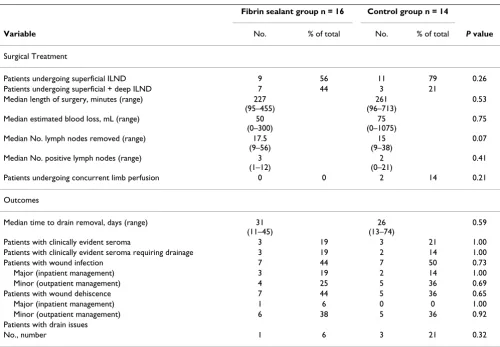
Thirty patients were enrolled in the randomized trial between June 17, 2005, and May 30, 2007; 14 patients were randomized to the control group and 16 to the fibrin sealant group. Patient demographics, comorbidities, and preoperative treatment regimens were similar in the two groups (Table 2). More patients in the fibrin sealant group (n = 7) underwent deep pelvic node dissection than in the control group (n = 3), but the difference was not signifi-cant. The median length of surgery, estimated blood loss, number of lymph nodes removed, and number of positive
Table 1: Summary of Responses from 18 Melanoma Patients Who Had Previous Inguino-femoral Lymph Node Dissection (ILND)
Variable No.
Median age, years (range) 56.3 (42–84)
Sex, male/female, no. patients 9/9
Median time to postoperative drain removal, days (range) 20.5 (5–35)
Time of daily care for draina, minutes (range) 60 (10–120)
No. patients with WTPa = $100 15
No. patients with WTPa = $500 5
WTPa, dollars (range) 175 (0–550)
No. of patients % of total % of patients ≥ 3
Discomfort 56
1 = Not a problem 4 22
2 = Mild problem 4 22
3 = Moderate problem 7 39
4 = Moderately severe problem 2 11
5 = Severe problem 1 6
Getting dressed 67
1 = Not a problem 3 17
2 = Mild problem 3 17
3 = Moderate problem 4 22
4 = Moderately severe problem 6 33
5 = Severe problem 2 11
Bathing 78
1 = Not a problem 3 17
2 = Mild problem 1 6
3 = Moderate problem 8 44
4 = Moderately severe problem 1 6
5 = Severe problem 5 28
Sleeping 72
1 = Not a problem 5 28
2 = Mild problem 0 0
3 = Moderate problem 7 39
4 = Moderately severe problem 4 22
5 = Severe problem 2 11
Importance of reducing number of days that drain in place 61
1 = Not at all important 4 22
2 = Slightly important 3 17
3 = Moderately important 4 22
4 = Very important 6 33
5 = Critically important 1 6
lymph nodes did not differ between the two groups (Table 3).
Postoperatively, there was no statistically significant dif-ference in the time to drain removal between the two groups: the fibrin sealant group required drains for a median of 31 days (range, 11–45 days), compared to 26 days (range, 13–74 days) in the control group (P = 0.6).
There was also no significant difference between the groups with respect to overall complications. Three patients in each group had postoperative seromas; except for one seroma in a control-group patient, the seromas required drainage. The incidences of wound infections and wound dehiscence were similar in the two groups. One patient in each group was treated with outpatient wound vacuum placement following wound dehiscence.
Six patients (20%; two in the control group and four in the fibrin sealant group) had major complications requir-ing hospital readmission, intravenous antibiotics, or oper-ative debridement. Minor complications, including wound infection (36% in the control arm and 25% in the fibrin sealant arm), minor wound dehiscence (36% and 38%), and drain issues (21% and 6%), were also similar in the two groups.
There were three drain complications in the control group: two required visits to the emergency center or
out-patient clinic, and one required placement of an addi-tional drain. One patient in the fibrin sealant group had a drain complication that required additional outpatient clinic visits and placement of an additional drain.
Because there were no significant differences between the fibrin sealant group and the control group, the groups were combined for a univariate analysis to evaluate the association between various clinicopathologic and treat-ment factors and the time to drain removal. There was no association between patient factors (i.e., body mass index or comorbidities), prior systemic therapy, surgical treat-ment, or postoperative complications and the time to drain removal (Table 4).
Discussion
The results of the pilot study demonstrated that postoper-ative CSDs had a major negpostoper-ative impact on patients' daily activities, comfort, and time. In a theoretical scenario, the majority of patients in the pilot study were willing to pay $100–$200 out-of-pocket to reduce the time to drain removal by at least 4 days. Given these findings, a rand-omized controlled trial was performed using fibrin seal-ant at the time of ILND to potentially decrease seroma formation and the time to CSD removal. The randomiza-tion process was successful with a similar distriburandomiza-tion of clinicopathologic factors among the fibrin sealant group and the control group. Our findings, however, do not sup-port the use of a fibrin sealant for this purpose, as it did
Table 2: Demographic and Clinicopathologic Factors in Melanoma Patients Undergoing Inguino-femoral Lymph Node Dissection (ILND)
Fibrin sealant group, n = 16 Control group, n = 14
Variable No.a % of total No.a % of total P value
Median age, years (range) 52 (38–91) 60 (18–73) 0.79
Sex, male/female 12/4 75/25 7/7 50/50 0.16
Median BMI, kg/m2 (range) 28.3 (19.6–42.1) 32.3 (21–48.6) 0.15
Comorbidities
Tobacco use 1 6 2 14 0.58
Diabetes 1 6 4 29 0.16
AJCC tumor stage 1.00
III 14 88 13 93
IV 2 12 1 7
Melanoma treatment prior to ILND
Surgery 0.34
None/FNA 5 31 4 29
SLN biopsy 6 38 8 57
Excisional biopsy/WLE 5 31 2 14
Systemic therapy 0.27
Chemotherapy 2 12 0 0.48
Interferon 1 6 2 14 0.59
Interleukin-2 1 6 0 1.00
BMI, body mass index; AJCC, American Joint Committee on Cancer; FNA, fine needle aspiration; SLN, sentinel lymph node; WLE, wide local excision.
not affect the time to drain removal for melanoma patients undergoing ILND.
The pathophysiology of seroma formation has not fully been delineated. The majority of literature pertains to breast cancer patients undergoing mastectomy with or
without axillary lymph node dissection. In these patients, it has been suggested that a number of anatomical factors play a role in seroma formation including the creation of a large potential dead space, irregularity of the chest wall, and movement of the chest wall secondary to respiration and shoulder movement all of which may prevent flap
Table 3: Surgical Treatments and Outcomes after Inguino-femoral Lymph Node Dissection (ILND)
Fibrin sealant group n = 16 Control group n = 14
Variable No. % of total No. % of total P value
Surgical Treatment
Patients undergoing superficial ILND 9 56 11 79 0.26
Patients undergoing superficial + deep ILND 7 44 3 21
Median length of surgery, minutes (range) 227
(95–455)
261 (96–713)
0.53
Median estimated blood loss, mL (range) 50
(0–300)
75 (0–1075)
0.75
Median No. lymph nodes removed (range) 17.5
(9–56)
15 (9–38)
0.07
Median No. positive lymph nodes (range) 3
(1–12)
2 (0–21)
0.41
Patients undergoing concurrent limb perfusion 0 0 2 14 0.21
Outcomes
Median time to drain removal, days (range) 31
(11–45)
26 (13–74)
0.59
Patients with clinically evident seroma 3 19 3 21 1.00
Patients with clinically evident seroma requiring drainage 3 19 2 14 1.00
Patients with wound infection 7 44 7 50 0.73
Major (inpatient management) 3 19 2 14 1.00
Minor (outpatient management) 4 25 5 36 0.69
Patients with wound dehiscence 7 44 5 36 0.65
Major (inpatient management) 1 6 0 0 1.00
Minor (outpatient management) 6 38 5 36 0.92
Patients with drain issues
No., number 1 6 3 21 0.32
Table 4: Univariate Analysis of Potential Factors Associated with Increased Time to Drain Removal Following Inguino-femoral Lymph Node Dissection (ILND)a
Variable Regression Coefficient Standard error P-value
Median BMI 0.01 0.01 0.37
Comorbidity
Tobacco use -0.03 0.24 0.90
Diabetes 0.04 0.20 0.86
Prior systemic therapy -0.05 0.18 0.80
Treatment group (fibrin sealant versus control) 3.31 0.11 0.88
Type of surgery (superficial +/- deep pelvic ILND) -0.01 0.16 0.95
Total no. of lymph nodes removed (< 17 versus ≥ 17) -0.15 0.14 0.32
No. of positive lymph nodes (< 2 versus ≥ 2) 0.01 0.15 0.95
Wound infection
Major -0.02 0.20 0.94
Major plus minor 0.01 0.15 0.95
adherence [18]. Leakage from transected lymphatics is believed to be an important factor in seroma formation although this is supported by only scant evidence. Other studies have suggested that seroma formation may result from an inflammatory exudate [19,20].
Kuroi et al., have identified several risk factors for seroma formation in breast cancer patients including obesity, extended radical mastectomy, and large output drain vol-ume in the early postoperative period [21]. Others have found that thermal trauma from electrocautery dissection may increase the incidence of seroma formation, how-ever, alternative techniques such as sharp dissection or ultrasonic scissors may increase operative blood loss [22]. Another surgical technique that may decrease seroma for-mation is obliteration of the dead space by suture flap fix-ation although this technique is not widely used [23,24].
Fibrin tissue adhesives, which first became commercially available in Europe in 1978, have been used in numerous surgical procedures [9-11]. To our knowledge, this is the first published prospective trial to assess the benefit of fibrin sealant as a means of decreasing lymphatic drainage in melanoma patients undergoing ILND. The basis for the current study included several studies that used fibrin tis-sue adhesives in axillary lymph node dissection or modi-fied radical mastectomy for breast cancer [25-30]. Given the technical similarities between these procedures and ILND–all of which include the creation of large skin flaps, transaction of multiple small blood vessels and lymphat-ics, and an anatomical area at risk for shearing forces–we postulated that the proposed benefits of using fibrin tissue adhesives following axillary surgery would translate to ILND.
Although a number of studies have used fibrin tissue adhesive following breast and axillary surgery, the results have been inconsistent. Several randomized trials have reported a benefit of using fibrin tissue adhesives in axil-lary lymph node dissection or modified radical mastec-tomy for breast cancer [26,31-34]. However, a similar number of prospective randomized trials have reported that fibrin sealants are ineffective at preventing seroma formation, decreasing the time to drain removal, or reduc-ing costs in patients undergoreduc-ing breast procedures [27-30]. Recently, Carless et al. performed a meta-analysis of 11 trials that had used fibrin sealant to prevent seroma formation after breast cancer surgery and found that fibrin sealant did not reduce the rate of postoperative seroma, drainage volume, or length of hospital stay [35]. These findings are similar to ours.
There are several limitations to the current study. First, the study was small, including a total of only 30 patients, which was 80 percent powered to detect a 7 day difference
in time-to-drain removal. Second, it is possible that the amount of fibrin sealant applied or the concentration used in this study was not optimal for lymphatic sealing.
Several factors, including safety issues and cost, must be considered when using fibrin sealants. The fibrinogen and thrombin components of TISSEEL are obtained from pooled human plasma from screened donors [8] and thus carries a risk of viral transmission. To avert this risk, a dou-ble-vapor heat deactivation procedure is used to eliminate viruses, and polymerase chain reaction testing for viral deoxyribonucleic acid is performed [8,13]. Another safety concern in TISSEEL is that aprotinin, the antifibrinolytic component used to prevent sealant degradation, is from a bovine source, and thus the product is contraindicated in patients who are sensitive to bovine products [36]. Newer, synthetic fibrin sealants have been developed to avoid the risk of allergic reactions. Another promising application of fibrin sealant matrices is the addition of products such as antibiotics or antineoplastics that would allow the fibrin sealant to act as a medium for local delivery of these agents [13,34].
Conclusion
The application of a fibrin sealant at the time of ILND in patients with melanoma does not significantly influence the time to drain removal, seroma formation, or subse-quent postoperative morbidity. Based on the results of this study, the use of fibrin sealant for ILND is not indi-cated. Alternative strategies that decrease the time to drain removal or eliminate the use of CSDs would be valuable in improving the quality of life of melanoma patients undergoing ILND.
Abbreviations
CSD: closed suction drains; ILND: inguino-femoral lymph node dissection; SLN: sentinel lymph node; BMI: body mass index
Competing interests
This study was supported by a research grant from Baxter Pharmaceuticals.
Authors' contributions
JEL, JEG, PFM, MIR, and JNC contributed to the concep-tion and design of the study, JEL, JEG, PFM, AL, MIR, and JNC contributed to the acquisition of data, MMM and YX contributed to the analysis and interpretation of data, SW participated in the coordination and helped to draft the manuscript. All authors read and approved the final man-uscript.
Acknowledgements
Publish with BioMed Central and every scientist can read your work free of charge "BioMed Central will be the most significant development for disseminating the results of biomedical researc h in our lifetime."
Sir Paul Nurse, Cancer Research UK
Your research papers will be:
available free of charge to the entire biomedical community
peer reviewed and published immediately upon acceptance
cited in PubMed and archived on PubMed Central
yours — you keep the copyright
Submit your manuscript here:
http://www.biomedcentral.com/info/publishing_adv.asp
BioMedcentral
References
1. Beitsch P, Balch C: Operative morbidity and risk factor assess-ment in melanoma patients undergoing inguinal lymph node dissection. Am J Surg 1992, 164(5):462-5; discussion 465-6. 2. Bland KI, Klamer TW, Polk HC Jr., Knutson CO: Isolated regional
lymph node dissection: morbidity, mortality and economic considerations. Ann Surg 1981, 193(3):372-376.
3. Landier W, Bhatia S, Eshelman DA, Forte KJ, Sweeney T, Hester AL, Darling J, Armstrong FD, Blatt J, Constine LS, Freeman CR, Friedman DL, Green DM, Marina N, Meadows AT, Neglia JP, Oeffinger KC, Robison LL, Ruccione KS, Sklar CA, Hudson MM: Development of risk-based guidelines for pediatric cancer survivors: the Chil-dren's Oncology Group Long-Term Follow-Up Guidelines from the Children's Oncology Group Late Effects Commit-tee and Nursing Discipline. J Clin Oncol 2004, 22(24):4979-4990. 4. Tonouchi H, Ohmori Y, Kobayashi M, Konishi N, Tanaka K, Mohri Y, Mizutani H, Kusunoki M: Operative morbidity associated with groin dissections. Surg Today 2004, 34(5):413-418.
5. de Vries M, Vonkeman WG, van Ginkel RJ, Hoekstra HJ: Morbidity after inguinal sentinel lymph node biopsy and completion lymph node dissection in patients with cutaneous melanoma. Eur J Surg Oncol 2006, 32(7):785-789.
6. Baas PC, Schraffordt Koops H, Hoekstra HJ, van Bruggen JJ, van der Weele LT, Oldhoff J: Groin dissection in the treatment of lower-extremity melanoma. Short-term and long-term morbidity. Arch Surg 1992, 127(3):281-286.
7. Ingvar C, Erichsen C, Jonsson PE: Morbidity following prophylac-tic and therapeuprophylac-tic lymph node dissection for melanoma--a comparison. Tumori 1984, 70(6):529-533.
8. Spotnitz WD, Prabhu R: Fibrin sealant tissue adhesive--review and update. J Long Term Eff Med Implants 2005, 15(3):245-270. 9. Albala DM, Lawson JH: Recent clinical and investigational
appli-cations of fibrin sealant in selected surgical specialties. J Am Coll Surg 2006, 202(4):685-697.
10. Berrevoet F, de Hemptinne B: Clinical application of topical seal-ants in liver surgery: does it work? Acta Chir Belg 2007,
107(5):504-507.
11. Hwu WJ, Krown SE, Menell JH, Panageas KS, Merrell J, Lamb LA, Wil-liams LJ, Quinn CJ, Foster T, Chapman PB, Livingston PO, Wolchok JD, Houghton AN: Phase II study of temozolomide plus thalid-omide for the treatment of metastatic melanoma. J Clin Oncol
2003, 21(17):3351-3356.
12. Weinrach JC, Cronin ED, Smith BK, Collins DR Jr., Cohen BE: Pre-venting seroma in the latissimus dorsi flap donor site with fibrin sealant. Ann Plast Surg 2004, 53(1):12-16.
13. Katkhouda N: New hemostatic agents in general open and laparoscopic surgery. Surg Technol Int 2004, 13:65-70.
14. Currie LJ, Sharpe JR, Martin R: The use of fibrin glue in skin grafts and tissue-engineered skin replacements: a review. Plast Reconstr Surg 2001, 108(6):1713-1726.
15. Gafni A: Willingness-to-pay as a measure of benefits. Relevant questions in the context of public decisionmaking about health care programs. Med Care 1991, 29(12):1246-1252. 16. O'Brien B, Gafni A: When do the "dollars" make sense?
Toward a conceptual framework for contingent valuation studies in health care. Med Decis Making 1996, 16(3):288-299. 17. Snedecor GW, Cochran WG: Statistical methods. 7th edition.
Ames, IA , Iowa State University Press; 1980.
18. Kuroi K, Shimozuma K, Taguchi T, Imai H, Yamashiro H, Ohsumi S, Saito S: Pathophysiology of seroma in breast cancer. Breast Cancer 2005, 12(4):288-293.
19. Watt-Boolsen S, Nielsen VB, Jensen J, Bak S: Postmastectomy seroma. A study of the nature and origin of seroma after mastectomy. Danish medical bulletin 1989, 36(5):487-489. 20. McCaul JA, Aslaam A, Spooner RJ, Louden I, Cavanagh T,
Purush-otham AD: Aetiology of seroma formation in patients under-going surgery for breast cancer. Breast (Edinburgh, Scotland)
2000, 9(3):144-148.
21. Kuroi K, Shimozuma K, Taguchi T, Imai H, Yamashiro H, Ohsumi S, Saito S: Evidence-based risk factors for seroma formation in breast surgery. Jpn J Clin Oncol 2006, 36(4):197-206.
22. Agrawal A, Ayantunde AA, Cheung KL: Concepts of seroma for-mation and prevention in breast cancer surgery. ANZ J Surg
2006, 76(12):1088-1095.
23. Purushotham AD: Management of the axilla in operable breast cancer treated by breast conservation: a randomized clinical trial. British Journal of Surgery 2000, 87(7):969-970.
24. Kuroi K, Shimozuma K, Taguchi T, Imai H, Yamashiro H, Ohsumi S, Saito S: Effect of mechanical closure of dead space on seroma formation after breast surgery. Breast Cancer 2006,
13(3):260-265.
25. Moore MM, Nguyen DH, Spotnitz WD: Fibrin sealant reduces serous drainage and allows for earlier drain removal after axillary dissection: a randomized prospective trial. Am Surg
1997, 63(1):97-102.
26. Moore MM, Freeman MG: Fibrin sealant in breast surgery. J Long Term Eff Med Implants 1998, 8(2):133-142.
27. Uden P, Aspegren K, Balldin G, Garne JP, Larsson SA: Fibrin adhe-sive in radical mastectomy. Eur J Surg 1993, 159(5):263-265. 28. Ulusoy AN, Polat C, Alvur M, Kandemir B, Bulut F: Effect of fibrin
glue on lymphatic drainage and on drain removal time after modified radical mastectomy: a prospective randomized study. Breast J 2003, 9(5):393-396.
29. Dinsmore RC, Harris JA, Gustafson RJ: Effect of fibrin glue on lymphatic drainage after modified radical mastectomy: a prospective randomized trial. Am Surg 2000, 66(10):982-985. 30. Pawlik TM, Ross MI, Johnson MM, Schacherer CW, McClain DM,
Mansfield PF, Lee JE, Cormier JN, Gershenwald JE: Predictors and natural history of in-transit melanoma after sentinel lym-phadenectomy. Ann Surg Oncol 2005, 12(8):587-596.
31. Moore M, Burak WE Jr., Nelson E, Kearney T, Simmons R, Mayers L, Spotnitz WD: Fibrin sealant reduces the duration and amount of fluid drainage after axillary dissection: a randomized pro-spective clinical trial. J Am Coll Surg 2001, 192(5):591-599. 32. Mustonen PK, Harma MA, Eskelinen MJ: The effect of fibrin
seal-ant combined with fibrinolysis inhibitor on reducing the amount of lymphatic leakage after axillary evacuation in breast cancer. A prospective randomized clinical trial. Scand J Surg 2004, 93(3):209-212.
33. Jain PK, Sowdi R, Anderson AD, MacFie J: Randomized clinical trial investigating the use of drains and fibrin sealant follow-ing surgery for breast cancer. Br J Surg 2004, 91(1):54-60. 34. Langer S, Guenther JM, DiFronzo LA: Does fibrin sealant reduce
drain output and allow earlier removal of drainage catheters in women undergoing operation for breast cancer? Am Surg
2003, 69(1):77-81.
35. Carless PA, Henry DA: Systematic review and meta-analysis of the use of fibrin sealant to prevent seroma formation after breast cancer surgery. Br J Surg 2006, 93(7):810-819.