Further Study on MOE-Based Multiuser Detection
in Unknown Multipath
Zhengyuan Xu
Department of Electrical Engineering, University of California, Riverside, CA 92521, USA Email: [email protected]
Received 9 January 2002
The minimum output energy (MOE) receiver has been developed for multiuser detection when multipath distortion is present. Its performance has been shown to be very close to the minimum mean square error (MMSE) receiver at high signal-to-noise ratio. However, due to the additive noise, the constraint vector required to construct the MOE receiver is a biased estimate of the channel vector. Thus, the MOE receiver exhibits degraded performance. To mitigate the noise effect, the constraint cost function is modified to obtain a modified MOE (MMOE) receiver in this paper, leading to a significantly improved channel estimate and detection performance. It is also revealed that the MMOE method converges to the well-known subspace method under certain conditions. In addition to the additive noise, imperfect estimation of the output data covariance matrix also causes performance loss and it is studied in details based on perturbation theory.
Keywords and phrases:minimum output energy, constrained optimization, perturbation analysis.
1. INTRODUCTION
The rapidly growing demands for integrated wideband/ broadband services have created considerable research inter-est in developing new wireless communication technologies [1, 2]. Among several options for the implementation of the air interface of future wideband wireless systems, direct se-quence (DS) code division multiple access (CDMA) spread spectrum has emerged as a leading technology due to its intriguing features. It allows many users to simultaneously share the finite amount of available spectrum with minimal coordination, thus increase the system capacity. It also ex-hibits exceptional robustness to jamming, interception and multipath fading. Additionally, it provides much flexibility in system design and implementation by its unique spread-ing mechanism. This technology will continue to thrive in multiuser systems and will further establish its dominance in the future wideband wireless networks.
In a DS/CDMA system, multiuser interference (MUI) is a typical obstacle to be obviated in detection of input sig-nals. Substantial efforts have focused on multiuser detection [3, 4, 5, 6]. Although the optimal receiver is well recognized to be the maximum likelihood sequence estimator (MLSE) [7], linear detectors receive considerable attention. Their low complexity, ease of implementation, and acceptable perfor-mance make them so attractive in many applications. Among those linear detectors, blind solutions are particularly suit-able for a bandwidth constrained system. Without multi-path fading, a blind minimum mean square error (MMSE)
detector can be implemented under certain constraints [8]. If multipath propagation occurs, a direct blind MMSE re-ceiver has been reported [9] which requires a noise subspace from the eigenvalue decomposition (EVD) of a data covari-ance matrix. Subspace methods not only provide sufficiently good channel estimates even for a short data record, but also yield MMSE detectors [10, 11, 12, 13].
Constrained minimum output energy (MOE) ap-proaches [14, 15] and subsequently developed robust meth-ods [16, 17] and provide direct detection techniques in the presence of unknown multipath distortions. These blind MOE methods minimize the output energy (or power) of the receiver subject to certain constraints to guarantee no can-cellation of the desired signal. Constraints can be parame-terized and optimized in order to optimally combine signals from different paths. The MOE receiver proposed in [15] ap-proaches the blind MMSE receiver at high signal-to-noise ratio (SNR), making it an attractive blind solution. How-ever, due to the presence of additive white Gaussian noise (AWGN), the constraint vector has been shown to be a bi-ased estimate of the channel vector. The bias, in terms of the vector norm, is proportional to the noise power. Thus, some performance loss from the MOE receiver is induced when compared with the MMSE receiver. Detailed study on the noise effect has been performed in [15].
covariance matrix. Following the procedure of constrained MOE optimization, a new solution is similarly derived. It is shown that the resulting modified MOE (MMOE) receiver significantly outperforms the MOE receiver by properly se-lecting an adjusting parameter pertaining to the noise power. Meanwhile, if the MMOE method is applied to estimate the channel parameters, it is closely related to the subspace-based channel estimation method, for example, [10]. Under certain conditions on the choice of the parameter, it will be revealed that these two methods employ approximately the same cost function, leading to a convergent solution. In such a case, the MMOE receiver also coincides with the MMSE receiver.
Besides the additive noise, imperfect estimation of the output data covariance matrix based on a finite number of data samples also degrades the detection performance. Some preliminary results have been reported in [18]. In practice, only finite number (N) of snapshots are collected for pro-cessing. Since the MOE receiver employs the second order statistics of the channel output which are estimated from the received data, the accuracy of covariance estimation depends on the available data record. Due to this estimation error, the optimal constraint vector is perturbed to be dependent on N. It will finally convey an error to the receiver’s parameters and result in performance loss of MOE-based detection. Al-though some simulation results are provided in [15], lack of analytical results also motivates us to further study the effect ofNon the performance of the MOE method in detail in this paper.
It is easily observed that perturbation exists in the esti-mated data covariance matrix. This quantity is essential for the behavior of the constrained cost function optimized in the MOE method. Once the objective matrix in the cost func-tion gets perturbed, one of its eigenvectors, which is the opti-mal constraint vector, is perturbed. Hence, the performance of the receiver will degrade for a finiteN. Based on pertur-bation analysis [19, 20] and the analytical expression of the MOE receiver, the performance of the perturbed receiver, in terms of the output signal-to-interference-plus-noise ratio (SINR), can be evaluated for differentN and further com-pared with that of the ideal MOE receiver. Our analytical re-sults are of much theoretical importance in predicting the system performance for any given set of system parameters. All those results are verified by computer simulations.
The paper is organized as follows. Section 2 presents a DS/CDMA system to be studied. After a brief review of the MOE multiuser detection method in Section 3, our modi-fied MOE method is proposed and analyzed in Section 4 by taking into account the noise effect. Effect of finite data sam-ples is investigated in Section 5. Numerical examsam-ples are then provided in Section 6 to justify our analyses and conclusions are drawn in the last section.
2. SYSTEM MODEL
Consider a DS/CDMA communication system withJ users. User j(j =1, . . . , J) has a zero-mean and i.i.d. information, bearing sequencewj(n) to transmit whose variance isσw2j =
E{wj(n)2}. Each symbol is spread by a periodic spreading
sequencecj(k) (k=0, . . . , P−1) of periodP. Then the signal
after spreading is given in [15]
sj(n)=
∞
l=−∞
wj(l)cj(n−lP). (1)
Let the chip sequence be transmitted through a linear chan-nel with a baseband impulse response gj(n). Then the
re-ceived discrete-time signal y(n) at the chip rate receiver due to userjbecomes
yj(n)=
wheredjis the delay of user jin chip periods,
hj(n)=
∞
m=−∞
gj(m)cj(n−m). (3)
After considering all users and AWGN with zero-mean and varianceσ2
Assume 0 ≤dj < Pand the receiver is synchronized to our
desired user—user 1 (d1 =0). The channelgj(n) has
maxi-mum orderqP[15]. After collectingPmeasurements in a vector, a vector form input/output relation follows
y(n)= user 1,wi(n) is an interference vector including intersymbol
interference (ISI) and MUI,Hiis the signature matrix with
columns representing signature waveforms of corresponding symbols inwi(n),v(n) is an AWGN vector. Based on (3), the
signature vector ofw1(n) can be decomposed ash1 = Cg1 whereCis a code filtering matrix corresponding to the de-sired user andg1is its unknown channel vector
C=
3. MOE-BASED MULTIUSER DETECTION
When multipath distortion exists in a communication sys-tem, an MOE receiverfis obtained by minimizing its output power subject to parameterized constraintsgas [15]
min f f
HRf, subject toCHf=g, (7)
where R = E{y(n)yH(n)}. In (7),g is a constraint vector
containingq+ 1 unknown constraints. Under multiple con-straints, the power of the desired symbol becomes a constant. Therefore, minimization of the output power is equivalent to minimization of interference plus noise. For a giveng, the optimal receiver can be derived, based on the Lagrange mul-tiplier method
f0=R−1C
CHR−1C−1g, (8)
while the minimum output power becomes
min=gH
CHR−1C−1g. (9)
In order to obtain an optimal constraint vector, it is proposed to maximizemin[15], that is, to maximize the power of the signal component after the interference has been suppressed in the first step. It is then transformed into the following problem:
g0=arg min g=1g
HAg, A=∆CHR−1C. (10)
Therefore,g0is the eigenvector ofAassociated with its min-imum eigenvalueλ. Withg0, the MOE receiver in (8) irre-spective of a positive scalar 1/λbecomes
f0=R−1Cg0. (11)
It can be observed from (11) that if g0 is replaced byg1, then f0 becomes the MMSE solution after ignoring a pos-itive scalar. Unfortunately, such an MOE receiver exhibits near-optimal performance [15] compared with the MMSE receiver mainly due to the fact thatg0is a biased estimate of g1. As revealed therein, the first-order discrepancy between g0andg1is proportional to the noise powerσv2. If the noise
power is reduced in the output covariance matrix, the es-timate of g1is expected to be improved. Finally, the detec-tion performance will approach that of the MMSE receiver. In Section 4, we will mitigate this noise effect by modifying the optimization cost function and develop a corresponding criterion.
4. MITIGATION OF NOISE IN MOE-BASED MULTIUSER DETECTION
4.1. Modified optimization criterion
The contribution of noise exists in the data covariance ma-trixR. We reconstruct a cost function by alleviating the noise
contribution1
min ¯ θ
¯ θH¯
Rθ¯, subject toCHθ¯=g,¯ (12)
where ¯R = R−ασ2
vI. Parameterαquantifies the extent of
noise mitigation and should satisfy 0 ≤α <1 such that the modified covariance matrix ¯R is positive definite. Its effect will be discussed later. Vector ¯θ is a pretended receiver be-cause it filters the denoised data which is difficult to obtain in practice. The main objective in this step is to formulate an optimization problem which guarantees a better solution for our channel estimate, upon which a practical MMSE receiver can be built. The optimal “receiver” from (12) becomes
¯
θ0=R¯−1CCHR¯−1C−1 ¯
g, (13)
while the minimum output power has a form
min=g¯H
CHR¯−1C−1g.¯ (14)
Following the similar procedure described in Section 3, ¯gis obtained by
¯
g0=arg min g¯=1g¯
HA¯g,¯ A¯ =∆CHR¯−1C. (15)
Once optimal solution ¯g0is obtained, our MMOE receiver is forced to take a similar form as (11)
¯
f0=R−1Cg¯0 (16)
instead of being constructed from ¯R. However, it is noticed that both ¯RandRare required to obtain ¯f0since ¯Raffects ¯g0. In practice,Rcan be easily estimated from the received data vectors. But the noise power is not knowna priori, rendering estimation of ¯Rmore difficult. We may proceed to obtain an estimate ofσ2
v from the smallest eigenvalue of the estimated
data covariance matrixR. Then chooseαas close to one as possible but ensure that ¯Rdoes not become rank deficient. It may also be feasible to treatασ2
vas a new parameter and
pre-select its value based on some preliminary knowledge about the noise level in a practical system.
Next we will study how parameterαaffects our channel estimator ¯g0and the performance of the receiver ¯f0. In par-ticular, the channel estimation error and the output SINR of the MMOE receiver will be derived and compared with the MOE-based approach.
4.2. Performance of the MMOE method
According to (15), (16), and our definition for ¯R, the perfor-mance of the modified channel estimator (constraint vector) and the MMOE receiver are highly dependent on the choice of α. For notational convenience, defineβ = (1−α)σ2
v. A
procedure similar to [15] will be taken in the following anal-ysis. First, under the assumption thatβis small, we express the optimal constraint vector as a power series ofβ. Thus, the
channel estimation error can be compared with [15]. It will be revealed that the error is significantly reduced. Then we will derive the SINR as a function ofαand show that SINR is also improved due to more accurate channel estimate.
To achieve our goal, we similarly perform EVD onRand ¯
noise subspaces, respectively.2In parallel with [15, Lemmas 1 and 2], we first present the following results. For simplicity, assumeg1 =1.
Lemma 1. The objective matrixA¯ in(15)after being scaled by βcan be expressed by a power series ofβ, similarly as matrixA by a power series ofσ2 eigenvalueγ¯minand eigenvectorg¯are given by
¯
Meanwhile, the following holds:
σ2
w1g H
1A1g1=1, (23)
where†denotes the pseudo-inverse.
These two lemmas can be similarly proved as in [15]. Ac-cording toLemma 2, the first-order bias in channel estimate becomes
∆g¯≈ −(1−α)σ2
vA†0A1g1, (24)
whereβhas been replaced by its definition (1−α)σ2
v. Noticing
the bias∆gfrom the MOE method
2We have dropped and will drop the subscripts for all identity matricesI
which can be easily identified from the context.
3For clarity later, the matrixA
2is defined to be positive definite which is
opposite to that in [15].
∆g≈ −σ2
vA†0A1g1, (25)
the channel estimation errors from the MMOE method and the MOE method are related to each other by∆¯g ≈ (1− α)∆g. Recalling that 0≤α <1,∆¯gis thus reduced, such that∆¯g<∆g. Especially whenαapproaches 1 (from the left)α→1−,∆g¯ ∆gand∆g¯ →0.
With these results, an interesting observation can be eas-ily made. The MMOE method is closely related to the sub-space method, for example, [10]. In fact, asα→1−,β→0. It is known that scaling a matrix by a constant scalar does not alter eigenvectors of the matrix. According to (18), the objective matrix of the MMOE method (scaled by β) con-verges to A0 which is exactly the one used in the subspace method to estimate channel parameters. Therefore, the con-straint vector can be well treated as an estimate of g1. The difference between the MMOE solution and the subspace so-lution diminishes asβ→0. It is thus not surprising that the performance of the MMOE receiver improves, as shown by the following proposition.
Proposition 3. The SINRs of the MMSE receiver, the MOE re-ceiver, and the proposed MMOE receiver are given by
SINRmmse= 1 +O
Proof. See Appendix A.
According to this proposition, we immediately obtain the following results in parallel with [15, Proposition 4], which measure the performance degradation of the MOE receiver and the MMOE receiver relative to the MMSE receiver, re-spectively
indicated by quantitiesg1,A0,A1, andA2. In particular, when αapproaches unity, ¯η→0 which indicates that the MMOE receiver approaches the MMSE receiver. These analytical re-sults will be verified by our computer simulations.
Besides the additive noise, imperfect estimation of the data covariance matrix also causes performance degradation of the MOE receiver and will be studied in Section 5.
5. PERFORMANCE LOSS IN MOE-BASED MULTIUSER DETECTION DUE TO IMPERFECT COVARIANCE ESTIMATION
As observed from (10) and (11),g0andf0 depend onR. If it is perturbed, thenf0gets perturbed. We will denote a per-turbation by preceding the corresponding quantity byδ, and perturbed quantity with
δf0=f0−f0, δR=R−R. (31)
In practice, R is estimated by sample average R =
(1/N)Nn=1y(n)yH(n). Perturbation arises in the estimated data covariance matrix when it is estimated fromNdata vec-tors [19]. AlthoughR converges toRasN → ∞, a pertur-bationδRdue to finiteNwill cause matrixAperturbed and finally the MOE solution. Matrix δR is a random variable due to randomness ofR. It has zero-meanE{δR} =0. Here, we are interested in a perturbed eigenvector of Aafter per-turbation inR, and investigate howNaffects the MSE of the estimate of the constraint vector and the performance of the MOE receiver.
According to (10),Adepends onR−1. Under small per-turbation assumption (largeN) and using Taylor’s expansion up to the first order, (R+δR)−1is approximated by
(R+δR)−1≈R−1−R−1δRR−1. (32)
Then the first-order perturbation ofAis
δA≈ −CHR−1δRR−1C. (33)
Due toδA,g0and associated eigenvalueλare perturbed with perturbationsδg0andδλ, respectively. It can be found that [19]
δg0≈ −(A−λI)†δAg0. (34)
Substituting (33) in (34),δg0is related toδRby
δg0≈(A−λI)†CHR−1δRf0, (35)
where (11) has been used. Therefore, the covariance of chan-nel estimate becomes
Eδg0δgH0
≈(A−λI)†CHR−1EδRf
0f0HδR
R−1C(A−λI)†. (36) The MSE of the estimate of the constraint vector is then the trace of matrixE{δg0δgH0}. Meanwhile, considering (11) and (32), the perturbation in the MOE receiver due toδRandδg0
has a form
δf0≈R−1Cδg0−R−1δRf0. (37)
Substituting (35) in (37),δf0is related to a random variable δRby
δf0≈A3δRf0, (38)
where
A3=∆
R−1C(A−λI)†CH−IR−1. (39)
It also has a zero-meanE{δf0} =0. The performance of the MOE receiver will be affected byδf0. If we adopt the SINR as a performance measure and define it as
SINR=∆ σ2
w1
Ef0Hh1 2
Ef0HRif0
, Ri=R−σw21h1h H
1, (40)
then after replacingf0byf0+δf0and noticing thatE{δf0} = 0, it is perturbed to be
SINR=σ2
w1
fH
0h12+E
δf0Hh1hH1δf0
f0HRif0+E
δf0HRiδf0
. (41)
Observe that
EδfH
0h1hH1δf0
≈f0HE
δRAH
3h1hH1A3δR
f0, EδfH
0Riδf0
≈fH
0 E
δRAH
3RiA3δR
f0.
(42)
To evaluate these two quantities, it suffices to determine the following general-form quantity
B=∆E{δRDδR}, (43)
where D can be replaced byAH3h1h1HA3 or AH3RiA3.
Simi-larly, ifDis replaced byf0f0H, then (36) can be evaluated as well. MatrixBdepends on the second-order statistics ofδR. Therefore, it will finally rely on up to the fourth-order statis-tics of the received data since δR is related to the second-order information of the output. It is shown in Appendix B that for a given data model, statistical properties of the in-put, and additive noise,Bcan always be evaluated according to (B.20) in Appendix B.
It is clear that both the MSE andSINR depend on 1 /N. They also depend on the signal and noise powers. The effect ofNwill be tested and compared with our analytical results by simulations.
6. SIMULATIONS
500 1000 1500 2000 2500 3000 Number of bit periods (N)
10−4
10−3
10−2
10−1
MSE
o
f
channel
estimat
e
MOE MMOE Subspace
Data-length effect on channel estimation errors
Figure1: Comparison of data-length effect on the channel
estima-tion error for different methods.
channel vector is then normalized. Totally 10 dB AWGN is added to the input. Totally 100 independent realizations are performed to obtain the average results.
We test the performance of the proposed MMOE method in different scenarios and compare it with the MOE method and the subspace method. The data length effect in terms of the number of received data vectors (N) is first examined. Figure 1 presents the MSE of channel estimation. The dash-dotted line is for the MOE method, the solid line represents the proposed method withα=0.7, and the dashed line is for the subspace method. It can be seen that for a large N, the MMOE method is much better than the MOE method, and is close to the subspace method. Therefore, modification of the MOE optimization criterion leads to improvement in chan-nel estimation. With these estimated chanchan-nel parameters, the corresponding receivers exhibit different output SINRs, as shown in Figure 2. It is clear that the MMOE receiver gives higher SINRs than the MOE receiver and similar SINRs as the blind MMSE receiver.
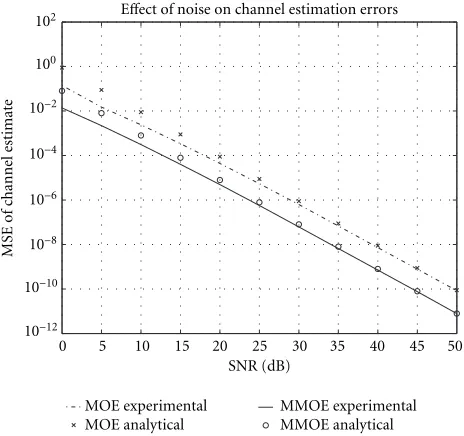
Next, we test the noise effect when the input SNR varies from 0 dB to 50 dB. In Figure 3, we compare the experimental results of channel estimation errors for the MMOE method (solid line) and the MOE method (dash-dotted line) with corresponding analytical results based on (24) withα=0.7 (0’s) and (25) (×’s), respectively. It can be observed that the proposed method always outperforms the MOE method by almost 10 dB. This difference agrees with the factor (1−α)2 in a logarithm scale as predicted by (24) and (25). It is also clear that the experimental results are highly consis-tent with the analytical results at high SNR upon which our approximation is based. Similarly, the output SINRs of the MMOE receiver and the MOE receiver are compared with the MMSE receiver and the SINR ratios plotted in
500 1000 1500 2000 2500 3000
Number of bit periods (N) 0
1 2 3 4 5 6 7 8 9
Output
SINR
(dB)
MOE MMOE Blind MMSE
Data-length effect on the output SINRs
Figure2: Comparison of data-length effect on the output SINR for
different methods.
0 5 10 15 20 25 30 35 40 45 50
SNR (dB) 10−12
10−10
10−8
10−6
10−4
10−2
100
102
MSE
o
f
channel
estimat
e
MOE experimental MOE analytical
MMOE experimental MMOE analytical Effect of noise on channel estimation errors
Figure3: Channel estimation improvement of the MMOE method
over the MOE method for different SNRs.
Figure 4. The analytical results are obtained from the recip-rocals of (29). The solid line represents the experimental ra-tio SINR(¯g)/SINRmmseof the proposed MMOE method, and
0 5 10 15 20 25 30 35 40 45 50 SNR (dB)
0.7 0.75 0.8 0.85 0.9 0.95 1 1.05
SINR/SINR
mmse
MOE experimental MOE analytical
MMOE experimental MMOE analytical Effect of noise on the SINR ratios
Figure4: SINR improvement of the MMOE receiver over the MOE
receiver for different SNRs.
It has been shown analytically that the parameterαhas a significant effect on the performance of the MMOE method. When α = 0, the MMOE method degrades to the MOE method. Whenα→1−, the MMOE method approaches the subspace method if channel estimation is of our interest, or the MMOE receiver becomes the MMSE receiver if detection is performed. These claims can be verified by our simulation results for the channel estimation error in Figure 5 and the output SINR in Figure 6. SNR is still set to be 10 dB. Parame-terαvaries from 0 to 1. Aroundα=1, we setα=0.999 to ap-proximate 1 in order for the required matrix to be invertible. In Figure 5, the experimental result from the MOE method at α=0 coincides with the experimental result for the MMOE method as the dash-dotted line overlaps with the solid line. Asαincreases, the difference between these two methods in-creases, especially whenαapproaches 1. Again, the analyti-cal result agrees with the experimental result for the MMOE method. Figure 6 clearly shows the relationship among the MMOE receiver, the MOE receiver, and the MMSE receiver. It thus suggests thatαshould be selected to be as close to 1 as possible.
Performance loss from imperfect covariance estimation is further investigated for the MOE method. The effect ofNis tested for a range from 100 to 104and corresponding SINRs are shown in Figure 7 with SNR = 10 dB. The dashed line represents the theoretical value (limit) asN → ∞, dashed-dotted line is from our analysis by (41), and solid line is based on simulation. It is observed that whenNreaches 2×10³, the simulation result converges to the analytical one. SINR con-vergence is due to the concon-vergence of the constraint vector to its optimal solution, as plotted in Figure 8, in terms of the MSE. The dashed line is our analytical result in (36) while the solid line is from our experiment. The point where the solid
0 0.1 0.2 0.3 0.4 0.5 0.6 0.7 0.8 0.9 1
α
10−8
10−7
10−6
10−5
10−4
10−3
10−2
10−1
MSE
o
f
channel
estimat
e
MMOE experimental MMOE analytical MOE
Effect of parameterαon channel estimation errors
Figure5: Effect of parameterαon the channel estimation error for
the MMOE method.
0 0.1 0.2 0.3 0.4 0.5 0.6 0.7 0.8 0.9 1
α
6.5 7 7.5 8 8.5
Output
SINR
(dB)
MMOE MOE MMSE
Effect of parameterαon the output SINRs
Figure6: Effect of parameterαon the output SINR of the MMOE
receiver.
line converges to the dashed line is approximately the same as that in Figure 5.
7. CONCLUSIONS
102 103 104
Data-length effect on the output SINRs
Figure7: Data-length effect on the output SINR of the MOE
re-ceiver.
Data-length effect on the constraint estimation
Figure 8: Data-length effect on the constraint estimation of the
MOE method.
the output SINRs with respect to the number of received data vectors, is examined both analytically and experimentally. Due to the additive noise, the MOE receiver suffers from per-formance degradation compared with the blind MMSE re-ceiver. Therefore, a modified MOE (MMOE) method is pro-posed by introducing a parameterαin the MOE constrained optimization criterion whose effect is throughly investigated. It is shown that significant improvement is achievable by properly selecting this parameter. It is also demonstrated that
the MMOE method is closely related to the subspace method and exhibits agreement whenα→1−. In such a scenario, the MMOE receiver also converges to the MMSE receiver.
APPENDICES
A. PROOF OF PROPOSITION 3
The SINRs of the MMSE receiver and the MOE receiver in (26) and (27) are direct results from [15, Appendix B]. Now, we derive (28) in details.
According to our input/output data model (5), the out-put SINR of our modified MOE receiver ¯f0 is given by the ratio of the signal power to the interference plus noise power
SINRmmoe= σ (A.1), we relate SINRmmoeto the optimal constraint vector as follows:
Based on (19) and (22) and noticing that VH
nCg1 = 0, we is the Hermitian of (A.3), we then obtain the quantity in the numerator of SINRmmoe
Similarly, according to (19) and (22) and noticing that VH
After considering (23), (A.5) becomes
Substituting (A.4) and (A.6) into (A.2), we have
B. DERIVATION OF MATRIXB
For notational convenience, denote y(n) in (5) by yn, and
Assume N data vectors are mutually independent for our derivation purpose. It can always be made possible by taking only thoseNvectors which are not contributed by common inputs, although data vectors consecutive in time may be de-pendent on each other due to channel span. Then
E{RD R} = 1
According to (B.1),ynynHcan be expanded into four terms
ynyHn =HwnwnHHH+HwnvnH+vnwHnHH+vnvHn. (B.6)
The noisevnhas been assumed to be zero-mean white
Gaus-sian. It is independent of the input sequence which is i.i.d. with zero-mean, varianceΓ, and finite fourth-order moment. Since E{vnvnH} = σv2I,E{wnwnH} = Γ. Only the following
terms survive inC1,
C1=HC2HH+C3+HE
where tr denotes the trace of a matrix, superscript “∗” de-notes complex conjugate
The last four terms inC1 are deterministic quantities. The first four terms are dependent on the statistical properties of the transmitted signal and the noise. Here as an example, we restrict our attention to a typical scenario: the transmitted symbols from different users are taken from real finite al-phabets and have equal power, and the noise is also real. For all other cases, we can follow the similar procedures detailed next. However, we will not enumerate them for our concise presentation.
We denote the variance of the input byσ2
wand its fourth
order moment bym4w. Then
To easily evaluateC2andC3, we perform vec operations first to combine corresponding terms, similarly as [21]. Then re-verse operations unvec are applied to obtain these matrices
C2=unvec
where the property of vec has been applied [22], and
C4=∆ E
Then it can be verified that [21]
C4=
andLis the length of the input vectorwn. Similarly, we can
evaluate C5. Since the second-order and fourth-order mo-ments of a white Gaussian process are related, we obtain
C5=σv4X3+σv4I, (B.15)
andPis the length of the data vector (or the noise vectorvn).
where
C6=unvec
m4w−3σw4
X1+σ4
wX2
vecHHDH. (B.18)
Observe that
R=σ2
wHHT+σv2I. (B.19)
Substituting (B.9) and (B.17) in (B.7) first, then (B.7) in (B.5), we obtain
B=σw2σv2
N
HHTDT+DTH∗HH
+σ 2
wσv2
N
tr(D)HHH+ trDHHHI
+σ 4
v
N unvec
X3vec(D)
+ 1 NHC6H
H,
(B.20)
which is our desired result.
ACKNOWLEDGMENT
This paper was presented in part at the 35th Asilomar Con-ference on Signals, Systems, and Computers, Pacific Grove, Calif, November 2001.
REFERENCES
[1] B. Arroyo-Fernandez, J. Dasilva, J. Fernandes, and R. Prasad, “Life after third-generation mobile communications,” IEEE Communications Magazine, vol. 39, no. 8, pp. 41–42, 2001. [2] W. Lu, “Broadband wireless access technologies and
appli-cations,” IEEE Communications Magazine, vol. 39, no. 9, pp. 111–145, 2001.
[3] G. Cherubini, J. M. Cioffi, A. Duel-Hallen, and H. V. Poor, “Multiuser detection techniques with application to wired and wireless communications systems I,”IEEE Journal on Se-lected Areas in Communications, vol. 19, no. 8, August 2001. [4] U. Mitra, “Comparison of maximum-likelihood-based
de-tection for two multirate access schemes for CDMA signals,” IEEE Trans. Communications, vol. 47, no. 1, pp. 64–77, 1999. [5] H. V. Poor, “Active interference suppression in CDMA overlay
systems,” IEEE Journal on Selected Areas in Communications, vol. 19, no. 1, pp. 4–20, 2001.
[6] S. Verd ´u, Multiuser Detection, Cambridge University Press, New York, NY, USA, 1998.
[7] S. Verd ´u, “Minimum probability of error for asynchronous Gaussian multiple-access channels,”IEEE Transactions on In-formation Theory, vol. 32, no. 1, pp. 85–96, 1986.
[8] M. Honig, U. Madhow, and S. Verd ´u, “Blind adaptive mul-tiuser detection,” IEEE Transactions on Information Theory, vol. 41, no. 4, pp. 944–960, 1995.
[9] D. Gesbert, J. Sorelius, P. Stoica, and A. Paulraj, “Blind mul-tiuser MMSE detector for CDMA signals in ISI channels,” IEEE Communications Letters, vol. 3, no. 8, pp. 233–235, 1999. [10] S. Bensley and B. Aazhang, “Subspace-based channel esti-mation for code division multiple access communication sys-tems,”IEEE Trans. Communications, vol. 44, no. 8, pp. 1009– 1020, 1996.
[11] M. Torlak and G. Xu, “Blind multiuser channel estimation in asynchronous CDMA systems,”IEEE Trans. Signal Processing, vol. 45, no. 1, pp. 137–147, 1997.
[12] X. Wang and H. V. Poor, “Blind multiuser detection: a sub-space approach,” IEEE Transactions on Information Theory, vol. 44, no. 2, pp. 677–690, 1998.
[13] X. Wang and H. V. Poor, “Blind equalization and multiuser detection in dispersive CDMA channels,” IEEE Trans. Com-munications, vol. 46, no. 1, pp. 91–103, 1998.
[14] H. Liu and K. Li, “A decorrelating RAKE receivers for CDMA communications over frequency-selective fading channels,” IEEE Trans. Communications, vol. 47, no. 7, pp. 1036–1045, 1999.
[15] M. Tsatsanis and Z. Xu, “Performance analysis of minimum variance CDMA receivers,”IEEE Trans. Signal Processing, vol. 46, no. 11, pp. 3014–3022, 1998.
[16] Z. Tian, K. Bell, and H. Van Trees, “Robust constrained lin-ear receivers for CDMA wireless systems,” IEEE Trans. Signal Processing, vol. 49, no. 7, pp. 1510–1522, 2001.
[17] Z. Xu and M. Tsatsanis, “Blind adaptive algorithms for min-imum variance CDMA receivers,” IEEE Trans. Communica-tions, vol. 49, no. 1, pp. 180–194, 2001.
[18] Z. Xu, “Perturbation study on MOE-based multiuser de-tection,” inProc. 35th Asilomar Conf. on Signals, Systems, and Computers (Asilomar ’01), vol. 2, pp. 1733–1737, Pacific Grove, Calif, USA, November 2001.
[19] B. Friedlander and A. Weiss, “On the second-order statis-tics of the eigenvectors of sample covariance matrices,” IEEE Trans. Signal Processing, vol. 46, no. 11, pp. 3136–3139, 1998. [20] F. Li, H. Liu, and R. Vaccaro, “Performance analysis for
DOA estimation algorithms: Further unification, simplifica-tion, and observations,” IEEE Trans. on Aerospace and Elec-tronics Systems, vol. 29, no. 4, pp. 1170–1184, 1993.
[21] Z. Xu, “Asymptotically near-optimal blind estimation of mul-tipath CDMA channels,” IEEE Trans. Signal Processing, vol. 49, no. 9, pp. 2003–2017, 2001.
[22] P. Lancaster and M. Tismenetsky,The Theory of Matrices, Aca-demic Press, San Diego, Calif, USA, 2nd edition, 1985.
Zhengyuan Xureceived both the B.E. and M.E. degrees in electronic engineering from Tsinghua University, Beijing, China, in 1989 and 1991, respectively, and the Ph.D. de-gree in electrical engineering from Stevens Institute of Technology, Hoboken, NJ, in 1999. From 1991 to 1996, he worked as an Engineer and Department Manager at the Tsinghua Unisplendour Group Corp., Tsinghua University. From 1996 to 1999,