Comparison of Skin Colour Detection
Techniques for Face Recognition
K. Divya1, B.L.Praksh 2
, Sreeja K.J3
PG Student, Dept. of ECE,Vignan’s Institute of Information Technology, Visakhapatnam, Andhra Pradesh, India1
Professor, Dept. of ECE, Vignan’s Institute of Information Technology, Visakhapatnam, Andhra Pradesh, India2
Associate Professor, Dept. of ECE, Vignan’s Institute of Information Technology, Visakhapatnam, Andhra Pradesh,
India3
ABSTRACT: Skin tone classification is a critical subset of this field and is useful when it is necessary to extract parts of an image that could possibly contain parts of a person.This paper aims to compare the efficiency of different colour
spaces (RGB, HSV, YCbCr) and compare them to see which one is the best for human skin detection. Skin colour has
proven to be a useful and robust cue for face detection, localization and tracking. Image content filtering, content aware video compression and image colour balancing applications can also benefit from automatic detection of skin in images.
KEY WORDS: Human skin colour detection, Colour model, face recognition, Comparative study of colour models.
I.INTRODUCTION
Human skin colour detection plays an important role in the applications of skin segmentation, face recognition, and tracking for security. Colour segmentation is an important aspect of digital image analysis. Upon recognition of a skin region, one could perform simple detection for a security application, or apply gesture analysis for the sake of human-computer interaction (such as for control or gaming). Electronic skin tone detection is made possible by analyzing the different properties of pixels, which will be the attributes learned by the system [1]. These attributes simply refer to the location of a pixel in a colour space that defines that pixel based on its Red, Green, and Blue contents, or it’s Hue, Saturation, and Value, or any parameter from any imaginable colour space.
The aim of this paperis to compare the efficiency of different colour spaces and to evaluate them that which one is the best for face recognition. Skin detection is useful in face detection, face tracking for security and video indexing applications, model-based video coding, etc. There are some difficulties when detecting skin pixels. Skin colour is affected by ambient light which is unknown in many situations; different cameras produce different colours, even from the same person, under the same illumination and finally skin colour changes from person to person. The methodology of determining some object in a large collection that depicts some particular types of properties [2]. Imaging noise can appear as speckles of skin like colour and many other objects like wood, cooper and some clothes are often confused as skin.
II.LITERATURE SURVEY
III.COLOUR MODELS
We can define the colour model as the digital representation of possibly contained colours, a different definition is found which is defined as the way that we can recognize colour, where human can visualize colour through its attributes such as: hue and brightness [4]. Colour model is a system for measuring colours that can be perceived by human and a process of combining different values as a set of primary colours. Typically colour models have three or four colour components. Different colour spaces are available for different applications. RGB colour space is the most commonly used colour space in digital images. It is a device-dependant colour model. It encodes colours as an additive combination of three primary colours: Red(R), Green (G) and Blue (B) [5]. RGB Colour space is often visualized as a 3-D cube where R, G and B are the three perpendicular axes. One main advantage of the RGB space is its simplicity.
HSV is a transformation of an RGB colour space and its components and colourimetry are relative to the RGB colour space from which it was derived.
Typically, the first thing that is usually noticed about a colour is its hue. Hue describes the shade of colour and where that colour is found in the colour spectrum. Red, yellow and purple are words that describe hue.
The next most significant aspect of colour is typically the saturation S. The saturation describes how pure the hue is with respect to a white reference.
Finally a colour also has brightness. This is a relative description of how much light is coming from the colour. If the colour reflects a lot of light, it is said that it is bright. The image in RGB was converted to HSV colour space, because it is more related to human colour perception. Consider H with values ranging within a threshold and a mix of morphological and smooth filters to minimize the noise. The YCbCr colour space is widely used for digital video. In this format, luminance information is stored as a single component (Y) and chrominance information is stored as two colour-difference components (Cb and Cr) [6].
Cb represents the difference between the blue component and a reference value.
Cr represents the difference between the red component and a reference value.
IV.COMPARITIVE STUDY OF COLOUR MODELS
a file format for image. Y luminance can be used separately for storage in high resolution and the chromaticity components treated separately to improve the performance [8]. Disadvantages of this colour model are, the colour range is restricted in the colour TV images because of the information compression required for the displayed image.
V. RESULT AND DISCUSSION
i. SKIN DETECTED OUTPUTS OF RGB COLOUR SPACE TECHNIQUE
Fig (i, a): Input image
Fig (i, A) illustrates the web captured image i.e., input image which is given as the input for the pre-processing stage so that the skin detected image is obtained.
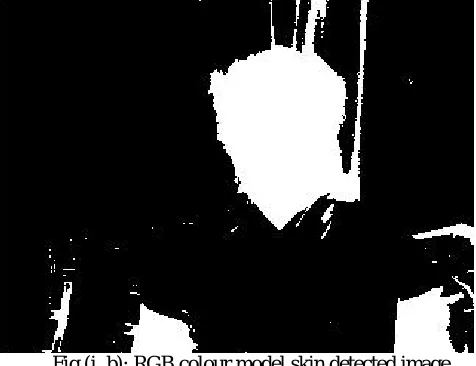
Fig (i, b): RGB colour model skin detected image
Fig (i, c): Face recognized image
Fig (i, C) illustrates the face recognized image which is obtained from the skin detected image and a bounding box which is in rectangular shape is fitted on the face region.
ii. SKIN DETECTED OUTPUTS OF HSV COLOUR SPACE TECHNIQUE
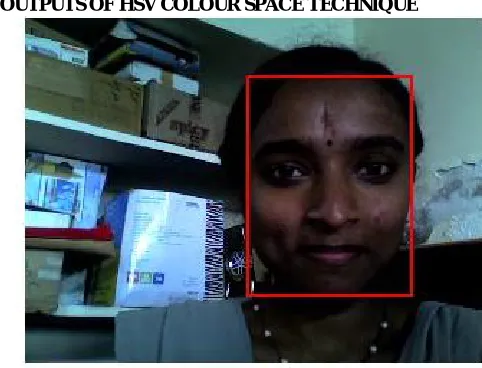
Fig (ii, a): Face recognized image
Fig (ii, A) illustrates the face recognized image for HSV colour space technique. This face recognized image will be obtained from the input image where there is more number of skin pixels.
Fig (ii, B): HSV segmented image
Fig(ii, B) illustrated the skin detected image using HSV colour space technique after pre- processing and morphological operations.
iii. SKIN DETECTED OUTPUTS OF YCbCr COLOUR SPACE TECHNIQUE
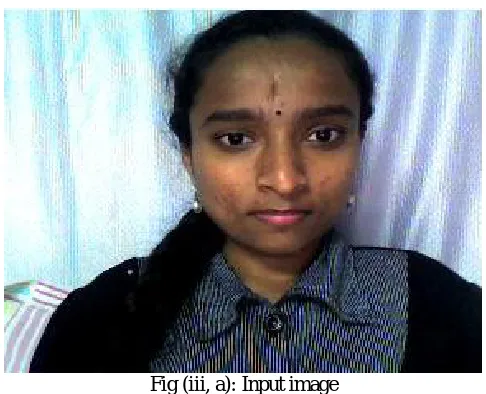
Fig (iii, a): Input image
Fig (iii, b): YCbCr segmented image
Fig (iii, B) illustrates the skin detected image using YCbCr colour space technique. Here, the skin pixels were detected and the non-skin pixels were not detected.
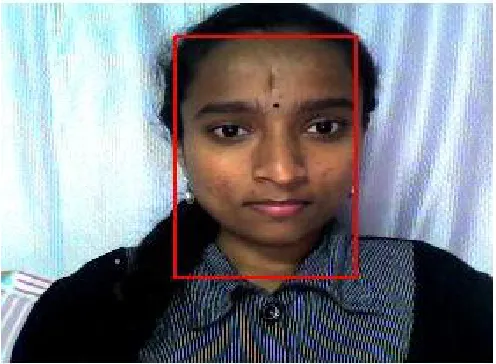
Fig (iii, c): Face recognized image
Fig (iii, C) illustrates the face recognized image from the skin detected image which indicates the face region. The face is detection is done where there is more number of skin pixels in human body.
V.CONCLUSION
Thus From the result analysis, we can say that YCbCr gives an efficient output compare to RGB and HSV skin colour detection methods. After that, HSV is efficient and finally RGB model. RGB is easy and can be applied for more no. of images but the accuracy is less. As we discussed earlier, RGB model is less efficient to real time inputs and detecting skin similar coloured images as skin region. The time required for retrieval of the images using HSV colour space is more than the time required for retrieval of the images using YCbCr colour space.
REFERENCES
[1] Kakumanu, P., Makrogiannis, S., & Bourbakis, N., "A survey of skin-colour modelling and Detection methods", Pattern Recognition, Vol. 40, pp. 1106 – 1122, 2007
[2] Rafael C. Gonzalez, Richard E. Woods. “Digital Image Processing”, third edition. 2009.
[3] Rein-lien Hsu, Mohamed Abdel-Mottaleb & Anil k. Jain, (2008) “Face Detection in Colour Images”, IEEE Transactions on Pattern Analysis and Machine Intelligence, Vol.24, No.5, pp696-706, 2006.
[4] R. M. Jusoh, N. Hamzah, M. H. Marhaban, and N. M. A. Alias, "Skin detection based on Thresholding in RGB and hue component," in IEEE Symposium on Industrial Electronics & Applications, Penang, Malaysia, pp. 515- 517, 2010.
[5] Che-Yen Wen, Chun-Ming Chou, “Colour Image Models and its Applications to Document Examination”, Forensic Science Journal. pp. 23- 32 .Vol. 3(1). 2004.
[6] D. Chai and K. N. Ngan, "Face segmentation using skin colour map in videophone applications," IEEE Trans. CSVT, vol. 9, no.4, pp. 551-564, Jun. 1999.
[7] E. Hjelmas and B. K. Low, "Face detection: a survey," Computer Vision and Image Understanding, vol. 83, no. 3, pp. 236-274, 2001. [8] N. Bojic and K. K. Pang, "Adaptive skin segmentation for head and shoulder video sequence," SPIE VCIP '2000, Perth,Australia, Jun. 2000.
BIORAPHY
Sreeja Kumari Jaya has received B.E. From S.R.K.R Engineering College in the year 2001. She has completed her M.tech in the year 2003 from University of Kerala with Digital Image Computing as her specialization. She has ten years experience of teaching under-graduate and post-graduate students. Currently working as a Associate professor in Vignan’s Institute of Information and Technology, Visakhapatnam, Andhra Pradesh. Her research interest area is digital image processing, communication and networking.
Koyilada Divya has completed her B.Tech from Dadi institute of engineering and technology, Anakapalli in 2011 and is now pursuing her M.tech Degree in Electronics and communications, Vignan’s Institute of Information and Technology, Duvvada, Visakhapatnam, A.P. Her area of interest in image processing