125 KHZ RFID BASED E-HEALTH RECORD SYSTEM
Dr.Suneetha Uppala
Department of Electronics, S.K.University, Anantapur (India)
ABSTRACT
Today’s hospitals are particularly interested in increasing the quality and efficiency of patient identification and monitoring procedures. Since many health care errors occur when important patient information is missing or simply not available, the electronic health records (EHRs) may easily alleviate the distress of most doctors and nurses working in today’s care system. The next step beyond the EHR is to connect and provide medical information to primary care physicians, medical and surgery specialists, anaesthesiologists, nurses, assisted -living staff, patients themselves, patient’s family and so on.Within this the present paper focuses on how RFID technology can be used in order to solve the problems e-Health is dealing. RFID tag consisting memory which is able to store information send through the RFID reader. By using this present technology we can store the patient present and past data (test reports and medication given by the phesetion) store with in the tag so that there is no space to do mistakes.
Keywords:
125 Khz (LF) RFID reader, RFID Tag, EHR and e-health, Personal Health Record (PHR).
I. INTRODUCTION
The most common method currently used by physicians in hospitals is to patient record data on paper, a method considered low cost and easy to use. But there are various disadvantages concerning this practice, especially when health records must be stored for a long period of time. The storage space, paper-based records require a significant amount of storage space in comparison with electronic/digital records. The costs involved with electronic storage media are cheaper as compared to traditional storage media. More problems can occur when a patient’s paper records are stored at different levels of several health units, the process of collecting patient’s information by a health care provider proves very difficult and time consuming [1]. To eliminate the mentioned disadvantages and weaknesses the use of electronic medical records becomes imperative.
The EHR has the ability to generate a complete record of a clinical patient encounter as well as supporting other care-related activities directly or indirectly via interface - including evidence-based decision support, quality management and outcomes reporting. Most hospitals have improved patient care by reducing wait times in the emergency ward after they decided to replace their paper-based process for emergency ward admission with a solution based on informatics systems [2].
460 | P a g e an electronic health record system by using 125 KHz RFID Reader/Writer and corresponding Tags. The software was developed by using MATLAB-GUI. The present information is present in the Tag and along with the present data, the previous data is maintained in a database by using My-SQL database.
II. ARCHITECTURE OF EHR SYSTEM
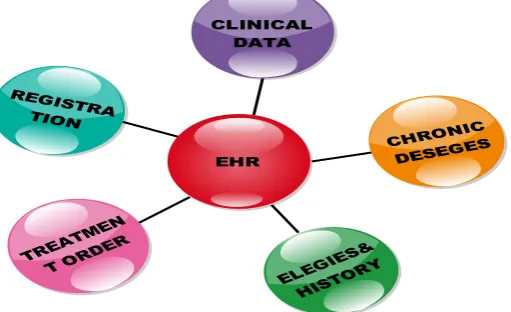
The electronic health record is shown in figure 1 indicating some areas feeding into the record from units/departments. The 125KHz RFID Tags will be used for identifying the patients with a UID number as default. On arrival, each patient receives a Tag with an embedded RFID storing a unique identifier and some information about the patient, such as blood type, medical allergies, or other health history [3]. In addition, all the patient’s paper medical histories and other important documents are tagged with self-adhesive 125 KHz RFID labels containing patient identifier. With the help of this additional information, the risk of administrating wrong medication in case of an emergency will be highly reduced. Moreover, the hospital staff will be able to take the best medical decisions according to the actual health state of the patient. Moreover, 125 KHz RFID Tag’s memory can be erased and written more than 100,000 times. Thus, to reduce the cost of the 125 KHz RFID healthcare system these 125KHz RFID Tags can be reusable. The data format that will be used for writing additional information into Tags can be defined through an advanced template editor, which allows user to establish all the necessary fields e.g. blood type, chronic diseases, allergies, etc. their type
CLINICAL DATA
EHR
ELEGIE S&
HISTOR Y TREATM
EN
T ORDE R
REGISTRTION A
CHRONIC DESEGES
Figure 1:
Elements in an EHR system
III. 125KHZ RFID SYSTEM
defines the antenna specifications. Antennas can be made from a variety of materials; they can be printed, etched, or stamped with conductive ink, or even vapour deposited onto labels.
IV. ATMEGA 328P MIROCONTROLLER
The present system design by using atmega328 microcontroller to read the data which is read by the 125KHz RFID reader and process further. Atmega 328 is high-performance Microchip 8-bit AVR RISC-based microcontroller combines 32KB ISP flash memory with read-while-write capabilities, 1KB EEPROM, 2KB SRAM, 23 general purpose I/O lines, 32 general purpose working registers, three flexible timer/counters with compare modes, internal and external interrupts,serial programmable USART, a byte-oriented 2-wire serial interface, SPI serial port, 6channel 10-bit A/D converter[6].
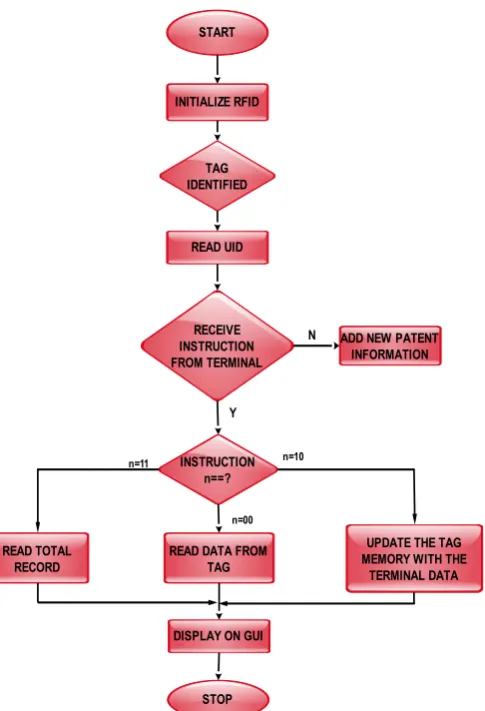
125 KHz RFID reader TX line is connected to the RX of atmega328P controller and RX line of reader is connected to the TX of 328P controller. The atmega328p any digital line is used for serial port read and write by software serial command. The serial lines are further connected to the Personal Computer. The flow chart is shown in the figure2.
Algorithm for EHR system Step 1: Start the application
Step 2: To initialize MFRFID reader/writer Step 3: To scan for tag
Step 4: If the tag is present read UID and READ the data. Step 5: Is previous records are used for verification, if yes Step 6: To re-write data with updated record, if no
462 | P a g e
START
INITIALIZE RFID
TAG IDENTIFIED
READ UID
RECEIVE INSTRUCTION FROM TERMINAL
INSTRUCTION n==?
UPDATE THE TAG MEMORY WITH THE
TERMINAL DATA READ DATA FROM
TAG READ TOTAL
RECORD
DISPLAY ON GUI
STOP
ADD NEW PATENT INFORMATION
n=00 n=10 n=11
N
Y
Figure 2: Flowchart process of EHR system with the 125 KHz RFID
Reader/Writer
V. CONCLUSION
A Personal Health Record (PHR) is an integral part of the EHR. Information in the Tag is used to store patient information including UID and other details about allergies, blood type, current health problems, medications and including recent findings. The Electronic Health Record system, all the health parameters like Blood Pressure, Blood glucose and other clinical parameters which are stored in a Personal Computer and later on the administrator transfer the same information of the Health Record onto the Tag through the 125KHz RFID reader. The software package has been developed in such a way that is suitable for corporate Hospital systems for issuing Master Health Checkup details in terms of e-record instead of paper file. We successfully developed, implemented and tested this application by using different Tags. Real time test was performed many times by
using 125KHz RFID Reader/Writer with different Tags successfully
.
REFERENCES
[2]. Health information technology in the United States: The information base for progress. Available at: http://www.rwjf.org/files/publications /other/EHRReport 0609.pdf. Accessed June 25, 2007.
[3]. Saving lives, reducing costs: computerized physician order entry lessons learned in community hospitals. First Consulting Group. Available at: http://www.masstec h.org/ ehealth/ CPOE_ lessonslearned.pdf. Accessed June 25, 2007.
[4]. H. Cai, Y. Lin. “Design of a roadside seamless wireless communication system for intelligent highway”. IEEE, Intelligent Transportation System. 2005
[5]. Application Notes, “Introduction to RFID Technology” CAENRFID: The Art of Identification (2008). [6]. Dr.Suryaprasad J, Praveen Kumar B O, Roopa D Arjun A K, A Novel Low-Cost Intelligent Shopping