Double-Blind Peer Reviewed Refereed Open Access International e-Journal - Included in the International Serial Directories Aryabhatta Journal of Mathematics and Informatics
http://www.ijmr.net.in email id- [email protected] Page 561
A STUDY ON COMPETENCY IN ICT OF B.Ed. STUDENTS IN RELATION TO THEIR GENDER AND LOCALITY
MANMOHAN GUPTA*; DR. DHARAMVEER** * Research Scholar
Mewar University, Rajasthan Reg. no. MUR1406519 ** Principal, C.D.L. College of Education Jagadhri, Yamuna Nagar, Haryana, India ABSTRACT
The present study is an attempt to investigate the competency in ICT of B.Ed. students in relation to their gender and locality. The objectives of the study were (1) To study the competency in ICT of male and female B.Ed. students. (2) To study the competency in ICT of rural and urban B.Ed. students. The sample for the study comprised of 150 B.Ed. Students of Saharanpur district. ICT COMPETENCY SCALE was developed and standardized by the researcher with the help of his guide. The findings of the study indicate that there were no significant difference between the competency in ICT of male and female B.Ed. students on the dimension of “using hardware and software device” and male B.Ed. students have good competency in ICT rather than female B.Ed. students on the dimension of “using internet and network” and the same was on total Competency in ICT. There were no significant difference between the competency in ICT of rural and urban B.Ed. students on the dimension of “using hardware and software device”, “using internet and network” and total ICT competency scale.
INTERODUCTION
After the 1980s, information and communication technologies (ICT) have become essential for teaching and learning environments day by day. These drastic changes certainly affect today's teacher education context. Initially, ICT issues quickly moved from instituting special programs for preparing individuals to become ICT specialists in schools and then to infusing ICT into all aspects of an educator's preparation. With the above-mentioned consequences, many action plans were adopted at national and international levels, as well as investments for ICT in teacher education. Most of the teacher education programs have been redesigning their curricula in order for prospective teachers to become competent users of new technologies when they become teachers (Glenn, 2002; Goktas, 2006).
Teachers play a crucial role in the development, adoption and Implementation of any educational curriculum or innovation. This role becomes even more critical in adoption and integration of information and communication technology (ICT) into the education programme of a country. It has been discovered that knowledge of (ICT) usage improves human capacity in every field of human endeavor, including business transaction, industrial operations, educational programmes and activities and life in general. Radloff (2001) highlights the opportunities
that ICT presents for enhancing the quality of teaching and learning to include:
Providing encouragement for staff and students to reflect on how they teach and learn.
Applying theory and research on learning and principles of good instruction to designing online learning environments.
Making teaching (and learning) more visible and public.
Encouraging collaboration and team work among staff (and students).
Offering greater access to learning for more people.
Double-Blind Peer Reviewed Refereed Open Access International e-Journal - Included in the International Serial Directories Aryabhatta Journal of Mathematics and Informatics
http://www.ijmr.net.in email id- [email protected] Page 562
Aware of the significance of ICT educational programmes, governments in the world have adopted several measures to facilitate acquisition of ICT education by enhancement of education and training programme, providing an enabling environment for the development of ICT, provision of incentives for computerisation and automation and creation of venture capital (Pelgrum and law 2003). Carlson and Gadio (2002) stated that teacher training in the use of ICT is the best starting point in the ICT policy of a country because they are the key to making learning happen. This according to them is so because teachers who succeed in making use of ICT in their work process, do not only contribute to improved learning outcomes in their students, but may also benefit personally from enhanced work productivity, reduced isolation and increased professional satisfaction. But in a study of 26 education systems (Pelgrum and Anderson 1999), lack of ICT knowledge and skills by teachers was perceived to be a major obstacle for attaining the schools ICT related goals, they equally found that there was a serious lack of skills related to pedagogical ICT use, the most challenging being how to make use of ICT to support and extend learning at the tertiary level of education. Developing teachers’ ICT skills is then imperative. The integration of ICT into these courses, by the teacher educators who offer the new courses in teacher education programs have important roles. By integrating ICT into these courses, the teacher educators can enhance the effectiveness of the courses and become role models for the prospective teachers. In the literature, good role models were recommended for prospective teachers to observe appropriate modeling throughout their undergraduate process (Kariuki, Franklin, & Duran, 2001; Yildirim, 2000). Competencies that need to be developed at the early stage of ICT adoption will include according to Pelgrum and Law (2003) the training of teachers in the use of common office application programme, sending of e-mails, making use of the internet, use of ICT in subject based teaching and class room practices. Production of multimedia course materials, data analysis, e-library, video conferencing, networking and e-payments are other areas of competencies that teachers need to develop.
SIGNIFICANCE OF THE STUDY
Currently, many educators in secondary schools and higher education are collecting information and bracing themselves with knowledge on how to approach the communication patterns of the younger generation. However, one essential aspect seems to be absent from the discourse; the possibility that these young people do not all behave, think and learn in the same way; that rather than having a generally ICT-competent generation, we have a generation with many different ICT competencies. It would appear that currently our youth are considered as one homogenous group and projects and research addressing their ICT skills often fail to mention that there may be gender aspects which need to be taken into account. Possibly, since research has shown that ICT remains primarily a male sphere, efforts to deal with the needs of the new generation actually focuses on how teenage boys and young male adults behave regarding ICT.
Double-Blind Peer Reviewed Refereed Open Access International e-Journal - Included in the International Serial Directories Aryabhatta Journal of Mathematics and Informatics
http://www.ijmr.net.in email id- [email protected] Page 563
Some studies have shown very significant differences in the use of ICT with regard to gender. To briefly mention two such studies, it should be noted that according to Hou et al (2006), girls treated computers as a device to complete a task while boys considered computers as recreational devices. Thus, the study indicates that boys use technology for fun, while girls tend to use it as a means of communication. Another study by Erstad (2004) at the University of Oslo also observes that while differences in time spent on computers between girls and boys have lessened, the two genders tend to use the technology in very different ways. With this background in mind, the project Gender Awareness in ICT with Focus on Education aims to identify how pupils use instant messaging systems, the Internet, down-load music, use mobile phones, MP3 players, computer games (on and off-line) and video games etc. With the aid of a substantial, electronic survey, we hope to be able to identify the actual behaviour of these digital students and map out differences and similarities in the two gender groups. An additional aim with our survey is to find out to what extent pupils are happy with the kind of ICT teaching and guidance they receive from teachers and what they actually expect from teachers regarding ICT. So this study “a study on competency in ICT of B.Ed. students in relation to their gender and locality” is very important to know ICT competency of the students in modern era.
OBJECTIVES OF THE STUDY
The present study is based on the following objectives:
To study the competency in ICT of male and female B.Ed. students.
To study the competency in ICT of rural and urban B.Ed. students. HYPOTHESES
The present study is carried out on the bases of following hypotheses:
There is no significant difference between the competency in ICT of male and female B.Ed. students.
There is no significant difference between the competency in ICT of rural and urban B.Ed. students. DELIMITATION OF THE STUDY
Due to the lack of time, resources and finance this study is confined only to the B.Ed. Colleges of Chaudhary Charan Singh University, Meerut district of Uttar Pradesh.
DESIGN OF THE STUDY
A good study depends on a goal oriented research design to produce better results. This study is descriptive in nature so survey method is use to collect the data.
POPULATION
All the students studying in B.Ed. course being offered by colleges of education affiliated to Chaudhary Charan Singh University, Meerut, district of Uttar Pradesh constituted the population for present study. SAMPLE & SAMPLING TECHNIQUES
Double-Blind Peer Reviewed Refereed Open Access International e-Journal - Included in the International Serial Directories Aryabhatta Journal of Mathematics and Informatics
http://www.ijmr.net.in email id- [email protected] Page 564 TOOL USED
To obtain the data, the data gathering device- ‘ICT COMPETENCY SCALE’ was prepared by the investigator over two dimensions e.g. (1) Using hardware and software device (2) Using internet and network and it had been given to some of the experts for the content validity and preliminary try out was made on the sample size -50. There were 50 B.Ed. students from C.C.S. University Meerut. The reliability of the tool was established by split half method and test retest method by computing coefficient of correlation by Karl Pearson Method. The value of coefficient of correlation was found be 0.92. The tool consists of 28 statements involving positive as well as negative items. Thus the tool was standardized by the research investigator with the help of his guide.
SCORING PROCEDURE OF ICTCOMPETENCY SCALE
The “ICT Competency Scale” constructed by the investigator this scale having 28 statements of which 24 of them positive statements and the remaining 4 were negative statements..
SCORES FOR POSITIVE STATEMENTS:
5 for Strongly Agree opinion (SA) 4 for Agree opinion (A)
3for Undecided opinion (U) 2 for Disagree opinion (D)
1 for Strongly Disagree opinion (SD) SCORES FOR NEGATIVE STATEMENTS
1 for Strongly Agree opinion(SA) 2 for Agree opinion(A)
3 for Undecided opinion(U) 4 for Disagree opinion(D)
5for Strongly Disagree opinion(SD)
The sample prospective teachers were asked to tick any one response out of given five alternatives for each statement. There are total 28 items in the present attitude scale. The maximum possible scores on the whole attitude were 140 and the minimum possible scores were 28.
STATISTICAL ANALYSIS
To get the meaningful results from the present study the researcher used mean, standard deviation and ‘t’-test to analyze the data.
Double-Blind Peer Reviewed Refereed Open Access International e-Journal - Included in the International Serial Directories Aryabhatta Journal of Mathematics and Informatics
http://www.ijmr.net.in email id- [email protected] Page 565 Table-1
Mean & S.D. Scores of Male and female B.Ed. students on “Using hardware and software device” Dimension of “ICT Competency Scale” (ICTCS)
Respondents N Mean SD t-value
(df 148)
Male B.Ed. students 75 82.63 7.397 1.746
(N.S.)
female B.Ed. students 75 80.80 5.255
*Not significant
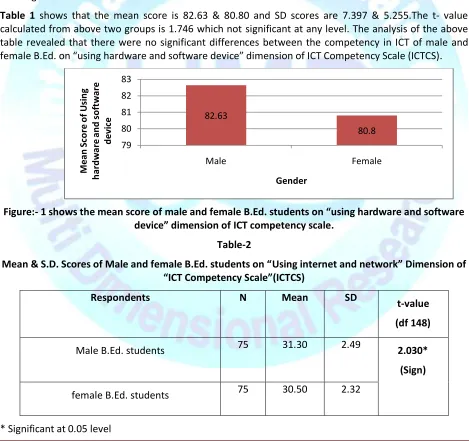
Table 1 shows that the mean score is 82.63 & 80.80 and SD scores are 7.397 & 5.255.The t- value calculated from above two groups is 1.746 which not significant at any level. The analysis of the above table revealed that there were no significant differences between the competency in ICT of male and female B.Ed. on “using hardware and software device” dimension of ICT Competency Scale (ICTCS).
Figure:- 1 shows the mean score of male and female B.Ed. students on “using hardware and software device” dimension of ICT competency scale.
Table-2
Mean & S.D. Scores of Male and female B.Ed. students on “Using internet and network” Dimension of “ICT Competency Scale”(ICTCS)
Respondents N Mean SD t-value
(df 148)
Male B.Ed. students 75 31.30 2.49 2.030*
(Sign)
female B.Ed. students 75 30.50 2.32
* Significant at 0.05 level
82.63
80.8 79
80 81 82 83
Male Female
M
ea
n
S
co
re
o
f
U
si
n
g
h
ard
w
are
an
d
s
o
ft
w
are
d
e
vi
ce
Double-Blind Peer Reviewed Refereed Open Access International e-Journal - Included in the International Serial Directories Aryabhatta Journal of Mathematics and Informatics
http://www.ijmr.net.in email id- [email protected] Page 566
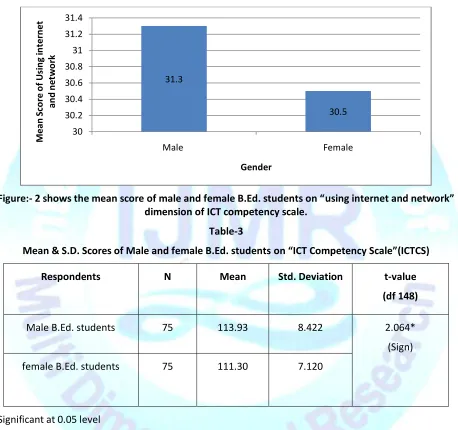
Table 2 shows that the mean score is 31.30 & 30.50 and SD scores are 2.49 & 2.32 .The t- value calculated from above two groups is 2.030 which is significant at 0.05 level. The analysis of the above table revealed that male B.Ed. students have good competency in ICT rather than female B.Ed. students on “Using internet and network” Dimension of “ICT Competency Scale”(ICTCS).
Figure:- 2 shows the mean score of male and female B.Ed. students on “using internet and network” dimension of ICT competency scale.
Table-3
Mean & S.D. Scores of Male and female B.Ed. students on “ICT Competency Scale”(ICTCS)
Respondents N Mean Std. Deviation t-value
(df 148)
Male B.Ed. students 75 113.93 8.422 2.064*
(Sign)
female B.Ed. students 75 111.30 7.120
*Significant at 0.05 level
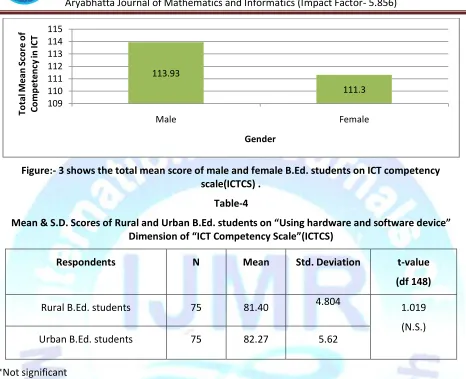
Table 3 shows that the mean score is 113.93 & 111.30 and SD scores are 8.422 & 7.120.The t- value calculated from above two groups is 2.064 which is significant at 0.05 level. The analysis of the above table revealed that male B.Ed. students have good competency in ICT rather than female B.Ed. students on “ICT Competency Scale”(ICTCS).
31.3
30.5
30 30.2 30.4 30.6 30.8 31 31.2 31.4
Male Female
M
ea
n
S
co
re
o
f
U
si
n
g
in
te
rn
et
an
d
n
et
w
o
rk
Double-Blind Peer Reviewed Refereed Open Access International e-Journal - Included in the International Serial Directories Aryabhatta Journal of Mathematics and Informatics
http://www.ijmr.net.in email id- [email protected] Page 567
Figure:- 3 shows the total mean score of male and female B.Ed. students on ICT competency scale(ICTCS) .
Table-4
Mean & S.D. Scores of Rural and Urban B.Ed. students on “Using hardware and software device” Dimension of “ICT Competency Scale”(ICTCS)
Respondents N Mean Std. Deviation t-value
(df 148)
Rural B.Ed. students 75 81.40 4.804 1.019
(N.S.)
Urban B.Ed. students 75 82.27 5.62
*Not significant
Table 4 shows that the mean score is 81.40 & 82.27 and SD scores are 4.804 & 5.62.The t- value calculated from above two groups is 1.019 which is not significant. The analysis of the above table revealed that there were no significant differences between the competency in ICT of rural and urban B.Ed. students on “Using hardware and software device” Dimension of “ICT Competency Scale”(ICTCS)
Figure:- 4 Shows the Mean Scores of Rural and Urban B.Ed. students on “Using hardware and software device” Dimension of “ICT Competency Scale”(ICTCS)
113.93 111.3 109 110 111 112 113 114 115 Male Female To ta l M ea n Sc o re o f C o m p et en cy in IC T Gender 81.4 82.27 80.8 81 81.2 81.4 81.6 81.8 82 82.2 82.4
Rural Urban
Double-Blind Peer Reviewed Refereed Open Access International e-Journal - Included in the International Serial Directories Aryabhatta Journal of Mathematics and Informatics
http://www.ijmr.net.in email id- [email protected] Page 568 Table-5
Mean & S.D. Scores of Rural and Urban B.Ed. students on “Using internet and network” Dimension of “ICT Competency Scale”(ICTCS)
Respondents N Mean Std. Deviation t-value
(df 148)
Rural B.Ed. students 75 29.80 2.98 1.227
(N.S)
Urban B.Ed. students 75 30.40 3.01
*Not significant
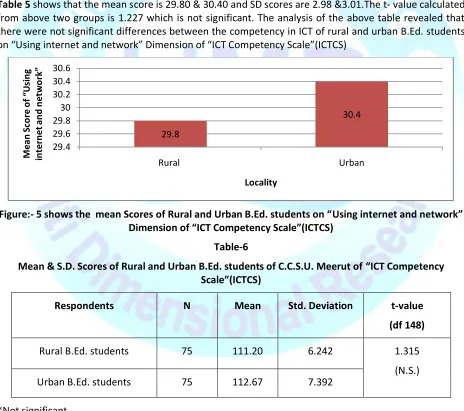
Table 5 shows that the mean score is 29.80 & 30.40 and SD scores are 2.98 &3.01.The t- value calculated from above two groups is 1.227 which is not significant. The analysis of the above table revealed that there were not significant differences between the competency in ICT of rural and urban B.Ed. students on “Using internet and network” Dimension of “ICT Competency Scale”(ICTCS)
Figure:- 5 shows the mean Scores of Rural and Urban B.Ed. students on “Using internet and network” Dimension of “ICT Competency Scale”(ICTCS)
Table-6
Mean & S.D. Scores of Rural and Urban B.Ed. students of C.C.S.U. Meerut of “ICT Competency Scale”(ICTCS)
Respondents N Mean Std. Deviation t-value
(df 148)
Rural B.Ed. students 75 111.20 6.242 1.315
(N.S.)
Urban B.Ed. students 75 112.67 7.392
*Not significant
29.8
30.4
29.4 29.6 29.8 30 30.2 30.4 30.6
Rural Urban
M
e
an
S
co
re
o
f
“U
si
n
g
in
te
rn
e
t a
n
d
n
e
tw
o
rk”
Double-Blind Peer Reviewed Refereed Open Access International e-Journal - Included in the International Serial Directories Aryabhatta Journal of Mathematics and Informatics
http://www.ijmr.net.in email id- [email protected] Page 569
Table 6 shows that the total mean score is 111.20 & 112.67 and SD scores are 6.242 & 7.392 .The t- value calculated from above two groups is 1.315 which is not significant at any level. The analysis of the above table revealed that there were no significant differences between the competency in ICT of Rural and Urban B.Ed. students on “ICT Competency Scale”(ICTCS)
Figure:-6 Shows that the Total Mean. Scores of Rural and Urban B.Ed. students on “ICT Competency Scale”(ICTCS)
FINDINGS OF STUDY
The first null hypothesis that there is no significant difference between the competency in ICT of male and female B.Ed. students is partially accepted and partially rejected. The findings related to above hypothesis are as follows:
There were no significant difference between the competency in ICT of male and female B.Ed. students on Using hardware and software device” Dimension of “ICT Competency Scale” (ICTCS). There were significant difference between the competency in ICT of male and female B.Ed.
students on “Using internet and network” Dimension of “ICT Competency Scale”(ICTCS).
There were significant difference between the competency in ICT of male and female B.Ed. students on “ICT Competency Scale”(ICTCS).
The second null hypothesis that there is no significant difference between the competency in ICT of rural and urban B.Ed. students is accepted. The findings related to above hypothesis are as follows:
There were no significant difference between the competency in ICT of rural and urban B.Ed. students on Using hardware and software device” Dimension of “ICT Competency Scale” (ICTCS). There were no significant difference between the competency in ICT of rural and urban B.Ed.
studentson “Using internet and network” Dimension of “ICT Competency Scale”(ICTCS).
There were no significant difference between the competency in ICT of rural and urban B.Ed. students on “ICT Competency Scale”(ICTCS).
111.2
112.67
110 110.5 111 111.5 112 112.5 113
Rural Urban
To
ta
l M
ea
n
s
co
re
o
f
C
o
m
p
et
en
cy
in
IC
T
Double-Blind Peer Reviewed Refereed Open Access International e-Journal - Included in the International Serial Directories Aryabhatta Journal of Mathematics and Informatics
http://www.ijmr.net.in email id- [email protected] Page 570 EDUCATIONAL IMPLICATIONS
The present study is an attempt to investigate the competency in ICT of B.Ed. students in relation to their gender and locality. The ICT awareness becomes an urgent need of the hour in present scenario. Now, the time has come to use the ICT equipments in the class rooms.
Furthermore the study makes contribution through its findings by revealing the difference between various groups of students and their competency in ICT is concerned.
1) On the basis of the results of this study it is suggested that the institutional of learning should organize some seminars and conferences on ICT awareness. In order to improve ICT awareness of students, their participation should be made mandatory in such events.
2) The college should also invite educationist for sharing their views with the students.
3) This study will encourage students to take some corrective measures such as ICT awareness, competency in ICT, ability to use the equipments of ICT and attitude towards ICT.
4) ICT awareness program should be made compulsory at all levels of teacher education. 5) ICT labs should be constituted in the school, colleges and universities.
SUGGESTION FOR FURTHER RESEARCHES
On the basis of the finding of the present investigation the investigator would like to suggest following for further research:
The present study is delimited to the comparison of the competency in ICT of B.Ed. students of Ch. Charan Singh University, Meerut. The same can be extended to different universities.
The present study is confined only to the U.P. state; similar study may also be conducted in different state of India.
The present study is confined only to district Saharanpur; similar study may also be conducted in different district of U.P.
Present study is deals with a sample of 150 B.Ed. students. A large number of samples can be used. The present study is related only to the B.Ed. students in the same way study can be conducted on
Double-Blind Peer Reviewed Refereed Open Access International e-Journal - Included in the International Serial Directories Aryabhatta Journal of Mathematics and Informatics
http://www.ijmr.net.in email id- [email protected] Page 571 BIBLIOGRAPHY
Kariuki, M., Franklin, T., & Duran, M. (2001). A technology partnership: lessons learned by mentors. Journal of Technology and Teacher Education, 9 (3), 407-417.
Göktaş, Y. (2006). The current status of information and communication technologies integration into schools of teacher education and K-12 in Turkey. Unpublished PhD. Thesis, METU, Ankara, Turkey.
Glenn, A.D. (2002). Emergence of technology standards for preservice teacher education. North Central Regional Educational Laboratory, NCREL’s Educational Technology. <http://www.ncrel.org/tech/standard> (2005, December 20)
Yildirim, S. (2000). Effects of an educational computing course on preservice and inservice teachers: A discussion and analysis of attitudes and use. Journal of Research on Computing in Education, 32(4), 479- 495.
Pelgrum, W.J. and Anderson, R.E. (1999) (Eds.) ICT and Emerging Paradigm for Lifelong Learning. Amsterdam: IEA.
Pelgrum, W.J. and Law, N. (2003). ICT in Education Around the World: Trends, Problems and Prospects. Paris: UNESCO.
BECTA. (2001). Emerging Findings from the Evaluation of the Impact of ICT on Pupils Attainment. London: BECTA.