A Study on Accomplishment in Data Mining
for e-Governance at Inner-City and Rustic
Areas
P. Muthukumar
M. Phil Research Scholar, Dept. of Computer Science, Bishop Appasamy College, Coimbatore, India
ABSTRACT: E-government is a conversion of government to present resourceful, suitable and clear services to society and business through Information and Communication Technology (ICT). It is tactically essential to people and works to operate efficiently and add value these system environment. The main important aspect of e-government is to develop public sector and communication between government and people. Introducing e-government means of reducing costs, improving services for people and increasing effectiveness and efficiency at national, regional and local level public sector. Many e-government services are available between government and citizens. G2C, G2B, G2G is the services of e-government. The main objective of this paper is to review e-government, e-government advantages, and e-government implementation, corruption.
KEYWORDS: e-government, e-government implementation, corruption, ICT, G2C, G2B, G2G.
I. INTRODUCTION
E-Government refers to the use of technologies particularly information and communication technology (ICT) and world wide web (WWW) to present governmental services to people, businesses, government employees and other organizations automatically. Nowadays not only developed countries but rising and less developed countries are frustrating to give services to their citizens electronically in order to get extra and added benefits from e-government system.
II. CORRUPTION
Fig1. Corruptions in many countries
III. REASON OF CORRUPTION
Diminishing values in the society.
Diminishing nationalism.
Be short of knowledge.
Lack of successful administration.
Lack of financial immovability. Lack of efficient political head.
It is useful to differentiate between types of corruption and to recognize those which e-Governance can most eagerly fight. Governments now understand that e-Governance is more than just balanced government web sites on the Internet. E-Governance represents a major chance to move onward with qualitative, cost efficient government services and an improved association among citizens and government. E-government systems are to control corruption, growth to good developing country and improve economic.
IV. ADVANTAGES OF E-GOVERNMENT
There are many advantages as apply an electronic government. The main advantage of an electronic government this will be to get better the good organization of the current scheme. That would in go again save money and time. The opening would also make easy better interactions between governments and businesses. An example would be, E-Procurement facilitates G2G and G2B statement; this will allow lesser business to struggle for government contracts as well as better business. This will have the advantage of creating an open market and stronger economy.[3] Business and citizens can obtain in sequence at a faster speed and it is probable at any time of the day. In adding together, touching away from a lot document based scheme to an electronic system would decrease that requires for man power. Thus, this would allow the process to be handles by smaller human resources and consequently to decrease process cost.
The general public is moving in the direction of the mobile connections. The facility of an e-government service to be available to citizens irrespective of position throughout the nation brings the next and potentially main gain of an e-government service. The society is moving toward the mobile connections.
Due to the fact that information and data are posted online, the plan of an “opened up” government and made government rule, information (together with some publicly expensive archival and past information) and services more obtainable. This would reproduce a better clearness of the service present by the government.
V. IMPLEMENTATION OF E-GOVERNMENT
A. Different Areas Of E-Governance
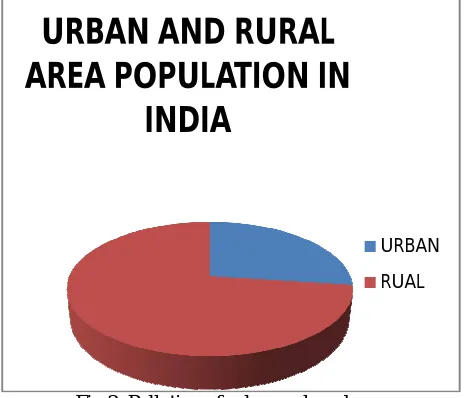
In the following section, we are describing the projects used in urban and rural areas of India.
Fig 2. Pollution of urban and rural area
B. E-Governance projects in urban areas:
Transportation:- Services provided by e-governance in this area are:-
Issuance of moment in time chart of buses.
Condition of booking ability for throughway move.
Transportation development agenda.
Local Transportation Plans.
Jamming organization procedure.
Transportation command administration.
C. Online payment of bills and taxes:
Services provided by e-governance in this area’s:
Online deal
expense of invoice
fee of taxes
sum of residence EMIs
Irrigate receipt
Revenue excise
License amount
Motor vehicle excise
Institution of higher education fees etc.,
D. Areas of e-governance in rural (pastoral) areas:
In countryside areas e-governance has its especially influential crash. At this time, from farming to restricted information the whole thing is complete from side to side e-governance.
Agriculture:- subsequent are the projects used in farming.
Gyandoot: In the position of Madhya Pradesh it is an Intranet-based administration to citizen (G2c) service release plan.
BELE:- It is a web-based request with 3-tier planning for capturing and monitoring the main activities and services.
AGMARKNET: - It is a project accepted by section of Marketing & Inspection (DMI), Ministry of Agriculture, and administration of India.
URBAN AND RURAL
AREA POPULATION IN
INDIA
URBAN
SEEDNET:-It is a SEED informatics system under department of Agriculture, management of India. The plan was started in Chhattisgarh in the month of July' 2008 for Kharif season.
Mustard Procurement organization System:- It is ongoing by Haryana government. It conducted the review of mustard sown by the farmers and nourishes this information in to the file of the system. This data is then processed and make coupons having in sequence of dates on which cultivator may stay in the Mandy to sale his mustard.
VI . TYPES OF COMMUNICATIONS IN E-GOVERNANCE
G2G (Government to Government) – In this case, in sequence and connections Technology is used not only to reorganize the governmental processes concerned in the performance of government entities but also to enlarge the run of information and services within and between dissimilar entities. This kind of contact is only inside the area of management and can be both flat i.e. among different government agencies as well as connecting dissimilar useful areas within an organization, or upright i.e. linking general, local and local government agencies as well as between special levels within an organization. The primary purpose is to add to competence, presentation and production.
G2C (Government to Citizens) – In this casing, a boundary is formed connecting the government and citizens which enables the people to benefit from capable release of a huge variety of community services. This expands the ease of use and convenience of community services on the one offer and improves the excellence of services on the additional. It gives citizens the option of when to cooperate with the government (e.g. 24 hours a day, 7 days a week), from where to cooperate with the government (e.g. service centre, unattended kiosk or from one’s home/workplace) and how to interrelate with the government (e.g. from side to side internet, fax, telephone, email, face-to-face, etc). The main reason is to create government, citizen-friendly.
G2B (Government to Business) – at this time, e-Governance tools are used to help the industry group of people – providers of supplies and services – to effortlessly cooperate with the government. The object is to cut red tape, save moment in time, decrease prepared Promoting e-Governance – The elegant method onward e-Governance: theoretical Framework 8 “e-Government: From idea to completion” by Subash Bhatnagar; Sage Publications; 2004. 9 opening speak to at IIT Delhi during global meeting on e-Governance.12 13 expenses and to make more see-through trade surroundings when dealing with the government. The G2B plan can be transactional, such as in licensing, permits, procurement and income compilation. They stay alive able to also be promotional and facilitative, such as in deal, sightseeing and savings. These events assist to give friendly surroundings to businesses to allow them to execute more professionally.
G2E (Government to Employees) – Government is by distant the main employer and like any association, it has to
cooperate with its employees on a usual basis. This communication is a two-way procedure between the association and the member of staff. Use of ICT tools helps in making these connections rapid and capable on the one hand over and increase fulfillment levels of human resources on the other.
VII . FUTURE OF E-GOVERNMENT
It concerns the upcoming jointly of two areas that are equally experiencing speedy growth. On the one hand we have information knowledge, how rapidly it is distribution and how the technology is rising in conditions of what we can do on the Internet, where it can be complete and with what rank of safety. On the other hand we have government rule, which is affected by factors such as the development of the EU, trends towards mixing or destruction and new tasks. Jointly, the development of these and other factors will decide the form and arrangement of e-Government in the future. Our purpose is to take a look around the corner to see what actuality will look like in 2016. We feel that the option of 2016 provides a suitable time viewpoint; it is shut sufficient to allow us to evaluate the trends and it is future adequate left for these trends.
VIII . CONCLUSION
efficiency of e-government and e-services wants to be enhanced. One-stop services and entrance are solution factors for innovative e-Services intended on the foundation of a user’s condition in existence or on business actions.
REFERENCES
1. Saleh Alshomrani “A Comparative Study on United Nations E-Government Indicators between Saudi Arabia and USA” Vol. 3, No. 3, March 2012.
2. Pathak, R. D. Singh, G., Belwal, R., Naz, R. & Smith, R. F. I. (2008). “E-governance, corruption and public service delivery: A comparative study of Fiji Ethiopia, JOAAG”, Vol. 3. No. 1
3. Pacheri Bari, Rajasthan, V. B. Singh Delhi College of Arts & Commerce, University of Delhi. “E-Governance: Past, Present and Future in India” Nikita Yadav Research Scholar, Singhania University, Volume 53– No.7, September 2012.
BIOGRAPHY
Muthukumar is a Research Scholar in the Department Computer Science, Bishop Appasamy College,