DOI: 10.1534/genetics.109.108068
A Combined-Cross Analysis Reveals Genes With Drug-Specific
and Background-Dependent Effects on Drug
Sensitivity in
Saccharomyces cerevisiae
Hyun Seok Kim*
,1and Justin C. Fay*
,†,2*Computational Biology Program and†Department of Genetics, Washington University, St. Louis, Missouri 63108
Manuscript received August 3, 2009 Accepted for publication August 26, 2009
ABSTRACT
Effective pharmacological therapy is often inhibited by variable drug responses and adverse drug reactions. Dissecting the molecular basis of different drug responses is difficult due to complex interactions involving multiple genes, pathways, and cellular processes. We previously found a single nucleotide polymorphism within cystathionine b-synthase (CYS4) that causes multi-drug sensitivity in a vineyard strain ofSaccharomyces cerevisiae. However, not all variation was accounted for byCYS4. To identify additional genes influencing drug sensitivity, we usedCYS4as a covariate and conducted both single- and combined-cross linkage mapping. After eliminating numerous false-positive associations, we identified 16 drug-sensitivity loci, only 3 of which had been previously identified. Of 4 drug-sensitivity loci selected for validation, 2 showed replicated associations in independent crosses, and two quantitative trait genes within these regions, AQY1and MKT1, were found to have drug-specific and background-dependent effects. Our results suggest that drug response may often depend on interactions between genes with multi-drug and drug-specific effects.
R
ESPONSE to pharmacological therapy varies and is often highly heritable (Evansand Johnson2001;Evans and McLeod 2003; Ingelman-Sundberg et al.
2007). Variable drug responses make it difficult to achieve optimal dosing and frequently result in adverse drug reaction, a major cause of death in hospitalized patients (Lazarouet al.1998). In addition to impacting
drug therapy, adverse drug reactions can limit or even eliminate the use of a drug (Shah2006). Consequently,
understanding the genetic basis of variable drug responses is important to both mitigating adverse drug reactions and developing new or improved pharmaco-logical therapies. Although many pharmacogenetic variants have been identified from surveys of candidate genes and pathways (Katzand Bhathena2009), there
have been only a few studies that have conducted genomewide mapping (Dolan et al. 2004; Watters et al. 2004; Perlstein et al. 2006; Duan et al. 2007;
Huanget al.2007; Kimand Fay2007; Perlsteinet al.
2007; Bleibelet al.2009; Shuklaet al.2009), and many
of these have focused on chemotherapy-induced cyto-toxicity in human lymphoblastoid cell lines, which in
some instances may be susceptible to false-positive asso-ciations due to low repeatability (Choy et al. 2008).
Furthermore, identification of individual genes and their causal variants in human cell lines is a significant challenge. Thus, there is still an incomplete picture of the genes, pathways, and processes responsible for both pharmacokinetic (absorption, distribution, metabolism, and excretion of a drug) and pharmacodynamic (physiological or biochemical effect of a drug) variation.
Saccharomyces cerevisiae has proved to be a useful system for pharmacological research. The yeast deletion collection has been used to identify a compound’s mechanism of action as well as its indirect effects on basic biological processes (Baetz et al. 2004; Giaever et al. 2004; Lum et al. 2004). Many yeast genes that
function in detoxification of xenobiotic compounds through drug transport and metabolism have been identified (Balzi and Goffeau 1995; Decottignies
and Goffeau1997; Wolfgeret al.2004; Moye-Rowley
2005; Barreto et al. 2006). In addition, many yeast
genes that function in pleiotropic drug resistance are homologous to human genes involved in multi-drug resistance to chemotherapy (Kuchler and Thorner
1992; Wolfger et al. 2001; Gottesman et al. 2002).
However, genes responsible for population genetic variation may be different from those identified through mutant screens since naturally occurring alleles may be neomorphic or have effects that are small or dependent on genetic background. Furthermore,
Supporting information is available online athttp://www.genetics.org/ cgi/content/full/genetics.109.108068/DC1.
1Present address: Department of Cell Biology, University of Texas
Southwestern Medical Center, Dallas, TX 75390.
2Corresponding author:Department of Genetics, Washington University,
4444 Forest Park Ave., St. Louis, MO 63108. E-mail: [email protected]
many drug-sensitive phenotypes may result from the combined effects of multiple genes that show very small or no effects by themselves.
Linkage mapping has generated significant insight into the genetic architecture and molecular basis of variable drug responses between different yeast strains. Two recent studies examined growth differences in the presence of 31 and 104 different compounds and found that drug sensitivity was often due to the combined effects of drug-specific as well as multi-drug-sensitive quantitative trait loci (QTL; Kimand Fay2007; Perlstein et al.2007). In addition to known mutations segregating at HO, URA3, HAP1, and LEU2, the two studies each identified a major-effect gene causing multi-drug sensi-tivity. Perlsteinet al. (2007) found a nonsynonymous
polymorphism withinPHO84, an inorganic phosphate transporter, that caused sensitivity to 25/104 com-pounds. PHO84 is a member of the major facilitator superfamily of transporters, which includes human genes in the solute carrier family 22 (SLC22) that are important for hepatic and renal excretion of cationic drugs (Koepsell 2004). Kimand Fay (2007) found a
nonsynonymous polymorphism withinCYS4, an enzyme in the cysteine biosynthesis pathway that is required for glutathione biosynthesis. Attachment of glutathione to a drug is one of the major mechanisms by which cells detoxify xenobiotic compounds (Hayes et al. 2005).
Thus, both genes affect the pharmacokinetic response to multiple drugs.
QTL with small and/or drug-specific effects also contribute to variable drug responses (Kim and Fay
2007; Perlsteinet al.2007). However, identification of
small-effect genes can be complicated by the simulta-neous segregation of other QTL, particularly those of large effect. Studies of other quantitative traits have shown that the effects of a QTL can be small in isolation but much larger in combination with other segregating QTL (e.g., Steinmetzet al. 2002; Deutschbauer and
Davis2005; Gerkeet al.2009). Thus, identification of
small-effect QTL may depend on accounting for inter-actions with those of large effect.
One approach to identifying small or background-dependent QTL is to generate recombinants that are fixed for the major QTL through backcrosses or in-trogression (e.g., Sinha et al. 2008). An alternative
approach, and the one implemented here, is to identify associations after statistically removing the effects of the major QTL (e.g., Brem et al. 2005). To map genes
affecting drug sensitivity while controlling for the large effects of a multi-drug-sensitive allele of CYS4, we conducted both single- and combined-cross linkage scans usingCYS4as a covariate. After eliminating many false-positive associations, we identified two genes,
AQY1 and MKT1, that show drug-specific and back-ground-dependent effects. Our results show how drug sensitivity can be mediated by a combination of genes with multi-drug and drug-specific effects.
MATERIALS AND METHODS
Strains, media, drugs, genotyping, and phenotyping: Pre-viously collected genotype and phenotype data are described in Kim and Fay (2007). M22 and YPS163 are homothallic
diploids derived from monosporic clones isolated from a vineyard in Italy and an oak tree in Pennsylvania, respectively, and S288c is a diploid laboratory strain (ho/ho,ura3D EcoRV-Stu1/ura3-52).
In this study, an independent set of new recombinant strains was generated using three diploid hybrid strains—MY, MS, and YS—generated by mating M22 (M), YPS163 (Y), and S288c (S) to one another by tetrad dissection, pairing spores, and selecting diploids by observation of shmooing. Hybrid strains were sporulated, tetrads were dissected, and a total of 80, 76, and 87 recombinant strains, each from a single spore of a different tetrad, were obtained from the MY, MS, and YS hybrids, respectively.
Strains were grown on rich medium (2% yeast extract, 1% peptone, 2% dextrose) and drug sensitivity was measured in rich medium by comparison of growth in the presence and absence of each drug. Strains were grown overnight, diluted in rich medium, grown for 2 hr, treated with either water or drug, and then grown for 20 hr in an iEMS incubator (30°), shaker (1200 rpm), and plate reader (Labsystems, Helsinki, Finland). OD600was used to quantify cell density every 2 min, and drug resistance was measured by the delay in growth caused by the drug relative to water treatment. The growth delay was measured by the difference in the time point at which maximum growth rate was observed while controlling for initial cell density (Kimand Fay 2007). Final drug
concen-trations were 2 mm for idazoxan hydrochloride (Drug 9),
dipropyldopamine (Drug 12), phenylephrine (Drug 22), and aminoguanidine (Drug 27) and 12.5 mm for palmitoyl-dl
-carnitine (Drug 31).
QTL mapping: Genome linkage scans were conducted using the Haley–Knott regression algorithm implemented in the statistical software package, R/QTL (Bromanet al.2003).
Both single-cross and combined-cross scans were conducted. The single-cross scans were based on recombinants from the MY, MS, and YS crosses, and the combined-cross scans were based on combinations of the single crosses MY–MS, MS–YS, and MY–YS, by assuming Y¼S, M¼Y, and M¼S for the three combined crosses, respectively. The phenotypic variance was normalized from each cross separately before merging. The regression model for a single cross wasyi¼b01b1Qi1ei,
whereiis the strain,b0andb1are regression coefficients, and
Qiis the QTL genotype. The regression model for a
combined-cross analysis wasyi¼b01b1Qi1b2Ci1b3QiCi1ei, whereCi
is an indicator for the cross origin. In each case in whichCYS4
showed significant linkage, a second linkage scan was con-ducted using the genotype of theCYS4causal polymorphism as a covariate. The regression model for a single-cross analysis wasyi¼b01b1Qi1b2CYS4i1b3QiCYS4i1ei, whereCYS4iis
the genotype of theCYS4causal polymorphism. Significant log odds ratio (LOD) scores were determined using the false discovery rate (FDR) from permutations of 1000 shuffled phenotypes. For models with CYS4 as a covariate, we con-ducted conditional permutations by including intact CYS4
genotypes during permutation. The FDR for a given LOD cutoff was estimated by the number of QTL from the shuffled data divided by the number from the real data.
QTL interactions and cross-specific QTL: Significant interactions between a QTL andCYS4were obtained using a two-QTL regression model based onCYS4and imputed QTL genotypes as implemented in the fitqtl module of R/QTL (Bromanet al.2003). For the 10 QTL identified in a single
whether the effects of a QTL were cross-specific. For a QTL identified in a single cross, we tested two sets of combined crosses that included the cross in which the QTL was originally identified. Cross-specific QTL were identified by a significant interaction (likelihood-ratio test,P,0.05) between the effects of a QTL and the cross in which it was segregating for both combined crosses. QTL that showed cross-specific interactions within one or neither of the combined crosses were not considered cross-specific.
QTL validation: QTL were validated in an independent set of 80, 76, and 87 segregants from the MY, MS, and YS crosses, respectively. Segregants were genotyped at the four candidate QTL [chromosome 4 (893,678 bp), chromosome 12 (766,637 bp), chromosome 14 (531,242 bp), and chromo-some 16 (894,088 bp)] by sequencing. Sensitivity to Drug 9 and Drug 27 was measured in the MY segregants for validation of the chromosome 4 and chromosome 16 QTL. Sensitivity to Drug 12 and Drug 31 was measured in the MY–SY segregants for validation of the chromosome 12 and chromosome 14 QTL. Significant associations between genotypes and pheno-types were tested by analysis of variance (ANOVA;P,0.05) using theCYS4genotype as a covariate.
Reciprocal hemizygosity test: Two or more independent deletions ofMKT1andAQY1were generated within YPS163 (MATa,trp1DThghMX) and BY4741 (an S288c derivative with
genotypeMATa,ura3D,met15D,his3D,leu2D) using akanMX
deletion cassette (Wach et al. 1994). Hemizygotes (163/D,
D/4741, and 163/288, where 163 refers to the YPS163 background and 288 refers to the S288c background) for
MKT1 and AQY1were generated by mating on rich media followed by selection of diploids on complete dropout media without trytophan, uracil, histidine, and leucine. Drug sensi-tivity was measured as described above except that Drugs 12, 22, and 27 were used at a final concentration of 4 mm, and for
AQY1, 2 or 6 mmpropargylglycine (PPG) was supplemented to
rich medium to phenocopy the effects of CYS4 (Kim et al.
2009). Significant differences between reciprocal hemizygotes were tested by at-test forMKT1and by ANOVA forAQY1to account for the different concentrations of PPG.
RESULTS
QTL mapping: In a previous study (Kim and Fay
2007), we examined the genetic basis of 31 variable drug responses using three sets of 45 recombinant strains (Figure 1A) generated from each pairwise cross of three strains of S. cerevisiae: M22 (vineyard isolate), YPS163 (oak tree isolate), and S288c (laboratory strain). Link-age analysis of 198 markers was used to map QTL for sensitivity to each drug, measured by the drug-dependent delay in growth from nearly continuous measurements of cell density in the presence and absence of each drug. A total of 56 QTL were identified at an FDR of 1% from linkage analysis of each drug in each cross separately. The 56 QTL represent 8 unique loci after QTL for different drugs or crosses were combined if they were within the same marker interval or within 15 cM of one another. We previously showed thatCYS4-I123N underlies one of these QTL and causes a large-effect, multi-drug-sensitive phenotype for 25 of the 31 drugs (Kimand Fay2007). With the exception of
the QTL corresponding toCYS4, the 7 remaining QTL affect sensitivity to only one or a small number of drugs.
To identify QTL underlying drug sensitivity while controlling for the effects of CYS4, we conducted linkage analysis using the genotype of the CYS4causal polymorphism as a covariate. The inclusion ofCYS4as a control variable removes any phenotypic differences that can be attributed toCYS4such that any additional factors that are found have at least some effect that is independent of CYS4. After combining QTL from different drugs or crosses into unique loci, 15 QTL were identified at a 5% FDR (Table 1). Of these 15 QTL, 11 were new QTL, and 2 of the 8 original QTL, chromo-some 4 (893,678 bp) and chromochromo-some 11 (634,178 bp), were no longer significant (supporting information,
Table S1). This result raises the possibility that some of
the previously identified QTL were false positives. However, the lack of overlap between the two sets of QTL could also be the result of lower power due to the small number of recombinant strains.
In a three-way cross design, each QTL is expected to segregate in two of the three crosses. However, many of the QTL were identified in only a single cross. Only 4 of the 19 QTL identified with or withoutCYS4as a covar-iate were identified independently in two crosses. Inter-estingly, 3 of these correspond to loci with known mutations:CYS4,HO,URA3. HO, andURA3are deleted in S288c and were identified as QTL in both crosses involving S288c. QTL that were identified in only one of the three crosses could be the result of false negatives due to low power or could be the result of epistasis. A QTL may show cross-specific effects if there are pairwise epistatic interactions with another QTL that is segregat-ing in only one of the two relevant crosses or, more generally, if the effects of a QTL are dependent on Figure 1.—Schematic of the three-way cross and
multiple loci in the genetic background. For example, a QTL caused by an allele of M22 that shows an interaction with a QTL caused by an allele of S288c may be detected only in the M22–S288c or the M22–YPS163 cross, de-pending on whether the interaction makes the QTL more or less easy to identify.
A combined-cross analysis has increased power over a single-cross analysis due to its larger sample size and makes it possible to explicitly test for QTL with cross-specific effects (Liet al.2005). A combined-cross
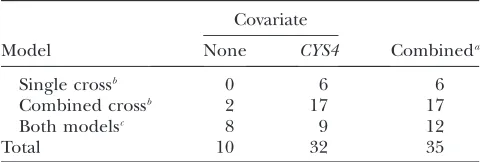
anal-ysis was conducted on all three pairs of crosses: MY–MS, MY–YS, and MS–YS, where M, Y, and S represent the M22, YPS163, and S288c parental strains. To conduct a linkage scan using data from two crosses, we normalized each set of phenotypes and recoded the genotypes to be biallelic. For example, the combined data from the M22–YPS163 (MY) and M22–S288c (MS) crosses were recoded such thatY¼Sto identify QTL caused by M22-specific alleles (Figure 1B). UsingCYS4as a covariate, the combined-cross analysis identified 26 unique QTL. The 26 QTL include 9 of the 15 QTL identified in the single-cross analysis as well as another 17 new QTL (Table 1). Together, the four QTL mapping models
identified 35 unique QTL on the basis of 31 drug traits (Table 1 andTable S1).
QTL validation: Four QTL were selected for valida-tion using a set of 80, 76, and 87 new recombinant strains derived from the MY, MS, and YS crosses, re-spectively.CYS4was genotyped as a positive control and for the covariate analysis. Of the four QTL selected for validation, chromosome 4 (893,678 bp) was identified in both the single- and combined-cross analysis but was not found to be significant in any of the models that usedCYS4as a covariate; chromosome 12 (766,637 bp) was identified in only the combined cross usingCYS4as a covariate; and chromosome 14 (531,242 bp) and chromosome 16 (894,088 bp) was identified by all four linkage models.
Two of the four QTL, chromosome 14 (531,242 bp) and chromosome 16 (894,088 bp), were validated in the independent set of recombinant strains (Figure 2 and
Table S1). Drug 27 (aminoguanidine) showed a
signif-icant association with the chromosome 16 QTL in the MY cross (ANOVA,P¼0.0007). For the chromosome 14 QTL, Drugs 12 and 22 did not show a significant association in the YS cross, but Drug 31 (palmitoyl-dl
-carnitine) showed a significant association in the MY–YS combined-cross analysis with CYS4as a covariate (AN-OVA,P¼0.015; Figure 2). Although the chromosome 14 QTL affected sensitivity to Drug 31 but not to Drugs 12 and 22, subsequent experiments (see below) showed that MKT1, a gene within the QTL interval, affects sensitivity to both Drugs 12 and 22. The difference between the two validated and two false-positive QTL is unlikely to be caused by the type of linkage analysis; the two validated QTL were identified in both the single-and the combined-cross analysis with single-and withoutCYS4
as a covariate. However, the two false-positive QTL showed smaller (secondary) effects relative to the largest-effect (primary) QTL. The chromosome 4 QTL was identified in the MY cross and was secondary to the effects of
CYS4. The chromosome 12 QTL was identified in the MY–YS combined-cross analysis and was secondary to the validated chromosome 14 QTL.
TABLE 1
QTL identified by four linkage models
Covariate
Model None CYS4 Combineda
Single crossb 0 6 6
Combined crossb 2 17 17
Both modelsc 8 9 12
Total 10 32 35
a
Total number of unique QTL identified with or without
CYS4as a covariate.
b
QTL identified only in the single-cross or only in the com-bined-cross model; seematerials and methodsfor model
descriptions.
cQTL identified by both the single- and the combined-cross
models.
Figure2.—Validation of selected QTL in an
The false-positive QTL can be attributed to inappro-priate linkage models. Most linkage models do not control for the effects of multiple QTL segregating in a single cross. When sample sizes are small and the effects of a true QTL are large, false-positive associations can attain genomewide significance if genotypes at one locus are correlated with or shadow those at a true QTL. The false-positive chromosome 4 QTL is likely a shadow QTL caused by a chance correlation withCYS4
since the chromosome 4 QTL was identified only in models that lackedCYS4as a covariate. As expected for a shadow QTL, genotypes at the chromosome 4 QTL were significantly correlated with those at CYS4 (Pearson correlation,P¼0.0014) in the original but not in the replicated recombinant strains. Comparison of linkage with and without CYS4 as a covariate shows that the chromosome 4 QTL completely disappears whenCYS4
is used as a covariate and that another QTL appears on chromosome 16 (Figure 3).
To help eliminate potentially false-positive QTL, we removed all QTL with secondary effects to another primary QTL identified in the same linkage scan. After this filter, a total of 19 unique QTL remained. Three QTL occur at positions with known mutations: chromo-some 7 (789,201 bp) corresponds toCYS4, chromosome 4 (112,957 bp) corresponds toHO, and chromosome 5 (104,539 bp) corresponds toURA3. Of the remaining 16 QTL (Table 2), 12 were identified exclusively by linkage
analysis that usedCYS4as a covariate, 1 was exclusively identified withoutCYS4, and 3 were identified by both methods. Six QTL were exclusively identified by the combined-cross analysis, 6 others were exclusively iden-tified by the single-cross analysis, and 4 others were identified by both.
Pleiotropic and drug-specific QTL: QTL that cause resistance to different drugs and map to the same location can be explained by a single pleiotropic QTL or by two linked QTL. Because our marker interval is not dense enough to distinguish between these two possi-bilities (Knottand Haley 2000), we defined QTL as
being potentially pleiotropic if they were within the same marker interval or within 15 cM of one another. Three of the 16 QTL are potentially pleiotropic, in-volving sensitivity to between two and five drugs (Table 2). Interestingly, the QTL that correspond to known mutations in CYS4, URA3, and HO show extensive pleiotrophy as they were identified on the basis of linkage to 25, 7, and 5 drug-sensitivity phenotypes, respectively.
Cross-specific QTL and epistatic interactions with CYS4: Epistasis may be responsible for cross-specific QTL and QTL identified using CYS4 as a covariate. Since 15/16 QTL were all identified using CYS4 as a covariate, we tested each for interactions withCYS4.
Four QTL showed significant interactions withCYS4
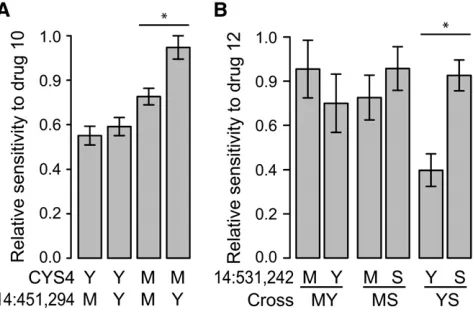
(ANOVA Bonferroni corrected P , 0.05, Table 2). Three of the four were exclusively identified in the single-cross analysis. These pairwise epistatic inter-actions can explain cross-specific QTL. For example, in the MY cross, the effect of the chromosome 14 (451,294 bp) QTL is observed only in combination with the M22 drug-sensitive allele of CYS4 (Figure 4A), providing an explanation for why it was detected in the MY but not in the YS cross.
Cross-specific QTL may also result from more com-plex, multilocus interactions present in one cross but not in another. Another possibility is that cross-specific QTL could be due to a QTL that has effects in two crosses, but due to power is significant in only one. To distinguish between these possibilities, we tested for cross-specific effects of a QTL in a combined-cross analysis (see materials and methods). Cross-specific
effects were identified if both sets of combined crosses showed an interaction between the effect of the QTL and the cross in which it was segregating. For example, if a QTL was detected in the MY cross, combined linkage analysis was performed on the MY1MS crosses and the MY1YS crosses. If the M-allele is sensitive and Y and S are resistant alleles, the MY1MS crosses should show no significant cross-by-QTL interaction term, whereas the MY1YS cross should show a significant interaction term because M and S are encoded (incorrectly) as being the same allele. Thus, the expected pattern in the absence of any background effects is a significant cross-specific term in one but not in both combined crosses. If both Figure3.—Linkage mapping withCYS4as a covariate
combined crosses showed a significant cross-by-QTL interaction term, we inferred that the difference be-tween the M and Y alleles is different from that bebe-tween the M and S alleles. The simplest explanation is that the effect of the M allele depends on genetic background. However, it is also possible that there are three QTL alleles such that the difference between the M and Y alleles is not the same as the difference between the M and S alleles.
Three of five QTL showed cross-specific effects in both combined-cross analyses (Table 2). Five of the 10 QTL that were identified in single crosses were not discernible because they were not significant in either of the combined-cross analyses with a cross-specific term. Two QTL showed results consistent with low power. One of the QTL showing cross-specific effects was the validated chromosome 14 QTL where the Y allele causes sensitivity in the YS cross but not in the MY cross (Figure 4B). The cross-specific effects of the Y allele may be due to complex epistasis since there is no simple epistatic interaction with CYS4. Another cross-specific QTL, chromosome 7 (886,487 bp), showed a marginally significant interaction withCYS4(P¼0.02, uncorrected for multiple tests) suggesting that this interaction may be responsible for the observed cross-specific effects (Table 2).
Three functionally distinct QTL alleles: QTL with cross-specific effects may in some cases be due to three different alleles in the three parental strains. Distin-guishing between epistasis and three alleles will ulti-mately require cloning the gene underlying a
cross-specific QTL. However, if the three alleles are suffi-ciently different from one another, then they should produce significant effects in all three crosses. One of the cross-specific QTL [chromosome 4 (512,797 bp), sensitivity to lithium chloride] showed evidence for three alleles on the basis of significantly different effects in all three crosses (Figure 5). While both the M and Y
TABLE 2
QTL with the highest LOD score in any single scan
Chromosome (bp) LODa Intervalb(kb) Drug Cross P(QTL3CYS4) Cross-specificd
2 (413,404) 5.1 367–460 1 MY-SY 0.46
4 (512,797) 6.9 482–520 3 All except MYc 0.074 Yes (MY, MS, YS)
4 (1,170,947) 5.5 1140–1224 29 MY 3.83106* NA
5 (265,654) 4.2 219–310 4 MS 0.23 NA
7 (886,487) 4.8 838–929 2 MY 0.021 Yes (MY)
8 (33,410) 4.8 1–81 21 MY 0.0014* NA
8 (479,987) 4.9 448–514 1 MY–MS 0.52
12 (461,183) 5.6 406–500 19 MY–MS 0.0059
13 (317,754) 5.3 287–546 4 MY–MS 0.055
14 (451,294) 5.1 407–476 10, 16 MY, MY–MS, MY–YS 4.13107* No (MY, YS) 14 (531,242) 3.9 429–569 12, 22 YSc, MY–YS, MS–YS 0.11 Yes (YS)
15 (181,894) 6.5 121–194 31 MY–MS 0.013
15 (381,869) 4.9 322–431 12 MY 0.022 NA
15 (642,515) 4.7 588–679 23 MY–YS 0.60
16 (382,638) 4.5 363–418 5, 15, 22, 24, 26 MY 0.00011* NA
16 (894,088) 6.3 860–922 27 MY, MY–YS 0.32 No (MY, YS)
*The significance of including an interaction term between the QTL andCYS4after Bonferroni correction is,0.05.
a
The maximum LOD for each unique QTL.
b
The intersection of pleiotropic QTL intervals defined by a 1.5-drop in LOD score, preferably from an individual cross.
c
QTL identified without covariate; all others were identified usingCYS4as a covariate.
d
The cross in parentheses indicates in which cross a QTL showed cross-specific effects. NA indicates that the test was not ap-plicable since cross-specific effects were not detected in either of the two combined cross analyses.
Figure4.—Examples of epistatic and cross-specific QTL.
alleles are sensitive relative to the S allele, the chromo-some 4 QTL also shows a significant effect in the MY cross alone. The 95% confidence interval from the posterior probability distribution of this QTL covers a 61-kb region on chromosome 4 that includes theENA
genes, which are P-type ATPases involved in the efflux of sodium and lithium ions and which vary in copy number among strains (Wielandet al.1995). Since the lab strain
has three tandemly repeatedENA genes, it is possible that the three alleles correspond to different alleles of
ENAand/or to differences inENAcopy number. MKT1 and AQY1 underlie cross-specific and drug-specific QTL:The validated chromosome 14 (531,242 bp) QTL covers an interval of 141 kb and includesMKT1. An S288c-specific amino acid change withinMKT1has been shown to affect high-temperature growth (Sinha et al.2006), sporulation efficiency (Deutschbauerand
Davis 2005), sensitivity to DNA damage (Demogines et al. 2008), and genomewide changes in gene ex-pression (Smith and Kruglyak 2008). Using a
re-ciprocal hemizygosity test (Steinmetzet al. 2002), we
found that the S288c allele of MKT1 also causes sensitivity to Drug 12, dipropyldopamine (t-test, P ¼
0.035), and Drug 22, phenylephrine (t-test,P¼0.047), and so is at least partially responsible for the chro-mosome 14 QTL (Figure 6A). This effect is absent in the presence of PPG, an inhibitor ofCYS3(Washtien
and Abeles1977) that phenocopies the M22 allele of CYS4 (Kim et al. 2009), which is consistent with the
absence of an effect in the MS cross where both the S288c allele of MKT1 and the M22 allele of CYS4
segregate (Figure 4B).
The validated chromosome 16 (894,088 bp) QTL covers a 62-kb interval and includesAQY1. AQY1is an aquaporin that mediates water transport across cell membranes and S288c carries an allele of AQY1 that fails to influence water transport and confers resistance to osmotic stress due to the combined effects of two amino acid mutations (Bonhivers et al. 1998). A
reciprocal hemizygosity test (Figure 6B) showed that YPS163 carries an allele ofAQY1that causes sensitivity to Drug 27, aminoguanidine (ANOVA,P¼0.00014), but not to Drugs 12 or 22. Interestingly, Figure 2 shows that the YPS163 allele is more resistant than that of M22 whereas Figure 6B shows that the YPS163 allele is more sensitive than that of S288c. These differences suggest the presence of three different alleles or two alleles with opposite effects that are dependent on the genetic background. Consistent with three functionally distinct alleles, there are three amino acid differences between the YPS163 and S288c alleles of AQY1, two of which (M121V and T255P) are functional in combination (Bonhivers et al. 1998), and there are three other
amino acid differences between the M22 and YPS163 alleles ofAQY1(R42K, V53A, and G226S). Alternatively, another gene in the QTL interval may also affect drug sensitivity.
DISCUSSION
Most quantitative traits are thought to be influenced by numerous genes of small effect. However, genes with small and/or background-dependent effects are much more difficult to identify than those of large effect and constitute a significant challenge to understanding the molecular basis of a trait. Using a combination of differ-ent mapping methods, we iddiffer-entified 16 QTL underlying sensitivity to 18 different pharmacological compounds. These QTL differ from a previously identified large-effect, multi-drug-sensitive allele ofCYS4(Kimand Fay
2007) in that their effects are smaller, drug-specific, and often background-dependent as a consequence of their interaction with CYS4 or the genetic background of the cross in which they segregate. Moreover, we identi-fied two genes underlying drug-specific effects:MKT1, involved in translational regulation (Lee et al. 2009),
andAQY1, a water channel protein (Laize´ et al.1999).
Our results highlight the diversity of molecular mech-anisms underlying variable drug responses.
Figure5.—A QTL on chromosome 4 shows evidence for
Using four mapping methods, we identified 35 unique QTL. However, a significant number are likely false positives due to shadow or ghost QTL that can arise due to chance correlations between a true QTL and an unlinked locus (Doergeand Churchill1996;
Cheverudet al.2004). When the true QTL has a large
effect, even a slight correlation with another locus can result in a significant association and a false-positive QTL unless the effects of the first QTL are included in the test for association. A number of statistical methods have been designed to eliminate these false positives either by conditioning on other markers in the genome ( Jansen1993; Zeng1993) or by conditional
permuta-tion tests (Doergeand Churchill1996). In our study,
the small sample size and large marker interval result in
considerable uncertainty in the location and the effect size of a QTL. To account for these uncertainties, we used the causal polymorphism within CYS4 as a cova-riate in the linkage analysis and we considered only primary QTL as candidates,i.e., the QTL with the largest effect in a single linkage scan. This approach reduced the number of unique QTL from 35 to 19. Although some true positives may have been eliminated, the validated QTL (Figure 2) and shadow QTL (Figure 3) suggest that many of the QTL that were eliminated were false positives. In addition to removing false positives, theCYS4covariate model increased the number of QTL identified. Fourteen of the 16 QTL shown in Table 2 were only identified by using CYS4 as a covariate, suggesting thatCYS4also obscured real associations at other loci.
Combined-cross analysis provides increased power and resolution due to larger sample sizes but also provides a means of identifying QTL with effects that depend on their genetic background (Li et al. 2005;
Blancet al.2006; Guoet al.2006; Jagodicand Olsson
2006; Malmanger et al. 2006). A number of lines of
evidence suggest that many of the drug-sensitivity QTL that we identified have effects that depend on their genetic background. First, 6 of the 16 QTL shown in Table 2 were identified only in the single-cross analysis despite the larger sample size and the lower FDR cutoff (5%vs.1%) used in the combined-cross analysis. Three of these QTL showed significant interactions withCYS4. This provides one explanation as to why they were identified in only a single cross; if the QTL is dependent onCYS4, its effects should be absent in a cross where the M22 allele of CYS4is not segregating. Second, in the combined-cross analysis, three of five cases that could be tested showed a significant interaction between the effect of the QTL and the cross in which it segregated. Although this type of epistasis is difficult to experimen-tally confirm, our results support the value of combined-cross analysis in identifying context-dependent QTL.
Most of the QTL showed drug-specific effects. Of the 16 QTL in Table 2, 13 showed significant associations with sensitivity to one drug. Although low statistical power may also contribute to this pattern, it is unlikely to account for all of the drug specificity. The two QTL that correspond to known mutations in URA3 and HO
showed effects similar to other drug-specific QTL but were found to be associated with seven and five drugs, respectively. The identification of QTL that correspond to mutations thought to be irrelevant to growth in rich medium is consistent with previous studies (Bremet al.
2002; Perlstein et al. 2007) and provides further
evidence that deficiencies may often have pervasive yet subtle effects (Hillenmeyeret al.2008).
The identification ofMKT1andAQY1highlights the diversity of molecular mechanisms by which cells are made drug sensitive.MKT1was first identified as a gene required for maintenance of the K2 killer toxin through Figure6.—MKT1andAQY1underlie two validated QTL.
propagation of satellite double-stranded RNA of an L-A virus (Wickner 1980, 1987). Mktp has been shown
to involved in post-transcriptional regulation of HO
(Tadauchi et al.2004) and in Puf3p-dependent
regu-lation of cytoplasmic processing bodies (P-bodies) (Lee et al. 2009). An amino acid polymorphism (G30D) within MKT1 has been shown to influence high-tem-perature growth (Steinmetz et al. 2002), sporulation
efficiency (Deutschbauerand Davis2005), cell
mor-phology (Nogami et al. 2007), sensitivity to DNA
damage (Demogines et al. 2008), the frequency of
petite mutants (Dimitrovet al.2009), and the
expres-sion of numerous genes (Smithand Kruglyak2008).
We found MKT1 affects sensitivity to the dipropyldo-pamine (Drug 12), a dodipropyldo-pamine agonist. In humans, catechol-O-methyltransferase transfers a methyl group fromS-adenosylmethionine to the catechol group of a variety of compounds (Ma¨ nnisto¨and Kaakkola1999).
The dependence of catecholamine metabolism on S -adenosylmethionine may explain why the effects of
MKT1are dependent on the M22 allele ofCYS4, which inhibits the cysteine/methionine biosynthesis pathway and upregulates S-adenosylmethionine (Kim et al.
2009).
AQY1 encodes an aquaporin that transports water across cell membranes (Bonhivers et al. 1998) and
improves freeze tolerance in vegetative cells (Tanghe et al.2002, 2004) but inhibits freeze tolerance in spores (Sidoux-Walteret al.2004). Recently, aquaporins have
been shown to also conduct other small molecules, such as carbon dioxide, nitric oxide, and ammonia (Wuand
Beitz2007). Mutations inAQY1increase permeability
to ammonia and methylamine by enlarging the central aromatic/arginine restriction within the water channel (Beitz et al.2006). This raises the possibility that the
amino acid differences between the YPS163 and S288c alleles ofAQY1affect the permeability of the cell wall to aminoguanidine (CH6N4), which is only slightly larger than methylamine (CH3NH2). However, it is also possi-ble that a reduction in water permeability indirectly affects sensitivity to aminoguanidine, an inhibitor of advanced glycosylation end products (Nilsson1999).
In addition to MKT1 and AQY1, other genes may contribute to the chromosome 14 (531,242 bp) and chromosome 16 (894,088 bp) QTL.MKT1occurs in a QTL hotspot; nine quantitative trait genes have been identified within a 60-kb region on chromosome 14 (Steinmetzet al.2002; Ben-Ariet al.2006; Hecket al.
2006; Dimitrovet al. 2009). Five of the genes, MKT1, END3,SAL1,PMS1, andSWS2, span a 10-kb region and are adjacent to one another. The other three genes,RAS2,
RHO2, andFKH2, lie 10–25 kb upstream or downstream of the five adjacent genes.END3andRHO2affect high-temperature growth (Steinmetz et al. 2002); RAS2, PMS1, SWS2, and FKH2 affect sporulation efficiency (Ben-Ariet al.2006);SAL1affects the frequency of petite
mutants (Dimitrov et al. 2009); and PMS1 affects the
sensitivity to DNA damage (Hecket al.2006). Thus, it is
quite plausible that one or more of these genes also influences drug sensitivity. Interestingly, the chromo-some 14 (531,242 bp) QTL interval includes all of the genes in the QTL hotspot. Although no other quantita-tive trait genes have been found nearAQY1, our results do not exclude this possibility.
In summary, our results support a model whereby drug sensitivity is often mediated by an interaction among multiple genes, including those with both multi-drug-sensitive and drug-specific effects. This model is supported by a substantial number of drug-sensitivity QTL with CYS4-dependent and cross-specific effects. The prevalence of these interactions within the context of an entire population is relevant to identifying the molecular basis of pharmacogenetic variation in hu-mans and has significant implications for the complex-ity of treatment through personalized medicine.
This work was supported by a Kauffman Fellowship to H.S.K. and by a grant from the National Institutes of Health (GM-080669) to J.C.F.
LITERATURE CITED
Baetz, K., L. McHardy, K. Gable, T. Tarling, D. Reberiouxet al., 2004 Yeast genome-wide drug-induced haploinsufficiency screen to determine drug mode of action. Proc. Natl. Acad. Sci. USA101:4525–4530.
Balzi, E., and A. Goffeau, 1995 Yeast multidrug resistance: the PDR network. J. Bioenerg. Biomembr.27:71–76.
Barreto, L., A. Garcera´, K. Jansson, P. Sunnerhagenand E. Herrero, 2006 A peroxisomal glutathione transferase of Saccharomyces cerevisiaeis functionally related to sulfur amino acid metabolism. Eukaryot. Cell5:1748–1759.
Beitz, E., B. Wu, L. M. Holm, J. E. Schultz and T. Zeuthen, 2006 Point mutations in the aromatic/arginine region in aqua-porin 1 allow passage of urea, glycerol, ammonia, and protons. Proc. Natl. Acad. Sci. USA103:269–274.
Ben-Ari, G., D. Zenvirth, A. Sherman, L. David, M. Klutsteinet al., 2006 Four linked genes participate in controlling sporulation efficiency in budding yeast. PLoS Genet.2:e195.
Blanc, G., A. Charcosset, B. Mangin, A. Gallaisand L. Moreau, 2006 Connected populations for detecting quantitative trait loci and testing for epistasis: an application in maize. Theor. Appl. Genet.113:206–224.
Bleibel, W. K., S. Duan, R. S. Huang, E. O. Kistner, S. J. Shukla
et al., 2009 Identification of genomic regions contributing to etoposide-induced cytotoxicity. Hum. Genet.125:173–180. Bonhivers, M., J. M. Carbrey, S. J. Gould and P. Agre,
1998 Aquaporins in Saccharomyces. Genetic and functional distinctions between laboratory and wild-type strains. J. Biol. Chem.273:27565–27572.
Brem, R., G. Yvert, R. Clintonand L. Kruglyak, 2002 Genetic dis-section of transcriptional regulation in budding yeast. Science 296:752–755.
Brem, R., J. Storey, J. Whittleand L. Kruglyak, 2005 Genetic in-teractions between polymorphisms that affect gene expression in yeast. Nature436:701–703.
Broman, K., H. Wu, S. Senand G. Churchill, 2003 R/qtl: QTL mapping in experimental crosses. Bioinformatics19:889–890. Cheverud, J. M., T. H. Ehrich, T. Hrbek, J. P. Kenney, L. S. Pletscher
et al., 2004 Quantitative trait loci for obesity- and diabetes-related traits and their dietary responses to high-fat feeding in LGXSM recombinant inbred mouse strains. Diabetes53:3328–3336. Choy, E., R. Yelensky, S. Bonakdar, R. M. Plenge, R. Saxenaet al.,
Decottignies, A., and A. Goffeau, 1997 Complete inventory of the yeast ABC proteins. Nat. Genet.15:137–145.
Demogines, A., E. Smith, L. Kruglyak and E. Alani, 2008 Identification and dissection of a complex DNA repair sensitivity phenotype in Baker’s yeast. PLoS Genet.4:e1000123. Deutschbauer, A. M., and R. W. Davis, 2005 Quantitative trait loci mapped to single-nucleotide resolution in yeast. Nat. Genet.37: 1333–1340.
Dimitrov, L. N., R. B. Brem, L. Kruglyakand D. E. Gottschling, 2009 Polymorphisms in multiple genes contribute to the spon-taneous mitochondrial genome instability ofSaccharomyces cerevi-siaeS288C strains. Genetics183:365–383.
Doerge, R. W., and G. A. Churchill, 1996 Permutation tests for multiple loci affecting a quantitative character. Genetics 142: 285–294.
Dolan, M. E., K. G. Newbold, R. Nagasubramanian, X. Wu, M. J. Ratainet al., 2004 Heritability and linkage analysis of sensitivity to cisplatin-induced cytotoxicity. Cancer Res.64:4353–4356. Duan, S., W. K. Bleibel, R. S. Huang, S. J. Shukla, X. Wuet al.,
2007 Mapping genes that contribute to daunorubicin-induced cytotoxicity. Cancer Res.67:5425–5433.
Evans, W. E., and J. A. Johnson, 2001 Pharmacogenomics: the in-herited basis for interindividual differences in drug response. An-nu. Rev. Genomics Hum. Genet.2:9–39.
Evans, W. E., and H. L. McLeod, 2003 Pharmacogenomics: drug disposition, drug targets, and side effects. N. Engl. J. Med.348: 538–549.
Gerke, J., K. Lorenzand B. Cohen, 2009 Genetic interactions be-tween transcription factors cause natural variation in yeast. Sci-ence323:498–501.
Giaever, G., P. Flaherty, J. Kumm, M. Proctor, C. Nislowet al., 2004 Chemogenomic profiling: identifying the functional in-teractions of small molecules in yeast. Proc. Natl. Acad. Sci. USA101:793–798.
Gottesman, M., T. Fojoand S. Bates, 2002 Multidrug resistance in cancer: role of ATP-dependent transporters. Nat. Rev. Cancer2: 48–58.
Guo, B., D. A. Sleper, J. Sun, H. T. Nguyen, P. R. Arelliet al., 2006 Pooled analysis of data from multiple quantitative trait lo-cus mapping populations. Theor. Appl. Genet.113:39–48. Hayes, J. D., J. U. Flanaganand I. R. Jowsey, 2005 Glutathione
transferases. Annu. Rev. Pharmacol. Toxicol.45:51–88. Heck, J. A., J. L. Argueso, Z. Gemici, R. G. Reeves, A. Bernardet al.,
2006 Negative epistasis between natural variants of the Saccha-romyces cerevisiae MLH1andPMS1genes results in a defect in mis-match repair. Proc. Natl. Acad. Sci. USA103:3256–3261. Hillenmeyer, M. E., E. Fung, J. Wildenhain, S. E. Pierce, S. Hoon
et al., 2008 The chemical genomic portrait of yeast: uncovering a phenotype for all genes. Science320:362–365.
Huang, R. S., S. Duan, W. K. Bleibel, E. O. Kistner, W. Zhanget al., 2007 A genome-wide approach to identify genetic variants that contribute to etoposide-induced cytotoxicity. Proc. Natl. Acad. Sci. USA104:9758–9763.
Ingelman-Sundberg, M., S. C. Sim, A. Gomezand C. Rodriguez -Antona, 2007 Influence of cytochrome P450 polymorphisms on drug therapies: pharmacogenetic, pharmacoepigenetic and clinical aspects. Pharmacol. Ther.116:496–526.
Jagodic, M., and T. Olsson, 2006 Combined-cross analysis of ge-nome-wide linkage scans for experimental autoimmune enceph-alomyelitis in rat. Genomics88:737–744.
Jansen, R. C., 1993 Interval mapping of multiple quantitative trait loci. Genetics135:205–211.
Katz, D. A., and A. Bhathena, 2009 Overview of pharmacoge-netics. Curr. Protoc. Hum. Genet.60:9.19.1–9.19.23.
Kim, H. S., and J. C. Fay, 2007 Genetic variation in the cysteine bio-synthesis pathway causes sensitivity to pharmacological com-pounds. Proc. Natl. Acad. Sci. USA104:19387–19391. Kim, H. S., J. Huhand J. C. Fay, 2009 Dissecting the pleiotropic
con-sequences of a quantitative trait nucleotide. FEMS Yeast Res.9: 713–722.
Knott, S. A., and C. S. Haley, 2000 Multitrait least squares for quantitative trait loci detection. Genetics156:899–911. Koepsell, H., 2004 Polyspecific organic cation transporters: their
functions and interactions with drugs. Trends Pharmacol. Sci. 25:375–381.
Kuchler, K., and J. Thorner, 1992 Functional expression of hu-man mdr1 in the yeastSaccharomyces cerevisiae. Proc. Natl. Acad. Sci. USA89:2302–2306.
Laize´, V., R. Gobin, G. Rousselet, C. Badier, S. Hohmannet al., 1999 Molecular and functional study ofAQY1from Saccharomy-ces cerevisiae: role of the C-terminal domain. Biochem. Biophys. Res. Commun.257:139–144.
Lazarou, J., B. H. Pomeranzand P. N. Corey, 1998 Incidence of adverse drug reactions in hospitalized patients: a meta-analysis of prospective studies. J. Am. Med. Assoc.279:1200–1205. Lee, S., A. M. Dudley, D. Drubin, P. A. Silver, N. J. Kroganet al.,
2009 Learning a prior on regulatory potential from eQTL data. PLoS Genet.5:e1000358.
Li, R., M. Lyons, H. Wittenburg, B. Paigenand G. Churchill, 2005 Combining data from multiple inbred line crosses im-proves the power and resolution of quantitative trait loci map-ping. Genetics169:1699–1709.
Lum, P., C. Armour, S. Stepaniants, G. Cavet, M. Wolf et al., 2004 Discovering modes of action for therapeutic compounds using a genome-wide screen of yeast heterozygotes. Cell 116: 121–137.
Malmanger, B., M. Lawler, S. Coulombe, R. Murray, S. Cooper
et al., 2006 Further studies on using multiple-cross mapping (MCM) to map quantitative trait loci. Mamm. Genome 17: 1193–1204.
Ma¨ nnisto¨, P. T., and S. Kaakkola, 1999 Catechol-O-methyltransfer-ase (COMT): biochemistry, molecular biology, pharmacology, and clinical efficacy of the new selective COMT inhibitors. Phar-macol. Rev.51:593–628.
Moye-Rowley, W. S., 2005 Retrograde regulation of multidrug re-sistance inSaccharomyces cerevisiae. Gene354:15–21.
Nilsson, B. O., 1999 Biological effects of aminoguanidine: an up-date. Inflamm. Res.48:509–515.
Nogami, S., Y. Ohyaand G. Yvert, 2007 Genetic complexity and quantitative trait loci mapping of yeast morphological traits. PLoS Genet.3:e31.
Perlstein, E. O., D. M. Ruderfer, G. Ramachandran, S. J. Haggarty, L. Kruglyak et al., 2006 Revealing complex traits with small molecules and naturally recombinant yeast strains. Chem. Biol. 13:319–327.
Perlstein, E. O., D. M. Ruderfer, D. C. Roberts, S. L. Schreiber and L. Kruglyak, 2007 Genetic basis of individual differences in the response to small-molecule drugs in yeast. Nat. Genet.39: 496–502.
Shah, R. R., 2006 Can pharmacogenetics help rescue drugs with-drawn from the market? Pharmacogenomics7:889–908. Shukla, S. J., S. Duan, X. Wu, J. A. Badner, K. Kasza et al.,
2009 Whole-genome approach implicates CD44 in cellular re-sistance to carboplatin. Hum. Genomics3:128–142.
Sidoux-Walter, F., N. Petterssonand S. Hohmann, 2004 The
Saccharomyces cerevisiaeaquaporin Aqy1 is involved in sporulation. Proc. Natl. Acad. Sci. USA101:17422–17427.
Sinha, H., B. P. Nicholson, L. M. Steinmetzand J. H. McCusker, 2006 Complex genetic interactions in a quantitative trait locus. PLoS Genet.2:e13.
Sinha, H., L. David, R. C. Pascon, S. Clauder-Mu¨ nster, S. Krishnakumaret al., 2008 Sequential elimination of major-effect contributors identifies additional quantitative trait loci condition-ing high-temperature growth in yeast. Genetics180:1661–1670. Smith, E. N., and L. Kruglyak, 2008 Gene-environment
interac-tion in yeast gene expression. PLoS Biol.6:e83.
Steinmetz, L. M., H. Sinha, D. R. Richards, J. I. Spiegelman, P. J. Oefneret al., 2002 Dissecting the architecture of a quantitative trait locus in yeast. Nature416:326–330.
Tadauchi, T., T. Inada, K. Matsumoto and K. Irie, 2004 Posttranscriptional regulation ofHOexpression by the Mkt1-Pbp1 complex. Mol. Cell. Biol.24:3670–3681.
Tanghe, A., D. P. Van, F. Dumortier, A. Teunissen, S. Hohmannet al., 2002 Aquaporin expression correlates with freeze tolerance in baker’s yeast, and overexpression improves freeze tolerance in in-dustrial strains. Appl. Environ. Microbiol.68:5981–5989. Tanghe, A., P. Van Dijck, D. Colavizza and J. M. Thevelein,
Wach, A., A. Brachat, R. Po¨ hlmannand P. Philippsen, 1994 New heterologous modules for classical or PCR-based gene disrup-tions inSaccharomyces cerevisiae. Yeast10:1793–1808.
Washtien, W., and R. H. Abeles, 1977 Mechanism of inactivation of gamma-cystathionase by the acetylenic substrate analogue propargylglycine. Biochemistry16:2485–2491.
Watters, J. W., A. Kraja, M. A. Meucci, M. A. Provinceand H. L. McLeod, 2004 Genome-wide discovery of loci influencing chemo-therapy cytotoxicity. Proc. Natl. Acad. Sci. USA101:11809–11814. Wickner, R. B., 1980 Plasmids controlled exclusion of the K2 killer
double-stranded RNA plasmid of yeast. Cell21:217–226. Wickner, R. B., 1987 MKT1, a nonessentialSaccharomyces cerevisiae
gene with a temperature-dependent effect on replication of M2 double-stranded RNA. J. Bacteriol.169:4941–4945. Wieland, J., A. M. Nitsche, J. Strayle, H. Steinerand H. K. Rudolph,
1995 The PMR2 gene cluster encodes functionally distinct isoforms of a putative Na1pump in the yeast plasma membrane. EMBO J.14:3870–3882.
Wolfger, H., Y. M. Mamnunand K. Kuchler, 2001 Fungal ABC proteins: pleiotropic drug resistance, stress response and cellular detoxification. Res. Microbiol.152:375–389.
Wolfger, H., Y. M. Mamnun and K. Kuchler, 2004 The yeast Pdr15p ATP-binding cassette (ABC) protein is a general stress re-sponse factor implicated in cellular detoxification. J. Biol. Chem. 279:11593–11599.
Wu, B., and E. Beitz, 2007 Aquaporins with selectivity for uncon-ventional permeants. Cell. Mol. Life Sci.64:2413–2421. Zeng, Z. B., 1993 Theoretical basis for separation of multiple linked
gene effects in mapping quantitative trait loci. Proc. Natl. Acad. Sci. USA90:10972–10976.
Supporting Information
http://www.genetics.org/cgi/content/full/genetics.109.108068/DC1
A Combined-Cross Analysis Reveals Genes With Drug-Specific
and Background-Dependent Effects on Drug Sensitivity in
Saccharomyces cerevisiae
Hyun Soek Kim and Justin C. Fay
H. S. Kim and J. C. Fay 2 SI
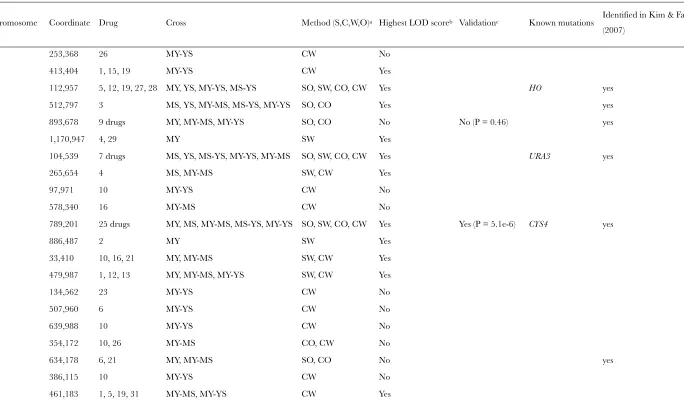
TABLE S1
Complete list of 35 unique QTL identified using any of the four linkage models
Chromosome Coordinate Drug Cross Method (S,C,W,O)a Highest LOD scoreb Validationc Known mutations Identified in Kim & Fay
(2007)
2 253,368 26 MY-YS CW No
2 413,404 1, 15, 19 MY-YS CW Yes
4 112,957 5, 12, 19, 27, 28 MY, YS, MY-YS, MS-YS SO, SW, CO, CW Yes HO yes
4 512,797 3 MS, YS, MY-MS, MS-YS, MY-YS SO, CO Yes yes
4 893,678 9 drugs MY, MY-MS, MY-YS SO, CO No No (P = 0.46) yes
4 1,170,947 4, 29 MY SW Yes
5 104,539 7 drugs MS, YS, MS-YS, MY-YS, MY-MS SO, SW, CO, CW Yes URA3 yes
5 265,654 4 MS, MY-MS SW, CW Yes
6 97,971 10 MY-YS CW No
7 578,340 16 MY-MS CW No
7 789,201 25 drugs MY, MS, MY-MS, MS-YS, MY-YS SO, SW, CO, CW Yes Yes (P = 5.1e-6) CYS4 yes
7 886,487 2 MY SW Yes
8 33,410 10, 16, 21 MY, MY-MS SW, CW Yes
8 479,987 1, 12, 13 MY, MY-MS, MY-YS SW, CW Yes
10 134,562 23 MY-YS CW No
10 507,960 6 MY-YS CW No
10 639,988 10 MY-YS CW No
11 354,172 10, 26 MY-MS CO, CW No
11 634,178 6, 21 MY, MY-MS SO, CO No yes
12 386,115 10 MY-YS CW No
H. S. Kim and J. C. Fay 3 SI
12 505,525 15 MY-YS CW No
12 766,637 12, 27 MY-YS, MS-YS CW No No (P = 0.93)
12 861,030 24 MS, MY-MS SW, CW No
13 91,118 10 MY-YS CW No
13 317,754 4 MY-MS CW Yes
13 370,679 2 MY SW No
14 451,294 10, 16 MY, MY-MS, MY-YS SW, CW Yes
14 531,242 12, 22, 31 YS, MY-YS, MS-YS SO, CO, CW Yes Yes (P* = 0.015) yes
15 181,894 11, 31 MY-MS CO, CW Yes
15 381,869 12 MY SW Yes
15 642,515 23 MY-YS CW Yes
16 382,638 5, 15, 22, 24, 26 MY SW Yes
16 486,321 10, 12 MY SW No
16 894,088 27 MY, MY-YS SO, SW, CO, CW Yes Yes (P = 7.00e-4) yes
a S: Individual cross, C: combined cross, W: with CYS4 as a covariate, O: without CYS4 as a covariate.
b QTL has the highest LOD score in the linkage scan.