Volume 2008, Article ID 217373,13pages doi:10.1155/2008/217373
Research Article
Sequential Monte Carlo Methods for Joint Detection and
Tracking of Multiaspect Targets in Infrared Radar Images
Marcelo G. S. Bruno, Rafael V. Ara ´ujo, and Anton G. Pavlov
Instituto Tecnol´ogico de Aeron´autica, S˜ao Jos´e dos Campos, SP 12228, Brazil
Correspondence should be addressed to Marcelo G. S. Bruno,[email protected]
Received 30 March 2007; Accepted 7 August 2007
Recommended by Yvo Boers
We present in this paper a sequential Monte Carlo methodology for joint detection and tracking of a multiaspect target in im-age sequences. Unlike the traditional contact/association approach found in the literature, the proposed methodology enables integrated, multiframe target detection and tracking incorporating the statistical models for target aspect, target motion, and background clutter. Two implementations of the proposed algorithm are discussed using, respectively, a resample-move (RS) par-ticle filter and an auxiliary parpar-ticle filter (APF). Our simulation results suggest that the APF configuration outperforms slightly the RS filter in scenarios of stealthy targets.
Copyright © 2008 Marcelo G. S. Bruno et al. This is an open access article distributed under the Creative Commons Attribution License, which permits unrestricted use, distribution, and reproduction in any medium, provided the original work is properly cited.
1. INTRODUCTION
This paper investigates the use of sequential Monte Carlo fil-ters [1] for joint multiframe detection and tracking of ran-domly changing multiaspect targets in a sequence of heavily cluttered remote sensing images generated by an infrared air-borne radar (IRAR) [2]. For simplicity, we restrict the discus-sion primarily to a single target scenario and indicate briefly how the proposed algorithms could be modified for multi-object tracking.
Most conventional approaches to target tracking in im-ages [3] are based on suboptimal decoupling of the detection and tracking tasks. Given a reference target template, a two-dimensional (2D) spatial matched filter is applied to a single-frame of the image sequence. The pixel locations where the output of the matched filter exceeds a pre-specified threshold are treated then as initial estimates of the true position of de-tected targets. Those preliminary position estimates are sub-sequently assimilated into a multiframe tracking algorithm, usually a linearized Kalman filter, or alternatively discarded as false alarms originating from clutter.
Depending on its level of sophistication, the spatial matched filter design might or might not take into account the spatial correlation of the background clutter and random distortions of the true target aspect compared to the
refer-ence template. In any case, however, in a scenario with dim targets in heavily cluttered environments, the suboptimal as-sociation of a single-frame matched filter detector and a mul-tiframe linearized tracking filter is bound to perform poorly [4].
algorithm, was later proposed in [4]. Furthermore, we also proposed in [4] an alternative tracker based on particle fil-tering [1,8] which, contrary to the original HMM tracker in [7], assumed a continuous-valued kinematic (position and velocity) state and a discrete-valued target aspect state. How-ever, the particle filter algorithm in [4] enabled tracking only (assuming that the target was always present in all frames) and used decoupled statistically independent models for tar-get motion and tartar-get aspect.
To better capture target motion, we drop in this paper the previous constraint in [5–7] and, as in the later sections of [4], allow the unknown 2D position and velocity of the target to be continuous-valued random variables. The un-known target aspect is still modeled however as a discrete random variable defined on a finite setI, where each sym-bol is a pointer to a possibly rotated, scaled, and/or sheared version of the target’s reference template. In order to inte-grate detection and tracking, building on our previous HMM work in [7], we extend the setI to include an additional dummy state that represents the absence of a target of interest in the scene. The evolution over time of the target’s kinematic and aspect states is described then by acoupledstochastic dy-namic model where the sequences of target positions, veloc-ities, and aspects aremutually dependent.
Contrary to alternative feature-based trackers in the liter-ature, the proposed algorithm in this paper detects and tracks the target directly from the raw sensor images, processing pixel intensities only. The clutter-free target image is modeled by a nonlinear function that maps a given target centroid po-sition into a spatial distribution of pixels centered around the (quantized) centroid position, with shape and intensity being dependent on the current target aspect. Finally, the target is superimposed to a structured background whose spatial cor-relation is captured by a noncausal Gauss-Markov random field (GMRf) model [9–11]. The GMRf model parameters are adaptively estimated from the observed data using an ap-proximate maximum likelihood (AML) algorithm [12].
Given the problem setup described in the previous pa ragraph, the optimal solution to the integrated detection/ tracking problem requires the recursive computation at each framenof the joint posterior distribution of the target’s kine-matic and aspect states conditioned on all observed frames from instant 0 up to instantn. Given, however, the inherent nonlinearity of the observation and (possibly) motion mod-els, the exact computation of that posterior distribution is generally not possible. We resort then to mixed-state parti-cle filtering [13] to represent the joint posterior by a set of weighted samples (or particles) such that, as the number of particles goes to infinity, their weighted average converges (in some statistical sense) to the desired minimum mean-square error (MMSE) estimate of the hidden states. Following a se-quential importance sampling (SIS) [14] approach, the par-ticles may be drawn recursively from the coupled prior statis-tical model for target motion and aspect, while their respec-tive weights may be updated recursively using a likelihood function that takes into account the models for the target’s signature and for the background clutter.
We propose two different implementations for the mixed-state particle filter detector/tracker. The first
imple-mentation, which was previously discussed in a conference paper (see [15]) is a resample-move (RS) filter [16] that uses particle resampling [17] followed by a Metropolis-Hastings move step [18] to combat both particle degeneracy and par-ticle impoverishment (see [8]). The second implementation, which was not included in [15], is an auxiliary particle filter (APF) [19] that uses the current observed frame at instantn to preselect those particles at instantn−1 which, when prop-agated through the prior dynamic model, are more likely to generate new samples with high likelihood. Both algorithms are original with respect to the previous particle filtering-based tracking algorithm that we proposed in [4], where the problem of joint detection and tracking with coupled motion and aspect models was not considered.
Related work and different approaches in the literature
Following the seminal work by Isard and Blake [20], parti-cle filters have been extensively applied to the solution of vi-sual tracking problems. In [21], a sequential Monte Carlo al-gorithm is proposed to track an object in video subject to model uncertainty. The target’s aspect, although unknown, is assumed, however, to be fixed in [21], with no dynamic aspect change. On the other hand, in [22], an adaptive ap-pearance model is used to specify a time-varying likelihood function expressed as a Gaussian mixture whose parameters are updated using the EM [23] algorithm. As in our work, the algorithm in [22] also processes image intensities di-rectly, but, unlike our problem setup, the observation model in [22] does not incorporate any information about spatial correlation of image pixels, treating instead each pixel as in-dependent observations. A different Bayesian algorithm for tracking nonrigid (randomly deformable) objects in three-dimensional images using multiple conditionally indepen-dent cues is presented in [24]. Dynamic object appearance changes are captured by a mixed-state shape model [13] con-sisting of a discrete-valued cluster membership parameter and a continuous-valued weight parameter. A separate kine-matic model is used in turn to describe the temporal evolu-tion of the object’s posievolu-tion and velocity. Unlike our work, the kinematic model in [24] is assumed statistically indepen-dent of the aspect to model.
Rather than investigating solutions to the problem of multiaspect tracking of a single target, several recent ref-erences, for example, [25, 26], use mixture particle filters to tackle the different but related problem of detecting and tracking an unknown number of multiple objects with dif-ferent but fixed appearance. The number of terms in the nonparametric mixture model, that represents the posterior of the unknowns, is adaptively changed as new objects are detected in the scene and initialized with a new associated observation model. Likewise, the mixture weights are also recursively updated from frame to frame in the image se-quence.
Organization of the paper
for target aspect and motion and review the observation and clutter models focusing on the GMRf representation of the background and the derivation of the associated likeli-hood function for the observed (target + clutter) image. In Section 3, we detail the proposed detector/tracker in the RS and APF configurations. The performance of the two filters is discussed in Section 4using simulated infrared airborne radar (IRAR) data. A preliminary discussion on multitarget tracking is found inSection 5, followed by an illustrative ex-ample with two targets. Finally, we present inSection 6the conclusions of our work.
2. THE MODEL
In the sequel, we present the target and clutter models that are used in this paper. We use lowercase letters to denote both random variables/vectors and realizations (samples) of ran-dom variables/vectors; the proper interpretation is implied in context. We use lowercase p to denote probability den-sity functions (pdfs) and uppercasePto denote the probabil-ity mass functions (pmfs) of discrete random variables. The symbol Pr(A) is used to denote the probability of an eventA in theσ-algebra of the sample space.
State variables
Letnbe a nonnegative integer number and let superscript T denote the transpose of a vector or matrix. The kine-matic state of the target at framenis defined as the four-dimensional continuous (real-valued) random vector sn = [xn xn˙ yn yn˙ ]T, that collects the positions,xnandyn, and the velocities, ˙xnand ˙yn, of the target’s centroid in a system of 2D Cartesian coordinates (x,y). On the other hand, the target’s aspect state at framen, denoted byzn, is assumed to be a discrete random variable that takes values in the finite setI= {0, 1, 2, 3,. . .,K}, where the symbol “0” is a dummy state that denotes that the target is absent at framen, and each symboli,i=1,. . .,K, is in turn a pointer to one possi-bly rotated, scaled, and/or sheared version of the target’s ref-erence template.
2.1. Target motion and aspect models
The random sequence{(sn,zn)},n≥ 0, is modeled as first-order Markov process specified by the pdf of the initial kine-matic state p(s0), the transition pdf p(sn | zn,sn−1,zn−1), the transition probabilities Pr({zn =i} | {zn−1 = j},sn−1), (i,j)∈I×I, and the initial probabilities Pr({z0=i}),i∈I.
Aspect change model
Assume that, at any given frame, for any aspect statezn, the clutter-free target image lies within a bounded rectangle of size (ri+rs+ 1)×(li+ls+ 1). In this notation,riandrs de-note the maximum pixel distances in the target image when we move away, respectively, up and down, from the target centroid. Analogously,li andlsare the maximum horizon-tal pixel distances in the target image when we move away, respectively, left and right, from the target centroid.
Assume also that each image frame has the size ofL×M pixels. We introduce next theextended gridL = {(r,j) :−rs+ 1≤r ≤L+ri,−ls+ 1≤j≤M+li}that contains all possible target centroid locations for which at least one target pixel still lies in the sensor image. Next, letGbe a matrix of size K×Ksuch thatG(i,j)≥0 for anyi,j=1, 2,. . .,Kand
K
i=1
G(i,j)=1 ∀j=1,. . .,K. (1)
Assuming that a transition from a “present target” state to the “absent target” state can only occur when the target moves out of the image, we model the probability of a change in the target’s aspect from the state j to the statei, Pr({zn = i} | {zn−1=j},sn−1), as
G(i,j)Prs∗n ∈L
|sn−1,
zn−1= j, i,j=1,. . .,K,
1−Prs∗n ∈L|sn−1,zn−1= j, i=0, j /=0, pa
K, i /=0, j=0, 1−pa, i=0, j=0,
(2)
where the two-dimensional vectors∗n =(x∗n,yn∗) denotes the quantized target centroid position defined on the extended image grid and obtained from the four-dimensional contin-uous kinematic statesnby making
x∗n =round
xn ζ1
,
y∗n =round
yn
ζ2 ,
(3)
whereζ1andζ2are the spatial resolutions of the image, re-spectively, in the directions x and y. The parameter pa in (2) denotes in turn the probability of a new target enter-ing the image once the previous target became absent. For simplicity, we restrict the discussion in this paper to the sit-uation where there is at most one single target of interest present in the scene at each image frame. The specification Pr({zn=i} | {zn−1=0},sn−1)= pa/K,i=1,. . .,K, corre-sponds to assuming the worst-case scenario where, given that a new target entered the scene, there is a uniform probability that the target will take any of theK possible aspect states. Finally, the term 1−Pr({s∗n ∈L} | sn−1,{zn−1=j}) in (2) is the probability of a target moving out of the image at frame ngiven its kinematic and aspect states at framen−1.
Motion model
For simplicity, we assume that, except in the situation where there is a transition from the “absent target” state to the “present target” state, the conditional pdf p(sn | zn,sn−1,zn−1) is independent of the current and previous as-pect states, resas-pectively,znandzn−1. In other words, unless zn−1=0 andzn=/ 0, we make
where fs(sn|sn−1) is an arbitrary pdf (not necessarily Gaus-sian) that models the target motion. Otherwise, ifzn−1 =0 andzn=/0, we reset the target’s position and make
psn|zn,sn−1,zn−1= f0
sn
, (5)
where f0(sn) is typically a noninformative (e.g., uniform) prior pdf defined in a certain region (e.g., upper-left corner) of the image grid. Given the independence assumption in (4), it follows that, for anyj=1,. . .,K,
Prs∗n ∈L
|sn−1,
zn−1=j=
{sn|s∗n∈L}
fssn|sn−1dsn.
(6)
2.2. Observation model and likelihood function
Next, we discuss the target observation model. Previous ref-erences mentioned inSection 1, for example, [21,22,24–26], are concerned mostly with video surveillance of near objects (e.g., pedestrian or vehicle tracking), or other similar appli-cations (e.g., face tracking in video). For that class of applica-tions, effects such as object occlusion are important and must be explicitly incorporated into the target observation model. In this paper by contrast, the emphasis is on a different ap-plication, namely, detection and tracking of small, quasipoint targets that are observed by remote sensors (usually mid-to high-altitude airborne platforms) and move in highly struc-tured, generally smooth backgrounds (e.g., deserts, snow-covered fields, or other forms of terrain). Rather than mod-eling occlusion, our emphasis is instead on additive natural clutter.
Image frame model
Assuming a single target scenario, thenth frame in the image sequence is modeled as theL×Mmatrix:
Yn=H(s∗n,zn) +Vn, (7) where the matrixVnrepresents the background clutter and
H(s∗n,zn) is a nonlinear function that maps the quantized tar-get centroid position,s∗n =(x∗n,yn∗), (see (3)) into a spatial distribution of pixels centered ats∗n and specified by a set of deterministic and knowntarget signature coefficients depen-dent on the aspect statezn. Specifically, we make [4]
Hx∗n,yn∗,zn
=
rs
k=−ri
ls
l=−li
ak,l
znExn∗+k,yn∗+l, (8)
whereEg,t is anL×Mmatrix whose entries are all equal to zero, except for the element (g,t) which is equal to 1.
For a given fixed template modelzn = i ∈ I, the co-efficients{ak,l(i)}in (8) are the target signature coefficients responding to that particular template. The signature coeffi -cients are the product of a binary parameterbk,l(zn)∈B =
{0, 1}, that defines the target shape for each aspect state, and a real coefficientφk,l(sn)∈R, that specifies the pixel intensi-ties of the target, again for the various states in the alphabetI.
For simplicity, we assume that the pixel intensities and shapes are deterministic and known at each frame for each possible value ofzn. In particular, ifzntakes the value 0 denoting ab-sence of target, then the functionH(:, :) in (7) reduces to the identically zero matrix, indicating that sensor observations consist of clutter only.
Remark 1. Equation (8) assumes that the target’s template is entirely located within the sensor image grid. Otherwise, for targets that are close to the image borders, the summa-tion limits in (8) must be changed accordingly to take into account portions of the target that are no longer visible.
Clutter model
In order to describe the spatial correlation of the background clutter, we assume that, after suitable preprocessing to re-move the local means, the random fieldVn(r,j), 1≤r ≤L, 1 ≤ j ≤ M, is modeled as a first-order noncausal Gauss-Markov random field (GMrf) described by the finite diff er-ence equation [9]
Vn(r,j)=βcv,n
Vn(r−1,j) +Vn(r+ 1,j)
+βch,n
Vn(r,j−1) +Vn(r,j+ 1)+εn(r,j), (9)
whereE{Vn(r,j)εn(k,l)} =σ2
c,nδr−k,j−l, withδi,j=1 ifi=j and zero otherwise. The symbolE{·}denotes here the expec-tation (or expected value) of a random variable/vector.
Likelihood function model
Let yn, h(s∗n,zn), and vn be the one-dimensional equiva-lent representations, respectively, ofYn,H(s∗n,zn) andVnin (7), obtained by row-lexicographic ordering. Let alsoΣv = E[vnvTn] denote the covariance matrix associated with the random vectorvn, assumed to have zero mean after appro-priate preprocessing. For a GMrf model as in (9), the corre-sponding likelihood function for a fixed aspect statezn=z,
z∈ {1, 2, 3,. . .,K}, is given by [4]
pyn|sn,z
=pyn|sn, 0
exp
2λ(s
n,z)−ρ(sn,z)
2σ2
c,n
(10)
where
λsn,z
=yT n
σ2
c,nΣ−1v
hs∗n,z (11) is referred to in our work as thedata termand
ρsn,z
=hTs∗
n,z
σ2
c,nΣ−1v
hs∗n,z (12) is called the energy term. On the other hand, for zn = 0, p(yn | sn,zn) reduces to the likelihood of the absent target state, which corresponds to the probability density function ofynassuming that the observation consists of clutter only, that is,
p(yn|sn, 0)= 1 (2π)LM/2detΣv
1/2exp
−1 2y
T
nΣ−1v yn .
Writing the difference equation (9) in compact matrix notation, it can be shown [9–11] by the application of the principle of orthogonality that Σ−1v has a block-tridiagonal structure of the form
σ2
c,nΣ−1v =IL⊗
IM−βch,nBM
+BL⊗
−βcv,nIM
, (14)
where⊗denotes the Kronecker product,IJ isJ×Jidentity matrix, andBJ is aJ×Jmatrix whose entriesBJ(k,l)=1 if
|k−l| =1 and are equal to zero otherwise.
Using the block-banded structure ofΣ−1v in (14), it can be further shown thatλ(sn,z) may be evaluated as the output of a modified 2Dspatial matched filterusing the expression
λ(sn,z)=
rs
k=−ri
ls
l=−li
ak,l(z)d(sn∗(1) +k, s∗n(2) +l), (15)
wheres∗n(i),i=1, 2, are obtained, from (3), andd(r,j) is the output of a 2Ddifferential operator
d(r,j)=Yn(r,j)−βch,nYn(r,j−1) +Yn(r,j+ 1)
−βcv,n
Yn(r−1,j) +Yn(r+ 1,j) (16)
with Dirichlet (identically zero) boundary conditions. Similarly, the energy termρ(sn,z) can be also efficiently computed by exploring the block-banded structure ofΣ−1v . The resulting expression is the difference between the au-tocorrelation of the signature coefficients {ak,l} and their lag-one cross-correlations weighted by the respective GMrf model parametersβch,norβcv,n. Before we leave this section, we make two additional remarks.
Remark 2. As before, (15) is valid forri+ 1≤s∗n(1)≤L−rs andli+1≤s∗n(2)≤M−ls. For centroid positions close to the image borders, the summation limits in (15) must be varied accordingly (see [6] for details).
Remark 3. Within our framework, a crude non-Bayesian sin-gle frame maximum likelihood target detector could be built by simply evaluating the likelihood map p(yn | sn,zn) for each aspect stateznand finding the maximum over the image grid of the sum of likelihood maps weighted by the a priori probability for each statezn(usually assumed to be identical). A target would be considered present then if the weighted likelihood peak exceeded a certain threshold. In that case, the likelihood peak would also provide an estimate for the target location. The integrated joint detector/tracker presented in Section 3outperforms, however, the decoupled single-frame detector discussed in this remark by fully incorporating the dynamic motion and aspect motion into the detection pro-cess and enabling multiframe detection within the context of a track-before-detect philosophy.
3. PARTICLE FILTER DETECTOR/TRACKER
3.1. Sequential importance sampling
Given a sequence of observed frames{y1,. . .,yn}, our goal is to generate, at each instantn, a properly weighted set of
samples (or particles){s(nj),zn(j)},j =1,. . .,Np, with associ-ated weights{wn(j)}such that, according to some statistical criterion, asNpgoes to infinity,
Np
j=1
w(nj) s(nj)
T
zn(j)
T
−→E sT
n zn
T |y
1:n
. (17)
A possible mixed-state sequential importance sampling (SIS) strategy (see [4,13]) for the recursive generation of the par-ticles{s(nj),zn(j)}and their proper weights is described in the algorithm below.
(1)InitializationForj=1,. . .,Np
(i) Draws(0j)∼p(s0), andz (j) 0 ∼P(z0). (ii) Makew(0j)=1/Npandn=1.
(2)Importance SamplingForj=1,. . .,Np
(i) Drawzn(j)∼P(zn|zn(−1j) ,s(nj−1) ) according to (2). (ii) Drawsn(j)∼p(sn | z(
j)
n ,s(nj−1) ,z(
j)
n−1) according to (4) or (5).
(iii) Update the importance weights
w(nj)∝w(nj−1) p
yn|sn(j),z (j) n
(18)
using the likelihood function inSection 2.2. End-For
(i) Normalize the weights{w(nj)}such thatNj=1p w (j)
n =1.
(ii) Forj=1,. . .,Np, makesn(j)=sn(j),z (j)
n =zn(j), andwn(j)=
w(nj).
(iii) Maken=n+ 1 and go back to step 2.
3.2. Resample-move filter
The sequential importance sampling algorithm in Section 3.1is guaranteed to converge asymptotically with probability one; see [27]. However, due to the increase in the variance of the importance weights, the raw SIS algorithm suffers from the “particle degeneracy” phenomenon [8,14,17]; that is, after a few steps, only a small number of particles will have normalized weights close to one, whereas the majority of the particles will have negligible weight. As a result of particle de-generacy, the SIS algorithm is inefficient, requiring the use of a large number of particles to achieve adequate performance.
Resampling step
A possible approach to mitigate degeneracy is [17] to re-sample from the existing particle population with replace-ment according to the particle weights. Formally, after the normalization of importance weights {w(nj)}, we draw i(j)∼{1, 2,. . .,Np}with Pr({i(j)=l})=w(l)
n, and build a new
particle set{sn(j),z(nj)}, j =1,. . .,Np, such that (sn(j),z(nj))= (sn(i(j)),z(i
(j))
n ).After the resampling step, the new selected tra-jectories (s(0:jn),z0:(jn)) = (s(i
(j))
0:n−1,s(i
(j))
n ,z(i
(j))
0:n−1,z(i
(j))
posterior pdfp(s0:n,z0:n|y1:n) so that we can reset all parti-cle weights to 1/Np.
Move step
Although particle resampling according to the weights re-duces particle degeneracy, it also introre-duces an undesir-able side effect, namely, loss of diversity in the particle population as the resampling processes generate multiple copies of a small number or, in the extreme case, only one high-weight particle. A possible solution, see [16], to re-store sample diversity without altering the sample statis-tics is to move the current particles {sn(j),z(nj)} to new lo-cations {s(nj),z(nj)} using a Markov chain transition kernel k(s(nj),z(nj) | sn(j),z(nj)), that is, invariant to the conditional mixture pdf p(sn,zn | s
(j) 0:n−1,z
(j)
0:n−1,y1:n). Provided that the invariance condition is satisfied, the new particle trajecto-ries (s(0:jn),z
(j) 0:n) = (s
(j)
0:n−1,s(nj),z0:(jn)−1,z(nj)) remain distributed according to p(s0:n,z0:n | y1:n) and the associated particle weights may be kept equal to 1/Np. A Markov chain that sat-isfies the desired invariance condition can be built using the following Metropolis-Hastings strategy [15,18].
Forj=1,. . .,Np, the following algorithm holds.
(i) Drawzn(j)∼P(zn|z(nj−1) ,s (j)
n−1) according to (2). (ii) Drawsn(j)∼p(sn | zn(j),s(nj−1) ,z
(j)
n−1) according to (4) or (5).
(iii) Drawu∼U([0, 1]). If
u≤ min
1,p
yn|s (j)
n ,z
(j) n
pyn|s (j)
n ,z
(j) n , (19) then
s(nj),z(nj)
=sn(j),z (j) n
. (20)
Else,
s(nj),z(nj)
=sn(j),z(nj)
. (21)
(iv) Resetwn(j)=1/Np.
End-For.
3.3. Auxiliary particle filter
An alternative to the resample-move filter inSection 3.2is to use the current observationynto preselect at instantn−1 a set of particles that, when propagated to instantnaccording to the system dynamics, is more likely to generate samples with high likelihood. That can be done using an auxiliary particle filter (APF) [19] which samples in two steps from a mixed importance function:
qi,sn,zn|y1:n
∝w(ni−1) p
yn|sn(i),zn(i)
psn,zn|sn(i−1) z(ni−1)
, (22)
wherezn(j) andsn(j)are drawn according to the mixed prior p(sn,zn|s
(j)
n−1,z(nj−1) ). The proposed algorithm is summarized into the following steps.
(1)Pre-sampling Selection StepForj=1,. . .,Np
(i) Drawzn(j)∼P(zn|zn(−1j) ,s(nj−1) ) according to (2).
(ii) Drawsn(j)∼p(sn | zn(j),s(nj−1) ,zn(j−1) ) according to (4) or (5).
(iii) Compute the first-stage importance weights
λ(nj)∝w (j)
n−1p
yn|s (j)
n ,zn(j)
,
Np
j=1
λ(nj)=1, (23)
using the likelihood function model inSection 2.2.
End-For
(2)Importance Sampling with Auxiliary ParticlesForj = 1,. . .,Np
(i) Samplei(j)∼{1,. . .,Np}with Pr({i(j)=l})=λ(l)
n .
(ii) Samplezn(j)∼P(zn|z(i
(j))
n−1,s(i
(j))
n−1) according to (2). (iii) Samplesn(j)∼p(sn|zn(j),s(i
(j))
n−1,z(i
(j))
n−1) according to (4) or (5).
(iv) Compute the second-stage importance weights
wn(j)∝
pyn|sn(j),zn(j)
pyn|s(i
(j))
n ,z(i
(j))
n
. (24)
End-For.
(v) Normalize the weights{w(nj)}such thatNj=1p wn(j)=1.
(3)Post-sampling Selection StepForj=1,. . .,Np
(i) Drawk(j)∼{1,. . .,Np}with Pr({k(j)=l})=w(l)
n .
(ii) Makes(nj)=s(k
(j))
n z(nj)=z(k
(j))
n andw(nj)=1/Np.
End-For.
(iii) Maken=n+ 1 and go back to step 1.
3.4. Multiframe detector/tracker
The final result at instant nof either the RS algorithm in Section 3.2or the APF algorithm in Section 3.3is a set of equally weighted samples{s(nj),zn(j)}that are approximately distributed according to the mixed posteriorp(sn,zn|y1:n). Next, letH1denote the hypothesis that the target of interest is present in the scene at framen. Conversely, letH0denote the hypothesis that the target is absent. Given the equally weighted set{s(nj),z(nj)}, we compute then theMonte Carlo
estimate,Pr({zn =0} | y1:n), of the posterior probability of target absence by dividing the number of particles for which zn(j) =0 by the total number of particlesNp. The minimum probability of error test to decide between hypothesesH1and H0at framenis approximated then by the decision rule
Przn=0|y1:n) H0
≷
H1
1−Pr(zn=0|y1:n
or, equivalently,
Przn=0|y1:n
H0
≷
H1 1
2. (26)
Finally, ifH1is accepted, the estimatesn|nof the target’s kinematic state at instantnis obtained from the Monte Carlo approximation ofE[sn | y1:n,{zn=/0}], which is computed by averaging out the particless(nj)such thatz(nj)=/0.
4. SIMULATION RESULTS
In this section, we quantify the performance of the proposed sequential Monte Carlo detector/tracker, both in the RS and APF configurations, using simulated infrared airborne radar (IRAR) data. The background clutter is simulated from real IRAR images from the MIT Lincoln Laboratory database, available at the CIS website, at Johns Hopkins University. An artificial target template representing a military vehicle is added to the simulated image sequence. The simulated target’s centroid moves in the image from frame to frame according to the simple white-noise acceleration model in [3,4] with parametersq = 6 andT = 0.04 second. A total of four rotated, scaled, or sheared versions of the reference template is used in the simulation.
The target’s aspect changes from frame to frame follow-ing a known discrete-valued hidden Markov chain model where the probability of a transition to an adjacent aspect state is equal to 40%. In the notation of Section 2.1, that specification corresponds to settingG(1, 1)=G(4, 4)=0.6, G(2, 2) = G(3, 3) = 0.2,G(i,j) = 0.4 if|i−j| = 1, and G(i,j)=0 otherwise. All four templates are equally likely at frame zero, that is,P(z0)=1/4 forz0=1, 2, 3, 4. The initial xandypositions of the target’s centroid at instant zero are assumed to be uniformly distributed, respectively, between pixels 50 and 70 in thexcoordinate and pixels 10 and 20 in theycoordinate. The initial velocitiesvx andvyare in turn Gaussian-distributed with identical means (10 m/s or 2 pix-els/frame) and a small standard deviation (σ=0.1).
Finally, the background clutter for the moving target se-quence was simulated by adding a sese-quence of synthetic GMrf samples to a matrix of previously stored local means extracted from the database imagery. The GMrf samples were synthetized using correlation and prediction error variance parameters estimated from real data using the algorithms de-veloped in [11,12] see [4] for a detailed pseudocode.
Two video demonstrations of the operation of the pro-posed detector/tracker are available for visualization by click-ing on the links in [29]. The first video (peak target-to-clutter ratio, or PTCR≈10 dB) illustrates the performance over 50 frames of an 8 000-particle RS detector/tracker implemented as inSection 3.2, whereas the second video (PTCR≈6.5 dB) demonstrates the operation over 60 frames of a 5 000-particle APF detector/tracker implemented as in Section 3.3. Both video sequences show a target of interest that is tracked in-side the image grid until it disappears from the scene; the algorithm then detects that the target is absent and correctly indicates that no target is present. Next, once a new target
en-120 100 80 60 40 20
20 40 60 80 100 120
(a)
120 100 80 60 40 20
20 40 60 80 100 120
(b)
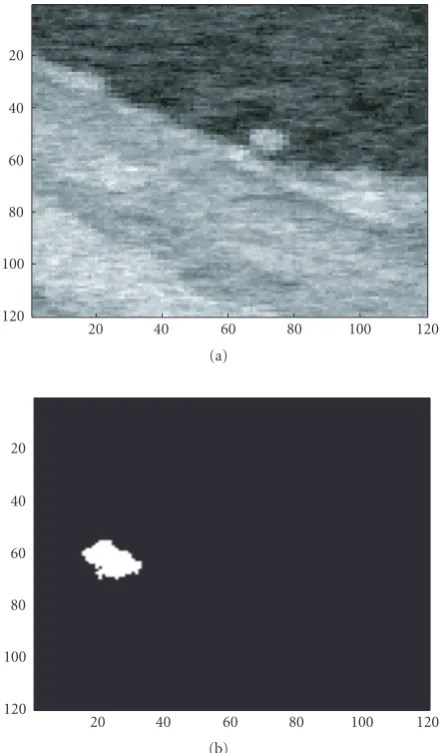
Figure1: (a) First frame of the cluttered target sequence, PTCR= 10.6 dB; (b) target template and position in the first frame shown as a binary image.
ters the scene, that target is acquired and tracked accurately until, in the case of the APF demonstration, it leaves the scene and no target detection is once again correctly indicated.
Both video demos show the ability of the proposed al-gorithms to (1) detect and track a present target both inside the image grid and near its borders, (2) detect when a target leaves the image and indicate that there is no target present until a new target appears and (3), when a new target enters the scene, correctly detect that the target is present and track it accurately. In the sequel, for illustrative purposes only, we show in the paper the detection/tracking results for a few se-lected frames using the RS algorithm and a dataset that is different from the one shown in the video demos.
120 100 80 60 40 20
20 40 60 80 100 120
(a)
120 100 80 60 40 20
20 40 60 80 100 120
(b)
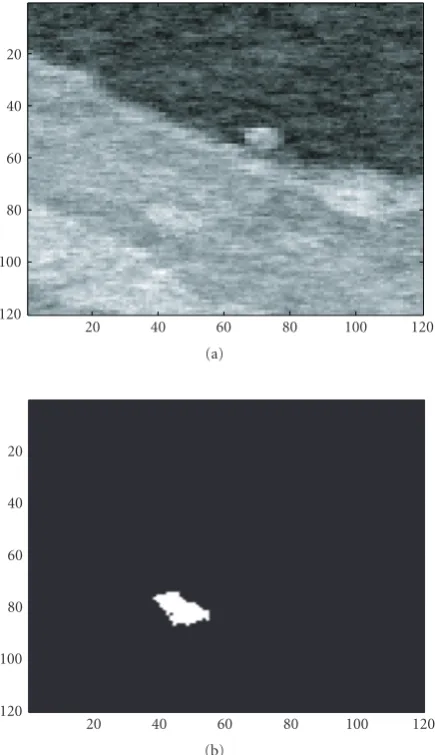
Figure2: (a) Tenth frame of the cluttered target sequence, PTCR= 10.6 dB, with target translation, rotation, scaling, and shearing; (b) target template and position in the tenth frame shown as a binary image.
Next,Figure 2(a)shows the tenth frame in the image se-quence. Once again, we show inFigure 2(b)the correspond-ing clutter-free target image as a binary image. Note that the target from frame 1 has now undergone a random change in aspect in addition to translational motion.
The tracking results corresponding to frames 1 and 10 are shown, respectively, in Figures3(a)and3(b). The actual tar-get positions are indicated by a cross sign (’+’), while the es-timated positions are indicated by a circle (’o’). Note that the axes in Figures1(a)and1(b)and Figures2(a)and2(b) rep-resent integer pixel locations, while the axes in Figures3(a) and3(b)represent real-valuedxandy, coordinates assum-ing spatial resolutions of ξ1 = ξ2 = 0.2 meters/pixel such that the [0, 120] pixel range in the axes of Figures1(a)and 1(b)and Figures2(a)and2(b)corresponds to a [0, 24] me-ter range in the axes of Figures3(a)and3(b).
In this particular example, the target leaves the scene at frame 31 and no target reappears until frame 37. The SMC
25 20 15 10 5 0
+ o
0 5 10 15 20 25
(a)
25 20 15 10 5 0
+o
0 5 10 15 20 25
(b)
Figure3: Tracking results: actual target position (+), estimated tar-get position (o); (a) initial frame, (b) tenth frame.
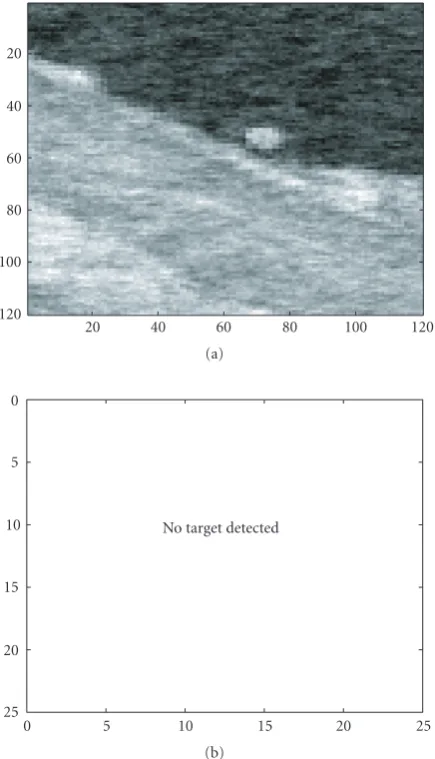
tracker accurately detects the instant when the target dis-appears and shows no false alarms over the 6 absent target frames as illustrated in Figures4(a)and4(b)where we show, respectively, the clutter+background-only thirty-sixth frame and the corresponding tracking results indicating in this case that no target has been detected. Finally, when a new target reappears, it is accurately acquired by the SMC algorithm. The final simulated frame with the new target at position (104, 43) is shown for illustration purposes inFigure 5(a). Figure 5(b)shows the corresponding tracking results for the same frame.
120 100 80 60 40 20
20 40 60 80 100 120
(a)
25 20 15 10 5 0
No target detected
0 5 10 15 20 25
(b)
Figure4: (a) Thirty-sixth frame of the cluttered target sequence with no target present; (b) detection result indicating absence of target.
diverged (i.e., failed to estimate the correct target trajectory) in 3 out of the 100 Monte Carlo trials, whereas the RS tracker diverged in 5 out of 100 runs. When we increased the PTCR to 8.1 dB, the divergence rates fell to 2 out of 100 for the APF, and 3 out of 100 for the RS filter. Figures6(a)and6(b)show, in the case of PTCR=6.5 dB, the root mean square (RMS) error curves (in number of pixels) for the target’s position estimates, respectively, in coordinatesxandygenerated by both the APF and the RS trackers. The RMS error curves in Figure 6were computed from the estimation errors recorded in each of the 100 Monte Carlo trials,excludingthe divergent realizations. Our simulation results suggest that, despite the reduction in the number of particles from 8000 to 5000, the APF tracker still outperforms the RS tracker, showing similar RMS error performance with a slightly lower divergence rate. For both filters, in the nondivergent realizations, the estima-tion error is higher in the initial frames and decreases over time as the target is acquired and new images are processed.
120 100 80 60 40 20
20 40 60 80 100 120
(a)
25 20 15 10 5 0
+o
0 5 10 15 20 25
(b)
Figure 5: (a) Fifty-first frame of the cluttered target sequence, PTCR=10.6 dB, with a new target present in the scene; (b) tracking results: actual target position (+), estimated target position (o).
5. PRELIMINARY DISCUSSION ON
MULTITARGET TRACKING
We have considered so far a single target with uncertain as-pect (e.g., random orientation or scale). In theory, however, the same modeling framework could be adapted to a sce-nario where we consider multiple targets with known (fixed) aspect. In that case, the discrete statezn, rather than repre-senting a possible target model, could denote instead a pos-sible multitarget configuration hypothesis. For example, if we knew a priori that there is a maximum ofNT targets in the field of view of the sensor at each time instant, thenzn would take K = 2NT possible values corresponding to the
hypotheses ranging from “no target present” to “all targets present” in the image frame at instantn. The kinematic state
0 0.2 0.4 0.6 0.8 1 1.2 1.4
RMSE
(n
u
mber
of
pix
els)
0 5 10 15 20
Frame number
Auxiliary particle filter,Np=5000 Resample-move filter,Np=8000
(a)
0.2 0.4 0.6 0.8 1 1.2
RMSE
(n
u
mber
of
pix
els)
0 5 10 15 20
Frame number
Auxiliary particle filter,Np=5000 Resample-move filter,Np=8000
(b)
Figure6: RMS error for the target’s position estimate, respectively, for the APF (divergence rate, 3%) and resample-move (divergence rate, 5%) trackers, PTCR=6.5 d; (a)xcoordinate, (b)ycoordinate.
given a certain target configuration hypothesis. Different tar-gets could be assumed to move independently of each other when present and to disappear only when they move out of the target grid as discussed inSection 2. Likewise, a change in target configuration hypotheses would result in new targets appearing in uniformly random locations as in (5).
The main difficulty associated with the approach de-scribed in the previous paragraph is however that, as the number of targets increases, the corresponding growth in the dimension of the state space is likely to exacerbate particle depletion, thus causing the detection/tracking filters to
di-verge if the number of particles is kept constant. That may render the direct application of the joint detection/tracking algorithms in this paper unfeasible in a multitarget scenario. The basic tracking routines discussed in the paper may be still viable though when used in conjunction with more conven-tional algorithms for target detection/acquisition and data association. For a review of alternative approaches to mul-titarget tracking, mostly for video applications, we refer the reader to [30–33].
5.1. Likelihood function modification in a multitarget scenario
In the alternative scenario with multiple (at mostNT) targets, whereznrepresents one of 2NTpossible target configurations,
the likelihood function model in (10) depends instead on a sum of data terms
λn,i
sn,zn
=yT n
σ2
c,nΣ−1v
hi
sn,zn
, 1≤i≤2NT, (27)
and a sum of energy terms
ρi,jsn,zn
=hTi
sn,zn
σ2
c,nΣ−1v
hj
sn,zn
, 1≤i,j≤2NT,
(28)
where hi(sn,zn) is the long-vector representation of the clutter-free image of theith target under the target configu-ration hypothesiszn, assumed to be identically zero for target configurations under which theith target is not present. The sum of the data terms corresponds to the sum of the out-puts of different correlation filters matched to each of theNT possible (fixed) target templates taking into account the spa-tial correlation of the clutter background. The energy terms, ρi,j(sn,zn), are on the other hand constant withsnfor most possible locations of targetsiandjon the image grid, except when either one of the two targets or both are close to the image borders. Finally, fori /=j, the energy terms are zero for present targets that are sufficiently apart from each other and, therefore, most of the time, they do not affect the computa-tion of the likelihood funccomputa-tion. The termsρi,j(sn,zn) must be taken into account, however, for overlapping targets; in this case, they may be computed efficiently exploring the sparse structure ofhi andΣ−1v . For details, we refer the reader to future work.
5.2. Illustrative example with two targets
120 100 80 60 40 20
20 40 60 80 100 120
(a)
120 100 80 60 40 20
20 40 60 80 100 120
(b)
Figure7: Simulated image sequence with two moving targets: (a) first frame, (b) tenth frame; PTCR≈12.5 dB.
done by applying the differential filter in (16) to the initial frame, and then applying the output of the differential filter to a bank of two spatial matched filters as in (15), designed according to the signature coefficients, respectively, for tar-gets 1 and 2. The outputs of the two matched filters minus the corresponding energy terms for targets 1 and 2, respec-tively, are finally added together and thresholded to provide the initial estimates of the location of the two targets. Note that the cross-energy terms discussed inSection 5.1may be ignored in this case since we are assuming that the two tar-gets are initially sufficiently far apart. Frames 1 and 10 of the simulated cluttered sequence with the two targets are shown in Figures7(a)and7(b)for illustration purposes.
Once the two targets are initially acquired, we track them jointly from the raw sensor images (i.e., without any other conventional decoupled data association/tracking method) using an auxiliary particle filter that assumes the modified likelihood function ofSection 5.1and two independent mo-tion models, respectively, for targets 1 and 2. The tracking filter usesNp = 8 000 particles. Figure 8shows the actual
20 30 40 50 60 70
Pix
el
location
(
y
co
or
dinat
e)
40 60 80 100 120
Pixel location (xcoordinate)
Actual T1 Actual T2
Estimated T1 Estimated T2
Figure8: Illustrative example of two-target tracking using an aux-iliary particle filter.
and estimated trajectories, respectively, for targets 1 and 2. As we can see from the plots, the experimental results are worse than those obtained in the single target, multiaspect case, but the filter was still capable of tracking the pixel loca-tions of the centroids of the two targets fairly accurately with errors ranging from zero to two or three pixels at most and without using any ad hoc data association routine.
6. CONCLUSIONS AND FUTURE WORK
We discussed in this paper a methodology for joint detection and tracking of multiaspect targets in remote sensing image sequences using sequential Monte Carlo (SMC) filters. The proposed algorithm enables integrated,multiframetarget de-tection and tracking incorporating the statistical models for target motion, target aspect, and spatial correlation of the background clutter. Due to the nature of the application, the emphasis is on detecting and tracking small, remote targets under additive clutter, as opposed to tracking nearby objects possibly subject to occlusion.
The discussion in this paper was restricted to targets that assume only a finite number of possible aspect states defined on a library of target templates. As an alternative for future work, an appearance model similar to the one described in [24] could be used instead, allowing the discrete-valued as-pect statessnto denote different classes of continuous-valued target deformation models, as opposed to fixed target tem-plates. Similarly, the framework in this paper could also be modified to allow for multiobject tracking as indicated in Section 5.
ACKNOWLEDGMENT
Part of the material in this paper was presented at the 2005 IEEE Aerospace Conference.
REFERENCES
[1] A. Doucet, S. Godsill, and C. Andrieu, “On sequential Monte Carlo sampling methods for Bayesian filtering,”Statistics and Computing, vol. 10, no. 3, pp. 197–208, 2000.
[2] J. K. Bounds, “The Infrared airborne radar sensor suite,” RLE Tech. Rep. 610, Massachusetts Institute of Technology, Cam-bridge, Mass, USA, December 1996.
[3] Y. Bar-Shalom and X. Li, Multitarget-Multisensor Tracking: Principles and Techniques, YBS Publishing, Storrs, Conn, USA, 1995.
[4] M. G. S. Bruno, “Bayesian methods for multiaspect target tracking in image sequences,”IEEE Transactions on Signal Pro-cessing, vol. 52, no. 7, pp. 1848–1861, 2004.
[5] M. G. S. Bruno and J. M. F. Moura, “Optimal multiframe de-tection and tracking in digital image sequences,” inProceedings of the IEEE International Acoustics, Speech, and Signal Process-ing (ICASSP ’00), vol. 5, pp. 3192–3195, Istanbul, Turkey, June 2000.
[6] M. G. S. Bruno and J. M. F. Moura, “Multiframe de-tector/tracker: optimal performance,” IEEE Transactions on Aerospace and Electronic Systems, vol. 37, no. 3, pp. 925–945, 2001.
[7] M. G. S. Bruno and J. M. F. Moura, “Multiframe Bayesian tracking of cluttered targets with random motion,” in Pro-ceedings of the International Conference on Image Processing (ICIP ’00), vol. 3, pp. 90–93, Vancouver, BC, Canada, Septem-ber 2000.
[8] M. S. Arulampalam, S. Maskell, N. Gordon, and T. Clapp, “A tutorial on particle filters for online nonlinear/non-Gaussian Bayesian tracking,” IEEE Transactions on Signal Processing, vol. 50, no. 2, pp. 174–188, 2002.
[9] J. M. F. Moura and N. Balram, “Recursive structure of non-causal Gauss-Markov random fields,”IEEE Transactions on In-formation Theory, vol. 38, no. 2, pp. 334–354, 1992.
[10] J. M. F. Moura and M. G. S. Bruno, “DCT/DST and Gauss-Markov fields: conditions for equivalence,”IEEE Transactions on Signal Processing, vol. 46, no. 9, pp. 2571–2574, 1998. [11] J. M. F. Moura and N. Balram, “Noncausal Gauss Markov
ran-dom fields: parameter structure and estimation,”IEEE Trans-actions on Information Theory, vol. 39, no. 4, pp. 1333–1355, 1993.
[12] S. M. Schweizer and J. M. F. Moura, “Hyperspectral imagery: clutter adaptation in anomaly detection,”IEEE Transactions on Information Theory, vol. 46, no. 5, pp. 1855–1871, 2000.
[13] M. Isard and A. Blake, “A mixed-state condensation tracker with automatic model-switching,” inProceedings of the 6th In-ternational Conference on Computer Vision, pp. 107–112, Bom-bay, India, January 1998.
[14] A. Doucet, J. F. G. Freitas, and N. J. Gordon, “An introduc-tion to sequential Monte Carlo methods,” inSequential Monte Carlo Methods in Practice, A. Doucet, N. F. G. Freitas, and N. J. Gordon, Eds., Springer, New York, NY, USA, 2001.
[15] M. G. S. Bruno, R. V. de Ara ´ujo, and A. G. Pavlov, “Sequential Monte Carlo filtering for multi-aspect detection/tracking,” in
Proceedings of the IEEE Aerospace Conference, pp. 2092–2100, Big Sky, Mont, USA, March 2005.
[16] W. R. Gilks and C. Berzuini, “Following a moving target— Monte Carlo inference for dynamic Bayesian models,”Journal of the Royal Statistical Society: Series B (Statistical Methodol-ogy), vol. 63, no. 1, pp. 127–146, 2001.
[17] N. Gordon, D. Salmond, and C. Ewing, “Bayesian state esti-mation for tracking and guidance using the bootstrap filter,”
Journal of Guidance, Control, and Dynamics, vol. 18, no. 6, pp. 1434–1443, 1995.
[18] C. P. Robert and G. Casella, Monte Carlo Statistical Meth-ods, Springer Texts in Statistics, Springer, New York, NY, USA, 1999.
[19] M. K. Pitt and N. Shephard, “Filtering via simulation: auxil-iary particle filters,”Journal of the American Statistical Associa-tion, vol. 94, no. 446, pp. 590–599, 1999.
[20] M. Isard and A. Blake, “Condensation—conditional density propagation for visual tracking,”International Journal of Com-puter Vision, vol. 29, no. 1, pp. 5–28, 1998.
[21] B. Li and R. Chellappa, “A generic approach to simultaneous tracking and verification in video,”IEEE Transactions on Image Processing, vol. 11, no. 5, pp. 530–544, 2002.
[22] S. K. Zhou, R. Chellappa, and B. Moghaddam, “Visual track-ing and recognition ustrack-ing appearance-adaptive models in par-ticle filters,” IEEE Transactions on Image Processing, vol. 13, no. 11, pp. 1491–1506, 2004.
[23] A. P. Dempster, N. M. Laird, and D. B. Rubin, “Maximum like-lihood from incomplete data via the EM algorithm,”Journal of the Royal Statistical Society: Series B (Statistical Methodology), vol. 39, no. 1, pp. 1–38, 1977.
[24] J. Giebel, D. M. Gavrila, and C. Schn¨orr, “A bayesian frame-work for multi-cue 3D object tracking,” in Proceedings of the 8th European Conference on Computer Vision (ECCV ’04), vol. 4, pp. 241–252, Prague, Czech Republic, May 2004. [25] J. Vermaak, A. Doucet, and P. P´erez, “Maintaining
multi-modality through mixture tracking,” inProceedings of the 9th IEEE International Conference on Computer Vision (ICCV ’03), vol. 2, pp. 1110–1116, Nice, France, October 2003.
[26] K. Okuma, A. Taleghani, N. de Freitas, J. J. Little, and D. G. Lowe, “A boosted particle filter: multitarget detection and tracking,” inProceedings of the 8th European Conference on Computer Vision (ECCV ’04), vol. 3021, pp. 28–39, Prague, Czech Republic, May 2004.
[27] J. Geweke, “Bayesian inference in econometric models using Monte Carlo integration,” Econometrica, vol. 57, no. 6, pp. 1317–1339, 1989.
[28] J. S. Liu, R. Chen, and T. Logvinenko, “A theoretical frame-work for sequential importance sampling with resampling,” in
Sequential Monte Carlo Methods in Practice, A. Doucet, J. F. G. Freitas, and N. J. Gordon, Eds., pp. 225–246, Springer, New York, NY, USA, 2001.
[30] W. Ng, J. Li, S. Godsill, and J. Vermaak, “Tracking variable number of targets using sequential Monte Carlo methods,” in
Proceedings of the IEEE/SP 13th Workshop on Statistical Signal Processing, pp. 1286–1291, Bordeaux, France, July 2005. [31] W. Ng, J. Li, S. Godsill, and J. Vermaak, “Multitarget tracking
using a new soft-gating approach and sequential Monte Carlo methods,” inProceedings of the IEEE International Conference on Acoustics, Speech, and Signal Processing (ICASSP ’05), vol. 4, pp. 1049–1052, Philadelphia, Pa, USA, March 2005.
[32] C. Hue, J.-P. Le Cadre, and P. P´erez, “Tracking multiple ob-jects with particle filtering,”IEEE Transactions on Aerospace and Electronic Systems, vol. 38, no. 3, pp. 791–812, 2002. [33] J. Czyz, B. Ristic, and B. Macq, “A color-based particle filter for