DOI: 10.1534/genetics.105.046847
Joint Evolution of Dispersal and Inbreeding Load
Fre´de´ric Guillaume
1and Nicolas Perrin
2Department of Ecology and Evolution, University of Lausanne, CH-1015 Lausanne, Switzerland
Manuscript received June 14, 2005 Accepted for publication February 27, 2006
ABSTRACT
Inbreeding avoidance is often invoked to explain observed patterns of dispersal, and theoretical models indeed point to a possibly important role. However, while inbreeding load is usually assumed constant in these models, it is actually bound to vary dynamically under the combined influences of mutation, drift, and selection and thus to evolve jointly with dispersal. Here we report the results of individual-based stochastic simulations allowing such a joint evolution. We show that strongly deleterious mutations should play no significant role, owing to the low genomic mutation rate for such mutations. Mildly deleterious mutations, by contrast, may create enough heterosis to affect the evolution of dispersal as an inbreeding-avoidance mechanism, but only provided that they are also strongly recessive. If slightly recessive, they will spread among demes and accumulate at the metapopulation level, thus contributing to mutational load, but not to heterosis. The resulting loss of viability may then combine with demographic stochasticity to promote population fluctuations, which foster indirect incentives for dispersal. Our simulations sug-gest that, under biologically realistic parameter values, deleterious mutations have a limited impact on the evolution of dispersal, which on average exceeds by only one-third the values expected from kin-competition avoidance.
T
HREE distinct ultimate causes are currently rec-ognized to explain the evolution of dispersal, a widespread feature in natural populations of many or-ganisms. Environmental and demographic stochasticity plays a major role by inducing spatio-temporal fluctu-ations in habitat quality or in population sizes, ex-tinction and recolonization dynamics representing the most extreme case (VanValen1971; Olivieriet al.1995; Gandonand Michalakis1999; Ronceet al.2000). Kin-competition and inbreeding avoidance (Hamilton and May 1977; Taylor 1988; Motro 1991; Clobert et al. 2001) provide two other potential incentives, which could drive the evolution of dispersal in equi-librium populations.Inbreeding is often invoked to account for the large amount of dispersal in natural populations (see Perrin and Goudet 2001, and references therein). However, although clear-cut empirical evidence exists that in-breeding may sometimes play a significant role in dis-persal (Packer1979, 1985; Wolff 1992; Packer and Pusey 1993), alternative explanations exist in many circumstances (reviewed in Blouin and Blouin1988; Pusey and Wolf 1996). Even features that strongly suggest inbreeding avoidance, including sex biases in
dispersal and negative among-species correlations be-tween male and female dispersal rates (Pusey and Packer 1987; Puseyand Wolf 1996), may also arise from kin-competition avoidance (Perrinand Goudet 2001). The empirical problem is further worsened by the fact that population structures that induce close inbreeding (small groups of highly related individuals) are precisely those most likely to promote kin compe-tition as well. As a result, the exact role of inbreeding avoidance in driving dispersal is difficult to determine and has been widely debated. While some authors see it as a major force (e.g., Wolff1994), others consider it largely irrelevant (e.g., Mooreand Ali1984).
Theoretical studies suggest that inbreeding avoid-ance might indeed play a significant role of its own (Bengtsson 1978; Waser et al. 1986; Perrin and Mazalov1999; Morgan2002), as well as in interaction with kin competition (Motro1991; Gandon1999; Perrin and Mazalov2000; Perrinand Goudet2001) on the evolution of dispersal. In the absence of inbreeding load (and in stable populations), evolutionary stable strategy (ESS) models predict a balanced solution: both sexes disperse to limit competition with kin. Directional sex biases may then arise from sex asymmetries in dispersal costs, resource competition, or mate competition. When a weak inbreeding load is added, the models still pre-dict sex-balanced ESS solutions, with dispersal values that only slightly exceed those expected under kin-competition avoidance alone (Perrinand Goudet2001). Moderate inbreeding load is expected to somewhat de-stabilize the equilibrium, as even slight sex asymmetries 1Present address:Department of Zoology, University of British Columbia,
Vancouver, BC V6T 1Z4, Canada. E-mail: [email protected] 2Corresponding author:Department of Ecology and Evolution, University of Lausanne, Biology Bldg., CH-1015 Lausanne, Switzerland.
E-mail: [email protected]
Perrinand Mazalov2000).
One potential problem with these theoretical expect-ations, however, is that the inbreeding load from which the costs of inbreeding arise is assumed to be constant. In reality, this load results from the dynamic interplay between mutation, drift, selection, and dispersal. Selec-tion coefficients and dominance effects of the deleterious mutants play crucial roles (Wanget al.1999; Bataillon and Kirkpatrick2000; Whitlock2002; Gle´ minet al. 2003; Rozeand Rousset2004). On the one hand, if the effect of deleterious mutations is large enough that selection is more important than drift, inbreeding load will be rapidly purged (Gle´ min 2003); however, muta-tions might still segregate locally at low frequency and induce significant loss in the fecundity of within-deme matings relative to among-deme matings (heterosis, see Whitlock et al. 2000; Gle´ min et al. 2003; Roze and Rousset 2004), so that selection for dispersal might remain high. On the other hand, if deleterious ef-fects are small enough that drift dominates, mutations are hidden from selection and might become fixed, strongly affecting offspring viability; however, whether these mutations contribute to heterosis and thus to the evolution of dispersal will depend on whether they be-come locally fixed at the level of demes or in the whole metapopulation.
The boundary between the two domains of accumu-lation and purging of deleterious mutations depends on the population structure, rate of inbreeding, and level of gene flow (Gle´ min 2003; Gle´ min et al. 2003) and hence on dispersal. Furthermore, the accumulation of mildly deleterious mutations may induce demographic effects, affecting both the inbreeding load and the evolution of dispersal. Given its complexity, the prob-lem is currently not analytically tractable without major simplifying assumptions (e.g., low migration, strong selection, infinite population models, no interaction with population demography, etc.; see Bataillonand Kirkpatrick 2000, Gle´ min et al. 2003, and Rozeand Rousset2004 for one-locus models of deleterious mu-tation dynamics and their simplifications). A simulation approach appears to be a good way of overcoming these limitations.
Here we present the results of individual-based simu-lations aimed at investigating the joint evolution of inbreeding load and dispersal in a structured popula-tion. Our approach differs from previous inroads in this area in that dispersal is an evolving trait (vs.Lynchet al. 1995b; Wang et al.1999; Higgins and Lynch 2001), and competitive interactions with kin are taken into account (see Morgan2002).
1. Viability selection: newborns survive with a probabil-ity derived from their deleterious mutation genotype to give the new offspring generation.
2. Dispersal: offspring randomly disperse in the meta-population with a probability given by their dispersal genotype and die during dispersal events with prob-abilityc. A disperser cannot return to its natal deme. 3. Regulation: random regulation of the population occurs, reducing the demic pool of competing in-dividuals of each sex to half of the carrying capacity of the demes, thus leading to equilibrated sex ratio whenever enough offspring of both sexes are pre-sent, without between-sex competition.
4. Reproduction: each individual, male or female, is as-signed a fecundity value drawn from a Poisson dis-tribution with constant meanf. They mate randomly in their deme as many times as indicated by their fecundity and produce one newborn per mating. This ensures similar reproductive variances between males and females. Newborn gender is set randomly with an equal probability of being male or female, and their alleles for deleterious and dispersal genes are randomly inherited from their parents’ copies and then mutated. Once reproduction has occurred, all adults are removed and the cycle starts again.
This life cycle generates different amounts of de-mographic stochasticity. The stochastic nature of fe-cundity, dispersal, and survival could lead to a large interdemic variance in deme sizes and sex ratios at the onset of the regulation episode. The variance is stronger with low fecundity values, small population sizes, and low viability. Stochasticity in this model sometimes reached values high enough to induce demic extinc-tions or even crashes of the entire metapopulation, even without the presence of deleterious mutations.
Dispersal genes consisted of two independent diploid loci, one controlling the female and the other the male dispersal rate, with allelic values continuously distrib-uted between 0 and 1. Mutation steps (forward or back-ward) were drawn from an exponential distribution with kurtosisl¼5 (i.e., mean step¼0.2) and probability¼
104. Mutated dispersal alleles were truncated at the limits (0 or 1). An individual’s dispersal phenotype was determined as the mean of the two alleles present at the corresponding sex-specific locus.
from a Poisson distribution with mean equal to the diploid genomic mutation rate: U ¼ 2Mu. Mutations thus occurred at rateuand affected only nondeleterious alleles, turning them into the deleterious form (thus reverse mutation was neglected). When a randomly chosen allele was already of the deleterious form, another was redrawn to replace it, thus ensuring a con-stant genomic mutation rate. Mutations were assumed to act independently on fitness so that the offspring viability,v, was computed as the product of the fitness effects of each locus:v¼ ð1sÞn1ð1hsÞn2, wheren1is the number of homozygous loci andn2the number of heterozygous loci.
The parameters of the deleterious mutations (U,
h, and s) were set according to empirical estima-tions from Drosophila melanogaster mainly (reviewed in Charlesworthand Charlesworth1987, 1999; Lynch et al. 1999). Inbreeding load in natural populations appears to be due to a combination of a few almost fully recessive lethal mutations (modeled here withU¼0.03,
s¼1, andh ¼0.02; Simmonsand Crow1977; Crow 1993) and many partially recessive, mildly deleterious ones (modeled here withU¼1, 0.01#s#0.05, andh¼
0.3, as used in stochastic simulations in Wanget al.1999 and Higgins and Lynch 2001). Accordingly, we de-signed our simulations to contrast the effects of the two kinds of mutations: larges-and smallh-valuesvs.small
s-and largeh-values. For smalls-values (0.01 and 0.05) we also ran a few simulations withhvarying from 0.01 to 0.4 to investigate the role of dominance on inbreeding load. We also investigated the effect of a large genomic mutation rate (U ¼1) for both types of mutations to assess the effects of contrasted levels of heterosis in small populations.
At the start of the simulations, individuals were ini-tialized with dispersal gene values drawn from a uniform distribution ranging from 0 to 1 (ensuring a large initial variance and an initial mean of 0.5) and potentially deleterious gene values all set to those of the wild-type allele. Note, however, that the way allelic values are initiated does not affect the ESS values, but only the time courses to equilibrium.
Simulations were first run without deleterious mu-tations, to isolate the effects of kin competition and compare equilibrium dispersal rates with theoretical expectations (model derived from Gandonand Rousset 1999, with finite population size and sex-specific dis-persal) and thereby validate our model. Deleterious effects were then added to estimate the additional dispersal that would evolve in the presence of an inbreeding load. Parameters were set as follows: dis-persal costsc¼20 and 70%, mean fecundityf¼20, with a few runs with lower fecundities (f¼8 and 3) to further investigate the importance of demographic stochasticity in the absence of inbreeding load. Heterosis was measured for each female asI¼ ðvpvgÞ=vp (Perrin and Mazalov 1999, 2000), where vg is the average
offspring effective viability when the male is from the same deme andvpis that when it comes from a different deme. The extent of purging of the deleterious mu-tations was measured by the ratio r¼qexp=q of the expected frequency qexp in an infinite and panmictic population at mutation–selection equilibrium relative to the mean observed frequency q (see also Gle´ min 2003, for definitions of the purging process).ris then greater than unity when mutations are purged (i.e.,q, qexp) and lower in the case of mutation accumulation (i.e.,q . qexp). qexp is given by solutions of the equa-tion s(12hÞq2
exp1hsð11uÞqexpu¼0 (Crow and Kimura1970, p. 260).
Other statistics measured include the mean overall dispersal rate, the mean male and female dispersal rates (to evaluate any sex bias in dispersal), the mean allele frequency, homozygosity and heterozygosity of delete-rious loci, and the number of fixed mutations in the whole population, as well as the mean overall offspring viability and the mean number of lethal equivalents per individual (Lequ¼
P
sq, Mortonet al.1956). All param-eters were estimated among offspring before dispersal. Unless otherwise stated, simulations were replicated 100 times over 3000 generations for each set of param-eters, and the metapopulation state was recorded every 10 generations for later analysis. To ensure stability, statistics were computed over the 100 last records.
RESULTS
Kin competition avoidance and demographic sto-chasticity: In the absence of inbreeding load, the evo-lution of dispersal was governed mostly by the effects of kin competition within demes. Equilibrium dis-persal values matched the theoretical ESS expectations (Hamiltonand May1977; Cominset al.1980; Gandon and Rousset 1999), decreasing with increased deme sizes (Figure 1) and dispersal costs (from 20 to 70%, see Table 1). The match was excellent at large population size (100 demes3100 individuals, results not shown), but theoretical expectations were slightly exceeded at low pop-ulation numbers, owing to demographic stochasticity.
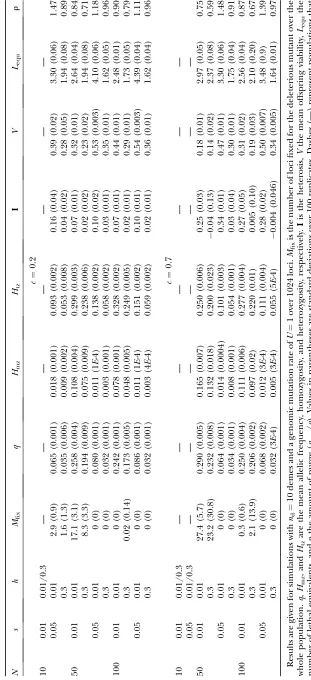
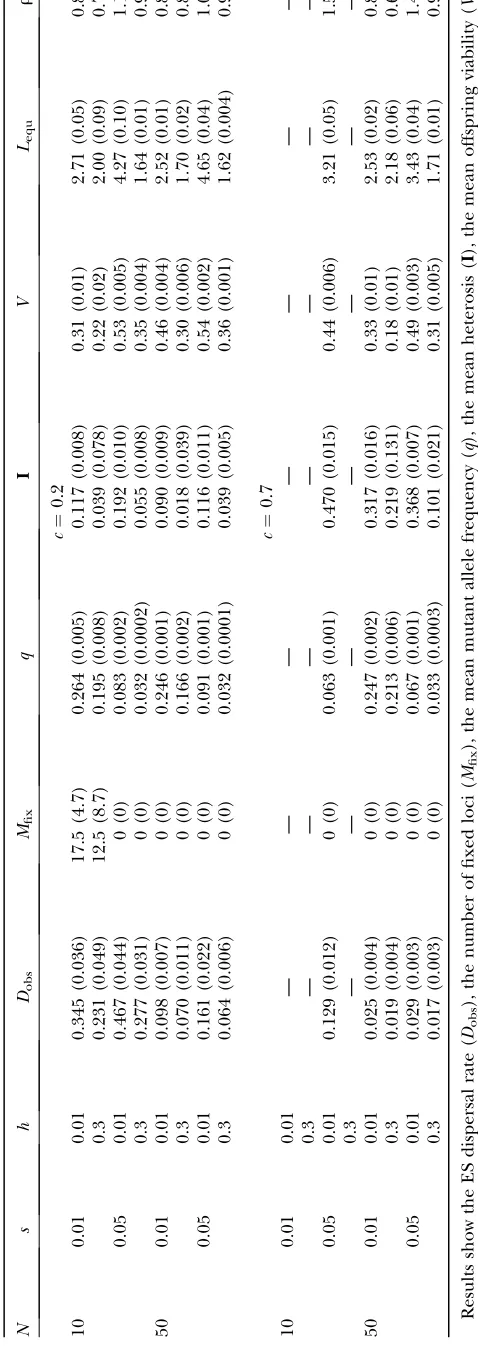
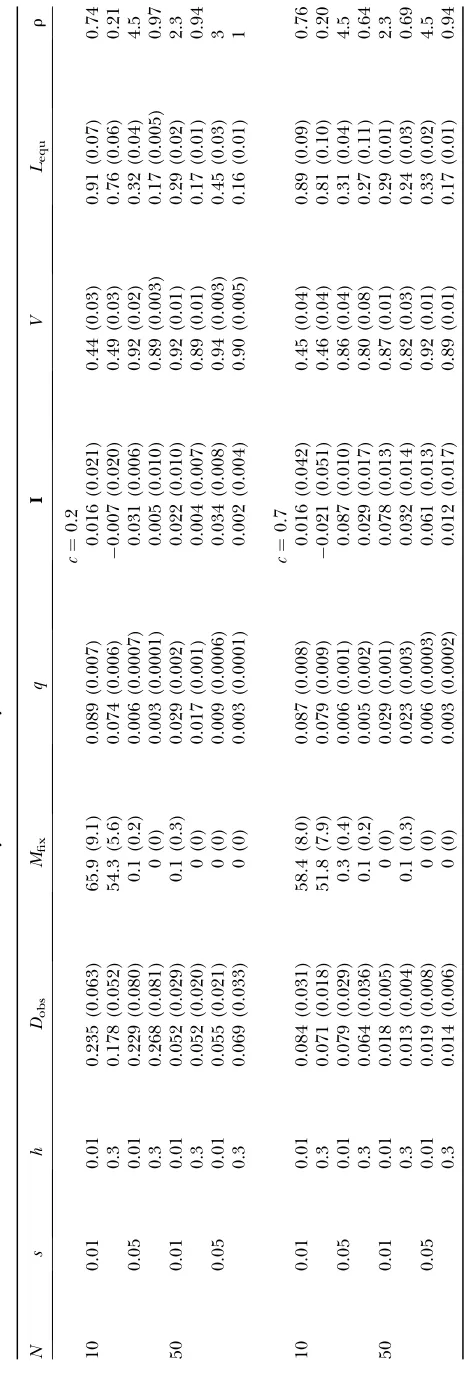
Mild mutations: The dynamics of weak and partially recessive mutations (s¼0.01 andh ¼0.3) were dom-inated by drift, which led to their progressive fixation at the metapopulation level (Figure 2A). Accumulation was most rapid for small deme sizes (N ¼ 10), low intrinsic fecundity (results not shown), and high dis-persal cost (c ¼ 0.7, see Table 2). These combined conditions led to population crashes before 3000 generations. Increasing deme sizes somewhat reduced the strength of drift, allowing for higher population persistence, but mutations still accumulated (r,1 and
qexp¼0.134 fors¼0.01 andh¼0.3, see Table 2). Because accumulation occurred at the metapopula-tion level, selecmetapopula-tion for dispersal due to the advantage of heterosis was low (I ffi2%, see Table 2). Indirect selection, however, arose from the large population fluctuations and frequent demic extinctions stemming from the high genetic load (mean offspring viability ranged 14–30%, see Table 2). In the case ofN¼50 and
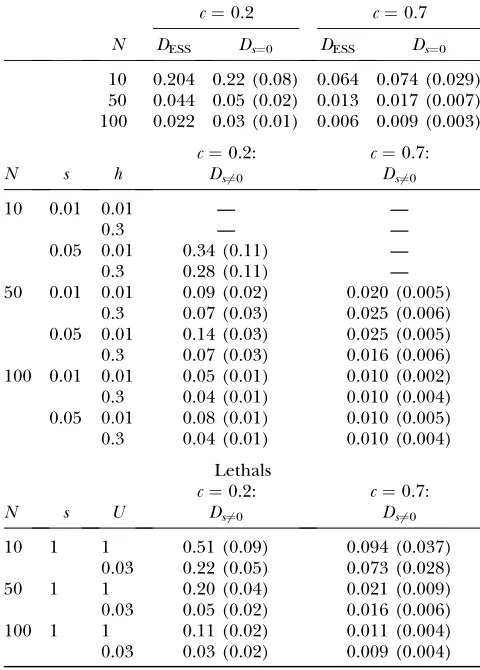
c¼0.7, for instance, heterosis did not differ significantly from zero, but, owing to a high extinction rate (23%), the mean dispersal rate (Ds6¼0¼ 0.025) exceeded sig-nificantly the value obtained under kin-competition avoidance alone (Ds¼0¼0.017, Table 1). Note, however, that this value was still lower than that expected from patch occupancy models (DESS ¼ 0.31, Gandon and Michalakis1999) for the aforementioned reason.
Drift lost its importance for the other cases of larger deme sizes or lower costs of dispersal (c¼0.2 orN$50). Genetic load was then insufficient to generate strong population fluctuations (extinction rate,3%) so that selection for dispersal remained low, and evolutionary stable (ES) values only slightly exceeded those under kin competition alone (average increase of one-third,
see Table 1). Drift also progressively lost importance as the selection coefficient was increased froms¼0.01 to
s¼0.05 (see Figure 2). In small populations, the genetic load was still large (mean viability30%, Table 2) but a fecundity of f ¼20 was sufficient to limit population fluctuations, so that dispersal was only slightly affected (e.g.,Ds¼0.05¼0.07vs. Ds¼0¼0.05 forN¼50 andc¼ 0.2). In large populations, a selection coefficient of
s ¼ 0.05 was enough to prevent accumulation at the metapopulation level, at least over the timescale con-sidered (3000 generations, see Mfixin Table 2). Muta-tions segregated close to their deterministic expectation (0.89,r,0.97 withqexp¼0.031, see Table 2), inducing some heterosis (Imax¼4%).
When strongly recessive (h¼0.01), mutations segre-gated at higher frequencies, being hidden in hetero-zygotes. However, their lower effect at the heterozygous state more than compensated for their higher fre-quency (see Table 2), so that offspring displayed higher mean viability (Figure 3D). Compared with their de-terministic expectations these frequencies shifted from accumulation to purging (r . 1). The value of h at which the shift occurred increased with population size, fromhlimffi0.2 forN¼10 tohlimffi0.3 forN$50 (and s ¼ 0.05). These values agree well with theoretical thresholds for the purging of mildly deleterious muta-tions (i.e., h , 1
3 as in Whitlock 2002; Roze and
Rousset 2004). However, for very mildly deleterious mutations (s ¼0.01) and small population sizes (N ¼
10), the domain of purging was not reached even for
h¼0.01, so that populations still crashed before 2000 generations (see Table 2). Strongly recessive mutations also induced more heterosis, owing to their higher equi-librium frequencies and number of lethal equivalents
Figure1.—Time course of the evolution of dispersal in populations of 10 demes with and without inbreeding load for three
demic sizesN¼10, 50, and 100. The long-dashed horizontal line is the theoretically expected dispersal rate under kin competition avoidance (see Table 1). The short-dashed curve corresponds to the simulations performed without genetic load. The others are for the three different mutant effects: dotted line fors¼0.01, dashed-single-dotted line fors¼0.05, and plain line for lethal mutants (s¼1 andh¼0.02). The first two have dominance coefficient ofh¼0.3. The dashed-double-dotted line is for very recessive mutations withs¼0.05 andh¼0.01. The other parameters are: genomic mutation rateU¼1 for all types of mutations,
nd¼10 demes,M¼1024 deleterious loci, mean fecundityf¼20, and cost of dispersalc¼0.2. Plotted values are the averages over
(Figure 3C). The costs of inbreeding were thus high enough in this case to induce significant incentives for dispersal (Figure 3, A and B). These costs seemed to weakly depend on population size at equilibrium (com-pareI-values forN¼50 andN¼100 withc¼0.2 in Table 2), as the effective number of migrants was approxi-mately constant at the ES dispersal rate (Table 1).
Lethal mutations: Lethal mutations (s ¼ 1) were largely purged with all deme sizes and dispersal costs, since equilibrium frequencies were much lower than expected in an infinite panmictic population. Purging was enhanced by population structure, in accordance with previous analytical treatments (i.e., purging by drift
sensu Gle´ min 2003). Assuming a biologically realistic genomic mutation rate of U ¼ 0.03 and highly
struc-tured populations (c ¼0.7),r reached values up to 5 (for a qexp ¼0.0007), allowing viabilities in excess of 98% (Table 3). Owing to this limited genomic mutation rate, heterosis could never build up (Table 3), and, because high viability values also limited demographic stochasticity, ES dispersal rates did not exceed those under kin-competition avoidance alone (Table 1). Note that under a biologically unrealistic genomic mutation rate ofU¼1, heterosis reached high enough values (10– 30%; Table 3) to contribute significantly to the evolu-tion of dispersal, even though lethal alleles were also purged (r . 1.2) compared to their deterministic equilibrium (qexp¼0.0144; Table 3).
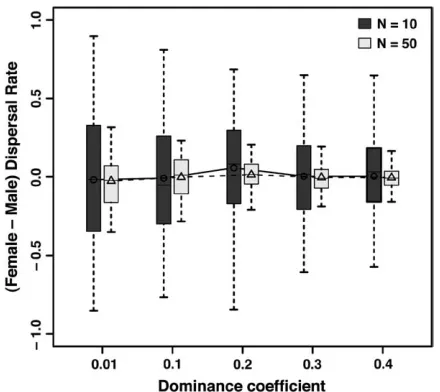
Sex-biased dispersal: A final important point is that male and female dispersal rates never differed signifi-cantly under realistic parameter values. Owing to the purging and accumulation processes, levels of heterosis were not high enough to induce a sex-biased dispersal strategy (bistable equilibrium expected from game-theoretical models, see Perrin and Mazalov 1999, 2000). Although the distribution of the difference be-tween male and female dispersal rates displayed more variance with more recessive mutations and smaller populations (Figure 4), it did not differ from normality and was always centered on zero. Boundary solutions (one sex dispersing while the other is entirely philopat-ric) did, however, occur under biologically less realistic parameter values (s¼0.3,h ¼0.01, U¼1), fostering high levels of mutational load (results not shown).
DISCUSSION
Before addressing the main issue that motivated our study (namely, the evolution of dispersal), a few com-ments on the dynamics of load and heterosis under our settings will help in delineating the context in which this evolution takes place.
Heterosis and mutation load: Several analytical treatments of the dynamics of deleterious mutations (Whitlock et al. 2000; Gle´ min et al.2003; Roze and Rousset 2004) concur to suggest that mild mutations should contribute more to heterosis than highly dele-terious ones, because the former accumulate locally while the latter are mostly purged. Our study confirms these results and also allows further specification of the relative role of mutation parameters and dispersal rate in the building and maintenance of heterosis and muta-tion load. We show in particular that weakly recessive mutations contribute more to mutation load, while strongly recessive mutations contribute more to heter-osis, because their higher equilibrium frequency results in a higher number of lethal equivalents (see also Whitlocket al.2000; Theodorouand Couvet2002). Hence, heterosis and load are not favored by the same mutational parameter values, opposing conclusions com-monly derived from analytical treatments (Whitlock et al.2000; Gle´ minet al.2003).
TABLE 1
ES dispersal rates
c¼0.2 c¼0.7
N DESS Ds¼0 DESS Ds¼0
10 0.204 0.22 (0.08) 0.064 0.074 (0.029) 50 0.044 0.05 (0.02) 0.013 0.017 (0.007) 100 0.022 0.03 (0.01) 0.006 0.009 (0.003)
c¼0.2: c¼0.7:
N s h Ds6¼0 Ds6¼0
10 0.01 0.01 — —
0.3 — —
0.05 0.01 0.34 (0.11) —
0.3 0.28 (0.11) —
50 0.01 0.01 0.09 (0.02) 0.020 (0.005)
0.3 0.07 (0.03) 0.025 (0.006)
0.05 0.01 0.14 (0.03) 0.025 (0.005)
0.3 0.07 (0.03) 0.016 (0.006)
100 0.01 0.01 0.05 (0.01) 0.010 (0.002)
0.3 0.04 (0.01) 0.010 (0.004)
0.05 0.01 0.08 (0.01) 0.010 (0.005)
0.3 0.04 (0.01) 0.010 (0.004)
Lethals
c¼0.2: c¼0.7:
N s U Ds6¼0 Ds6¼0
10 1 1 0.51 (0.09) 0.094 (0.037)
0.03 0.22 (0.05) 0.073 (0.028)
50 1 1 0.20 (0.04) 0.021 (0.009)
0.03 0.05 (0.02) 0.016 (0.006)
100 1 1 0.11 (0.02) 0.011 (0.004)
0.03 0.03 (0.02) 0.009 (0.004)
Results of simulations for the two costs of dispersalc¼0.2 and 0.7 in populations withnd¼10 demes are shown. In the
top, ES rates without genetic load (Ds¼0) are compared with
the theoretical expectations (DESS). The middle and bottom
show the ES dispersal rates with genetic load (Ds6¼0) for the
Mild mutations contribute very little to heterosis at small population sizes and weak dispersal costs. Under these parameter values, kin competition is strong enough to foster high dispersal, which often reaches values large enough (Nm . 1) that mild mutations spread rapidly among demes. Owing to a low number of demes, mildly deleterious mutations are thus fixed at the metapopulation level, thereby contributing to over-all load, but not to heterosis. This effect, however, disappears when overall metapopulation size reaches or exceeds 1000 individuals (10 demes of 100 individ-uals or 50 demes of 50 individindivid-uals; Table 4). Mildly deleterious mutations that previously get fixed at the global scale now cause more localized drift load, so that heterosis reaches values comparable to those gathered from empirical data (Madsen et al. 1996; Richards 2000; Haaget al.2002; Marret al.2002) or predicted from analytical treatments (Whitlocket al.2000).
With strong drift (small populations and low selection coefficient), synergistic interactions between popula-tion size and mutapopula-tion load induced crashes of the whole metapopulation (the so-called mutational melt-down; Lynchand Gabriel1990; Lynchet al.1995a,b; Higgins and Lynch 2001). Mildly deleterious
muta-tions were thus more damaging to the long-term population viability than were more harmful ones, owing to this accumulation process. This outcome agrees well with previous theoretical analyses (Kimura et al.1963; Bataillon and Kirkpatrick 2000; Whitlock 2002; Gle´ minet al.2003; Rozeand Rousset2004), as well as with stochastic simulation studies (Wang et al. 1999; Higginsand Lynch2001).
Several factors concurred to induce mutational melt-downs in our simulations. First, to ensure reasonable computing times, we had to deal with metapopulations of small overall size, which induced a high drift. In the few simulation runs with 50 demes instead of 10 (Table 4), the mutation load was reduced, which allowed for higher population persistence. Populations that pre-viously underwent early mutational meltdowns now persisted over 10,000 generations.
Second, the genomic mutation rate for mild muta-tions was set at a fairly high value (U¼1). This value was borrowed directly from experimental Drosophila stud-ies, but might still vary from taxon to taxon (e.g., be lower in Caenorhabditis elegansthan in Drosophila; see Keightley and Caballero 1997). The range might actually lie between 0.1 and 1 mutation per genome per
Figure 2.—Deleterious
mutation dynamics for mildly deleterious (s¼0.01–0.05) and partially recessive (h¼
generation (see Drakeet al.1998 and Lynchet al.1999 for reviews and Charlesworth et al. 2004 for recent reanalysis of the Drosophila data). Simulations con-ducted with a lower genomic mutation rate ofU¼0.1 (Table 5) indeed showed a much lower accumulation rate, so that the risks of mutational meltdown were consequently diminished.
Finally, the multiplicative fitness model chosen played a role as well. We also performed simulations (not shown here) with an additive model implying non-independent action of alleles (Wadeet al.2001). This resulted in an intensified selection on the deleterious mutations. Purge was effective over a much wider range of the parameters explored, and populations that pre-viously crashed before 1000 generations (i.e., 737649 generations fors¼0.01,nd, andN¼10) now persisted for 10,000 generations on average (SD3000 gener-ations). Synergistic interactions between deleterious loci are indeed expected to enhance their damaging effect on fitness and increase the purge, thereby limiting their impact on population survivorship in sexual species [although enhancing it in asexual species (Lynch et al. 1993)]. Empirical evidence of epistatic interactions among detrimental loci is scarce (but see
Elenaand Lenski1997, Petersand Keightley2000, Wloch et al. 2001, and Salathe and Ebert 2003 in asexual species and Whitlockand Bourguet2000 and Riveroet al.2003 in sexual ones) and remains question-able (West et al. 1998; Trouve et al. 2004). As our simulations underscore, this issue is not a purely tech-nical one, but appears to bear important practical implications for conservation, since the minimal viable population size is bound to depend on the way del-eterious mutations interact.
Evolution of dispersal: All three main selective pressures on dispersal (kin competition, population variability, and inbreeding avoidance) played a role under our settings, but at different extents depending on parameter values. Kin competition, in interaction with dispersal costs, took the leading role in the absence of inbreeding load, as evidenced by the excellent match between simulation results and expectations from game-theoretical models, mostly at large population sizes. At low population sizes or fecundity values, some departures from expectations stemmed from drift and demographic stochasticity. The addition of deleterious mutations to these settings contributed to the evolution of dispersal in two alternative ways, depending on
Figure 3.—Effect of the
whether parameter values induced a regime of accu-mulation or one of purge.
Accumulation by drift of mildly deleterious and weakly recessive mutations boosted demographic sto-chasticity, throwing populations into a dynamic of extinction–recolonization, which in turn increased dis-persal rate. More direct selective pressure, however, emerged under regimes of purge. When highly reces-sive, mildly deleterious mutations segregating at low
frequencies had the potential to induce a significant heterosis, thereby boosting dispersal as an inbreeding-avoidance mechanism. But genomic mutation rates also played a role here: the relatively low (but biologically realistic) value of U ¼ 0.03 set for lethal mutations prevented load from reaching equilibrium values high enough to induce a significant heterosis. Since genomic mutation rates vary greatly among organisms (e.g.,U$
1 in mammals but 0.1 in Drosophila; Drakeet al.1998; Keightleyand Eyre-Walker2000), this result opens the possibility that the role of inbreeding load in driving dispersal may vary among taxa.
Our results thus point to highly contrasted effects of different types of mutation on the evolution of dis-persal. While strongly deleterious mutations seem to play no significant role (owing to low genomic mutation rate), the effect of mildly deleterious ones depends on the coefficient of dominance: strongly recessive muta-tions contribute directly to heterosis and dispersal, but slightly recessive ones contribute indirectly, through the disequilibrium dynamics they foster. More estimates of dominance levels, which are scarce, would be helpful in this context.
Altogether, our results suggest that, under realistic mutation parameters, the additional amount of dispersal driven by inbreeding avoidance, although significant, is not overwhelming, being increased on average by one-third over the value expected from kin-competition avoidance. This conclusion seemingly opposes the results of Morgan (2002) who concluded, from individual-based simulations with similar mutation settings, that deleterious mutations are likely to foster strong dis-persal. It is worth noting, however, that this model did not incorporate competitive interactions between kin and assumed no cost to dispersal. Under these con-ditions, inbreeding-depression avoidance should drive TABLE 3
Dynamics of the lethal mutations
N U q Htz I V Lequ r
c¼0.2
10 1 0.0093 (7E-4) 0.019 (0.001) 0.28 (0.02) 0.69 (0.02) 9.2 (0.6) 1.55
0.03 0.0002 (3E-5) 0.0004 (6E-5) 0.014 (0.001) 0.992 (0.001) 0.21 (0.03) 3.5
50 1 0.0113 (5E-4) 0.023 (0.001) 0.15 (0.02) 0.64 (0.01) 11.3 (0.5) 1.27
0.03 0.0003 (2E-5) 0.0006 (4E-5) 0.009 (0.001) 0.988 (0.001) 0.29 (0.02) 2.3
100 1 0.0117 (4E-4) 0.023 (0.001) 0.13 (0.01) 0.63 (0.01) 11.7 (0.4) 1.23
0.03 0.0004 (2E-5) 0.0007 (4E-5) 0.012 (0.001) 0.986 (0.001) 0.36 (0.02) 2.0
c¼0.7
10 1 0.005 (3E-4) 0.010 (5E-4) 0.31 (0.10) 0.81 (0.01) 5.1 (0.3) 2.87
0.03 0.00015 (8E-6) 0.0003 (2E-5) 0.012 (0.003) 0.994 (3E-4) 0.15 (0.01) 4.7
50 1 0.008 (1E-4) 0.016 (2E-4) 0.22 (0.03) 0.72 (0.004) 8.1 (0.1) 1.83
0.03 0.00025 (8E-6) 0.0005 (1E-5) 0.009 (0.002) 0.990 (2E-4) 0.25 (0.01) 2.8
100 1 0.009 (8E-5) 0.018 (2E-4) 0.16 (0.03) 0.68 (0.002) 9.5 (0.1) 1.55
0.03 0.0003 (7E-6) 0.0006 (1E-5) 0.010 (0.004) 0.987 (3E-4) 0.32 (0.01) 2.3
The same simulation parameters as for Table 2 are shown.
Figure4.—Differences in dispersal rates between females
breeding load on equilibrium dispersal values), because, owing to our small overall population sizes, mildly deleterious mutations tended to be fixed at the meta-population level. As already noted, however, for me-tapopulation sizes .1000 individuals, our heterosis values were comparable to those stemming from the few cases convincingly documented in natural popula-tions (Madsenet al.1996; Richards2000; Haaget al. 2002; Marret al.2002). It is also worth noting that such studies usually report significant genetic structures or suggest restrained dispersal between populations. From our results, such patterns not only point to an important load of mildly deleterious mutations, but also suggest a strong pressure counteracting the evolution of dis-persal, stemming possibly from high costs to disdis-persal, as already mentioned, but also from high benefits to philopatry (e.g., kin cooperation) and/or other means to achieve inbreeding avoidance (e.g., kin recognition; Lehmannand Perrin2003).
Indeed, there are also reasons to believe that our con-clusions might actually be conservative and to expect an even weaker effect of inbreeding avoidance on dispersal in natural situations. First, as already mentioned, the genomic mutation rate used in our simulations might have overestimated real values, at least for a range of species. Second, we did not include in our model al-ternative ways of purging load or avoiding inbreeding. As shown by Gle´ min(2003), for instance, nonrandom mating is expected to purge more effectively than drift, which might further decrease the incentives for dis-persal. Inbreeding load might also affect selection for alternative mating strategies. Our results do suggest an advantage for selfing when mutations accumulate at the metapopulation level (see Theodorou and Couvet 2002). The coevolution of dispersal and mating strate-gies is still a challenging question deserving proper investigations. Similarly, the patterns of kin discrimina-tion are also worth investigating in this context, since kin recognition represents an important alternative to dispersal when it comes to avoiding inbreeding (e.g., Lehmannand Perrin2003).
It is worth noting in this context that, under normal settings, the system did not achieve boundary solutions in the ES dispersal rates (i.e., dispersal by one sex only, indifferently male or female). Thus, when inbreeding load is allowed to evolve, the combined effects of purge and accumulation limit heterosis sufficiently that, with the parameter values used, the stabilizing effect of kin-competition avoidance was always strong enough to prevent the bistable sex asymmetry in dispersal rate that analytical models suggest as a possible outcome (Motro
cooperation might surpass the costs of inbreeding and thus enforce higher philopatry and higher inbreeding loads in local groups, which might possibly induce sex biases in dispersal rate (see,e.g., Perrin and Goudet 2001).
V. Reviol provided constant and enthusiastic support for the programing work, and L. Lehmann helped in deriving the analyti-cal model. We thank D. Couvet, S. Gandon, J. Goudet, V. Ravigne´, and O. Ronce for helpful discussions of the results. P. Fontanillas, L. Handley, L. Lehmann, and M. Reuter helped to clarify the writing. D. Charlesworth and two anonymous referees made insightful com-ments on a previous version of the manuscript. This work was supported by grants 31-59442.99 and 31-1000348/1 from the Swiss National Science Foundation.
LITERATURE CITED
Bataillon, T., and M. Kirkpatrick, 2000 Inbreeding depression
due to mildly deleterious mutations in finite populations: size does matter. Genet. Res.75:75–81.
Bengtsson, B. O., 1978 Avoiding inbreeding: At what cost? J. Theor.
Biol.73:439–444.
Blouin, S. F., and M. Blouin, 1988 Inbreeding avoidance
behav-iors. Trends Ecol. Evol.3:230–233.
Charlesworth, B., and D. Charlesworth, 1999 The genetic basis
of inbreeding depression. Genet. Res.74:329–340.
Charlesworth, B., H. Borthwick, C. Bartolomeand P. Pignatelli,
2004 Estimates of the genomic mutation rate for detrimental alleles inDrosophila melanogaster.Genetics167:815–826.
Charlesworth, D., and B. Charlesworth, 1987 Inbreeding
de-pression and its evolutionary consequences. Annu. Rev. Ecol. Syst.18:237–268.
Clobert, J., E. Danchin, A. A. Dhondt and J. D. Nichols,
2001 Dispersal.Oxford University Press, Oxford.
Comins, H. N., W. D. Hamiltonand R. M. May, 1980 Evolutionarily
stable dispersal strategies. J. Theor. Biol.82:205–230.
Crow, J. F., 1993 Mutation, mean fitness, and genetic load, pp. 3– 42 in Oxford Surveys in Evolutionary Biology, Vol. 9, edited by
D. Futuyama and J. Antonovics. Oxford University Press,
Oxford.
Crow, J. F., and M. Kimura, 1970 An Introduction to Population Genetics
Theory.Harper & Row, New York.
Drake, J. W., B. Charlesworth, D. Charlesworthand J. F. Crow, 1998 Rates of spontaneous mutation. Genetics146:1667–1686. Elena, S. F., and R. E. Lenski, 1997 Test of synergistic interactions among deleterious mutations in bacteria. Nature390:395–398.
Gandon, S., 1999 Kin competition, the cost of inbreeding and the
evolution of dispersal. J. Theor. Biol.200:345–364.
Gandon, S., and Y. Michalakis, 1999 Evolutionarily stable dispersal
rate in a metapopulation with extinctions and kin competition. J. Theor. Biol.199:275–290.
Gandon, S., and F. Rousset, 1999 Evolution of stepping-stone
dis-persal rates. Proc. R. Soc. Lond. Ser. B266:2507–2513.
Gle´ min, S., 2003 How are deleterious mutations purged? Drift
ver-sus nonrandom mating. Evolution57:2678–2687.
Gle´ min, S., J. Ronfortand T. Bataillon, 2003 Patterns of
inbreed-ing depression and architecture of the load in subdivided popu-lations. Genetics165:2193–2212.
Haag, C., J. Hottinger, M. Riekand D. Ebert, 2002 Strong in-breeding depression in a Daphniametapopulation. Evolution
56:518–526.
Hamilton, W. D., and R. M. May, 1977 Dispersal in stable habitats.
Higgins, K., and M. Lynch, 2001 Metapopulation extinction caused by mutation accumulation. Proc. Natl. Acad. Sci. USA
98:2928–2933.
Keightley, P., and A. Caballero, 1997 Genomic mutation rates for
lifetime reproductive output and lifespan inCaenorhabditis ele-gans.Proc. Natl. Acad. Sci. USA94:3823–3827.
Keightley, P. D., and A. Eyre-Walker, 2000 Deleterious mutations
and the evolution of sex. Science290:331–333.
Kimura, M., T. Maruyamaand J. F. Crow, 1963 Mutation load in
small populations. Genetics48:1303–1312.
Lehmann, L., and N. Perrin, 2003 Inbreeding avoidance through
kin recognition: choosy females boost male dispersal. Am. Nat.
162:638–652.
Lynch, M., and W. Gabriel, 1990 Mutation load and the survival of small populations. Evolution44:1725–1737.
Lynch, M., R. Bu¨ rger, D. Butcherand W. Gabriel, 1993 The mu-tational meltdown in asexual populations. J. Hered.84:339–344. Lynch, M., J. Coneryand R. Bu¨ rger, 1995a Mutation accumula-tion and the extincaccumula-tion of small populaaccumula-tions. Am. Nat. 146:
489–518.
Lynch, M., J. Coneryand R. Bu¨ rger, 1995b Mutational meltdowns in sexual populations. Evolution49:1067–1080.
Lynch, M., J. Blanchard, D. Houle, T. Kibota, S. Schultzet al., 1999 Perspective: spontaneous deleterious mutation. Evolution
53:645–663.
Madsen, T., B. Stilleand R. Shine, 1996 Inbreeding depression in
an isolated population of addersVipera berus.Biol. Conserv.75:
113–118.
Marr, A., L. Kellerand P. Arcese, 2002 Heterosis and outbreeding depression in descendants of natural immigrants to an inbred population of song sparrows (Melospiza melodia). Evolution56:
131–142.
Moore, J., and R. Ali, 1984 Are dispersal and inbreeding avoidance related? Anim. Behav.32:94–112.
Morgan, M. T., 2002 Genome-wide deleterious mutation favors
dis-persal and species integrity. Heredity89:253–257.
Morton, N. E., J. F. Crowand H. J. Muller, 1956 An estimate of
the mutational damage in man from data on consanguineous marriages. Proc. Natl. Acad. Sci. USA42:855–863.
Motro, U., 1991 Avoiding inbreeding and sibling competition— the evolution of sexual dimorphism for dispersal. Am. Nat.
137:108–115.
Olivieri, I., Y. Michalakisand P. Gouyon, 1995 Metapopulation
genetics and the evolution of dispersal. Am. Nat. 146: 202– 228.
Packer, C., 1979 Intertroop transfer and inbreeding avoidance in
Papio anubis.Anim. Behav.27:1–36.
Packer, C., 1985 Dispersal and inbreeding avoidance. Anim. Behav.
33:676–678.
Packer, C., and A. Pusey, 1993 Dispersal, kinship and inbreeding in
African lions, pp. 375–391 inThe Natural History of Inbreeding and Outbreeding, edited by N. W. Thornhill. University of Chicago Press, Chicago.
Parvinen, K., U. Dieckmann, M. Gyllenberg and J. A. J. Metz,
2003 Evolution of dispersal in metapopulations with local den-sity dependence and demographic stochasticity. J. Evol. Biol.16:
143–153.
Perrin, N., and J. Goudet, 2001 Inbreeding, kinship, and the
evo-lution of natal dispersal, pp. 123–142 in Dispersal, edited by
J. Clobert, E. Danchin, A. A. Dhondtand J. D. Nichols.
Oxford University Press, Oxford.
Perrin, N., and V. Mazalov, 1999 Dispersal and inbreeding
avoid-ance. Am. Nat.154:282–292.
Perrin, N., and V. Mazalov, 2000 Local competition, inbreeding,
and the evolution of sex-biased dispersal. Am. Nat.155:116–127.
Peters, A. D., and P. D. Keightley, 2000 A test for epistasis among
induced mutations inCaenorhabditis elegans.Genetics156:1635– 1647.
Pusey, A. E., and C. Packer, 1987 The evolution of sex-biased dis-persal in lions. Trends Ecol. Evol.101:275–310.
Pusey, A. E., and M. Wolf, 1996 Inbreeding avoidance in animals. Trends Ecol. Evol.11:201–206.
Richards, C. M., 2000 Inbreeding depression and genetic rescue in
a plant metapopulation. Am. Nat.155:383–394.
Rivero, A., F. Ballouand S. A. West, 2003 Testing for epistasis
be-tween deleterious mutations in a parasitoid wasp. Evolution57:
1698–1703.
Ronce, O., F. Perretand I. Olivieri, 2000 Evolutionarily sable dis-persal rates do not always increase with local extinction rates. Am. Nat.155:485–496.
Roze, D., and F. O. Rousset, 2004 Joint effects of self-fertilization and population structure on mutation load, inbreeding depres-sion and heterosis. Genetics167:1001–1015.
Salathe, P., and D. Ebert, 2003 The effects of parasitism and
in-breeding on the competitive ability inDaphnia magna: evidence for synergistic epistasis. J. Evol. Biol.16:976–985.
Simmons, M. J., and J. F. Crow, 1977 Mutations affecting fitness in
Drosophilapopulations. Annu. Rev. Genet.11:49–78.
Taylor, P. D., 1988 An inclusive fitness model for dispersal of
off-spring. J. Theor. Biol.130:363–378.
Theodorou, K., and D. Couvet, 2002 Inbreeding depression and
heterosis in a subdivided population: influence of the mating sys-tem. Genet. Res.80:107–116.
Trouve, S., A. Dingand J. Goudet, 2004 Synergistic epistasis and
alternative hypotheses. J. Evol. Biol.17:1400–1401.
VanValen, L., 1971 Group selection and the evolution of dispersal. Evolution25:591–598.
Wade, M. J., R. G. Winther, A. F. Agrawaland C. J. Goodnight, 2001 Alternative definitions of epistasis: dependence and inter-action. Trends Ecol. Evol.16:498–504.
Wang, J., W. G. Hill, D. Charlesworthand B. Charlesworth, 1999 Dynamics of inbreeding depression due to deleterious mutations in small populations: mutation parameters and in-breeding rate. Genet. Res.74:165–178.
Waser, P. M., S. N. Austadand B. Keane, 1986 When should ani-mals tolerate inbreeding. Am. Nat.128:529–537.
West, S., A. Petersand N. Barton, 1998 Testing for epistasis be-tween deleterious mutations. Genetics149:435–444.
Whitlock, M., and D. Bourguet, 2000 Factors affecting the
ge-netic load in Drosophila: synergistic epistasis and correlations among fitness components. Evolution54:1654–1660.
Whitlock, M. C., 2002 Selection, load and inbreeding depression
in a large metapopulation. Genetics160:1191–1202.
Whitlock, M. C., P. K. Ingvarssonand T. Hatfield, 2000 Local
drift load and the heterosis of interconnected populations. Heredity84:452–457.
Wloch, D. M., R. H. Bortsand R. Korona, 2001 Epistatic interac-tions of spontaneous mutainterac-tions in haploid strains of the yeast Sac-charomyces cerevisiae.J. Evol. Biol.14:310–316.
Wolff, J. O., 1992 Parents suppress reproduction and stimulate dis-persal in opposite-sex juvenile white-footed mice. Nature359:
409–410.
Wolff, J. O., 1994 More on juvenile dispersal in mammals. Oikos
71:349–352.