STABILITY INDICATING RP-HPLC METHOD DEVELOPMENT AND
VALIDATION FOR ESTIMATION OF AZILSARTAN MEDOXOMIL
IN TABLET DOSAGE FORM
Reshma S. Kore1*, Sonali P. Mahaparale2 and Ashlesha P. Bhagat3
*Dr. D. Y. Patil College of Pharmacy, Akurdi, Pune, Maharashtra India.
ABSTRACT
Present study aims to develop a simple, precise and accurate method
for estimation of Azilsartan Medoxomil in tablet dosage form. The
wavelength and solvent system were optimized in order to maximize
the sensitivity of the proposed method. Azilsartan shows the maximum
absorbance at 248 nm. The separation was achieved on RP-HPLC
Isocratic system equipped with HPLC Agilent 1100 series. The mobile
phase was prepared with buffer pH 3.0 and ACN in the ratio of 55:45,
pH was adjusted with o – phosphoric acid (pH 3.0). Run through
Octadecylsilane Column 150mm X 4.6mm, 5µ (Hypersil BDS 18C)
with a flow rate of 1.5 ml/min for 10 min run time. System suitability parameters like plate
count and tailing factor were passed according to ICH guidelines. Percentage recovery of
Azilsartan was 99.03%. Linearity was observed in the concentration range of 70-130% and
correlation coefficient of Azilsartan was obtained 0.99962. Robustness was found to be
within the limits i.e. not 2. Stability studies were done and % degraded was within limits. A
simple method was developed for estimation of Azilsartan. The RP-HPLC method was
developed and validated for estimation of Azilsartan Medoxomil in tablet dosage form.
KEYWORDS: Azilsartan Medoxomil, RP-HPLC, Stability indicating, Method development,
Validation.
1. INTRODUCTION
RP-HPLC includes the partition of atoms based on hydrophobicity. Excellent resolution can
be achieved under a wide range of chromatographic conditions. Chromatographic selectivity
can be manipulated through changes in mobile phase characteristics.
Volume 8, Issue 11, 1023-1035. Research Article ISSN 2277– 7105
Article Received on 07 August 2019,
Revised on 27 August 2019, Accepted on 17 Sept. 2019,
DOI: 10.20959/wjpr201911-15899
*Corresponding Author
Reshma S. Kore
Dr. D. Y. Patil College of
Pharmacy, Akurdi, Pune,
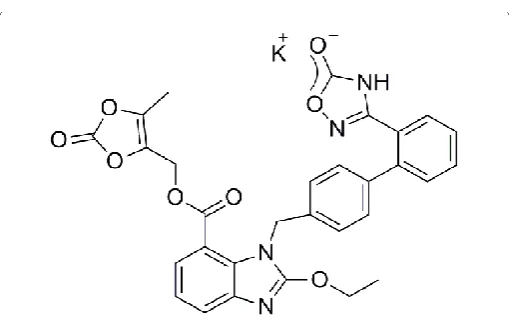
Azilsartan medoxomil chemically (AZM) known as 5-methyl-2-oxo-1,3-dioxol-4-yl) methyl
2-ethoxy-3-[[4-[2-(5-oxo-2~{H}-1,2,4-oxadiazol-3-yl)phenyl]phenyl]methyl]
benzimidazole-4-carboxylate and molecular formula is C25H20N4O5. Azilsartan was practically insoluble in
water but freely soluble in methanol.
Azilsartan Medoxomil is an anti-hypertensive. Azilsartan medoxomil hinders the angiotensin
ii type 1 receptor counteracting angiotensin ii from authoritative and causing
vasoconstriction. Azilsartan's capacity to remain firmly bound to AT1 receptors for extensive
stretches after medication washout is among its most abnormal highlights. Azilsartan
medoxomil decreases the pressure effect of angiotensin II. Accordingly, angiotensin I,
angiotensin II, and renin are expanded while aldosterone is diminished. After oral
administration Azilsartan medoxomil blocks the angiotensin II type 1 receptor preventing
angiotensin II from binding and causing vasoconstriction. In this paper we portray a
straightforward yet quick, particular and exceedingly touchy HPLC strategy, not requiring
test treatment, for assurance of Azilsartan Medoxomil. We also have laid emphasis on the
stability indicating assay method of sample by HPLC.
[image:2.595.170.428.425.593.2]Chemical Structure of Azilsartan Medoxomil
Figure 1: Azilsartan Medoxomil.
2. MATERIALS AND METHOD
2.1 Materials
Azilsartan Medoxomil, Active Pharmaceutical ingredient (API) and working standard was
supplied by Alkem Laboratories (Taloja, Navi Mumbai). Tablet of Azilsartan Medoxomil as
a sample for respected study were provided by the same firm.
2.2 Chemicals and Reagents
SR NO. Chemicals/Solvent Grade
1. Potassium Dihydrogen Phosphate : AR Grade or Equivalent
2. Water : HPLC Grade or Equivalent
3. Methanol : AR Grade
4. Acetonitrile : HPLC Grade
5. Orth phosphoric Acid : AR Grade
2.3 Apparatus and Equipment
A. HPLC Equipped with Pump, UV Detector, Make: Agilent 1100 Series.
B. HPLC Equipped with Pump, Injector and PDA Detector, Make: Agilent 1100series.
C. Analytical Balance, Make: Mettler Toledo.
D. Hot Air Oven, Make: Thermolab.
E. Photo stability Chamber, Make: Newtronic
F. Sonicator, Make: Spectra Lab UCB 300D.
2.4 Chromatographic Conditions
Chromatographic separation was performed on a reverse phase Thermo Fisher Sceintifc C18
Shield. The mobile phase was a mixture of buffer pH 3.0: ACN (55:45) v/v.
Column : Octadecylsilane Column 150 x 4.6 mm,
5µ (Hypertsil BDS C18, or equivalent)
Flow Rate : 1.5 ml/min
Wavelength : 248 nm
Injection Volume : 10 µL
Column Temperature : 40°C
Sample Compartment
Temperature : 10°C
Run Time : 10 min
Retention Time : 6.5 min
2.5 Preparation of buffer pH 3.0
Dissolve 6.8g of Potassium Dihydrogen Orthophosphate in 1000ml of water. Adjust pH to
3.0 with Orthophosphoric acid.
2.6 Preparation of diluent
ACN: Water (75:25).
2.7 Preparation of standard solution
Weigh accurately about 43mg of Azilsartan Medoxomil working standard into 50ml
diluent. Further dilute 5ml of this solution with 50 ml of mobile phase. (maintain cold
condition during processing).
2.8 Analysis of Marketed Formulation
Assay was performed by using tablets of Azilsartan Medoxomil for the preparation of sample
solution 5 tablets were used. Lightly crush 5 tablets into 2-3 pieces. Weigh and transfer five
lightly crush tablets (equivalent about 400mg of Azilsartan Medoxomil) into 50ml volumetric
flask, and add about 20ml of water then sonicate fir 5min with intermittent shaking and add
350ml of diluent and sonicate for about 30min with intermittent shaking and make up the
volume with diluent. Filter through 0.45µ PVDF filter. Further dilute 5ml of this solution to
50ml of mobile phase.
(Maintain cold condition during processing).
3. METHOD VALIDATION
The method was validated for linearity, accuracy, precision, specificity, robustness, filter
paper study, solution stability and forced degradation study.
3.1 Accuracy
Placebo was spiked with the known amount of Azilsartan Medoxomil at 70%. 100% and
130% of test concentration as Azilsartan Medoxomil Tablet (80mg Azilsartan Medoxomil per
tablet). The amount of Azilsartan Medoxomil was quantified as per the test method. The
percentage recovery was calculated from the amount found and the actual amount added.
3.2 Precision
The instrument precision was evaluated by determining the absorbance of the standard
solution six times repeatedly. The outcomes are accounted for as far as relative standard
deviation. The intra-day and inter-day variation for the determination was carried out in
triplicate for the standard solution.
3.3 Linearity
Linearity for AZM performed over range of 5.659 mcg/ml to 10.510mcg/ml (about 70% to
130%) test concentration. A graph was plotted with concentration (in mcg/ml) on X- axis and
peak areas on Y-axis. Slope, Y-intercept, correlation coefficient (r-value) and residual sum of
3.4 Specificity
Specificity is the ability of a method to discriminate between the analyte(s) and other
components in sample. Blank (mobile phase), Placebo, standard and sample solution were
injected into the HPLC system (in triplicate preparation). Volume of 10µl working placebo
sample solution was injected into the chromatogram and chromatogram was recorded.
3.5 Stability in analytical solution
Prepared standard and one sample solution as per test method and injected into HPLC at
initial and different time intervals up to 24 hours and further at 25°C. Determined % assay at
different intervals. The difference in the results shall not be more than 2.0
3.6 Filter paper selection study
Selection of filter paper was evaluated by preparing the assay preparation in triplicate as per
test method. Filtered the test solution through 0.45µm PVDF filter and 0.45µm Nylone filter
analysed the samples against centrifuged a portion of sample solution.
3.7 Robustness
Robustness of proposed method for Azilsartan Medoxomil was carried out by changing the
optimum HPLC conditions set for this method. The small changes include,
a) Flow rate: 10%.
b) pH mobile phase: ± 2.
c) Temperature:± 5°C.
d) Organic content: ± 2 %.
3.8 Force degradation
Force degradation studies were carried out as per ICH guideline. The study was performed by
subjecting the drug substance to acid, alkaline, oxidative, thermal, photolytic and ultraviolet
degradations.
Degradation Condition Condition details
Acid Alkali Oxidation Humidity Thermal U.V.
1 mL of 0.1N HCL at RT 1 mL of 0.01N NaOH at RT
1 mL of 3.0% H2O2 at RT
3.9 System suitability
System suitability for this method was tested by five replicates injections of standard
preparation. Plate tally, following variable, goals and % RSD were accounted for.
3.10 Solution Stability
Solution stability of standard and sample solutions were prepared at room temperature. The
solutions were analysed after 4, 6, 8, 10, 12, 14 hours. The relative standard deviation was
found to be below 2.0% in this method.
3.11 Assay
Percentage labeled amount was found by performing assay. Sample and standard solution of
same concentration were prepared and sample peak area were compared to the standard peak
area.
4. RESULT AND DISCUSSION
An Isocratic reverse - phase HPLC procedure was suggested as a suitable method for the
assay of Azilsartan Medoxomil. In this method development process, many trials were done
with different columns, mobile phase compositions, by changing the buffer and its pH. The
peaks of active ingredient and other additives as well as the degradation product were
separated out by the RP-HPLC method. Complete validation studies for this method proved
them to be specific, linear, robust and reproducible.
4.1 System Suitability
Framework appropriateness was assessed by infusing standard arrangement amid different
long stretches of approval. The tailing factor for the first standard injection and % relative
standard deviation for the peak areas of Azilsartan Medoxomil from five replicate injections
of standard solution were verified at every stage.
The results are tabulated in table -
Retention Time (Mean SEM)
Theoretical plates (n)
Tailing (T)
6.580 7717 1.2
4.2 Linearity
Linearity was established by plotting a graph between concentration verses peak area and the
Table- Linearity data of AZM.
Spike level in % Concentration mcg/ml Area
70 5.659 634352
80 6.468 730908
90 7.276 831166
100 8.085 921123
110 8.893 1003584
120 9.702 1096455
130 10.510 1200335
Slope 114916 y-intercept -12214 r-value 0.99962
RSS 184307183
Linearity plot for Azilsartan.
4.3 Specificity
Blank (mobile phase), Placebo, standard and sample solution were injected into the HPLC
system. There was no interference from the blank and placebo at the retention time of
Azilsartan Medoxomil peak. Peak purity data reveals that Azilsartan Medoxomil peak was
homogeneous and there were no co-eluting peaks at the retention time of Azilsartan
Medoxomil peak.
Sample type Retention Time (min) Peak purity
Standard 6.307 999.995
Control Sample 6.327 999.997
4.4 Method Precision
The precision of method was evaluated by calculating the % RSD of peak areas of six
Method Precision
Sr. No. % Assay
1 102.33 2 102.64 3 103.54 4 102.58 5 102.54 6 103.37 Mean 102.83
SD 0.496
% RSD 0.48
4.5 Method Recovery
The accuracy was carried out using various set of different standard addition method of
different concentration levels, 70%, 100% and 130%, and then comparing the difference
between the spiked value and actual found value.
Table – Method Precision.
Level no/Spike level
in %
Actual Amount of Azilsartan Medoxomil added in
mg
Amount of Azilsartan Medoxomil found in mg
%Recovery Mean SD %
RSD
Level – 1 (70%)
279.61 299.85 100.70
100.81 0.297 0.29
279.70 299.94 100.59
279.93 300.19 101.15
Level – 2 (100%)
400.26 429.23 98.63
98.72 0.090 0.09
400.03 428.98 98.81
400.46 429.44 98.72
Level – 3 (130%)
519.47 557.06 99.08
99.03 0.146 0.15
519.79 557.41 98087
519.36 556.95 99.15
Over all mean 99.52
Over all SD 0.993
Over all % RSD 1.00
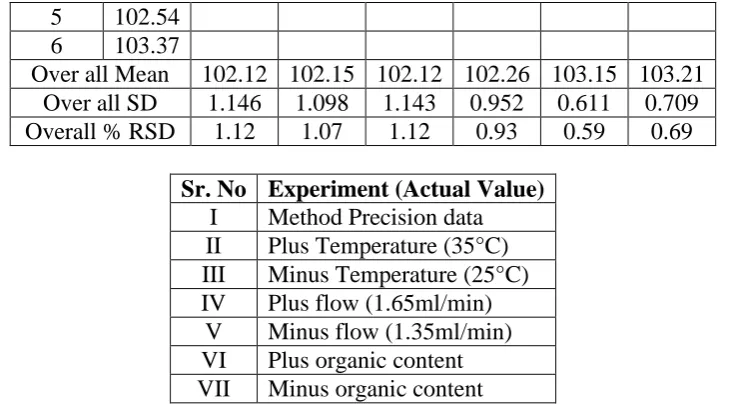
4.6 Method Robustnes
Robustness of proposed method for Azilsartan Medoxomil was carried out by changing the
optimum HPLC conditions set for this method. The percentage recovery and RSD were noted
for Azilsartan Medoxomil.
Sr. No. I II III IV V VI VII
5 102.54 6 103.37
Over all Mean 102.12 102.15 102.12 102.26 103.15 103.21 Over all SD 1.146 1.098 1.143 0.952 0.611 0.709 Overall % RSD 1.12 1.07 1.12 0.93 0.59 0.69
Sr. No Experiment (Actual Value)
I Method Precision data II Plus Temperature (35°C) III Minus Temperature (25°C) IV Plus flow (1.65ml/min)
V Minus flow (1.35ml/min) VI Plus organic content VII Minus organic content
The method is robust for change in flow rate, change in column oven temperature and change
in organic content in mobile phase.
4.7 Solution Stability
Stability of Azilsartan Medoxomil peak in analytical solution was verified by analyzing the
standard solutions and sample solutions, initially and also at different time intervals as
mentioned below by storing in sample compartment of HPLC instrument at 10°C. Calculated
[image:9.595.116.484.71.276.2]the % assay for standard solution and sample solutions.
Table of Solution Stability for standard solution.
Time in hours % Assay Difference
Initial 100.05 -
2 100.17 0.12
4 100.51 0.46
6 100.73 0.68
8 100.48 0.43
10 100.9 0.85
12 100.97 0.92
14 100.85 0.80
Table of Solution Stability for sample solution.
Time in hours % Assay Difference
Initial 3.18 -
2 3.19 0.01
4 3.19 0.01
6 3.19 0.01
8 3.21 0.03
10 3.21 0.03
12 3.21 0.03
The difference in assay in both the standard and sample solutions were within the acceptance
criteria, hence it was concluded that the standard solution and sample solution is stable up to
14 hours at 10°C.
4.8 Force Degradation Studies
Prepared Azilsartan Medoxomil Placebo, AZM API samples were exposed to different stress
conditions to determine peak purity as that of the normal condition. The method was found to
be stability indicating for assay of Azilsartan Medoxomil in Azilsartan Tablet (80mg
Azilsartan Medoxomil per tablet).
Condition % Assay % Degradation Peak Purity
Untreated Sample 100.49 999.997
Acid Treated sample 89.20 11.23 999.941
Base Treated sample 94.71 5.57 999.933
Peroxide Treated sample 87.69 12.74 999.993
Water Treated sample 76.36 23.58 999.996
Heat Treated sample 100.91 -0.42 999.996
UV Treated sample 97.90 1.97 999.998
Humidity Treated Sample 112.89 -12.34 999.965
4.9 Assay
The assay results were about 998-100%. The mean retention time was found 6.5. The results
of assay by using this method indicate that the method is specific for the analysis of
Azilsartan Medoxomil without interference from the excipients used to prepare and formulate
these tablets.
5. CONCLUSION
RP- HPLC method was found to be stability indicating for estimation of Azilsartan
Medoxomil in presence of other degradation products and various excipients used in sold
dosage form. Technique approval results have ended up being particular, exact, precise and
vigorous just as soundness demonstrating. Under FD experiment samples were stressed
various stress conditions and analyzed along with unstressed samples. Therefore, this method
can successfully apply for routine analysis.
ACKNOWLEDGMENT
All the authors thankful to Alkem Laboratories, Taloja- Navi Mumbai, Maharashtra, India for
REFERENCES
1. Paras P. Vekariya and Hitendra S. Joshi. Development and Validation of RP-HPLC
Method for Azilsartan Medoxomil Potassium Quantitation in Human Plasma by Solid
Phase Extraction Procedure. Hindawi. Volume 2013, Article ID 572170, 6 pages.
2. Ramalingam Peraman, Subba Rao Dakinedi2, Rajesh Reddy Kadiri and Lavanya
malineni. Reliable and Sensitive Stability Indicating – Liquid Chromatographic Method
for Determination of Azilsartan Medoxomil and Characterization of Common Hydrolytic
Degradation Product. J Young Pharm, 2017; 9(2): 197-202.
3. Kunal Sharad Surwade and Ravindra Bhanudas Saudagar. Solubility enhancement of
Azilsartan medoxomil using mixed hydrotropy. World journal of pharmacy and
pharmaceutical sciences. Volume, 4: 1167-1179.
4. Madhu Babu Kasimala, Bikshal Babu Kasimala. Reverse phase-HPLC method
development and validation for the Simultaneous estimation of Azilsartan medoxomil and
Chlortalidone in pharmaceutical dosage forms. ISSN – 2277 – 1247. Accepted on: 2012;
29–02.
5. Mohamed A. Kassem, Magdy I. Mohamed and Asmaa A. Mohamed. Development and
validation of a stability indicating assay for Azilsartan kamedoxomil in solid dosage
forms. International journal of advanced research. ISSN: 2320-5407.Published: October,
2016.
6. Jigna Zankat, Mayank Bapna, Jigisha Patel. Development and validation of analytical
method for simultaneous estimation of Azilsartan medoxomil and Amlodipine besylate in
synthetic mixture. ISSN: 2349-7092; 2015, 2(2): 22-29.
7. S. S. Aher, r. B. Saudagar, hemant Kothari. Development and validation of RP-HPLC
method for simultaneous estimation of Azilsartan medoxomil and chlorthalidone in bulk
and tablet dosage form. International Journal of Current Pharmaceutical Research. ISSN-
0975-7066. 2018; 10: 6.
8. B. Sahithi Chowdary*, M. Prasada Rao. Stability indicating method development and
validation for the simultaneous estimation of Azilsartan medoxomil and chlorthalidone by
RP-HPLC in pharmaceutical dosage form. International journal of pharmacy. ISSN
2249-1848. 2014; 4(4): 326-332.
9. Madala Anuradha, Sarad Pawar Naik. B. A novel validated stability indicating RP-HPLC
Method development for determination of Azilsartan medoxomil in its dosage form. Indo
10.Sandeep kumar sohni, robin kumar, mymoona akhtar, chanda ranjan, gita Chawla.
Development and validation of RP-HPLC method for simultaneous estimation of
Azilsartan Medoximil and chlorthalidone in bulk form and formulation using quality by
design. ISSN: 0975-1491, 2016; 8: 2.
11.Dr. R. Srinivasan, J. Kamal Chandra, D. Rajesh Kumar, N. Dushyanth Kumar. Stability
Indicating RP-HPLC Method for Determination of Azilsartan Medoxomil in Bulk and its
Dosage Form. International Journal of Pharmacy and Analytical Research. ISSN:
2320-2831, 2014; 3: 4.
12.Ramesh R Dargad, Jai D Parekh, Rohit R Dargad, Shweta Kukrety. Azilsartan: Novel
Angiotensin Receptor Blocker. Association of Physicians of India, 2016; 64.
13.S. NAAZNEEN, A. SRIDEVI Stability-indicating RP-HPLC method for the
simultaneous estimation of Azilsartan medoxomil and chlorthalidone in solid dosage
forms. International Journal of Pharmacy and Pharmaceutical Sciences ISSN- 0975-1491,
2014; 6: 6.
14.Purnima D. Hamrapurkar and Kamalesh K. Gadapayale. Optimization and Validation of
RP - HPLC Stability Indicating Method for Determination of Olmesartan Medoxomil and
Its Degraded Product. International Journal of Applied Science and Engineering, 2013;
11(2): 137-147.
15.A. Srinivas and Y. Sneha. Stability indicating forced degradation RP-HPLC method
development and validation of Olmesartan medoxomil. International Journal of
Pharmaceutical Sciences and Research. E-ISSN: 0975-8232; P-ISSN: 2320-5148, 2014;
5(7): 2848-2855.
16.Mohammad Yunoos and D. Gowri Sankar. Optimization and validation of RP-HPLC
stability indicating method for simultaneous determination of Olmesartan Medoxomil and
Chlorthalidone in pure drug and pharmaceutical dosage form. Journal of Chemical and
Pharmaceutical Research,ISSN: 0975-7384 2015, 7(3): 2440-2448.
17.Masthanamma S.K., Pradeepthi, Jahnavi. Stability Indicating RP-HPLC Method for
Determination of Azilsartan Medoxomil in Pharmaceutical Dosage Form. Research
Journal of Pharmacy and Technology. ISSN: 0974-4304, 2013; 5(4): 1728-1735.
18.D Sangeetha and M Senthil Kumar, Clinical pharmacokinetics of Azilsartan medoxomil
for the treatment of cardiovascular disease. Institute of Physics Publishing, 2017.
19.Ramesh R Dargad1, Jai D Parekh2, Rohit R Dargad3, Shweta Kukrety4. Azilsartan:
Novel Angiotensin Receptor Blocker. Journal of The Association of Physicians of India,
20.http://www.drugbank.ca/drugs/DB08822.
21.ICH (2003) Stability Testing of New Drug Substances and Products Q1A (R2)
International Conference on Harmonization, IFPMA, Geneva.
22.ICH (1996) Stability testing: Photostability testing new drug substances and products
International Conference on Harmonization, IFPMA, Geneva.
23.ICH (2005) Validation of analytical procedure: text and methodology Q2 (R1), IFPMA,