JOURNAL OF FOREST SCIENCE, 59, 2013 (3): 101–106
Study of briquette properties at their long-time storage
M. Brožek
Faculty of Engineering, Czech University of Life Sciences Prague, Prague, Czech Republic
ABSTRACT: The paper presents the results of laboratory tests aimed at the study of storage place, storage manner and storage time in relation to mechanical properties of briquettes made from spruce shavings. A BrikStar 50 briquetting press with a pressure chamber 65 mm in diameter of the Briklis firm was used for the briquette production. All bri-quettes were made at the constant adjustment of all parameters of the briquetting press. The briquette properties were evaluated by determination of their density and rupture force. Moreover, mechanical durability, gross calorific value, total mois ture and ash content were determined. It follows from the results of tests that at briquette storage in a well closed plastic bag neither place nor storage time influenced significantly their life time. At briquette storage in a net plastic bag various intensive damage to briquettes occurred, mainly depending on their storage place and storage time.
Keywords: spruce shavings; gross calorific value; density; rupture force; moisture content
Briquetting is a relatively old technology. The first mentions of their use were published in the first half of the 18th century. Otto’s Encyclopaedic Dic-tionary describes relatively lengthily the basis and the use of briquetting and of briquettes in practice. The mention of briquetting technology and of bri-quettes can be found in practice in all older as well in new domestic (Stehlík et al. 1966) and foreign encyclopaedias.
In the Czech Republic the briquetting technology has also been used in the field of metallic and non-metallic processing in the last twenty years. The basis of this method is the effect of a high pressure on fine-grained material. Briquettes, most often of cylindrical form and various diameter and length, are the final product. But briquettes can be of vari-ous shape, e.g. of cuboid with rounded corners, of hexagonal cuboid etc., according to the design of the press chamber of the used briquetting press.
The use of briquetting technology can bring about substantial savings. The waste pressed from flamma-ble materials, e.g. from wood waste (chips, sawdust), straw, coal, paper, cellulose, tobacco etc., is mostly utilized energetically (by combustion) (Basore 1929; Sheridan, Berte 1959; Plíštil et al. 2004; Brožek 2011; Brožek et al. 2012). After its compression the waste from combustible materials, e.g. dust col-lected on air filters, abrasion dust (Brožek 2007)
or chips from the cutting of metals and their alloys [ČSN 42 1331 (1991); ČSN 42 0030 (1994); Brožek 2009; Brožek, Nováková 2010] is better usable. Af-ter compression the waste volume strongly decreases. This makes its handling easy and decreases costs of transport or storage on a waste disposal site.
MATERIAL AND METHODS
The tested briquettes were made from spruce shavings. A BrikStar 50 briquetting press (BRIKLIS, Malšice, Czech Republic) with a pressure chamber 65 mm in diameter was used for briquette produc-tion. All briquettes were made at the constant ad-justment of briquetting parameters.
The aim of experiments was to assess the prop-erties of newly made briquettes and of briquettes stored during 9 months under suitable and less suitable conditions. Briquettes were divided into four groups and deposited in the following storage spaces:
– storage space A – in closed heated room, in plas-tic net bag and in plasplas-tic bag,
– storage space B – in closed unheated room, in plastic net bag and in plastic bag.
After sampling the briquettes were numbered, weighed and their length and diameter were mea-sured. Then single briquettes were loaded by pres-sure using the universal tensile strength testing ma-chine (Fig. 1). The rupture force at the split testing was determined.
The briquette density was calculated from the measured values. With regard to the production technology the briquettes are of different length. Therefore their rupture force was recalculated and it is presented as the force per unit.
The determination of mechanical durability [ac-cording to ČSN EN 14961-1 (2010) and ČSN EN 15210-2 (2011)] was a part of our test. Moreover, the gross calorific value [according to ČSN EN 14918 (2010)], ash content [according to ČSN EN 14775 (2010)] and total moisture content [accord-ing to ČSN EN 14774-2 (2010)] were determined.
RESULTS
The gross calorific value of spruce shavings used for briquette production was determined [accord-ing to ČSN EN 14918 (2010)] from three samples,
that is 19.24 ± 0.02 MJ·kg–1. The ash content of spruce shavings was determined [according to ČSN EN 14775 (2010)] also from three samples, that is 0.32 ± 0.03%.
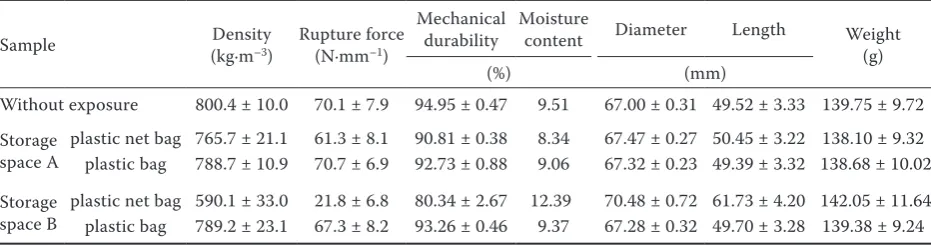
The test results are presented in figures and ta-bles. During the tests the changes in briquette den-sity (Fig. 2a), rupture force (Fig. 2b), mechanical durability (Fig. 2c), moisture content (Fig. 2d), di-ameter (Fig. 2e), length (Fig. 2f) and weight (Fig. 2g) were monitored. In all groups the zone of changes of 10 ± 10% was marked. The real course was not studied; a line was fitted through the initial and fi-nal values. Fig. 9 shows the relationship between the rupture force and the density (the average val-ues from all measurements are plotted). All mea-sured values were evaluated statistically (Table 1).
DISCUSSION
[image:2.595.335.495.55.236.2]It is evident in Fig. 2a and Table 1 that the den-sity of tested briquettes was only 800.4 kg·m–3, which is less than the lower limit set down by Di-rective No. 14-2009 of Ministry of Environment
Table 1. Test results
Sample (kg·mDensity –3) Rupture force (N·mm–1)
Mechanical
durability Moisture content Diameter Length Weight
(g)
(%) (mm)
Without exposure 800.4 ± 10.0 70.1 ± 7.9 94.95 ± 0.47 9.51 67.00 ± 0.31 49.52 ± 3.33 139.75 ± 9.72
Storage
space A plastic net bag 765.7 ± 21.1plastic bag 788.7 ± 10.9 61.3 ± 8.170.7 ± 6.9 90.81 ± 0.3892.73 ± 0.88 8.349.06 67.47 ± 0.27 50.45 ± 3.22 138.10 ± 9.3267.32 ± 0.23 49.39 ± 3.32 138.68 ± 10.02
Storage
[image:2.595.64.530.632.755.2]space B plastic net bag 590.1 ± 33.0plastic bag 789.2 ± 23.1 21.8 ± 6.867.3 ± 8.2 80.34 ± 2.67 12.3993.26 ± 0.46 9.37 70.48 ± 0.72 61.73 ± 4.20 142.05 ± 11.6467.28 ± 0.32 49.70 ± 3.28 139.38 ± 9.24
Fig. 1. Principle of the test of briquette strength
plate
plate briquette
F
F
of the Czech Republic. Considering the fact that briquettes of the same density are commonly mar-keted, the tests were carried out.
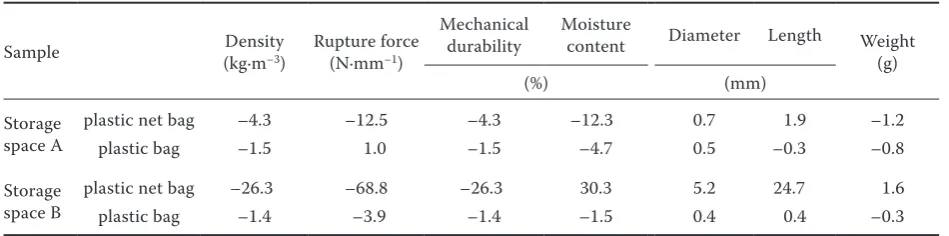
Percentage changes in the studied parameters are presented in Table 2. The values are related to the properties of newly produced briquettes (without exposure). The positive numbers indicate an in-crease in the studied value, the negative numbers show a decrease in the studied value.
[image:3.595.62.535.51.561.2]It is evident in Fig. 2a, Tables 1 and 2 that the briquette density decreased after 9-month storage regardless of the storage space and manner. An in-significant increase in density was determined in briquettes stored in the plastic bag in the closed heated room (space A) as well in the unheated room (space B). A moderately higher decrease in density (by 4.3%), but still meeting the require-ments, was determined in briquettes in the net Fig. 2. Relationship between: (a) briquette density and storage time, (b) briquette rupture force and storage time, (c) briquette mechanical durability and storage time, (d) briquette moisture content and storage time, (e) briquette diameter and storage time, (f) briquette length and storage time, (g) briquette weight and storage time
500 600 700 800 900
0 1 2 3 4 5 6 7 8 9
Densit
y (
kg·m
–3)
Months
storage space A, plastic net bag storage space A, plastic bag storage space B, plastic net bag storage space B, plastic bag
±10% 20 30 40 50 60 70 80
0 1 2 3 4 5 6 7 8 9
Rupture force (N·mm –1) Months D ensity ( kg·m –3) Rupt ur e f or ce ( N·mm –1) 500 600 700 800 900
0 1 2 3 4 5 6 7 8 9
Densit
y (
kg·m
–3)
Months
storage space A, plastic net bag storage space A, plastic bag storage space B, plastic net bag storage space B, plastic bag ±10% 125 130 135 140 145 150 155
0 1 2 3 4 5 6 7 8 9
Weigh t (g) Months W eig ht ( g) Month
0 1 2 3 4 5 6 7 8 9 0 1 2 3 4 5 6 7 8 9
75 80 85 90 95 100
0 1 2 3 4 5 6 7 8 9
Me ch anic al du ral ib ilt y (% ) Months M ec hanic al dura bility ( % )
0 1 2 3 4 5 6 7 8 9
60 62 64 66 68 70 72 74
0 1 2 3 4 5 6 7 8 9
D ia m et er (m m ) Months Di ame ter ( mm )
0 1 2 3 4 5 6 7 8 9
0 1 2 3 4 5 6 7 8 9
6 8 10 12 14
0 1 2 3 4 5 6 7 8 9
M oi st ur e c on te nt (% ) Months M oi st ur e c on ten t ( % )
0 1 2 3 4 5 6 7 8 9
40 45 50 55 60 65
0 1 2 3 4 5 6 7 8 9
Length (m m ) Months Month Leng ht ( mm )
0 1 2 3 4 5 6 7 8 9
(a) (b)
(c) (d)
(e) (f)
plastic bag in the closed heated room (space A). On the contrary, a significant decrease in density (by 26.3%) occurred at briquette storage in the plastic net bag in the closed unheated room (space B). Af-ter 9 months these briquettes do not meet the Di-rective requirements any more.
The following results of measuring the rupture force were determined (Fig. 2b, Tables 1 and 2). Al-though Directive No. 14-2009 of Ministry of Envi-ronment of the Czech Republic does not prescribe the monitoring of this parameter, the results are in-teresting. After briquette storage in the plastic bag and at the split testing (Fig. 1) only a moderate de-crease in the rupture force (by 3.9%) occurred, so that briquettes stored in this way meet the require-ments also after 9-month storage. After 9-month storage in the net bag an unacceptable decrease in the rupture force occurred, namely at their storage in the closed heated room (space A, by 12.5%) as well in the closed unheated room (space B, by 68.8%).
Similar results were obtained in the parameter mechanical durability (Fig. 2c, Tables 1 and 2). In briquettes stored in the plastic bag a relatively small decrease in mechanical durability occurred at storage in the closed heated room (by 1.5%), as well as in the closed unheated room (by 1.4%). At briquette storage in the net bag in the closed heated room a larger but still satisfactory decrease in me-chanical durability (by 4.3%) occurred. At briquette storage in the net bag in the closed unheated room an inacceptable decrease in mechanical durability (by 26.3%) occurred.
The newly made briquettes met the Directive re-quirements when their moisture content was lower than 10%. During the long-term storage changes in this parameter also occurred, as it is evident in Fig. 2d, Tables 1 and 2. In the closed heated room (space A) the moisture content decrease was 4.7% in briquettes stored in the plastic bag and 12.7% in briquettes stored in the plastic net bag. In the closed unheated room (space B) the moisture con-tent decrease at storage in the plastic bag was 1.5%,
but there was a significant increase in moisture content at storage in the plastic net bag (by 30.3%), The moisture content changes are closely related with the air humidity change in the storage space. At the same time, the changes are influenced by the easier (in the plastic net bag) or more difficult (in the plastic bag) access of the ambient atmosphere to stored briquettes.
The changes in briquette size, i.e. changes in bri-quette diameter (Fig. 2e, Tables 1, and 2) and length (Fig. 2f, Tables 1 and 2), are also interesting. At bri-quette storage in the closed heated room (space A) only relatively small size changes occurred (diameter up to 0.7%, length up to 1.9%), regardless of briquette storage in the plastic bag or in the plastic net bag. The changes were practically small at briquette storage in the plastic bag in the closed heated room (diameter 0.4%, length 0.4%). On the contrary, in briquettes stored in the plastic net bag a considerable increase in diameter (by 5.2%) and length (by 24.7%) occurred.
The change in briquette density is in a close rela-tion with the change in size (diameter, length) and especially with the moisture content (Fig. 2g, Ta-bles 1 and 2). But these changes are less significant than the changes in some other parameters.
It follows from evaluation of the above-men-tioned tests that briquette disintegration occurs in the course of long-term storage. Their size (diam-eter, length) become larger, their density as well as the rupture force decrease. Their mechanical du-rability decreases at the same time. The change in the moisture content depends first of all on storage location and conditions. In conclusion it is possible to state that briquettes disintegrate while practi-cally all studied parameters get worse.
It follows from the results of tests that storage time does not have a substantial influence on bri-quette durability, but primarily they are influenced by their storage space and manner. According to the manufacturer’s recommendation dry and heat-ed rooms can be considerheat-ed as suitable spaces. On the contrary, unheated spaces are less suitable.
Bri-Table 2. Changes in studied parameters during briquette storage
Sample (kg·mDensity –3) Rupture force (N·mm–1)
Mechanical
durability Moisture content Diameter Length Weight
(g)
(%) (mm)
Storage space A
plastic net bag –4.3 –12.5 –4.3 –12.3 0.7 1.9 –1.2
plastic bag –1.5 1.0 –1.5 –4.7 0.5 –0.3 –0.8
Storage space B
plastic net bag –26.3 –68.8 –26.3 30.3 5.2 24.7 1.6
[image:4.595.62.537.638.756.2]quettes should always be stored in leakproof closed plastic containers.
It was explicitly proved by the tests that at bri-quette storage in the well closed plastic bag neither storage space (A, B) nor storage time (0 months, 9 months) influenced their quality significantly.
A methodology developed by the author was used for evaluation of the influence of briquette storage place and time on changes in briquette properties. The author does not know any works of other au-thors engaged in this theme. Therefore the results published here could not be compared with other works.
CONCLUSIONS
In this paper results of the study of three factors influencing the briquette mechanical properties at long-time storage are presented. The influence of briquette storage space (closed heated room, closed unheated room) was the first studied fac-tor, the second was the storage manner (plastic bag, plastic net bag) and the third the storage time (new briquettes, briquettes after 9-month storage). Density and destruction force were the criterions for briquette evaluation. Other parameters were also studied at the same time, namely mechanical durability, moisture content, diameter, length and weight of briquettes.
It was unambiguously proved by the tests that the manner of briquette long-term storage has the highest influence on their durability. Briquettes stored in the well closed plastic bag (space A) as well in the less suitable place (space B) changed their properties after 9 months only little (Fig. 3). Briquettes stored in the plastic net bag in the closed heated room (space A) changed their prop-erties more substantially. Briquette storage in the plastic bag in the closed unheated room (space B) can be considered as absolutely unsuitable.
Consid-erable briquette degradation occurred already after 9 months in this way of storage. At the same time, almost all studied parameters deviated from limits laid down by the Directive No. 14-2009 of Ministry of Environment of the Czech Republic.
It follows from the above-mentioned conclusions that briquettes should always be stored in leak-proof well closed plastic containers. If briquettes are supplied by their manufacturers in various con-tainers or even in bulk, it is necessary without delay to transfer them into suitable containers. Only in this way is it possible to guarantee their required properties also after 9-month storage.
References
Basore C.A. (1929): Fuel Briquettes from Southern Pine Sawdust. Auburn, Alabama Polytechnic Institute: 30. Brožek M. (2007). Technicko-ekonomické hodnocení
aplikace návarů u plužních čepelí. [Technic-economical evaluation of the overlays application on the plough shares.] Acta Universitatis Agriculturae et Silviculturae Mendelianae Brunensis, LV: 129–136.
Brožek M. (2009): The turning of overlays using sintered carbide tools. International Journal of Advanced Manu-facturing Technology, 40: 438–446.
Brožek M., Nováková A. (2010): Briquetting of chips from nonferrous metal. In: Malinovska L., Osadcuks V. (eds): Proceedings of the 9th International Scientific Conference Engineering for Rural Development. Jelgava, 27.–28. May 2010. Jelgava, Latvia University of Agriculture, Faculty of Engineering: 236–241.
Brožek M. (2011): Quality evaluation of briquettes made
from biomass. In: Proceedings of the 5th International
Scientific Conference Rural Development 2011. Akademija, 24.–25. November 2011. Akademija, Aleksandras Stulgin-skis University: 308–313.
Brožek M., Nováková A., Kolářová M. (2012): Quality evaluation of briquettes made from wood waste. Research in Agricultural Engineering, 58: 30–35.
Fig. 3. Relation between rupture force and density
Density (kg·m–3)
Rupt ur e f or ce ( N·mm –1)
550 600 650 700 750 800 80 60 40 20 0 0 20 40 60 80
550 600 650 700 750 800
rupt ur e f orc e (N/ mm)
Density (kg · m3)
without exposure storage space A, plastic net bag storage space A, plastic bag storage space B, plastic net bag storage space B, plastic bag
0 20 40 60 80
550 600 650 700 750 800
rupt ur e f orc e (N/m m)
Density (kg · m3)
without exposure storage space A, plastic net bag storage space A, plastic bag
storage space B, plastic net bag storage space B, plastic bag
80 without exposure storage space A, plastic net bag storage space A, plastic bag
storage space B plastic net bag storage space B plastic bag
60
storage space B, plastic net bag storage space B, plastic bag
40 for ce (N/mm) 20 ru pt ur e f 0
550 600 650 700 750 800
Density (kg · m3)
80 without exposure storage space A, plastic net bag storage space A, plastic bag
storage space B plastic net bag storage space B plastic bag
60
storage space B, plastic net bag storage space B, plastic bag
40 for ce (N/mm) 20 ru pt ur e f 0
550 600 650 700 750 800
Plíštil D., Brožek M., Malaťák J., Heneman P. (2004): Heating briquettes from energy crops. Research in Agri-cultural Engineering, 50: 136–139.
Sheridan E.T., Berte V.C. (1959): Fuel-briquetting and Packaged-fuel Plants in the United States that Reported. Washington, U.S. Government Printing Office: 7.
Stehlík V., Vodenka B., Bláha B. (1966): Naučný slovník
zemědělský. [Encyclopaedia Agricultural.] 1st Ed. Praha,
SZN: 1102.
Received for publication April 4, 2012 Accepted after corrections February 13, 2013
Corresponding author:
Prof. Ing. Milan Brožek, CSc., Czech University of Life Sciences Prague, Faculty of Engineering, 165 21 Prague 6-Suchdol, Czech Republic