A STUDY OF E-LEARNING READINESS OF UNIVERSITY
Yogita Navani
Department of Agricultural Communication
Technology, PANTNAGAR
ARTICLE INFO ABSTRACT
Integration of Information and Communication Technologies (ICTs) in education sector has completely changed the dynamics of teaching and learning process; and has undeniable impact on learning outcomes. Consequently, e
the learning outcome as well as expand the learning opportunities. The present study was undertaken to assess the e
Stratified random sampling with proportional allocation method was used to select the respondents. The results obtained indicate that
improvement regarding e
experience, computer literacy, achievement motivation and attitude towards e correlation with e
negative correl
independent variables included in the study sample significantly contributed in their ELR to the extent of 78.4 %. Thus, the study would be a handy guide for any SAU for launc
initiatives in higher agriculture education systems.
Copyright©2016, Yogita Navani and Dr. Ansari. This
unrestricted use, distribution, and reproduction in any medium, provided the original work is properly cited.
INTRODUCTION
There is a common understanding that the twenty will be a more globalized and knowledge advancements in information and communication
(ICTs) have culminated in a new dynamics of teaching and learning, and are providing new ways of interacting and learning. E-learning has emerged as an important educational tool and provided the teachers a new instrument to expand the learning opportunities and enhance the learning outcomes. The explosive growth in Information Technology (IT) and new developments in learning science provides opportunities to createwell-designed,learner-centered, meaningful
and facilitated e-learning environments (Khan, 2005). The higher educational institutions, in order to be relevant and competitive in a globalised networked world, need to invest heavily in ICTs infrastructure and develop appropriate mechanism to advance e-learning readiness o
besides developing a policy framework to promote e The Universities have also recognised the critical importance
*Corresponding author: Dr. M. A. Ansari, Professor,
Department of Agricultural Communication, College of Agriculture, G. B. Pant University of Agriculture & Technology, PANTNAGAR Uttarakhand (India)
ISSN: 0975-833X
Article History:
Received 21st May, 2016
Received in revised form 10th June, 2016
Accepted 15th July, 2016
Published online 20th August,2016
Key words:
ICTs in education, e-learning, e-readiness, e-learning readiness.
Citation: Yogita Navani and M. A. Ansari, 2016.
(08), 35752-35756.
RESEARCH ARTICLE
EARNING READINESS OF UNIVERSITY FACULTY
Yogita Navani and *Ansari, M. A.
Department of Agricultural Communication, College of Agriculture, G. B. Pant University of Agriculture &
Technology, PANTNAGAR-263145, Uttarakhand (India)
ABSTRACT
Integration of Information and Communication Technologies (ICTs) in education sector has completely changed the dynamics of teaching and learning process; and has undeniable impact on learning outcomes. Consequently, e-learning has emerged as an important
the learning outcome as well as expand the learning opportunities. The present study was undertaken to assess the e-learning readiness of teachers of a premier State Agriculture University (SAU) in India. Stratified random sampling with proportional allocation method was used to select the respondents. The results obtained indicate that the teachers of the SAUs under study are ready but needs little improvement regarding e-learning readiness. Further, Teacher’s age, gender, annual income, teaching experience, computer literacy, achievement motivation and attitude towards e
correlation with e-learning readiness (ELR) whereas educational qualification and designation had negative correlation. Further, coefficient of determination (R2
independent variables included in the study sample significantly contributed in their ELR to the extent of 78.4 %. Thus, the study would be a handy guide for any SAU for launc
initiatives in higher agriculture education systems.
This is an open access article distributed under the Creative Commons Att use, distribution, and reproduction in any medium, provided the original work is properly cited.
There is a common understanding that the twenty-first century will be a more globalized and knowledge-based era. The advancements in information and communication technologies (ICTs) have culminated in a new dynamics of teaching and learning, and are providing new ways of interacting and learning has emerged as an important educational tool and provided the teachers a new instrument to expand the g opportunities and enhance the learning outcomes. The explosive growth in Information Technology (IT) and new developments in learning science provides opportunities to centered, meaningfully distributed rning environments (Khan, 2005). The higher educational institutions, in order to be relevant and competitive in a globalised networked world, need to invest heavily in ICTs infrastructure and develop appropriate learning readiness of the teachers besides developing a policy framework to promote e-learning. The Universities have also recognised the critical importance
Professor,
Department of Agricultural Communication, College of Agriculture, G. B. Pant University of Agriculture & Technology, PANTNAGAR-263145,
of e-learning in an institutional setting, and are making effort to be e-ready and also assessing e
teachers as well as students.
innovative shift in the field of learning, providing rapid access to specific knowledge and information, and offers online instruction that can be delivered anytime and anywhere through a wide range of electronic learning solutions such as a web-based courseware and online discussion groups. (2005) observed that explosive growth in Information Technology (IT) and new developments in learning science provides opportunities to create well
centered, meaningful distributed and faci
environments. Nowadays, e-learning has become an accepted educational paradigm across universities worldwide (OECD, 2005). Shu-Sheng Liaw., et al.
of using e-learning as learning and/or teaching tool is now rapidly expanding into education sector.
Definition of e-learning
There are many definitions given to e
(which stands for electronic learning) refers to the use of ICTs to enhance and/or support learning in higher education. Liaw, Huang, and Chen (2007) defined
International Journal of Current Research
Vol. 8, Issue, 08, pp.35752-35756, August, 2016
INTERNATIONAL
“A study of e-learning readiness of university faculty”, International Journal of Current Research
FACULTY
G. B. Pant University of Agriculture &
Integration of Information and Communication Technologies (ICTs) in education sector has completely changed the dynamics of teaching and learning process; and has undeniable impact on learning has emerged as an important educational tool to improve the learning outcome as well as expand the learning opportunities. The present study was undertaken learning readiness of teachers of a premier State Agriculture University (SAU) in India. Stratified random sampling with proportional allocation method was used to select the respondents. the teachers of the SAUs under study are ready but needs little er’s age, gender, annual income, teaching experience, computer literacy, achievement motivation and attitude towards e-learning had a positive learning readiness (ELR) whereas educational qualification and designation had
2
= 0.784) indicated that all the independent variables included in the study sample significantly contributed in their ELR to the extent of 78.4 %. Thus, the study would be a handy guide for any SAU for launching the e-learning
is an open access article distributed under the Creative Commons Attribution License, which permits
learning in an institutional setting, and are making effort ready and also assessing e-learning readiness of teachers as well as students. E-learning represents an innovative shift in the field of learning, providing rapid access to specific knowledge and information, and offers online instruction that can be delivered anytime and anywhere through a wide range of electronic learning solutions such as a based courseware and online discussion groups. Khan explosive growth in Information Technology (IT) and new developments in learning science create well-designed, learner-centered, meaningful distributed and facilitated e-learning
learning has become an accepted educational paradigm across universities worldwide (OECD, . (2007) observed that the trend learning as learning and/or teaching tool is now rapidly expanding into education sector.
There are many definitions given to e-learning. E-learning (which stands for electronic learning) refers to the use of ICTs to enhance and/or support learning in higher education. Liaw, d e-learning as the convergence of
INTERNATIONAL JOURNAL OF CURRENT RESEARCH
technology and learning, and as the use of network technologies to facilitate learning anytime, anywhere. However, in today’s technologically-driven age, e-learning has become an important tool for enhancing the delivery, interaction, and facilitation of both teaching and learning processes. The Commission on Technology and Adult Learning (2001) defined e-learning as instructional content or learning experiences delivered or enabled by electronic technology. With the increasing enrollments of students in higher education institutes/universities every year, it has become imperative to introduce some alternative method of imparting education. Online courses, hybrid courses through e-learning are a solution to this. Swatman (2006) mentioned that for e-learning implementation to succeed there is a need to acknowledge the importance of assessing the readiness of stakeholders (organizations, teachers and learners) to adopt this learning style. E-learning is destined to be the future of learning worldwide as it offers the remarkable advantages of economy besides the enhancement in learning outcomes and academic achievements.
The demand for a well-educated workforce has driven many countries to rethink and redesign their education systems. An education system has to be suited to the demands of the technological age so that a competitive edge can be maintained. Such demand for a technology savvy workforce is reflected in Alvin Toffler’s declaration (in Rosenberg, 2001), that “the illiterate of the 21st century will not be those, who cannot read and write but those who cannot learn, unlearn, and relearn.” This indicates that learning institutions will have to constantly change and adapt in their environments if they are not to lag behind.
E-learning Readiness
As e-learning gains popularity across educational institutions in developing countries, the users’ as well as providers’ readiness will become critical. Aydın and Taşçı’s (2005) observed that it needs to address the issues related to technical readiness, content readiness, human resources readiness and financial readiness. Further, there are demographic factors such as age, education, gender (of providers) that may have an impact on e-learning readiness, and thus are considered as important factors in e-learning readiness. For the present study, e-learning readiness was conceptualised as the ability (competency) of the providers of e-learning (i.e. teachers) in a given context. A number of researchers and theorists have suggested different models/ frameworks which can be used for assessing e-learning readiness organisations across many sectors. In the present study, Comprehensive Organisational e-learning Readiness Instrument (COERI) developed by Retisa Mutiaradevi (2009) for measuring e-learning Readiness in the Forestry Research and Development Agency of Indonesia was used with minor modification to suit the context of present study. The COERI Scale comprised of the following eight indicators: (1) Technological skills readiness (2) Equipment/infrastructure readiness (3) Online learning style readiness (4) Attitude readiness (5) Human resources readiness (6) Cultural readiness (7) Environmental readiness and (8) Financial readiness. These indicators, together, represented the e-learning readiness of an SAU under study.
When implementing e-learning frameworks in an institution of higher education, we need to focus on readiness of teachers which will be critical to its success. They need to be skilled in the use of ICTs and trained in how to develop the course materials for e-learning besides pedagogical approaches. Heinrich (1995), Fullan (1994) and Wang (2002) supported the view that the way a teacher teaches is the product of their own schooling, training and experiences. In this context, user’s acceptance of technology becomes critical in integrating e-learning into the mainstream of educational interventions and learning environment.
Technology Acceptance Model (TAM) given by Davis (1989) was used in predicting the user acceptance of any information technology system and to diagnose design problems before the users actually use this system through two factors: perceived usefulness (PU) and perceived ease of use (PEOU). The core idea of TAM is that user's acceptance of technology is determined by his/her behavioural intention (BI), which in turn is determined by his/her PU and PEOU. Behavioural Intention (BI) is strongly related to the learners’ actual behavior. Theory of Planned Behavior (TPB) is another model by Taylor and Todd (2001) grounded on sociology that has been used to explain social behavior and information use. It lays emphasis on the “perceived ease or difficulty of performing the behavior”. The TPB views the control that people have over their behavior as lying on a continuum from behavior that are easily performed, to those that require considerable effort. Thus, the Theory of Planned Behavior was developed incorporating behavioral control factors in predicting behavior. Tubaishat and Lansari (2011) observed that the evaluation of e-learning readiness is critical for the successful implementation of e-learning as a platform for various learning environments. Success in e-learning can be achieved by understanding the needs as well as the readiness of all stakeholders in a particular e-learning environment. Broadley (2007) observed that teacher’s perception and attitude towards learning also play a critical role in e-learning implementation.
Against this conceptual framework, the present investigation was carried out to measure e-learning readiness of teachers’ in a State Agriculture University (SAU) in Northern India with the following specific objectives.
1. To study socio-personal and psychological characteristics of SAU teachers,
2. To assess their e-learning readiness,
3. To study relationship between socio-personal and psychological characteristics of SAU teachers with their e-learning readiness
Methodology
using stratified random sampling with proportional allocation. Socio-personal characteristics of Teachers were considered critical while studying e-learning readiness. These included Age, Gender, Educational qualification, Designation, Annual income, Teaching experience, Computer literacy, Achievement motivation, Access to internet facility, mobile phone ownership and use, Perceived usefulness, Perceived ease of use, Attitude towards e-learning (taken as independent variables).The e-learning readiness was taken as dependent variable for the study.
The study sample included three designations (Assistant Professor, Associate Professor and Professor) of the faculty members. Stratified random sampling technique with the proportional allocation was used to select the study sample. Following formula was used to determine the sample size from each strata:
nh1= (Nh1/N)*n
where, nh1= sample size for stratum h1
N h1= population size for stratum h1
N = total population size n = total sample size
Following the above stated sampling, the study sample comprising 30 Assistant Professors, 16 Associate Professors and 24 Professors (total sample size, N=70)was finally selected for the present study. A structured questionnaire was used for data collection which included close-ended as well as open-ended questions. It was given to the selected respondents. SPSS 16.0 was used to analyse the collected data.
RESULTS AND DISCUSSION
(1). Socio-personal characteristics of respondents
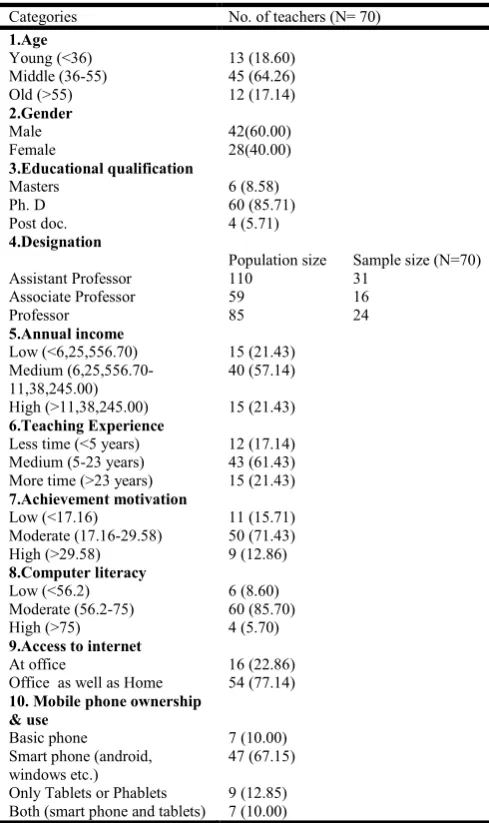
A number of socio-personal characteristics were included in the present study. The results obtained are presented in Table-1. The findings presented in the above table reveals that majority of the respondents (64.28%) belong to the middle age category followed by 18.60% belonging to young age and 17.14% in old age category. Gender-wise, 60% were male teachers and 40% were female. As regards educational qualifications of teachers, a large majority of respondents (85.71%) were having Ph.D. The break-up in respect of annual income reveals that 57.14% belong to ‘medium’ category of annual income, and the remaining 21.43% each in ‘low’ and ‘high’ level of annual income respectively. Further, majority of teachers (61.43%) were in the ‘medium’ category of their teaching experience (5-23 years) followed by 21.43% with more than 23 years of teaching experience, and the remaining had less than 5 years of teaching experience. Further, majority of teachers (71.43%) displayed ‘moderate’ level of achievement motivation followed by 15.71% with ‘low’ and 12.86 % with ‘high’ achievement motivation. A large majority of respondents were found to have ‘high’ computer literacy and more than half (77.14%) of the respondents reported to have access to internet at office and only 22.86% at home. As regards mobile ownership, majority of teachers (67.15%) owned smart phones, and 12% owned Phablet/Tablet. Thus we
[image:3.595.310.555.118.530.2]can conclude that respondents have a varied profile in terms of socio-personal, psychological and technological attributes.
Table 1. Distribution of respondents according to their socio-personal characteristics
Categories No. of teachers (N= 70)
1.Age
Young (<36) 13 (18.60) Middle (36-55) 45 (64.26) Old (>55) 12 (17.14)
2.Gender
Male 42(60.00) Female 28(40.00)
3.Educational qualification
Masters 6 (8.58) Ph. D 60 (85.71) Post doc. 4 (5.71)
4.Designation
Population size Sample size (N=70) Assistant Professor 110 31
Associate Professor 59 16 Professor 85 24
5.Annual income
Low (<6,25,556.70) 15 (21.43) Medium
(6,25,556.70-11,38,245.00)
40 (57.14)
High (>11,38,245.00) 15 (21.43)
6.Teaching Experience
Less time (<5 years) 12 (17.14) Medium (5-23 years) 43 (61.43) More time (>23 years) 15 (21.43)
7.Achievement motivation
Low (<17.16) 11 (15.71) Moderate (17.16-29.58) 50 (71.43) High (>29.58) 9 (12.86)
8.Computer literacy
Low (<56.2) 6 (8.60) Moderate (56.2-75) 60 (85.70) High (>75) 4 (5.70)
9.Access to internet
At office 16 (22.86) Office as well as Home 54 (77.14)
10. Mobile phone ownership & use
Basic phone 7 (10.00) Smart phone (android,
windows etc.)
47 (67.15)
Only Tablets or Phablets 9 (12.85) Both (smart phone and tablets) 7 (10.00) * The data in the parenthesis denotes percentage.
(ii). Technology Acceptance by University Teachers
Whenever any new technology is introduced, people are initially reluctant to adopt as it brings loads of uncertainty. ‘Perceived Usefulness (PU)’ and ‘Perceived Ease of use (PEOU)’ of any particular technology are the two important factors that play critical role in acceptance of technology by the prospective users. It has been reported by Davis (1989) that higher levels of PU and PEOU predicted favourable attitudes which, in turn, predict behavioural intentions to use. Also, the TAM model suggests that users develop a positive attitude toward technology when they perceive it to be useful and easy to use. The results obtained are presented in the following table -3.
remaining belongs to ‘low’ category. Further, the above table reveals that majority of teachers (70%) belongs to ‘moderate’ level and 17.14 % ‘low’ level of perceived ease of use (PEOU) and the remaining belongs to ‘high’ category. Further, the findings in the above table reveal that majority of teachers (64.29%) had ‘neutral’ attitude towards e-learning followed by 18.57 % who hold ‘positive’ attitude and the remaining hold ‘negative’ attitude towards e-learning. As regards behavioural intentions, majority of teachers (61.42%) displayed ‘moderate’ level of behavioral intention followed by 20 % who had ‘low’ and the remaining 18.57% in ‘high’ behavioral intention to use the technology.
(iii). E-learning Readiness
To determine e-learning readiness of SAU, Comprehensive Organisational e-learning Readiness Instrument (COERI) developed by Retisa Mutiaradevi (2009) for measuring e-learning Readiness in the Forestry Research and Development
Agency of Indonesia was used with minor modification to suit the context of present study. The COERI Scale comprised of the following eight indicators: (1) Technological skills readiness (2) Equipment/ infrastructure readiness (3) Online learning style readiness (4) Attitude readiness (5) Human resources readiness (6) Cultural readiness (7) Environmental readiness and (8) Financial readiness. The results obtained are given in the following table-3. The study findings given in the above table reveals that SAU’s overall mean for eight indicators was 3.73 which indicate that the SAU under study is e-Ready but needs few improvements in one or all the components as described above.
[image:4.595.154.442.220.386.2]However, the individual Mean(s) for each component indicates that the SAU under study is ‘ready’ in respect of two indicators - infrastructure readiness, and financial readiness; further, it is ‘ready but needs few improvements’ in respect of technological skills readiness, Online learning readiness, Attitude readiness, environmental readiness and cultural
Table 2. Distribution of respondents according to the variables involved in TAM
Categories No. of teachers (N=70) 1.Perceived Usefulness
Low (<48.11) 10 (14.30) Moderate (48.11-63.57) 44 (62.85) High (>63.57) 16 (22.85)
2.Perceived ease of use
Low (<50.24) 12 (17.14) Moderate (50.24-64.28) 49 (70.00) High (>64.28) 9 (12.86)
3.Attitude towards e-learning
Negative (<35.4) 12 (17.14) Neutral (35.4-49.02) 45 (64.29) Positive (>49.02) 13 (18.57)
4.Behavioral Intention
Low (<20.47) 14 (20.00) Moderate (20.47-29.15) 43 (61.43) High (>29.15) 13 (18.57)
[image:4.595.77.515.424.524.2]* The data in the parenthesis denotes percentage.
Table 3. Distribution of respondents with dimensions of Readiness
Item no e-learning Readiness (ELR): Different dimensions Mean Comments
1 Technological Skills Readiness 3.74 Ready but needs few improvements
2 Online learning style readiness 3.55 Ready but needs few improvements
3 Infrastructure readiness 4.32 Ready go ahead
4 Attitude readiness 3.73 Ready but needs few improvements
5 Human resources readiness 2.83 Not ready needs some work
6 Environmental readiness 3.60 Ready but needs few improvements
7 Cultural readiness 4.19 Ready but needs few improvements
8 Financial readiness 4.24 Ready go ahead
Overall Mean (ELR) 3.73 Ready but needs few improvements
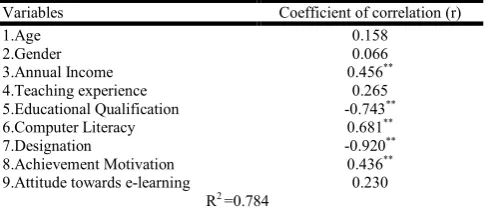
Table 4. Correlation between Socio-personal & Psychological characteristics of teachers and e-learning readiness (N=70)
Variables Coefficient of correlation (r)
1.Age 0.158
2.Gender 0.066
3.Annual Income 0.456**
4.Teaching experience 0.265 5.Educational Qualification -0.743**
6.Computer Literacy 0.681**
7.Designation -0.920**
8.Achievement Motivation 0.436**
9.Attitude towards e-learning 0.230 R2=0.784
[image:4.595.178.424.560.665.2]readiness; and ‘not ready’ in case of Human resources readiness. Thus, the University administrations should draw elaborate plans to enhance the readiness in case of suggested indicators (‘not ready’ and ‘ready but needs few improvements’.
(iv). Relationship between Socio-personal & psychological characteristic and e-learning readiness
The results obtained in respect of relationship between independent variables (socio-personal and psychological characteristics) with dependent variable (e-learning readiness) are presented in following table-4.
The results in the above table clearly reveal that age, gender, annual income, teaching experience, computer literacy, achievement motivation and attitude towards e-learning readiness had positive correlation with total e-learning readiness (ELR) whereas educational qualification and designation had negative correlation. Thus, we can conclude that those teachers who are senior (higher designation) and have high educational qualification do not think positively that e-learning can make an impact on learning outcomes. This is expected and is also a reflection of generation gap. Further, coefficient of determination was also calculated to find out the contribution of independent variables on the variations in dependent variable (ELR). The R2 value (0.784) indicates that 78.4 % variation in the dependent variable was contributed by the selected independent variables. Thus, we can conclude that the teacher’s age, gender, annual Income, teaching experience, educational qualification, computer literacy, designation, achievement motivation and attitude towards e-learning do have significant impact on the e-learning readiness of the teachers.
Conclusion
E-learning represents a paradigm shift in the field of teaching and learning, thereby providing rapid access to specific knowledge and information, and offers online instruction that can be delivered anytime and anywhere through a wide range of electronic learning solutions such as a web-based courseware and online discussion groups. Nowadays, e-learning has become an accepted educational paradigm across universities worldwide (OECD, 2005). However, implementation of any e-learning programme should be preceded by measurement of e-learning readiness as it enables the institutions to design a suitable and appropriate system to fit their requirement. E-learning has emerged as the new form of technological innovation in the education system to ensure quality, access and equity to education. It has a huge potential in bridging the gap created through digital divide. Research on faculty members’ readiness of teaching with e-learning is important, because it can support the expansion of pedagogical practices for professors. An SAU in northern India was studied for assessing e-learning readiness of teachers. The results of the preset investigation reveal various parameters of e-learning readiness of teachers. Besides, the University studied was found to be ‘ready but needs a few improvements’.
The study findings will be able to guide in developing an enabling framework for promoting e-learning in higher agriculture education in the country.
REFERENCES
Aydın, C. and Tasci, D. 2005. Measuring readiness for e-learning: Reflections from an emerging country.
Educational Technology and Society, 8(4): 244-257.
Broadley, T. 2007. Implementation of e-learning: A Case Study of Three Schools, Curtin University of Technology. Retrieved online on 2011-12-17, from http://www.aare.edu. au/07pap/bro07340.pdf.
Commission on Technology and Adult Learning 2001 "E-learning workforce for America's". A vision of report of the Commission on Technology and Adult Learning. Retrieved online from http://www.nga.org/Files/pdf/elearning report.pdf
Cruthers, M. 2008. Education Technology Gives Teachers a Wider Reach. ETNI, 5. Retrieved October 10, 2009, from http://www.etni.org.il/etnirag/issue5/mark_cruthers.htm Davis, F. 1989. Perceived usefulness, perceived ease of use,
and user acceptance of information technology. MIS
Quarterly. 13: 318-340.
Khan B.H. 2005. E-learning: A Quick Checklist. Hershey, PA: Information Science Publishing. Retrieved online from http://BooksToRead.com/checklist.
Liaw, S., Huang, H. and Chen, G. 2007. Surveying instructor and learner’s attitude towards e-learning. Computers &
Education. 49 (4), 1066–1080.
Mutiaradevi, R. 2009. Measuring e-learning Readiness in the Forestry Research and Development Agency of Indonesia OECD. 2005. E-learning in tertiary education: Where do we
stand? Education & Skills, 4, 1–293.
Rosenberg M.J. 2000a. E-learning: Strategies for Delivering
Knowledge in the Digital Age: New York:McGraw-Hill.
Rosenberg M.J. 2000b.The E-learning Readiness Survey. Retrieved online from
Rosenberg M.J. 2001. E-learning: Strategies for Building
Online Learning in theDigitalAge.NewYork:McGraw-Hill.
Swatman, P. 2006. e-learning readiness of Hong Kong teachers. Hong Kong IT in Education Conference 2006“Capacity Building for Learning through IT” (HKITEC2006), February 6-8, 2006, Hong Kong Exhibition and Convention Centre, Hong Kong.
Toro, U. and Joshi, M. 2012. ICT in Higher Education:
International Journal of Innovation, Management and Technology. 3 (1)
Tubaishat, A. and Lansari, A. 2011. Are Students Ready to Adopt E-learning? A Preliminary E-readiness Study of a University in the Gulf Region. International Journal of
Information and Communication Technology Research.1
(5): 210-215 www.books.mcgrawhill.com/training/ elearning/eLearning_Survey.pdf