Chen J and Pawliszyn JB (1995) Solid-phase microextrac-tion coupled to high-performance liquid chromatogra-phy.Analytical Chemistry67: 2530.
Daimon H and Pawliszyn J (1996) High temperature water extraction combined with solid phase mictroextraction. Analytical Communications33: 421.
Eisert R and Levsen K (1996) Solid-phase microextraction coupled to gas chromatography: a new method for the analysis of organics in water.Journal of Chromatogra-phy A733: 143.
Eisert R and Pawliszyn J (1997) New trends in solid-phase microextraction.Critical Reviews in Analytical Chem-istry27: 103.
Fromberg A, Nilsson T, Larsen BRet al. (1996) Analysis of chloro- and nitroanilines and -benzenes in soils by head-space solid-phase microextraction.Journal of Chrom-atography A746: 71.
Hageman KJ, Mazeas L, Grabanski CB et al. (1996) Coupled subcritical water extraction with solid-phase microextraction for determining semivolatile organics in enviornmental solids.Analytical Chemistry68: 3892. Louch D, Motlagh S and Pawliszyn J (1992) Dynamics of
organic compounds extraction from water using liquid-coated fused silica Rbres. Analytical Chemistry 64: 1187.
Nilsson T, Pelusio F, Montanarella L et al. (1995) An evaluation of solid-phase microextraction for analysis of volatile organic compounds in drinking water.Journal of High Resolution Chromatography18: 617.
Nilsson T, Ferrari R and Facchetti S (1997) Inter-laborat-ory studies for the validation of solid-phase microextrac-tion for the quantitative analysis of volatile organic compounds in aqueous samples.Analytica Chimica Acta 356: 113.
Nilsson T, Montanarella L, Baglio Det al. (1998) Analysis of volatile organic compounds in environmental water samples and soil gas by solid-phase microextraction. International Journal of Environmental Analytical Chemistry69: 217.
Pawliszyn J (1997)Solid Phase Microextraction, Theory and Practice. New York: Wiley-VCH.
Pawliszyn J (ed.) (1999)Applications of Solid Phase Micro-extraction. Cambridge: Chromatography Monographs Series, Royal Society of Chemistry.
Zhang Z and Pawliszyn J (1993) Headspace solid-phase microextraction. Analytical Chemistry 65: 1843.
Zhang Z, Yang MJ and Pawliszyn J (1994) Solid-phase microextraction, a solvent-free alternative for sample preparation.Analytical Chemistry66: 844A.
Soxhlet Extraction
M. D. Luque de Castro and L. E. GarceHa Ayuso,
University of CoHrdoba, CoHrdoba, Spain
Copyright^ 2000 Academic Press
The health of our environment is now a matter of great concern. This has stimulated an intensive search for an understanding of both the ways in which the natural environment works and the anthropogenic actions that bring about environmental changes. A large number of studies have been, or are in the process of being, developed in order to increase our knowledge of the processes causing environmental pollution and to propose clean analytical methods for monitoring and subsequent control. Thus, a high per-centage of the studies developed so far fall within the
Reld of analytical chemistry. There are a number of
stages involved in any analytical method: deRnition of
the aim, selection and establishment of an appropri-ate method, sampling plan, sample collection, sample
handling and pretreatment, Rnal measurements
(de-tection/determination), method validation,
assess-ment and interpretation of the results and, Rnally,
safety.
In spite of the evolution of analytical techniques involved in some of the above mentioned stages
(par-ticularly detection/determination), the development
of some of these has not been as great as desirable. These steps constitute ‘critical points’ of an analytical method and, consequently, the main source of errors. The pretreatment step (including separation tech-niques) can be considered as a ‘critical step’. Conven-tional Soxhlet extraction is currently one of the most frequently used pretreatment techniques, not only in
environmental analysis, but also in many otherRelds.
Its principles, performance, environmental applica-tions and improvements are considered in more detail below.
Principles of Conventional Soxhlet
Extraction
Soxhlet extraction is a very useful tool for preparative purposes in which the analyte is concentrated from the matrix as a whole or separated from particu-lar interfering substances. Sample preparation of environmental samples has been developed for dec-ades using a wide variety of techniques. Solvent ex-traction of solid samples, which is commonly known
as solid}liquid extraction (also referred to as leaching
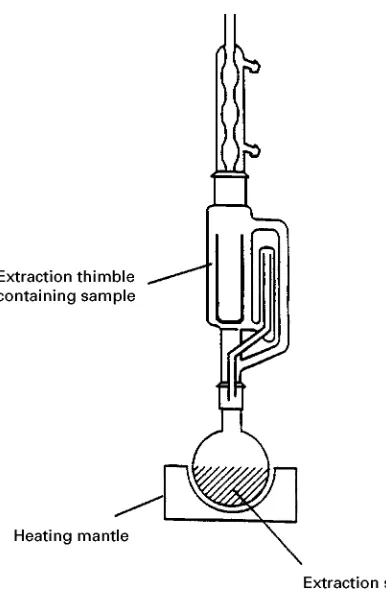
Figure 1 Soxhlet extraction apparatus. (Reproduced from Reeves RN (1994) Environmental Analysis. New York: John Wiley.)
relevant techniques in the environmental extraction
Reld. This assertion is supported by the double use of
conventional Soxhlet: (1) as an extraction step in
a given method, and/or (2) as a well-established
model for comparison of new extraction alternatives. In conventional Soxhlet, the sample is placed in a thimble-holder and during operation is gradually
Rlled with condensed fresh solvent from a distillation
Sask. When the liquid reaches an overSow level,
a siphon aspirates the whole contents of the
thimble-holder and unloads it back into the distillationSask,
carrying the extracted analytes in the bulk liquid. This operation is repeated until complete extraction is achieved. This performance makes Soxhlet a hybrid
continuous}discontinuous technique. Inasmuch as
the solvent acts stepwise, the assembly can be con-sidered as a batch system; however, since the solvent is recirculated through the sample, the system also
bears a continuous character. Figure 1 shows
a scheme of a conventional Soxhlet device. As can be seen, Soxhlet extraction is a very simple technique. This simplicity makes the procedures for different samples very similar. For this reason, an overview of
its extensive application in the environmental Reld
during the last two decades is presented here, which cover the kind of samples, analytes, solvents, etc. used
[image:2.568.56.249.52.349.2]and the role of Soxhlet extraction in the overall ana-lytical process.
Table 1summarizes the main characteristics of
Sox-hlet extraction, clean up and detection/determination
for each group of pollutants discussed below.
Use of Conventional Soxhlet
Extraction for Leaching
of Organic Pollutants
Organic pollutants present in solid environmental samples from natural or man-made sources are most of the time properly extracted with organic solvents in a Soxhlet device. The following sections show how conventional Soxhlet extraction is used as a technique for separation of the analytes from the solid matrix.
The pollutants are classiRed into three groups
de-pending on the matrices in which they are present: air, solid and liquid samples. It is worth noting that, in spite of the solid character of particulates, the
samples are classiRed as a function of the medium in
which they are present. Thus, airborne and water
particulates are classiRed as air and liquid samples,
respectively.
Organic Pollutants in Air
Organic pollutants are in the gas phase of the atmos-phere and are associated with airborne particulate matter. Sampling of organic pollutants is usually
car-ried out byRlters through which a large volume of air
is circulated. After Rltration, the Rlter is extracted
with an appropriate solvent and the target analytes are removed in the extract. When the extract is not
suitable for direct individual separation/
determina-tion a prior clean-up stage must be applied. These and other aspects are discussed below.
Polycyclic aromatic hydrocarbons Polycyclic
aro-matic hydrocarbons (PAHs) and their derivatives are among the most studied environmental pollutants. This is due to both their continuous emissions from combustion and their biological activities, such as toxicity, mutagenicity and carcinogenicity. Deter-mination of PAHs from air requires a suitable samp-ling device, including an aspiration pump, which
retains the air particulates on glass or quartz Rbre,
cellulose or paperRlters. However, theRlter is not the
sole collection medium for PAH-containing small-size aerosols. Chemicals such as Tenax GC, PUFs (see
Table 2 for abbreviations) or Amberlite XAD-2
resins should provide a back up to these Rlters by
retaining PAHs not trapped by theRlter. A layer of
activated charcoal between two Rlters is used for
Ta bl e 1 S e le ct ion of th e m ost re p resen ta ti ve cha ract er ist ics o f met h o ds fo r d e te rmin at ion of o rg a nic p ollu ta n ts w it h S o x h let e x tr act io n a s p re tr e a tm e n t s tep Co mp ou n d Ma tr ix Sa mp lin g S o xh le t fea tu res Cle an u p De tect /Det e rm. S o lven t T ime PA H s PCD Ds / PC D F s PCB s / OC Ps Ph en o ls Be nzidin es Ni tr o s am in es Ph th a la te e st ers Et c. So lid s a mp le s (s o il, s e d im en t, s lud g e , bi ol o g ic al ti s s u e, et c .) Pa rt ic ula tes, v a po u r, smo k e , liq u id sa mp le s Ho mo ge n iza ti o n (mix, gro u n d a n d sieve) Mo is ture con tr o l F ilt er s (g lass o r q u ar tz fibr e ) an d P UF s , XA D res in s , Ten ax G C , e tc . Po la r s pe c ie s Dime th yl fo rm a m id e Te tr a h ydr o fura n Ace to nit rile Ace to ne Me th a n o l Et h a n o l Non -p o la r s p ecies He xa ne Iso -oc ta n e Et h e rs Ligh t p e trole um Ar o m a ti c s Be nzen e To lu e n e Gen e ra l use Dichlor o m e tha n e E thyl a c e ta te Is op ro p y l a lc oh o l C h lo ro fo rm Fro m 8 to 4 8 h de p e nd ing on th e ma tr ix, an a ly te a n d so lv e n t H So rb e n ts A lum in a (no n -p o lar an a ly tes w ith po la r in terfe re n ts ) S ili c a g e l (s tr o n gly p o la r spe c ie s ) Flor is il (a rom at ic a n d al ip h a ti c in ter fe re n ts ) A c ti v a te d c a rbo n (n o n -p o la r a n a ly te s fr om aq u e ou s sam p le s ) H S o lid p ha s e ex tr ac ti o n } (no n-p olar spe ci e s )
C18 C8 Cy
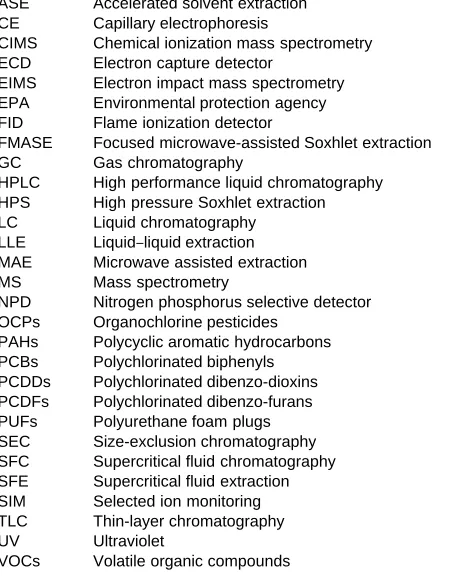
Table 2 Abbreviations
ASE Accelerated solvent extraction CE Capillary electrophoresis
CIMS Chemical ionization mass spectrometry ECD Electron capture detector
EIMS Electron impact mass spectrometry EPA Environmental protection agency FID Flame ionization detector
FMASE Focused microwave-assisted Soxhlet extraction GC Gas chromatography
HPLC High performance liquid chromatography HPS High pressure Soxhlet extraction LC Liquid chromatography
LLE Liquid}liquid extraction MAE Microwave assisted extraction MS Mass spectrometry
NPD Nitrogen phosphorus selective detector OCPs Organochlorine pesticides
PAHs Polycyclic aromatic hydrocarbons PCBs Polychlorinated biphenyls PCDDs Polychlorinated dibenzo-dioxins PCDFs Polychlorinated dibenzo-furans PUFs Polyurethane foam plugs SEC Size-exclusion chromatography SFC Supercritical fluid chromatography SFE Supercritical fluid extraction SIM Selected ion monitoring TLC Thin-layer chromatography UV Ultraviolet
VOCs Volatile organic compounds
The adsorbed compounds are extracted by Soxhlet into different organic solvents such as toluene, ben-zene, cyclohexane, tetrahydrofuran, dichloromethane and liquid CO2. Clean-up extract procedures are mainly performed by the use of silica gel (SFC, LLE and LC are also used), and the individual
separ-ation/determination stage involves HPLC-UV and
GC-MS. A less common technique for PAH deter-mination is TLC-UV.
Polychlorinated dibenzo-dioxins (PCDDs) and
polychlorinated dibenzo-furans (PCDFs) Analysis
of dioxins has become an issue of major importance because of their carcinogenic nature. The main source of dioxin emission is combustion (in waste inciner-ation and the steel industry). In comparison with the wide variety of methods used for the determination of PAHs from air, the method for determination of PCDDs and PCDFs is well established and only some
minor modiRcations are found in the literature. These
compounds are sampled by splitting the air into two
phases. The split involves glass Rbre Rlters, which
retain airborne particulates, and PUF solid sorbents,
which retain vapours. The PUF sorbents are fortiRed
with a range of 13C-labelled PCDDs and PCDFs
be-fore sampling (sometimes spiking precedes the samp-ling step). The same spiked procedure is applied to
particulate phases before extraction. The Rlter and
foam are then extracted by Soxhlet with toluene
(ben-zene/ethanol and dichloromethane have also been
used but less frequently than toluene), followed by an
acid}base clean-up step, then drawing of the extract
through micro-columns of silica gel, alumina and carbon (sometimes a chromatographic clean up is applied before). Individual separation of the analytes and determination are performed by high-resolution
GC}EIMS-SIM.
Polychlorinated biphenyls (PCBs) and other
chlorin-ated compounds A wide variety of pollutants other
than PCDDs and PCDFs contain chlorine. This makes them very harmful due to their activity in the atmosphere. PCBs and other compounds (chlorinated solvents, halogenated methoxybenzenes (halogenated anisoles), polychlorinated naphthalenes, etc.) are the most representative chlorinated compounds in addition to OCPs (alpha and gamma
hexachloro-cyclohexane (HCHs), chlorothalonil, dichloSuanid,
toxaphene, chlorpyrifos, alachlor, etc.).
Sampling of these compounds is similar to that described in the previous two sections and either the adsorbent used or the extraction solvent and post-extraction procedures applied are widely documented in the literature. Thus, the performance of different sorbents, such as Chromosorb 102, Porapak R, Supelpak-2, Amberlite XAD-2, Amberlite XAD-4, Carbonaceous Ambersorb XE-340 and polyurethane foam, has been evaluated with use of atmospheres containing known concentrations of OCPs. The most
efRcient trap for HCH and PCBs was found to be
two cartridges containing PUFs-Tenax-GC sandwich traps, connected in series. Halogenated anisoles and hexachlorobenzene (HCB) have been sampled from air using a high volume sampling technique in which air was pumped through two layers of solid sorbent: the upper sorbent layer was a mixture of silica gel
60/ENVI-Carb or ANGI-Sorb 5B/ANGI-Sorb 10B
and the lower sorbent layer was silica gel 60/
ENVI-Carb or ANGI-Sorb 2.5B. These solid sorbents are Soxhlet extracted with organic solvents, mainly di-chloromethane (but also with others such as petrol-eum ether, ethyl ether, hexane, acetone and mixtures)
and, after the appropriate clean up, the detection/
determination step is developed mainly by GC-ECD.
Other pollutants usually determined in air In
addi-tion to PAHs and chlorinated pollutants from the atmosphere, there are some other families of
pollutants that have a signiRcant effect on the
envi-ronment. Thus, alcohols and phenols,
organophos-phorous compounds, anilines and benzidines,
classiRcation. The procedures for determination and the general characteristics of the chemicals and in-struments used (solid sorbents, extractant, extraction
time, clean up and detection/determination) are
sim-ilar to those discussed in previous sections.
Organic pollutants in solid samples Organic
pollu-tants are present in a wide range of environmental solid samples. Thus, soil, sediment, sewage sludge and ash are the most commonly studied matrices in
the environmental Reld. All these matrices can be
leached by conventional Soxhlet extraction. There are two criteria that solid samples must meet before
extraction: (1) they must beRnely divided (in order to
improve the sample}solvent contact), and (2) sample
moisture must be carefully controlled. After the ex-traction step by an organic solvent, a clean-up pro-cedure is necessary due to the co-extraction of both fat residues and other interferent substances. The usual procedures for analytical processing of the most representative organic pollutants are as outlined below.
Polycyclic aromatic hydrocarbons Soil or sediment
samples are dried to constant weight, ground, sieved and mixed with anhydrous Na2SO4. Soxhlet extrac-tion is performed with dichloromethane
(chloro-benzene, (chloro-benzene, cyclohexane and hexane/acetone
are less common for this purpose) and the extract is
reduced in a Kuderna}Danish concentrator, a
rotary-evaporator or under a N2stream. Clean up (if needed)
involves: (1) passing the extract through one or more microcolumns containing silica gel, alumina, C18,
Florisil, Amberlite XAD-2, etc., and/or (2)
fractiona-tion by semi-preparative normal-phase LC. The PAHs are determined either by HPLC (with UV, MS
or Suorimetric detection) or GC (with FID or MS
detection).
Fly ash is Soxhlet extracted with toluene (or benzene) and the extract is cleaned up by TLC on
a plate coated with silica gel. Detection/
determina-tion involves the same techniques as those used in soil.
Sewage sludge is Soxhlet extracted with toluene.
The extract is evaporated and then, liquid}liquid
par-titioned between cyclohexane, dichloromethane and
H2O. The cyclohexane extract is puriRed on a silica
column. Separation of neutral and polar PAHs is performed by HPLC-UV with individual
separ-ation/determination by GC-FID.
Polychlorinated dibenzo-dioxins and polychlorinated
dibenzo-furans As could be seen in the previous
section, the extraction of PCDDs and PCDFs is usu-ally performed in a single step. The special
character-istics of these compounds makes it mandatory to study them apart from the rest of the chlorinated pollutants. Despite the existence of papers on deter-mination of dioxins and furans from solid matrices such as soil or sediment, the main source of emission in the literature is combustion processes. Here, the
most important solid matrix isSy ash from
inciner-ators. However, the procedure followed for Sy ash
could be applied to other matrices with minor changes of the sample preparation step. Fly ash sam-ples are collected at the bottom of the electrostatic precipitators of the incinerator (this is why they are considered as solid pollutants; however, when ashes are in the atmosphere they are considered as air
pollutants). The Sy ash is treated with 1 N HCl,
Rltered, washed with H2O and air-dried at room
temperature. After addition of 13C-labelled PCDD
and PCDF internal standards, the sample is
Soxhlet-extracted with toluene (benezene and hexane/acetone
have also been used) and the extract is concentrated, then subjected to clean up involving partitioning
with concentrated H2SO4 and sequential LC on
multi-layered silica gel (containing acid-modiRed,
base-modiRed, AgNO3-modiRed and neutral forms
of silica gel), acid alumina and Celite/Carbopack
stationary phases as described in US EPA Method 8280A. A portion of the resulting solution is analysed by high resolution GC-EIMS-SIM.
Polychlorinated biphenyls and other chlorinated
compounds The large number of chlorinated
pollu-tants in solid samples present in the environment
makes their classiRcation and study very difRcult.
However, it has been clearly demonstrated that there are three groups (PCBs, OCPs and polychlorinated phenols), which are the subject of most of the papers found in the literature. Despite that the following paragraphs are devoted to these groups of organic pollutants, the procedures described are also applic-able to the rest of the chlorinated compounds (parti-cularly with regard to Soxhlet extraction).
TheRrst step of the analysis of chlorinated phenolic
compounds in polluted soils is wetting of the sample with H2SO4, followed by Soxhlet extraction with
hexane/acetone or diethyl ether/petroleum ether.
Dif-ferent techniques can be used for subsequent treat-ment of the extract, the most representative being acetylation and LLE. After evaporation, the acetates are cleaned up on a deactivated silica gel column and subjected to GC (with ECD or MS detection). The
chlorophenols are also individually separated/
deter-mined by LC-atmospheric-pressure-CIMS.
high thermal stability, dielectric behaviour, etc.) make them the most frequently used organic com-pounds and, consequently, the greatest environmental pollutant.
As the overall procedures followed for the deter-mination of PCBs and OCPs are similar, both groups are usually determined together. Solid sample prep-aration is similar to that shown for the determination of pollutants from solid samples (see PAHs from soils). Soxhlet extraction is performed with either a single solvent (toluene or dichloromethane) or
a mixture of solvents such as, hexane/acetone,
pen-tane/dichloromethane, etc. Clean up usually involves
sulfur removal by reaction with Cu or
tetrabutyl-ammonium sulRte and the use of silica gel, Florisil
and fractionation by SEC if required. The most usual
way for individual separation/determination of PCBs
and OCPs is GC-ECD.
Other pollutants in solid samples There are some
other pollutants that are frequently determined in solid samples. These compounds (in general, the same as those covered in Organic Pollutants in Air) are usually in trace amounts in the environment. Thus, organic pollutants such as aliphatic hydrocarbons, aldehydes, non-chlorinated phenols, cresols, anilines and benzidines, VOCs (mainly organic solvents), phthalates, amines, non-chlorinated pesticides, etc., are also determined due to their importance in the environment. Soxhlet extraction has shown its suit-ability as a technique for separation of these pollu-tants from solid environmental matrices.
Organic Pollutants in Water
Water is the most important liquid in the environ-ment. A wide range of human activities, such as mining, coal and fuel combustion, industrial and agri-cultural processes, domestic sewage, etc, contribute to the pollution of the aquatic environment. However, the key contribution to water pollution is the solubilization of pollutants. Thus, the study of pollutants in water can be divided into pollutants that are solubilized in water (mainly inorganic pollu-tants) and those present as the solid phases of the aquatic medium, such as sludge, sediment, partic-ulates and biological species (organic and inorganic pollutants).
The way in which sludge and sediment are Soxhlet extracted in order to isolate the analytes from the solid matrix has been discussed in previous sections. This section is therefore devoted to the analysis of organic pollutants (mainly PCBs and pesticides) from water and associated particulates. In spite of the fact that biological samples are also a part of the environ-ment, they are considered to be a matter concerning
biochemistry and toxicology and, therefore, beyond the scope of this article.
It is obvious that Soxhlet extraction is not a suit-able method for direct separation of analytes from liquid sample, but that it must be used after a
pre-viousRltration step. This procedure is very similar to
that followed for air samples. The two phases existing in water within suspension matter samples (liquid
and particulate) are split byRlters (paper, glass-Rbre
or quartz-Rbre) and solid sorbents (PUFs, granular
activated carbon, Aquapak 440A, Separon SE, ODS gel and Amberlite XAD-2, -4 or -7 resins). The solid sorbents and the particulate matter constitute the solid sample to be subsequently extracted by Soxhlet. Collection of the solid matter by centrifugation is an
alternative toRltration. Some of the procedures found
in the literature are discussed below.
PCBs and OCPs are Soxhlet extracted from solid particulate matter with dichloromethane. After silica gel or Florisil clean up in the presence of activated Cu, analyses are developed by GC-ECD (or GC-MS). The determination of organophosphorus and organoni-trogen pesticides in solid particulate matter from sur-face water is developed by dichloromethane Soxhlet extraction and GC-NPD. The determination of PAHs
from water samples requires hexane/acetone Soxhlet
extraction, cleanup on both an Al2O3}Na2SO3
col-umn and silica colcol-umn, andRnally, individual
separ-ation by HPLC andSuorimetric detection.
Many aquatic organisms accumulate pollutants in-side their tissues by bioaccumulation. This behaviour is used in pollution surveillance programmes, due to the following advantages it provides: (1) the analyses of soil, air, water, etc. yield levels of pollutants pres-ent at the time the samples were taken, whereas those
observed in bioaccumulator species reSect the level
over a period of time; and (2) pollutants concentrate in biological species at high levels, and can therefore be monitored by analytical techniques with relatively high detection limits.
The most relevantReld in which biological samples
extraction of the mixture with an organic solvent (depending on the nature of the analytes) is per-formed.
Use of Conventional Soxhlet
Extraction for the Leaching of
Inorganic Pollutants
The application of conventional Soxhlet extraction in
theReld of inorganic pollutants has been developed to
a much less extent than that of organic pollutants. There are in the literature only a few applications of Soxhlet extraction to inorganic compounds. Soxhlet extraction is used mainly as a clean up step prior to the determination of inorganic pollutants with the aim of removing organic substances in the extract. As an exception to this, metals have been determined in the extract after a Soxhlet step. This is possible either when metals are forming organometal compounds or are concentrated by sorption on PUFs impregnated with an organic substance. However, the suitability of Soxhlet extraction for the isolation of inorganic pollutants is poor and some other techniques such as hydrolysis, digestion, distillation, etc. are recommen-ded for this purpose.
Improvements in Soxhlet Extraction
Soxhlet extraction has been the most frequently used technique for isolation of organic pollutants from environmental samples for the last twenty years. However, the use of new extraction techniques that overcome the drawbacks associated with Soxhlet is, today, one of the most promising research lines in the
Reld of solid sample treatment.
The most signiRcant drawbacks of Soxhlet
extrac-tion are the long time required for the extracextrac-tion and the large amount of organic solvent wasted, which is not only expensive to dispose of but which can cause environmental pollution itself. Moreover, the con-ventional device is not easily automated. There are two different ways in which to circumvent the draw-backs of conventional Soxhlet extraction, namely: (1) the use of one of the new alternatives (such as SFE, MAE, ASE, etc.); and (2) the improvement of conven-tional Soxhlet. As this article is devoted to Soxhlet extraction, the following sections discuss only the latter way, that is, improving the shortcomings of the conventional device while keeping its positive characteristics.
High-pressure Soxhlet extraction
High pressure in Soxhlet devices is achieved by plac-ing the extractor in a cylindrical stainless-steel
autoclave or by the use of either commercial or
labor-atory-made supercritical Suid-Soxhlet extractors.
Thus, PAHs and PCBs and be removed from
environ-mental samples using HPS with liquid CO2in
work-ing conditions close to those correspondwork-ing to the supercritical state of the extractant. The main draw-back of this alternative is the change from supercriti-cal to liquid state of the extractant, which affects Soxhlet performance.
Automated Soxhlet (Soxtec HT and BuKchi B811)
Commercial automated Soxhlet devices perform the extraction with similar precision to conventional
Sox-hlet but with a signiRcant saving of time and
extrac-tant. The most relevant characteristic of a Soxtec system is the possibility of developing three different steps, namely, boiling, rinsing and recovery of the solvent, by switching a lever. The B811 extractor is able to perform the same steps as a Soxtec device but it can also work as a conventional Soxhlet. The over-all performance of the B811 extractor is computer controlled. The analysis of organic pollutants from soil and sediments is an example of the methods developed for use with this device.
Focused microwave-assisted Soxhlet extraction (Soxwave and FMASE)
The Soxwave is a commercial system with an opera-tional performance similar to that of Soxtec HT. The system performs the same three steps but with two
signiRcant differences: (1) a different heating source
(microwave instead of electricity) is used; and (2) the sample is also irradiated with microwave energy,
making it easier to rupture the analyte}matrix bonds.
The main drawback of Soxwave is its dependence on
the extractant dielectric constant. Thus, efRcient
ex-tractions are only obtained with polar solvents (due to the characteristics of microwave irradiation) and, consequently, this device is not as universal as a conventional Soxhlet is. Moreover, the energy the analytes receive is at least as high as that necessary to reach the boiling point of the solvent, which can cause degradation of thermolabile analytes. Some ap-plications of Soxwave have been developed in the
environmental Reld and, due to its suitability for
water-based extractions, quantitative extractions have been achieved in the isolation of metals from solid samples such as coal or soils.
Figure 2 Scheme of the FMASE device. (Reproduced with permission from GarcmHa-Ayuso LE and Luque de Castro MD (1999) Analytica Chimica Acta 382: 309.)
Figure 2shows a scheme of the FMASE device. The
similar performance with respect to its conventional counterpart makes FMASE a suitable alternative for almost all the applications developed in a con-ventional Soxhlet, that can be developed without changes, except in the time required for quantita-tive extraction.
FMASE maintains the advantages of conventional Soxhlet extraction while overcoming the limitations, such as the long extraction time, non-quantitative extraction of strongly retained analytes and unsuita-bility for automation. Solvent distillation in FMASE is achieved by electrical heating, which is independent of the extractant polarity, and recycling saves
75}85% of the total extractant volume. The main
drawback in FMASE is the difRculty of using water as
extractant due to its design, as both thermal insula-tion and shortening of the present distillainsula-tion device is mandatory for reception of water vapour on the sample-cartridge vessel, condensation there and dropping on the sample. A comparison between con-ventional Soxhlet and FMASE for leaching of PAHs, herbicides and n-alkanes from soil shows the advant-ages of the latter when compared with the
con-ventional design. FMASE provides efRciencies similar
to those obtained by conventional Soxhlet with ex-traction times at least eight times shorter.
Further Reading
Ballschmeter K (1993) Sample treatment techniques for or-ganic trace analysis.Pure Applied Chemistry55: 1943. FiReld FW and Haines PJ (1995)Environmental Analytical
Chemistry. London: Chapman and Hall.
Luque de Castro MD and Da Silva MP (1997) Strategies for solid sample pretreatment.Trends in Analytical Chem-istry16: 16.
Luque de Castro MD and Garcia-Ayuso LE (1998) Soxhlet extraction of solid materials: an outdated technique with a promising innovative future.Analytica Chimica Acta 369: 1.
Poole CF and Poole SK (1996) Trends in extraction of semivolatile compounds from solids for environmental analysis.Analytical Communications33: 11H. Poole SK, Dean TA, Oudsema JW and Poole CF (1990)
Sample preparation for chromatographic separations: an overview.Analytica Chimica Acta236: 3.
Prichard E, MacKay GM and Points J (1996)Trace Analy-sis:A Structured Approach to Obtaining Reliable Re-sults. Cambridge: The Royal Society of Chemistry. Warner PO (1976)Analysis of Air Pollutants. New York:
John Wiley.
Supercritical Fluid Extraction
V. Camel, Institut National Agronomique
Paris-Grignon,Paris,France
Copyright^ 2000 Academic Press
There has been growing interest in supercriticalSuid
extraction (SFE) in the past few years due to its numerous advantages over liquid extraction (rapid-ity, low solvent volumes, nontoxicity of carbon
diox-ide, great selectivity by modifying the Suid density,
low dilution of the extracts, possibility of online coupling with chromatographic techniques and auto-mation).
Analytical applications of SFE began in the late 1980s, with particular focus on environmental sam-ples. While early reports were on spiked matrices
and/or highly contaminated samples, recent
applica-tions deal with samples containing low levels of in-curred contaminants. It was soon found that extrac-tion condiextrac-tions are strongly dependent on both the solutes and the matrix, so that parameters need to be adjusted for every new application.
This article will focus on the main pollutants
ex-tracted, showing the important parameters that inS
u-ence extraction recoveries, and illustrating the great potential of this technique together with its limitations.
Sample Preparation Prior to
Extraction
To ensure better desorption of analytes from the matrix, several sample treatments can be performed, either physical (e.g. grinding) or chemical (e.g. addi-tion of derivatizaaddi-tion reagents).
Pretreatment of the Sample
This step is of prime importance, as it may greatly
enhance the extraction efRciency.
Solids The moderate water solubility in
supercriti-cal CO2may lead to restrictor plugging; in addition,
water can be detrimental to the extraction of nonpo-lar compounds. Consequently, matrices with a high
water content (typically 75%) require the addition of
a drying agent to the sample (e.g. hydromatrix, a pel-letized diatomaceous earth, magnesium or sodium sulfate). This also enlarges the surface area of the sample. However, the presence of residual water usu-ally favours the extraction of polar compounds.
Grinding the sample should also enhance the ex-traction but, excessive grinding may lead to a pres-sure drop within the extraction cell, thereby decreas-ing the solubility of the analyte at the bottom of the cell. The pressure drop problem may be overcome by
mixing the Rnely ground sample with a coarse
dis-persing agent.
Finally, the presence of sulfur in some matrices (e.g. sediments or sewage sludges) can cause lack of repro-ducibility and restrictor blockages. To overcome these problems, it is suggested to mix the sample with copper prior to extraction to act as sulfur scavenger.
Liquids A few studies have been performed on the
direct SFE of aqueous matrices using a special extrac-tion vessel. However, such analytes are mainly pre-concentrated on to a solid-phase extraction (SPE) disk or cartridge, before being eluted with the
super-critical Suid. This SPE-SFE combination offers
a greater selectivity compared to elution with an
organic solvent (e.g. CO2 at low density selectively
extracts organochlorine pesticides from C18 disks,
while extraction at a higher density in the presence of methanol is required to elute organophosphorus pesticides).
Derivatization Reactions
Extraction of highly polar compounds may be im-proved by coupling derivatization reactions with SFE, to convert polar functions into less polar groups for
better solubility in the Suid. This procedure affords