Hybridisations within a Graph Based
Hyper-heuristic Framework for University
Timetabling Problems
Rong Qu and Edmund K Burke
Automated Scheduling, Optimisation and Planning (ASAP) Group
School of Computer Science, University of Nottingham, Nottingham, NG8 1BB, UK [email protected], [email protected]
Abstract. A significant body of recent literature has explored various research directions in hyper-heuristics (which can be thought asheuristics to choose heuristics). In this paper, we extend our previous work to construct a unified graph based hyper-heuristic (GHH) framework, under which a number of local search based algorithms as the high level heuristics are studied to search upon sequences of low level
graph colouring heuristics. To gain an in-depth understanding on this new framework, we address some fundamental issues concerning neighbourhood structures and characteristics of the two search spaces (namely the search spaces of the heuristics and the actual solutions). Furthermore, we investigate efficient hybridisations in GHH with local search methods and address issues concerning the exploration of the high level search and the exploitation ability of the local search. These, to our knowledge, represent entirely novel directions in hyper-heuristics. The efficient hybrid GHH obtained competitive results compared with the best published results for both benchmark course and exam timetabling problems, demonstrating its efficiency and generality across different problem domains. Possible extensions upon this simple yet general GHH framework are also discussed.
Keywords: university timetabling, graph colouring heuristics, hyper-heuristics, Tabu Search, Variable Neighbourhood Search, Iterated Local Search
1. Introduction
Timetabling Problems
Timetabling problems have been widely investigated in the operational research and artificial intelligence
research communities for more than four decades (e.g. see [16, 45, 49, 53]). They appear in the forms of
educational timetabling (e.g. [5, 20, 23, 24, 44, 45]), nurse rostering (e.g. [10]), sports timetabling (e.g. [29])
and transportation scheduling (e.g. [37]).
This paper is concerned with university (course and exam) timetabling problems, which have attracted
particular attention over the years. They are important administrative activities which have to be addressed
research covering a variety of research issues (e.g. [13, 16, 20, 44, 45, 49, 53]). Specific papers on course
[24] and exam [23] timetabling provide excellent surveys up to 1998 and 1996, respectively. A discussion of
the difference between course and exam timetabling is presented in [4140].
In [16], the goal of a general timetabling problem is defined as being“to assign times and resources to the
meetings so as to satisfy the constraints as far as possible”. This is to assign a set of events (courses or
exams) to a limited timeslots while satisfying a number of constraints. Constraints in university timetabling
can usually be grouped into two types:
Hard Constraints which must be satisfied under any circumstances. For example, conflicting events
(i.e. those courses/exams/meetings with common resources such as students) cannot be scheduled
simultaneously (i.e. xi ≠ xj,i≠ j and Dij> 0; Dij: the number of students in both events iand j; xi: the
time period that event i is assigned). Room capacity needs to be large enough to accommodate all
students (i.e.∑si≤Ct; xi= t; si: number of students taking exami; Ct: room capacity of time periodt).
Solutions which satisfy all of the hard constraints are often calledfeasiblesolutions.
Soft Constraints are desirable but not essential requirements. For example, in exam timetabling, it is
preferable to avoid students sitting two exams in consecutive time periods. On the other hand, in
course timetabling, students may prefer to have consecutive courses.
Soft constraints are usually used to evaluate how good the feasible timetables are. For real world
university timetabling problems, it is usually impossible to find solutions satisfying all the soft constraints.
Indeed, it is sometimes very difficult to just find a solution which satisfies all the hard constraints.
Timetabling problems in their simplified form (i.e. with only the conflicting hard constraints) can be
modelled as graph colouring problems [16]. Graph colouring heuristics represent some of the very early
timetabling approaches (from the 1960s) (e.g. [16, 53]). Constraint based techniques have also been
employed (e.g. [39, 54]) by modelling timetabling problems as Constraint Satisfaction Problems [7].
Meta-heuristics [14, 46] have been very successful over a range of complex timetabling problems in recent
research. These include Tabu Search (e.g. [31, 43, 55]), Simulated Annealing (e.g. [9, 28, 52]) and
Evolutionary Algorithms (e.g. [18, 51]).
Recent new techniques and methodologies on timetabling include Ant Algorithms (e.g. [30, 50]),
Case-Based Reasoning (e.g. [11, 21]), fuzzy reasoning (e.g. [4]), GRASP (e.g. [26]) and hybrid approaches [22].
Innovative neighbourhood design in search algorithms has also obtained some success (i.e. Very Large Scale
Neighbourhood Search [1, 40], multi-neighbourhood search [3] and Variable Neighbourhood Search [2],
etc). An overview of the timetabling literature can be seen by consulting the following papers: [23, 24, 45,
1.2 Hyper-heuristics
Most meta-heuristic [14, 46] implementations need to be fine tuned for solving particular problems, and such
fine-tuned methods do not usually transfer easily to different problems. The definition of hyper-heuristics is
rather simple. They are “heuristics to choose heuristics” [12, 47]. They search upon a search space of
heuristics rather than actual solutions. This implies thatanyheuristics (meta-heuristics and population based
algorithms, etc) could be employed as high level heuristics to operate upon a search space of low level
heuristics, which could also, essentially, be any heuristics. In most of the papers in the literature,
meta-heuristics are employed directly on a solution based search space. There is, of course, the possibility of using
meta-heuristics as the “low level” heuristics (i.e. those to be selected) in a hyper-heuristics approach but, as
far as we are aware, this has never been addressed in the literature.
The heuristics being searched are used (at a lower level) to solve the actual problems. The high level
heuristics choose from a set of low level heuristics rather than dealing with the actual elements in the
problems. The driving motivation behind this newly emerging framework is to raise the generality of search
algorithms in order to solve a wider range of problems. By defining our search spaces upon heuristics rather
than actual solutions, hyper-heuristics avoid dealing with the specific details of problem domains. Domain
knowledge of the actual problems is left to the low level heuristics. The idea is that the high level search
should be more generic. The representation of the search space is usually quite simple (rather than having
complex structures representing problem solutions). The role of the high level search is purely to manage and
learn upon the set of low level heuristics so that they can be adaptively applied to a range of problems.
The idea of hyper-heuristics originated in 1960s, although, at the time, the particular term was not used
[12]. It is thus related to some algorithms, however, is also fundamentally different from most heuristic
approaches. For example, in resource constrained project scheduling [8], permutations of jobs are usually
obtained by using certain (fixed) strategies and jobs are then scheduled one by one in this specific order. In
hyper-heuristics, the aim is to search for a set of (low level) strategies which permute the jobs during the
scheduling to construct high quality solutions. The goal is to learn to adaptively adjust the low level
strategies used at different stages of the scheduling. In [27], a framework was built to integrate multiple
heuristics within a stochastic sampling search algorithm, where online statistical models of the search
performance were used to select heuristics during the search for resource-constrained project scheduling. As
an emerging research direction, the field of hyper-heuristics is also strongly related to some other research in
the literature. In [33], algorithm portfolios were developed where a set of heuristics was used for solving
combinatorial optimisation problems. In [42], reinforcement learning was used to adaptively choose
promising heuristics during the search process within a constraint programming environment for two
Hyper-heuristics have been investigated either on using moving strategies (i.e. [15, 28, 32]) or on using
constructive heuristics [6, 11, 17, 21, 48, 51] as the low level heuristics. In [15], Tabu Search was employed
as the high level heuristic upon a set of moving strategies on both the nurse rostering problems and course
timetabling. A Simulated Annealing hyper-heuristic was developed in [28] to deal with the shipper sizes in
transportation problems. In [32], a distributed choice function was also proposed as a hyper-heuristic for
exam timetabling problems.
Another body of hyper-heuristic work has employed constructive heuristics as the low level heuristics. In
[6], heuristic selection and move acceptance criteria were analysed in depth within a hyper-heuristic for both
optimisation functions and exam timetabling problems. In [21], graph colouring heuristics were selected by
using Case Based Reasoning to order the events upon problem solving situations. A Genetic Algorithm was
also developed in [48] to evolve event picking and slot picking heuristics to construct timetables for both
class and exam benchmark timetabling problems. Issues of representation and fitness functions were also
addressed. Constraint satisfaction strategies were also evolved by using Evolutionary Algorithms in [51] for
constructing exam timetables.
In our previous work [17], the search space under consideration consisted of sequences of graph colouring
heuristics as the low level heuristics. We employed Tabu Search for solving both course and exam
timetabling problems. We also raised the issue of two search spaces in hyper-heuristics. Based on the above
approach, in this paper, we formally define a unified graph based hyper-heuristic (GHH) framework, within
which a number of high level heuristics are analysed systematically to obtain a deeper understanding of the
framework. Important issues on neighbourhood structures and the search space of heuristics, compared with
search space of solutions, are addressed. Within the research covered in the hyper-heuristic literature, to our
knowledge, there is no work which analyses the structure and nature of the search space of heuristics in this
way. Hybridisations of the GHH framework with local search methods within the solution space are also
investigated on both course and exam benchmark timetabling problems. Note that exactly the same GHH is
applied for both problems which are quite different in terms of problem constraints [41]. There are very few
papers in the literature which deal with both problems by using the same system.
1.3 Benchmark Course and Exam Timetabling Problems
The course timetabling problems tested in this paper were generated by the Meta-heuristic Network
(http://www.metaheuristics.net/). The problem set consists of 11 problems in three (small, medium and large)
sizes, where from 100 to 400 courses need to be assigned into 45 timeslots, 9 timeslots per day for 5 days of
a week. Room capacity and features need to be considered to accommodate all the students in a particular
course. We list both the hard and soft constraints in Table 1. The penalty of the feasible timetables generated
INSERT TABLE 1 HERE.
The exam timetabling problems we tested in this paper were first introduced in [25], and have been widely
tested by a number of approaches during the last ten years [45]. The dataset consists of 13 problems from
different institutions, among which 11 have been more heavily investigated because of errors in the other two
problems. A more detailed discussion of those datasets (and the difficulties caused by different instances
circulating under the same name) was given in [45]. The constraints in the problems can be outlined as
follows:
Hard constraint: no conflicting exams (with common students) should be scheduled into the same
timeslot.
Soft constraint: to spread conflicting exams across the timetables.
Table 2 presents the characteristics of the 11 problems in the dataset. The "conflict density" gives the
density of elements with value 1 in the conflict matrix, where element Cij= 1 if eventsiandjconflict, Cij= 0
otherwise. The penalty of the timetable generated is the sum of costs per student, where costs wi,i 0, 1, 2,
3, 4, indicate the timeslots between two conflict exams. More details can be found at
http://www.asap.cs.nott.ac.uk/resources/data.shtml.
INSERT TABLE 2 HERE.
The rest of the paper is organised as follows. The GHH framework is formally presented in Section 2. A
number of high level heuristics are investigated and analysed within this framework in Section 3. In Section
4, we present a hybrid GHH and analyse the search in two search spaces. Experimental results for both the
course and exam benchmark timetabling problems are reported in Section 5. We present our conclusions on
this work in Section 6.
2 The Graph Based Hyper-heuristic Framework
2.1 Graph Colouring Heuristics
Graph colouring heuristics [16] are constructive heuristics which order the events (courses or exams in
timetabling) in terms of difficulty measures. These ordered events are then assigned, one by one from the
most difficult ones, to construct the solutions (timetables). The basic assumption is that the most difficult
events need to be scheduled earlier to avoid causing problems at a later stage. A list of the graph colouring
heuristics widely employed in timetabling is presented in Table 3. For example, if Saturation Degree is used
partial timetable during the solution construction. These ordered exams are scheduled one by one to the
timetable being constructed.
INSERT TABLE 3 HERE.
As simple constructive heuristics, straightforward implementations of graph colouring heuristics on their
own are not appropriate methodologies for addressing complex timetabling problems. Indeed, for some of the
problem instances we are testing in this work, they failed to even generate feasible solutions on their own.
However, recent research has shown that they can be very effectively employed as initialisation methods for
meta-heuristics (e.g. [16]), or intelligently hybridised to solve complex timetabling and optimisation
problems [4, 11, 21] for exam timetabling. This motivates us to investigate using hyper-heuristics to choose
graph colouring heuristics for constructing high quality timetables.
2.2 The Graph Based Hyper-heuristic Approach
In our previous Graph Based Hyper-heuristic (GHH) [17], sequences of graph colouring heuristics (at the
low level) were searched by a Tabu Search and applied to construct timetables. In most of the work on
classical heuristics (such as graph colouring heuristics), solutions are built by assigning events in a specified
order using a single or static strategy. These approaches often failed to obtain even feasible solutions. The
GHH approach searches upon sequences of graph colouring heuristics, which order the events using different
strategies during the solution construction. This can be seen as adaptively employing different and
appropriate heuristics in different problem solving situations.
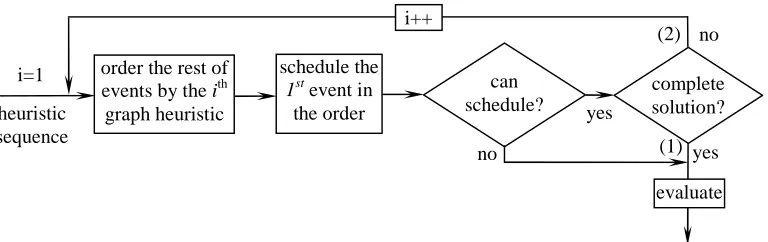
Figure 1 presents the process of the solution construction by using a sequence of graph colouring
heuristics. At iterationi, theith low level graph colouring heuristic in the sequence is employed to order the
events (courses or exams) not yet scheduled by using the corresponding difficulty measuring strategy in
Table 3. For example, if Saturation Degree in the heuristic sequence is employed at the current step of
solution construction, the events that are not yet scheduled are ordered by the number of feasible timeslots
available for the events at that time. Then the most difficult event (the 1st event in the ordered list) is
scheduled into the timetable. In the next step, the next graph colouring heuristic in the heuristic sequence will
be used to reorder the events that are left by using the corresponding (maybe different) difficulty measuring
strategy. This process is repeated until a complete solution is constructed or no further feasible construction
can be made. In this work the same solution construction process is used within the GHH framework.
INSERT FIGURE 1 HERE.
The role of the Tabu Search is to find, at a higher level, the best heuristic sequences to construct the best
objective value for the next step of the Tabu Search. The process is illustrated by the pseudo-code in Figure
2.
INSERT FIGURE 2 HERE.
The GHH approach [17] highlights two search spaces: the search space of high level heuristic sequences
and the search space of solutions. Each of the heuristic sequences in the heuristic search space is used to
construct a complete solution that corresponds to a point in the solution space. The quality of a solution in the
solution space is used in the objective function for the high level heuristic in the heuristic search space. The
GHH approach search is carried out upon combinations of difficulty measuring strategies (heuristic
sequences) rather than actual solutions. The solutions constructed by similar (“close to each other’s
neighbourhood”) heuristic sequences in the heuristic search space may be very different from each other in
the solution space. This means that the GHH may cover solutions across different areas in the solution space
by making neighbourhood moves in the high level search. Note that in most local search based timetabling
methods, search is undertaken by moving just a few events in actual solutions (i.e. being just a few events
apart within a local area). By making a neighbourhood move on heuristic sequences in the GHH high level
heuristic, the solutions constructed have the potential to be far moredifferentfrom each other. The search by
the high level heuristic can be seen as jumping within the solution space. This is because the way of
constructing the solutions is fundamentally changed. With the same amount of moves in the high level
heuristic search, the mapping solutions are (potentially) widely distributed within the solution space.
2.2 Defining the GHH Framework
In this work, we extend the above approach by firstly presenting a formal definition of the GHH framework
as follows:
Given an optimisation problem P, let H be the search space of P, and letf be the objective function that
we are aiming to optimise. A moving operator Ochanges the incumbent solution hH to its neighbourhood
N(h)Hby a moving strategyM. In terms of our timetabling problems, we consider the following problem
and terminology.
Optimisation problem P: to optimise the sequences of graph colouring heuristics h, which are
employed to construct timetables concerning the objective functionf. That isP= minf(h),hH.
Search space H: consists of heuristic sequenceshH.
Objective function f: maps the heuristic sequences to the penalties of the corresponding timetables
constructed (by evaluating the violations of soft constraints).
Neighbourhoods N: N(h)H are all the heuristic sequences h that can be reached by a moving
operatorOapplied onh.
Moving strategy M: a move is taken by using moving operator O and evaluating neighbourhoods N.
This is defined by different high level heuristics.Walks, which accept moves to heuristic sequences of
the same quality, are allowed in the GHH framework.
Low level heuristics: elements (graph colouring heuristics) in the heuristic sequencesh, which are used
to construct timetables.
High level heuristics: different search algorithms upon the search space H using different moving
strategiesM.
3 High Level Heuristics within the GHH Framework
We investigate a number of high level heuristics without any fine-tuning on their parameters (standard
versions of the Steepest Descent method, Tabu Search, Iterated Local Search and Variable Neighbourhood
Search) based on the unified framework defined above. The objective is to compare their performance under
the unified framework with the aim of studying the heuristic search space, rather than fine-tuning them to get
the best solutions. In practice, any of these algorithms can be employed to carry out local search. Five graph
colouring heuristics (presented in Table 3) are employed as the low level heuristics in the framework. Of
course, more constructive heuristics may be employed in the framework and we have investigated the effect
of employing a different number of low level heuristics in the Tabu Search based GHH in [17].
In the context of testing different high level heuristics in this framework, there is no greedy local search
on each complete solution that is generated at each move (as was the case in [17]). The aim is two fold.
Firstly, the high level search in the GHH framework will not deal with the domain knowledge of the actual
problems but rather it will work upon the objective values returned from the low level heuristics. All the
necessary information about problems is dealt with by the low level heuristics. This establishes a certain level
of generality in the GHH framework. Secondly, we would like to compare their behaviour within the unified
framework in order to draw general conclusions about the GHH. Our aim is not to obtain the best possible
results by putting effort into developing problem specific techniques. The goal is to develop methods which
can be immediately used on a broad range of problems than can be achieved at the moment.
We will investigate the performance of different high level heuristics starting from the same initial points
(initial heuristic sequences consisting of only Saturation Degree) and with the same computational cost (the
same total number of evaluations). Walks(which accept heuristic sequences of the same quality) are always
such moves within the search space of heuristic sequences gives more flexibility to the high level search. The
methods that we employ are outlined in the following subsections.
3.1 Steepest Descent method (SDM)
We test a simple SDM where the best heuristic sequence among neighbourhoods is always selected if it is
better than or the same as the current one. The search stops when there is no same or better neighbourhood,
or after a set number of evaluations (which is the same as that used for the other high level heuristics) is
carried out.
3.2 Iterated Local Search (ILS)
In the ILS [38], the search is re-started after a certain number of iterations of SDM. The re-starting point is
made different from the previous one by changing the heuristics at the beginning of the heuristic sequence.
Note that the earlier a different constructive heuristic is employed in the heuristic sequences, the larger the
differences in the solutions generated by them. The aim is to explore wider regions of solution space. Again
the same number of evaluations is set as the stopping condition.
3.3 Tabu Search (TS)
The TS we employ here is similar to that of our previous work [17]. The difference is that we do not carry
out the greedy local search on the complete solutions at each step. The length of the tabu list is set to be 9,
which is determined by empirical experience and suggested by classical settings in the literature [46]. The
search stops after the set number of evaluations is carried out.
3.4 Variable Neighbourhood Search (VNS)
The motivation for employing VNS within the framework is to investigate the effect of employing more
neighbourhood structures upon the performance of the high level search. The VNS employed is an iterative
process where search is re-started after a certain number of walks are made by a standard VNS (see [34, 35]).
The total number of evaluations is set as the same as it is for other high level heuristics.
We define a set of simple neighbourhood structures as randomly changing 2, 3, 4 or 5 heuristics in the
sequence to any other graph colouring heuristics. These neighbourhood structures are simple, general and
easy to implement and are widely employed in different VNS implementations. We do not employ a
swapping neighbourhood because the search is upon heuristics rather than actual solutions. The two
heuristics in the sequence do not have any link/relationship in the way that two events in actual solutions may
have. Swapping two heuristics in the sequence has the same effect as that of changing the two corresponding
4 Hybridisations within the GHH Framework
Based on the GHH framework, we further explore how local search can be hybridised in terms of the search
within the two search spaces. We also further investigate the hypothesis in [17] that only a subset of the
solutions in the solution space can be sampled by the high level search.
4.1 Local Search within the GHH
We study two ways of hybridising the local search, which is a simple greedy search, within the GHH. They
are marked in Figure 1 as (1) and (2), and are described below:
(1) Local Improvement upon Complete Solutions (GHH1): At each step of the high level heuristic, a
complete solution will be generated by a heuristic sequence. A greedy search is implemented on these
complete solutions in the solution space to improve their quality in terms of their respective local optima.
(2) Local Improvement during the Solution Construction (GHH2): During the solution construction by a
heuristic sequence, at each step, the 1stevent in the ordered list is scheduled into the partial solution. The
greedy search is then implemented upon this partial solution to further reduce the costs to the lowest
possible. In the next step of solution construction, the 1st event measured by the next graph colouring
heuristic is scheduled based on the improved partial solution from the last step.
INSERT FIGURE 3 HERE.
We present, in Figure 3, the pseudo-code of the hybrid GHH within a general framework without
specifying a particular high level search algorithm. Instructions marked with a * are optional depending on
the particular high level heuristics or the hybrid local search employed.
4.2 Two Search Spaces within the Hybrid GHH
In the hybrid GHH, two search spaces are involved. They are the search space of high level heuristics upon
heuristic sequences, and the search space of the local search upon actual solutions. That is, not only the
sequences in the search space of heuristics are searched to generate the best possible solutions mapping to
certain solutions in the solution space, but also the mapping solutions are improved by the local search in the
search space of actual solutions. The latter is similar to most of the local search algorithms in the literature
which operate upon a search space of solutions.
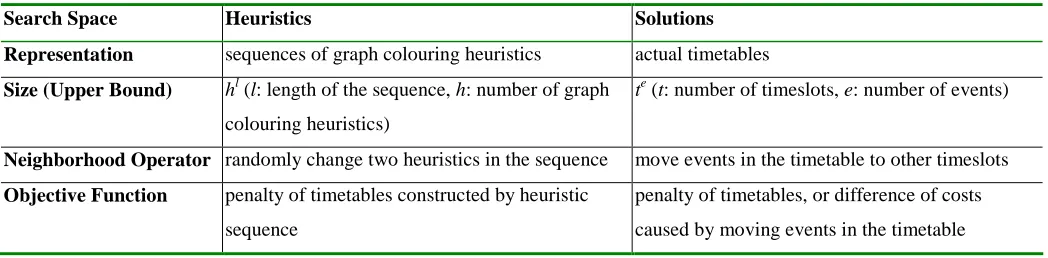
Table 4 presents the characteristics of these two fundamentally different search spaces in the GHH
framework. Not only the representations, but also the upper bounds of the size of the search spaces (including
infeasible points) are different. The objective functions are different. They evaluate the quality of the
the neighbourhood operators, respectively. The neighbourhood operators are also different depending on the
high level heuristics and local search employed in the hybrid GHH framework.
INSERT TABLE 4 HERE.
Also note that in the GHH, at each step, five possible graph colouring heuristics may be used to assign
each event. The upper bound of the size of the heuristic search space is then5e. This is much smaller than
that of the solution space (which iste, wheretis the number of timeslots) because, in practice, the number of
timeslots is usually much higher than 5. This implies that the search of the high level heuristics is carried out
within a much smaller search space. This also further shows that not all of the solutions in the solution space
correspond to sequences in the heuristic space.
4.3 Exploring and Exploiting within the Hybrid GHH
The aim of hybridising local search methods within the GHH framework is twofold. Firstly, along with the
exploration by the high level heuristics (jumpingwithin different areas of the solution space), the local search
moves (in the solution space) to local optima. Secondly, as not all of the solutions can be mapped to the
heuristic sequences, performing a local search can make more solutions in the solution space reachable.
At a higher level, the overall idea of the exploration and exploitation by the hybridisation in GHH is
similar to that of a Memetic Algorithm or genetic local search [36], where recombination and/or mutation on
population facilitates the exploration of the search, while the local search exploits within local regions. The
difference is that in our hybrid GHH the high level heuristic explores the search space of solutions by
searching heuristic sequences in the manner of local search at a higher level. Also in Memetic Algorithms, an
initial population is needed, while the GHH constructs solutions iteratively, thus is not sensitive to
initialisation methods. This makes the hybrid GHH much simpler yet still capable of exploring and exploiting
the search space simultaneously.
5 Experimental Results on Benchmark Timetabling Problems
We carried out two sets of experiments to test the GHH which a) employs different high level heuristics (see
Section 3) and b) is hybridised with local search (see Section 4). Two sets of the widely studied benchmark
course and exam timetabling problems are used (see Section 1.3). These datasets are very different and have
been widely employed by a number of state-of-the-art approaches (but have not been tackled together by one
approach). Our aim with these experiments is not to beat the state-of-the-art approaches in the literature
(although the results are competitive with the best results reported), but to present the potential of this more
optimisation problems. Fundamental issues such as neighbourhood structures and search spaces are also
analysed to gain a deeper understanding of the technique.
5.1 Analysis on the High Level Search Space of Heuristics
Different high level heuristics described in Section 3 are tested on both of the benchmark problems within the
unified GHH framework. Due to the fact that there is no domain knowledge required in the framework, the
only difference in the GHH upon these two different problems is the evaluation functions that are used to
evaluate the solutions generated. This can be easily switched between different problems and this is the key
achievement of the work: to develop a methodology that can be easily switched between different problems.
In both sets of experiments, the best and average results obtained from five runs with distinct seeds are
reported. As the same number of evaluations is set as the stopping condition for all the high level heuristics,
similar computational time is observed for each of these approaches. It is important to note that the purpose
of this section is to investigate the employment of different methods on the heuristic space. We use the
results of this section to produce the better results which are generated by the hybridised method in the next
section.
5.2.1 Course Timetabling Problems
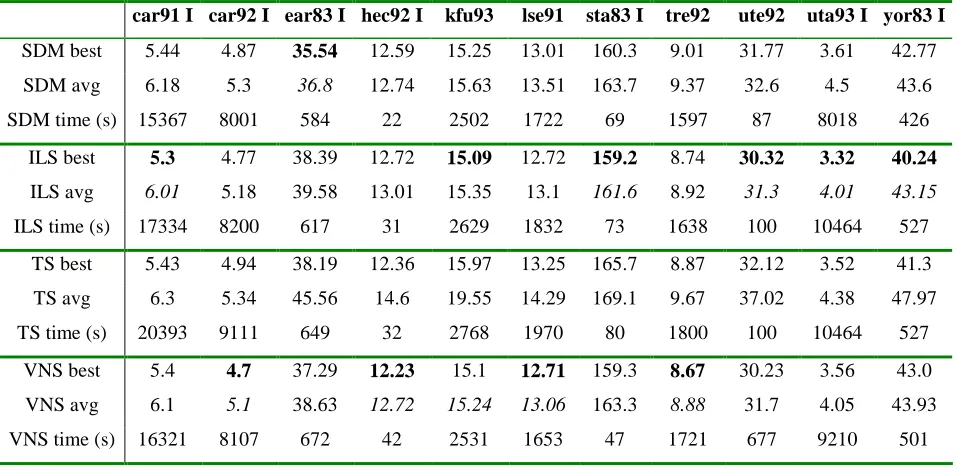
Table 5 presents the best and average results by the GHH employing the Steepest Descent Method (SDM),
Iterated Local Search (ILS), Tabu Search (TS) and Variable Neighbourhood Search (VNS) as the high level
heuristics for the benchmark course timetabling problems. It can be seen that within the unified GHH
framework, most of the high level heuristics (except SDM) perform similarly. VNS obtained the best results
(on a small scale) on 6 out of 11 problems, and the best average results on 5 out of 11 problems.
Another observation is that when GHH is applied to course timetabling problems, some of the soft
constraints (such as soft constraint 3 in Table 1) cannot be evaluated accurately during the solution
construction until a complete solution is generated. This may affect GHH's ability to obtain high quality
solutions for some problems.
INSERT TABLE 5 HERE.
5.2.2 Exam Timetabling Problems
The results on the benchmark exam timetabling problems by the GHH employing SDM, ILS, TS and VNS
are presented in Table 6. It can be observed that, again, all high level heuristics (except SDM) perform quite
similarly. ILS obtained the best results on 6 out of 11 problems and the best average results on 5 out of 11
problems. VNS is the 2ndbest algorithm (again on a small scale though) on these problems, obtaining the best
INSERT TABLE 6 HERE.
5.2.3 Discussion
The comparisons between the different high level heuristics on both course and exam timetabling problems
have shown that high level heuristic moving strategies are not crucial within the unified GHH framework.
Elaborate algorithms such as TS are not effective for searching in the search space of heuristics. Iterative
techniques such as ILS and VNS (which is, overall, an iterative process - see Section 3.4) were shown to be
effective on both the course and exam timetabling problems tested.
The reason is that very large and different areas of the solution space can be covered by relatively small
moves in the heuristic space. With the search in the heuristic space, the chance of the high level search
having better or same quality neighbourhoods is higher than that of local search methods. During the high
level heuristic search, it was observed that a large number of walks were performed before the search
obtained the next better heuristic sequences. The search space of the high level heuristic is more likely to be
smooth and to contain large areas of plateaus where different heuristic sequences can produce similar quality
solutions.
Due to the characteristics of the high level search space of heuristic sequences, we thus conclude that the
role of high level heuristics within the GHH is tosearch quickly within limited areas and to restart iteratively
at different areas. More parts of the solution space (even disconnected from each other) can thus be searched,
which increases the chance of obtaining more high quality solutions in a limited time.
5.3 Analysis of the Hybridisations within the GHH Framework
In this section, the two hybridisations of the GHH (see GHH1 and GHH2 in Section 4.1) are tested on both
benchmark course and exam timetabling problems. Due to the above observations (see subsection 5.2.3), we
employ ILS as the high level heuristic.
5.3.1 Course Timetabling Problems
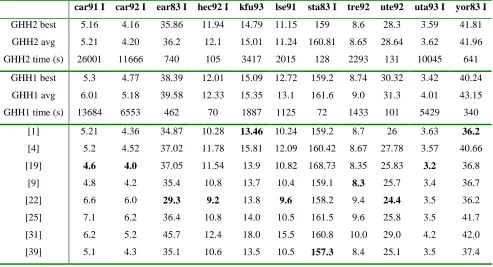
Table 7 presents the results of our hybrid GHH, together with the best results reported in the literature by
different approaches. We can observe that both of the hybrid GHH methods work well. In particular, GHH2
obtained the best and best average results on all of the small instances and two of the medium instances
among all of the approaches reported in the literature. During the experiments of GHH2, we observed that
high quality solutions can usually be obtained fairly quickly after each re-start of the high level ILS. This, in
practice, can significantly reduce the computational time of this hybrid GHH. Also note that for GHH2, the
best and average results on all the problems are very close, meaning that the approach is consistent over
INSERT TABLE 7 HERE.
As explained above, because GHH searches for heuristic sequences to construct solutions, some of the
soft constraints (such as soft constraint 3 in Table 1) cannot be accurately evaluated on the partial solution
built at that time. By hybridising local search upon actual solutions, these soft constraints can be effected on
a complete or a partial solution during the solution construction.
5.3.2 Exam Timetabling Problems
Table 8 presents the results on the benchmark exam timetabling problems by the two hybrid GHH
approaches. Again, GHH2 outperforms GHH1 over all of the problems on average results, and 9 out of 11
problems on the best results. Hybridising local greedy search to carry out exploitive search upon partial
solutions during the solution construction is observed to be more effective than that of on a complete
solution. Again the GHH2 is very consistent on all of the runs with distinct seeds.
INSERT TABLE 8 HERE.
It can be observed that the best results reported in the literature were obtained by different approaches
over the years. Among the 8 approaches compared (which have obtained the best results in the literature on
the benchmarks), our hybrid GHH obtained competitive results. However, the most important point to make
here is that all of the other approaches were specifically designed for the exam timetabling problem. Only our
method, which does not require parameter tuning, can also work well on the course timetabling problem by
simply changing its evaluation function.
6 Conclusions and Future Work
This paper defined a unified graph based hyper-heuristic (GHH) framework. It investigated different high
level heuristics on both benchmark course and exam timetabling problems. Hybridisations of the GHH with
local search methods were also investigated.
We studied the search space of high level heuristics within the GHH framework. Experimental results
indicate that iterative techniques such as Iterated Local Search and Variable Neighbourhood Search are more
effective than Tabu Search and Steepest Descent Method within this GHH framework on both course and
exam timetabling problems. It is observed that by employing neighbourhood moves within the heuristic
search space, the high level search is capable ofjumpingwithin the solution space of problems. The heuristic
sequences cover only a subset (but well distributed areas) of the solution space. It is also observed that the
search space of heuristics is relatively smooth (i.e. it contains a large number of plateaus where solutions
within the limited areas quickly and to explore as widely as possible the solution space by re-starting from
different heuristic sequences within a limited computational time.
We investigated two ways of hybridising the GHH with local search. Of particular interest is the
hybridisation of local search during the solution construction, which can quickly obtain good results for both
benchmark course and exam timetabling problems compared with the different approaches that appeared in
the literature over the years. Compared with the basic GHH, the hybridisation of local search during the
solution construction presented significant improvement on solution quality and computational time.
The comparisons of the characteristics of the two search spaces (of heuristics and of solutions) further
strengthen the views that not all of the solutions in the solution space can be mapped to the heuristic
sequences in the heuristic search space. This implies that the high level search is carried out within a much
smaller search space (of heuristics) but is still able to cover wide areas of the solution space. The hybrid
GHH has the ability of exploring and exploiting within the solution space simultaneously by searching within
the two search spaces.
The hybrid GHH is a more general framework than other timetabling methods. Simple and fast search
techniques can be employed as the high level heuristic and the local search on the solution space without
much tuning effort. In fact, the basic methodology can be applied to any problems that can be modelled as
graph colouring problems. Testing on a wider range of application domains such as general timetabling and
scheduling problems represents a significant direction in our future research. The hyper-heuristic search has a
simple structure and is focused on high level heuristics, leaving much scope for hybridisation with other
techniques. Further in-depth performance analysis and understanding may also lead to general observations
benefiting general meta-heuristic research. For example, knowledge of the good sequences that generate high
quality solutions can be extracted and collected in helping build fundamentally more general approaches for
timetabling and optimisation problems. As an iterative constructive approach, the computational time of
GHH is usually much larger than that of local search improvement algorithms. More knowledge and better
understanding of the GHH framework may further improve the efficiency of this general approach for a
range of optimisation problems.
References
1. Abdullah S., Ahmadi S., Burke E. and Dror M.: Investigating Ahuja-Orlin's Large Neighbourhood Search for Examination TimetablingOR Spectrum,29(2): 351-372, 2007.
3. Abdullah S., Burke E.K. and McCollum B.: Using a Randomised Iterative Improvement Algorithm with Composite Neighborhood Structures for University Course Timetabling. In: Doerner K.F., Gendreau M., Greistorfer P., Gutjahr W.J., Hartl R.F. and Reimann M. (eds.). Computer Science Interfaces Book Series, Springer Operations Research, 2006.
4. Asmuni H., Burke E.K. and Garibaldi J.: Fuzzy Multiple Ordering Criteria for Examination Timetabling. In: Burke E.K. and Trick M. (eds.): Selected Papers from the 5thInternational Conference on the Practice and Theory of Automated Timetabling, Lecture Notes in Computer Science 3616, 334-353, 2005.
5. Bardadym V.A.: Computer-Aided School and University Timetabling: The New Wave. In: Burke E.K. and Ross P. (eds.). Practice and Theory of Automated Timetabling: Selected Papers from the 1stInternational Conference. Springer Lecture Notes in Computer Science 1153. 22-45. 1996.
6. Bilgin B., Özcan E. and Korkmaz E.E.: An Experimental Study on Hyper-Heuristics and Exam Scheduling, In: Burke E.K. and Rudová H. (eds.) Selected Papers from the 6th International Conference on the Practice and Theory of Automated Timetabling, Lecture Notes in Computer Science 3867, 394-412.
7. Brailsford S.C., Potts C.N. and Smith B.M..: Constraint satisfaction problems: Algorithms and applications.European Journal of Operations Research,119: 557- 581, 1999.
8. Brucker P. and Knust S. Complex Scheduling. Springer, 2006.
9. Burke E., Bykov Y., Newall J. and Petrovic S.: A Time-Predefined Local Search Approach to Exam Timetabling Problems. IIE Transactions.36(6): 509-528, 2004.
10. Burke E.K., De Causmaecker P., Vanden Berghe G. and Van Landeghem H.: The State of the Art of Nurse Rostering.Journal of Scheduling,7(6): 441-499, 2004.
11. Burke E.K., Dror M., Petrovic S. and Qu R.: Hybrid Graph Heuristics within a Hyper-heuristic Approach to Exam Timetabling Problems. In: Golden B.L., Raghavan S. and Wasil E.A. (eds.). The Next Wave in Computing, Optimization and Decision Technologies. 79-91. Springer. 2005.
12. Burke E.K., Hart E., Kendall G., Newall J., Ross P. and Schulenburg S.: Hyperheuristics: an Emerging Direction in Modern Search Technology. In: Glover F. and Kochenberger G. (eds).Handbook of Meta-Heuristics, Kluwer 457-474, 2003.
13. Burke E.K., Jackson K., Kingston J.H. and Weare R.: Automated University Timetabling: The State of the Art.The Computer Journal,40(9): 565-571, 1997.
14. Burke E.K. and Kendall G. (eds.): Introductory Tutorials in Optimisation, Decision Support and Search Methodology, Springer, 2005.
15. Burke E.K., Kendall G. and Soubeiga E.: A Tabu Search Hyperheuristic for Timetabling and Rostering.Journal of Heuristics.
9(6): 451-470, 2003.
16. Burke E.K., Kingston J. and de Werra D.: Applications to Timetabling. In: Gross J. and Yellen J. (eds.),Handbook of Graph Theory. Chapman Hall/CRC Press. 445-474, 2004.
17. Burke E.K., McCollum B, Meisels A., Petrovic S. and Qu, R.: A Graph-Based Hyper Heuristic for Timetabling Problems. European Journal of Operational Research,176: 177-192, 2007.
18. Burke E.K. and Newall J.: A Multi-Stage Evolutionary Algorithm for the Timetabling Problem. IEEE Transactions on Evolutionary Computation.3(1): 63-74, 1999.
19. Burke, E.K. and Newall, J.: Solving Examination Timetabling Problems through Adaptation of Heuristic Orderings.Annals of operations Research,129: 107-134, 2004.
21. Burke E.K., Petrovic S. and Qu R.: Case Based Heuristic Selection for Examination Timetabling.Journal of Scheduling,9(2): 99-113, 2006.
22. Caramia M., DellOlmo P. and Italiano G.: New Algorithms for Examination Timetabling. In: Naher, S., Wagner, D. (eds.) Algorithm Engineering, Lecture Notes in Computer Science 1982, 230-241, 2001.
23. Carter M. and Laporte G.: Recent Developments in Practical Exam Timetabling. In: Burke E.K. and Ross P. (eds.): Selected Papers from the 1st International Conference on the Practice and Theory of Automated Timetabling, Lecture Notes in Computer Science 1153, 3-21, 1996.
24. Carter M. and Laporte G.: Recent Developments in Practical Course Timetabling. In: Burke E.K. and Ross P. (eds.): Selected Papers from the 1st International Conference on the Practice and Theory of Automated Timetabling, Lecture Notes in Computer Science 1153, 3-19, 1998.
25. Carter M., Laporte G. and Lee S.: Examination Timetabling: Algorithmic Strategies and Applications.Journal of Operational Research Society,47: 373-383, 1996.
26. Casey S. and Thompson J.: GRASPing the Examination Scheduling Problem. In: Burke, E. and Causmaecker, P. (eds.): Selected Papers from the 4thInternational Conference on the Practice and Theory of Automated Timetabling, Lecture Notes in Computer Science 2740, 232-246, 2003.
27. Cicirello V.A. and Smith S.F.: Heuristic Selection for Stochastic Search Optimization: Modeling Solution Quality by Extreme Value Theory. In: Principles and Practice of Constraint Programming CP 2004, 197-211, 2004.
28. Dowsland K., Soubeiga E. and Burke E.K.: A Simulated Annealing Hyperheuristic for Determining Shipper Sizes.European Journal of Operational Research,179(3): 759-774, 2007.
29. Easton K., Nemhauser G. and Trick M.: Sports Scheduling. In: Leung J. (ed.).Handbook of Scheduling: Algorithms, Models, and Performance Analysis. Chapter 52, CRC Press, 2004.
30. Eley M.: Ant Algorithms for the Exam Timetabling Problem. In: Burke E.K. and Rudova H. (eds). Selected Papers from the 6thInternational Conference on the Practice and Theory of Automated Timetabling, Lecture Notes in Computer Science 3867, 364-382, 2007.
31. Di Gaspero L. and Schaerf A.: Tabu Search Techniques for Examination Timetabling. In: Burke E.K. and Erben W. (eds.): Selected Papers from the 3rdInternational Conference on the Practice and Theory of Automated Timetabling, Lecture Notes in Computer Science 2079, 104-117, 2001.
32. Gaw A., Rattadilok P. and Kwan R.S.: Distributed Choice Function Hyperheuristics for Timetabling and Scheduling. In: Burke E.K. and Trick M. (eds.): Selected Papers from the 5th International Conference on the Practice and Theory of Automated Timetabling, Lecture Notes in Computer Science 3616, 51-67, 2005.
33. Gomes C.P. and Selman B.: Algorithm Portfolios.Artificial Intelligence,126(1-2): 43 - 62, 2001.
34. Hansen P. and Mladenovic N.: Variable Neighbourhood Search: Principles and Applications. European Journal of Operational Research,130: 449-467, 2001.
35. Hansen P. and Mladenovic N.: Variable Neighbourhood Search. In: Burke E.K. and Kendall G. (eds.)Search Methodologies: Introductory Tutorials in Optimisation and Decision Support Techniques. Springer, Chapter 8, 211-238, 2005.
36. Krasnogor N., Aragon A. and Pacheco J.: Memetic Algorithms. In: Marti R. and Alba E. (eds.), Metaheuristics in Neural Networks Learning. Kluwer, 2006.
37. Kwan R.: Bus and Train Driver Scheduling. In: Leung J. (ed.), Handbook of Scheduling: Algorithms, Models, and Performance Analysis, Chapter 51, CRC Press, 2004.
39. Merlot L., Boland N. Hughes B. and Stuckey P.: A Hybrid Algorithm for the Examination Timetabling Problem. In: Burke, E. and Causmaecker, P. (eds.): Selected Papers from the 4thInternational Conference on the Practice and Theory of Automated Timetabling, Lecture Notes in Computer Science 2740, 207-231, 2002.
40. Meyers C. and Orlin J.B.: Very Large-Scale Neighborhood Search Techniques. In: Burke E.K. and Rudova H. (eds.) Selected Papers from the 6th International Conference on the Practice and Theory of Automated Timetabling, Lecture Notes in Computer Science 3867, 24-39, 2007.
41. McCollum B.G.C.: A Perspective on Bridging the Gap in University Timetabling. In: Burke E.K. and Rudová H. (eds.), Selected Papers from the 6thInternational Conference on the Practice and Theory of Automated Timetabling, Lecture Notes in Computer Science 3867, 3-23.
42. Nareyek A.: Choosing Search Heuristics by Non-Stationary Reinforcement Learning. In: Resende M.G.C. and de Sousa J.P. (eds.), Metaheuristics: Computer Decision-Making, Kluwer Academic Publishers, 523-544. 2003.
43. Nonobe K. and Ibaraki T.: A Tabu Search Approach to the Constraint Satisfaction Problem as a General Problem Solver. European Journal of Operational Research,106: 599-623, 1998.
44. Petrovic S. and Burke E.K.: University Timetabling. In: Leung J. (ed.) Handbook of Scheduling: Algorithms, Models, and Performance Analysis, Chapter 45, 2004.
45. Qu R., Burke E.K., B. McCollum, L.T.G. Merlot, and S.Y. Lee. A Survey of Search Methodologies and Automated System Development for Examination Timetabling. Accepted byJournal of Scheduling, 2008. DOI: 10.1007/s10951-008-0060-1. 46. Reeves C.R. (ed.):Modern Heuristic Techniques for Combinatorial Problems. Oxford: Scientific Publications. 1993.
47. Ross P.: Hyper-heuristics. In: Burke E.K. and Kendall G. (eds.)Search Methodologies: Introductory Tutorials in Optimisation and Decision Support Techniques. Springer, Chapter 17, 529-556, 2005.
48. Ross P., Marin-Blazquez J. and Hart E.: Hyper-heuristics Applied to Class and Exam Timetabling Problems. Proceedings of the 2004 congress on evolutionary computation (CEC 2004), 1691-1698.
49. Schaerf A.: A Survey of Automated Timetabling.Artificial Intelligence Review.13(2): 87-127, 1999.
50. Socha K., Knowles J. and Sampels M.: A Max-Min Ant System for the University Course Timetabling Problem. In: Proceedings of the 3rdInternational Workshop on Ant Algorithms, Lecture Notes in Computer Science 2463, 1-13, 2002. 51. Terashima-Marin H., Ross P., Valenzuela-Rendon M.: Evolution of Constraint Satisfaction Strategies in Examination
Timetabling. Proceedings of the Genetic and Evolutionary Computation Conference, 635-642, 1999.
52. Thompson J. and Dowsland K.: A Robust Simulated Annealing Based Examination Timetabling System. Computers & Operations Research,25: 637-648, 1998.
53. de Werra D.: An Introduction to Timetabling.European Journal of Operational Research,19: 151-162, 1985.
54. White G. M.: Constrained Satisfaction, Not So Constrained Satisfaction and the Timetabling Problem. In: Burke E.K. and Erben W. (eds.) Proceedings of the 3rd International Conference on the Practice and Theory of Automated Timetabling, keynote, 32-54, 2000.
Table 1Constraints of the benchmark course timetabling problems
Hard constraints Soft constraints
[image:19.612.75.531.238.323.2]no students can be scheduled to more than one event at the same time a student has a class in the last timeslot of the day the room meets all features required by the event a student has more than two classes in a row no more than one event is allowed per room and per timeslot a student has only one class on a day room capacity is respected
Table 2Characteristics of the benchmark exam timetabling problems
car91I car92I ear83I hec92I kfu93 lse91 sta83I tre92 ute92 uta93I yok83I
exams 682 543 190 81 461 381 139 261 184 622 181
timeslots 35 32 24 18 20 18 13 23 10 35 21
students 16925 18419 1125 2823 5349 2726 611 4360 2750 21266 941
conflict density 0.13 0.14 0.27 0.42 0.6 0.6 0.14 0.18 0.8 0.13 0.29
Table 3Difficulty measuring strategies based upon graph heuristics for timetabling problems
Graph Heuristics Difficulty Measuring Strategy that Orders Events
Largest Degree decreasingly by the number of conflicts the event has with the other events Largest Weighted Degree the same as above but weighted by the number of students involved in the events Largest Enrolment decreasingly by the number of enrolments in the events
Colour Degree decreasingly by the number of conflicts the event has with those already scheduled Saturation Degree increasingly by the number of feasible timeslots available for the event at that time
Table 4Characteristics of the search spaces of the heuristics and solutions in the hybrid GHH
Search Space Heuristics Solutions
Representation sequences of graph colouring heuristics actual timetables
Size (Upper Bound) hl(l: length of the sequence,h: number of graph
colouring heuristics)
te(t: number of timeslots,e: number of events)
Neighborhood Operator randomly change two heuristics in the sequence move events in the timetable to other timeslots
Objective Function penalty of timetables constructed by heuristic
sequence
[image:19.612.68.545.389.494.2] [image:19.612.45.569.558.687.2]Table 5Different high level heuristics in the GHH framework on benchmark course timetabling problems (s1-s5: small problems; m1-m5: medium problems). The best results and the best average results are highlighted and italicised for each problem, respectively. “x%”: the percentage of runs where no feasible solutions can be obtained.
s1 s2 s3 s4 s5 m1 m2 m3 m4 m5 large
SDM best 7 8 3 6 10 368 100% 367 356 195 100%
SDM avg 10.8 15.6 5 11.8 12.2 382.5 100% 383 374.5194.5 100% SDM time (s) 15 38 10 8 30 3823 3672 3752 3637 1989 4013
ILS best 6 9 4 6 8 373 461 375 374 172 1132
ILS avg 8.8 13.25.4 7.6 12 375 480.5 377.5 380.5 179.7114460% ILS time (s) 32 47 15 11 23 3656 3018 3382 3451 1822 3811
TS best 11 11 5 11 16 496 533 460 529 214 1164 TS avg 12.2 16.4 9.2 12.2 18.2 511.5 533 80% 468 539 236 1164 80% TS time (s) 12 18 9 7 19 3326 2996 3160 3280 1650 3564
VNS best 7 12 4 6 6 346 433 359 370 156 1148
[image:20.612.68.547.449.684.2]VNS avg 10 14.8 5.2 8 10.6 365 44340%369.5377.5165.51148 80% VNS time (s) 32 45 16 10 30 3920 3723 3856 3667 2013 4079
Table 6Different high level heuristics in the GHH framework on benchmark exam timetabling problems (the best and best average
results are highlighted and italicised, respectively.)
car91 I car92 I ear83 I hec92 I kfu93 lse91 sta83 I tre92 ute92 uta93 I yor83 I
SDM best 5.44 4.87 35.54 12.59 15.25 13.01 160.3 9.01 31.77 3.61 42.77
SDM avg 6.18 5.3 36.8 12.74 15.63 13.51 163.7 9.37 32.6 4.5 43.6
SDM time (s) 15367 8001 584 22 2502 1722 69 1597 87 8018 426
ILS best 5.3 4.77 38.39 12.72 15.09 12.72 159.2 8.74 30.32 3.32 40.24
ILS avg 6.01 5.18 39.58 13.01 15.35 13.1 161.6 8.92 31.3 4.01 43.15
ILS time (s) 17334 8200 617 31 2629 1832 73 1638 100 10464 527
TS best 5.43 4.94 38.19 12.36 15.97 13.25 165.7 8.87 32.12 3.52 41.3 TS avg 6.3 5.34 45.56 14.6 19.55 14.29 169.1 9.67 37.02 4.38 47.97
TS time (s) 20393 9111 649 32 2768 1970 80 1800 100 10464 527
VNS best 5.4 4.7 37.29 12.23 15.1 12.71 159.3 8.67 30.23 3.56 43.0 VNS avg 6.1 5.1 38.63 12.72 15.24 13.06 163.3 8.88 31.7 4.05 43.93
Table 7 State-of-the-art approaches and GHH hybridising local search (GHH1: on complete solutions; GHH2: during solution construction) on benchmark course timetabling problems. “x/y": the percentage x that cannot obtain feasible solutions, and the best result y of feasible solutions. The best results and the best average results are highlighted and italicised, respectively.
s1 s2 s3 s4 s5 m1 m2 m3 m4 m5 large
GHH1 best 0 0 0 0 0 257 259 192 235 112 0.8/1132
GHH1 avg 0.2 0.6 0 0.4 0.1 261 273 214.5 242 116 1135
GHH1 time (s) 50 54 48 45 65 19411 15750 18512 18782 9725 20328
GHH2 best 2 2 1 1 0 310 419 332 324 162 0.8/1162
GHH2 avg 2.6 2.8 1 3 2.6 323 428 345 335 182 1162
GHH2 time (s) 155 218 240 171 260 62115 50403 57387 65821 36955 81148
ANT [50] 1 3 1 1 0 195 184 248 164.5 219.5 851.5
CNS [3] 0 0 0 0 0 242 161 265 181 151 757
TS-HH [15] 1 2 0 1 0 146 173 267 169 303 1166 80%
RRLS [50] 8 11 8 7 5 199 202.5 77.5% 177.5 100% 100%
VNS [2] 0 0 0 0 0 317 313 357 247 292 929
Table 8 State-of-the-art approaches and GHH hybridising local search (GHH1: on complete solutions; GHH2: during solution
construction) on benchmark exam timetabling problems. A selection of appropriate methods which includes those that generate the best results among all of the approaches in the literature are highlighted.
car91 I car92 I ear83 I hec92 I kfu93 lse91 sta83 I tre92 ute92 uta93 I yor83 I
GHH2 best 5.16 4.16 35.86 11.94 14.79 11.15 159 8.6 28.3 3.59 41.81 GHH2 avg 5.21 4.20 36.2 12.1 15.01 11.24 160.81 8.65 28.64 3.62 41.96
GHH2 time (s) 26001 11666 740 105 3417 2015 128 2293 131 10045 641
GHH1 best 5.3 4.77 38.39 12.01 15.09 12.72 159.2 8.74 30.32 3.42 40.24 GHH1 avg 6.01 5.18 39.58 12.33 15.35 13.1 161.6 9.0 31.3 4.01 43.15
GHH1 time (s) 13684 6553 462 70 1887 1125 72 1433 101 5429 340
[1] 5.21 4.36 34.87 10.28 13.46 10.24 159.2 8.7 26 3.63 36.2
[4] 5.2 4.52 37.02 11.78 15.81 12.09 160.42 8.67 27.78 3.57 40.66
[19] 4.6 4.0 37.05 11.54 13.9 10.82 168.73 8.35 25.83 3.2 36.8
[9] 4.8 4.2 35.4 10.8 13.7 10.4 159.1 8.3 25.7 3.4 36.7
[22] 6.6 6.0 29.3 9.2 13.8 9.6 158.2 9.4 24.4 3.5 36.2
[25] 7.1 6.2 36.4 10.8 14.0 10.5 161.5 9.6 25.8 3.5 41.7
[31] 6.2 5.2 45.7 12.4 18.0 15.5 160.8 10.0 29.0 4.2 42.0
[image:21.612.61.554.413.680.2]Figure 1Solution construction by a sequence of graph heuristics
Figure 2Pseudo-code of the graph based hyper-heuristic
Figure 3The hybrid GHH framework
initialisation of the heuristic sequence hl
// Tabu Search upon heuristic sequences for i = 0 to i = the number of iterations
h = change two heuristics in heuristic sequence hl //a move in Tabu Search if h is not in the tabu list
construct a complete solution using heuristic sequence h (see Figure 1) if penalty of solution c < the least penalty cg obtained
save the best solution, cg = c
update the tabu list
hl = h
//end if
//end of Tabu Search
output the best solution with penalty of cg
initialisation of the heuristic sequence hl = {h1 h2 … hk} //k: number of events
// high level search upon heuristic sequences for i = 0 to i = the number of iterations
*multiple starts in Iterated Local Search //optional
h = change upon heuristic sequence hl //a move in the high level search
//construct solution using heuristic sequence h
for j = 0 to j = k //k: length of heuristic sequence schedule an event using heuristic hj
*(2) local improvement on the partial solution (see (2) in Figure 1)
*(1) local improvement on complete solution (see (1) in Figure 1) if penalty of solution c <= the least penalty cg obtained
save the best solution according to acceptance criteria in the high level search, cg = c
*update tabu list //optional for Tabu Search
hl = h
//end of high level search
output the best solution with penalty of cg
(1) yes no
heuristic sequence
schedule the 1stevent in
the order can schedule? complete solution? evaluate i++ yes no i=1 (2) order the rest of
[image:22.612.99.483.68.189.2]List of Figures
Figure 1Solution construction by a sequence of graph heuristics. Figure 2Pseudo-code of the graph based hyper-heuristic.
Figure 3The hybrid GHH framework.
List of Tables
Table 1Constraints of the benchmark course timetabling problems Table 2Characteristics of the benchmark exam timetabling problems
Table 3Difficulty measuring strategies based upon graph heuristics for timetabling problems Table 4Characteristics of the search spaces of the heuristics and solutions in the hybrid GHH
Table 5Different high level heuristics in the GHH framework on benchmark course timetabling problems (s1-s5: small problems; m1-m5: medium problems). The best results and the best average results are highlighted and italicised for each problem, respectively. “x%”: the percentage of runs where no feasible solutions can be obtained.
Table 6Different high level heuristics in the GHH framework on benchmark exam timetabling problems (the best and best average results are highlighted and italicised, respectively.)
Table 7State-of-the-art approaches and GHH hybridising local search (GHH1: on complete solutions; GHH2: during solution construction) on benchmark course timetabling problems. “x/y": the percentage x that cannot obtain feasible solutions, and the best result y of feasible solutions. The best results and the best average results are highlighted and italicised, respectively.