IMS at the CoNLL 2017 UD Shared Task:
CRFs and Perceptrons Meet Neural Networks
Anders Bj¨orkelund∗ and Agnieszka Falenska∗ and Xiang Yu∗ and Jonas Kuhn Institute for Natural Language Processing
University of Stuttgart
{anders,falenska,xiangyu,jonas}@ims.uni-stuttgart.de
Abstract
This paper presents the IMS contribution to the CoNLL 2017 Shared Task. In the preprocessing step we employed a CRF POS/morphological tagger and a neural tagger predicting supertags. On some lan-guages, we also applied word segmenta-tion with the CRF tagger and sentence seg-mentation with a perceptron-based parser. For parsing we took an ensemble approach by blending multiple instances of three parsers with very different architectures. Our system achieved the third place over-all and the second place for the surprise languages.
1 Introduction
This paper presents the IMS contribution to the
CoNLL 2017 UD Shared Task (Zeman et al.,
2017). Our submission to the Shared Task (ST)
ranked third. Our overall approach relies on estab-lished techniques for improving accuracies of de-pendency parsers, including strong preprocessing, supertagging and parser combination.
The task was to predict dependency trees
from raw text. To make the ST more
ac-cessible to participants, the organizers provided baseline predictions for all preprocessing steps (including word and sentence segmentation and POS/morphological feature predictions) using the baseline UDPipe system (Straka et al.,2016). We scrutinized the baseline and considered where we could improve over it. It turns out that, although the UDPipe baseline is a strong one, considerable parsing accuracy improvements can be gained by improving the preprocessing steps. In particular, we applied our own POS/morphology tagging
us-ing a CRF tagger and supertaggus-ing (Ouchi et al.,
∗All three authors contributed equally.
2014) with a neural tagger. Additionally, we
per-formed our own word and/or sentence segmenta-tion on a subset of the test sets.
For the parsing step we applied an ensem-ble approach using three different parsers, some-times using multiple instances of the same parser: one graph-based parser trained with the percep-tron; one transition-based beam search parser also trained with the perceptron; and one greedy transition-based parser trained with neural net-works. The parser outputs were combined through
blending (also known as reparsing; Sagae and
Lavie, 2006) using the Chu-Liu-Edmonds algo-rithm (Chu and Liu,1965;Edmonds,1967).
The final test runs were carried out on the TIRA platform (Potthast et al.,2014) where participants were assigned a virtual machine. To ensure that our final test run would finish on time on the VM, we established a time budget for each treebank and set a goal that a full test run should finish within 24 hours. Thus we applied a combination search under a time constraint to limit the maximal num-ber of instances of the individual parsers.
An interesting aspect of the ST was the intro-duction of four surprise languages. These lan-guages were only announced one week before the test phase at which point the participants were pro-vided with roughly 20 gold standard sentences for each language. Unfortunately, among the allowed external resources the amount of parallel data for the surprise languages was rather limited. This prevented us from using cross-lingual techniques or multilingual word vectors. We therefore re-sorted to blending models trained on the small samples as well as delexicalized models trained on other source languages.
Another challenge of the ST were 14 parallel new test domains for the known languages. Since the UD annotation scheme is applied on all of the treebanks, this suggests that the training data of
the same language from different domains could be combined. We made several experiments in this direction and trained models on merged treebanks for most of the parallel test sets (Section7).
The remainder of this paper is organized as
fol-lows. Section2discusses our preprocessing steps,
including word and sentence segmentation, POS and morphological tagging, and supertagging. In
Section 3 we describe the three baseline parsers,
while blending is reviewed in Section4. In
Sec-tion 5 we go through our pipeline and show
re-sults on the development data. Sections 6 and7
describe our approaches to the surprise languages and parallel test sets, respectively. Our official test
set results are shown in Section 8 and Section9
concludes.
2 Preprocessing
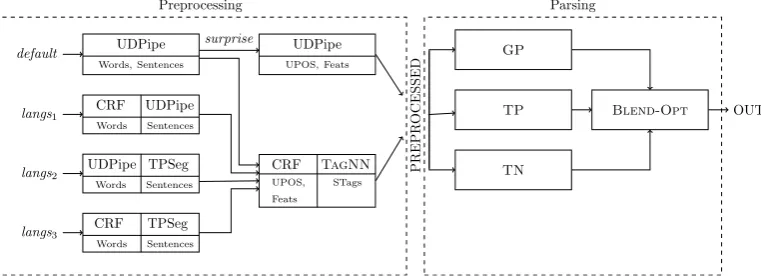
For most data sets word and sentence segmenta-tion plays a minimal role, as it is delivered al-most for free by means of whitespaces, sentence-final punctuation and capital letters. Therefore our overall architecture applies word/sentence seg-mentation pipeline only on treebanks for which this task is non-trivial (see Figure 1). These test sets can roughly be grouped into two categories: Languages where tokenization is challenging, e.g., Chinese and Japanese, but also languages such as Arabic and Hebrew, where many orthographic to-kens are segmented into smaller syntactic words with transformations. The second category com-prises the treebanks where the detection of sen-tence boundaries is difficult, mostly classical texts.
2.1 Word Segmentation
We applied our own word segmentation on six lan-guages: Arabic, French, Hebrew, Japanese, Viet-namese, and Chinese. We selected them by ana-lyzing the UDPipe baseline and picking out cases where we potentially could surpass it.
For Arabic, French and Hebrew, the difficulty
lies in splitting orthographic words (i.e.,
multi-word tokens) into severalsyntacticwords (e.g., cl-itics). Additionally the orthographic words are of-ten not the simple concaof-tenation of their compo-nents. For example in French, the multiword
to-kendeswould be split into two syntactic wordsde
andles. We cast this problem as classification by predicting the Levenshtein edit script to transform a multiword token into its components.
Concretely with the French example, we take
the multiword token des as input, and predict
de&les, where& is an artificial delimiter to split the token. To reduce the tag set, we used the Levenshtein edit script “=2+&le=1” instead of de&les as the target class, which means keeping the first 2 characters, adding “&le”, then
keep-ing 1 character, so that des can be transformed
intode&les(thus split intodeandles). Using edit scripts reduced the tag set size from about 12,000 to 1,000 for Arabic and from 14,000 to 600 for Hebrew.
For Japanese, Vietnamese and Chinese, we sim-ply applied a standard chunking method: for each character (or phoneme in Vietnamese), we pre-dicted the chunk boundary, jointly with the POS tag of the word.
In both cases, we used the state-of-the-art
mor-phological CRF tagger1 MarMoT (M¨uller et al.,
2013) to predict the tags (edit scripts or chunk
boundaries). We used second order models for Arabic, French and Hebrew, and third order mod-els for Japanese, Vietnamese and Chinese.
2.2 Sentence boundary detection
We applied our own sentence segmentation on
nine languages (see Figure 1). For some of
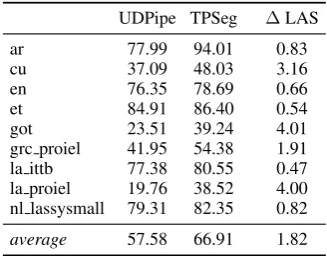
them, like Gothic or Latin PROIEL, typical or-thographic features (e.g., punctuation or capital-ization) that indicate sentence boundaries are not present and UDPipe was achieving extremely low scores (23.51 and 19.76 F1 respectively). The oth-ers were selected empirically by tests on the devel-opment data.
We employed a beam-search transition-based parser extended to predict sentence boundaries (Bj¨orkelund et al.,2016). This parser (referred to asTPSeg) is an extension of our transition-based
parser (see Section3.2) using the perceptron and
is trained using DLASO updates (Bj¨orkelund and
Kuhn, 2014; Bj¨orkelund et al., 2016). It marks sentence boundaries with an additional transition. For this parser the input is not just a pre-tokenized sentence, but a pre-tokenized document. As docu-ments during test-time we used paragraphs from the raw input text, assuming that no sentence would span across a paragraph break.
A training instance for the parser is a document (rather than a sentence). Some treebanks have the entire training set represented as a single para-graph (document). Initial experiments showed that
UDPipe
Words, Sentences
CRF UDPipe
Words Sentences
UDPipe TPSeg
Words Sentences
CRF TPSeg
Words Sentences
UDPipe
UPOS, Feats
CRF TagNN
UPOS, STags Feats
surprise default
langs1
langs2
langs3
PREPR
OCESSED
GP
TP
TN
Blend-Opt OUT
[image:3.595.109.490.63.203.2]Preprocessing Parsing
Figure 1: System architecture, wherelangs1: he, ja, fr, fr sequoia, fr partut, fr pud, vi, zh;langs2: cu, en, et, got, grc proiel, la, la ittb, la proiel, nl lassysmall, sl sst;langs3: ar, ar pud.
training the parser on a single document took con-siderable time and also did not perform very well. Instead, we created artificial documents for train-ing by taktrain-ing chunks of 10 sentences from the training set and treating them as documents (irre-spective of whether they went across paragraphs). We trained the parser using gold word segmen-tation and POS/morphology information. At test time we relied on UDPipe predictions in most cases. However, for Arabic, the only language where we did both word and sentence segmenta-tion, we applied our own POS/morphology tag-ger since the word segmentation had changed. Additionally, we applied our tagger on Old Church Slavonic, Estonian, Gothic, Ancient Greek PROIEL and Dutch LassySmall since we found that this lead to better sentence segmentation re-sults on the development sets.
2.3 Part-of-Speech and Morphological Tagging
We used MarMoT to jointly predict POS tags and morphological features. We annotated the training sets via 5-fold jackknifing. All parsers for all lan-guages except the surprise ones were trained on jackknifed features. We did not use XPOS tags and lemmas. We used MarMoT with default hy-perparameters.
2.4 Supertags
Supertags (Joshi and Bangalore,1994) are labels for tokens which encode syntactic information, e.g., the head direction or the subcategorization frame. Supertagging has recently been proposed to provide syntactic information to the feature model of statistical dependency parsers (Ambati et al. (2013;2014),Ouchi et al.(2014)).
We follow the definition of supertagging from
Ouchi et al. (2014) and extract supertag tag sets from the treebanks. We use their Model 1 to de-sign our supertags. That is, we encode the depen-dency relation (label), the relative head direction
(hdir) and the presence of left and right
depen-dents (hasLdep,hasRdep) and follow the template label/hdir+hasLdep hasRdep.
We used an in-house neural-based tagger
(TAGNN) to predict the supertags (Yu et al.,
2017). It takes the context of a word within a win-dow size of 15. The input word representations are concatenations of three components: output of a character-based Convolutional Neural Network (CNN), pretrained word embeddings provided by the ST organizers, and a binary code indicating the target word. The word representations of the whole context-window are then fed into another CNN to predict the supertag of the target word.
We used TAGNN instead of CRF for supertagging,
since it performed considerably better in the pre-liminary experiments.
3 Baseline parsers
Surdeanu and Manning (2010) show that com-bining a set of parsers with a simple voting
scheme can improve parsing performance.
Mar-tins et al.(2013) demonstrate that self-application, i.e., stacking a parser on its own output, only leads
to minuscule improvements.2 Therefore to profit
from combining components one of the most sig-nificant factor is their diversity. Thus we experi-mented with three parsers with quite different
ar-2In fact, even supertagging can be regarded as a form of
chitectures and additionally varied their settings.
3.1 Graph-based perceptron parser
As the graph-based parser we usedmate3(Bohnet,
2010), henceforth referred to as GP. This is
a state-of-the-art graph- and perceptron-based
parser. The parser uses the Carreras (2007)
ex-tension of the Eisner (1997) decoding algorithm
to build a projective parse tree. It then ap-plies the non-projective approximation algorithm ofMcDonald and Pereira (2006) to recover non-projective dependencies. We train the parser using the default number of training epochs (10).
We modified the publicly available sources of this parser in two ways. First, we extended the feature set with features based on the supertags
following Fale´nska et al. (2015). Second, we
changed the perceptron implementation to
shuf-fle the training instances between epochs.4
Shuf-fling enables us to obtain different instances of the parser trained with different random seeds, which are used in the blending step.
Since the time complexity of the Carreras
(2007) decoder is quite high (O(n4)) this parser required a considerable amount of time to parse long sentences. Therefore, while applying this parser in the blending scenario, we skipped all
sen-tences longer than 50 tokens.5 We additionally
made sure that for each treebank we had at least one parser that was not GP, so that all sentences would be parsed.
3.2 Transition-based beam-perceptron parser
We apply an in-house transition-based beam search parser trained with the perceptron (Bj¨orkelund and Nivre,2015), henceforth referred
to as TP.6 We have previously extended this
parser to accommodate features from supertags (Fale´nska et al., 2015). It uses the ArcStandard
system extended with a Swap transition (Nivre,
2009) and is trained using the improved oracle by
Nivre et al.(2009).
The parser is trained with a globally optimized structured perceptron (Zhang and Clark,2008)
us-ing max-violation updates (Huang et al., 2012).
3http://code.google.com/p/mate-tools
4The publicly available version does not shuffle. 5For the baseline results on the development sets (Tables3
and4), the parser was applied to all sentences.
6This parser as well as the variant that we applied for
sen-tence segmentation (TPSeg) is available on the first author’s website.
We use the default settings for beam size (20) and number of training epochs (also 20). Simi-larly to GP, we employ different seeds for the ran-dom number generator used during shuffling of the training instances in order to obtain multiple dif-ferent models.
3.3 Transition-based greedy neural parser
We use an in-house transition-based greedy parser
with neural networks (Yu and Vu, 2017),
hence-forth referred to asTN.7
The parser uses a CNN to compose word rep-resentations from characters, it also takes the em-beddings of word forms, universal POS tags and supertags and concatenates all of them as input features. The input is then fed into two hidden lay-ers with ReLU non-linearity, and finally predicts the transition with a softmax layer. The parser uses the same Swap transition system and oracle as TP. We use the default hyperparameters during train-ing and testtrain-ing.
During training the parser additionally pre-dicts the supertag of the top token in the stack and includes the tagging cross-entropy into the cost function. This approach is similar to
stack-propagation (Zhang and Weiss, 2016), where the
tagging task is only used as a regularizer.
4 Blending
To enhance the performance of the baseline single
parsers we combined them using blending (Sagae
and Lavie,2006). We trained multiple instances of each baseline parser using different random seeds. We parsed every sentence and assigned scores to arcs depending on how frequent they were in the predicted trees. We used the Chu-Liu-Edmonds algorithm to decode the maximum spanning tree from the resultant graph. This way we obtained the majority decision of the parser instances under the tree constraint.
As a baseline for blending (BLEND-BL), we
took four instances from each of the baseline parsers: The four GP instances were trained with different random seeds. The four TP instances further split into two groups: two parse from left to right (TP-l2r) and two parse from right to left (TP-r2l). The four TN instances differ not only in the parsing direction, but also in the word embeddings, two use pretrained embeddings
7This parser as well as the neural tagger used for
from the organizers (TN-l2r-vec, TN-r2l-vec) and two use randomly initialized embeddings (TN-l2r-rand, TN-r2l-rand).
The 4+4+4 combination was rather arbitrary and simply based on the intuition that different parsers should be equally represented and as di-verse as possible. However, this might not be the optimal combination since different parsers are better at different treebanks. Also, given the rel-atively limited computing resources on the VM, we needed to optimize the number of blended in-stances in terms of speed.
We thus applied a combination search under a time constraint. First we measured time needed by each parser to parse every development treebank on the VM as an estimation of time usage for the test run. We then defined a time budget of 1,000 seconds for each treebank, and checked all combi-nations of the parsers on the development set un-der the time budget. We took the combinations from a pool of 24 individual instances, divided
into seven groups: 8×GP; 4×TP-l2r; 4×TP-r2l;
2×TN-l2r-rand; 2×TN-l2r-vec; 2×TN-r2l-rand;
2×TN-r2l-vec.
Note that enumerating all combinations of indi-vidual instances is not feasible (224combinations). Thus we applied a two-step heuristic search. First we searched for the optimal number of instances from the 7 groups, by drawing samples from the pool of instances with only different random seed
(at most9×5×5×3×3×3×3 = 18,225
pos-sibilities). Once the optimal numbers of instances were found, we then searched exhaustively for the optimal instances (BLEND-OPT).
5 Evaluation
In this section we evaluate the aforementioned methods on the 55 treebanks for which develop-ment data was available.
5.1 Word and sentence segmentation
As discussed in Section 2, we applied our own
word and/or sentence segmentation to a subset of languages. The corresponding results on the
de-velopment sets are shown in Tables1and2.
For word tokenization both our methods (pre-dicting edit script and tagging with chunk bound-aries) outperform the UDPipe baseline by 2.64 F1-score points on average. The biggest gains are achieved for Hebrew (4.57 points) and Vietnamese (4.67 points).
Using the TPSeg parser to predict sentence boundaries results in an average improvement of 9.32 points on sentence segmentation F1-score over the UDPipe baseline. Especially the diffi-cult data sets that do not use orthographic features to indicate sentence boundaries improve by a big margin, for example Latin PROIEL by 18.76 and Gothic by 15.73.
Most importantly, the improvements in word and sentence segmentation F1-score roughly translate into LAS improvements with a 1:1 and a 5:1 ratio, respectively.
UDPipe CRF ∆LAS
ar 93.86 95.53 2.04
fr 99.18 99.66 0.60
fr sequoia 98.65 99.35 0.90
he 88.15 92.72 4.82
ja 89.53 92.10 5.08
vi 83.99 88.66 5.57
zh 88.95 92.76 5.47
[image:5.595.342.493.235.343.2]average 91.76 94.40 3.50
Table 1: F1 scores for word segmentation and gains in LAS for TP.
UDPipe TPSeg ∆LAS
ar 77.99 94.01 0.83
cu 37.09 48.03 3.16
en 76.35 78.69 0.66
et 84.91 86.40 0.54
got 23.51 39.24 4.01
grc proiel 41.95 54.38 1.91 la ittb 77.38 80.55 0.47 la proiel 19.76 38.52 4.00 nl lassysmall 79.31 82.35 0.82
average 57.58 66.91 1.82
Table 2: F1 score for sentence segmentation and gains in LAS for TP.
5.2 Preprocessing and Supertags
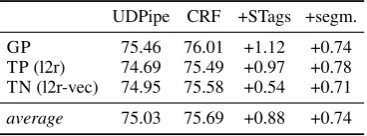
To see the improvements stemming from our pre-processing steps we run the baseline parsers in four incremental settings: (1) using only the UD-Pipe baseline predictions, (2) replacing POS and morphological features with CRF predictions, (3) adding supertags, and (4) applying our own word
and sentence segmentation. Table 3 shows the
[image:5.595.334.498.401.529.2]and sentence segmentation was used while train-ing parsers in all setttrain-ings.
The table shows that replacing the POS and morphological tagging with the CRF instead of baseline UDPipe predictions improves the parsers by 0.66 on average.8 The introduction of supertags
brings an additional 0.88 points which demon-strates that supertags are a useful source of syn-tactic features for dependency parsers, irrespec-tive of architecture. Replacing the word and sen-tence segmentation from UDPipe with our own improves on average by 0.74 points. It is worth noting that this improvement stems only from the 15 treebanks where we applied our own
segmen-tation, although the averages in Table3 are
com-puted across all 55 treebanks.
UDPipe CRF +STags +segm. GP 75.46 76.01 +1.12 +0.74 TP (l2r) 74.69 75.49 +0.97 +0.78 TN (l2r-vec) 74.95 75.58 +0.54 +0.71
[image:6.595.90.274.292.360.2]average 75.03 75.69 +0.88 +0.74
Table 3: Average (across 55 treebanks) gains in parsing accuracies (LAS) for incremental changes to UDPipe preprocessing baseline.
5.3 Development Results
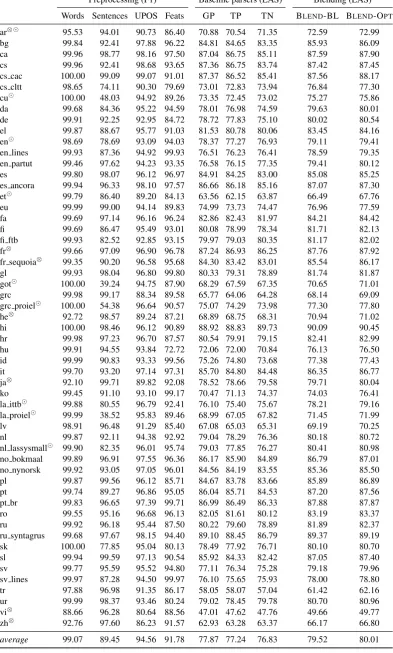
Our overall results on the development sets are
shown in Table 4. The table shows the
perfor-mance of the preprocessing steps, the individual baseline parsers, and the results of the two blends. The 15 treebanks where we applied our own word and/or sentence segmentation are marked explic-itly in the table, for the other cases we used the UDPipe baseline.
The three single baseline parsers achieved sim-ilar average performances. Each one of them per-formed the highest on some of the treebanks, but not on all. It is worth noting that the strongest baseline parser, GP, is perceptron-based rather than a neural model. That is not to say that per-ceptrons generally are stronger than neural mod-els (our neural TN parser is a greedy parser, and other participants in the Shared Task present con-siderably stronger neural models), however it in-dicates that perceptrons are not miles behind the more recent neural-based parsers.
Blending parsers yield a strong boost over the
8The actual improvements on the POS and morphological
tagging tasks amount to 0.68 and 1.17, respectively.
baselines. BLEND-BL improves roughly 2-3
points depending on the choice of baseline. By searching for optimal combinations under the time budget, this can be further improved by 0.49 on
average (BLEND-OPT). The search reduced the
number of models from 660 to 438. In particular, there were 221 instances of GP, 79 of TP, and 138 of TN.
6 Surprise languages
The implementation of the surprise languages in the Shared Task was done in a rather peculiar way with respect to preprocessing. The test sets were annotated by the organizers through cross-validation. That is, the test sets were provided with predicted (by UDPipe) POS and morpholog-ical tags. Participants were provided with a small sample (about 20 sentences) for each surprise lan-guage, however only with gold standard prepro-cessing. This meant that it was difficult to use the samples for tuning/development since we would either have to use gold standard preprocessing, or apply cross-validation on the samples ourselves which most likely would have resulted in consider-ably worse preprocessing than that which was de-livered for the test sets. We chose to consistently use gold preprocessing for all development exper-iments on the surprise languages.
A straightforward approach to the surprise lan-guages is to use delexicalized parser transfer ( Ze-man and Resnik, 2008). The idea is to train a parser on a source treebank using only non-lexical features (in our case universal POS tags and morphological features) and apply it on sen-tences from the target language. We followed
Rosa and Zabokrtsk´y(2015) and performed multi-source delexicalized transfer by blending together models trained on several languages. Contrary to them, we treat the source languages equally and blend them with the same weight.
We trained delexicalized TP and GP parsers for 40 source languages (we took the 40 biggest tree-banks, excluding the domain specific ones). We refrained from training TN since the main moti-vation of this parser is that it operates on charac-ters. Therefore, using it in the delexicalized setting does not make sense.
Preprocessing (F1) Baseline parsers (LAS) Blending (LAS) Words Sentences UPOS Feats GP TP TN BLEND-BL BLEND-OPT ar⊗ 95.53 94.01 90.73 86.40 70.88 70.54 71.35 72.59 72.99
bg 99.84 92.41 97.88 96.22 84.81 84.65 83.35 85.93 86.09
ca 99.96 98.77 98.16 97.50 87.04 86.75 85.11 87.59 87.90
cs 99.96 92.41 98.68 93.65 87.36 86.75 83.74 87.42 87.45
cs cac 100.00 99.09 99.07 91.01 87.37 86.52 85.41 87.56 88.17 cs cltt 98.65 74.11 90.30 79.69 73.01 72.83 73.94 76.84 77.30 cu 100.00 48.03 94.92 89.26 73.35 72.45 73.02 75.27 75.86
da 99.68 84.36 95.22 94.59 78.01 76.98 74.59 79.63 80.01
de 99.91 92.25 92.95 84.72 78.72 77.83 75.10 80.02 80.54
el 99.87 88.67 95.77 91.03 81.53 80.78 80.06 83.45 84.16
en 98.69 78.69 93.09 94.03 78.37 77.27 76.93 79.11 79.41
en lines 99.93 87.36 94.92 99.93 76.51 76.23 76.41 78.59 79.35 en partut 99.46 97.62 94.23 93.35 76.58 76.15 77.35 79.41 80.12
es 99.80 98.07 96.12 96.97 84.91 84.25 83.00 85.08 85.25
es ancora 99.94 96.33 98.10 97.57 86.66 86.18 85.16 87.07 87.30
et 99.79 86.40 89.20 84.13 63.56 62.15 63.87 66.49 67.76
eu 99.99 99.00 94.14 89.83 74.99 73.73 74.47 76.96 77.59
fa 99.69 97.14 96.16 96.24 82.86 82.43 81.97 84.21 84.42
fi 99.69 86.47 95.49 93.01 80.08 78.99 78.34 81.71 82.13
fi ftb 99.93 82.52 92.85 93.15 79.97 79.03 80.35 81.17 82.02 fr⊗ 99.66 97.09 96.90 96.78 87.24 86.93 86.25 87.76 87.92
fr sequoia⊗ 99.35 90.20 96.58 95.68 84.30 83.42 83.01 85.54 86.17
gl 99.93 98.04 96.80 99.80 80.33 79.31 78.89 81.74 81.87
got 100.00 39.24 94.75 87.90 68.29 67.59 67.35 70.65 71.01
grc 99.98 99.17 88.34 89.58 65.77 64.06 64.28 68.14 69.09
grc proiel 100.00 54.38 96.64 90.57 75.07 74.29 73.98 77.30 77.80
he⊗ 92.72 98.57 89.24 87.21 68.89 68.75 68.31 70.94 71.02
hi 100.00 98.46 96.12 90.89 88.92 88.83 89.73 90.09 90.45
hr 99.98 97.23 96.70 87.57 80.54 79.91 79.15 82.41 82.99
hu 99.91 94.55 93.84 72.72 72.06 72.00 70.84 76.13 76.50
id 99.99 90.83 93.33 99.56 75.26 74.80 73.68 77.38 77.43
it 99.70 93.20 97.14 97.31 85.70 84.80 84.48 86.35 86.77
ja⊗ 92.10 99.71 89.82 92.08 78.52 78.66 79.58 79.71 80.04
ko 99.45 91.10 93.10 99.17 70.47 71.13 74.37 74.03 76.41
la ittb 99.88 80.55 96.79 92.41 76.10 75.40 75.67 78.21 79.16
la proiel 99.99 38.52 95.83 89.46 68.99 67.05 67.82 71.45 71.99
lv 98.91 96.48 91.29 85.40 67.08 65.03 65.31 69.19 70.25
nl 99.87 92.11 94.38 92.92 79.04 78.29 76.36 80.18 80.72
nl lassysmall 99.90 82.35 96.01 95.74 79.03 77.85 76.27 80.41 80.98
no bokmaal 99.89 96.91 97.55 96.36 86.17 85.90 84.89 86.79 87.01 no nynorsk 99.92 93.05 97.05 96.01 84.56 84.19 83.55 85.36 85.50
pl 99.87 99.56 96.12 85.71 84.67 83.78 83.66 85.89 86.89
pt 99.74 89.27 96.86 95.05 86.04 85.71 84.53 87.20 87.56
pt br 99.83 96.65 97.39 99.71 86.99 86.49 86.33 87.88 87.87
ro 99.55 95.16 96.68 96.13 82.05 81.61 80.12 83.19 83.37
ru 99.92 96.18 95.44 87.50 80.22 79.60 78.89 81.89 82.37
ru syntagrus 99.68 97.67 98.15 94.40 89.10 88.45 86.79 89.37 89.19
sk 100.00 77.85 95.04 80.13 78.49 77.92 76.71 80.10 80.70
sl 99.94 99.59 97.13 90.54 85.92 84.33 82.42 87.05 87.40
sv 99.77 95.59 95.52 94.80 77.11 76.34 75.28 79.18 79.96
sv lines 99.97 87.28 94.50 99.97 76.10 75.65 75.93 78.00 78.80
tr 97.88 96.98 91.35 86.17 58.05 58.07 57.04 61.42 62.16
ur 99.99 98.37 93.46 80.24 79.02 78.45 79.78 80.70 80.96
vi⊗ 88.66 96.28 80.64 88.56 47.01 47.62 47.76 49.66 49.77
zh⊗ 92.76 97.60 86.23 91.57 62.93 63.28 63.37 66.17 66.80
[image:7.595.102.496.72.726.2]average 99.07 89.45 94.56 91.78 77.87 77.24 76.83 79.52 80.01
Table 4: Development results. The treebanks for which we did our own word and/or sentence
segmen-tation are marked with⊗andrespectively. The TP and TN models correspond to TP-l2r TN-l2r-vec,
combination (across both parsers) where, instead of a time budget, we arbitrarily set the maximum number of parsers to eight.
smelex 51.02
fidelex 51.02
no bokmaaldelex 47.62
etdelex 47.62
BLEND-OPT 60.54 (a) Target language: sme
kmrlex 48.76
fadelex 42.15
eldelex 33.88
ukdelex 29.75
BLEND-OPT 44.63 (b) Target language: kmr
hsblex 65.00
csdelex 78.04
sldelex 76.74
skdelex 75.43
BLEND-OPT 78.70 (c) Target language: hsb
bxrlex 41.83
eudelex 37.25
urdelex 35.95
hidelex 35.29
[image:8.595.77.281.116.287.2]BLEND-OPT 44.44 (d) Target language: bxr
Table 5: Parsing accuracy (LAS) for surprise lan-guages: the three best delexicalized TP-l2r parsers and lexicalized parser obtained by leave-one-out jackknifing.
In addition to the delexicalized models, we also
trained lexicalized TP and GP models9 on the
sample data and applied leave-one-out
jackknif-ing.10 A comparison between the three best
delex-icalized TP models and the lexdelex-icalized TP parser
is shown in Table 5. Only for Upper Sorbian
were transferred models able to surpass the model trained on the very small training data. Interest-ingly, the blended models were much better than any of the models for all languages except Kur-manji. Therefore we decided not to use any of the delexicalized models for this language. For the other three surprise languages we used ultimately blended eight delexicalized (selected as described above) and eight lexicalized models, the intuition being that this would give equal weight to lexical-ized and delexicallexical-ized models.
7 Parallel datasets
For the 14 additional parallel datasets (PUD) we used parsers trained on their corresponding lan-guages. For several languages there were more than one treebank in the training data for the cor-responding PUD test set. This begs the question as to whether the models used for the PUD test sets
9We did not train lexicalized TN models since it had
prob-lems with exploding gradients and convergence due to the small size of the sample data.
10That is, for a sample set of 20 sentences this boils down
to 20-fold cross-validation.
should be trained only on the primary treebank, or on the combination of all training sets corre-sponding to that language. For the main treebanks, initial experiments indicated that this was a bad idea and parsers performed better when training sets were not combined. However, for the PUD test sets we had no information on the annotation scheme nor the domain, which made it difficult to decide whether to use only the primary training set or all available.
For each language with multiple training sets, we trained one parser on each training set as well as on their concatenation. We applied these mod-els on the development sets and created a confu-sion matrix. Without prior knowledge about the PUD treebanks, we estimated the expected LAS as the average LAS of the development sets and chose the model that maximizes the estimation.
Table 6 shows such a confusion matrix for
Swedish using the TN parser. The expected LAS for PUD (right-most column) is highest when trained on the concatenation of the two treebanks. This observation held for all the languages with multiple treebanks that we tested and we there-fore used models trained on the concatenation of all training data with two exceptions: For Czech time prevented us from training models and creat-ing a confusion matrix and we only used models trained on the primary treebank. For Finish FTB the README distributed with the treebank states that this treebank is a conversion that tries to ap-proximate the primary Finish treebank. This sug-gests that it does not entirely conform to the Finish UD standard. We assumed that the Finish PUD test set would be closer to the primary treebank and therefore chose to use only the model trained on the primary treebank.
sv sv lines exp. sv pud
sv 75.28 63.54 69.41
sv lines 67.78 75.93 71.86 sv concat 75.31 75.23 75.27
Table 6: Confusion matrix for Swedish with ex-pected LAS on Swedish PUD.
8 Test Set results
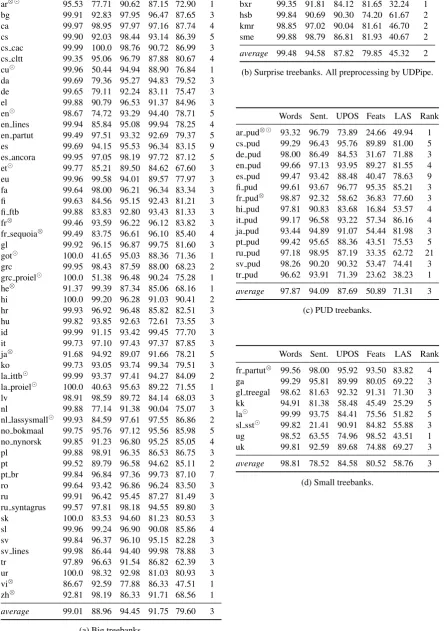
Our final results on the test sets are shown in
Ta-ble7. Overall we ranked third in the Shared Task
state-of-the-art neural-based parsers (Zeman et al.,
2017).
Our efforts to improve the preprocessing scores paid off. On most of the languages where we ap-plied our word and/or sentence segmentation we achieved the best parsing results. On the sec-ondary evaluation metrics we ranked first for word segmentation and sentence segmentation, second for POS tagging, and first for morphological tag-ging. Additionally we were second on parsing the surprise languages.
As it turns out, all PUD treebanks were presum-ably annotated following the guidelines of the pri-mary treebanks. This most likely lowered our re-sults a little bit for some of the PUD treebanks. However, for Russian PUD our results are abnor-mally low compared to many other participants. We scored about 13 points behind the top result, in comparison to an average distance of less than 2 points. This is most likely an artifact of how the non-primary (SynTagRus) Russian treebank is considerably larger than the primary Russian tree-bank, which means that a parser trained on the concatenation is mostly dominated by the SynTa-gRus annotation style and domains.
9 Conclusion
We have presented the IMS contribution to the CoNLL 2017 UD Shared Task. We have shown that tuning the preprocessing methods is a way to achieve competitive parsing performance. We made use of a CRF tagger for POS and morpho-logical features and very strong word and sentence segmentation tools.
None of our baseline parsers alone would rank third. We therefore used blending to combine them. In general, we can confirm the observation ofSurdeanu and Manning(2010) that the diversity of parsers is important. Additionally, we observed that both the diversity of parser architectures and number of instances of the same parser can im-prove performance. Furthermore, our automatized combination search method could be seen as a case of a “sparsely” weighted voting scheme.
We confirmed two of our previous findings on a larger scale. (1) Syntactic information can help sentence segmentation (Bj¨orkelund et al., 2016). (2) Supertags improve parsing performance across all languages (Fale´nska et al.,2015).
For the surprise languages we blended delexi-calized models from other languages with
lexical-ized models trained on the small in-language sam-ple data. This approach seems to have been ro-bust and rendered us second rank for surprise lan-guages. However, further analysis would be re-quired in order to understand whether the lexical-ized or delexicallexical-ized models in general fare better in this setting.
As for the PUD treebanks we found that, al-though the UD annotation scheme should be con-sistent across treebanks, combining training sets for one language is not useful for parsing the PUD test sets. Whether this depends on annotation idiosyncrasies or domain differences is an open question and deserves further attention.
Acknowledgments
This work was supported by the Deutsche Forschungsgemeinschaft (DFG) via the SFB 732, project D8. We express our gratitude to the orga-nizers of the Shared Task (Zeman et al.,2017), the treebank providers (Nivre et al., 2017) and base-line system authors (Straka et al.,2016). We also thank our colleagues ¨Ozlem C¸etino˘glu and Kyle Richardson for the contribution of ideas.
References
Bharat Ram Ambati, Tejaswini Deoskar, and Mark Steedman. 2013. Using CCG categories to im-prove Hindi dependency parsing. In Proceed-ings of the 51st Annual Meeting of the As-sociation for Computational Linguistics (Volume 2: Short Papers). Association for Computa-tional Linguistics, Sofia, Bulgaria, pages 604–609. http://www.aclweb.org/anthology/P13-2107. Bharat Ram Ambati, Tejaswini Deoskar, and
Mark Steedman. 2014. Improving Depen-dency Parsers using Combinatory Categorial Grammar. In Proceedings of the 14th Confer-ence of the European Chapter of the Association for Computational Linguistics, volume 2: Short Papers. Association for Computational Lin-guistics, Gothenburg, Sweden, pages 159–163. http://www.aclweb.org/anthology/E14-4031. Anders Bj¨orkelund, Agnieszka Fale´nska, Wolfgang
Seeker, and Jonas Kuhn. 2016. How to train de-pendency parsers with inexact search for joint sen-tence boundary detection and parsing of entire doc-uments. In Proceedings of the 54th Annual Meet-ing of the Association for Computational LMeet-inguistics (Volume 1: Long Papers). Association for Compu-tational Linguistics, Berlin, Germany, pages 1924– 1934.http://www.aclweb.org/anthology/P16-1181. Anders Bj¨orkelund and Jonas Kuhn. 2014.
resolu-Words Sent. UPOS Feats LAS Rank ar⊗ 95.53 77.71 90.62 87.15 72.90 1
bg 99.91 92.83 97.95 96.47 87.65 3 ca 99.97 98.95 97.97 97.16 87.74 4 cs 99.90 92.03 98.44 93.14 86.39 5 cs cac 99.99 100.0 98.76 90.72 86.99 3 cs cltt 99.35 95.06 96.79 87.88 80.67 4 cu 99.96 50.44 94.94 88.90 76.84 1
da 99.69 79.36 95.27 94.83 79.52 3 de 99.65 79.11 92.24 83.11 75.47 3 el 99.88 90.79 96.53 91.37 84.96 3 en 98.67 74.72 93.29 94.40 78.71 5
en lines 99.94 85.84 95.08 99.94 78.25 4 en partut 99.49 97.51 93.32 92.69 79.37 5 es 99.69 94.15 95.53 96.34 83.15 9 es ancora 99.95 97.05 98.19 97.72 87.12 5 et 99.77 85.21 89.50 84.62 67.60 3
eu 99.96 99.58 94.01 89.57 77.97 3 fa 99.64 98.00 96.21 96.34 83.34 3 fi 99.63 84.56 95.15 92.43 81.21 3 fi ftb 99.88 83.83 92.80 93.43 81.33 3 fr⊗ 99.46 93.59 96.22 96.12 83.82 3
fr sequoia⊗ 99.49 83.75 96.61 96.10 85.40 4
gl 99.92 96.15 96.87 99.75 81.60 3 got 100.0 41.65 95.03 88.36 71.36 1
grc 99.95 98.43 87.59 88.00 68.23 2 grc proiel 100.0 51.38 96.48 90.24 75.28 1
he⊗ 91.37 99.39 87.34 85.06 68.16 1
hi 100.0 99.20 96.28 91.03 90.41 2 hr 99.93 96.92 96.48 85.82 82.51 3 hu 99.82 93.85 92.63 72.61 73.55 3 id 99.99 91.15 93.42 99.45 77.70 3 it 99.73 97.10 97.43 97.37 87.85 3 ja⊗ 91.68 94.92 89.07 91.66 78.21 5
ko 99.73 93.05 93.74 99.34 79.51 3 la ittb 99.99 93.37 97.41 94.27 84.09 2
la proiel 100.0 40.63 95.63 89.22 71.55 1
lv 98.91 98.59 89.72 84.14 68.03 3 nl 99.88 77.14 91.38 90.04 75.07 3 nl lassysmall 99.93 84.59 97.61 97.55 86.86 2
no bokmaal 99.75 95.76 97.12 95.56 85.98 5 no nynorsk 99.85 91.23 96.80 95.25 85.05 4 pl 99.88 98.91 96.35 86.53 86.75 3 pt 99.52 89.79 96.58 94.62 85.11 2 pt br 99.84 96.84 97.36 99.73 87.10 7 ro 99.64 93.42 96.86 96.24 83.50 3 ru 99.91 96.42 95.45 87.27 81.49 3 ru syntagrus 99.57 97.81 98.18 94.55 89.80 3 sk 100.0 83.53 94.60 81.23 80.53 3 sl 99.96 99.24 96.90 90.08 85.86 4 sv 99.84 96.37 96.10 95.15 82.28 3 sv lines 99.98 86.44 94.40 99.98 78.88 3 tr 97.89 96.63 91.54 86.82 62.39 3 ur 100.0 98.32 92.98 81.03 80.93 3 vi⊗ 86.67 92.59 77.88 86.33 47.51 1
zh⊗ 92.81 98.19 86.33 91.71 68.56 1
average 99.01 88.96 94.45 91.75 79.60 3 (a) Big treebanks.
Words Sent. UPOS Feats LAS Rank bxr 99.35 91.81 84.12 81.65 32.24 1 hsb 99.84 90.69 90.30 74.20 61.67 2 kmr 98.85 97.02 90.04 81.61 46.70 2 sme 99.88 98.79 86.81 81.93 40.67 2
average 99.48 94.58 87.82 79.85 45.32 2 (b) Surprise treebanks. All preprocessing by UDPipe.
Words Sent. UPOS Feats LAS Rank ar pud⊗ 93.32 96.79 73.89 24.66 49.94 1
cs pud 99.29 96.43 95.76 89.89 81.00 5 de pud 98.00 86.49 84.53 31.67 71.88 3 en pud 99.66 97.13 93.95 89.27 81.55 4 es pud 99.47 93.42 88.48 40.47 78.63 9 fi pud 99.61 93.67 96.77 95.35 85.21 3 fr pud⊗ 98.87 92.32 58.62 36.83 77.60 3
hi pud 97.81 90.83 83.68 16.84 53.57 4 it pud 99.17 96.58 93.22 57.34 86.16 4 ja pud 93.44 94.89 91.07 54.44 81.98 3 pt pud 99.42 95.65 88.36 43.51 75.53 5 ru pud 97.18 98.95 87.19 33.35 62.72 21 sv pud 98.26 90.20 90.32 53.47 74.41 3 tr pud 96.62 93.91 71.39 23.62 38.23 1
average 97.87 94.09 87.69 50.89 71.31 3 (c) PUD treebanks.
Words Sent. UPOS Feats LAS Rank fr partut⊗ 99.56 98.00 95.92 93.50 83.82 4
ga 99.29 95.81 89.99 80.05 69.22 3 gl treegal 98.62 81.63 92.32 91.31 71.30 3 kk 94.91 81.38 58.48 45.49 25.29 5 la 99.99 93.75 84.41 75.56 51.82 5
sl sst 99.82 21.41 90.91 84.82 55.88 3
ug 98.52 63.55 74.96 98.52 43.51 1 uk 99.81 92.59 89.68 74.88 69.27 3
[image:10.595.74.521.84.716.2]average 98.81 78.52 84.58 80.52 58.76 3 (d) Small treebanks.
Table 7: Test results. The treebanks for which we did our own word and/or sentence segmentation are
tion with latent antecedents and non-local features. In Proceedings of the 52nd Annual Meeting of the Association for Computational Linguistics (Vol-ume 1: Long Papers). Association for Computa-tional Linguistics, Baltimore, Maryland, pages 47– 57.http://www.aclweb.org/anthology/P14-1005. Anders Bj¨orkelund and Joakim Nivre. 2015.
Non-deterministic oracles for unrestricted non-projective transition-based dependency parsing. In Pro-ceedings of the 14th International Conference on Parsing Technologies. Association for Computa-tional Linguistics, Bilbao, Spain, pages 76–86. http://www.aclweb.org/anthology/W15-2210. Bernd Bohnet. 2010. Top accuracy and fast
depen-dency parsing is not a contradiction. InProceedings of the 23rd International Conference on Computa-tional Linguistics (Coling 2010). Coling 2010 Or-ganizing Committee, Beijing, China, pages 89–97. http://www.aclweb.org/anthology/C10-1011. Xavier Carreras. 2007. Experiments with a
higher-order projective dependency parser. In Proceed-ings of the CoNLL Shared Task Session of EMNLP-CoNLL 2007. Association for Computational Lin-guistics, Prague, Czech Republic, pages 957– 961. http://www.aclweb.org/anthology/D/D07/D07-1101.
Yoeng-jin Chu and Tseng-hong Liu. 1965. On the shortest aborescence of a directed graph. Science Sinica14:1396–1400.
Jack Edmonds. 1967. Optimum branchings. Jour-nal of Research of the NatioJour-nal Bureau of Standards 71(B):233–240.
Jason Eisner. 1997. Bilexical grammars and a cubic-time probabilistic parser. In Proceedings of the 5th International Workshop on Parsing Technolo-gies (IWPT). MIT, Cambridge, MA, pages 54–65. http://cs.jhu.edu/ jason/papers/#eisner-1997-iwpt. Agnieszka Fale´nska, Anders Bj¨orkelund, ¨Ozlem
C¸etino˘glu, and Wolfgang Seeker. 2015. Stacking or supertagging for dependency parsing – what’s the difference? InProceedings of the 14th International Conference on Parsing Technologies. Association for Computational Linguistics, Bilbao, Spain, pages 118–129. http://www.aclweb.org/anthology/W15-2215.
Liang Huang, Suphan Fayong, and Yang Guo. 2012. Structured perceptron with inexact search. In Proceedings of the 2012 Conference of the North American Chapter of the Association for Computational Linguistics: Human Language Technologies. Association for Computational Linguistics, Montr´eal, Canada, pages 142–151. http://www.aclweb.org/anthology/N12-1015. Aravind K. Joshi and Srinivas Bangalore. 1994.
Dis-ambiguation of Super Parts of Speech (or Su-pertags): Almost Parsing. In Proceedings of the
15th Conference on Computational Linguistics -Volume 1. Association for Computational Linguis-tics, Stroudsburg, PA, USA, COLING ’94, pages 154–160. https://doi.org/10.3115/991886.991912. A. Martins, M. Almeida, and N. A. Smith. 2013.
”turn-ing on the turbo: Fast third-order non-projective turbo parsers”. InAnnual Meeting of the Associa-tion for ComputaAssocia-tional Linguistics - ACL. volume -, pages 617–622.
Ryan McDonald and Fernando Pereira. 2006. Online learning of approximate dependency parsing algo-rithms. InProceedings of the 11th Conference of the European Chapter of the ACL (EACL 2006). Asso-ciation for Computational Linguistics, Trento, Italy, pages 81–88. http://www.aclweb.org/anthology-new/E/E06/E06-1011.pdf.
Thomas M¨uller, Helmut Schmid, and Hinrich Sch¨utze. 2013. Efficient Higher-Order CRFs for Morpholog-ical Tagging. InIn Proceedings of EMNLP. Joakim Nivre. 2009. Non-projective dependency
parsing in expected linear time. In Proceed-ings of the Joint Conference of the 47th An-nual Meeting of the ACL and the 4th Interna-tional Joint Conference on Natural Language Pro-cessing of the AFNLP. Association for Computa-tional Linguistics, Suntec, Singapore, pages 351– 359. http://www.aclweb.org/anthology/P/P09/P09-1040.
Joakim Nivre, ˇZeljko Agi´c, Lars Ahrenberg, et al. 2017. Universal dependencies 2.0 CoNLL 2017 shared task development and test data. LIN-DAT/CLARIN digital library at the Institute of For-mal and Applied Linguistics, Charles University. http://hdl.handle.net/11234/1-2184.
Joakim Nivre, Marco Kuhlmann, and Johan Hall. 2009. An improved oracle for dependency pars-ing with online reorderpars-ing. In Proceedings of the 11th International Conference on Parsing Technologies (IWPT’09). Association for Compu-tational Linguistics, Paris, France, pages 73–76. http://www.aclweb.org/anthology/W09-3811. Hiroki Ouchi, Kevin Duh, and Yuji Matsumoto.
2014. Improving Dependency Parsers with Su-pertags. In Proceedings of the 14th Confer-ence of the European Chapter of the Associ-ation for ComputAssoci-ational Linguistics, volume 2: Short Papers. Association for Computational Lin-guistics, Gothenburg, Sweden, pages 154–158. http://www.aclweb.org/anthology/E14-4030. Martin Potthast, Tim Gollub, Francisco Rangel, Paolo
International Conference of the CLEF Initiative (CLEF 14). Springer, Berlin Heidelberg New York, pages 268–299. https://doi.org/10.1007/978-3-319-11382-1 22.
Rudolf Rosa and Zdenek Zabokrtsk´y. 2015. Kl-cpos3 - a language similarity measure for delex-icalized parser transfer. In Proceedings of the 53rd Annual Meeting of the Association for Com-putational Linguistics and the 7th International Joint Conference on Natural Language Process-ing of the Asian Federation of Natural Language Processing, ACL 2015, July 26-31, 2015, Beijing, China, Volume 2: Short Papers. pages 243–249. http://aclweb.org/anthology/P/P15/P15-2040.pdf. Kenji Sagae and Alon Lavie. 2006. Parser
com-bination by reparsing. In Proceedings of the Human Language Technology Conference of
the NAACL, Companion Volume: Short
Pa-pers. Association for Computational Linguis-tics, New York City, USA, pages 129–132. http://www.aclweb.org/anthology/N/N06/N06-2033.
Milan Straka, Jan Hajiˇc, and Jana Strakov´a. 2016. UDPipe: trainable pipeline for processing CoNLL-U files performing tokenization, morphologi-cal analysis, pos tagging and parsing. In Proceedings of the Tenth International Confer-ence on Language Resources and Evaluation (LREC’16). European Language Resources Asso-ciation (ELRA), Paris, France. http://www.lrec-conf.org/proceedings/lrec2016/pdf/873 Paper.pdf. Mihai Surdeanu and Christopher D Manning. 2010.
Ensemble models for dependency parsing: cheap and good? In Human Language Technologies: The 2010 Annual Conference of the North American Chapter of the Association for Computational Lin-guistics. Association for Computational Linguistics, pages 649–652.
Xiang Yu, Agnieszka Falenska, and Ngoc Thang Vu. 2017. A general-purpose tagger with con-volutional neural networks. In arXiv preprint arXiv:1706.01723.
Xiang Yu and Ngoc Thang Vu. 2017. Character com-position model with convolutional neural networks for dependency parsing on morphologically rich lan-guages. InProceedings of the 52nd Annual Meeting of the Association for Computational Linguistics. Association for Computational Linguistics, Vancou-ver, Canada.
Daniel Zeman, Martin Popel, Milan Straka, Jan Hajiˇc, Joakim Nivre, Filip Ginter, Juhani Luotolahti, Sampo Pyysalo, Slav Petrov, Martin Potthast, Fran-cis Tyers, Elena Badmaeva, Memduh G¨okırmak, Anna Nedoluzhko, Silvie Cinkov´a, Jan Hajiˇc jr., Jaroslava Hlav´aˇcov´a, V´aclava Kettnerov´a, Zdeˇnka Ureˇsov´a, Jenna Kanerva, Stina Ojala, Anna Mis-sil¨a, Christopher Manning, Sebastian Schuster, Siva Reddy, Dima Taji, Nizar Habash, Herman Leung,
Marie-Catherine de Marneffe, Manuela Sanguinetti, Maria Simi, Hiroshi Kanayama, Valeria de Paiva, Kira Droganova, Hˇector Mart´ınez Alonso, Hans Uszkoreit, Vivien Macketanz, Aljoscha Burchardt, Kim Harris, Katrin Marheinecke, Georg Rehm, Tolga Kayadelen, Mohammed Attia, Ali Elkahky, Zhuoran Yu, Emily Pitler, Saran Lertpradit, Michael Mandl, Jesse Kirchner, Hector Fernandez Alcalde, Jana Strnadova, Esha Banerjee, Ruli Manurung, An-tonio Stella, Atsuko Shimada, Sookyoung Kwak, Gustavo Mendonc¸a, Tatiana Lando, Rattima Nitis-aroj, and Josie Li. 2017. CoNLL 2017 Shared Task: Multilingual Parsing from Raw Text to Universal Dependencies. InProceedings of the CoNLL 2017 Shared Task: Multilingual Parsing from Raw Text to Universal Dependencies. Association for Computa-tional Linguistics.
Daniel Zeman and Philip Resnik. 2008. Cross-language parser adaptation between related lan-guages. InThird International Joint Conference on Natural Language Processing, IJCNLP 2008, Hy-derabad, India, January 7-12, 2008. pages 35–42. http://aclweb.org/anthology/I/I08/I08-3008.pdf. Yuan Zhang and David Weiss. 2016.
Stack-propagation: Improved representation learning for syntax. In Proceedings of the 54th Annual Meet-ing of the Association for Computational Lin-guistics (Volume 1: Long Papers). Association for Computational Linguistics, pages 1557–1566. https://doi.org/10.18653/v1/P16-1147.
Yue Zhang and Stephen Clark. 2008. A tale of two parsers: Investigating and combining graph-based and transition-based dependency
pars-ing. In Proceedings of the 2008