12
Training a Neural Network in a Low-Resource Setting on Automatically
Annotated Noisy Data
Michael A. Hedderich1,2 Dietrich Klakow1 1Spoken Language Systems (LSV)
2Saarbr¨ucken Graduate School of Computer Science
Saarland Informatics Campus, Saarland University, Saarbr¨ucken, Germany
{mhedderich,dietrich.klakow}@lsv.uni-saarland.de
Abstract
Manually labeled corpora are expensive to create and often not available for low-resource languages or domains. Auto-matic labeling approaches are an alterna-tive way to obtain labeled data in a quicker and cheaper way. However, these labels often contain more errors which can de-teriorate a classifier’s performance when trained on this data. We propose a noise layer that is added to a neural network ar-chitecture. This allows modeling the noise and train on a combination of clean and noisy data. We show that in a low-resource NER task we can improve performance by up to 35% by using additional, noisy data and handling the noise.
1 Introduction
For training statistical models in a supervised way, labeled datasets are required. For many natural language processing tasks like part-of-speech tag-ging (POS) or named entity recognition (NER), every word in a corpus needs to be annotated. While the large effort of manual annotation is reg-ularly done for English, for other languages this is often not the case. And even for English, the corpora are usually limited to certain domains like newspaper articles. For tasks in low-resource ar-eas there tend to be no or only few labeled words available.
Distant supervision and automatic labeling ap-proaches are an alternative to manually creating labels. These exploit the fact that frequently large amounts of unannotated texts do exist in the tar-geted domain, e.g. from web crawls. The la-bels are then assigned using techniques like trans-ferring information from high-resource languages
(Das and Petrov, 2011) or simple look-ups in
knowledge bases or gazetteers (Dembowski et al.,
2017). Once such an automatic labeling system is set up, the amount of text to annotate becomes nearly irrelevant, especially in comparison to man-ual annotation. Also, it is often rather easy to ap-ply the system to different settings, e.g. by using a knowledge base in a different language.
However, while easily obtainable in large amounts, the automatically annotated data usu-ally contains more errors than the manuusu-ally an-notated. When training a machine learning algo-rithm on such noisy training data, this can result in a low performance. Furthermore, the combination of noisy and clean training instances can perform even worse than just using clean data.
In this work, we present an approach to training a neural network with a combination of a small amount of clean data and a larger set of automat-ically annotated, noisy instances. We model the noise explicitly using a noise layer that is added to the network architecture. This allows us to di-rectly optimize the network weights using stan-dard techniques. After training, the noise layer is not needed anymore, removing any added com-plexity.
2 Related Work
Existing work showed the importance of handling label noise. Zhu and Wu (2004) suggested that noise in labels tends to be more harmful than noise in features. Beigman and Beigman Klebanov
(2009) showed that annotation noise in difficult in-stances can deteriorate the performance even on simple instances that would have been classified correctly in the absence of the hard cases.
Rehbein and Ruppenhofer (2017) presented a
technique for detecting annotation noise in auto-matically labeled POS and NER tags in an ac-tive learning scheme. It requires, however, several sources of automatic annotations and human su-pervision. Similarly,Rocio et al.(2007) and Lofts-son (2009) focused on detecting noisy instances in (semi-) automatically annotated POS corpora, leaving the correction to human annotators.
The model proposed byBekker and Goldberger
(2016) assumes that all clean labels pass through a noisy channel. One does only observe the noisy labels. The model of the noise channel, as well as the clean labels, are estimated using an EM al-gorithm. A neural network is then trained on the estimated labels.van den Berg(2016) applied this model to different tasks, obtaining small improve-ments on NER with automatically annotated data. A disadvantage of this approach is that the neural network needs to be retrained in every iteration of the EM algorithm, making the model difficult to scale to complex neural architectures.
Goldberger and Ben-Reuven (2017)
trans-formed this model into an end-to-end trainable neural network by replacing the EM component with a noise adaptation layer. They experimented with simple image classification data and Dgani
et al. (2018) applied it on the medical image
do-main. Both limit their approach to only using noisy data. Also, they just evaluate the effec-tiveness of their noise-handling method on simple synthetic noise (uniform and permutation). When applied to real-life scenarios, the noise might have a more complex structure.
In the image classification domain, several ideas have been proposed for estimating cleaned labels using a combination of clean and noisy labels.
Fergus et al. (2009) employ a label propagation
approach. Sukhbaatar et al.(2015) apply a noise model on top of a Convolutional Neural Network.
Vahdat (2017) constructs an undirected graphical
model to represent the relationship between clean
and noisy labels. However, an additional source of auxiliary information is needed to infer clean from noisy labels. The approach presented byVeit et al.
(2017) uses two components. A cleaning network learns to map noisy labels to clean ones. The sec-ond network is used to learn the actual image clas-sification task from clean and cleaned labels. We compare our approach to this idea in the experi-ments.
3 Noise Layer
Given a clean datasetC consisting of feature and label tuples(x, y), we can construct a multi-label neural network softmax classifier
p(y=i|x;w) = exp(u T i h(x)) Pk
j=1exp(uTjh(x))
(1)
wherekis the number of classes,his a non-linear function or a more complex neural network and
ware the network weights including the softmax weightsu.
The noisy datasetN is a set of additional train-ing instances. Followtrain-ing the approach of
Gold-berger and Ben-Reuven (2017), we assume that
each originally clean (but unseen) label y went through a noise channel transforming it into the noisy labelz. We only observe the noisy label, i.e.
N consists of tuples(x, z).
The noise transformation from a clean label y
with classito a noisy labelzwith classjis mod-eled using a stochastic matrix
θ(i, j) =p(z=i|y=j) = Pkexp(bij) l=1exp(bil)
(2)
for i, j ∈ {1, ..., k} and where b are learned weights. We call this the noise layer here. The probability for an observed, noisy label then be-comes
p(z=j|x;w;θ) =
k X
i=1
p(z=j|y=i;θ)p(y=i|x;w) (3)
for(x, z)∈N.
In contrast to the work byGoldberger and
Ben-Reuven(2017), we also have access to clean data
Neural Network
w x
(x,y) ∈ C
θ
Neural Network x
h
h Softmax
Softmax Noise Layer y
y
[image:3.595.319.516.62.147.2]z (x,z) ∈ N u
Figure 1: General architecture of the approach. Above is the base model trained on clean data C
and predicting clean labelsy. Below is the noise layer model trained on noisy label data N. The predicted labels y are transformed into the seen, noisy labelszusing the noise layer.
network weights. The models are trained alter-natingly, each for one epoch of its corresponding clean or noisy data. For prediction, the noise layer is removed and just the base model is used.
As stated by Goldberger and Ben-Reuven
(2017), the initialization ofθ is important. Since we have access to a small amount of clean data
C, we use it for initializing the stochastic matrix. We assume that we can create noisy labels for the clean instances using the same process as for the noisy dataN. We then initialize the weights ofθ
as
bij = log( P|C|
t=11{yt=i}1{zt=j} P|C|
t=11{yt=1}
) (4)
whereztis obtained by creating a noisy label for (xt, yt)∈C.
4 Dataset and Automatic Annotation
Named Entity Recognition (NER) is the task of assigning phrases in a text an entity label. In the sentence
Only France backed Fischler’s pro-posal.
the countryFranceis of the entity class location andFischlerrefers to a person. Creating training data for this task requires that each word in the text is labeled with its corresponding class. The effort to create a sufficiently large dataset might be too large for a low-resource language.
To tackle this problem,Dembowski et al.(2017) proposed to use external lists and gazetteers of en-tities to automatically label words in a training cor-pus. A list of person names can e.g be extracted from all of the entries appearing in Wikipedia’s person category. Equipped with such lists for all
Class Precision Recall F1
[image:3.595.74.285.64.125.2]PER 48.09% 25.90% 33.67% ORG 52.45% 10.02% 16.83% LOC 56.76% 65.42% 60.78% MISC 0.00% 0.00% 0.00% Overall 53.31% 27.36% 36.16%
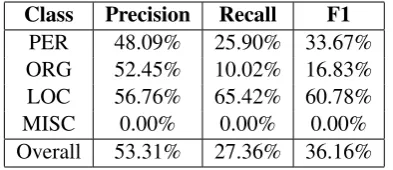
Table 1: Evaluation of the automatic labeling on the full English CoNLL-2003 training set (which we use as noisy datasetN).
entity classes, one can then label a text automat-ically. A word gets assigned a specific class if it appears in the corresponding entity list. A word or token that does not appear in any list gets assigned the null class ”O”. Additionally, simple heuris-tics help to resolve conflicts between lists and to remove some sources of errors. One might e.g. not label the day of the weeks as names, although
”Friday”might be in the list of person names. For this work, we use the English CoNLL-2003 NER corpus (Tjong Kim Sang and De Meulder,
2003). The dataset is labeled with the classes per-son (PER), location (LOC), organization (ORG), miscellaneous name (MISC) and the null class (O). It consists of a training, a development and a test set. To obtain a low-resource setting, we ran-domly sample a subset of the training set as clean dataC. In the experiments, we vary this size be-tween ca. 400 and 20000 words. The rest of the labels are removed from the training set.
We then label the whole training set using the method by Dembowski et al. (2017) in the ver-sion with heuristics. This approach of automati-cally labeling words allows to quickly obtain large amounts of labeled text. However, both precision and recall tend to be lower than for manually la-beled corpora (cf. Table1). It should be noted that the MISC class is not covered with this technique which is an additional source of noise in the auto-matically annotated data. We use this as our noisy dataN.
5 Model Architectures and Training
In this section, we present the different model ar-chitectures we evaluated in our experiments and we give details on the training procedure.
”coun-tries other than Britain until the scientific”where
”Britain”is the target word with labely= LOC. Sentence boundaries are padded. We encode the words using the 300-dimensional GloVe vectors trained on cased text from Common Crawl ( Pen-nington et al.,2014).
The base-model uses a bidirectional LSTM
(Hochreiter and Schmidhuber, 1997) with state
size 300 to encode the input. Then a dense layer is applied with size 100 and ReLU activation (
Glo-rot et al.,2011). Afterwards, the softmax layer is
used for classification. This model is only trained on the clean dataC.
The noise-modelis built upon the base model
and uses the noise layer architecture explained in section3. First, the model is trained without noise layer for one epoch on the clean data. Then, we alternate between training with the noise layer on the noisy data and without the noise layer on the clean, each for one epoch. Instead of training on the full noisy corpus, we use a subsampleN˜, randomly picked in each epoch. This allows the model to see many different noisy samples while preventing the noise from being too dominant. In section6.2, we evaluate this effect.
For the base-model-with-noise we use the same clean and noisy data but the noise layer is left out, using only the base model architecture with-out an explicit noise-handling technique.
To evaluate the importance of the initialization of the stochastic matrixθ, the
noise-model-with-identity-inituses the same training approach and
data as thenoise-model. However,θis initialized with the identity matrix instead of using formula
4.
The noise-adaptation-modeluses the original
model ofGoldberger and Ben-Reuven (2017). It consists of the base model with the noise layer and is trained on the whole noisy dataset in each epoch. It does not use the clean data. For initial-izingθ, the base model is pretrained on the noisy data and its predictions are used as an approxima-tion to the clean labels.
We also compare to the recent work by Veit
et al.(2017). They train a noise cleaning
compo-nent which learns to map from a noisy label and a feature representation to a clean label. These cleaned labels are then used for training of what we call the base model. The authors did not report specific layer sizes and their architecture is devel-oped for an image classification task, which
dif-fers structurally from our NER dataset (e.g. their label vector is much sparser). We, therefore, adapt their concept to our setting. As feature represen-tation, we use the output of the BiLSTM which is projected to a 30-dimensional space with a lin-ear layer. This is concatenated with the noisy la-bel and used as input to the noise cleaning com-ponent. It is passed through a dense layer with the same dimension as the label vector. The skip-connection and clipping are used as in their pub-lication. We use the same training approach and data as with the noise-model, replacing the step where the noise layer is trained. Instead, in each epoch the noise cleaning component is trained on
C and the corresponding noisy labels. The base model is then trained on a cleaned version ofN˜
andC. We call this thenoise-cleaning-model. All models are trained using cross-entropy loss, except for the noise cleaning component of the
noise-cleaning-modelwhich is trained with the ab-solute error loss like in the original paper. All models are trained for 40 epochs and the weights of the best performing epoch are selected accord-ing to the F1 score on the development set. Adam
(Kingma and Ba,2015) is used for stochastic
op-timization.
6 Experiments and Evaluation
In this section, we report on our experiments and their results. The training on noisy data as well as the randomness in training neural networks in general lead to a certain amount of variance in the evaluation scores. Therefore, we repeat all experi-ments five times and report the average as well as the standard error. To obtain meaningful results, no noise is added to the test data.
6.1 Model Comparison
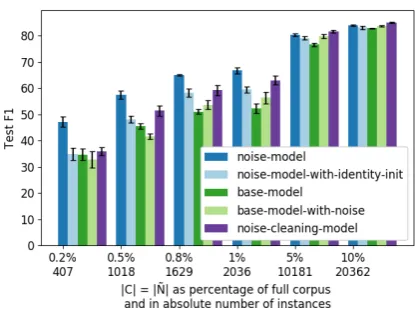
To simulate different degrees of low-resource set-tings, we trained the models on different amounts of clean data. We vary the size between 407 la-beled words (0.2% of the CoNLL-2003 training data) and 20362 labeled words (10%) in six steps. Since the noisy labels are easy to obtain, we use the whole corpusN. The size of the random sub-sampleN˜ in each epoch is set to the same size as the clean data.
Figure 2: Evaluation results of the models. Ex-periments were run for different sizes of the clean data C and the per epoch randomly subsampled data N˜. The average F1 score on the test set is given over five runs. The error bars show two-times standard error in both directions.
have obtained enough clean training data, the ad-ditional noisy data cannot add much more infor-mation, even when cleaned. This is reminiscent of results from semi-supervised learning (e.g. in
Nigam et al.,2006).
For the two settings with the lowest amount of data, thebase-model-with-noise(which is trained on clean and noisy data without a noise channel) performs worst. For the four settings with more data, it is better than base-model (which is only trained onC). This could indicate that noisy labels do hurt the performance in low-resource settings. However, once a certain amount of clean training data is obtained, this is enough to cope with the noise to a certain degree and obtain improvements, even when the noise is not explicitly handled.
The models that do handle noise, outperform these baselines. When comparing noise-model
andnoise-model-with-identity-init, we see a large gap in performance. This shows the importance of a good initialization of the noise modelθin the low-resource setting.
The originalnoise-adaptation-model model by
Goldberger and Ben-Reuven(2017) obtains an
av-erage F1 score of 38.8. This shows that a model purely trained on a large amount of automatically annotated data can be an alternative to a model trained on very few clean instances. However, the effect of cleaning noisy labels without access to any clean data seems limited, as the model can-not even reach the performance of either the
base-model trained on 1018 instances nor our noise-modelon the smaller set of 407 instances.
The noise-model outperforms the
cleaning-modelin the four lower-resource settings while the latter performs slightly better in the two scenarios with more data. With its access to the features in the noise cleaning component, thecleaning-model
might be able to model more complex noise trans-formations. However, it does not seem to be able to leverage this capability in a low-resource set-ting. In the low-resource settings, ournoise-model
is able to handle the noise well and it gains over ten points in F1 score over not using a noise-handling mechanism or only training on clean data.
6.2 Amount of Noisy Data
In this experiment, we evaluate the effect of using different amounts of noisy data during each epoch, i.e. we vary the size of the subsampled, noisy dataN˜. We experiment with thenoise-modeland fix the amount of clean data C to 2036 labeled words (1% of the CoNLL-2003 training data). We choose |N˜|as multiples of |C|using factors 0.5, 1, 2, 10, 20, 30 and 50.
The results are given in Figure3. One can see a trend that increasing the size ofN˜ results in an improvement in F1 score. This holds until factor 5. Afterwards, the performance degrades again. This might indicate that the noisy data becomes too dominant and the cleaning effect of the noise layer is not able to mitigate it.
6.3 Learned Weights
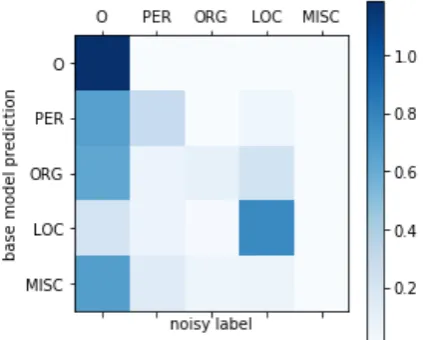
Since, for evaluation purposes, we do have access to the clean labels of the whole training set, we can compare the noise that is in the noisy data to what the noise layer learned. Table 1 shows the evaluation of the automatically annotated labels on the training data. Figure 4 shows the stochastic matrix θ that was learned in one run of training thenoise-model with|C| = |N˜| =2036 labeled words (1% of the CoNLL-2003 training data).
Figure 3: Evaluation results for varying the size of the per epoch randomly subsampled noisy dataN˜. Thenoise-modelwas used and the amount of clean dataC fixed to 2036 labeled words. The average F1 score on the test set is given over five runs. The error bars show two-times standard error in both directions.
class, the recall in the noisy labels is much higher and we see this reflected in the learned weights. The prominent weight isθLOC, LOC, i.e. a
predic-tion of the label LOC is mostly left unchanged be-cause it tends to be correctly labeled in the noisy data.
7 Conclusions and Future Work
In this work, we presented a technique to train a neural network on a combination of clean and noisy annotations. We modeled the noise explic-itly using a noise layer. We evaluated our ap-proach on an NER task using real noise in the form of automatically annotated labels. We found that the probabilistic noise matrix learned is a useful model of the noise. In the low-resource setting where only a few manually annotated instances are available, we showed the improvements of up to 35% obtained from using additional, noisy data and handling the noise.
For future work, we want to experiment with different classification tasks and other sources of noisy data. We would also like to explore more complex noise models that are able to perform well both in low- and high-resource settings.
References
Eyal Beigman and Beata Beigman Klebanov. 2009. Learning with annotation noise. In Proceedings of
Figure 4: Representation of the noise transition weightsθlearned in the noise layer. Each square is a valueexp(θij)whereiis the vertical andjthe
horizontal index in the visualization.
the Joint Conference of the 47th Annual Meeting of the ACL and the 4th International Joint Conference on Natural Language Processing of the AFNLP.
Alan Joseph Bekker and Jacob Goldberger. 2016. Training deep neural-networks based on unreliable labels. InIEEE International Conference on Acous-tics, Speech and Signal Processing (ICASSP).
Esther Maria van den Berg. 2016. Noisy label neu-ral network approach to named entity recognition. Master’s thesis, Rijksuniversiteit Groningen, Uni-versit¨at des Saarlandes.
Dipanjan Das and Slav Petrov. 2011. Unsupervised part-of-speech tagging with bilingual graph-based projections. In Proceedings of the 49th Annual Meeting of the Association for Computational Lin-guistics: Human Language Technologies-Volume 1.
Julia Dembowski, Michael Wiegand, and Dietrich Klakow. 2017. Language independent named en-tity recognition using distant supervision. In Pro-ceedings of Language and Technology Conference (LTC).
Yair Dgani, Hayit Greenspan, and Jacob Goldberger. 2018. Training a neural network based on unreliable human annotation of medical images. InIEEE Inter-national Symposium on Biomedical Imaging (ISBI).
Rob Fergus, Yair Weiss, and Antonio Torralba. 2009. Semi-supervised learning in gigantic image collec-tions. InAdvances in neural information processing systems.
[image:6.595.311.523.71.241.2]Jacob Goldberger and Ehud Ben-Reuven. 2017. Train-ing deep neural-networks usTrain-ing a noise adaptation layer. In Int. Conference on Learning Representa-tions (ICLR).
Sepp Hochreiter and J¨urgen Schmidhuber. 1997. Long short-term memory.Neural computation, 9(8).
Diederik Kingma and Jimmy Ba. 2015. Adam: A method for stochastic optimization. InInternational Conference on Learning Representations (ICLR).
Hrafn Loftsson. 2009. Correcting a pos-tagged corpus using three complementary methods. In Proceed-ings of the 12th Conference of the European Chapter of the Association for Computational Linguistics.
Kamal Nigam, Andrew McCallum, and Tom Mitchell. 2006. Semi-supervised text classification using em.
Semi-Supervised Learning.
Jeffrey Pennington, Richard Socher, and Christo-pher D. Manning. 2014. Glove: Global vectors for word representation. InEmpirical Methods in Natu-ral Language Processing (EMNLP).
Ines Rehbein and Josef Ruppenhofer. 2017. Detecting annotation noise in automatically labelled data. In
Proceedings of the 55th Annual Meeting of the As-sociation for Computational Linguistics (Volume 1: Long Papers).
Vitor Rocio, Joaquim Silva, and Gabriel Lopes. 2007. Detection of strange and wrong automatic part-of-speech tagging. In Progress in Artificial Intelli-gence.
Sainbayar Sukhbaatar, Joan Bruna, Manohar Paluri, Lubomir D. Bourdev, and Rob Fergus. 2015. Train-ing convolutional networks with noisy labels. In
ICLR Workshop track.
Erik F Tjong Kim Sang and Fien De Meulder. 2003. Introduction to the conll-2003 shared task: Language-independent named entity recognition. In
Proceedings of the seventh conference on Natural language learning at HLT-NAACL.
Arash Vahdat. 2017. Toward robustness against la-bel noise in training deep discriminative neural net-works. InAdvances in Neural Information Process-ing Systems.
Andreas Veit, Neil Alldrin, Gal Chechik, Ivan Krasin, Abhinav Gupta, and Serge Belongie. 2017. Learn-ing from noisy large-scale datasets with minimal su-pervision. In The Conference on Computer Vision and Pattern Recognition (CVPR).