Learning a Part-of-Speech Tagger from Two Hours of Annotation
Dan Garrette
Department of Computer Science The University of Texas at Austin
Jason Baldridge
Department of Linguistics The University of Texas at Austin
Abstract
Most work on weakly-supervised learning for part-of-speech taggers has been based on un-realistic assumptions about the amount and quality of training data. For this paper, we attempt to create true low-resource scenarios by allowing a linguist just two hours to anno-tate data and evaluating on the languages Kin-yarwanda and Malagasy. Given these severely limited amounts of either type supervision (tag dictionaries) or token supervision (labeled sentences), we are able to dramatically im-prove the learning of a hidden Markov model through our method of automatically general-izing the annotations, reducing noise, and in-ducing word-tag frequency information.
1 Introduction
The high performance achieved by part-of-speech (POS) taggers trained on plentiful amounts of la-beled word tokens is a success story of computa-tional linguistics (Manning, 2011). However, re-search on learning taggers using type supervision (e.g. tag dictionaries or morphological transducers) has had a more checkered history. The setting is a seductive one: by labeling the possible parts-of-speech for high frequency words, one might learn accurate taggers by incorporating the type informa-tion as constraints to a semi-supervised generative learning model like a hidden Markov model (HMM). Early work showed much promise for this strategy (Kupiec, 1992; Merialdo, 1994), but successive ef-forts in recent years have continued to peel away and address layers of unrealistic assumptions about the
size, coverage, and quality of the tag dictionaries that had been used (Toutanova and Johnson, 2008; Ravi and Knight, 2009; Hasan and Ng, 2009; Gar-rette and Baldridge, 2012). This paper attempts to strip away further layers so we can build better intu-itions about the effectiveness of type-supervised and token-supervised strategies in a realistic setting of
POS-tagging for low-resource languages.
In most previous work, tag dictionaries are tracted from a corpus of annotated tokens. To ex-plore the type-supervised scenario, these have been used as a proxy for dictionaries produced by lin-guists. However, this overstates their effectiveness. Researchers have often manuallyprunedtag dictio-naries by removing low-frequency word/tag pairs; this violates the assumption that frequency informa-tion is not available. Others have also created tag dictionaries by extracting every word/tag pair in a large, labeled corpus,including the test data—even though actual applications would never have such complete lexical knowledge. Dictionaries extracted from corpora are also biased towards including only the most likely tag for each word type, resulting in a cleaner dictionary than one would find in real sce-nario. Finally, tag dictionaries extracted from anno-tated tokens benefit from the annotation process of labelingandreviewandrefinement over an extended collaboration period. Such high quality annotations are simply not available for most low-resource lan-guages.
This paper describes an approach to learning a POS-tagger that can be applied in a truly low-resource scenario. Specifically, we discuss tech-niques that allow us to learn a tagger given only
the amount of labeled data that a human annotator could provide in two hours. Here, we evaluate on the languages Malagasy and Kinyarwanda, as well as English as a control language. Furthermore, we are interested in whether type-supervision or token-supervision is more effective, given the strict time constraint; accordingly, we had annotators produce both a tag dictionary and a set of labeled sentences.
The data produced under our conditions differs in several ways from the labeled data used in previous work. Most obviously, there is less of it. Instead of using hundreds of thousands of labeled tokens to construct a tag dictionary (and hundreds of thou-sands more as unlabeled (raw) data for training), we only use the 1k-2k labeled tokens or types provided by our annotators within the timeframe. Our train-ing data is also much noisier than the data from a typical corpus: the annotations were produced by a single non-native-speaker working alone for two hours. Therefore, dealing with the size and quality of training data were core challenges to our task.
To learn aPOS-tagger from so little labeled data,
we developed an approach that starts by generalizing the initial annotations to the entire raw corpus. Our approach uses label propagation (LP) (Talukdar and
Crammer, 2009) to infer tag distributions on unla-beled tokens. We then apply a novelweighted vari-ant of the model minimization procedure originally developed by Ravi and Knight (2009) to estimate se-quence and word-tag frequency information from an unlabeled corpus by approximating the minimal set of tag bigrams needed to explain the data. This com-bination of techniques turns a tiny, unweighted, ini-tial tag dictionary into a weighted tag dictionary that covers the entire corpus’s vocabulary. This weighted information limits the potential damage of tag dic-tionary noise and bootstraps frequency information to approximate a good starting point for the learning of an HMM using expectation-maximization (EM), and far outperforms just using EM on the raw an-notations themselves.
2 Data
Our experiments use Kinyarwanda (KIN), Malagasy
(MLG), and English (ENG). KIN is a Niger-Congo language spoken in Rwanda. MLG is an Austrone-sian language spoken in Madagascar. BothKINand
MLGare low-resource andKINis morphologically-rich. For each language, the word tokens are divided into four sets: training data to be labeled by anno-tators, raw training data, development data, and test data. For consistency, we use 100k raw tokens for each language.
Data sources For ENG, we used the Penn Tree-bank (PTB) (Marcus et al., 1993). Sections 00-04
were used as raw data, 05-14 as a dev set, and 15-24 (473K tokens) as a test set. The PTB uses 45 dis-tinctPOStags. TheKINtexts are transcripts of
testi-monies by survivors of the Rwandan genocide pro-vided by the Kigali Genocide Memorial Center. The
MLGtexts are articles from the websites1Lakroaand La Gazetteand Malagasy Global Voices,2 a citizen journalism site.3 Texts in bothKIN and MLGwere tokenized and labeled withPOStags by two
linguis-tics graduate students, each of which was studying one of the languages. TheKIN andMLGdata have 14 and 24 distinctPOS tags, respectively, and were
developed by the annotators.
Time-bounded annotation One of our main goals is to evaluate POS-tagging for low-resource lan-guages in experiments that correspond better to a real-world scenario than previous work. As such, we collected two forms of annotation, each constrained by a two-hour time limit. The annotations were done by the same linguists who had annotated the KIN
and MLG data mentioned above. Our experiments are thus relevant to the reasonable context in which one has access to a linguist who is familiar with the target language and a given set ofPOStags.
The first annotation task was to directly produce a dictionary of words to their possiblePOStags—i.e.,
collecting an actual tag dictionary of the form that is typicallysimulatedinPOS-tagging experiments. For each language, we compiled a list of word types, or-dered starting with most frequent, and presented it to the annotator with a list of admissible POS tags. The annotator had two hours to specifyPOStags for as many words as possible. The word types and fre-quencies used for this task were taken from the raw training data and did not include the test sets. This
1www.lakroa.mgandwww.lagazette-dgi.com 2
mg.globalvoicesonline.org/
3
data is used for what will calltype-supervised train-ing. The second task was annotating full sentences withPOStags, again for two hours. We refer to this
astoken-supervisedtraining.
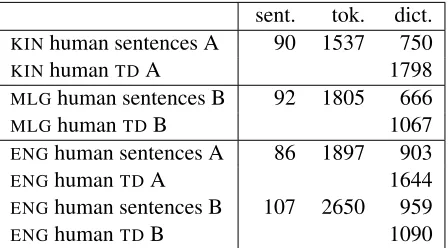
Having both sets of annotations allows us to in-vestigate the relative value of each with respect to training taggers. Token-supervision provides valu-able frequency and tag context information, but type-supervision produces larger dictionaries. This can be seen in Table 1, where the dictionary size column in the table gives the number of unique word/tag pairs derived from the data.
We also wanted to directly compare the two an-notators to see how the differences in their relative annotation speeds and quality would affect the over-all ability to learn an accurate tagger. We thus had them complete the same two tasks for English. As can be seen in Table 1, there are clear differences between the two annotators. Most notably, annota-tor B was faster at annotating full sentences while annotator A was faster at annotating word types.
3 Approach
Our approach to learning POS-taggers is based on Garrette and Baldridge (2012), which properly sep-arated test data from learning data, unlike much pre-vious work. The input to our system is a raw cor-pus and either a human-generated tag dictionary or human-tagged sentences. The majority of the sys-tem is the same for both kinds of labeled training data, but the following description will point out dif-ferences. The system has four main parts, in order:
1. Tag dictionary expansion 2. Weighted model minimization
3. Expectation maximization (EM)HMMtraining
4. MaxEnt Markov Model (MEMM) training
3.1 Tag dictionary expansion
In a low-resource setting, most word types will not be found in the initial tag dictionary. EM-HMM
train-ing uses the tag dictionary to limit ambiguity, so a sparse tag dictionary is problematic because it does not sufficiently confine the parameter space.4 Small
4This is of course not the case for purely unsupervised tag-gers, though we also note that it is not at all clear they are actu-ally learning taggers for part-of-speech.
sent. tok. dict.
KINhuman sentences A 90 1537 750
KINhumanTDA 1798
MLGhuman sentences B 92 1805 666
MLGhumanTDB 1067
ENGhuman sentences A 86 1897 903
ENGhumanTDA 1644
ENGhuman sentences B 107 2650 959
[image:3.612.316.540.54.178.2]ENGhumanTDB 1090
Table 1: Statistics for Kinyarwanda, Malagasy, and English data annotated by annotators A and B.
dictionaries also interact poorly with the model min-imization of Ravi et al. (2010): if there are too many unknown words, and every tag must be considered for them, then the minimal model will simply be the one that assumes that they all have the same tag.
For these reasons, we automatically expand an initial small dictionary into one that has coverage for most of the vocabulary. We use label propagation (LP)—specifically, the Modified Adsorption (MAD) algorithm (Talukdar and Crammer, 2009)5—which is a graph-based technique for spreading labels be-tween related items. Our graphs connect token nodes to each other via feature nodes and are seeded withPOS-tag labels from the human-annotated data.
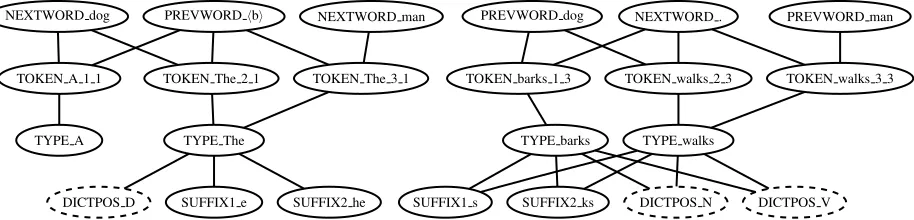
Defining theLPgraph OurLP graph has several types of nodes, as shown in Figure 1. The graph contains a TOKEN node for each token of the la-beled corpus (when available) and raw corpus. Each word type has one TYPE node that is connected to
its TOKEN nodes. Both kinds of nodes are con-nected with feature nodes. The PREVWORD x and
NEXTWORD x nodes represent the features of a to-ken being preceded by or followed by word typexin the corpus. Thesebigramfeatures capture extremely simple syntactic information. To capture shallow morphological relatedness, we useprefixandsuffix nodes that connect word types that share prefix or suffix character sequences up to length 5. For each node-feature pair, the connecting edge is weighted as1/N whereN is the number of nodes connected to the particular feature.
5
TOKEN A 1 1 TOKEN walks 2 3
SUFFIX1 e
TOKEN barks 1 3
SUFFIX1 s
PREVWORD dog
SUFFIX2 he TYPE A
TOKEN The 2 1 TOKEN The 3 1 TOKEN walks 3 3 PREVWORD man NEXTWORD .
TYPE barks TYPE The
SUFFIX2 ks DICTPOS D
NEXTWORD dog
DICTPOS N DICTPOS V TYPE walks
[image:4.612.79.536.55.165.2]NEXTWORD man PREVWORDhbi
Figure 1: Subsets of theLPgraph showing regions of connected nodes. Graph represents the sentences “A dog barks .”, “The dog walks .”, and “The man walks .”
We also explored the effectiveness of using an ex-ternal dictionary in the graph since this is one of the few available sources of information for many low-resource languages. Though a standard dictionary probably will not use the same POStag set that we are targeting, it nevertheless provides information about the relatedness of various word types. Thus, we use nodesDICTPOS p that indicate that a particu-lar word type is listed as havingPOSpin the dictio-nary. Crucially, these tags bear no particular con-nection to the tags we are predicting: we still tar-get the tags defined by the linguist who annotated the types or tokens used, which may be more or less granular than those provided in the dictionary. As external dictionaries, we use English Wiktionary (614k entries),malagasyworld.org(78k entries), andkinyarwanda.net(3.7k entries).6
Seeding the graph is straightforward. With token-supervision, labels for tokens are injected into the corresponding TOKEN nodes with a weight of 1.0. In the type-supervised case, anyTYPEnode that
ap-pears in the tag dictionary is injected with a uniform distribution over the tags in its tag dictionary entry.
Toutanova and Johnson (2008) (also, Ravi and Knight (2009)) use a simple method for predict-ing possible tags for unknown words: a set of 100 most common suffixes are extracted and then mod-els ofP(tag|suffix)are built and applied to unknown words. However, these models suffer with an ex-tremely small set of labeled data. Our method uses character affix feature nodes along with sequence feature nodes in the LP graph to get distributions over unknown words. Our technique thus subsumes
6Wiktionary (wiktionary.org) has only 3,365 en-tries for Malagasy and 9 for Kinyarwanda.
theirs as it can infer tag dictionary entries for words whose suffixes do not show up in the labeled data (or with enough frequency to be reliable predictors).
Extracting a result from LP LP assigns a label distribution to every node. Importantly, each indi-vidual TOKEN gets its own distribution instead of sharing an aggregation over the entire word type. From this graph, we extract a new version of the raw corpus that contains tags for each token. This provides the input for model minimization.
We seek a small set of likely tags for each token, butLPgives each token a distribution over the entire set of tags. Most of the tags are simply noise, some of which we remove by normalizing the weights and excluding tags with probability less than 0.1. Af-ter applying this cutoff, the weights of the remain-ing tags are re-normalized. We stress that this tag dictionary cutoff is not like those used in past re-search, which were done with respect to frequen-cies obtained from labeled tokens: we use either no word-tag frequency information (type-supervision) or very small amounts of word-tag frequency infor-mation indirectly throughLP(token-supervision).7
Some tokens might not have any associated tag labels after LP. This occurs when there is no path from a TOKEN node to any seeded nodes or
when all tags for theTOKENnode have weights less than the threshold. Since we require a distribution for every token, we use a default distribution for such cases. Specifically, we use the unsupervised emission probability initialization of Garrette and Baldridge (2012), which captures both the estimated frequency of a tag and its openness using only a
7
hbi The man saw the saw hbi
hbi
D
N
V 1.0
1.0
1.0 0.2
0.8 1.0
0.7
[image:5.612.78.300.60.142.2]0.3 1.0
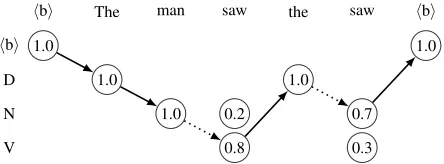
Figure 2: Weighted, greedy model minimization graph showing a potential state between the stages of the tag bigram choosing algorithm. Solid edges: selected bigrams. Dotted edges: holes in the path.
small tag dictionary and unlabeled text.
Finally, we ensure that tokens of words in the original tag dictionary are only assigned tags from its entry. With this filter,LPof course does not add new tags to known words (without it, we found per-formance drops). If the intersection of the small tag dictionary entry and the token’s resulting distribu-tion from LP (after thresholding) is empty, we fall back to the filtered and renormalizeddefault distri-bution for that token’s type.
The result of this process is a sequence of (ini-tially raw) tokens, each associated with a distribu-tion over a subset of tags. From this we can extract an expanded tag dictionary for use in subsequent stages that, crucially, provides tag information for words not covered by the human-supplied tag dic-tionary. This expansion is simple: an unknown word type’s set of tags is the union of all tags assigned to its tokens. Additionally, we add the full entries of word types given in the original tag dictionary.
3.2 Weighted model minimization
EM-HMM training depends crucially on having a clean tag dictionary and a good starting point for the emission distributions. Given only raw text and a tag dictionary, these distributions are difficult to es-timate, especially in the presence of a very sparse or noisy tag dictionary. Ravi and Knight (2009) use model minimization to remove tag dictionary noise and induce tag frequency information from raw text. Their method works by finding a minimal set of tag bigrams needed to explain a raw corpus.
Model minimization is a natural fit for our system since we start with little or no frequency informa-tion and automatic dicinforma-tionary expansion introduces
noise. We extend the greedy model minimization procedure of Ravi et al. (2010), and its enhance-ments by Garrette and Baldridge (2012), to develop a novel weighted minimization procedure that uses the tag weights from LP to find a minimal model that is biased toward keeping tag bigrams that have consistently high weights across the entire corpus. The new weighted minimization procedure fits well in our pipeline by allowing us to carry the tag dis-tributions forward fromLPinstead of simply throw-ing that information away and usthrow-ing a traditional tag dictionary.
In brief, the procedure works by creating a graph such that each possible tag of each raw-corpus token is a vertex (see Figure 2). Any edge that would con-nect two tags of adjacent tokens is a potential tag bi-gram choice. The algorithm first selects tag bibi-grams until every token is covered by at least one bigram, then selects tag bigrams that fill gaps between exist-ing edges until there is a complete bigram path for every sentence in the raw corpus.8
Ravi et al. (2010) select tag bigrams that cover the most new words (stage 1) or fill the most holes in the tag paths (stage 2). Garrette and Baldridge (2012) introduced the tie-breaking criterion that bi-gram choices should seek to introduce the small-est number of newword/tag pairspossible into the paths. Our criteria adds to this by using the tag weights on each token: a tag bigrambis chosen by summing up the node weights of any not-yet cov-ered words touched by the tag bigram b, dividing this sum by one plus the number of new word/tag pairs that would be added byb, and choosing the b
that maximizes this value.9
Summing node weights captures the intuition of Ravi et al. (2010) that good bigrams are those which have high coverage of new words: each newly cov-ered node contributes additional (partial) counts. However, by using the weights instead of full counts, we also account for the confidence assigned byLP. Dividing by the number of new word/tag pairs added focuses on bigrams that reuse existing tags for words
8
and thereby limits the addition of new tags for each word type.
At the start of model minimization, there are no selected tag bigrams, and thus no valid path through any sentence in the corpus. As bigrams are selected, we can begin to cover subsequences and eventually full sentences. There may be multiple valid taggings for a sentence, so after each new bigram is selected, we run the Viterbi algorithm over the raw corpus us-ing the set of selected tag bigrams as a hard con-straint on the allowable transitions. This efficiently identifies the highest-weight path through each sen-tence, if one exists. If such a path is found, we re-move the sentence from the corpus and store the tags from the Viterbi tagging. The algorithm terminates when a path is found for every raw corpus sentence. The result of weighted model minimization is this set of tag paths. Since each path represents a valid tagging of the sentence, we use this output as a nois-ily labeled corpus for initializingEMin stage three.
3.3 Tagger training
Stage one provides an expansion of the initial la-beled data and stage two turns that into a corpus of noisily labeled sentences. Stage three uses the EM
algorithm initialized by the noisy labeling and con-strained by the expanded tag dictionary to produce an HMM.10 The initial distributions are smoothed with one-count smoothing (Chen and Goodman, 1996). If human-tagged sentences are available as training data, then we use their counts to supplement the noisy labeled text for initialization and we add their counts into every iteration’s result.
The HMM produced by stage three is not used directly for tagging since it will contain zero-probabilities for test-corpus words that were unseen during training. Instead, we use it to provide a Viterbi labeling of the raw corpus, following the “auto-supervision” step of Garrette and Baldridge (2012). This material is then concatenated with the token-supervised corpus (when available), and used to train a Maximum Entropy Markov Model tag-ger.11 The MEMM exploits subword features and
10An added benefit of this strategy is that the
EMalgorithm with the expanded dictionary runs much more quickly than without it since it does not have to consider every possible tag for unknown words, averaging 20x faster onPTBexperiments.
11We use OpenNLP:opennlp.apache.org.
generally produces 1-2% better results than anHMM
trained on the same material.
4 Experiments12
Experimental results are shown in Table 2. Each ex-periment starts with an initial data set provided by annotator A or B. Experiment (1) simply uses EM
with the initial small tag dictionary to learn a tag-ger from the raw corpus. (2) usesLPto infer an ex-panded tag dictionary and tag distributions over raw corpus tokens, but then takes the highest-weighted tag from each token for use as noisily-labeled train-ing data to initializeEM. (3) performs greedy
model-minimization on theLPoutput to derive that noisily-labeled corpus. Finally, (4) is the same as (3), but additionally uses external dictionary nodes in theLP
graph. In the case of token-supervision, we also in-clude (0), in which we simply used the tagged sen-tences as supervised data for an HMM without EM
(followed byMEMMtraining).
The results show that performance improves with our LP and minimization techniques compared to basicEM-HMM training. LP gives large
across-the-board improvements overEM training with only the original tag dictionary (compare columns 1 & 2). Weighted model minimization further improves re-sults for type-supervision settings, but not for token supervision (compare 2 & 3).
Using an external dictionary in the LP graph has little effect for KIN, probably due to the available
dictionary’s very small size. However, MLG with its larger dictionary obtains an improvement in both scenarios. Results on ENG are mixed; this may be
because the PTB tagset has 45 tags (far more than the dictionary) so the external dictionary nodes in theLPgraph may consequently serve to collapse
dis-tinctions (e.g. singular and plural) in the larger set. Our results show differences between token- and type-supervised annotations. Tag dictionary expan-sion is helpful no matter what the annotations look like: in both cases, the initial dictionary is too small for effectiveEMlearning, so expansion is nec-essary. However, model minimization only ben-efits the type-supervised scenarios, leaving token-supervised performance unchanged. This suggests
12
Human Annotations 0. NoEM 1.EMonly 2. WithLP 3. LP+min 4. LP(ed)+min
Initial data T K U T K U T K U T K U T K U
KINtokens A 72 90 58 55 82 32 71 86 58 71 86 58 71 86 58
KINtypes A 63 77 32 78 83 69 79 83 70 79 83 70
MLGtokens B 74 89 49 68 87 39 74 89 49 74 89 49 76 90 53
MLGtypes B 71 87 46 72 81 57 74 86 56 76 86 60
ENGtokens A 63 83 38 62 83 37 72 85 55 72 85 55 72 85 56
ENGtypes A 66 76 37 75 81 56 76 83 56 74 81 55
ENGtokens B 70 87 44 70 87 43 78 90 60 78 90 60 78 89 61
[image:7.612.78.534.54.194.2]ENGtypes B 69 83 38 75 82 61 78 85 61 78 86 61
Table 2: Experimental results. Three languages are shown: Kinyarwanda (KIN), Malagasy (MLG), and
English (ENG). The letters A and B refer to the annotator. LP(ed) refers to label propagation including nodes from an external dictionary. Each result given as percentages for Total (T), Known (K), and Unknown (U).
that minimization is working as intended: it induces frequency information when none is provided. With token-supervision, the annotator provides some in-formation about which tag transitions are best and which emissions are most likely. This is miss-ing with type-supervision, so model minimization is needed to bootstrap word/tag frequency guesses.
This leads to perhaps our most interesting result: in a time-critical annotation scenario, it seems better to collect a simple tag dictionary than tagged sen-tences. While the tagged sentences certainly contain useful information regarding tag frequencies, our techniques can learn this missing information auto-matically. Thus, having wider coverage of word type information, and having that information be focused on the most frequent words, is more important. This can be seen as a validation of the last two decades of work on (simulated) type-supervision learning for
POS-tagging—with the caveat that the additional ef-fort we do is needed to realize the benefit.
Our experiments also allow us to compare how the data from different annotators affects the quality of taggers learned. Looking at the direct comparison on English data, annotator B was able to tag more sentences than A, but A produced more tag dictio-nary entries in the type-supervision scenario. How-ever, it appears, based on theEM-only training, that
the annotations provided by B were of higher quality and produced more accurate taggers in both scenar-ios. Regardless, our full training procedure is able to substantially improve results in all scenarios.
Table 3 gives the recall and precision of the tag
[image:7.612.330.525.269.323.2]Tag Dictionary Source R P (1) human-annotatedTD 18.42 29.33 (2)LPoutput 35.55 2.62 (3) model min output 30.49 4.63
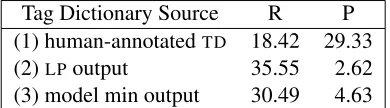
Table 3: Recall (R) and precision (P) for tag dictio-naries versus the test data in a “MLGtypes B” run.
dictionaries forMLGfor settings 1, 2 and 3. The ini-tial, human-provided tag dictionary unsurprisingly has the highest precision and lowest recall. LP ex-pands that data to greatly improve recall with a large drop in precision. Minimization culls many entries and improves precision with a small relative loss in recall. Of course, this is only a rough indicator of the quality of the tag dictionaries since the word/tag pairs of the test set only partially overlap with the raw training data and annotations.
Because gold-standard annotations are available for the English sentences, we also ran oracle ex-periments using labels from the PTB corpus
#Errors 11k 6k 5k 4k 3k Gold TO NNP NN JJ NNP
[image:8.612.318.536.53.264.2]Model IN NN JJ NN JJ
Table 4: Top errors from an “ENGtypes B” run.
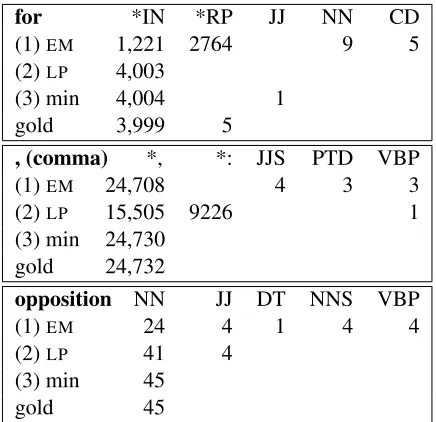
Error Analysis One potential source of errors comes directly from the annotators themselves. Though our approach is designed to be robust to an-notation errors, it cannot correct all mistakes. For example, for the “ENGtypes B” experiment, the an-notator listed IN (preposition) as the only tag for word type “to”. However, the test set only ever as-signs tag TO for this type. This single error accounts for a 2.3% loss in overall tagging accuracy (Table 4). In many situations, however, we are able to auto-matically remove improbable tag dictionary entries, as shown in Table 5. Consider the word type “for”. The annotator has listed RP (particle) as a potential tag, but only five out of 4k tokens have this tag. With RP included,EMbecomes confused and labels a ma-jority of the tokens as RP when nearly all should be labeled IN. We are able to eliminate RP as a possi-bility, giving excellent overall accuracy for the type. Likewise for the comma type, the annotator has in-correctly given “:” as a valid tag, and LP, which uses the tag dictionary, pushes this label to many to-kens with high confidence. However, minimization is able to correct the problem.
Finally, the word type “opposition” provides an example of the expected behavior for unknown words. The type is not in the tag dictionary, so
EM assumes all tags are valid and uses many labels.
LPexpands the starting dictionary to cover the type, limiting it to only two tags. Minimization then de-termines that NN is the best tag for each token.
5 Related work
Goldberg et al. (2008) trained a tagger for Hebrew using a manually-created lexicon which was not de-rived from an annotated corpus. However, their lexi-con was lexi-constructed by trained lexicographers over a long period of time and achieves very high coverage of the language with very good quality. In contrast, our annotated data was created by untrained linguis-tics students working alone for just two hours.
Cucerzan and Yarowsky (2002) learn a POS
-for *IN *RP JJ NN CD
(1)EM 1,221 2764 9 5
(2)LP 4,003
(3) min 4,004 1 gold 3,999 5
, (comma) *, *: JJS PTD VBP
(1)EM 24,708 4 3 3
(2)LP 15,505 9226 1
(3) min 24,730 gold 24,732
opposition NN JJ DT NNS VBP
(1)EM 24 4 1 4 4
(2)LP 41 4
(3) min 45
[image:8.612.85.288.54.95.2]gold 45
Table 5: Tag assignments in different scenarios. A star indicates an entry in the human-providedTD.
tagger from existing linguistic resources, namely a dictionary and a reference grammar, but these re-sources are not available, much less digitized, for most under-studied languages.
Subramanya et al. (2010) apply LP to the prob-lem of tagging for domain adaptation. They con-struct anLPgraph that connects tokens in low- and high-resource domains, and propagate labels from high to low. This approach addresses the prob-lem of learning appropriate tags for unknown words within a language, but it requires that the language have at least one high-resource domain as a source of high quality information. For low-resource lan-guages that have no significant annotated resources available in any domain, this technique cannot be applied.
Das and Petrov (2011) and T¨ackstr¨om et al. (2013) learn taggers for languages in which there are noPOS-annotated resources, but for which
in a two-hour timeframe. Of course, if they are avail-able, such parallel text links could be incorporated into our approach.
Furthermore, their approaches require the use of a universal tag set shared between both languages. As such, their approach is only able to induce POS
tags for the low-resource language if the same tag set is used to tag the high-resource language. Our approach does not rely on any such universal tag set; we learn whichever tags the human annotator chooses to use when they provide their annotations. In fact, in our experiments we learn much more de-tailed tag sets than the fairly coarse universal tag set used by Das and Petrov (2011) or T¨ackstr¨om et al. (2013): we learn a tagger for the full Penn Treebank tag set of 45 tags versus the 12 tags in the universal set.
Ding (2011) constructed anLPgraph for learning
POStags on Chinese text by propagating labels from an initial tag dictionary to a larger set of data. This
LP graph contained Wiktionary word/POS relation-ships as features as well as Chinese-English word alignment information and used it to directly esti-mate emission probabilities to initialize anEM train-ing of anHMM.
Li et al. (2012) train an HMM using EM and an
initial tag dictionary derived from Wiktionary. Like Das and Petrov (2011), they use a universalPOStag set, so Wiktionary can be directly applied as a wide-coverage tag dictionary in their case. Additionally, they evaluate their approach on languages for which Wiktionary has high coverage—which would cer-tainly not get far with Kinyarwanda (9 entries). Our approach does not rely on a high-coverage tag dic-tionary nor is it restricted to use with a small tag set.
6 Conclusions and future work
With just two hours of annotation, we obtain 71-78% accuracy forPOS-tagging across three languages
us-ing both type and token supervision. Without tag dictionary expansion and model minimization, per-formance is much worse, from 63-74%. We dramat-ically improve performance on unknown words: the range of 37-58% improves to 53-70%.
We also have a provisional answer to whether an-notation should be on types or tokens: use type-supervision if you also expand and minimize. These
methods can identify missing word/tag entries and estimate frequency information, and they produce as good or better results compared to starting with to-ken supervision. The case of Kinyarwanda was most dramatic: 71% accuracy for token-supervision com-pared to 79% for type-supervision. Studies using more annotators and across more languages would be necessary to make any stronger claim about the relative efficacy of the two strategies.
Acknowledgements
We thank Kyle Jerro, Vijay John, Katrin Erk, Yoav Goldberg, Ray Mooney, Slav Petrov, Oscar T¨ackstr¨om, and the reviewers for their assistance and feedback. This work was supported by the U.S. Department of Defense through the U.S. Army Re-search Office (grant number W911NF-10-1-0533) and via a National Defense Science and Engineer-ing Graduate Fellowship for the first author. Experi-ments were run on the UTCS Mastodon Cluster, pro-vided by NSF grant EIA-0303609.
References
Michele Banko and Robert C. Moore. 2004. Part-of-speech tagging in context. InProceedings of COLING, Geneva, Switzerland.
Stanley F. Chen and Joshua Goodman. 1996. An empir-ical study of smoothing techniques for language mod-eling. InProceedings of ACL, Santa Cruz, California, USA.
Silviu Cucerzan and David Yarowsky. 2002. Boot-strapping a multilingual part-of-speech tagger in one person-day. InProceedings of CoNLL, Taipei, Taiwan. Dipanjan Das and Slav Petrov. 2011. Unsupervised part-of-speech tagging with bilingual graph-based projec-tions. InProceedings of ACL-HLT, Portland, Oregon, USA.
Weiwei Ding. 2011. Weakly supervised part-of-speech tagging for Chinese using label propagation. Master’s thesis, University of Texas at Austin.
Dan Garrette and Jason Baldridge. 2012. Type-supervised hidden Markov models for part-of-speech tagging with incomplete tag dictionaries. In Proceed-ings of EMNLP, Jeju, Korea.
Yoav Goldberg, Meni Adler, and Michael Elhadad. 2008. EM can find pretty good HMM POS-taggers (when given a good start). InProceedings ACL.
resource-scarce languages. In Proceedings of EACL, Athens, Greece.
Julian Kupiec. 1992. Robust part-of-speech tagging us-ing a hidden Markov model. Computer Speech & Lan-guage, 6(3).
Shen Li, Jo˜ao Grac¸a, and Ben Taskar. 2012. Wiki-ly supervised part-of-speech tagging. InProceedings of EMNLP, Jeju Island, Korea.
Christopher D. Manning. 2011. Part-of-speech tagging from 97% to 100%: Is it time for some linguistics? In Proceedings of CICLing.
Mitchell P. Marcus, Beatrice Santorini, and Mary Ann Marcinkiewicz. 1993. Building a large annotated cor-pus of English: The Penn Treebank. Computational Linguistics, 19(2).
Bernard Merialdo. 1994. Tagging English text with a probabilistic model. Computational Linguistics, 20(2).
Sujith Ravi and Kevin Knight. 2009. Minimized models for unsupervised part-of-speech tagging. In Proceed-ings of ACL-AFNLP.
Sujith Ravi, Ashish Vaswani, Kevin Knight, and David Chiang. 2010. Fast, greedy model minimization for unsupervised tagging. InProceedings of COLING. Amarnag Subramanya, Slav Petrov, and Fernando
Pereira. 2010. Efficient graph-based semi-supervised learning of structured tagging models. InProceedings EMNLP, Cambridge, MA.
Oscar T¨ackstr¨om, Dipanjan Das, Slav Petrov, Ryan Mc-Donald, and Joakim Nivre. 2013. Token and type con-straints for cross-lingual part-of-speech tagging. In Transactions of the ACL. Association for Computa-tional Linguistics.
Partha Pratim Talukdar and Koby Crammer. 2009. New regularized algorithms for transductive learning. In Proceedings of ECML-PKDD, Bled, Slovenia. Kristina Toutanova and Mark Johnson. 2008. A