Bag of What? Simple Noun Phrase Extraction for Text Analysis
Abram Handler UMass Amherst [email protected]
Matthew J. Denny Penn State [email protected]
Hanna Wallach Microsoft Research
Brendan O’Connor UMass Amherst [email protected]
Abstract
Social scientists who do not have specialized natural language processing training often use a unigram bag-of-words (BOW) representa-tion when analyzing text corpora. We offer a new phrase-based method,NPFST, for en-riching a unigram BOW. NPFST uses a part-of-speech tagger and a finite state transducer to extract multiword phrases to be added to a unigram BOW. We compare NPFST to bothn -gram and parsing methods in terms of yield, recall, and efficiency. We then demonstrate how to use NPFST for exploratory analyses; it performs well, without configuration, on many different kinds of English text. Finally, we present a case study using NPFST to ana-lyze a new corpus of U.S. congressional bills. For our open-source implementation, see http://slanglab.cs.umass.edu/phrases/.
1 Introduction
Social scientists typically use a unigram represen-tation when analyzing text corpora; each document is represented as a unigram bag-of-words (BOW), while the corpus itself is represented as a document– term matrix of counts. For example, Quinn et al. (2010) and Grimmer (2010) used a unigram BOW as input to a topic model, while Monroe et al. (2008) used a unigram BOW to report the most partisan terms from political speeches. Although the simplic-ity of a unigram BOW is appealing, unigram analy-ses do not preserve meaningful multiword phraanaly-ses, such as “health care” or “social security,” and cannot distinguish between politically significant phrases that share a word, such as “illegal immigrant” and “undocumented immigrant.” To address these limi-tations, we introduceNPFST, which extracts multi-word phrases to enrich a unigram BOW as additional columns in the document–term matrix. NPFST is suitable for many different kinds of English text; it
uses modest computational resources and does not require any specialized configuration or annotations.
2 Background
We compare NPFST to several other methods in terms of yield, recall, efficiency, and interpretability. Yield refers to the number of extracted phrases—a lower yield requires fewer computational and human resources to process the phrases. Recall refers to a method’s ability to recover the most relevant or im-portant phrases, as determined by a human. A good method should have a low yield, but high recall.
2.1 n-grams
Our simplest baseline is AllNGrams(K). This method extracts alln-grams, up to lengthK, from tokenized, sentence-segmented text, excluding n-grams that cross sentence boundaries. This method is commonly used to extract features for text classifi-cation (e.g., Yogatama et al. (2015)), but has several disadvantages in a social scientific context. First, social scientists often want to substantively inter-pret individual phrases, but fragmentary phrases that cross sentence constituents may not be meaning-ful. For example, the Affordable Care Act includes the hard-to-interpret 4-gram, “the Internet website of.” Second, although AllNGrams(K) has high re-call (provided thatKis sufficiently large), it suffers from a higher yield and can therefore require sub-stantial resources to process the extracted phrases.
2.2 Parsing
An alternative approach1 is to use syntax to
re-strict the extracted phrases to constituents, such as noun phrases (NPs). Unlike verb, prepositional, 1Statistical collocation methods provide another approach
(e.g., Dunning (1993), Hannah and Wallach (2014)). These methods focus on within-n-gram statistical dependence. In informal analyses, we found their recall unsatisfying for low-frequency phrases, but defer a full comparison for future work.
or adjectival phrases, NPs often make sense even when stripped from their surrounding context— e.g., [Barack Obama]NP vs. [was inaugurated in 2008]V P. There are many methods for extracting NPs. Given the long history of constituent parsing research in NLP, one obvious approach is to run an off-the-shelf constituent parser and then retrieve all NP non-terminals from the trees.2 We refer to this
method asConstitParse. Unfortunately, the major sources of English training data, such as the Penn Treebank (Marcus et al., 1993), include determin-ers within the NP and non-nested flat NP annota-tions,3 leading to low recall in our context (see§4).
Since modern parsers rely on these sources of train-ing data, it is very difficult to change this behavior.
2.3 Part-of-Speech Grammars
Another approach, proposed by Justeson and Katz (1995), is to use part-of-speech (POS) patterns to find and extract NPs—a form of shallow partial pars-ing (Abney, 1997). Researchers have used this ap-proach in a variety of different contexts (Benoit and Nulty, 2015; Frantzi et al., 2000; Kim et al., 2010; Chuang et al., 2012; Bamman and Smith, 2014). A pattern-based method can be specified in terms of a triple of parameters:(G, K, M), whereGis a gram-mar,Kis a maximum length, andM is a matching strategy. The grammar Gis a non-recursive regu-lar expression that defines an infinite set of POS tag sequences (i.e., a regular language); the maximum lengthKlimits the length of the extractedn-grams ton≤K; while the matching strategyM specifies how to extract text spans that match the grammar.
The simplest grammar that we consider is (A|N)∗N(P D∗(A|N)∗N)∗
defined over a coarse tag set of adjectives, nouns (both common and proper), prepositions, and deter-miners. We refer to this grammar as SimpleNP. The constituents that match this grammar are bare NPs (with optional PP attachments), N-bars, and names. We do not include any determiners at the root NP.
2Another type of syntactic structure prediction is NP
chunk-ing. This produces a shallower, non-nested representation.
3The English Web Treebank (LDC2012T13) has some more
nesting structure and OntoNotes (version 5, LDC2013T19) in-cludes a variant of the Penn Treebank with Vadas and Curran (2011)’s nested NP annotations. We look forward to the avail-ability of constituent parsers trained on these data sources.
We also consider three baseline matching strate-gies, each of which can (in theory) be used with any GandK. The first, FilterEnum, enumerates all pos-sible strings in the regular language, up to lengthK, as a preprocessing step. Then, at runtime, it checks whether eachn-gram in the corpus is present in this enumeration. This matching strategy is simple to implement and extracts all matches up to lengthK, but it is computationally infeasible ifKis large. The second, FilterFSA, compilesGinto a finite-state au-tomaton (FSA) as a preprocessing step. Then, at runtime, it checks whether eachn-gram matches this FSA. Like FilterEnum, this matching strategy ex-tracts all matches up to length K; however, it can be inefficient ifK is large. The third, GreedyFSA, also compilesG into an FSA, but uses a standard greedy matching approach at runtime to extract n-grams that matchG. Unlike the other two match-ing strategies, it cannot extract overlappmatch-ing or nested matches, but it can extract very long matches.4
In their original presentation, Justeson and Katz (1995) defined a grammar that is very similar to SimpleNP and suggested using 2- and 3-grams (i.e., K= 3). With this restriction, their grammar com-prises seven unique patterns. They also proposed us-ing FilterEnum to extract text spans that match these patterns. We refer to this method as JK = (Sim-pleNP,K= 3, FilterEnum). Many researchers have used this method, perhaps because it is described in the NLP textbook by Manning and Sch¨utze (1999).
3 NPFST
Our contribution is a new pattern-based extraction method: NPFST = (FullNP,K=∞, RewriteFST). In§3.1, we define the FullNP grammar, and in§3.2, we define the RewriteFST matching strategy.
3.1 FullNP Grammar
FullNP extends SimpleNP by adding coordination of pairs of words with the same tag (e.g., (VB CC VB)in (cease and desist) order); coordination of noun phrases; parenthetical post-modifiers (e.g., 401(k), which is a 4-gram because of common NLP tokenization conventions); numeric modifiers and nominals; and support for the Penn Treebank tag set, 4We implemented both FilterFSA and GreedyFSA using
����� �����
�����
����� ������� �����
����� �����
����� �����
Figure 1:Composed rewrite latticeL=I◦P for inputI = (JJ NNP NN). Five spans are retrieved during lattice traversal.
the coarse universal tag set (Petrov et al., 2011), and Gimpel et al. (2011)’s Twitter-specific coarse tag set. We provide the complete definition in the appendix.
3.2 RewriteFST Matching Strategy
RewriteFST uses a finite-state transducer (FST) to rapidly extract text spans that matchG—including overlapping and nested spans. This matching strat-egy is a form of finite-state NLP (Roche and Sch-abes, 1997), and therefore builds on an extensive body of previous work on FST algorithms and tools. The input to RewriteFST is a POS-tagged5
se-quence of tokens I, represented as an FSA. For a simple tag sequence, this FSA is a linear chain, but, if there is uncertainty in the output of the tagger, it can be a lattice with multiple tags for each position. The grammar G is first compiled into a phrase transducer P,6 which takes an input sequence I
and outputs the same sequence, but with pairs of start and end symbols—[S] and [E], respectively— inserted to indicate possible NPs (see figure 1). At runtime, RewriteFST computes an output lattice L=I◦P using FST composition;7since it is
non-deterministic,Lincludes all overlapping and nested spans, rather than just the longest match. Finally, FilterFST traverses L to find all edges with a [S] symbol. From each one, it performs a depth-first search to find all paths to an edge with an [E] sym-bol, accumulating all [S]- and [E]-delimited spans.8
In table 1, we provide a comparison of FilterFST and the three matching strategies described in§2.3.
5We used the ARK POS tagger for tweets (Gimpel et al.,
2011; Owoputi et al., 2013) and used Stanford CoreNLP for all other corpora (Toutanova et al., 2003; Manning et al., 2014).
6We used foma (Hulden, 2009; Beesley and Karttunen,
2003) to compileGintoP. fomawas designed for building morphological analyzers; it allows a developer to write a gram-mar in terms of readable production rules with intermediate cat-egories. The rules are then compiled into a single, compact FST.
7We implemented the FST composition using OpenNLP
(Allauzen et al., 2007) andpyfst(http://pyfst.github.io/).
8There are alternatives to this FST approach, such as a
back-tracking algorithm applied directly to the original grammar’s FSA to retrieve all spans starting at each position in the input.
Matching Strategy All Matches? LargeK?
FilterEnum yes infeasible
FilterFSA yes can be inefficient
GreedyFSA no yes
RewriteFST yes yes
Table 1:RewriteFST versus the matching strategies described in§2.3. Like FilterEnum and FilterFSA, RewriteFST extracts all matches up to length K; in contrast, GreedyFSA can-not extract overlapping or nested matches. Like GreedyFSA, RewriteFST can extract long matches; in contrast, FilterEnum and is infeasible and FilterFSA can be inefficient ifKis large.
4 Experimental Results
In this section, we provide experimental results com-paring NPFST to the baselines described in §2 in terms of yield, recall, efficiency, and interpretability. As desired, NPFST has a low yield and high recall, and efficiently extracts highly interpretable phrases.
4.1 Yield and Recall
Yield refers to the number of phrases extracted by a method, while recall refers to a method’s ability to recover the most relevant or important phrases, as determined by a human. Because relevance and importance are domain-specific concepts that are not easy to define, we compared the methods using three named-entity recognition (NER) data sets: mentions of ten types of entities on Twitter from the WNUT 2015 shared task (Baldwin et al., 2015); mentions of proteins in biomedical articles from the BioNLP shared task 2011 (Kim et al., 2011); and a synthetic data set of named entities in New York Times ar-ticles (Sandhaus, 2008), identified using Stanford NER (Manning et al., 2014). Named entities are un-doubtedly relevant and important phrases in all three of these different domains.9 For each data set, we
defined a method’s yield to be the total number of spans that it extracted and a method’s recall to be the percentage of the (labeled) named entity spans that were present in its list of extracted spans.10
9Although we use NER data sets to compare the methods’
yield and recall, social scientists are obviously interested in analyzing other phrases, such as “heath care reform,” which have a less psycholinguistically concrete status (Brysbaert et al., 2014). We focus on these kinds of phrases in§4.3 and§5.
(a) WNUT (b) BioNLP (c) NYT
[image:4.612.336.513.278.373.2]Figure 2:Recall versus yield for AllNGrams(K) withK = 1, . . . ,6, ConstitParse, JK, (SimpleNP,K=∞, GreedyFSA), and NPFST. A good method should have a low yield, but high recall—i.e., the best methods are in the top-left corner of each plot. For visual clarity, they-axis starts at 0.5. We omit yield and recall values for AllNGrams(K) withK >6because recall approaches an asymptote. For the WNUT data set, we omit yield and recall values for ConstitParse because there is no reliable constituent parser for tweets. As described in§4.1, we also show yield and recall values for NPFST run on input lattices (denoted by0.01and0.001).
Figure 2 depicts recall versus yield11 for NPFST
and the following baseline methods: AllNGrams(K) with different values ofK, ConstitParse,12 JK, and
(SimpleNP,K=∞, GreedyFSA). Because the yield and recall values for (SimpleNP,K= 3, FilterFSA) are the same as those of JK, we omit these values from figure 2. We also omit yield and recall val-ues for (FullNP,K=∞, FilterEnum) and (FullNP, K =∞, FilterFSA) because they are identical to those of NPFST. Finally, we omit yield and recall values for (FullNP, K =∞, GreedyFSA) because our implementation of GreedyFSA (using standard Python libraries) is too slow to use with FullNP.
A good method should have a low yield, but high recall—i.e., the best methods are in the top-left corner of each plot. The pattern-based methods all achieved high recall, with a considerably lower yield than AllNGrams(K). ConstitParse achieved a lower yield than NPFST, but also achieved lower recall. JK performed worse than NPFST, in part because it can only extract 2- and 3-grams, and, for example, the BioNLP data set contains men-tions of proteins that are as long as eleven tokens (e.g., “Ca2+/calmodulin-dependent protein kinase (CaMK) type IV/Gr”). Finally, (SimpleNP,K=∞, GreedyFSA) performed much worse than JK be-cause it cannot extract overlapping or nested spans.
11The WNUT data set is already tokenized; however, we
ac-cidentally re-tokenized it in our experiments. Figure 2 therefore only depicts yield and recall for the 1,278 (out of 1,795) tweets for which our re-tokenization matched the original tokenization.
12We used the Stanford CoreNLP shift–reduce parser.
Method Time
AllNGrams(∞) 44.4 ms ConstitParse 825.3 ms
JK 45.3 ms
(SimpleNP,K=3, FilterFSA) 46.43 ms (SimpleNP,K=∞, GreedyFSA) 39.34 ms
NPFST 82.2 ms
Table 2: Timing results for AllNGrams(∞), ConstitParse, JK, (SimpleNP, K = 3, FilterFSA), (SimpleNP, K = ∞, GreedyFSA), and NPFST on ten articles from the BioNLP data set; AllNGrams(∞) is equivalent to AllNGrams(56) in this con-text. The pattern-based methods’ times include POS tagging (37.1 ms), while ConstitParse’s time includes parsing (748 ms).
4.2 Efficiency
We used ten articles from the BioNLP data set to compare the methods’ preprocessing and run-time costs. Table 2 contains timing results13
for AllNGrams(∞), ConstitParse, JK, (SimpleNP, K = 3, FilterFSA), and (SimpleNP, K = ∞, GreedyFSA), and NPFST. We omit results for (FullNP,K=∞, FilterEnum), (FullNP,K=∞, Fil-terFSA), and (FullNP,K=∞, GreedyFSA) because they are too slow to compete with the other methods. POS tagging is about twenty times faster than parsing, which is helpful for social scientists who may not have fast servers. NPFST is slightly slower than the simpler pattern-based methods; however, 80% of its time is spent constructing the inputIand traversing the output lattice L, both of which are implemented in Python and could be made faster.
4.3 Interpretability
When analyzing text corpora, social scientists of-ten examine ranked lists of terms, where each term is ranked according to some score. We argue that multiword phrases are more interpretable than uni-grams when stripped from their surrounding context and presented as a list. In §4.3.1 we explain how to merge related terms, and in §4.3.2, we provide ranked lists that demonstrate that NPFST extracts more interpretable phrases than other methods.
4.3.1 Merging Related Terms
As described in§3.2, NPFST extracts overlapping and nested spans. For example, when run on a data set of congressional bills about crime, NPFST ex-tracted “omnibus crime control and safe streets act,” as well as the nested phrases “crime control” and “safe streets act.” Although this behavior is gener-ally desirable, it can also lead to repetition in ranked lists. We therefore outline an high-level algorithm for merging the highest-ranked terms in a ranked list. The input to our algorithm is a list of termsL. The algorithm iterates through the list, starting with the highest-ranked term, aggregating similar terms ac-cording to some user-defined criterion (e.g., whether the terms share a substring) until it has generatedC distinct term clusters. The algorithm then selects a single term to represent each cluster. Finally, the
al-13We used Python’stimeitmodule.
gorithm orders the clusters’ representative terms to form a ranked list of lengthC. By starting with the highest-ranked term and terminating afterCclusters have been formed, this algorithm avoids the ineffi-ciency of examining all possible pairs of terms.
4.3.2 Ranked Lists
To assess the interpretability of the phrases ex-tracted by NPFST, we used three data sets: tweets about climate change, written by (manually identi-fied) climate deniers;14transcripts from criminal
tri-als at the Old Bailey in London during the 18th
cen-tury;15 and New York Times articles from
Septem-ber, 1993. For each data set, we extracted phrases using ConstitParse, JK, and NPFST and produced a list of terms for each method, ranked by count. We excluded domain-specific stopwords and any phrases that contained them.16 Finally, we merged
related terms using our term-merging algorithm, ag-gregating terms only if one term was a substring of another, to produce ranked lists of five representative terms. Table 4.3 contains these lists, demonstrating that NPFST produces highly interpretable phrases.
5 Case Study: Finding Partisan Terms in U.S. Congressional Legislation
Many political scientists have studied the rela-tionship between language usage and party affilia-tion (Laver et al., 2003; Monroe et al., 2008; Slapin and Proksch, 2008; Quinn et al., 2010; Grimmer and Stewart, 2013). We present a case study, in which we use NPFST to explore partisan differences in U.S. congressional legislation about law and crime. In
§5.1, we describe our data set, and in §5.2, we ex-plain our methodology and present our results.
5.1 The Congressional Bills Corpus
We used a new data set of 97,221 U.S. congressional bills, introduced in the House and Senate between
14https://www.crowdflower.
com/data/sentiment-analysis-global-warmingclimate-change-2/
15http://www.oldbaileyonline.org/
16For example, for the tweets, we excluded phrases that
Data Set Method Ranked List
Twitter unigrams snow, #tcot, al, dc, gore
JK al gore’s, snake oil science, snow in dc, mine safety NPFST al gore’s, snake oil science, 15 months, snow in dc,
*bunch of snake oil science
Old Bailey unigrams jacques, goodridge, rust, prisoner, sawtell
ConsitParse the prisoner, the warden, the draught, the fleet, the house
JK middlesex jury, public house, warrant of attorney, baron perryn, justice grose NPFST middlesex jury, public house, warrant of attorney, baron perryn,
*middlesex jury before lord loughborough NYT unigrams will, united, one, government, new
ConstitParse he united states, the government, the agreement, the president, the white house JK united states, united nations, white house, health care, prime minister
NPFST united states, united nations, white house, health care, *secretary of state warren christopher
Table 3: Ranked lists of representative terms for unigrams, ConstitParse, JK, and NPFST. For NPSFT, we include the highest-ranked phrase of length four or more (on its own line, denoted by *) in order to highlight the kinds of longer phrases that JK is unable to extract. For the Twitter data set, we omit results for ConstitParse because there is no reliable constituent parser for tweets.
1993 and 2014. We created this data set by scraping the Library of Congress website.17 We used
Stan-ford CoreNLP to tokenize and POS tag the bills. We removed numbers and punctuation, and discarded all terms that occurred in fewer than five bills. We also augmented each bill with its author, its final outcome (e.g., did it survive committee deliberations, did it pass a floor vote in the Senate) from the Congres-sional Bills Project (Adler and Wilkerson, 2014), and its major topic area (Purpura and Hillard, 2006). For our case study, we focused on a subset of 488 bills, introduced between 2013 and 2014, that are primarily about law and crime. We chose this subset because we anticipated that it would clearly highlight partisan policy differences. For exam-ple, the bills include legislation about immigration enforcement and about incarceration of low-level offenders—two areas where Democrats and Repub-licans tend to have very different policy preferences.
5.2 Partisan Terms
We used NPFST to extract phrases from the bills, and then created ranked lists of terms for each party using the informative Dirichlet18 feature selection
17http://congress.gov/
18In order to lower the z-scores of uninformative,
high-frequency terms, we set the Dirichlet hyperparameters to be proportional to the term counts from our full data set of bills.
method of Monroe et al. (2008). This method computes az-score for each term that reflects how strongly that term is associated with Democrats over Republicans—a positivez-score indicates that Democrats are more likely to use the term, while a negativez-score indicates that Republications are more likely to use the term. We merged the highest-ranked terms for each party, aggregating terms only if one term was a substring of another and if the terms were very likely to co-occur in a single bill,19
[image:6.612.104.506.55.262.2]to form ranked lists of representative terms. Finally, for comparison, we also used the same approach to create ranked lists of unigrams, one for each party.
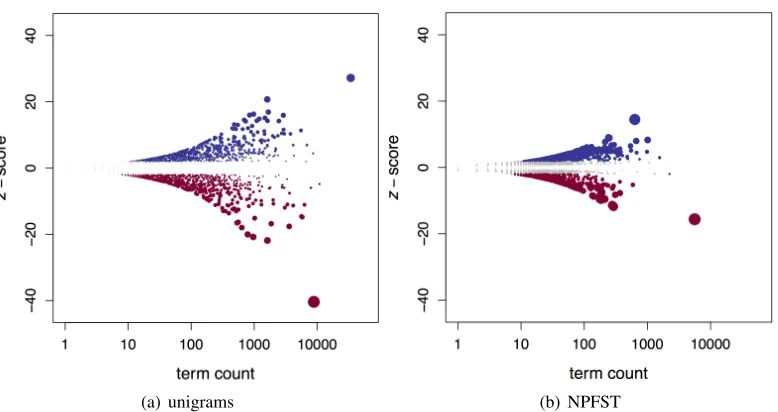
Figure 3 depictsz-score versus term count, while table 4 lists the twenty highest-ranked terms. The unigram lists suggest that Democratic lawmakers fo-cus more on legislation related to mental health, ju-venile offenders, and possibly domestic violence, while Republican lawmakers focus more on illegal immigration. However, many of the highest-ranked unigrams are highly ambiguous when stripped from their surrounding context. For example, we do not know whether “domestic” refers to “domes-tic violence,” “domes“domes-tic terrorism,” or “domes“domes-tic programs” without manually reviewing the
origi-19We used the correlation between the terms’ tf-idf vectors
(a) unigrams (b) NPFST
Figure 3:z-score versus term count. Each dot represents a single term and is sized according to that term’sz-score. Terms that are more likely to be used by Democrats are shown in blue; terms that are more likely to be used by Republicans are shown in dark red.
nal bills (e.g., using a keyword-in-context inter-face (O’Connor, 2014)). Moreover, many of the highest-ranked Republican unigrams, such as “com-munication,” are not unique to law and crime.
In contrast, the phrase-based lists are less am-biguous and much more interpretable. They include names of bills (which are often long) and important concepts, such as “mental health,” “victims of do-mestic violence,” “interstate or foreign commerce,” and “explosive materials.” These lists suggest that Democratic lawmakers have a very strong focus on programs to prevent child abuse and domestic vio-lence, as well as issues related to mental health and gang violence. Republican lawmakers appear to fo-cus on immigration and incarceration. This fofo-cus on immigration is not surprising given the media cov-erage between 2013 and 2014; however, there was much less media coverage of a Democratic focus on crime-related legislation during that time period.
These results suggest that social scientists will be less likely to draw incorrect conclusions from ranked lists of terms if they include multiword phrases. Because phrases are less ambiguous than unigrams, social scientists can more quickly dis-cover meaningful term-based associations for fur-ther exploration, without undertaking a lengthy pro-cess to validate their interpretation of the terms.
6 Conclusions and Future Work
Social scientists typically use a unigram BOW representation when analyzing text corpora, even though unigram analyses do not preserve meaning-ful multiword phrases. To address this limitation, we presented a new phrase-based method, NPFST, for enriching a unigram BOW. NPFST is suitable for many different kinds of English text; it does not re-quire any specialized configuration or annotations.
We compared NPFST to several other methods for extracting phrases, focusing on yield, recall, effi-ciency, and interpretability. As desired, NPFST has a low yield and high recall, and efficiently extracts highly interpretable phrases. Finally, to demonstrate the usefulness of NPFST for social scientists, we used NPFST to explore partisan differences in U.S. congressional legislation about law and crime. We found that the phrases extracted by NPFST were less ambiguous and more interpretable than unigrams.
Method Party Ranked List
unigrams Democrat and, deleted, health, mental, domestic, inserting, grant, programs, prevention, violence, program, striking, education, forensic, standards, juvenile, grants, partner, science, research
Republican any, offense, property, imprisoned, whoever, person, more, alien, knowingly, officer, not, united, intent, commerce, communication, forfeiture, immigration, official, interstate, subchapter NPFST Democrat mental health, juvenile justice and delinquency prevention act, victims of domestic violence,
child support enforcement act of u.s.c., fiscal year, child abuse prevention and treatment act, omnibus crime control and safe streets act of u.s.c., date of enactment of this act,
violence prevention, director of the national institute, former spouse,
section of the foreign intelligence surveillance act of u.s.c., justice system, substance abuse criminal street gang, such youth, forensic science, authorization of appropriations, grant program
Republican special maritime and territorial jurisdiction of the united states, interstate or foreign commerce, federal prison, section of the immigration and nationality act,
[image:8.612.76.535.63.273.2]electronic communication service provider, motor vehicles, such persons, serious bodily injury, controlled substances act, department or agency, one year, political subdivision of a state, civil action, section of the immigration and nationality act u.s.c., offense under this section, five years, bureau of prisons, foreign government, explosive materials, other person
Table 4:Ranked lists of unigrams and representative phrases of length two or more for Democrats and Republicans.
Our open-source implementation of NPFST is available at http://slanglab.cs.umass.edu/phrases/.
Acknowledgments
Appendix: FullNP Grammar
The followingfomagrammar defines the rewrite phrase transducerP:
# POS tag categories. "Coarse" refer to the Petrov Univeral tag set. # We directly use PTB tags, but for Twitter, we assume they’ve been # preprocessed to coarse tags.
# CD is intentionally under both Adj and Noun. define Adj1 [JJ | JJR | JJS | CD | CoarseADJ]; define Det1 [DT | CoarseDET];
define Prep1 [IN | TO | CoarseADP];
define Adv1 [RB | RBR | RBS | CoarseADV];
# Note that Twitter and coarse tags subsume some of this under VERB. define VerbMod1 [Adv1 | RP | MD | CoarsePRT];
# PTB FW goes to CoarseX, but we’re excluding CoarseX since for Gimpel et al.’s # Twitter tags, that’s usually non-constituent-participating things like URLs. define Noun [NN | NNS | NNP | NNPS | FW | CD | CoarseNOUN | CoarseNUM]; define Verb [VB | VBD | VBG | VBN | VBP | VBZ | CoarseVERB];
define AnyPOS [O | Adj1|Det1|Prep1|Adv1|VerbMod1|Noun|Verb | CoarseDOT|CoarseADJ|CoarseADP|CoarseADV|CoarseCONJ|CoarseDET| CoarseNOUN|CoarseNUM|CoarsePRON|CoarsePRT|CoarseVERB|CoarseX ]
define Lparen ["-LRB-" | "-LSB-" | "-LCB-"]; # Twitter doesnt have this. define Rparen ["-RRB-" | "-RSB-" | "-RCB-"];
# Ideally, auxiliary verbs would be VerbMod, but PTB gives them VB* tags. # single-word coordinations
define Adj Adj1 [CC Adj1]*; define Det Det1 [CC Det1]*; define Adv Adv1 [CC Adv1]*; define Prep Prep1 [CC Prep1]*; define VerbMod VerbMod1 [CC VerbMod1]*;
# NP (and thus BaseNP) have to be able to stand on their own. They are not # allowed to start with a determiner, since it’s usually extraneous for our # purposes. But when we want an NP right of something, we need to allow # optional determiners since they’re in between.
define BaseNP [Adj|Noun]* Noun;
define PP Prep+ [Det|Adj]* BaseNP; define ParenP Lparen AnyPOSˆ{1,50} Rparen; define NP1 BaseNP [PP | ParenP]*; define NP NP1 [CC [Det|Adj]* NP1]*;
regex NP -> START ... END;
References
[Abney1997] Steven Abney. 1997. Part-of-speech tag-ging and partial parsing. In Corpus-based methods in language and speech processing, pages 118–136. Springer.
[Adler and Wilkerson2014] E. Scott Adler and John Wilkerson. 2014. Congressional Bills Project: (1980-2004).
[Allauzen et al.2007] Cyril Allauzen, Michael Riley, Jo-han Schalkwyk, Wojciech Skut, and Mehryar Mohri. 2007. OpenFST: A general and efficient weighted finite-state transducer library. InImplementation and Application of Automata, pages 11–23. Springer. [Baldwin et al.2015] Timothy Baldwin, Marie-Catherine
de Marneffe, Bo Han, Young-Bum Kim, Alan Ritter, and Wei Xu. 2015. Shared tasks of the 2015 work-shop on noisy user-generated text: Twitter lexical nor-malization and named entity recognition. In Proceed-ings of the Workshop on Noisy User-generated Text, pages 126–135, Beijing, China, July. Association for Computational Linguistics.
[Bamman and Smith2014] David Bamman and Noah A. Smith. 2014. Unsupervised discovery of biographical structure from text. Transactions of the Association for Computational Linguistics, 2:363–376.
[Beesley and Karttunen2003] Kenneth R. Beesley and Lauri Karttunen. 2003. Finite-state morphology: Xe-rox tools and techniques. CSLI, Stanford.
[Benoit and Nulty2015] Kenneth Benoit and Paul Nulty. 2015. More than unigrams can say: Detecting mean-ingful multi-word expressions in political text. MPSA Working Paper, pages 1–19.
[Brysbaert et al.2014] Marc Brysbaert, Amy Beth War-riner, and Victor Kuperman. 2014. Concreteness rat-ings for 40 thousand generally known English word lemmas.Behavior Research Methods, 46(3):904–911. [Chuang et al.2012] Jason Chuang, Christopher D. Man-ning, and Jeffrey Heer. 2012. “Without the clut-ter of unimportant words”: Descriptive keyphrases for text visualization. ACM Transactions on Computer-Human Interaction (TOCHI), 19(3):19.
[Dunning1993] Ted Dunning. 1993. Accurate methods for the statistics of surprise and coincidence. Compu-tational Linguistics, 19:61–74.
[Frantzi et al.2000] Katerina Frantzi, Sophia Ananiadou, and Hideki Mima. 2000. Automatic recognition of multi-word terms: The c-value/nc-value method. In-ternational Journal on Digital Libraries, 3(2):115– 130.
[Gimpel et al.2011] Kevin Gimpel, Nathan Schneider, Brendan O’Connor, Dipanjan Das, Daniel Mills, Jacob Eisenstein, Michael Heilman, Dani Yogatama, Jeffrey Flanigan, and Noah A. Smith. 2011. Part-of-speech
tagging for Twitter: Annotation, features, and exper-iments. InProceedings of the 49th Annual Meeting of the Association for Computational Linguistics: Hu-man Language Technologies: short papers-Volume 2, pages 42–47. Association for Computational Linguis-tics.
[Grimmer and Stewart2013] Justin Grimmer and Bran-don M. Stewart. 2013. Text as data: The promise and pitfalls of automatic content analysis methods for political texts.Political Analysis, 21(3):267–297. [Grimmer2010] Justin Grimmer. 2010. A Bayesian
hi-erarchical topic model for political texts: Measuring expressed agendas in Senate press releases. Political Analysis, 18(1):1–35.
[Hannah and Wallach2014] Lauren Hannah and Hanna Wallach. 2014. Topic summarization: From word lists to phrases. InProceedings of the NIPS Workshop on“Modern Machine Learning and Natural Language Processing”.
[Hulden2009] Mans Hulden. 2009. Foma: A finite-state compiler and library. InProceedings of the 12th Con-ference of the European Chapter of the Association for Computational Linguistics: Demonstrations Session, pages 29–32. Association for Computational Linguis-tics.
[Justeson and Katz1995] John S. Justeson and Slava M. Katz. 1995. Technical terminology: Some linguistic properties and an algorithm for identification in text. Natural Language Engineering, 1(01):9–27.
[Kim et al.2010] Su Nam Kim, Timothy Baldwin, and Min-Yen Kan. 2010. Evaluating n-gram based eval-uation metrics for automatic keyphrase extraction. In Proceedings of the 23rd international conference on computational linguistics, pages 572–580. Association for Computational Linguistics.
[Kim et al.2011] Jin-Dong Kim, Sampo Pyysalo, Tomoko Ohta, Robert Bossy, Ngan Nguyen, and Jun’ichi Tsu-jii. 2011. Overview of BioNLP shared task 2011. In Proceedings of the BioNLP Shared Task 2011 Work-shop, pages 1–6. Association for Computational Lin-guistics.
[Kuleshov and Liang2015] Volodymyr Kuleshov and Percy S. Liang. 2015. Calibrated structured predic-tion. In Advances in Neural Information Processing Systems, pages 3456–3464.
[Laver et al.2003] Michael Laver, Kenneth Benoit, and John Garry. 2003. Extracting policy positions from political texts using words as data. The American Po-litical Science Review, 97(2):311–331.
[Manning and Sch¨utze1999] Christopher D. Manning and Hinrich Sch¨utze. 1999. Foundations of Statistical Natural Language Processing. MIT Press.
Bethard, and David McClosky. 2014. The Stanford CoreNLP natural language processing toolkit. In As-sociation for Computational Linguistics (ACL) System Demonstrations, pages 55–60.
[Marcus et al.1993] Mitchell P. Marcus, Mary Ann Marcinkiewicz, and Beatrice Santorini. 1993. Build-ing a large annotated corpus of English: The Penn Treebank.Computational Linguistics, 19(2):313–330. [Monroe et al.2008] Burt L. Monroe, Michael P. Colaresi, and Kevin M. Quinn. 2008. Fightin’ words: Lex-ical feature selection and evaluation for identifying the content of political conflict. Political Analysis, 16:372–403.
[Nguyen and O’Connor2015] Khanh Nguyen and Bren-dan O’Connor. 2015. Posterior calibration and exploratory analysis for natural language processing models. InProceedings of the 2015 Conference on Empirical Methods in Natural Language Processing, pages 1587–1598. Association for Computational Lin-guistics.
[O’Connor2014] B O’Connor. 2014. MITEXTEX-PLORER : Linked brushing and mutual information for exploratory text data analysis. InACL 2014 Work-shop on Interactive Language Learning, Visualization, and Interfaces.
[Owoputi et al.2013] Olutobi Owoputi, Brendan O’Connor, Chris Dyer, Kevin Gimpel, Nathan Schneider, and Noah A. Smith. 2013. Improved part-of-speech tagging for online conversational text with word clusters. InProceedings of NAACL. [Petrov et al.2011] Slav Petrov, Dipanjan Das, and Ryan
McDonald. 2011. A universal part-of-speech tagset. arXiv preprint arXiv:1104.2086.
[Purpura and Hillard2006] Stephen Purpura and Dustin Hillard. 2006. Automated classification of congres-sional legislation. Proceedings of The 2006 Interna-tional Conference on Digital Government Research, pages 219–225.
[Quinn et al.2010] Kevin M. Quinn, Burt L. Mon-roe, Michael Colaresi, Michael H. Crespin, and Dragomir R. Radev. 2010. How to analyze political attention with minimal assumptions and costs. Ameri-can Journal of Political Science, 54(1):209–228. [Roche and Schabes1997] Emmanuel Roche and Yves
Schabes. 1997. Finite-State Language Processing. MIT Press.
[Sandhaus2008] Evan Sandhaus. 2008. The New York Times Annotated Corpus. Linguistic Data Consor-tium, LDC2008T19.
[Slapin and Proksch2008] Jonathan B Slapin and Sven-Oliver Proksch. 2008. A scaling model for estimating time-serial positions from texts. American Journal of Political Science, 52(3):705–722.
[Toutanova et al.2003] K. Toutanova, Dan Klein, Christo-pher D. Manning, and Yoram Singer. 2003. Feature-rich part-of-speech tagging with a cyclic dependency network. In Proceedings of the 2003 Conference of the North American Chapter of the Association for Computational Linguistics on Human Language Technology-Volume 1, pages 173–180.
[Vadas and Curran2011] David Vadas and James R. Cur-ran. 2011. Parsing noun phrases in the Penn Treebank. Computational Linguistics, 37(4):753–809.